2027 Most Affordable Selective Colleges for Healthcare Management

Co-Founder and Chief Data Scientist
Choosing a healthcare management college is a cost-and-career decision, not just a campus preference. The right program should help you build skills in healthcare operations, finance, policy, quality improvement, ethics, and people management without creating unnecessary debt. That matters because the U.S. Bureau of Labor Statistics (BLS) reports a median annual wage of $117,960 for medical and health services managers and projects 23% job growth from 2024 to 2034. This guide explains how to compare affordable selective colleges for healthcare management, what the listed programs offer, how online and campus formats differ, what costs to expect, and which career paths may be available after graduation.
Quick answer: What should you look for in an affordable selective healthcare management college?
The best affordable selective colleges for healthcare management combine recognized accreditation, reasonable tuition, relevant coursework, internship or applied learning options, and career support. A low price is helpful, but it should not be the only factor. Students should also verify transfer policies, online program quality, faculty experience, job placement support, and whether the curriculum includes current healthcare technology, data analytics, compliance, and leadership training.
What are the benefits of attending affordable selective colleges for healthcare management?
- Students can improve their return on investment by targeting lower-cost programs while preparing for a field where graduates may pursue roles connected to median annual wages of $110,680.
- Some affordable programs cost around $8,000 per year, which can reduce borrowing compared with higher-priced institutions.
- Many healthcare management programs include internships, projects, or applied coursework that helps students practice the administrative skills used in hospitals, outpatient centers, clinics, public health agencies, and long-term care organizations.
What can I expect from the most affordable selective colleges for healthcare management?
Affordable selective healthcare management programs are designed to teach the business side of healthcare. Students usually study healthcare delivery systems, health law, healthcare finance, ethics, information systems, human resources, strategic planning, and organizational leadership. Strong programs do more than assign readings. They connect classroom concepts to real administrative problems such as staffing, budgeting, compliance, patient experience, quality improvement, and resource allocation.
You should expect a mix of general education, business courses, healthcare-specific classes, and either an internship, capstone, practicum, or project-based experience. The most useful programs help students graduate with both a degree and evidence of practical ability, such as completed projects, internship evaluations, software exposure, or experience analyzing healthcare operations.
Where can I work with a healthcare management degree?
A healthcare management degree can prepare graduates for administrative, supervisory, operational, and analyst-oriented roles in several healthcare and health-adjacent settings, including:
- hospitals,
- outpatient care centers, and
- nursing homes.
Graduates may also seek opportunities with:
- government agencies,
- insurance companies, and
- non-profit organizations.
States with high employment for healthcare managers include:
- California
- Texas
- New York
- Florida
- Pennsylvania
Large metro areas such as Los Angeles, New York City, and Houston tend to offer more healthcare administration opportunities because they have dense networks of hospitals, specialty practices, insurers, public agencies, and healthcare systems. According to the BLS, California employs the most healthcare managers, with about 47,400 jobs, followed by New York and Texas. Students who want to work in these markets should compare programs not only by tuition but also by internship access, alumni presence, and employer relationships.
How much can I make with a healthcare management degree?
Healthcare management salaries vary by role, location, employer type, experience level, and graduate education. The BLS reported that the median annual wage for medical and health services managers was $117,960 in May 2024. Some states report higher average pay. New York offers an average salary of $155,430, while California reports an average salary of $140,310.
Other high-paying locations include Massachusetts, with an average of $140,270, and the District of Columbia, with an average of $157,590. These figures should not be treated as guaranteed outcomes for new graduates. Entry-level positions often pay less than management roles requiring years of experience, but an affordable degree can help reduce the pressure to earn a very high salary immediately after graduation.
- 2027 affordable selective healthcare management colleges
- Graduate perspectives on healthcare management degrees
- Key findings from this guide
- How long healthcare management programs usually take
- Online vs. on-campus healthcare management programs
- Average cost of affordable selective healthcare management colleges
- Financial aid options for healthcare management students
- Common admission requirements
- Courses commonly included in healthcare management programs
- Healthcare management specialization options
- How to choose the right affordable selective program
- Career paths for healthcare management graduates
- How accelerated programs may affect career advancement
- Job market outlook for healthcare management graduates
- How selective colleges can support long-term career success and job market planning
- How fast track PharmD programs may support healthcare management goals
- Whether a bachelor's in healthcare management is worth it
- How interdisciplinary degrees strengthen healthcare management practice
- How data analytics improves healthcare management decisions
- Technology trends in healthcare management education and practice
- Why accreditation matters and how technology affects program quality
- Whether additional certifications can help your career
- How medical coding and technical skills may create an advantage
- Combining healthcare management with emerging technologies, technology trends, job outlook, and next-step planning
2027 Most Affordable Selective Colleges for Healthcare Management
The colleges below are presented as affordable selective options for students who want healthcare management training without taking on unnecessary cost. Use the list as a starting point, then verify tuition, fees, delivery format, admission requirements, and curriculum directly with each school before applying.
How do we rank schools?
This list is based on research and data review by our editorial team. You can learn more in our ranking methodology. The data sources used include:
- IPEDS database
- Peterson’s database
- Distance Learning Licensed Data Set, College Scorecard database
- National Center for Education Statistics
| School | Program | Length | Credits | Tuition detail listed | Accreditation |
| Florida Atlantic University | Bachelor of Science in Health Services Administration | 4 years | 120 credits | $263.29 per credit hour, fully online tuition | Southern Association of Colleges and Schools Commission on Colleges (SACSCOC) |
| University of North Carolina at Charlotte | Bachelor of Science in Health Systems Management | 4 years | 120 credits | $3,812 total annual tuition for NC residents | SACSCOC |
| University of Central Florida | Bachelor of Science in Health Services Administration | 4 years | 120 credits | $212.28/per credit hour; $179.19/ credit hour purely online | SACSCOC |
| Florida International University | Bachelor of Science in Health Services Administration | 5 semesters | 120 credits | $3,084 per semester for FL residents | SACSCOC |
| Columbia Southern University | Bachelor of Science in Health Care Administration | 4 years | 120 credits | $270.00 per credit; $250 for all active-duty military members | SACSCOC |
1. Florida Atlantic University
Florida Atlantic University offers a Bachelor of Science in Health Services Administration for students seeking preparation for entry-level healthcare administration roles or future graduate study. The program emphasizes leadership, analysis, social responsibility, business problem-solving, and applied healthcare decision-making. Courses such as Management Information Systems and Healthcare Economics and Policy are especially relevant for students who want to understand both administrative systems and the economic pressures affecting healthcare organizations.
- Program Length: 4 years
- Tracks/concentrations: Minor in Health Services, Minor in Healthcare Information Systems
- Tuition cost: $263.29 per credit hour, fully online tuition (includes tuition and fees)
- Required Credits to Graduate: 120 credits
- Accreditation: Southern Association of Colleges and Schools Commission on Colleges (SACSCOC)
2. University of North Carolina at Charlotte
The University of North Carolina at Charlotte offers a Bachelor of Science in Health Systems Management with attention to collaboration, community engagement, diversity, health equity, innovation, professionalism, and social justice. Its coursework blends technical preparation with culturally relevant healthcare perspectives and reflects competencies valued by the American College of Healthcare Executives.
- Program Length: 4 years
- Tracks/concentrations: various minors, including biology, communication studies, gerontology, international studies, management information systems, political science, and public health
- Total annual tuition cost: $3,812 (at home, on-campus, off-campus), NC residents
- Required Credits to Graduate: 120 credits
- Accreditation: SACSCOC
3. University of Central Florida
The University of Central Florida provides a Bachelor of Science in Health Services Administration that can be completed online or on campus. Students study healthcare systems, finance, ethics, patient experience, human resources, and strategy. Around 70% of graduates begin their careers within six months, and the program highlights community health areas such as diabetes, vaccinations, and nutrition.
- Program Length: 4 years
- Tracks/concentrations: Various
- Tuition cost: $212.28/per credit hour ($179.19/ credit hour purely online)
- Required Credits to Graduate: 120 credits
- Accreditation: SACSCOC
4. Florida International University
Florida International University offers a Bachelor of Science in Health Services Administration through the Nicole Wertheim College of Nursing and Health Sciences. Students may study face-to-face at Biscayne Bay Campus or complete the program fully online. A notable feature is the 3-credit Administrative Internship, which includes 210 hours in a professional setting and helps students connect academic work to healthcare administration practice.
- Program Length: 5 semesters
- Tracks/concentrations: Various
- Tuition cost (per semester): $3,084 (FL resident)
- Required Credits to Graduate: 120 credits
- Accreditation: SACSCOC
5. Columbia Southern University
Columbia Southern University offers a Bachelor of Science in Health Care Administration focused on business principles, healthcare leadership, professional ethics, and organizational strategy. The school also offers a specialized B.S. in Health Care Administration Emergency Medical Services, which may appeal to students with emergency services backgrounds or interests in EMS operations.
- Program Length: 4 years
- Tracks/concentrations: Various
- Tuition cost (per credit): $270.00; $250 for all active-duty military members
- Required Credits to Graduate: 120 credits
- Accreditation: SACSCOC
Here's What Graduates Have to Say About Their Healthcare Management Degrees
- My affordable healthcare management program helped me understand operations, leadership, and community impact. The coursework was demanding, but faculty support made it manageable and gave me the confidence to grow professionally. -Diana
- I needed a program that worked with my schedule as a working parent. The online format gave me flexibility while still requiring discipline, interaction, and serious academic work. -Patrick
- The biggest value for me was the applied experience. Internships and real healthcare projects made the transition from student to professional much smoother. -Jessica
Key Findings
- The median annual wage for medical and health services managers was $117,960 in 2024.
- Employment for medical and health services managers is projected to grow 23% from 2024 to 2034.
- New York and California offer high salaries for healthcare managers, averaging $155,430 and $140,310, respectively.
- Graduates from affordable selective colleges often pursue roles in markets where wages in Massachusetts average $140,270 and the District of Columbia averages $157,590.
- California employs the most healthcare managers, with about 47,400 jobs, followed by New York and Texas.
- 70% of graduates from the University of Central Florida's program start careers within six months, contributing to community health areas such as diabetes, vaccinations, and nutrition.
How long does it take to complete healthcare management in the most affordable selective colleges?
Most bachelor’s degrees in healthcare management take about four years of full-time study. Florida Atlantic University, the University of North Carolina at Charlotte, and the University of Central Florida all list four-year programs requiring 120 credits. Students usually complete general education, business foundations, healthcare management courses, and electives or specialization-related coursework.
Florida International University lists a 5-semester structure, which may appeal to students who want a more concentrated format. Its 3-credit Administrative Internship gives students 210 hours of applied experience. If you are comparing healthcare career timelines, you may also want to review how long nurse anesthetist training takes to understand how management pathways differ from advanced clinical careers.
How does online healthcare management compare to an on-campus program?
Online healthcare management programs can be comparable to campus programs when they are properly accredited, academically rigorous, and offered by institutions with strong reputations. The image below notes that 76% of academic leaders believe online degrees are equal to on-campus degrees, increasing to 89% when the college also has a traditional campus. For students, the key question is not simply whether a program is online, but whether it delivers the same learning outcomes, support, and credibility as the campus version.
Online study is often best for working adults, caregivers, military students, transfer students, and learners who cannot relocate. Campus study may be better for students who want face-to-face networking, structured schedules, easier access to local internships, or in-person student services.
| Program format | Best for | Questions to ask before enrolling |
| Online | Students who need flexibility, already work in healthcare, or live far from campus | Is the program regionally accredited? Are internships available near me? Are online students eligible for the same career services? |
| On campus | Students who prefer in-person instruction, campus networking, and local employer access | Are healthcare employers actively recruiting from the campus? What internship sites are available? |
| Hybrid | Students who want flexibility but still value occasional in-person interaction | How often must I visit campus, and are those requirements realistic for my schedule? |
What is the average cost of the most affordable selective colleges for healthcare management?
Based on the schools in this article, tuition for affordable selective healthcare management programs averages around $8,000 per year for in-state students. Florida Atlantic University lists $263.29 per credit hour, which equals about $7,899 for 30 credit hours per year. The University of North Carolina at Charlotte lists annual tuition of $3,812 for NC residents. The University of Central Florida lists $212.28 per credit hour, which totals around $6,368 for 30 credit hours per year.
The chart below compares those figures with broader program costs. For 2024, the average undergraduate tuition for Health/Healthcare Administration/Management programs is $9,791 for in-state students and $25,636 for out-of-state students. Students considering future graduate education can also compare healthcare management with the best online master’s degrees in public health to understand how advanced study may affect cost and career direction.
What are the financial aid options for students enrolling in the most affordable selective colleges for healthcare management?
Healthcare management students should compare net price, not only published tuition. Financial aid may include grants, scholarships, federal loans, state aid, employer tuition assistance, military benefits, and payment plans. The best first step is usually completing the FAFSA and checking the school’s financial aid portal for program-specific scholarships.
- Federal Pell Grants: Need-based aid for eligible low-income undergraduate students that does not have to be repaid.
- State Grants and Scholarships: Funding from state agencies, often based on residency, need, merit, or field of study.
- Federal Direct Subsidized Loans: Need-based loans where the government pays interest while the student is enrolled.
- Federal Direct Unsubsidized Loans: Loans available to eligible students regardless of need, with interest accruing while in school.
- Federal Direct PLUS Loans: Credit-based loans for graduate students or parents of undergraduate students who need to cover remaining education costs.
Students can also search for field-specific awards. Examples listed by external scholarship resources include healthcare management scholarships such as the Albert W. Dent Graduate Student Scholarship and The Bachrach Family Scholarship for Excellence in Health Care Administration. If you are still comparing healthcare pathways, you may also want to review affordable online FNP programs.
What are the prerequisites for enrolling in the most affordable selective colleges for healthcare management?
Admission requirements vary by school and applicant type, but most bachelor’s-level healthcare management programs require a high school diploma or equivalent. Some programs also review high school coursework, GPA, standardized test scores, essays, recommendations, and transfer credits. External guidance on healthcare management prerequisites often emphasizes preparation in science, math, and communication.
Common requirements may include:
- High School Diploma or GED
- Minimum GPA, which varies by institution
- Standardized Test Scores, such as SAT/ACT, when required
- Completed Courses in Science and Math
Some colleges may also ask for letters of recommendation, a personal statement, or evidence of leadership, service, or healthcare-related interest. If you are comparing management and clinical pathways, review the common prerequisites for nursing school and neonatal nurse education requirements.
What courses are typically in the most affordable selective colleges for healthcare management?
Healthcare management curricula usually combine business education with healthcare-specific administration. The goal is to help students understand how healthcare organizations operate, how regulations shape decisions, and how managers can improve quality, access, efficiency, and patient experience.
Common courses include:
- Healthcare Systems: Introduces hospitals, clinics, public health agencies, insurers, and other parts of the healthcare delivery system.
- Healthcare Finance: Covers budgeting, reimbursement, financial planning, and resource management in healthcare organizations.
- Health Law and Ethics: Examines regulations, patient rights, compliance, confidentiality, and ethical decision-making.
- Patient Experience Management: Focuses on service quality, patient satisfaction, communication, and care coordination.
- Human Resources in Healthcare: Explores staffing, hiring, training, performance management, and workforce challenges.
- Healthcare Strategies: Teaches planning, organizational analysis, decision-making, and competitive positioning in healthcare settings.
What specializations are available in the most affordable selective colleges for healthcare management?
Specializations help students align their degree with a specific career direction. Not every school offers the same options, so applicants should compare concentrations, minors, electives, and internship placements before deciding.
Common specialization areas include:
- Health Informatics: Focuses on healthcare data, information systems, and technology-supported decision-making.
- Public Health: Emphasizes prevention, community health, population health, and health promotion.
- Healthcare Policy: Examines healthcare laws, regulation, public programs, and policy development.
- Long-term Care Management: Prepares students for administrative work in nursing homes, assisted living, and other long-term care environments.
- Human Resources Management: Builds skills in recruitment, training, workforce planning, and employee relations in healthcare settings.
How to Choose the Most Affordable Selective Colleges for Healthcare Management
The right program should fit your budget, schedule, academic background, and career goals. A low tuition rate is valuable, but it should be evaluated alongside accreditation, curriculum quality, student support, internship access, and graduate outcomes.
| Factor | Why it matters | What to verify |
| Accreditation | Affects degree credibility, transferability, and financial aid eligibility | Regional accreditation and any relevant healthcare management accreditation |
| Total cost | Tuition is only one part of the price | Fees, books, technology costs, residency rates, travel, and internship expenses |
| Flexibility | Format affects whether you can finish on time | Online, hybrid, part-time, full-time, and accelerated options |
| Applied experience | Employers value practical exposure | Internship, practicum, capstone, simulation, or employer projects |
| Career support | Job search help can influence outcomes | Resume review, interview preparation, employer connections, and alumni networking |
Students who discover they prefer direct patient care rather than administration may want to ask, which nursing specialization fits my goals? Healthcare management is one strong path, but it is not the only healthcare career option.
Common mistakes to avoid when choosing a healthcare management program
- Choosing on tuition alone: A cheap program may become expensive if credits do not transfer, support is weak, or graduation takes longer than expected.
- Ignoring accreditation: Always confirm institutional accreditation before enrolling.
- Assuming online means easier: Quality online programs require the same discipline, deadlines, and applied work as campus programs.
- Overlooking internships: Healthcare administration is practical. Experience can help you compete for entry-level roles.
- Relying only on rankings: Rankings are useful, but your best fit also depends on cost, location, transfer credits, schedule, and career goals.
What career paths are available for graduates of the most affordable selective colleges for healthcare management?
Healthcare management graduates can pursue administrative and operational roles in hospitals, physician practices, insurance organizations, public health agencies, long-term care facilities, and consulting environments. Exact job titles and pay depend on experience, employer, geography, and whether the role requires graduate education or specialized credentials.
Common career paths and estimated salaries include:
- Hospital Administrator: Oversees hospital or facility operations, with an average salary of around $270,262 per year.
- Healthcare Consultant: Helps healthcare organizations improve strategy, operations, or performance, typically earning around $74,021 annually.
- Practice Manager: Manages daily operations for a medical practice and pays an average of about $144,796 per year.
- Health Information Manager: Oversees patient data and health information systems and pays an average annual salary of $105,918.
- Public Health Program Manager: Leads public health programs and initiatives and earns around $106,180 per year.
How Do Accelerated Programs Impact Healthcare Management Career Advancement?
Accelerated healthcare administration programs can shorten the time to completion by using condensed schedules and focused coursework. This format may help motivated students enter the workforce sooner or qualify for advancement more quickly, but it can also require a heavier weekly workload. Before choosing this route, students should consider whether they can manage fast-paced assignments, group projects, internships, and exams while balancing work or family responsibilities. For a closer look at these options, review accelerated healthcare administration degree online programs.
What is the job market for graduates with the most affordable selective colleges for healthcare management certificates?
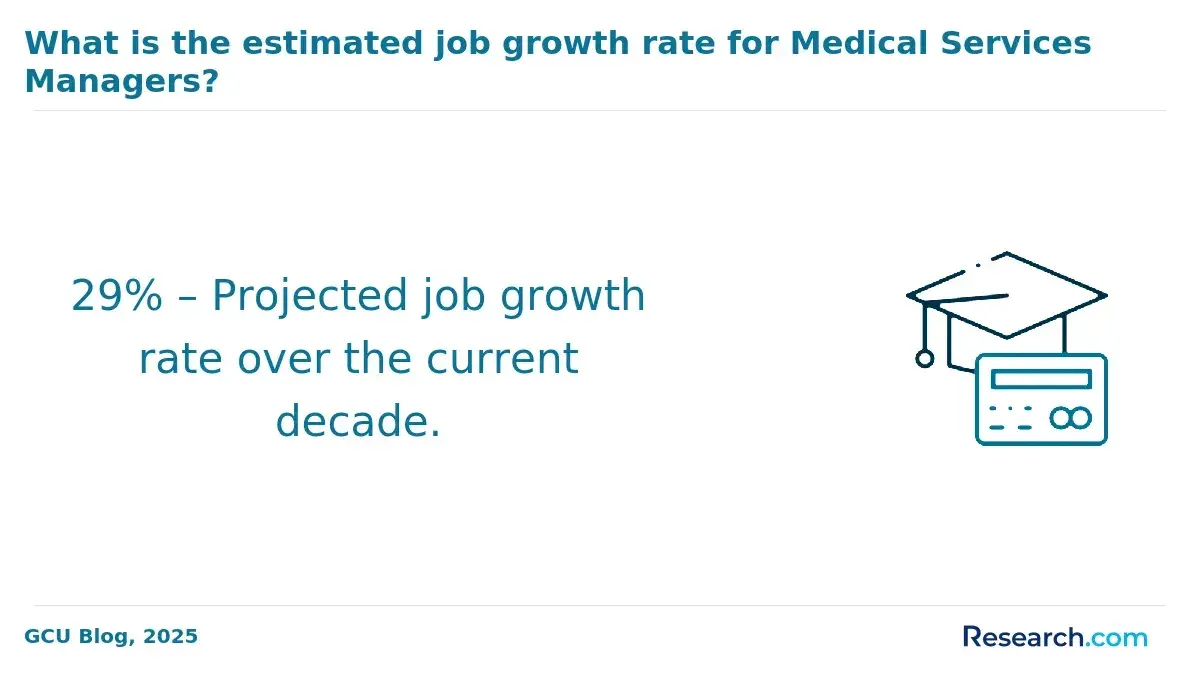
The job market for healthcare management graduates is supported by strong projected demand. The image below shows that employment for medical and health services managers is expected to grow much faster than the average for all occupations from 2024 to 2034 and ranks among the top 15 occupations with the fastest job growth. Demand is tied to healthcare service expansion, aging populations, regulatory complexity, and the need for effective operations in healthcare organizations.
Healthcare staffing shortages also affect administrative planning, scheduling, recruitment, retention, and patient flow. Graduates with management training may be positioned to help organizations respond to these pressures. If you are comparing advanced practice and administrative healthcare roles, see this guide to PA vs NP.
How Do Selective Colleges Support Long-Term Career Success?
Selective colleges can support career growth through advising, internship placement, employer partnerships, alumni networks, mentorship, and graduate school preparation. These services are especially useful in healthcare management because many roles require both academic knowledge and professional credibility. Students who want broader healthcare expertise may also compare adjacent programs such as online pharmacy school programs.
Can fast track PharmD programs strengthen your healthcare management strategy?
Pharmacy-focused accelerated programs can help healthcare managers better understand medication workflows, pharmacy operations, clinical coordination, and patient safety issues. This can be useful for managers working in hospitals, integrated care systems, pharmaceutical services, or quality improvement. Students interested in this interdisciplinary direction can compare fast track PharmD programs with healthcare administration degrees before choosing a pathway.
Is a Bachelor's Degree in Healthcare Management a Worthwhile Investment?
A bachelor’s degree in healthcare management may be worthwhile when the program is affordable, accredited, aligned with your career goals, and supported by applied learning. The investment is strongest for students who want administrative roles and are willing to build experience after graduation. It may be less ideal for students who want direct clinical practice, which usually requires a different degree and licensure pathway. To compare earning potential across related undergraduate healthcare paths, review the highest paying healthcare careers with a bachelor's degree.
How Do Interdisciplinary Degrees Enrich Healthcare Management Practice?
Healthcare managers often work with clinicians, pharmacists, compliance officers, technology teams, finance staff, and public health professionals. Interdisciplinary education can improve communication across those groups and help managers make better operational decisions. For example, pairing healthcare management knowledge with clinical pharmacy education from online Pharm D programs may be valuable for professionals focused on medication systems, quality improvement, or integrated care operations.
How Does Data Analytics Enhance Strategic Decision-Making in Healthcare Management?
Data analytics helps healthcare managers evaluate patient outcomes, staffing patterns, costs, utilization, revenue cycles, and operational performance. Managers who understand data can identify bottlenecks, improve scheduling, support quality initiatives, and make more defensible budget decisions. Students who want deeper preparation in healthcare data may consider an online CAHIIM accredited health information management degree as a related pathway.
How Technology is Transforming Healthcare Management Education and Practice
Technology now shapes both healthcare administration education and the daily work of healthcare managers. Students should look for programs that teach not only management theory but also how digital systems affect patient access, compliance, operations, billing, scheduling, and quality measurement.
1. Technology in healthcare management education
Many affordable selective healthcare management programs use online platforms, simulations, virtual collaboration tools, and data-focused assignments to prepare students for modern healthcare workplaces. Strong programs may include:
- Interactive Learning: Simulated management scenarios can help students practice decisions involving patient flow, staffing, budgeting, and resource allocation.
- Data Analytics Tools: Coursework may introduce students to software and methods used to interpret healthcare data for operational decision-making.
- Flexible Access: Online delivery can make degree completion more realistic for students balancing work, family, or location constraints.
Students planning to continue into graduate study can compare affordable options such as the cheapest masters degree online programs.
2. Technology in healthcare management practice
Healthcare organizations increasingly rely on digital tools, and managers must understand how those tools affect staff, patients, compliance, and budgets. Important areas include:
- Electronic Health Records (EHRs): Managers need to understand how patient information is documented, protected, shared, and used for reporting.
- Telemedicine: Virtual care requires planning around staffing, scheduling, reimbursement, privacy, and patient experience.
- AI: AI tools may support forecasting, workflow improvement, administrative automation, and decision support, but managers must evaluate risks, accuracy, costs, and ethical implications.
Why this matters for students and professionals
Students who understand technology, data, and operations can stand out in healthcare management roles. Employers increasingly need administrators who can communicate with clinical teams, IT departments, finance leaders, and compliance staff while keeping patient care and organizational performance aligned.
The Importance of Accreditation When Choosing a Healthcare Management Program
Accreditation is one of the most important checks before enrolling. It signals that an institution or program has been reviewed against recognized academic standards. It may also affect federal financial aid eligibility, credit transfer, graduate school admission, and employer confidence.
Regional accreditation is especially important because it is broadly recognized by employers and other colleges. Students considering online study should verify that their school is properly accredited; many regionally accredited online schools offer healthcare-related programs with flexible delivery.
When comparing healthcare management programs, check institutional accreditation and, where relevant, programmatic recognition from organizations such as the Commission on Accreditation of Healthcare Management Education (CAHME) or regional accrediting agencies. Do not rely only on marketing language. Confirm accreditation through the accreditor or school catalog.
Can Additional Certifications Enhance Your Healthcare Management Career?
Additional credentials can help healthcare management professionals document specialized skills in compliance, operations, revenue cycle processes, health information, project management, or quality improvement. They are most useful when they match a clear career goal. Students and graduates can compare targeted healthcare certifications to decide whether a short credential would complement their degree.
Can Technical Skills Like Medical Coding Provide a Competitive Edge in Healthcare Management?
Medical coding knowledge can help healthcare managers understand billing workflows, documentation requirements, reimbursement processes, and compliance risks. This is especially useful for roles connected to revenue cycle management, practice administration, health information management, or operations analysis. Students who want this technical layer can consider a medical coding course online alongside a healthcare management degree.
How to Combine Healthcare Management with Emerging Technologies for Career Advancement
Healthcare management careers increasingly reward professionals who can connect administration, technology, data, and patient-centered operations. Students do not need to become software engineers, but they should understand how digital tools influence care delivery and organizational performance.
- Focus on Health Informatics: Health informatics connects healthcare data, information systems, and operational improvement. Students who want deeper technical preparation can explore the best health informatics programs online.
- Embrace Telemedicine and Remote Healthcare Technologies: Telemedicine affects scheduling, staffing, reimbursement, compliance, patient access, and care coordination. Managers who understand these issues can help organizations run virtual care more effectively.
- Understand Electronic Health Records (EHR) Systems: EHR systems shape documentation, reporting, patient information access, and quality measurement. Healthcare managers should understand both the operational benefits and workflow challenges of EHR use.
- Learn About Data Analytics and Big Data in Healthcare: Analytics can support better decisions about staffing, patient flow, claims, costs, and outcomes. Students who build data skills can compete for roles that require evidence-based decision-making.
- Stay Updated on Artificial Intelligence and Machine Learning in Healthcare: AI and machine learning may influence administrative automation, predictive analytics, patient engagement, and operational planning. Healthcare managers need enough knowledge to evaluate tools responsibly and understand their workforce, budget, and ethics implications.
References
- GCU. (2025). Careers in Health Information Management. https://www.gcu.edu/blog/nursing-healthcare/health-information-management-careers
- Robert Half. (2025). 2026 Nonclinical Healthcare Salary Trends. https://www.roberthalf.com/us/en/insights/research/nonclinical-healthcare-salary-trends
- U.S. Bureau of Labor Statistics. (2025). Medical and health services managers. https://www.bls.gov/ooh/management/medical-and-health-services-managers.htm Related salary source: https://www.roberthalf.com/us/en/insights/research/nonclinical-healthcare-salary-trends
- U.S. Bureau of Labor Statistics. (2025). Medical Records Specialists. Occupational Outlook Handbook. https://www.bls.gov/ooh/healthcare/medical-records-and-health-information-technicians.htm
- U.S. Bureau of Labor Statistics. (2025). Occupational Outlook Handbook: Healthcare. https://www.bls.gov/ooh/healthcare/ Related sources: https://www.bls.gov/ooh/healthcare/medical-records-and-health-information-technicians.htm, https://www.roberthalf.com/us/en/insights/research/nonclinical-healthcare-salary-trends, https://www.gcu.edu/blog/nursing-healthcare/health-information-management-careers
Key Insights
- Affordable selective healthcare management colleges can offer strong value when they combine low tuition with accreditation, applied learning, and career support.
- The BLS reports a $117,960 median annual wage for medical and health services managers and 23% projected job growth from 2024 to 2034, but individual salaries depend on role, experience, employer, and location.
- Most bachelor’s programs require 120 credits and take about four years, though some formats may be shorter or more intensive.
- Online healthcare management degrees can be credible when offered by accredited institutions with strong academic standards and equal support for distance learners.
- Do not choose a program based only on tuition. Compare total cost, accreditation, transfer policies, internships, technology training, and career services before enrolling.
- Students who want stronger long-term options should build skills in healthcare data, EHR systems, telemedicine operations, compliance, finance, and leadership.
Other Things You Should Know About Selective Colleges for Healthcare Management
As of 2027, CUNY Lehman College is noted for offering one of the most affordable yet selective healthcare management degree programs. It provides top-tier education with competitive admissions and low tuition costs.
In a healthcare management program, students can expect to engage in various real-world projects and internships that provide practical experience in the field. These may include managing healthcare facilities, developing strategic plans, and improving operational efficiencies. Internships are often available in hospitals, clinics, public health organizations, and healthcare consulting firms, where students work under the guidance of experienced professionals. Projects might involve analyzing healthcare data, implementing quality improvement initiatives, and addressing regulatory compliance issues. These hands-on experiences help students apply classroom knowledge to real-world scenarios, build professional networks, and gain a comprehensive understanding of the complexities of healthcare management.