2027 Highest-Paying Business Majors

Co-Founder and Chief Data Scientist
Choosing a business major is no longer just a question of what sounds interesting. Students now have to weigh tuition, debt, internship access, employer demand, graduate school options, and whether the major builds skills that remain valuable as analytics, automation, and artificial intelligence reshape business work. The U.S. Bureau of Labor Statistics projects a 7% increase in business and financial occupations by 2031, but the strongest outcomes usually go to graduates who match the right specialization with practical experience and marketable skills.
This guide is for students comparing business majors, parents helping evaluate college costs, working adults considering a business degree, and career changers who want a clearer path to higher-paying roles. You will learn which business-focused majors are commonly linked to strong earning potential, what these programs cost, how online and campus formats compare, what employers look for, and how to judge whether a degree is likely to be worth the investment.
Quick answer: What business majors tend to lead to high-paying careers?
The highest-paying business paths are typically tied to finance, accounting, business analytics, information systems, supply chain management, marketing, international business, healthcare management, entrepreneurship, and management consulting. Salary outcomes vary widely by school reputation, internships, location, industry, graduate degree, certifications, and work experience. For example, financial managers earn a median annual salary of approximately $156,100, while marketing managers have a median annual income of about $135,030. New hires with an MBA or PhD at top consulting firms such as McKinsey & Company, Boston Consulting Group, and Bain & Company can expect base salaries around $190,000.
What are the benefits of choosing a high-paying business major?
- More direct access to competitive roles: Strong business specializations can lead to careers in finance, consulting, marketing, management, analytics, accounting, and operations.
- Broad earning range: Professionals with a business degree may earn from $60,000 to over $100,000 annually, depending on specialization, employer, experience, and location.
- Flexible study formats: Online business degrees can help working students reduce commuting and relocation costs while balancing school with professional or family responsibilities.
- Transferable skills: Business programs teach decision-making, communication, quantitative reasoning, leadership, and problem-solving skills that apply across many industries.
- Graduate school optionality: A bachelor’s degree in business can lead directly to work, while an MBA, specialized master’s, DBA, or PhD can support career changes, executive advancement, consulting, or academic goals.
What can you expect from a high-paying business major?
A high-paying business major usually combines a broad business core with a specialized skill set. Students study how organizations earn revenue, manage costs, analyze markets, lead teams, comply with regulations, and make decisions under uncertainty. The most career-focused programs also include internships, case competitions, capstone projects, employer networking, and hands-on work with business data.
| Program feature | What it usually means for students |
| Core business subjects | Finance, accounting, marketing, management, economics, operations, business strategy, and business law commonly form the foundation. |
| Tuition range | Tuition for high-paying business majors range from approximately $10,000 to $50,000 per year, depending on public or private status, residency, and delivery format. |
| Typical duration | Most undergraduate business programs take about four years; master’s programs such as an MBA typically require one to two years of full-time study. |
| Specialization options | Students may focus on finance, entrepreneurship, healthcare management, business analytics, supply chain management, international business, or marketing. |
| Career preparation | Internships, case studies, simulations, consulting projects, and capstones can help students build experience before graduation. |
Where can you work with a high-paying business major?
Business graduates work in nearly every sector because organizations need people who can manage money, people, operations, strategy, customers, and data. Common employers include corporate offices, banks, investment firms, consulting firms, hospitals, universities, government agencies, technology companies, retailers, real estate firms, sports organizations, hospitality companies, and startups.
| Business field | Common work settings | Typical focus |
| Finance | Banks, investment firms, corporate finance departments, insurance companies | Capital planning, investment analysis, risk, budgeting, and financial strategy |
| Marketing | Technology firms, retailers, agencies, entertainment companies, consumer brands | Brand growth, customer research, digital campaigns, pricing, and product positioning |
| Management | Healthcare systems, education, government, nonprofits, corporations | Team leadership, operations, performance improvement, and organizational strategy |
| Supply chain | Manufacturing, logistics, retail, e-commerce, distribution companies | Procurement, inventory, transportation, vendor management, and efficiency |
| Information systems | Technology companies, consulting firms, finance, healthcare, enterprise IT teams | Data systems, cybersecurity, process improvement, analytics, and digital transformation |
How much can you make with a high-paying business major?
Business salaries depend on the role, industry, employer, geography, school network, internships, graduate education, and professional credentials. A finance graduate entering investment banking may follow a very different pay trajectory than a marketing graduate entering a nonprofit or a supply chain graduate starting in logistics operations.
Still, several business roles have strong documented earning potential. Financial managers earn a median annual salary of approximately $156,100, and the top 10% make over $239,200 per year. Marketing managers report a median annual income of about $135,030. In management consulting, new hires with an MBA or PhD at firms such as McKinsey & Company, Boston Consulting Group, and Bain & Company can expect base salaries around $190,000.
Use salary figures as benchmarks, not guarantees. Your actual outcome will depend on your experience, location, employer, performance, and how well your degree is supported by internships, technical skills, and a strong job-search strategy.
- 10 Highest-Paying Business Majors for 2027
- How long does it take to complete a high-paying business major?
- How does an online high-paying business major compare to an on-campus program?
- What is the average cost of a high-paying business major?
- What are the financial aid options for students enrolling in a high-paying business major?
- What are the prerequisites for enrolling in a high-paying business major?
- What emerging trends are shaping high-paying business majors?
- What courses are typically in a high-paying business major?
- Is pursuing a doctoral degree the right move for career growth?
- What types of specializations are available in a high-paying business major?
- How can you measure the ROI of a high-paying business degree?
- How does accreditation impact quality and affordability in business education?
- How are emerging technologies reshaping high-paying business majors?
- How to choose the best high-paying business major?
- Can online MBA programs accelerate career growth?
- What career paths are available for graduates of a high-paying business major?
- How can an accelerated MBA program boost career advancement?
- Which certifications and continuing education opportunities further boost career prospects?
- How can specialized project management training boost business leadership?
- What is the job market for graduates of a high-paying business major?
10 Highest-Paying Business Majors for 2027
The programs below represent business-related majors and concentrations that can support access to higher-paying career tracks. They should not be read as a guarantee of salary or as the only strong options. The right choice depends on your academic fit, admissions profile, cost, location, internship access, and intended career.
How should you use this list?
Use the list as a comparison tool. Look beyond prestige and ask whether the curriculum, career services, alumni network, employer recruiting, accreditation, and total cost match your goals. If you want to understand how Research.com evaluates institutions, review our methodology section.
Rankings and program research rely on established education data sources, including the Integrated Postsecondary Education Data System (IPEDS), Peterson's database and Distance Learning Licensed Data Set, the College Scorecard, and the National Center for Education Statistics.
| Program | Best fit for students interested in | Cost per year | Credits or units | Accreditation |
| University of Michigan - Bachelor of Business Administration with a Focus on Marketing | Marketing strategy, consulting, brand management, and consumer analytics | $17,786 (in-state), $57,273 (out-of-state) | 120 | AACSB |
| University of South Carolina - Bachelor of Science in Business Administration with a Major in International Business | Global markets, trade, cross-cultural management, and international careers | $12,688 (in-state), $33,928 (out-of-state) | 122 | AACSB |
| University of Pennsylvania - Bachelor of Science in Economics with a Concentration in Finance | Finance, investment management, corporate finance, and financial analysis | $63,452 | 136 | AACSB |
| Massachusetts Institute of Technology (MIT) - Bachelor of Science in Economics | Economics, quantitative analysis, policy, finance, and consulting | $59,750 | 180 units | NECHE |
| University of Texas at Austin - Bachelor of Business Administration in Accounting | Public accounting, taxation, auditing, financial reporting, and CPA preparation | $11,698 (in-state), $41,070 (out-of-state) | 120 | AACSB |
| Carnegie Mellon University - Bachelor of Science in Information Systems | Business technology, data analytics, software, cybersecurity, and IT project work | $61,344 | 360 units | MSCHE |
| Michigan State University - Bachelor of Arts in Supply Chain Management | Logistics, procurement, operations, and global supply chains | $15,966 (in-state), $41,290 (out-of-state) | 120 | AACSB |
| University of Nevada, Las Vegas (UNLV) - Bachelor of Science in Hospitality Management | Hotel leadership, tourism, resorts, events, and hospitality operations | $8,893 (in-state), $24,273 (out-of-state) | 120 | AACSB |
| University of North Carolina at Chapel Hill - Bachelor of Science in Public Health with a Concentration in Health Policy and Management | Healthcare administration, health policy, public health leadership, and healthcare finance | $9,028 (in-state), $37,360 (out-of-state) | 120 | CEPH |
| Babson College - Bachelor of Science in Business Administration with a Concentration in Entrepreneurship | Startups, venture creation, innovation, family business, and business ownership | $54,144 | 129 | AACSB |
1. University of Michigan - Bachelor of Business Administration with a Focus on Marketing
The University of Michigan offers a BBA pathway with marketing-focused coursework that develops skills in consumer research, brand strategy, digital marketing, and evidence-based business decisions. Students at Ross can build experience through internships, consulting-style projects, and employer engagement.
- Program Length: Typically 4 years (full-time)
- Tracks/Concentrations: Marketing, Strategy, Consulting
- Cost per Year: $17,786 (in-state), $57,273 (out-of-state)
- Required Credits to Graduate: 120
- Accreditation: Association to Advance Collegiate Schools of Business (AACSB)
2. University of South Carolina - Bachelor of Science in Business Administration with a Major in International Business
The University of South Carolina offers an international business major designed for students who want to understand global markets, international trade, regional business practices, and cross-cultural management. Study abroad options and global company partnerships help students connect classroom learning with international business realities.
- Program Length: Typically 4 years (full-time)
- Tracks/Concentrations: International Business and Regional Specializations
- Cost per Year: $12,688 (in-state), $33,928 (out-of-state)
- Required Credits to Graduate: 122
- Accreditation: AACSB
3. University of Pennsylvania - Bachelor of Science in Economics with a Concentration in Finance
The University of Pennsylvania offers Wharton’s Bachelor of Science in Economics with a finance concentration, a program built around corporate finance, investments, financial modeling, markets, and analytical decision-making. Students can benefit from finance research activity, internship access, and strong links to financial employers.
- Program Length: Typically 4 years (full-time)
- Tracks/Concentrations: Finance, Investment Management
- Cost per Year: $63,452
- Required Credits to Graduate: 136
- Accreditation: AACSB
4. Massachusetts Institute of Technology (MIT) - Bachelor of Science in Economics
MIT offers a Bachelor of Science in Economics that emphasizes economic theory, quantitative methods, empirical research, and policy analysis. The program is suited to students who want a math-heavy path into finance, consulting, research, or policy-related business roles.
- Program Length: Typically 4 years (full-time)
- Tracks/Concentrations: Economic Policy, Data Science
- Cost per Year: $59,750
- Required Credits to Graduate: 180 units
- Accreditation: New England Commission of Higher Education (NECHE)
5. University of Texas at Austin - Bachelor of Business Administration in Accounting
The University of Texas at Austin offers a BBA in Accounting through the McCombs School of Business. Students study financial reporting, taxation, auditing, and managerial accounting, making the program a strong option for those planning careers in public accounting, corporate finance, consulting, or CPA preparation.
- Program Length: Typically 4 years (full-time)
- Tracks/Concentrations: Financial Accounting, Taxation
- Cost per Year: $11,698 (in-state), $41,070 (out-of-state)
- Required Credits to Graduate: 120
- Accreditation: AACSB
6. Carnegie Mellon University - Bachelor of Science in Information Systems
Carnegie Mellon University offers an Information Systems degree that connects business, technology, and social science. Students learn how data analytics, software development, cybersecurity, and project management support organizational decision-making and digital transformation.
- Program Length: Typically 4 years (full-time)
- Tracks/Concentrations: Data Analytics, IT Project Management
- Cost per Year: $61,344
- Required Credits to Graduate: 360 units
- Accreditation: Middle States Commission on Higher Education (MSCHE)
7. Michigan State University - Bachelor of Arts in Supply Chain Management
Michigan State University offers a supply chain management program through the Broad College of Business. The curriculum focuses on logistics, procurement, operations, and the coordination of goods, information, and vendors across complex business networks.
- Program Length: Typically 4 years (full-time)
- Tracks/Concentrations: Logistics, Procurement, Operations
- Cost per Year: $15,966 (in-state), $41,290 (out-of-state)
- Required Credits to Graduate: 120
- Accreditation: AACSB
8. University of Nevada, Las Vegas (UNLV) - Bachelor of Science in Hospitality Management
UNLV offers a hospitality management degree for students targeting hotels, resorts, tourism, food and beverage, and event operations. Its Las Vegas location can be useful for students seeking industry exposure and internship opportunities with major hospitality employers.
- Program Length: Typically 4 years (full-time)
- Tracks/Concentrations: Hotel Management, Event Planning
- Cost per Year: $8,893 (in-state), $24,273 (out-of-state)
- Required Credits to Graduate: 120
- Accreditation: AACSB
9. University of North Carolina at Chapel Hill - Bachelor of Science in Public Health with a Concentration in Health Policy and Management
The University of North Carolina at Chapel Hill offers a BSPH concentration in Health Policy and Management. The program blends business, public health, healthcare systems, policy, financial management, and leadership preparation for students interested in healthcare organizations or public health administration.
- Program Length: Typically 4 years (full-time)
- Tracks/Concentrations: Health Policy, Healthcare Administration
- Cost per Year: $9,028 (in-state), $37,360 (out-of-state)
- Required Credits to Graduate: 120
- Accreditation: Council on Education for Public Health (CEPH)
10. Babson College - Bachelor of Science in Business Administration with a Concentration in Entrepreneurship
Babson College offers a BSBA concentration in Entrepreneurship focused on opportunity recognition, innovation, business planning, venture financing, and leadership. It is especially relevant for students who want to build companies, work in startups, or support entrepreneurial growth in established organizations.
- Program Length: Typically 4 years (full-time)
- Tracks/Concentrations: Entrepreneurship, Family Business
- Cost per Year: $54,144
- Required Credits to Graduate: 129
- Accreditation: Association to Advance Collegiate Schools of Business (AACSB)
Key findings about business degrees and outcomes
- Financial managers are projected to see the strongest growth among the business-related occupations discussed here, with a 17% increase from 2023 to 2033, according to the U.S. Bureau of Labor Statistics.
- Management occupations represent the largest employment category for business degree holders at 25%, followed by business and financial operations occupations at 23%.
- Bachelor’s degrees in business fields declined from 390,490 in 2018-19 to 375,418 in 2021-22, suggesting changing student demand or enrollment patterns.
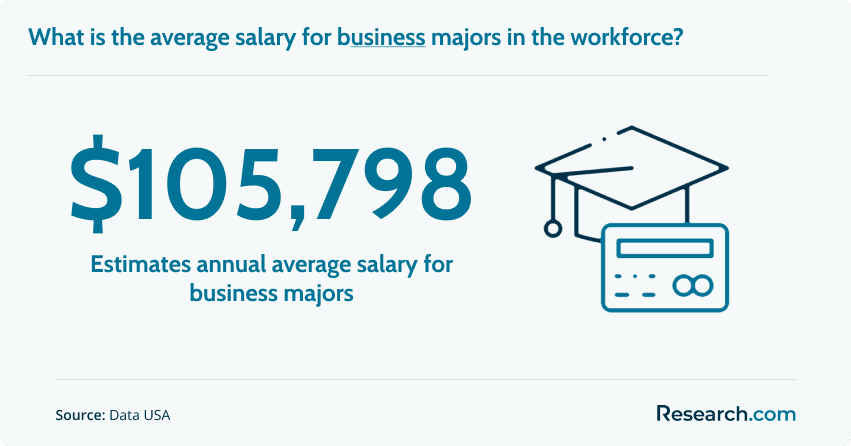
- Business majors earn an estimated annual average salary of $105,798, though individual outcomes vary significantly.
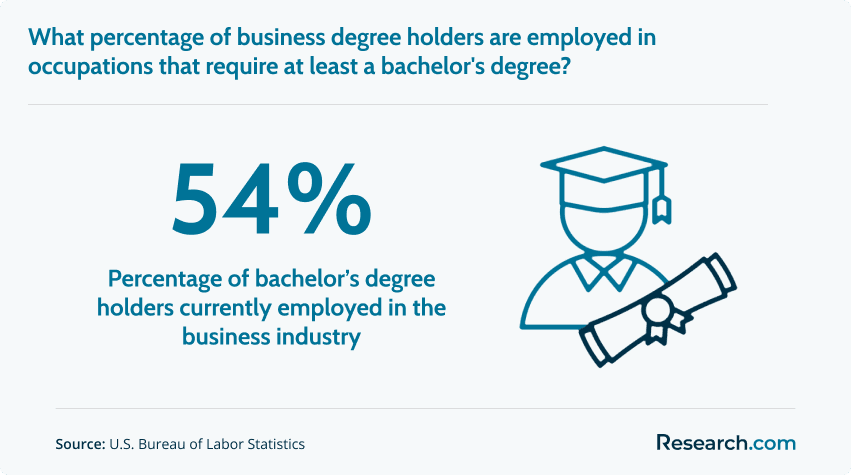
- About 54% of business degree holders work in occupations that require at least a bachelor's degree, showing that many graduates use the credential in degree-aligned roles.
How long does it take to complete a high-paying business major?
Your timeline depends on degree level, enrollment status, transfer credits, internships, double majors, and whether the program is accelerated or part-time. Most students begin with a bachelor’s degree, then decide later whether a graduate degree is necessary for their goals.
| Degree level | Typical time | Best for | Important trade-off |
| Bachelor’s degree | 4 years | Entry-level roles in finance, accounting, marketing, management, supply chain, and analytics | Accelerated options may save time, but double majors or extra concentrations can extend completion. |
| Master’s degree or MBA | 1-2 years | Career changers, promotion seekers, future managers, and professionals targeting consulting or finance | Full-time study may reduce income during school; part-time study may take longer. |
| Ph.D. or DBA | 3-6 years | Academic careers, research, executive consulting, or senior strategic leadership | Doctoral study is time-intensive and should be tied to a clear career reason. |
Bachelor’s degree: the usual starting point
Many high-paying business careers begin with a bachelor’s degree in business administration, finance, accounting, marketing, management, economics, analytics, or a related field. A business administration degree can be useful for students who want broad exposure to business functions before specializing through electives, internships, or graduate study.
Students comparing business with other people-focused fields may also want to understand different graduate timelines. For example, if you are evaluating psychology instead of business, this guide on how many years is a master's degree in psychology explains a different educational route.
Master’s degree: useful when the credential changes your opportunities
An MBA or specialized master’s degree can help professionals move into leadership, consulting, finance, analytics, or a new industry. Full-time MBA programs typically take one to two years, while part-time and executive formats may take two to three years depending on work schedules.
If you are deciding between business and counseling-oriented graduate study, it may help to compare the career purpose of each credential. This resource on Is a master’s degree in counseling worth it offers a useful contrast for students considering nonbusiness paths.
Doctoral degree: best for specialized leadership, research, or academia
A Ph.D. or DBA in business can take three to six years and usually includes advanced coursework, research, and a dissertation or applied doctoral project. It may be worthwhile for professionals pursuing academic roles, research-intensive consulting, or executive-level thought leadership. Students considering a public-sector doctoral path can also review best online PhD in public administration degree programs.
How does an online high-paying business major compare to an on-campus program?
Online and on-campus business degrees can both be valuable when they are accredited, rigorous, and aligned with your career goals. The better option depends on your schedule, budget, learning style, need for campus recruiting, and target industry.
| Factor | Online business program | On-campus business program |
| Flexibility | Often better for working adults, caregivers, military students, and students who need asynchronous coursework. | Better for students who want a structured schedule and regular in-person interaction. |
| Networking | Can include virtual events, discussion boards, online career fairs, and remote projects. | Usually stronger for face-to-face networking, student clubs, career fairs, and campus recruiting. |
| Cost | May reduce commuting, housing, and relocation costs; tuition depends on the institution. | May carry higher living and campus costs but can provide more in-person resources. |
| Employer perception | Strongest when the school is accredited and the transcript or diploma is from a reputable institution. | May still carry advantages in industries that heavily recruit from specific campuses. |
| Best fit | Students who need flexibility and can stay disciplined without daily classroom structure. | Students seeking immersive campus life, in-person mentorship, and direct recruiter access. |
Flexibility and convenience
Online business programs often work best for students who cannot pause work or relocate. Asynchronous courses let students complete assignments around professional and personal obligations. Similar flexibility concerns appear in other fields; for example, nurses exploring RN to BSN fast options often prioritize accelerated, work-compatible formats.
Networking and recruiting
Campus programs can have an advantage when a student’s target career relies heavily on in-person recruiting, alumni relationships, and employer events. Investment banking, consulting, and some leadership development programs may draw more actively from specific campuses. Online students should ask whether the program provides virtual career fairs, alumni introductions, employer panels, and internship support.
Academic quality
Accredited online business programs may use the same faculty and curriculum as campus programs. The main difference is not always quality; it is often delivery. Online students need strong time management, written communication, and self-direction. Campus students may receive more immediate access to faculty, peers, and support offices.
Cost considerations
Online study may lower total attendance costs by reducing housing, transportation, and campus-related expenses. However, students should compare total cost, not tuition alone. Published information on Tuition fees for online degrees can help frame the broader cost conversation, but every school’s net price will depend on fees, aid, residency, and enrollment status.
What is the average cost of a high-paying business major?
Business degrees can pay off, but the upfront investment can be substantial. Students should compare tuition, fees, living expenses, books, technology costs, internship travel, lost wages, and loan interest before committing.
Undergraduate business degree costs
- Public universities: In-state students at public universities pay around $9,800 per year on average, while out-of-state students pay approximately $22,370 per year, according to the National Center for Education Statistics (NCES).
- Private universities: Private institutions average $40,700 in annual tuition, and some elite business schools, including those at Harvard, Stanford, and the University of Pennsylvania (Wharton), often exceed $60,000 per year for undergraduate programs.
- Living expenses: Housing, food, and personal costs can add an additional $15,000 to $20,000 per year, depending on location and lifestyle.
Graduate business degree costs
- Top-tier MBA programs: Schools such as Harvard, Stanford, and Wharton charge around $80,000 to $90,000 per year in tuition, with total two-year costs reaching $150,000 to $200,000 when fees, books, and living expenses are included.
- Mid-tier and state university MBA programs: Public university MBA programs may charge around $30,000 to $50,000 for in-state students, while out-of-state students may pay $50,000 to $80,000 for the full program.
- Online MBA programs: Online MBA tuition can range from $10,000 to $40,000, depending on reputation and accreditation.
Additional expenses students often underestimate
| Cost category | Typical amount stated | Why it matters |
| Housing and living expenses | $10,000 to $25,000 per year | Can change the true cost more than tuition differences between schools. |
| Books and course materials | $1,000 and $3,000 annually | Business software, cases, textbooks, and access codes can add up. |
| Student fees | $2,000 to $5,000 per year | Technology, facilities, activities, and program fees may not be included in advertised tuition. |
| Internship and travel costs | Varies by program and location | Study abroad, internship relocation, conferences, and networking trips can affect affordability. |
The chart below shows bachelor’s degrees conferred across business-related specializations by degree-granting postsecondary institutions, offering a snapshot of student interest and program trends in business education.
What are the financial aid options for students enrolling in a high-paying business major?
Financial aid can change the value of a business degree dramatically. Do not judge affordability by sticker price alone. Compare net price after grants, scholarships, assistantships, employer support, and loan terms.
- Federal and private student loans: Federal loan programs are available through the U.S. Department of Education, while private loans depend on lender requirements and creditworthiness.
- Scholarships and grants: Universities may offer merit aid for business students, and outside organizations such as the Forte Foundation and the National Black MBA Association provide additional opportunities.
- Employer sponsorship: Some employers reimburse tuition for workers pursuing business degrees that support advancement within the company.
- Online and lower-cost pathways: Students focused on minimizing debt can compare affordable online options, including programs discussed in this guide to business degree online cost.
What are the prerequisites for enrolling in a high-paying business major?
Admissions requirements vary by school and degree level. Competitive programs usually evaluate grades, quantitative readiness, communication ability, leadership potential, work experience, and fit with the program’s goals.
Undergraduate business degree prerequisites
Applicants usually need a high school diploma or equivalent and strong preparation in mathematics, English, and economics-related coursework. Many universities expect a minimum GPA of 3.0, while more selective programs may expect 3.5 or higher. Some institutions require SAT or ACT scores, with typical ranges of 1200-1400 for SAT and 25-30 for ACT.
Helpful preparation may include algebra, statistics, writing, public speaking, economics, and business-related extracurriculars such as DECA or FBLA. Applications often include essays, letters of recommendation, and sometimes an interview.
Graduate business degree prerequisites
MBA applicants usually need a bachelor’s degree from an accredited institution, and many programs prefer a GPA of 3.0 or higher. Work experience is common, especially 2 to 5 years in professional or leadership roles. Many programs require the GMAT or GRE, with competitive scores ranging from 650-750 for GMAT and 310-330 for GRE.
Applicants may also need essays, recommendations, an interview, and prerequisite coursework in accounting or finance. Non-native English speakers may need TOEFL or IELTS scores.
Special considerations for highly selective business schools
Schools such as Harvard, Wharton, and Stanford often expect exceptional academic performance, leadership evidence, professional impact, and strong test results, including GMAT scores of 700+. Entrepreneurship, major projects, community impact, and clear communication can also strengthen an application.
What emerging trends are shaping high-paying business majors?
Business curricula are changing because employers increasingly expect graduates to understand analytics, digital platforms, automation, artificial intelligence, sustainability, and fast-moving global markets. Programs are adding more experiential learning, virtual simulations, industry projects, and flexible online pathways so students can connect theory with current business practice.
Students should look for programs that do more than teach traditional business concepts. Strong programs now help learners interpret data, use business technology responsibly, communicate with technical teams, evaluate risk, and make decisions in uncertain environments.
What courses are typically in a high-paying business major?
Most business majors share a common core, then add specialized coursework. The core gives students a working understanding of how organizations operate; the concentration helps them compete for specific jobs.
- Accounting: Students learn financial statements, managerial accounting, budgeting, cost behavior, and internal controls. If you are comparing accounting as a primary path, this guide asks is an accounting degree worth it.
- Finance: Courses cover corporate finance, investments, financial markets, valuation, risk, and capital budgeting.
- Economics: Students study microeconomics, macroeconomics, market behavior, policy, incentives, and economic decision-making.
- Marketing: Coursework examines market research, branding, customer behavior, digital marketing, pricing, and campaign strategy.
- Management and organizational behavior: Students learn leadership, motivation, team dynamics, organizational structure, and strategic decision-making.
- Business law and ethics: Courses address contracts, regulation, corporate responsibility, compliance, and ethical decision-making.
- Operations and supply chain management: Students examine logistics, procurement, production, process improvement, and quality management.
- Business statistics and data analytics: Coursework introduces statistical reasoning, data interpretation, dashboards, forecasting, and analytics tools used in business decisions.
Is pursuing a doctoral degree the right move for career growth?
A doctoral business degree can make sense for professionals who want to teach at the college level, conduct research, build authority as consultants, or move into high-level strategy roles. It is not the fastest or cheapest route to higher earnings, so the decision should be tied to a specific goal.
A focused online DBA program may appeal to experienced professionals who want applied doctoral training while continuing to work. Before enrolling, compare dissertation or project requirements, faculty expertise, time to completion, accreditation, tuition, and whether alumni actually move into the roles you want.
What types of specializations are available in a high-paying business major?
Specialization matters because employers hire for skills, not just for the word “business” on a transcript. The best concentration for you depends on whether you prefer numbers, people, systems, strategy, technology, operations, or entrepreneurship.
| Specialization | Best for students who like | Common career direction |
| Finance | Markets, valuation, investments, risk, and quantitative analysis | Financial analyst, investment banking, corporate finance, portfolio management |
| Accounting | Accuracy, compliance, tax, auditing, reporting, and structured problem-solving | Public accounting, auditing, tax consulting, forensic accounting, controllership |
| Marketing | Customer behavior, branding, digital strategy, communication, and research | Marketing manager, digital strategist, brand manager, market research analyst |
| Management and leadership | People, strategy, operations, organizational change, and decision-making | Operations manager, general manager, consultant, executive leadership |
| International business | Global markets, cultures, trade, languages, and multinational operations | Global operations, international trade, market entry strategy, multinational management |
| Entrepreneurship | Innovation, risk-taking, venture building, pitching, and product-market fit | Startup founder, business development, venture capital, innovation management |
Finance
Finance prepares students for roles involving investment decisions, capital structure, risk, forecasting, and corporate value. It is often a strong fit for students who are comfortable with quantitative analysis and high-pressure decision-making.
Accounting
Accounting builds expertise in financial reporting, taxation, auditing, and compliance. Many graduates pursue CPA licensure, and accounting can provide a stable foundation across industries. Students comparing earnings can review state-level information on CPA salary.
Marketing
Marketing focuses on understanding customers and persuading markets. As digital channels, e-commerce, and social platforms continue to shape consumer behavior, employers often value marketers who can combine creativity with analytics.
Management and leadership
Management students study teams, organizational systems, strategy, and execution. Professionals who later pursue advanced leadership study may also explore options such as an online PhD organizational leadership.
International business
International business is useful for students interested in multinational companies, global supply chains, international trade, and cross-cultural negotiation.
Entrepreneurship
Entrepreneurship suits students who want to build ventures, work in startups, support innovation inside established companies, or evaluate early-stage business opportunities.
The chart below shows how business degree holders are distributed across occupational groups, highlighting the range of careers connected to business education.
How can you measure the ROI of a high-paying business degree?
Return on investment is the relationship between what you spend and what the degree helps you earn or achieve. For business degrees, ROI should include direct costs, opportunity costs, career outcomes, debt, and the time required to recover the investment.
| ROI factor | Question to ask | Why it affects value |
| Total cost | What will I pay after scholarships, grants, employer aid, and loans? | Sticker price can be misleading if aid packages differ significantly. |
| Opportunity cost | Will I stop working, reduce hours, or relocate? | Lost income can be one of the largest hidden costs of full-time study. |
| Career outcomes | What jobs do graduates actually get, and in what industries? | Employment data is more useful than broad salary promises. |
| Payback period | How long might it take to recover tuition, fees, and living expenses? | A faster payback period can reduce financial risk. |
| Program format | Would online, part-time, or accelerated study reduce my costs? | Format can affect tuition, living expenses, and income continuity. |
Students comparing graduate business options should include detailed estimates such as online MBA cost when calculating total investment. The best-value program is not always the cheapest; it is the one that provides credible career outcomes at a manageable cost.
How does accreditation impact quality and affordability in business education?
Accreditation helps students identify programs that meet recognized standards for curriculum, faculty qualifications, student support, and institutional stability. It also matters for transfer credits, graduate admissions, employer confidence, and in some cases eligibility for financial aid.
For business students, AACSB accreditation can be an important quality signal, especially at the graduate level. Students looking for lower-cost accredited options can compare programs such as the cheapest online MBA AACSB pathways. Always verify accreditation directly through the school and the accreditor before applying.
How are emerging technologies reshaping high-paying business majors?
Business graduates increasingly need to understand how technology changes strategy, operations, marketing, finance, and decision-making. Programs are adding coursework in artificial intelligence, data analytics, cybersecurity, digital strategy, e-commerce, and technology innovation.
The goal is not for every business graduate to become a software engineer. The goal is to produce professionals who can ask better questions, interpret data, work with technical teams, manage digital risk, and translate business goals into technology-enabled action. Working professionals who want a faster graduate option can review accelerated MBA programs online.
How to choose the best high-paying business major?
The best business major is the one that fits your strengths, target career, tolerance for risk, preferred work style, and financial situation. A high salary projection is not enough if you dislike the day-to-day work or cannot access the internships and networks that lead to competitive jobs.
Step-by-step decision process
- Identify your strongest skills: Finance and accounting reward quantitative precision; marketing rewards research and communication; supply chain rewards systems thinking; management rewards leadership and execution.
- Map majors to real jobs: Review job postings before choosing a major. Note required software, certifications, internships, and preferred coursework.
- Compare market demand: Use sources such as the U.S. Bureau of Labor Statistics and employer reports to evaluate growth, competition, and role requirements.
- Calculate net cost: Include tuition, fees, living costs, books, travel, and lost income. Do not rely on tuition alone.
- Check career services: Ask about internship placement, employer partnerships, alumni mentoring, career fairs, and placement outcomes by major.
- Verify accreditation: Confirm institutional and programmatic accreditation before enrolling.
- Consider flexibility: Decide whether online, on-campus, full-time, part-time, or accelerated study fits your life and career timeline.
External career guidance on Choosing a business major can be helpful, but your final decision should be based on verified school data and your own career goals.
Common mistakes to avoid
| Mistake | Why it can hurt you | Better approach |
| Choosing only by salary headline | High-paying roles may require selective recruiting, internships, certifications, or graduate education. | Research actual job requirements and alumni outcomes. |
| Ignoring accreditation | Credits may not transfer, employers may question quality, and aid eligibility may be affected. | Verify accreditation with official accreditor sources. |
| Looking only at tuition | Fees, housing, books, transportation, and lost wages can change total cost. | Compare full cost of attendance and net price. |
| Assuming online is always cheaper | Some online programs have high fees or limited aid. | Compare total cost, support services, and career outcomes. |
| Relying only on rankings | A highly ranked school may not be the best fit for your budget, location, or career path. | Use rankings as one input, not the whole decision. |
| Skipping internships | Business employers often value experience as much as coursework. | Prioritize programs with strong internship and employer access. |
Can online MBA programs accelerate career growth?
Online MBA programs can support career growth when they combine flexible scheduling with rigorous coursework, employer-relevant projects, and meaningful networking. They are especially useful for professionals who want to keep working while building leadership, strategy, finance, analytics, and management skills.
Before enrolling, compare faculty access, live class options, cohort structure, career services, employer reputation, and alumni outcomes. Professionals evaluating flexible graduate options can start with Research.com’s guide to MBA programs online.
What career paths are available for graduates of a high-paying business major?
Business graduates can move into finance, accounting, marketing, management, consulting, analytics, technology, healthcare administration, supply chain, entrepreneurship, and operations. The most competitive candidates usually combine a relevant major with internships, technical tools, communication skills, and measurable project experience.
| Career area | Example roles | Helpful preparation |
| Finance | Investment banker, financial analyst, risk manager, corporate treasurer | Financial modeling, valuation, Excel, internships, market knowledge |
| Accounting | CPA, forensic accountant, internal auditor, tax consultant | Auditing, tax, financial reporting, CPA preparation, attention to detail |
| Marketing | Marketing manager, digital marketing specialist, brand manager, market research analyst | Analytics, SEO, consumer research, campaign strategy, communication |
| Management | General manager, operations manager, CEO, business consultant | Leadership, operations, strategy, project management, people management |
| Entrepreneurship | Startup founder, business development manager, venture capital analyst, product manager | Business planning, fundraising, product strategy, market validation, risk management |
| Business analytics | Data analyst, business intelligence analyst, big data consultant, machine learning specialist in business | Statistics, dashboards, SQL, visualization, business problem framing |
Finance careers
Finance roles involve analyzing capital, risk, investments, budgets, and financial strategy. They can be competitive, especially in investment banking and asset management, so internships and quantitative skills matter.
- Investment Banker: Advises companies on mergers, acquisitions, and raising capital.
- Financial Analyst: Reviews financial data to support business or investment decisions.
- Risk Manager: Helps organizations identify, measure, and reduce financial exposure.
- Corporate Treasurer: Oversees liquidity, capital structure, and financial planning.
Accounting careers
Accounting careers center on reporting, compliance, taxation, auditing, and financial controls. Many students pursue CPA certification to broaden career options and strengthen credibility.
- Certified Public Accountant (CPA): Prepares reports, supports tax compliance, and advises organizations or individuals.
- Forensic Accountant: Investigates fraud, irregularities, and financial disputes.
- Internal Auditor: Evaluates financial systems, controls, compliance, and operational risk.
- Tax Consultant: Helps clients plan for and comply with tax obligations.
Marketing careers
Marketing roles connect business goals with customer behavior. Strong candidates can combine creativity with data, digital tools, and measurable campaign results.
- Marketing Manager: Plans and leads campaigns for products, services, or brands.
- Digital Marketing Specialist: Works on online campaigns, SEO, paid media, email, and social platforms.
- Brand Manager: Shapes brand positioning and consistency across channels.
- Market Research Analyst: Studies customer behavior, competitors, and market trends.
Management and leadership careers
Management roles exist across nearly every industry and focus on people, performance, strategy, operations, and execution. Students interested in workforce strategy can also compare graduate HR options such as an online master in human resources.
- General Manager: Oversees teams, budgets, operations, and business goals.
- Operations Manager: Improves efficiency, processes, logistics, and production systems.
- Chief Executive Officer (CEO): Sets organizational direction and leads high-level strategy.
- Business Consultant: Advises organizations on growth, efficiency, restructuring, or strategy.
Entrepreneurship and startup careers
Entrepreneurship can offer high upside, but it also carries significant risk. Students should build skills in finance, customer discovery, product development, sales, and fundraising.
- Startup Founder: Creates and grows a new venture.
- Business Development Manager: Finds partnerships, customers, and growth opportunities.
- Venture Capital Analyst: Evaluates startups and investment opportunities.
- Product Manager: Coordinates customer needs, business goals, and product development.
Business analytics and data science careers
Business analytics roles help organizations turn data into better decisions. These roles are strongest for students who can connect technical analysis with practical business questions.
- Data Analyst: Interprets data and communicates findings to decision-makers.
- Business Intelligence Analyst: Builds dashboards, reports, and performance metrics.
- Big Data Consultant: Helps organizations use large data sets to improve strategy or operations.
- Machine Learning Specialist (in Business): Applies AI and machine learning concepts to business problems.
How can an accelerated MBA program boost career advancement?
An accelerated MBA can shorten the time needed to complete graduate business training while helping professionals apply new skills sooner. These programs are most useful for students who already have clear goals, strong time management, and enough professional experience to connect coursework with real business problems.
Before choosing an accelerated MBA program, ask whether the faster pace reduces internship access, networking time, elective flexibility, or career support. Speed is valuable only if the program still delivers the outcomes you need.
Which certifications and continuing education opportunities further boost career prospects?
Business certifications can strengthen a degree by signaling specialized knowledge. The best credential depends on your field. Accounting students may consider CPA preparation, finance students may look at CFA pathways, project-focused professionals may pursue PMP, and marketers may benefit from platform-specific or digital marketing credentials.
Continuing education can also help professionals update skills without committing to a long program. Some students seeking a flexible graduate route compare options such as the easiest MBA program to complete, but ease should not be the only criterion. Accreditation, career relevance, and employer recognition matter more.
How can specialized project management training boost business leadership?
Project management training helps business professionals plan work, manage risk, coordinate teams, control budgets, communicate with stakeholders, and deliver results. These skills are valuable in consulting, operations, technology, healthcare, construction, finance, and product management.
Students who want a faster and more focused route can compare an accelerated online degree project management program, especially if their goal is to move into operations leadership, program management, or cross-functional business roles.
What is the job market for graduates of a high-paying business major?
The job market for business graduates remains broad, but it is not automatic. Prestigious credentials help, yet recent evidence shows that competition can be intense even for graduates from elite programs. For example, 23% of Harvard M.B.A. graduates from the previous spring were still seeking employment three months post-graduation, up from 20% the prior year.
The U.S. Bureau of Labor Statistics projects a 7% growth in business and financial occupations from 2021 through 2031, representing approximately 715,100 new jobs. Financial management is also expected to see a 16% increase in job opportunities from 2022 to 2032. These figures suggest opportunity, but students still need relevant experience, strong technical skills, and a disciplined job-search strategy.
To improve employability, students should prioritize internships, analytics skills, technology fluency, communication, client relationship management, and networking. A business degree opens doors, but work experience and demonstrated results often determine who gets the strongest offers.
This chart highlights the top occupations employing people with business degrees and shows which career paths commonly attract business graduates.
References:
- Business Insider. (2025). Top skills for advertising and business job market. Business Insider.
- Data USA. (2022). Business: Profile of CIP. Data USA.
- National Center for Education Statistics. (2022). Fast facts: Business. National Center for Education Statistics.
- The Times. (2025). Internships and networking importance. The Times.
- The Wall Street Journal. (2025). Harvard MBA employment struggles. The Wall Street Journal.
- U.S. Bureau of Labor Statistics. (2025). Business: Occupational outlook handbook. U.S. Bureau of Labor Statistics.
Key Insights
- The strongest business majors are not simply “high-paying” by name; they connect to specific skills employers pay for, such as finance, accounting, analytics, technology, supply chain, marketing, and leadership.
- Cost matters as much as salary. Compare net price, living expenses, fees, lost income, loan interest, and time to completion before choosing a program.
- Accreditation is a nonnegotiable quality check. It can affect transfer credits, employer confidence, graduate school options, and financial aid eligibility.
- Online programs can be a smart choice for working students, but campus programs may offer stronger in-person recruiting and networking for fields such as consulting and finance.
- Internships, projects, technical tools, and networking often separate strong job candidates from graduates who only completed coursework.
- Graduate degrees and certifications can raise career potential, but they are worth pursuing only when they support a clear role, promotion, industry switch, or leadership goal.
- No business major guarantees a salary. The best decision is the one that balances your strengths, target occupation, school quality, total cost, and access to real career-building experience.
Other Things You Should Know About a High-Paying Business Major
Finance, accounting, business analytics, and management information systems are among the highest-paying business majors in 2027. Entry-level pay is strongest in investment banking, consulting, corporate finance, and tech-related analyst roles, where starting salaries often exceed $70,000 and can rise much higher with internships and certifications.
In 2027, analytical skills, strategic thinking, and proficiency in digital tools are vital for excelling in top-paying business majors like Finance and Information Systems. Strong communication and leadership abilities are increasingly important, enabling graduates to thrive in dynamic business environments and command higher salaries.
Proficiency in data analytics, cloud computing, and blockchain can significantly boost earnings for business majors in 2027. Employers value these skills for strategic decision-making and innovation, making graduates with technical expertise more competitive in high-paying business fields.