2027 How Fast Can I Finish an RN to BSN

Co-Founder and Chief Data Scientist
Registered nurses often ask the same practical question before enrolling in an RN to BSN program: how quickly can I finish without burning out or disrupting my work schedule? The answer depends less on the degree name and more on your transfer credits, course load, employer flexibility, clinical or practicum expectations, and whether the program runs on standard semesters or shorter accelerated terms.
This guide explains realistic RN to BSN completion timelines for 2026, including full-time, part-time, online, accelerated, and 6-month options. It also covers admissions requirements, accreditation, financial aid, course content, salary and job outlook considerations, common mistakes, and how to compare programs based on value rather than speed alone.
Quick answer: How long does an RN to BSN take?
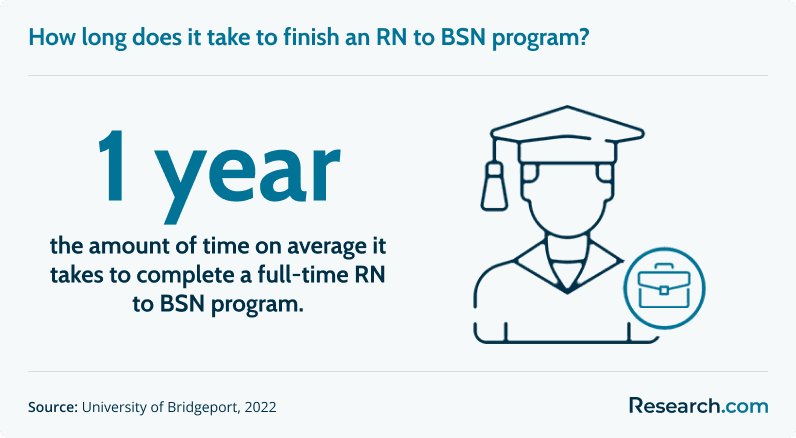
Most RN to BSN programs take about 1 year for full-time students who already meet prerequisites and transfer in enough prior nursing credits. Part-time students commonly need 18 months to 2 years. Some accelerated online programs advertise completion in 9 to 12 months, while the shortest options require unusually strong preparation, a heavy course load, and careful confirmation that the program is accredited and accepted by employers.
| Program pace | Typical completion time | Best fit | Main trade-off |
| Full-time RN to BSN | 9 months to 1 year | RNs who can commit significant weekly study time | Fast progress but heavier workload |
| Part-time RN to BSN | 18 months to 2 years | Working nurses with family or shift-work obligations | More manageable schedule but longer timeline |
| Online RN to BSN | 9 months to 2 years | RNs who need flexibility and remote coursework | Requires strong self-direction |
| Bridge pathway with missing prerequisites | May add 6 months to 1 year | Students who still need general education or science courses | Extra time before or during BSN coursework |
Key things to know about finishing an RN to BSN program in 2026:
- Many RN to BSN programs can be completed in as little as 12 months, but your actual timeline depends on transfer credit, prerequisite status, course sequencing, and whether you study full time or part time.
- Online and hybrid formats are often easier to fit around nursing shifts because they may offer asynchronous coursework, shorter terms, and multiple start dates.
- The salary for registered nurses can range from $63,720 to $132,680, depending on education, experience, specialty, location, and employer type.
- Average RN to BSN completion time in 2026
- Can accelerated RN to BSN programs finish in under a year?
- What affects how long an RN to BSN takes?
- Do online RN to BSN programs help students finish faster?
- Common RN to BSN courses in 2026
- RN to BSN admissions requirements
- Online vs. campus RN to BSN programs
- Financial aid for accelerated RN to BSN programs
- Are 6-month RN to BSN programs realistic?
- Registered nurse job outlook
- Why RN to BSN accreditation matters
- Can you enroll without prerequisites?
- How to choose an RN to BSN program
- How to compare cost and quality
- Common challenges during an RN to BSN program
- How an RN to BSN supports doctoral study
- Are online RN to BSN programs credible?
- Moving into specialized nursing after the BSN
- Trends shaping RN to BSN programs
- Advanced degree options after the BSN
- Does a BSN improve salary potential?
- How to judge RN to BSN cost-effectiveness
How long does it take to finish an RN to BSN program on average in 2026?
An RN to BSN program is built for licensed registered nurses who already completed a diploma or associate degree in nursing and want to earn a Bachelor of Science in Nursing. Because students enter with prior nursing education and RN licensure, these programs are usually shorter than a traditional four-year BSN.
- Full-time programs: Many full-time RN to BSN programs take 9 months to 1 year. This route is fastest but may be difficult for nurses working frequent overtime, night shifts, or rotating schedules.
- Part-time programs: Part-time plans often run 18 months to 2 years. This is usually the more realistic choice for RNs balancing work, caregiving, and unpredictable clinical schedules.
- Online programs: Online RN to BSN programs may take 9 months to 2 years, depending on term length, transfer credit, and how many courses a student takes at once.
- Programs with added prerequisites: If you still need general education or science coursework, the program may take longer, sometimes adding 6 months to 1 year.
The fastest timeline is usually available to students who enter with most general education requirements complete, have an active RN license, and choose a program with frequent start dates. Students comparing nursing bridge routes may also want to review ADN to MSN bridge programs if their long-term goal is advanced practice rather than stopping at the BSN.
Speed should not be the only measure. A program that looks short on paper can feel difficult if it compresses writing-heavy leadership, research, population health, and informatics courses into back-to-back terms. If you are concerned about workload, this guide on how hard RN to BSN online programs can be can help you judge whether an accelerated plan fits your schedule.
| If your situation is... | Likely timeline | What to check before enrolling |
| You have an ADN, active RN license, and most prerequisites done | 9 months to 1 year | Maximum transfer credits, start dates, and course load rules |
| You work full time and want a manageable pace | 18 months to 2 years | Part-time sequencing, asynchronous options, and assignment deadlines |
| You are missing general education requirements | May add 6 months to 1 year | Whether prerequisites can be completed concurrently |
| You want the shortest advertised program | Possibly under 1 year | Accreditation, practicum expectations, and weekly workload |
Are there accelerated RN to BSN programs that can be completed in under a year?
Yes. Some accelerated RN to BSN programs can be completed in less than 1 year, often in 9 to 12 months. These programs are usually designed for licensed RNs who can transfer substantial credit and handle an intensive academic pace.
Accelerated programs tend to work best for nurses who have predictable schedules, strong writing and research skills, and few remaining prerequisites. They may be online, hybrid, or competency-based, but the key issue is not simply format; it is whether you can complete multiple upper-division nursing courses in a compressed calendar.
Before choosing an accelerated option, confirm that the program is properly accredited and that your employer recognizes the degree. Students often ask whether online nursing degrees are legitimate. The answer can be yes when the institution and nursing program meet recognized accreditation standards, but students should verify accreditation directly rather than relying on advertising language.
| Accelerated RN to BSN may be a good fit if... | It may be risky if... |
| You can study several days per week outside of work | Your work schedule changes weekly with little notice |
| You already completed most prerequisites | You still need multiple general education courses |
| You are comfortable with online learning platforms | You need frequent in-person support to stay on track |
| You have employer support or tuition assistance | You must take on heavy debt to finish quickly |
What factors can impact the time it takes to finish an RN to BSN program?
The advertised length of an RN to BSN program is only a starting point. Your personal completion time may be shorter or longer based on academic, work, and institutional factors.
- Enrollment status: Full-time students often finish in 9 months to 1 year, while part-time students commonly need 18 months to 2 years.
- Program format: Online programs may offer accelerated schedules, shorter terms, or self-paced options that are not always available in campus-based programs.
- Transfer credits: The more credits your school accepts from your ADN or diploma program, the fewer courses you may need to complete.
- Workload outside school: Full-time nursing work, rotating shifts, family responsibilities, and overtime can slow progress even in flexible programs.
- Prerequisites: Missing courses such as anatomy and physiology, microbiology, English composition, statistics, or psychology can extend the timeline.
- Clinical or practicum expectations: Some RN to BSN programs include community health, leadership, or population health practice experiences that require scheduling in approved settings.
- School policies: Course caps, term structures, required sequencing, and start dates can determine whether you can accelerate or must wait for the next course offering.
RNs who are reconsidering their long-term professional direction may also compare nursing with adjacent graduate pathways. For example, students interested in behavioral health, counseling, or research sometimes ask whether a master’s degree in psychology is worth it, although that path has different licensure and career requirements than nursing.
Where you work also affects earnings and advancement opportunities. Some of the best places to work as a registered nurse may offer stronger wages, better tuition assistance, or more BSN-preferred roles. Median wages vary by industry: RNs working in the government earn around $99,840, those in hospitals earn around $88,430, those in ambulatory healthcare services earn around $81,230, those in residential care facilities earn around $79,280, and those in educational services earn around $71,550.
Nurses who enjoy systems improvement, staffing data, quality metrics, or operational reporting may eventually move toward analytics-focused healthcare roles. A broader look at the business analytics career path can help nurses understand how data skills are used outside direct patient care.
The chart below shows the median annual wages for RNs in the top industries in which they can work:
Do online RN to BSN programs offer faster completion options?
Online RN to BSN programs often provide faster pathways because they are commonly designed around working nurses. Many use 5–8-week terms, multiple yearly start dates, asynchronous assignments, and transfer-friendly policies. Those features can shorten the calendar if you are ready to take a heavier course load.
However, online does not automatically mean easy or fast. A self-paced program still requires regular reading, discussion posts, papers, projects, and practicum coordination. The advantage is control: you may be able to study around shifts instead of commuting to campus at fixed times.
- Flexible access: Online courses let students complete readings, lectures, and assignments from locations that fit their schedule.
- Accelerated calendars: Shorter terms and year-round enrollment can help motivated students progress more quickly.
- Potential cost savings: Online students may avoid commuting, parking, relocation, and some campus-related expenses, although tuition varies by institution.
- Adjustable pace: Some programs allow students to take one course at a time, while others permit multiple courses per term.
- Continued employment: Many RNs keep working while applying leadership, informatics, and evidence-based practice concepts in their current roles.
- Career-focused coursework: RN to BSN curricula often emphasize practical skills such as care coordination, quality improvement, patient education, and team leadership.
| Online feature | How it may speed completion | Question to ask |
| Short terms | Students can complete more course cycles in a year | Are courses 5–8 weeks, semester-based, or self-paced? |
| Multiple start dates | Less waiting between admission and first class | How many entry points are available each year? |
| Generous transfer policy | Fewer remaining credits may be required | How many ADN or diploma credits can transfer? |
| Asynchronous coursework | Students can study around shifts | Are any live class meetings mandatory? |
What types of courses are included in an RN to BSN program in 2026?
RN to BSN coursework builds on prior RN preparation. Instead of repeating basic nursing skills, the curriculum usually focuses on leadership, research, public health, systems thinking, communication, technology, and broader patient-care outcomes.
- Community and public health nursing: Students learn how nurses support health promotion, prevention, education, and care coordination across communities and vulnerable populations.
- Nursing leadership and management: Coursework covers delegation, communication, team-based care, conflict management, and decision-making in healthcare organizations. Nurses planning future graduate study may also compare accessible MSN routes, including the easiest nurse practitioner programs to get into.
- Evidence-based practice and research: Students learn to evaluate research, interpret findings, and use evidence to improve patient care and clinical processes.
- Pathophysiology and pharmacology: Some programs include advanced review of disease processes and medication effects, especially when students need upper-division science coursework.
- Ethics in healthcare: Courses examine patient autonomy, end-of-life decisions, health equity, confidentiality, and professional responsibility.
- Nursing informatics: Students explore electronic health records, data security, digital documentation, quality reporting, and technology-supported care.
- Clinical or practicum experiences: RN to BSN practice experiences often focus on leadership, population health, quality improvement, or community-based care rather than bedside skill repetition.
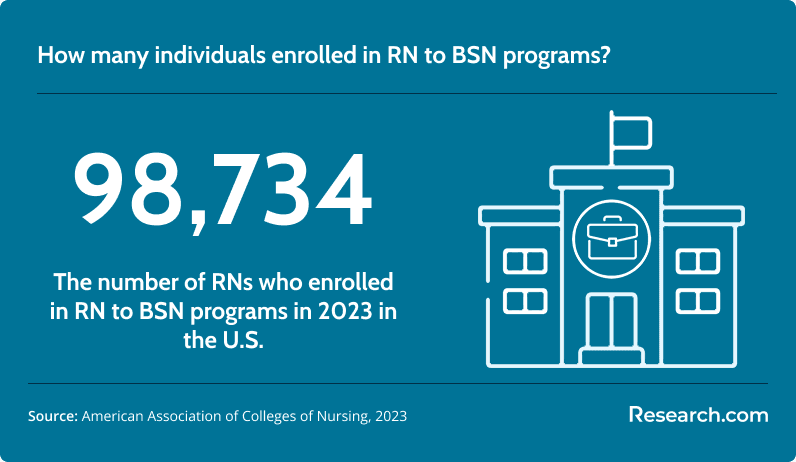
Based on our research, 98,734 individuals enrolled in RN to BSN programs in the U.S. in 2023. This reflects continued interest among RNs seeking broader qualifications, leadership preparation, and alignment with expectations from organizations such as the American Nurses Credentialing Center (ANCC) and the Institute of Medicine (IOM).
| Course area | Why it matters for working RNs |
| Leadership and management | Prepares nurses for charge nurse, coordinator, supervisor, and quality roles |
| Evidence-based practice | Strengthens the ability to use research in clinical decisions |
| Public health nursing | Expands care perspective from individual patients to populations |
| Informatics | Builds comfort with EHRs, reporting systems, and data-informed care |
| Ethics and policy | Supports better decision-making in complex healthcare environments |
What are the requirements for enrolling in an RN to BSN program?
RN to BSN admission requirements vary by school, but most programs are designed for licensed RNs with prior nursing education. The workload is generally manageable for experienced nurses, but students comparing schedules should still consider how demanding RN to BSN programs can be before choosing an accelerated format.
- Active RN license: Applicants usually need an active, unencumbered RN license in the state tied to coursework, practicum activities, or employment-based learning.
- Prior nursing credential: Most programs require an ADN or nursing diploma from an accredited program. Some schools set a minimum GPA, often ranging from 2.5 to 3.0.
- Official transcripts: Schools review transcripts from all postsecondary institutions to verify previous coursework and determine transfer credit.
- Prerequisite coursework: Common prerequisites include anatomy and physiology, microbiology, English composition, and sometimes statistics or psychology.
- Clinical experience: RN licensure often satisfies clinical background expectations, but some programs may prefer or require current nursing employment.
- Recommendations: Some schools ask for academic or professional references from supervisors, faculty, or colleagues.
- Background check and drug screening: These may be required for practicum placement, even when much of the program is online.
How do online RN to BSN programs differ from on-campus options?
Online and on-campus RN to BSN programs can lead to the same degree, but they differ in scheduling, interaction, pacing, costs, and practicum logistics. The better choice depends on how you learn, how predictable your work schedule is, and whether you need in-person structure.
Flexibility and schedule control
Online programs usually give students more control over when and where they complete coursework. This can be especially useful for nurses working evenings, weekends, rotating shifts, or 12-hour shifts. Campus programs typically require attendance at scheduled times, which can be valuable for structure but harder to coordinate with nursing work.
Learning environment
Online RN to BSN programs use learning management systems, video lectures, discussion boards, digital assignments, online exams, and virtual simulations. Some students appreciate the independence, while others prefer direct classroom interaction. If you want a flexible option with a lighter admissions process, reviewing the easiest RN to BSN online programs may help you identify programs built for working adults.
Program pace
Online programs may offer accelerated, self-paced, or multiple-start formats. Campus programs more often follow fixed semester calendars. Students who want the fastest route should ask whether courses are offered every term or only once per year.
Cost considerations
Online students may save on commuting, parking, housing, and relocation costs. Still, tuition, technology fees, distance-learning fees, books, and practicum costs vary widely, so compare total program cost rather than tuition alone.
Clinical or practicum structure
RN to BSN clinical requirements are often different from prelicensure nursing clinicals. Online programs may allow approved community health or leadership projects near where students live or work. Campus programs may use assigned partner sites, which can be less flexible but more structured.
| Factor | Online RN to BSN | On-campus RN to BSN |
| Schedule | Often asynchronous or flexible | Usually fixed class times |
| Best for | Working RNs needing remote access | Students who prefer in-person accountability |
| Pace | May offer accelerated or self-paced terms | Often follows standard semesters |
| Interaction | Digital discussions, email, virtual meetings | Face-to-face faculty and peer contact |
| Costs | May reduce commuting and relocation expenses | May include campus-related expenses |
Does financial aid cover accelerated RN to BSN programs?
Financial aid may cover accelerated RN to BSN programs when the school and program meet eligibility requirements and the student qualifies. The most important first step is checking accreditation and federal aid participation before assuming a short program is aid-eligible.
- Federal financial aid: If the program is offered through an eligible accredited institution, students may qualify for federal aid such as Pell Grants, Federal Supplemental Educational Opportunity Grants (FSEOG), Direct Subsidized and Unsubsidized Loans, and Parent PLUS Loans. Students apply through the FAFSA.
- State aid: Some states provide grants, scholarships, or loan forgiveness programs for nursing students. Eligibility depends on state rules and may include work-service obligations.
- Institutional scholarships: Colleges and universities may offer merit-based, need-based, or nursing-specific scholarships for RN to BSN students.
- Employer tuition assistance: Hospitals and healthcare systems may reimburse tuition or provide education benefits, often with grade requirements or continued-employment commitments.
- Veteran benefits: Eligible veterans and family members may use GI Bill or related military education benefits for approved programs.
| Funding source | What to verify | Why it matters |
| Federal aid | School eligibility and FAFSA requirements | Not every program qualifies for federal aid |
| Employer reimbursement | Annual limits, grade rules, and service commitments | Can reduce out-of-pocket cost substantially |
| Scholarships | Deadlines and nursing-specific eligibility | Free aid may require separate applications |
| Loans | Total repayment cost | Borrowing should be weighed against realistic career benefits |
Is a 6-month RN to BSN program a viable option for career advancement?
A 6 month RN to BSN program can be realistic for a limited group of students: experienced RNs with substantial transfer credit, completed prerequisites, strong academic readiness, and the ability to manage a compressed workload. These programs may use competency-based or highly accelerated formats, but they should still meet legitimate academic and accreditation standards.
Before choosing a 6-month pathway, ask for a written degree plan showing exactly how many credits you need, how practicum requirements are handled, whether courses are self-paced or term-based, and what happens if you cannot finish within the advertised period.
What is the job outlook for registered nurses?
Registered nurse employment is projected to grow by 6% from 2023 to 2033, faster than the average for all occupations. Demand is connected to ongoing healthcare needs, an aging population, chronic condition management, and replacement openings as nurses retire or move into other roles.
Employment projections show 3,300,100 RNs employed as of 2023, with employment expected to reach around 3,497,300 by 2033. An average of 197,200 openings for registered nurses is expected each year, with opportunities across hospitals, outpatient care, home healthcare, long-term care, government, and educational settings.
The chart below shows the projected employment change for RNs from 2023 to 2033:
Why is accreditation important for RN to BSN programs?
Accreditation is one of the most important checks when comparing RN to BSN programs. It signals that a school or nursing program has been reviewed against recognized academic and professional standards. It can also affect financial aid, transfer credit, graduate school admission, and employer acceptance.
- Academic quality: Accreditation helps confirm that the curriculum, faculty qualifications, and student outcomes meet established expectations.
- Financial aid eligibility: Federal financial aid generally depends on institutional eligibility and accreditation status.
- Credit transfer: Credits from accredited institutions are more likely to be considered by other accredited schools.
- Employer recognition: Many healthcare employers prefer or require degrees from accredited programs.
- Future education: Graduate nursing programs may require a BSN from an accredited institution or nursing program.
If you are planning beyond the BSN, accreditation becomes even more important. Students considering advanced nursing pathways can also compare options such as online direct entry MSN programs for non-nurses, although those programs serve a different audience than RN to BSN pathways.
Can I enroll in an RN to BSN program without prerequisites?
Some programs allow students to begin while completing remaining prerequisites, but “no prerequisites” should be read carefully. An accredited RN to BSN program still has degree requirements, and missing courses may be built into the plan rather than waived entirely.
Programs promoted as RN to BSN online programs without prerequisites may reduce barriers by accepting more transfer credit, embedding general education courses, or using alternative assessments. Before enrolling, request a transcript evaluation so you know whether the program is truly shorter for you.
What should I consider when choosing an RN to BSN program?
The best RN to BSN program is the one that fits your timeline, budget, learning style, employer requirements, and future education goals. Do not choose based only on the shortest advertised duration.
- Confirm institutional and nursing program accreditation.
- Ask how many of your prior credits will transfer before you enroll.
- Compare total cost, including tuition, fees, books, technology, and practicum expenses.
- Check whether coursework is asynchronous, synchronous, self-paced, or semester-based.
- Review practicum requirements and whether you can complete them locally.
- Ask about student support, tutoring, writing help, advising, and technology assistance.
- Evaluate whether the program supports your next step, such as leadership, graduate school, or specialization.
If affordability and speed are both priorities, compare fast and affordable online RN to BSN programs carefully. The cheapest program is not always the best value if it accepts fewer credits or lacks strong advising.
| Question to ask | Why it matters |
| How many credits will transfer? | This directly affects time and cost. |
| Is the nursing program accredited? | Accreditation affects credibility, aid, and future education. |
| Are classes asynchronous? | This matters for nurses with variable shifts. |
| What practicum experiences are required? | Scheduling can affect completion speed. |
| What is the total program cost? | Fees can change the real price significantly. |
How do I balance program cost with educational quality in advanced nursing education?
A low tuition rate is helpful, but cost should be weighed against accreditation, transfer credit acceptance, advising quality, graduation support, and whether the curriculum prepares you for your intended role. A slightly higher-priced program may be a better value if it shortens your timeline through generous credit transfer or provides stronger support for working nurses.
If your goal is eventual advanced practice, compare the RN to BSN cost with future graduate expenses. Reviewing options such as the most affordable nurse practitioner programs can help you plan a multi-degree pathway without overborrowing at the BSN stage.
What challenges might I face during an RN to BSN program?
RN to BSN students are usually experienced clinicians, but returning to school still creates pressure. The biggest challenges are time management, academic writing, online learning discipline, practicum scheduling, and balancing school deadlines with patient-care responsibilities.
- Work-school conflict: Shift changes, overtime, and fatigue can interfere with weekly assignments.
- Writing-heavy coursework: BSN courses often require papers, research analysis, and discussion posts.
- Technology requirements: Online platforms, proctoring tools, and digital simulations may require adjustment.
- Practicum coordination: Even flexible programs may require approved projects, preceptors, or site documentation.
- Motivation over time: Part-time students may need systems to stay engaged across multiple terms.
Students who want less competitive entry options can also compare the easiest nursing programs to get into, but admissions ease should never replace checks on accreditation, cost, and outcomes.
| Common mistake | Better approach |
| Choosing the shortest program without checking accreditation | Verify accreditation before applying. |
| Comparing tuition only | Calculate total cost after fees, books, and transfer credits. |
| Assuming online means easier | Ask about weekly workload and assignment types. |
| Ignoring practicum requirements | Confirm where and how practice experiences are completed. |
| Waiting until enrollment to request transfer review | Get a written transfer evaluation first. |
How does an RN to BSN degree prepare you for doctoral studies?
An RN to BSN program can strengthen the academic foundation needed for graduate and doctoral nursing education. Courses in research, evidence-based practice, leadership, health policy, informatics, and population health help students prepare for the expectations of MSN, DNP, and other advanced programs.
If a doctoral degree is part of your long-term plan, choose an RN to BSN program that emphasizes writing, research literacy, and leadership. You can also explore later options such as an affordable online Doctor of Nursing Practice program to understand how BSN preparation connects to advanced clinical leadership.
Are online RN to BSN programs credible?
Online RN to BSN programs can be credible when they are offered by properly accredited institutions and meet nursing education standards. Employers are generally more concerned with accreditation, school reputation, competencies, and licensure status than with whether lectures were delivered online or on campus.
The safest approach is to verify accreditation, confirm employer acceptance, review graduation support, and ask how practicum or project-based requirements are supervised. Students still unsure whether online nursing degrees are respected should focus on program approval and outcomes rather than format alone.
How can I transition into specialized nursing roles after my BSN?
A BSN can support movement into specialized or leadership-adjacent roles, but specialization usually requires experience, certifications, graduate education, or employer-based training. After earning the BSN, nurses may pursue areas such as public health, case management, quality improvement, informatics, education, leadership, or specialty clinical practice.
For nurses interested in women’s health, graduate-level preparation may eventually be necessary. Comparing affordable online women’s health nurse practitioner programs can help you understand how a BSN may fit into a longer specialization plan.
What graduates say about RN to BSN programs
-
: "
"Completing an RN to BSN program changed the direction of my career. The flexible format helped me keep working while building stronger leadership and clinical judgment skills. I finished feeling more prepared for roles with greater responsibility." – Caitlyn
"
-
: "
"The RN to BSN pathway allowed me to advance my education without stepping away from my job. The coursework was practical, especially the focus on evidence-based practice and patient care improvement. It helped me qualify for opportunities I had not considered before." – Madison
"
-
: "
"My BSN program strengthened my critical thinking and made me more confident as a nurse. The transition back to school was manageable because the support was clear and the schedule worked with full-time employment. I saw real professional growth by the end." – Jayce
"
Are emerging trends shaping the future of RN to BSN programs?
RN to BSN programs are increasingly shaped by digital learning, telehealth, simulation, informatics, quality improvement, and population health. These areas reflect how nursing work is changing across hospitals, outpatient settings, home care, and community-based systems.
Technology does not remove the need for clinical judgment. Instead, BSN programs are placing more emphasis on using data, communicating across teams, coordinating care, and leading process improvements. Nurses planning further study can also compare flexible doctoral routes, including the easiest DNP programs to get into, while remembering that “easiest” should still include accreditation and academic fit.
What advanced degree options are available after a BSN?
After completing an RN to BSN program, nurses may continue into graduate nursing education depending on their goals. Common options include MSN programs, nurse practitioner pathways, nursing education, nursing administration, informatics, public health nursing, and doctoral study.
A DNP may appeal to nurses interested in advanced clinical leadership, systems improvement, or high-level practice roles. If speed and flexibility matter, comparing short online DNP programs can help you understand what comes after the BSN.
Does earning a BSN enhance my salary potential?
A BSN can improve salary potential by helping RNs qualify for positions with broader responsibility, including leadership, specialty, public health, case management, quality, and graduate-school pathways. It does not guarantee a specific salary, because earnings still depend on location, employer, experience, shift differentials, union agreements, and specialization.
For long-term planning, some nurses compare BSN-level advancement with graduate roles that can have different compensation structures. For example, reviewing psychiatric nurse practitioner salary by state can show how advanced education may affect future earning paths beyond the BSN.
How can I evaluate the cost-effectiveness of RN to BSN programs?
To judge cost-effectiveness, compare what you will pay with what the program helps you accomplish. The best value is not always the lowest sticker price or the fastest advertised timeline. A good RN to BSN investment should minimize unnecessary credits, preserve accreditation quality, fit your schedule, and support your next career step.
- Request a written transfer-credit evaluation before enrolling.
- Calculate total cost, not just tuition per credit.
- Ask whether employer reimbursement can be used.
- Confirm whether courses are offered often enough to avoid delays.
- Check whether the degree supports graduate admission if you plan to continue.
- Compare debt with realistic salary and promotion expectations, not guaranteed outcomes.
If your long-term goal includes doctoral study, reviewing affordable BSN to DNP programs can help you decide whether to choose a lower-cost RN to BSN now and reserve more of your budget for graduate education.
Resources
- American Association of Colleges of Nursing. (2023). New Data Show Enrollment Declines in Schools of Nursing, Raising Concerns About the Nation’s Nursing Workforce. https://www.aacnnursing.org/news-data/all-news/new-data-show-enrollment-declines-in-schools-of-nursing-raising-concerns-about-the-nations-nursing-workforce
- U.S. Bureau of Labor Statistics. (2024). Occupational Outlook Handbook: Registered Nurses. https://www.bls.gov/ooh/healthcare/registered-nurses.htm#tab-5
- University of Bridgeport. (2022). RN to BSN Program Length | University of Bridgeport. https://www.bridgeport.edu/news/rn-to-bsn-program-length
Key Insights
- Most full-time RN to BSN students can finish in about 1 year, while part-time students often need 18 months to 2 years.
- Accelerated online programs may take 9 to 12 months, but they require completed prerequisites, strong transfer credit, and disciplined time management.
- A 6-month RN to BSN program can work for some experienced RNs, but students should verify accreditation, practicum requirements, transfer credits, and total weekly workload before enrolling.
- Online programs are often preferred by working nurses because they can reduce commuting and offer more scheduling flexibility, but they still require consistent academic effort.
- Registered nurse employment is projected to grow by 6% from 2023 to 2033, with an average of 197,200 openings expected each year.
- Accreditation is nonnegotiable. It can affect financial aid, employer recognition, transfer credit, and future graduate school eligibility.
- The smartest RN to BSN choice balances speed, cost, accreditation, transfer credit, support services, and long-term career goals rather than focusing on advertised completion time alone.
Other Things You Should Know About Finishing an RN to BSN Program
Yes. RN to BSN programs should hold accreditation from CCNE or ACEN, and the nursing school should be approved by the state board of nursing where required. These credentials help confirm eligibility for licensure-related study and for future graduate nursing admission.
In 2027, several factors influence the speed of completing an RN to BSN degree, including program type (full-time or part-time), prior credits, work commitments, and personal schedule. Many programs offer flexible online options, allowing for completion in as little as one year with full-time dedication.