2027 Best 6-Month RN to BSN Programs

Co-Founder and Chief Data Scientist
Many working nurses struggle to advance their careers because of the time and financial investment required to earn a BSN degree. This often involves juggling demanding work schedules, family responsibilities, and limited financial resources. The need for a program that fits into a busy lifestyle without compromising quality or affordability is crucial for those looking to move into higher-paying, more specialized roles.
To help, I’ve compiled a list of the best 6-month RN to BSN programs, designed for nurses who want to earn their degree quickly without compromising on quality. My goal is to make your journey toward career growth as seamless as possible. These options are tailored for busy professionals, offering the flexibility and quality needed to help you achieve your career goals without unnecessary delays.
What are the benefits of getting an RN to BSN degree?
- An RN to BSN degree qualifies nurses for advanced roles such as nurse manager, public health nurse, or case manager, enhancing career flexibility.
- Nurses with a BSN earn a median salary of approximately $86,070 annually, which is higher than that of RNs without a bachelor's degree.
- Many RN to BSN programs are offered online, allowing working nurses to balance education with their professional and personal commitments.
What can I expect from an RN to BSN degree?
An RN to BSN program is an excellent pathway for registered nurses aiming to advance their careers, enhance their expertise, and adapt to the evolving demands of the healthcare industry. Designed with working professionals in mind, RN to BSN programs provide flexibility and valuable learning opportunities, making them a practical choice for career growth.
- RN to BSN programs emphasize advanced coursework in leadership, research, and public health, equipping nurses with the skills needed for higher-level roles.
- Most programs can be completed in 12 to 24 months, allowing nurses to advance their education efficiently.
- Tuition costs range from $9,000 to $30,000, varying based on the institution and delivery format.
- Many programs are designed for working professionals, offering online learning options that enable nurses to balance work, education, and personal responsibilities.
- Completing an RN to BSN program opens doors to expanded career opportunities, including leadership positions and specialized roles in the healthcare industry.
Where can I work with an RN to BSN degree?
Earning an RN to BSN degree opens doors to a variety of employment opportunities in diverse healthcare settings. With this degree, you can work in hospitals, where BSN-prepared nurses are often preferred for leadership roles and specialized units such as critical care, pediatrics, or oncology. Community health centers and outpatient clinics also value BSN graduates for their advanced training in patient care and public health.
Beyond traditional healthcare settings, RN to BSN graduates may pursue roles in education, serving as clinical instructors or trainers in nursing schools and universities. Public health agencies and nonprofit organizations also seek BSN-prepared nurses for positions in health advocacy, policy development, and community outreach programs. This degree equips you with the credentials to explore administrative roles, such as nurse manager or case manager, offering opportunities to impact patient care on a systemic level.
How much can I make with an RN to BSN degree?
Earning an RN to BSN degree can significantly boost your earning potential compared to holding an associate degree in nursing (ADN). According to the Bureau of Labor Statistics, registered nurses earn an average annual salary of $86,070; however, BSN-prepared nurses typically command higher wages, with averages ranging from $80,000 to $100,000 annually, depending on location, experience, and specialization.
You can also pursue a master’s in nursing program to increase your salary potential. In high-demand specialized areas such as nurse anesthesiology, nurse midwifery, and nurse practitioner, MSN holders may earn even more, often exceeding $129,480 per year.
- Best 6-Month RN to BSN Programs for 2027 Best Programs
- How long does it take to complete a 6-month RN to BSN program? How long does it take to complete a 6-month RN to BSN program?
- How does an online 6-month RN to BSN program compare to an on-campus program? Online vs. On-Campus
- What is the average cost of a 6-month RN to BSN program? Cost
- What are the financial aid options for students enrolling in a 6-month RN to BSN program? Financial Aid
- What are the prerequisites for enrolling in a 6-month RN to BSN program? Requirements
- What courses are typically in a 6-month RN to BSN program? Courses
- What types of specializations are available in 6-month RN to BSN programs? Specializations
- What are the key challenges of completing a 6-month RN to BSN program? What are the key challenges of completing a 6-month RN to BSN program?
- How to choose the best 6-month RN to BSN program? How to choose the best 6-month RN to BSN program?
- Can a 6-month RN to BSN program pave the way for advanced nursing roles? Can a 6-month RN to BSN program pave the way for advanced nursing roles?
- What student support services are available in 6-month RN to BSN programs? What student support services are available in 6-month RN to BSN programs?
- What accelerated graduate pathways can build on a 6-month RN to BSN degree? What accelerated graduate pathways can build on a 6-month RN to BSN degree?
- How do 6‑Month RN to BSN Programs Compare to a 12 Month FNP Program Online? How do 6‑Month RN to BSN Programs Compare to a 12 Month FNP Program Online?
- How can specialized certifications after a 6‑month RN to BSN program boost career progression and compensation? How can specialized certifications after a 6‑month RN to BSN program boost career progression and compensation?
- What accreditation standards should I consider when evaluating 6‑month RN to BSN programs? What accreditation standards should I consider when evaluating 6‑month RN to BSN programs?
- What career paths are available for graduates of 6-month RN to BSN programs? What career paths are available for graduates of 6-month RN to BSN programs?
- What are the emerging trends in advanced nursing education after a 6‐Month RN to BSN program? What are the emerging trends in advanced nursing education after a 6‐Month RN to BSN program?
- What is the job market for graduates with a 6-month RN to BSN degree? Job Outlook
- What is the return on investment for a 6-month RN to BSN program? What is the return on investment for a 6-month RN to BSN program?
- Can a 6‐Month RN to BSN Program Facilitate a Seamless Transition to a DNP? Can a 6‐Month RN to BSN Program Facilitate a Seamless Transition to a DNP?
- What innovative technologies enhance learning in a 6-month RN to BSN program? What innovative technologies enhance learning in a 6-month RN to BSN program?
Best 6-Month RN to BSN Programs for 2027
Registered nurses who already hold an ADN or nursing diploma often look at RN to BSN programs for one practical reason: a BSN can strengthen eligibility for leadership roles, graduate nursing programs, specialized practice areas, and employers that prefer bachelor’s-prepared nurses. The challenge is choosing a program that is fast without being unrealistic, affordable without hidden costs, and accredited enough to support your long-term nursing goals.
This guide explains how 6-month RN to BSN programs work, which schools offer accelerated options, what they cost, what admission requirements to expect, and how to decide whether an accelerated online format fits your work schedule. It also covers financial aid, accreditation, career paths, graduate-school options, and common mistakes to avoid before enrolling.
Quick answer: Are 6-month RN to BSN programs real?
Yes, some RN to BSN programs can be completed in as little as six months, but that timeline usually requires full-time enrollment, completed general education requirements, generous transfer credit, an active RN license, and strong time management. Many students finish closer to 12 months, especially if they continue working while enrolled.
How Research.com evaluates schools
Research.com builds school lists using our methodology, along with institutional data, program details, and education databases. The goal is to help working nurses compare programs using practical factors such as completion time, tuition, accreditation, online flexibility, and transfer policies. Sources used in the review process include:
- IPEDS database
- Peterson's database, including the Distance Learning Licensed Data Set
- College Scorecard database
- National Center for Education Statistics
Best accelerated RN to BSN programs at a glance
| School | Reported program length | Tuition or cost figure listed | Accreditation |
| Purdue University Global | six to 18 months | $315 per credit hour | CCNE |
| Western Governors University | six to 12 months | $7,996 per year | CCNE |
| University of Texas at Houston | Six to 12 months | $273 per credit hour | Commission on Collegiate Nursing Education (CCNE) |
| Grand Canyon University | six to 12 months | $340 per credit hour | CCNE |
| University of Texas Arlington | six to 12 months | $257 per credit hour | CCNE |
| George Mason University | six to 12 months | $420 (in-state), $1,427 (out-of-state). | CCNE |
| Liberty University | 12 months to four years | $330 per credit hour | CCNE |
| Georgia Southern University | 12 months | $3,780 per semester | CCNE |
| University of South Alabama | 12 months | $423 per credit hour | CCNE |
| Oklahoma State University | Nine to 12 months | $112 per credit hour | CCNE |
1. Purdue University
The RN-to-BSN pathway at Purdue University Global is built for licensed nurses who want an online bachelor’s completion option while continuing to work. The curriculum emphasizes evidence-informed nursing practice, leadership, healthcare improvement, and professional growth across clinical settings. Students may transfer up to 135 credits, which can shorten the time to graduation substantially, and many complete the program in as little as one year.
- Program Length: six to 18 months
- Tracks/concentrations: N/A
- Cost per Credit/Tuition: $315 per credit hour
- Accreditation: CCNE
2. Western Governors University
The Western Governors University (WGU) Online RN-to-BSN program uses a competency-based model, which can benefit nurses who are comfortable moving quickly through material they already understand. The program covers evidence-based care, community health, nursing leadership, and includes six embedded professional certificates. Coursework is online, with scheduled in-person clinical hours that allow working RNs to apply BSN-level learning in practice.
- Program Length: six to 12 months
- Tracks/concentrations: N/A
- Cost per Credit/Tuition: $7,996 per year
- Accreditation: CCNE
3. University of Texas at Houston
The University of Texas Health Science Center at Houston (UTHealth) RN-to-BSN program is intended for registered nurses who want to deepen clinical judgment, leadership preparation, and professional nursing knowledge. Its flexible structure can support working nurses, especially those connected to healthcare networks in Texas. Students may choose full-time study for one semester, which takes about six months, although the average time to complete most RN to BSN programs is 12 months.
- Program Length: Six to 12 months
- Tracks/concentrations: N/A
- Cost per Credit/Tuition: $273 per credit hour
- Accreditation: Commission on Collegiate Nursing Education (CCNE)
4. Grand Canyon University
The online RN-to-BSN option at Grand Canyon University (GCU) is designed for RNs who want a flexible bachelor’s completion route with coursework in leadership, community health, and evidence-based nursing practice. The program is fully online and uses accelerated course options. With transfer credits, some students can finish in as little as 12 months.
- Program Length: six to 12 months
- Tracks/concentrations: N/A
- Cost per Credit/Tuition: $340 per credit hour
- Accreditation: CCNE
5. University of Texas Arlington
The University of Texas at Arlington (UTA) RN-to-BSN program is a fully online option for registered nurses who want asynchronous coursework and a structured path to a BSN. The curriculum builds on prior nursing education through courses in nursing science, leadership principles, and broader liberal arts foundations. UTA may be a strong fit for nurses who need online flexibility but still want a program connected to a large public university system.
- Program Length: six to 12 months
- Tracks/concentrations: N/A
- Cost per Credit/Tuition: $257 per credit hour
- Accreditation: CCNE
6. George Mason University
The RN-to-BSN program at George Mason University (GMU) allows qualified registered nurses to complete the BSN in as little as two full-time semesters. The program is delivered online and includes interactive learning resources, faculty support, and practicum opportunities where students can apply new competencies. Applicants must complete nursing prerequisite courses and hold a U.S.-issued registered nurse license.
- Program Length: six to 12 months
- Tracks/concentrations: N/A
- Cost per Credit/Tuition: $420 (in-state), $1,427 (out-of-state).
- Accreditation: CCNE
7. Liberty University
The RN-to-BSN program at Liberty University offers online 8-week courses for registered nurses seeking a Bachelor of Science in Nursing. Students complete coursework at a flexible pace while engaging in clinical practice and capstone work. The curriculum also incorporates a Christian worldview, which may appeal to nurses who want faith-informed professional education.
- Program Length: 12 months to four years
- Tracks/concentrations: N/A
- Cost per Credit/Tuition: $330 per credit hour
- Accreditation: CCNE
8. Georgia Southern University
Georgia Southern University offers a fully online RN-to-BSN program for nurses who want to broaden their professional options through advanced nursing coursework. The curriculum focuses on leadership, clinical reasoning, and professional development. The program can typically be completed in as little as 12 months, depending on the student’s pace, and students may benefit from Georgia State's healthcare partnership network for clinical and professional opportunities.
- Program Length: 12 months
- Tracks/concentrations: N/A
- Cost per Credit/Tuition: $3,780 per semester
- Accreditation: CCNE
9. University of South Alabama
The University of South Alabama provides an online RN to BSN route for registered nurses who want to expand their professional nursing knowledge. Coursework addresses current nursing issues, informatics in healthcare, global health issues, and collaboration across interprofessional teams. The university’s healthcare connections may also support hands-on learning experiences.
- Program Length: 12 months
- Tracks/concentrations: N/A
- Cost per Credit/Tuition: $423 per credit hour
- Accreditation: CCNE
10. Oklahoma State University
Oklahoma State University offers an online RN to BSN program designed for working nurses who need a flexible schedule. Coursework includes nursing theory, research and community nursing, global health, leadership, and management. Students complete a capstone project with a clinical component in appropriate locations of their choice.
- Program Length: Nine to 12 months
- Tracks/concentrations: N/A
- Cost per Credit/Tuition: $112 per credit hour
- Accreditation: CCNE
How long does it take to finish a 6-month RN to BSN program?
A true 6-month RN to BSN timeline is possible only for students who can handle a heavy academic load and who enter with most required credits already completed. In practice, many RN to BSN programs take about two semesters or 12 months to complete. Timeline depends on transfer credits, general education requirements, course sequencing, clinical or practicum expectations, and whether the nurse enrolls full-time or part-time.
Part-time enrollment can stretch completion to three years. That may be the better option for nurses working long shifts, rotating schedules, or overtime. Accelerated study saves time, but it also compresses reading, writing, discussion posts, projects, and practice-based assignments into a demanding schedule.
| Completion pace | Best for | Main trade-off |
| Six months | RNs with strong transfer credit, completed prerequisites, and enough time for full-time study | Very intense workload with limited room for schedule disruption |
| 12 months | Working nurses who want speed but need a more manageable pace | Takes longer than the fastest options but may reduce burnout |
| Part-time up to three years | Nurses balancing full-time work, family responsibilities, or variable shifts | Lower weekly pressure but delayed graduation |
After the BSN, some nurses continue into graduate nursing education. A master's degree in nursing (MSN) takes an average of two years. If you are not yet an RN, direct entry nurse practitioner programs can allow students to earn both a BSN and an MSN in one pathway in only three to four years.
Online vs. on-campus 6-month RN to BSN programs
Online RN to BSN programs are usually the most practical choice for working registered nurses because coursework can often be completed around shifts. Campus-based programs may offer more in-person interaction, but they can be harder to manage for nurses who cannot commute regularly or attend classes at fixed times.
| Factor | Online RN to BSN | On-campus RN to BSN |
| Scheduling | Often asynchronous or more flexible for working nurses | Usually requires attendance at set times |
| Completion speed | Frequently designed for accelerated completion | May follow a more traditional academic calendar |
| Interaction | Uses discussion boards, video meetings, online advising, and digital collaboration | Provides face-to-face access to faculty and classmates |
| Costs beyond tuition | May reduce commuting, parking, and housing expenses | May involve campus fees, transportation, and relocation costs |
| Best fit | Licensed RNs who need flexibility and can stay self-directed | Students who prefer structured classrooms and in-person support |
Flexibility and scheduling
Online accelerated RN to BSN programs allow nurses to complete coursework from home or another location, which helps those managing work shifts and family responsibilities. The flexibility is useful, but it also requires self-discipline because accelerated online courses can move quickly.
Speed of completion
Many online programs are built for faster completion than traditional campus formats. Similar to an LPN fast track program, accelerated RN to BSN options are designed for learners who already have healthcare training and want a shorter route to the next credential.
Learning experience
Online and campus RN to BSN programs may cover similar learning outcomes, but the experience differs. Online learners rely more on digital platforms, written communication, recorded or live sessions, and virtual collaboration. Students who learn best through direct classroom discussion should carefully evaluate the level of faculty access and peer interaction before choosing an online program.
Cost considerations
Online programs, including online RN to BSN programs with no clinicals, may reduce costs tied to travel, parking, and housing. However, total cost should include tuition, fees, books, technology requirements, transfer-credit limits, and whether clinical or practicum requirements create additional expenses.
What does a 6-month RN to BSN program cost?
Costs vary widely by school, residency status, transfer credits, fees, and financial aid. Per-credit tuition can be helpful for comparison, but students should also ask for a full program estimate based on their transcript evaluation. A low per-credit price may not mean the lowest final cost if the school accepts fewer transfer credits or requires additional general education courses.
| School | Cost figure listed | What to verify before enrolling |
| Grand Canyon University | $40,800 | Whether this includes all required materials, fees, and transfer-credit adjustments |
| Purdue Global | $40,950 | How financial aid and transfer credits affect the final bill |
| University of Texas at Arlington | $8,995 | Whether additional fees, books, or residency-related charges apply |
| Liberty University | $39,600 | Installment options, fees, and total credits required after transfer review |
Before committing, request a written cost breakdown from each school. Ask specifically about application fees, technology fees, graduation fees, course materials, payment plans, employer reimbursement timing, and whether tuition changes during the program could affect your total cost.
Financial aid options for accelerated RN to BSN students
Accelerated study can reduce time in school, but the condensed schedule may make payments feel larger over a shorter period. Nurses should compare financial aid, employer benefits, and payment plans before enrolling.
- Federal Financial Aid: Students can submit the Free Application for Federal Student Aid (FAFSA) to determine eligibility for federal grants and loans. Federal loans often include borrower protections and structured repayment options.
- Scholarships and Grants: Colleges, healthcare organizations, nursing associations, and foundations may offer merit-based or need-based awards for RN to BSN students.
- Employer Tuition Reimbursement: Hospitals and health systems sometimes help pay for BSN completion, often with conditions such as remaining employed for a set period after graduation.
- State Nursing Education Funding: Some states support nurses who continue their education or agree to work in underserved communities.
- Military Benefits: Active-duty service members, veterans, and eligible family members may qualify for GI Bill or military tuition assistance benefits.
Admission requirements for 6-month RN to BSN programs
Most accelerated RN to BSN programs are designed for licensed registered nurses, not students entering nursing for the first time. Requirements differ by school, but applicants commonly need the following:
- Active RN License: A valid, unencumbered registered nurse license in the applicant’s state or region of practice is typically required.
- Associate Degree or Nursing Diploma: Applicants generally need an Associate Degree in Nursing (ADN) or a nursing diploma from an accredited program.
- Minimum GPA: Many schools expect a cumulative GPA in the 2.5 to 3.0 range for prior coursework.
- Completed General Education Credits: Courses such as anatomy, physiology, and microbiology may need to be finished before enrollment or before upper-division nursing courses.
- Professional Experience: Some programs prefer or require clinical nursing experience, especially for practice-based assignments.
Healthcare workers who are not yet nurses should compare bridge options carefully. For example, a phlebotomist considering nursing may want to review career earnings and advancement differences, including how much a phlebotomist can make compared with RN roles.
Common courses in a 6-month RN to BSN curriculum
RN to BSN programs do not repeat basic nursing training. Instead, they build on RN preparation by emphasizing leadership, research, population health, communication, ethics, and systems-level thinking.
- Nursing Leadership and Management: Students study delegation, decision-making, team coordination, and healthcare systems leadership. Nurses interested in leadership education beyond nursing may also compare broader programs such as the most affordable online doctorate in organizational leadership.
- Evidence-Based Practice: This course teaches nurses to evaluate research and apply findings to improve care quality and patient outcomes.
- Community and Public Health Nursing: Students learn about disease prevention, population health, health promotion, and care delivery across diverse communities.
- Healthcare Ethics and Policy: Coursework examines ethical decision-making, professional responsibility, and how healthcare policy affects nursing practice.
- Advanced Health Assessment: This area strengthens assessment skills across physical, emotional, psychosocial, and lifespan considerations.
- Pathophysiology and Pharmacology: Students deepen their understanding of disease processes and medication-related decision-making.
- Professional Communication in Healthcare: Students practice communication with patients, families, interdisciplinary teams, and healthcare organizations. Those interested in administrative healthcare roles may also review affordable online medical billing and coding courses.
Specializations and electives in accelerated RN to BSN programs
Not every RN to BSN program offers formal concentrations, and several programs listed above report N/A for tracks or concentrations. When electives are available, they may help nurses align coursework with a preferred clinical population or work setting.
- Pediatrics Nursing: Focuses on infants, children, adolescents, developmental stages, and pediatric health concerns.
- Critical Care Nursing: Builds knowledge for caring for patients with severe or life-threatening conditions in ICU or emergency settings.
- Community and Public Health Nursing: Prepares nurses to support disease prevention, population health, and community-based health initiatives.
- Geriatric Nursing: Addresses the needs of older adults, including chronic disease care, functional decline, and end-of-life considerations.
- Mental Health Nursing: Develops skills for supporting patients with behavioral health needs through therapeutic communication and coordinated care.
- Oncology Nursing: Focuses on patients with cancer, including symptom management, treatment support, and family education.
Clinical interests can also guide post-BSN certifications or job moves. Some nurses pursue areas such as labor and delivery nursing, ICU nursing, ER nursing, oncology, informatics, or public health.
Challenges of completing an RN to BSN in six months
The biggest challenge is not the online format itself; it is the pace. A 6-month program can require frequent deadlines, substantial writing, group work, clinical or practicum documentation, and rapid movement through leadership and research-focused courses. Nurses working full-time should be realistic about shift length, overtime expectations, family obligations, and recovery time after demanding clinical work.
| Common challenge | Why it matters | Better strategy |
| Underestimating workload | Accelerated courses can require several assignments each week | Review sample syllabi and map deadlines before the term starts |
| Assuming online means easy | Online programs require independent organization and consistent participation | Use a weekly study calendar and set fixed coursework blocks |
| Working too many extra shifts | Overtime can quickly disrupt an accelerated timeline | Discuss schedule stability with your employer before enrolling |
| Ignoring technology needs | Digital platforms, video tools, and electronic submissions are central to online learning | Test required software and internet access before classes begin |
| Skipping prerequisite review | Gaps in research, writing, or health assessment can slow progress | Refresh key topics before the first course |
Nurses entering from a different healthcare background should expect an adjustment period. Bridge routes such as paramedic to RN bridge programs also require careful preparation because prior clinical experience does not eliminate the need for nursing theory, documentation, and academic writing.
How to choose the best 6-month RN to BSN program
The best program is not always the fastest or cheapest. It is the one that accepts the most applicable transfer credits, fits your schedule, holds appropriate accreditation, supports your state and career goals, and provides a clear total cost before you enroll.
- Accreditation: Confirm that the nursing program is accredited by a recognized accreditor such as the Commission on Collegiate Nursing Education (CCNE) or ACEN.
- Program Flexibility: Check whether courses are asynchronous, synchronous, hybrid, or tied to specific weekly deadlines.
- Tuition Costs and Financial Aid: Compare total program price after transfer credits, not just the advertised per-credit rate.
- Clinical Requirements: Ask whether the program requires practicums, projects, local site approvals, or employer verification.
- Specializations Offered: If you want pediatrics, critical care, public health, or another focus, confirm whether electives are actually available.
- Reputation and Student Reviews: Look for evidence of student support, responsive advising, and positive outcomes for working nurses.
Questions to ask before applying
| Question | Why it matters |
| How many of my credits will transfer? | Transfer credit can determine whether six months is realistic. |
| Is the program accredited by CCNE or ACEN? | Accreditation can affect employer recognition and graduate-school options. |
| Are there in-person clinical or practicum requirements? | Even online programs may require local practice-based experiences. |
| What is the full program cost after my transcript review? | Advertised tuition may not include every fee or required course. |
| Can I continue working full-time? | Some accelerated schedules are difficult to combine with full-time clinical work. |
| Will this program support MSN, DNP, or NP admission later? | Graduate programs may look closely at accreditation and BSN preparation. |
Can a 6-month RN to BSN support advanced nursing roles?
A BSN can strengthen a nurse’s foundation for leadership, education, specialty practice, and graduate school. It does not automatically make someone an advanced practice registered nurse, but it can be an important step toward MSN, NP, or doctoral pathways. Nurses who want to become nurse practitioners should compare bridge and graduate options early; for example, RN to NP programs online may offer structured routes for nurses moving beyond the BSN.
Student support services to look for in accelerated RN to BSN programs
Because accelerated programs move quickly, support services can directly affect whether students finish on time. Look for academic advising, writing support, tutoring, library access, technical help, career counseling, and faculty availability outside standard business hours. Peer mentoring and discussion communities can also help working nurses stay engaged.
Nurses planning graduate study should ask whether advisors help with MSN or NP planning. Those considering a faster move into family practice may want to compare accelerated FNP programs after completing the BSN.
Graduate pathways after a 6-month RN to BSN degree
After earning a BSN, nurses may pursue an MSN, nurse practitioner program, nurse educator track, healthcare leadership degree, or doctorate. The right choice depends on whether the nurse wants direct patient care authority, leadership responsibility, teaching roles, research preparation, or policy influence.
Students from non-nursing backgrounds should not assume an RN to BSN route applies to them. They may need a different pathway, such as direct entry MSN programs for non-nurses online, which are structured for students entering nursing from another field.
6-month RN to BSN vs. 12 month FNP program online
A 6-month RN to BSN program and a 12 month FNP program online serve different goals. The RN to BSN is a bachelor’s completion pathway for licensed RNs who want stronger leadership, research, and population-health preparation. An FNP program is graduate-level education focused on advanced assessment, diagnosis, treatment planning, and nurse practitioner preparation.
| Program type | Primary purpose | Best for |
| 6-month RN to BSN | Completing a bachelor’s degree in nursing | Licensed RNs with an ADN or diploma who want BSN-level credentials |
| 12 month FNP program online | Preparing for family nurse practitioner responsibilities | BSN-prepared nurses pursuing advanced clinical practice |
How certifications after an RN to BSN can support career growth
Specialty certifications can help nurses document focused expertise in areas such as critical care, pediatrics, oncology, informatics, psychiatric-mental health, or maternal health. Certification does not guarantee a raise or promotion, but it may strengthen a nurse’s profile for specialized roles, leadership assignments, and salary discussions. Nurses exploring advanced psychiatric practice can review regional compensation context through psychiatric nurse practitioner salary information.
Accreditation standards to verify before enrolling
Accreditation is one of the most important filters when comparing RN to BSN programs. A program accredited by CCNE or ACEN has undergone external review for curriculum quality, faculty qualifications, learning outcomes, and continuous improvement. This matters for employer confidence and may affect eligibility for graduate nursing programs.
Do not rely only on a school’s general institutional accreditation. Confirm nursing program accreditation separately. If you are still comparing entry points into nursing, our guide to the easiest nursing schools to get into can help you understand how admissions criteria differ across nursing pathways.
Career paths for graduates of 6-month RN to BSN programs
RN to BSN graduates may pursue broader clinical, leadership, community health, and administrative opportunities. Actual eligibility depends on employer requirements, experience, location, certifications, and licensure rules.
- Clinical Nursing Roles: BSN-prepared nurses may qualify for roles such as charge nurse, clinical coordinator, or specialty positions in critical care, pediatrics, or oncology.
- Leadership and Management Positions: The BSN can support progression toward nurse manager, supervisor, or director of nursing roles, especially when paired with experience.
- Public Health Nursing: Graduates may work in community health settings focused on education, prevention, outreach, and population health.
- Healthcare Administration: The BSN can support movement toward case management, quality improvement, clinical coordination, or administrative roles.
- School Nursing: BSN-prepared nurses may work with students, manage chronic conditions, provide screenings, and coordinate school health services.
- Specialized Nursing Fields: Experience and additional credentials can lead to work in informatics, forensic nursing, telehealth, or psychiatric-mental health. Nurses considering psychiatric specialization may compare online PMHNP certificate programs, while those aiming for doctoral study may review the shortest DNP program online options.
Current trends affecting RN to BSN and advanced nursing education
Several trends are shaping RN to BSN decisions. Healthcare employers continue to value BSN-level preparation for leadership, quality improvement, and interdisciplinary care. Online nursing education is also becoming more sophisticated, with virtual simulation, digital case studies, telehealth exposure, and informatics-focused assignments appearing more frequently in nursing curricula.
Another trend is earlier planning for graduate education. Nurses who know they want leadership, policy, research, or advanced clinical roles may compare MSN and DNP options soon after BSN completion. For example, affordable DNP programs may appeal to nurses planning long-term advancement in practice, systems leadership, or healthcare transformation.
Job market outlook for RN to BSN graduates
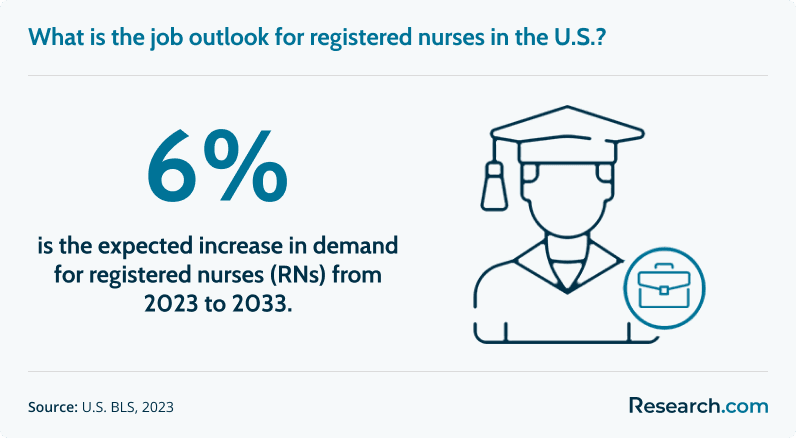
The broader registered nursing labor market remains steady. The demand for registered nurses is expected to increase by six percent from 2023 to 2033, with about 194,500 job openings for RNs projected each year, on average, over the decade.
A BSN can help nurses compete for employers and roles that prefer bachelor’s-prepared candidates, including hospitals, health systems, leadership positions, and nurse educator pathways. However, salary outcomes vary by location, specialty, experience, union status, shift differentials, and employer type. Nurses comparing compensation can review how much a BSN nurse makes and compare it with RN roles requiring an associate degree.
Return on investment of a 6-month RN to BSN program
ROI depends on total cost, time to completion, employer reimbursement, transfer credits, and how the BSN affects your career opportunities. A faster program may reduce opportunity cost because you finish sooner, but it may not be worth it if the workload forces you to cut work hours, retake courses, or pay more than necessary.
The strongest ROI usually comes from choosing an accredited program that accepts the most transfer credits, fits your work schedule, and supports your next career step. Nurses planning to become family nurse practitioners may view the BSN as one stage of a longer education plan and compare BSN to MSN FNP online programs after graduation.
What graduates say about accelerated RN to BSN study
- Marie: "Finishing my RN to BSN in six months felt like a major milestone. Online classes made it possible to keep working full time and manage family responsibilities, and the material connected directly to the way I practice as a nurse. The pace was demanding, but the outcome was worth the effort."
- Kristina: "The accelerated RN to BSN format helped me build my credentials much faster than I expected. I liked being able to study online while continuing to work, and the program helped me feel more prepared for the next stage of my nursing career."
- Daniel: "I did not expect to complete the BSN this quickly, but the online structure kept me organized. The assignments were clear, the content was practical, and I was able to apply what I learned at work almost immediately. I now feel better prepared for leadership opportunities."
Can a 6-month RN to BSN help prepare for a DNP?
A 6-month RN to BSN program can provide the bachelor’s-level foundation needed for later doctoral nursing study. It can strengthen leadership, evidence-based practice, communication, and systems thinking before a nurse enters a graduate or doctoral pathway. Nurses with long-term doctoral goals may compare affordable BSN to DNP programs to see how BSN coursework connects to advanced clinical or leadership preparation.
How to succeed in a 6-month RN to BSN program
Success in an accelerated RN to BSN program requires planning before the first course begins. Nurses should protect study time, understand weekly deadlines, communicate with employers about scheduling limits, and use advising or tutoring early rather than waiting until problems build.
- Create a weekly study calendar that includes readings, discussion posts, papers, projects, and clinical or practicum tasks.
- Reduce optional overtime during the heaviest course weeks whenever possible.
- Ask instructors early about unclear expectations, rubrics, or project requirements.
- Use online library tools, writing centers, and tutoring before major assignments are due.
- Build a small peer support group for accountability and discussion.
- Plan your next credential only after confirming your BSN workload is manageable. Nurses interested in women’s health may later compare options such as the most affordable online women's health NP program.
Technology used in modern RN to BSN programs
Online RN to BSN programs increasingly use learning management systems, virtual case studies, simulation tools, telehealth-related assignments, digital labs, video discussions, and real-time webinars. These tools help students practice clinical reasoning, leadership decisions, documentation, collaboration, and patient education in online environments.
Technology also prepares nurses for workplaces that use electronic health records, remote care tools, data dashboards, and interprofessional communication platforms. Nurses who want to continue into doctoral education can later compare advanced online options, including easiest DNP online degrees, while still prioritizing accreditation and clinical fit.
Common mistakes to avoid when choosing a 6-month RN to BSN program
- Choosing based only on speed: A six-month timeline is useful only if you can realistically manage the workload.
- Ignoring accreditation: Always verify nursing program accreditation, not just the school’s overall accreditation.
- Comparing tuition without transfer credits: The cheapest per-credit rate may not lead to the lowest total cost.
- Assuming online means no clinical work: Some online programs still require projects, practicums, or local practice experiences.
- Overlooking employer reimbursement rules: Reimbursement may require preapproval, minimum grades, or continued employment.
- Forgetting graduate-school requirements: If you plan to pursue an MSN, NP, or DNP, confirm that the BSN program will support that next step.
Key Insights
- Six-month RN to BSN programs are possible, but most students need strong transfer credit, completed prerequisites, and full-time study capacity to finish that quickly.
- Accreditation from CCNE or ACEN should be a non-negotiable requirement when comparing programs.
- Total cost matters more than advertised tuition. Ask each school for a transcript-based estimate before enrolling.
- Online RN to BSN programs work well for many nurses, but they require self-discipline, reliable technology, and careful time management.
- The BSN can support leadership, specialty nursing, public health, administration, and graduate nursing pathways, but it does not guarantee a specific salary or job title.
- The best program is the one that fits your schedule, accepts your credits, supports your career plan, and provides enough advising and academic support to help you finish.
References:
- Grand Canyon University. (2024). RN to BSN Degree. https://www.gcu.edu/degree-programs/bachelor-of-science-in-nursing-rn-to-bsn
- Liberty University. (2024). Online Nursing Degree (RN to BSN). https://www.liberty.edu/online/nursing/bachelors/rn-to-bsn
- Purdue Global. (2024). Bachelor of Science in Nursing RN-to-BSN. https://www.purdueglobal.edu/tuition-financial-aid/graduation-date-and-tuition-calculator/?source=SF54114&ve=62268
- University of Texas Arlington. (2024). Registered Nurse to Bachelor of Science in Nursing Online. https://academicpartnerships.uta.edu/healthcare-nursing-online-programs/rn-to-bsn
- U.S. Bureau of Labor Statistics. (2023). Occupational Outlook Handbook: Registered Nurses. https://www.bls.gov/ooh/healthcare/registered-nurses.htm#tab-1
Other Things You Should Know About 6-Month RN to BSN Programs
Yes. Many accelerated RN to BSN programs require a capstone or evidence-based project, usually completed in the final term. Schools often assign 3 to 6 credits for it, and it may involve a written paper, presentation, and faculty approval before graduation.
A 6-month RN to BSN program in 2027 typically includes clinical practice components focusing on leadership and community health. Students often engage in projects or practicums that enhance their skills in data management and patient care coordination within healthcare settings.