
2027 Best Online BSN to MSN Bridge Programs

Co-Founder and Chief Data Scientist
Nurses are in high demand across the United States, with every state seeking more registered professionals to support patient care in diverse medical settings. Among them, nurse practitioners (NPs) are especially sought after due to their advanced training and specialized skills. By 2033, the NP workforce is projected to grow by 135,500, highlighting the strong demand for MSN-prepared professionals.
To take advantage of the demand, quality education is a must. As such, this guide features the best online BSN to MSN bridge programs and presents essential information about the degree, such as program cost, offered courses and specializations, and the potential career paths of graduates.
What are the benefits of getting an online BSN to MSN bridge program?
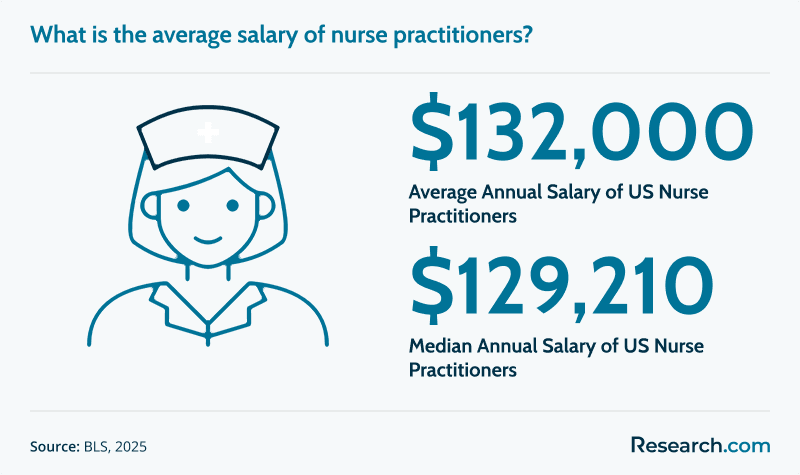
- The average yearly salary of nurse practitioners is $132,000, while their median yearly salary is $129,210.
- Completing an online BSN to MSN bridge program enables graduates to become nurse practitioners, nurse administrators, nurse educators, or nurse informatics specialists.
- Compared to traditional on-campus programs, online BSN to MSN bridge programs offer more flexible schedules and timelines and usually charge lower fees.
What can I expect from an online BSN to MSN bridge program?
Students enrolling in an online BSN to MSN bridge program can expect a flexible, rigorous educational pathway that builds upon their existing Bachelor of Science in Nursing (BSN) foundation to prepare them for advanced roles in nursing.
These programs typically offer accelerated coursework in advanced nursing theory, leadership, healthcare policy, evidence-based practice, informatics, and specialized nursing tracks such as nurse practitioner, nursing education, or healthcare administration.
The online format is designed to accommodate working nurses with asynchronous classes, virtual collaboration tools, and accessible resources available around the clock, allowing students to balance study with professional and personal responsibilities.
Although delivered primarily online, BSN to MSN bridge programs incorporate practical clinical or practicum experiences that students complete locally to meet certification and licensure requirements.
Students receive personalized academic advising, technology support, and faculty interaction to help them navigate their coursework and progress efficiently. Many programs also offer customizable pacing, with options for part-time, full-time, or accelerated study, as well as multiple start dates throughout the year.
Where can I work with an online BSN to MSN bridge program?
Graduates of an online BSN to MSN bridge program can work in a wide variety of healthcare settings, depending on their specialization and career goals. With advanced clinical and leadership training, they are qualified for higher-level positions that focus on patient care, administration, education, and informatics.
Here are their common work environments:
- Hospitals and Health Systems: Many MSN-prepared nurses take on roles as nurse practitioners, clinical nurse leaders, nurse educators, or administrators within hospital departments or specialty units.
- Primary Care Clinics: Graduates with a nurse practitioner specialization often work in family medicine, pediatrics, internal medicine, or women’s health clinics, providing direct patient care.
- Long-Term Care and Rehabilitation Facilities: MSN graduates may serve as nursing directors, clinical supervisors, or consultants, ensuring quality care and regulatory compliance in these settings.
- Community Health Centers: Those with a focus in public health or primary care often work in underserved areas, delivering preventive care and health education to diverse populations.
- Mental Health and Behavioral Health Facilities: Psychiatric-mental health nurse practitioners (PMHNPs) are qualified to assess, diagnose, and treat patients with mental health and substance use disorders.
- Academic Institutions: Nurse educators teach nursing students in classroom and clinical settings, develop curricula, and contribute to faculty-led research at colleges and universities.
- Home Health and Hospice Organizations: MSN-prepared nurses may manage care plans, provide advanced nursing services, or supervise staff delivering care in patients’ homes.
- Government and Public Health Agencies: Public health nurses or policy specialists may work for local, state, or federal health departments, focusing on population health initiatives and health policy.
- Healthcare Administration and Leadership Roles: Those with a focus in nursing administration or executive leadership often work in roles such as nurse manager, director of nursing, or chief nursing officer.
- Telehealth and Virtual Care Platforms: Many nurse practitioners and nurse educators now work in telehealth, delivering virtual care, conducting remote assessments, and providing patient education online.
How much can I make with an online BSN to MSN bridge program?
According to the United States Bureau of Labor Statistics (BLS), the average yearly salary of nurse practitioners is $132,000, while their median yearly salary is $129,210. These figures are considerably larger than the collective median annual salary of all jobs in the country, which is $49,500.
The typical salary range of a nurse practitioner is from $97,960 to $169,950. Entry-level roles and lower job grades earn salaries at the lower end of the spectrum but will gradually increase with experience and promotions. Seasoned NPs who work in large facilities in high-demand states, on the other hand, usually earn sums north of the average yearly salary.
- Best Online BSN to MSN Bridge Programs for 2027 List of Programs
- How long does it take to complete an online BSN to MSN bridge program? Completion Time
- How does an online BSN to MSN bridge program compare to an on-campus program? How does an online BSN to MSN bridge program compare to an on-campus program?
- What is the average cost of an online BSN to MSN bridge program? Average Cost
- What are the financial aid options for students enrolling in an online BSN to MSN bridge program? Financial Aid
- What are the prerequisites for enrolling in an online BSN to MSN bridge program? Requirements
- What courses are typically in an online BSN to MSN bridge program? What courses are typically in an online BSN to MSN bridge program?
- What types of specializations are available in online BSN to MSN bridge programs? What types of specializations are available in online BSN to MSN bridge programs?
- How to choose the best online BSN to MSN bridge program? How to choose the best online BSN to MSN bridge program?
- What career paths are available for graduates of online BSN to MSN bridge programs? Career Paths
- What is the job market for graduates with an online BSN to MSN bridge program? Job Market
- What potential challenges should I expect in an online BSN to MSN bridge program? What potential challenges should I expect in an online BSN to MSN bridge program?
- How do online BSN to MSN bridge programs prepare graduates for emerging healthcare trends? How do online BSN to MSN bridge programs prepare graduates for emerging healthcare trends?
Best Online BSN to MSN Bridge Programs for 2027
If you already have a Bachelor of Science in Nursing and an active RN license, an online BSN to MSN bridge program can help you move from bedside nursing into advanced practice, nursing education, informatics, or healthcare leadership. The decision is not simple. Programs vary widely in cost, clinical placement support, specialty options, state authorization, and whether the online format is truly flexible for working nurses.
This guide is designed for BSN-prepared registered nurses comparing online MSN options and trying to decide which program fits their career goals, schedule, budget, and licensure plans. You will find ranked program options, admissions and curriculum expectations, cost and financial aid considerations, online-versus-campus comparisons, career paths, labor market data, and practical questions to ask before enrolling. Nurses who are still earlier in their education pathway may also compare this route with a fast track RN to BSN to MSN online option.
Quick answer: Is an online BSN to MSN bridge program worth it?
An online BSN to MSN bridge program can be worth it for licensed RNs who want to qualify for nurse practitioner, nurse educator, nurse executive, nurse-midwifery, nursing informatics, or other advanced nursing roles without relocating or leaving work completely. The best choice is usually a CCNE- or ACEN-accredited program that offers the exact specialization you need, supports clinical placement, is authorized in your state, and has a total cost you can realistically manage through savings, employer assistance, federal aid, scholarships, or repayment programs.
The biggest mistake is choosing only by tuition or school name. For advanced practice tracks, state licensure compatibility and clinical placement logistics can matter as much as academic reputation.
How we evaluated online BSN to MSN programs
Online BSN to MSN programs require a serious commitment of money, clinical hours, and study time. To make the list more useful, we focused on transparent program information from reputable education and labor-market sources rather than promotional claims.
Data sources used in the ranking process include the IPEDS database, College Scorecard, Peterson's database, and the National Center for Education Statistics. Accreditation was prioritized because graduate nursing education affects certification, licensure, and employer recognition. More detail on ranking inputs is available on our methodology page.
| Rank | School | Program length | Credits | Cost per credit | Accreditation |
| 1 | University of South Carolina | 4.5 years | 30 to 47 | $770 to $1,438 | Commission on Collegiate Nursing Education |
| 2 | Duke University | 2 to 3 years | 42 to 49 | $2,166 | Commission on Collegiate Nursing Education |
| 3 | Ohio State University Online | 2 to 3 years | 53 to 73 | $829.75 to $1,859.50 | Commission on Collegiate Nursing Education |
| 4 | The University of Alabama | 2 to 3 years | 53 to 79 | $480 | Commission on Collegiate Nursing Education |
| 5 | Emory University | 18 months to 3 years | around 48 | $2,082 | Commission on Collegiate Nursing Education |
| 6 | University of Michigan | 2 years | 54 to 56 | $1,698 to $3,488 | Commission on Collegiate Nursing Education |
| 7 | Loyola University New Orleans | 2 to 3 years | around 48 to 49 | $850 | Commission on Collegiate Nursing Education |
| 8 | Villanova University | 2 to 3 years | 33 to 47 | $1,050 | Commission on Collegiate Nursing Education |
| 9 | New York University | 2 to 3 years | 45 to 54 | $2,400 | Commission on Collegiate Nursing Education |
| 10 | Johns Hopkins University | 4 to 7 semesters; 3 to 6 years (MSN/MBA Dual Degree) | 68 to 72 | $1,995 | Commission on Collegiate Nursing Education |
1. University of South Carolina Master of Science in Nursing
The University of South Carolina offers an online Master of Science in Nursing for nurses seeking advanced clinical, educational, informatics, or leadership preparation. Its broad specialty menu makes it useful for students who want several possible MSN directions in one school search, including nurse practitioner, nurse-midwifery, nursing education, informatics, and healthcare leadership pathways.
- Program Length: 4.5 years
- Concentrations:
- Family Nurse Practitioner
- Psychiatric Mental Health Nurse Practitioner
- Adult-Gerontology Acute Care
- Nursing Informatics
- Healthcare Leadership
- Nursing Education
- Nurse-Midwifery
- Required Credits to Graduate: 30 to 47
- Cost per Credit: $770 to $1,438
- Accreditation: Commission on Collegiate Nursing Education
2. Duke University Master of Science in Nursing
Duke University provides an MSN with both advanced practice and healthcare systems options. The program is best suited for nurses who want a large selection of nurse practitioner majors or who are comparing clinical tracks with leadership, informatics, or education-focused routes. Optional specialty certificates, including cardiology, palliative care, and oncology, may appeal to nurses who want additional focused preparation beyond the MSN major.
- Program Length: 2 to 3 years
- Concentrations:
- Adult-Gerontology Nurse Practitioner – Acute Care
- Adult-Gerontology Nurse Practitioner – Primary Care
- Family Nurse Practitioner
- Neonatal Nurse Practitioner
- Pediatric Nurse Practitioner – Acute Care
- Pediatric Nurse Practitioner – Primary Care
- Psychiatric Mental Health Nurse Practitioner
- Women’s Health Nurse Practitioner
- Health Informatics
- Nursing and Healthcare Leadership
- Nursing Education
- Required Credits to Graduate: 42 to 49
- Cost per Credit: $2,166
- Accreditation: Commission on Collegiate Nursing Education
3. Ohio State University Online Master of Science in Nursing
The MSN at Ohio State University is built for BSN-prepared nurses who want advanced practice training grounded in clinical preparation and evidence-based care. Many specialties are offered online or through hybrid delivery, though some tracks may require campus visits. This program may be a strong fit for nurses who want a large menu of NP and nurse-midwifery specialties and are comfortable confirming format details by concentration.
- Program Length: 2 to 3 years
- Concentrations:
- Neonatal Nurse Practitioner
- Psychiatric Mental Health Nurse Practitioner
- Family Nurse Practitioner
- Acute Care Pediatric Nurse Practitioner
- Adult-Gerontology Acute Care Nurse Practitioner
- Adult-Gerontology Primary Care Nurse Practitioner
- Nurse-Midwifery
- Pediatric Primary Care Nurse Practitioner
- Pediatric Acute Care Nurse Practitioner
- Women’s Health Nurse Practitioner
- Required Credits to Graduate: 53 to 73
- Cost per Credit: $829.75 to $1,859.50
- Accreditation: Commission on Collegiate Nursing Education
4. The University of Alabama Nursing, MSN
The University of Alabama offers a CCNE-accredited online MSN with nurse practitioner, nurse educator, and nurse executive options. Coursework is mainly online, but students should plan for orientation and a clinical intensive. Applicants need a BSN from an accredited institution, an active RN license, and successful completion of a background and drug screen.
- Program Length: 2 to 3 years
- Concentrations:
- Nurse Executive
- Nurse Educator
- Family Nurse Practitioner
- Psychiatric Mental Health Nurse Practitioner
- Dual Psychiatric Mental Health and Family Nurse Practitioner
- Required Credits to Graduate: 53 to 79
- Cost per Credit: $480
- Accreditation: Commission on Collegiate Nursing Education
5. Emory University Master of Science in Nursing
Emory University offers an MSN with multiple advanced practice specialties and dual-degree options, including MSN-MA in Bioethics and MSN-MPH. The program uses hybrid formats that combine online coursework with periodic campus intensives. It may be a good match for nurses who want advanced clinical preparation and are open to in-person components as part of the learning experience.
- Program Length: 18 months to 3 years
- Concentrations:
- Adult/Gerontology Acute Care Nurse Practitioner
- Adult/Gerontology Primary Care Nurse Practitioner
- Family Nurse Practitioner
- Master in Cardiovascular Perfusion Science
- Neonatal Nurse Practitioner
- Pediatric Acute Care Nurse Practitioner
- Pediatric Primary Care Nurse Practitioner
- Women’s Health/Gender-related Nurse Practitioner
- Psychiatric/Mental Health Nurse Practitioner
- Required Credits to Graduate: around 48
- Cost per Credit: $2,082
- Accreditation: Commission on Collegiate Nursing Education
6. University of Michigan Master of Science in Nursing
The University of Michigan offers MSN pathways for nurses pursuing clinical practice, nurse-midwifery, or leadership-oriented roles. Its online MSN in Leadership, Analytics, and Innovation can be completed in two years, while most clinical programs use hybrid delivery with online learning and selected campus intensives. This option is especially relevant for working nurses who want a research-intensive university environment but need some flexibility.
- Program Length: 2 years
- Concentrations:
- Adult-Gerontology Acute Care Nurse Practitioner
- Adult-Gerontology Primary Care Nurse Practitioner
- Primary Care Family Nurse Practitioner
- Nurse-Midwifery
- Nurse-Midwifery/Primary Care Family Nurse Practitioner
- Leadership, Analytics, and Innovation
- Required Credits to Graduate: 54 to 56
- Cost per Credit: $1,698 to $3,488
- Accreditation: Commission on Collegiate Nursing Education
7. Loyola University New Orleans Master of Science in Nursing
Loyola University New Orleans offers online and hybrid MSN options focused on evidence-based and culturally responsive nursing practice. The fully online Family Nurse Practitioner pathway includes 800 clinical hours and is designed to prepare graduates for national certification. Nurse-Midwifery and Psychiatric Mental Health Nurse Practitioner options are delivered in hybrid formats, so applicants should confirm travel expectations before enrolling.
- Program Length: 2 to 3 years
- Concentrations:
- MSN General
- Family Nurse Practitioner
- Nurse Midwifery
- Required Credits to Graduate: around 48 to 49
- Cost per Credit: $850
- Accreditation: Commission on Collegiate Nursing Education
8. Villanova University Master's in Nursing
Villanova University offers online MSN tracks that still require in-person clinical learning. Students may benefit from access to healthcare sites near the Philadelphia campus, but applicants should clarify whether relocation or travel could be necessary for their chosen track. The program is best for nurses who want online coursework but are comfortable with clinical and in-person requirements.
- Program Length: 2 to 3 years
- Concentrations:
- Adult-Gerontology Nurse Practitioner
- Family Nurse Practitioner
- Pediatric Nurse Practitioner
- Psychiatric-Mental Health Nurse Practitioner
- Nursing Education
- Required Credits to Graduate: 33 to 47
- Cost per Credit: $1,050
- Accreditation: Commission on Collegiate Nursing Education
9. New York University Master of Science in Nursing
New York University offers MSN pathways for nurses interested in advanced clinical practice, education, administration, informatics, research, and public health. The curriculum emphasizes leadership, ethical practice, and evidence-based decision-making. Students who want public health preparation can also consider the dual-degree MS/MPH option.
- Program Length: 2 to 3 years
- Concentrations:
- Adult-Gerontology Acute Care Nurse Practitioner
- Adult-Gerontology Primary Care Nurse Practitioner
- Clinical Research Nursing
- Family Nurse Practitioner
- Nurse-Midwifery
- Nursing Administration
- Nursing Education
- Nursing Informatics
- Pediatrics Nurse Practitioner Primary Care
- Pediatrics Nurse Practitioner Primary Care/Acute Care
- Psychiatric-Mental Health Nurse Practitioner
- Required Credits to Graduate: 45 to 54
- Cost per Credit: $2,400
- Accreditation: Commission on Collegiate Nursing Education
10. Johns Hopkins University Master of Science in Nursing (MSN) Programs
Johns Hopkins University offers MSN options focused on healthcare leadership, innovation, quality improvement, and organizational change. Students may pursue the Healthcare Organizational Leadership Track or a dual MSN/MBA, while candidates with non-nursing bachelor’s degrees can consider the full-time MSN Entry into Nursing track. BSN-prepared nurses should carefully confirm which MSN pathway matches their current licensure status and career goal.
- Program Length: 4 to 7 semesters; 3 to 6 years (MSN/MBA Dual Degree)
- Concentrations:
- Entry into Nursing
- Healthcare Organizational Leadership Track
- MSN/MBA Dual Degree
- Required Credits to Graduate: 68 to 72
- Cost per Credit: $1,995
- Accreditation: Commission on Collegiate Nursing Education
How long does it take to complete an online BSN to MSN bridge program?
Most online BSN to MSN bridge programs take 2 to 3 years, but the actual timeline depends on the specialty, whether you enroll full time or part time, how quickly you complete clinical hours, and whether the program uses year-round or traditional academic scheduling. This timeline is similar to other streamlined graduate routes, including some of the fastest online master's programs in clinical mental health counseling.
| Enrollment path | Typical completion time | Best for | Main trade-off |
| Full-time enrollment | 18 to 24 months | Nurses who can reduce work hours or manage an intensive academic load | Faster completion, but less scheduling room for overtime, family obligations, or unexpected clinical delays |
| Part-time enrollment | 28 to 36 months or more | Working nurses who need a steadier pace | More manageable weekly workload, but a longer time before graduation and certification eligibility |
| Accelerated format | 12 to 18 months | Highly organized students with strong support systems | Shorter timeline, but heavier coursework and less flexibility if work schedules change |
| Clinical-heavy specialties | Varies by placement availability | Students entering NP, nurse-midwifery, or other direct-care roles | Clinical site scheduling can extend the timeline even when online coursework is on track |
Time to completion should be evaluated alongside workforce demand. A projected 1.2 million new nurses are needed to fulfill the demand in the country by 2030, which is one reason many RNs are considering graduate nursing education while remaining employed.
How does an online BSN to MSN bridge program compare to an on-campus program?
Online and campus-based BSN to MSN programs can lead to the same graduate credential, but they create very different student experiences. The better option depends on your schedule, learning style, clinical placement needs, location, and access to campus resources.
| Factor | Online BSN to MSN | On-campus BSN to MSN | Decision tip |
| Schedule | Often designed for working nurses and may include asynchronous coursework | Usually follows set class, lab, and campus meeting times | Choose online if shift work makes fixed class times difficult |
| Learning environment | Uses learning platforms, recorded lectures, discussion boards, virtual simulations, and remote collaboration | Offers face-to-face lectures, direct classroom discussion, and immediate in-person feedback | Choose campus if you learn best through live interaction and structured routines |
| Clinical training | Clinical hours are still required and may be completed locally if approved | Clinical sites are often near the university and arranged through school partners | Ask who secures placements before you apply |
| Resources | Usually includes virtual advising, online library access, remote tutoring, and technical support | May provide easier access to labs, simulation centers, faculty offices, and campus networking | Online students should confirm the availability and hours of support services |
| Cost and access | May reduce commuting, housing, and relocation costs | May add travel, parking, housing, or relocation expenses | Compare total cost, not tuition alone |
Online learning does not remove hands-on requirements. This is especially important in clinical specializations, including child-focused tracks such as those found in fast track MSN pediatric nurse practitioner online programs, where supervised practice experiences remain central to preparation.
What is the average cost of an online BSN to MSN bridge program?
The average cost of an online BSN to MSN bridge program typically ranges from $20,000 to $60,000. Your final cost can vary based on whether the school is public or private, the number of credits in your specialty, residency pricing, program fees, clinical requirements, technology costs, books, and required campus visits.
| Cost category | Typical range or consideration | What to verify |
| Public universities | $20,000 to $40,000 | Whether online students receive in-state, out-of-state, or flat-rate tuition |
| Private universities | $40,000 to $60,000 or higher | Whether higher tuition includes placement help, advising, networking, or specialized faculty access |
| Fees and materials | Varies by school and specialty | Technology fees, books, background checks, testing fees, clinical compliance costs, and software |
| Travel costs | May apply if intensives, labs, or campus visits are required | How often you must travel and whether lodging is needed |
Many students manage the cost through federal financial aid, school-based scholarships, nursing scholarships, employer tuition reimbursement, payment plans, or loan repayment programs. Nurses comparing ROI should avoid assuming that a higher-priced program automatically produces a higher salary. Specialty, location, licensure, experience, and employer type all affect earnings.
A direct way to evaluate potential return is to compare program costs with likely career outcomes in the specialty you plan to pursue. The US states that offer the highest average yearly salaries to nurse practitioners, as shown in the chart below, are California ($161,540), Nevada ($148,670), and Washington ($145,400). These salary levels can be compared with other specialized nursing routes, including fast track adult-gerontology pcnp graduate certificate programs online.
What are the financial aid options for students enrolling in an online BSN to MSN bridge program?
Online BSN to MSN students may qualify for several types of aid, including federal loans, scholarships, employer support, military benefits, and repayment programs. Some funding categories are also relevant across allied health education, such as online medical assistant programs with financial aid, but graduate nursing students should focus on aid specifically available for MSN-level study.
| Aid option | How it can help | Important caution |
| Federal Student Aid | Submitting the Free Application for Federal Student Aid (FAFSA) can make students eligible for Direct Unsubsidized Loans and Graduate PLUS Loans. | Borrow only what you need and compare repayment obligations before accepting the full amount offered. |
| Scholarships and Grants | Schools, nursing associations, and private organizations may offer need-based or merit-based awards for graduate nursing students. | Deadlines can be early, and awards may be tied to specialty, location, or enrollment status. |
| Employer Tuition Assistance | Hospitals and healthcare systems may reimburse tuition when the MSN supports workforce needs. | Some employers require continued service after graduation or limit eligible schools and programs. |
| State and Federal Loan Forgiveness Programs | Programs such as the Nurse Corps Loan Repayment Program and Public Service Loan Forgiveness (PSLF) may reduce debt for qualifying service. | Eligibility rules are specific, so document qualifying employment and payments carefully. |
| Military and Veterans’ Benefits | Eligible students may use GI Bill® or Yellow Ribbon Program benefits toward online MSN expenses. | Confirm program approval and benefit limits before enrolling. |
| Institutional Payment Plans | Monthly payment structures can reduce the need to pay an entire term at once. | Plans may not cover all fees and may require enrollment charges. |
| Private Loans | Private lenders can fill funding gaps after federal aid and scholarships. | Interest rates, credit requirements, and repayment protections may be less favorable than federal loans. |
| Graduate Assistantships | Some schools may offer teaching or research support roles, though these are less common in online formats. | Availability may be limited for working nurses and distance learners. |
What are the prerequisites for enrolling in an online BSN to MSN bridge program?
Admissions requirements vary by university and specialization, but most online BSN to MSN programs expect applicants to show academic readiness, current nursing licensure, and the ability to complete graduate-level clinical or leadership work. Nurse practitioner and nurse-midwifery tracks may be more selective than some non-clinical MSN tracks.
- Bachelor of Science in Nursing: Applicants are typically expected to hold a BSN from an accredited institution, commonly one accredited by CCNE (Commission on Collegiate Nursing Education) or ACEN (Accreditation Commission for Education in Nursing).
- Active RN License: Most schools require a current, unencumbered registered nurse license. Some programs also require licensure in the state where clinical hours will be completed.
- Minimum GPA: Many programs look for an undergraduate GPA of 3.0 or higher, although some review applicants with lower GPAs individually.
- Prerequisite Coursework: Schools may require prior courses in statistics, health assessment, nursing research, or pathophysiology if those topics were not completed during the BSN.
- Work Experience: Some tracks, especially Nurse Practitioner or Nurse Executive options, may expect 1–2 years of clinical nursing experience before admission.
- Letters of Recommendation: Applicants are commonly asked for two to three references from supervisors, faculty, or professional colleagues who can evaluate clinical judgment and graduate readiness.
- Statement of Purpose or Personal Essay: Programs often require a written explanation of career goals, specialty interest, and reasons for pursuing an MSN.
- Resume or CV: A current professional document should summarize nursing roles, certifications, leadership experience, education, and achievements.
- Interview: Some schools use phone or video interviews to assess communication skills, specialty fit, and motivation.
- English Language Proficiency: International applicants or non-native English speakers may need TOEFL or IELTS scores.
Educational expectations for advanced nursing roles are high. According to College Board, as shown in the visual below, 65.22% of nurse practitioners in the United States have a master's or professional degree, 30.44% have a doctoral degree or more, and 4.35% hold a bachelor's degree. This differs from shorter technical or associate-level healthcare routes, such as a fast track online medical billing and coding associate degree.
What courses are typically in an online BSN to MSN bridge program?
Online BSN to MSN coursework combines graduate nursing theory, evidence-based practice, systems leadership, and specialty-specific clinical preparation. The exact curriculum depends on the concentration, but many MSN programs include the following types of courses.
| Course area | What students learn | Why it matters |
| Advanced Pathophysiology | Disease processes and how health conditions affect the body across the lifespan | Builds the clinical reasoning needed for advanced assessment and management |
| Advanced Health Assessment | Comprehensive physical, mental, psychosocial, and population-based assessment methods | Prepares students to evaluate complex patient needs using evidence-based approaches |
| Advanced Pharmacology | Medication principles, pharmacokinetics, pharmacodynamics, safety, and management | Essential for nurse practitioner tracks and other roles involving medication decisions |
| Theoretical Foundations of Nursing Practice | Nursing theories and professional models used in practice, education, and research | Connects advanced nursing roles to a professional and scholarly framework |
| Health Policy and Advocacy | Healthcare systems, regulation, policy development, and the nurse’s role in advocacy | Helps graduates influence care delivery and respond to policy changes |
| Evidence-Based Practice and Research | Research appraisal, quality improvement, and implementation of findings in practice | Supports safer, more effective care and leadership in clinical improvement |
| Leadership and Organizational Systems | Strategic planning, team leadership, finance, operations, and interprofessional collaboration | Useful for nurse leaders, educators, administrators, and advanced practice nurses |
| Population Health and Epidemiology | Health trends, prevention, community health, and determinants of health | Prepares nurses to address care beyond individual patient encounters |
| Ethics and Legal Issues in Nursing | Professional accountability, ethical frameworks, legal responsibilities, and decision-making | Important for expanded scopes of practice and leadership responsibilities |
| Specialty-Specific Clinical Practicums | Supervised practice in the student’s MSN concentration | Allows students to apply advanced skills and meet certification or licensure expectations |
What types of specializations are available in online BSN to MSN bridge programs?
The specialization is one of the most important decisions in an MSN search because it determines the courses you take, the clinical hours you complete, the certification exams you may pursue, and the jobs you can target after graduation.
| Specialization | Primary focus | Best for nurses who want to... |
| Family Nurse Practitioner (FNP) | Primary care for patients across the lifespan | Diagnose illness, prescribe medications where authorized, manage chronic conditions, and provide preventive care |
| Adult-Gerontology Nurse Practitioner (AGNP) | Care for adult and older adult populations in acute or primary care settings | Work with aging-related health needs, chronic disease, and adult-focused care |
| Pediatric Nurse Practitioner (PNP) | Care for infants, children, and adolescents | Practice in pediatric clinics, hospitals, schools, or community settings |
| Psychiatric-Mental Health Nurse Practitioner (PMHNP) | Mental health assessment, therapy, and psychopharmacology | Treat patients with behavioral health, psychiatric, or substance use needs; this is also one route for nurses researching how to become a psychiatric nurse |
| Nurse Educator | Teaching, curriculum design, evaluation, and clinical instruction | Train nursing students or staff in academic and healthcare settings |
| Nurse Administrator or Nurse Executive | Healthcare management, staffing, finance, operations, and strategy | Lead nursing units, departments, or healthcare organizations |
| Women’s Health Nurse Practitioner (WHNP) | Reproductive, gynecological, prenatal, postpartum, and wellness care | Specialize in women’s health across clinical settings |
| Clinical Nurse Leader (CNL) | Care coordination, outcomes improvement, and interdisciplinary leadership | Improve quality and safety for complex patient populations |
| Public Health Nursing | Community health, prevention, public health response, and health education | Work in government, nonprofit, or population health roles |
| Informatics Nursing | Healthcare data, electronic health records, workflow, and decision-support systems | Use technology and information systems to improve care delivery |
Some MSN graduates later pursue doctoral education. If you are comparing long-term advancement options, it may help to review what does a DNP do and how doctoral preparation differs from an MSN.
How to choose the best online BSN to MSN bridge program?
The best online BSN to MSN program is the one that fits your target role, state requirements, clinical needs, learning style, and budget. Rankings can help you build a shortlist, but they should not replace careful program verification.
Questions to ask before applying
- Is the program accredited? Look for recognition from a nursing accreditor such as the Commission on Collegiate Nursing Education (CCNE) or the Accreditation Commission for Education in Nursing (ACEN).
- Does the school offer your exact specialization? A general MSN will not prepare you for the same roles as an FNP, PMHNP, nurse-midwifery, or informatics track.
- Will the program meet licensure or certification requirements in your state? This is especially important for advanced practice tracks.
- Who finds clinical placements? Some schools assist with placements; others expect students to identify preceptors and sites.
- How flexible is the schedule? Ask whether courses are asynchronous, synchronous, part time, full time, or accelerated.
- What is the full cost? Include tuition, fees, books, technology, travel, clinical compliance expenses, and lost work hours.
- What student support is available online? Look for advising, tutoring, library access, technical support, career services, and faculty office hours.
- What outcomes can the school document? Ask about certification exam pass rates, graduation rates, employment outcomes, and clinical placement support.
- Are faculty active in the specialty? Faculty experience can matter in clinical tracks, leadership preparation, research, and professional networking.
- What happens if you move states during the program? State authorization and clinical approval can change when your location changes.
Common mistakes to avoid
| Mistake | Why it can hurt you | Better approach |
| Choosing only by lowest tuition | A cheap program may still become costly if it lacks placement support or requires unexpected travel | Compare total cost and support services |
| Ignoring accreditation | Accreditation can affect certification, transfer options, employer recognition, and further education | Confirm programmatic nursing accreditation before applying |
| Assuming online means no campus visits | Hybrid intensives, labs, and orientations may still be required | Ask for a complete residency and travel calendar |
| Not checking state authorization | A program may not be approved for students in your state or may not meet advanced practice requirements | Verify state eligibility with the school and your state nursing board |
| Waiting too long to plan clinicals | Clinical site shortages can delay graduation | Ask about placement timelines and preceptor responsibilities early |
| Relying only on rankings | A high-ranked school may not fit your specialty, budget, or schedule | Use rankings as a starting point, then evaluate fit |
The chart below shows which industries NPs mainly work in.
What career paths are available for graduates of online BSN to MSN bridge programs?
Career options after an online BSN to MSN bridge program depend heavily on the concentration. Clinical tracks can lead to advanced practice nursing roles, while non-clinical tracks often support movement into education, administration, informatics, public health, or quality improvement.
- Family Nurse Practitioner (FNP): FNPs provide primary care to individuals and families, including health assessment, diagnosis, medication management where permitted, chronic condition management, and prevention.
- Adult-Gerontology Nurse Practitioner (AGNP): AGNPs focus on adult and older adult care in settings such as internal medicine, acute care, long-term care, and specialty clinics.
- Pediatric Nurse Practitioner (PNP): PNPs care for children and adolescents in pediatric clinics, schools, hospitals, and community health settings.
- Psychiatric-Mental Health Nurse Practitioner (PMHNP): PMHNPs assess, diagnose, and treat mental health and substance use disorders through therapy, medication management, and coordinated behavioral health care. Students interested in mental health outside nursing may also compare this path with PsyD in clinical psychology requirements.
- Nurse Educator: Nurse educators teach in academic programs and clinical environments, design curriculum, mentor students, and support workforce development.
- Nurse Administrator or Nurse Executive: These professionals oversee nursing teams, budgets, staffing, policies, quality initiatives, and healthcare operations.
- Clinical Nurse Leader (CNL): CNLs coordinate care for complex patients, lead quality improvement projects, and support safer care delivery across teams.
- Public Health Nurse: Public health nurses work with communities, agencies, and nonprofits on prevention, education, emergency response, and population health programs.
- Nursing Informatics Specialist: Informatics nurses support electronic health records, clinical data systems, workflow improvement, and technology-enabled care decisions.
- Case Manager: Case managers coordinate services, care plans, transitions, and resources for patients across healthcare settings.
What is the job market for graduates with an online BSN to MSN bridge program?
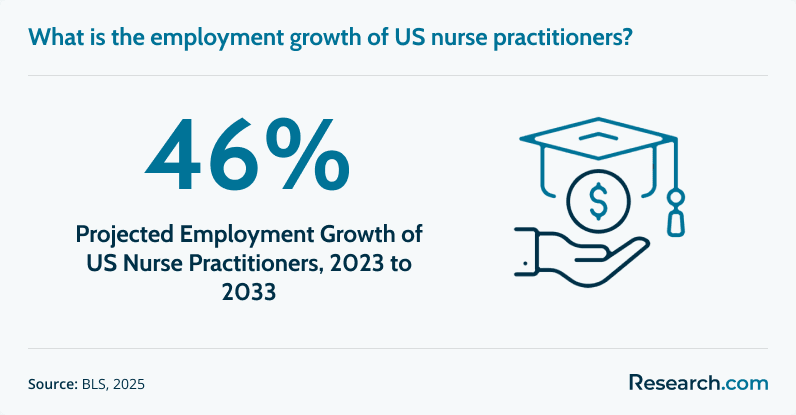
The strongest labor-market data in this article applies to nurse practitioners, one of the most common MSN outcomes. According to the BLS, employment of nurse practitioners is projected to grow by 46% from 2023 to 2033, compared with the national average of 4% across all occupations. The NP workforce is projected to grow from 292,500 in 2023 to approximately 427,900 by 2033.
Current job postings also suggest broad demand. Indeed lists over 45,000 job openings for nurse practitioner roles in the United States, not counting other MSN-level roles such as nurse educator, nursing informatics specialist, case manager, or nurse administrator.
The industries employing the most NPs are physicians' offices (137,030), general medical and surgical hospitals (61,740), and outpatient care centers (25,440). The states with the highest employment levels are Florida (22,270), California (21,740), and Texas (20,170).
Current trends affecting BSN to MSN graduates
- Advanced practice demand remains strong: The projected growth for nurse practitioners makes MSN clinical tracks attractive, especially for nurses interested in primary care, mental health, adult-gerontology, pediatrics, and women’s health.
- Telehealth is now part of routine care delivery: MSN students should look for coursework or clinical exposure that addresses virtual assessment, documentation, patient communication, and technology-supported care.
- Informatics and data skills are increasingly valuable: Healthcare organizations rely on electronic health records, quality metrics, and workflow analytics, making informatics knowledge useful even for nurses outside formal informatics roles.
- Clinical placement capacity can be a bottleneck: Demand for advanced nursing education has made preceptor and site availability a key issue in many regions.
- Employers still care about accreditation and certification readiness: A flexible online format is helpful, but it must still prepare students for the credentialing expectations attached to their target role.
What graduates often say about online BSN to MSN bridge programs
- Mariah: "The online format gave me access to classmates from many healthcare settings, which made discussions more practical and realistic. The work was demanding, but faculty support and applied assignments helped me connect graduate-level concepts to my nursing practice."
- Whitney: "I valued being able to complete online coursework while arranging hands-on clinical experiences closer to home. The structure helped me build advanced clinical and leadership skills without stepping away from work and family responsibilities."
- Celine: "Earning the MSN online made career advancement possible while I continued working. Managing clinical hours, family life, and coursework was not easy, but flexible scheduling made the goal realistic. I am now practicing as a nurse practitioner."
What challenges should you expect in an online BSN to MSN bridge program?
Online MSN study offers flexibility, but it is not easier than campus-based graduate nursing education. Students must stay organized, manage deadlines independently, communicate consistently with faculty and preceptors, and balance clinical requirements with work schedules. Technology platforms, virtual simulations, and remote support systems also vary by school, so the quality of the online experience is not identical across programs.
The most serious challenge is often clinical placement. Before enrolling, ask whether the school secures placements, provides a placement coordinator, approves student-identified sites, or limits clinical locations by state. Program reviews, accreditation status, student outcomes, and state authorization information can help you identify risks before committing. Nurses still comparing entry or second-degree routes may also review an accelerated BSN online program pathway.
How do online BSN to MSN bridge programs prepare graduates for emerging healthcare trends?
Strong online BSN to MSN bridge programs now prepare nurses for care models shaped by telehealth, data systems, value-based care, interdisciplinary collaboration, and population health. Many programs include health informatics, evidence-based practice, quality improvement, policy, leadership, and case-based clinical reasoning so graduates can adapt as care delivery changes.
Students should look for curricula that connect theory to current practice through virtual simulations, clinical practicums, data-informed decision-making, and specialty-specific scenarios. Nurses who are not yet ready for MSN study may first compare BSN completion options, including easiest online nursing programs RN to BSN.
References
- BLS (2024, April 3). 29-1171 Nurse Practitioners. BLS
- BLS (2025, July 29). Industry: Cross-industry, Private, Federal, State, and Local Government Period: May 2024. BLS
- BLS (2025, April 18). Nurse Anesthetists, Nurse Midwives, and Nurse Practitioners. BLS
- College Board. Nurse Practitioners. College Board
- University of St. Augustine for Health Sciences (2024, December 30). Nursing Shortage: A 2024 Data Study Reveals Key Insights. University of St. Augustine for Health Sciences
Key Insights
- Start with your target role. The right MSN depends on whether you want advanced practice, education, informatics, administration, public health, or leadership.
- Accreditation and state authorization are non-negotiable. For licensure-linked roles, confirm that the program meets requirements in the state where you plan to practice and complete clinicals.
- Online does not mean fully remote. Many programs still require supervised clinical hours, intensives, orientations, labs, or campus visits.
- Clinical placement support can determine your timeline. Ask whether the school finds sites or expects you to secure preceptors yourself.
- Total cost matters more than advertised tuition. Include fees, books, technology, compliance costs, travel, and reduced work hours when comparing programs.
- The job outlook is strongest for nurse practitioners. BLS projects 46% growth from 2023 to 2033 for nurse practitioners, but outcomes still depend on specialty, location, certification, and experience.
- A good program should prepare you for modern care delivery. Look for telehealth, informatics, evidence-based practice, quality improvement, and interprofessional leadership in the curriculum.
Other Things You Should Know About Online BSN to MSN Bridge Programs
Most BSN to MSN bridge programs require at least 500 supervised clinical hours for the MSN portion, and some specialty tracks require more. Programs also require an accredited BSN, an unrestricted RN license, and a minimum GPA, often 3.0.
Admission requirements typically include an active RN license, a BSN degree from an accredited institution, and a minimum GPA of 3.0. Some programs may also require a certain number of clinical hours and professional references for eligibility in 2027.


