2027 RN vs BSN Degree: Explaining the Difference

Co-Founder and Chief Data Scientist
Deciding between becoming an RN through an associate degree or earning a BSN is really a decision about timing, cost, career flexibility, and long-term advancement. Both routes can lead to registered nurse licensure, but they do not offer the same educational depth, employer appeal, or promotion potential.
This guide is for prospective nursing students, current ADN-prepared registered nurses, career changers, and working nurses comparing RN, BSN, and RN to BSN pathways. You will learn how the credentials differ, how long each route takes, what jobs they can lead to, how salaries compare, what licensing requires, and how to choose a program without overpaying or selecting a degree that does not support your goals.
The nursing workforce is also changing. Men now represent 11% of RNs, the percentage of White/Caucasian LPNs/LVNs has declined, and the median RN age is 46 years. At the same time, employer expectations are shifting toward higher educational preparation, especially in hospitals, leadership roles, public health, case management, quality improvement, and graduate nursing pathways.
Quick Answer: RN vs. BSN
An RN is a licensed registered nurse. A BSN is a Bachelor of Science in Nursing degree. You can become an RN through an associate degree in nursing, a nursing diploma, or a BSN program, but the BSN provides broader preparation in leadership, research, population health, evidence-based practice, and systems-level care.
| Question | RN Pathway | BSN Pathway |
| What does it lead to? | Eligibility to pursue RN licensure after completing an approved nursing program and passing the NCLEX-RN | Eligibility to pursue RN licensure plus stronger preparation for advancement, leadership, and graduate study |
| Typical length | 2-3 years through an ADN or diploma program | 4 years for a traditional BSN; 1-2 years for many RN to BSN programs |
| Best for | Students who want a faster and often lower-cost route into nursing | Students or working RNs who want broader job options, stronger mobility, or a foundation for graduate nursing |
| Common trade-off | Faster entry, but possible limits for leadership or preferred hospital roles | More time and cost, but stronger long-term flexibility |
Key Things You Should Know about RN vs. BSN Degrees
- RN and BSN are not the same type of credential. RN refers to licensure as a registered nurse. BSN refers to a bachelor’s degree that can prepare someone for RN licensure or help an already licensed RN advance academically.
- Education length differs. Many RN candidates complete a 2-3 year associate degree in nursing or diploma program. BSN students complete a 4-year bachelor’s degree with additional study in leadership, research, public health, and evidence-based care.
- The workforce is moving toward BSN preparation. Between 2015 and 2022, the share of nurses with an ADN decreased from 30.1% to 24.3%, while the share with a BSN increased from 43.4% to 51.1%.
- Pay can differ by education, role, employer, and location. RNs earn a median annual wage of $77,600, while BSN nurses commonly fall between $80,000 and $90,000, with higher earnings possible in leadership or specialized roles.
- A BSN may support stronger patient care preparation. BSN coursework emphasizes evidence-based practice, critical thinking, quality improvement, and care coordination; facilities with larger percentages of BSN-prepared nurses have been associated with lower mortality rates and fewer complications.
- The return on investment depends on your plan. A BSN often costs more at the start, but a sample five-year comparison shows a potential $12,000 earnings advantage for BSN-prepared nurses, depending on assumptions and career path.
- Best RN to BSN Degree Options for 2027
- What is the main difference between an RN and BSN degree?
- What job opportunities are available for RNs versus BSNs?
- How much do RNs make compared to BSNs?
- How long does it take to complete an RN degree versus a BSN?
- Do you need a license to work as an RN or BSN?
- What are the core responsibilities of an RN nurse?
- Where do RNs typically work, and how does that compare to BSNs?
- What should you consider when choosing an RN to BSN program?
- How does a BSN degree impact long-term career growth?
- What graduate degree options can build on a BSN?
- What challenges should you expect when pursuing a BSN?
- Can a BSN help you move toward nurse practitioner roles? Review BSN challenges
- Does a BSN improve patient care quality compared with an RN pathway?
- Can accelerated BSN programs create a faster career advantage?
- Are self-paced RN to BSN programs a good option for advancement?
- How can you verify RN to BSN accreditation and quality?
- Is a BSN more expensive than an RN degree?
- Can you complete an RN to BSN degree in six months?
- Can a BSN speed up your path to advanced specialty roles?
- Can an RN to BSN program without clinicals meet your goals? Advanced-role planning Six-month options Cost comparison
Best RN to BSN Degree Options for 2027
The programs below are RN to BSN options for licensed registered nurses who want to complete a Bachelor of Science in Nursing. Use the list as a starting point, not as the only factor in your decision. Before applying, confirm tuition, transfer-credit rules, clinical or practicum requirements, state authorization, and current accreditation directly with the school.
How do we rank schools?
Because nursing education can be a major financial and professional investment, Research.com evaluates programs using data from established education sources, including the IPEDS database, Peterson's database, the College Scorecard database, and The National Center for Education Statistics. These sources help provide a data-based foundation for comparing colleges and programs. You can review additional details on the Research.com methodology page.
| School | Program Snapshot | Cost of Attendance | Length | Accreditation | Key Details |
| The Ohio State University | Online RN to BSN option for registered nurses seeking broader preparation in leadership, communication, and clinical decision-making. | $373 per credit hour (Ohio residents); $506 per credit hour (non-residents) | Typically 1-2 years, depending on the student's course load and transfer credits | Commission on Collegiate Nursing Education (CCNE) | Flexible full-time and part-time scheduling; clinical practicum may be arranged locally. |
| West Virginia University | Fully online RN to BSN program focused on evidence-based practice, leadership, and patient-care improvement. | $335 per credit hour (in-state); $590 per credit hour (out-of-state) | 1 to 2 years, depending on course load and transfer credits | Commission on Collegiate Nursing Education (CCNE) | Online courses with required clinical practica; allows transfer of up to 90 credits. |
| The University of Cincinnati | Online RN to BSN pathway designed for working RNs who need flexibility while strengthening clinical, leadership, and evidence-based practice skills. | $370 per credit hour | Typically 1.5 to 2 years, depending on course load and prior credits | Commission on Collegiate Nursing Education (CCNE) | 100% online with clinical practice requirements, personalized advising, and support services. |
| Purdue University Global | Online RN to BSN program that builds on prior nursing experience with coursework in leadership, patient care, and healthcare management. | $371 per credit hour | Typically 18-24 months, depending on prior coursework and enrollment status | Commission on Collegiate Nursing Education (CCNE) | 100% online with no clinical hours required for students who are already working as RNs; accelerated pathways and military discounts are available. |
| Gateway Community College | Online RN to BSN program for registered nurses who want advanced study in nursing practice, leadership, and patient care. | $370 per credit hour | Approximately 18 months to 2 years, depending on transfer credits and individual pace | Commission on Collegiate Nursing Education (CCNE) | Entirely online delivery with locally completed clinical hours and personalized advising. |
| The University of Phoenix | Online RN to BSN program structured for working professionals seeking leadership preparation and stronger patient-care knowledge. | $398 per credit hour | Typically 12 to 24 months, depending on previous credits and course load | Commission on Collegiate Nursing Education (CCNE) | 100% online with local clinical practice options, multiple start dates, and personalized support. |
| Ohio University | RN to BSN program for registered nurses seeking flexible academic progression and stronger clinical and leadership preparation. | $325 per credit hour (for Ohio residents); $510 per credit hour (for non-residents) | Approximately 2 years (varies based on course load) | Commission on Collegiate Nursing Education (CCNE) | Fully online with optional in-person clinicals and a capstone project. |
| Western Governors University | Competency-based RN to BSN pathway that allows working RNs to move through coursework based on demonstrated mastery. | $4,375 per term | Approximately 6-12 months, depending on student pace | Commission on Collegiate Nursing Education (CCNE) | No set class schedules; includes nursing theory, leadership, and research coursework. |
| Capella University | Online RN to BSN program emphasizing critical thinking, leadership, and evidence-based practice. | $295 per credit hour | Typically 12 months (dependent on course load) | Commission on Collegiate Nursing Education (CCNE) | FlexPath learning format available; students may receive credit for prior work experience and nursing knowledge. |
| Chamberlain University | Flexible online RN to BSN program intended to help healthcare professionals strengthen leadership skills and patient outcome knowledge. | $590 per credit hour | As few as 3 semesters, depending on course load and prior coursework | Commission on Collegiate Nursing Education (CCNE) | Includes clinical practicum hours, faculty support, and interactive online learning tools. |
What is the main difference between an RN and BSN degree?
The main difference is that RN is a professional license, while BSN is an academic degree. A person becomes an RN by completing an approved nursing program and passing the NCLEX-RN. A BSN is one type of nursing degree that can prepare students for RN licensure, but it includes more upper-division coursework than an associate degree or diploma route.
| Category | RN Through ADN or Diploma | BSN |
| Credential type | Licensure pathway leading to registered nurse practice | Bachelor’s degree that can lead to RN licensure or help licensed RNs advance |
| Education focus | Core clinical skills, patient assessment, medications, and direct care | Direct care plus leadership, research, population health, quality improvement, and evidence-based practice |
| Career positioning | Strong route for entering the nursing workforce more quickly | Often better aligned with hospitals, advancement tracks, specialty roles, and graduate education |
| Workforce trend | The percentage of nurses with an ADN declined from 30.1% to 24.3% between 2015 and 2022 | The percentage of nurses with a BSN increased from 43.4% to 51.1% between 2015 and 2022 |
If your goal is to start working as quickly as possible, an ADN route may make sense. If you want stronger long-term flexibility or expect to pursue graduate nursing, leadership, or advanced practice later, a BSN is usually the stronger foundation. Nurses interested in doctoral-level advancement can also compare how higher education affects compensation by reviewing Research.com’s guide to doctorate in nursing salary outcomes.
What job opportunities are available for RNs versus BSNs?
RNs and BSN-prepared nurses can both provide direct patient care after licensure. The difference is not that ADN-prepared RNs cannot be nurses; they can. The difference is that BSN-prepared nurses may be more competitive for roles involving leadership, coordination, education, quality improvement, and specialized units.
| Role Area | ADN/Diploma RN Access | BSN Advantage |
| Hospital bedside nursing | Common entry route where employers accept ADN or diploma preparation | May be preferred by some hospitals or required for advancement |
| Clinics and outpatient care | Strong fit for direct care, assessment, triage, and patient education | May support care coordination, population health, and leadership responsibilities |
| Charge nurse or nurse manager | Possible with experience, depending on employer policy | More commonly aligned with leadership coursework and promotion criteria |
| Specialized units | Possible with experience, certifications, and employer training | Can strengthen competitiveness for roles requiring advanced judgment and coordination |
| Public health, case management, quality improvement | May be available in some organizations | Often a better academic fit because BSN programs include broader systems-focused content |
| Graduate nursing preparation | Usually requires bridge education before graduate study | Provides a direct academic foundation for MSN, DNP, and advanced practice pathways |
- Shared entry-level opportunities. Both ADN-prepared and BSN-prepared RNs may work in hospitals, clinics, long-term care, home health, ambulatory care, and other patient-care settings.
- Leadership opportunities. BSN-prepared nurses are often better positioned for charge nurse, supervisor, nurse manager, educator, and quality-improvement roles.
- Specialization pathways. Pediatrics, oncology, critical care, perioperative nursing, and other areas may be open to RNs, but a BSN can support advancement and competitiveness.
- Job-search advantage. The average job offer rate for new BSN graduates at the time of graduation is 77%, indicating strong demand for BSN-prepared candidates.
- Promotion potential. A BSN can make it easier to meet internal education requirements for advancement, especially in large healthcare systems.
How much do RNs make compared to BSNs?
BSN-prepared nurses generally have higher earning potential than RNs whose highest nursing education is an associate degree or diploma, but salary is never determined by degree alone. Location, shift differentials, specialty, employer type, union contracts, experience, overtime, and leadership responsibilities can all affect pay.
The median annual wage for registered nurses is approximately $77,600, according to the U.S. Bureau of Labor Statistics. This figure includes registered nurses across education levels and settings, including those who entered nursing through associate degree or diploma routes.
BSN nurses often earn between $80,000 and over $90,000, depending on role and location. Nurses who move into management, specialty practice, education, care coordination, or advanced clinical environments may earn more.
| Pay Factor | How It Can Affect RN vs. BSN Earnings |
| Location | Urban and high-cost labor markets often pay more than rural areas, although expenses may also be higher. |
| Employer | Hospitals, specialty centers, outpatient systems, and long-term care employers may use different pay scales. |
| Specialty | Critical care, emergency, perioperative, oncology, and other specialized areas may offer stronger earning opportunities. |
| Leadership duties | Charge nurse, supervisor, educator, and manager roles may require or prefer a BSN. |
| Experience | Experienced ADN-prepared RNs may out-earn newer BSN graduates in some settings, so compare career stage as well as degree level. |
Quality of life also matters. If you are comparing regions, workplaces, and lifestyle factors, Research.com’s guide to Where do the happiest nurses live can help you think beyond salary alone.
How long does it take to complete an RN degree versus a BSN?
An RN pathway through an associate degree or diploma usually takes 2 to 3 years. A traditional BSN usually takes about 4 years. Licensed RNs who return for an RN to BSN program may finish in 1 to 2 years, depending on transfer credits, enrollment intensity, general education requirements, and program format.
| Pathway | Typical Time | Best Fit | Important Consideration |
| ADN to RN | 2 to 3 years | Students seeking a faster route to RN licensure eligibility | You may later need a BSN for advancement or preferred employer roles. |
| Nursing diploma to RN | 2 to 3 years | Students in areas where diploma programs are available and approved | Transferability into later bachelor’s programs can vary. |
| Traditional BSN | 4 years | Students who want a bachelor’s degree from the start | Higher time commitment, but broader academic preparation. |
| RN to BSN | 1 to 2 years | Licensed RNs who already completed an ADN or diploma | Transfer credits and required nursing courses determine completion time. |
RN Degree Timeline
ADN and diploma programs focus on the clinical and scientific foundation needed for entry-level nursing practice. Students study patient assessment, pharmacology, adult health, maternal-child nursing, mental health, clinical judgment, and supervised practice. Many graduates begin working as RNs and later return for a BSN when employer requirements or career goals change.
BSN Degree Timeline
A BSN includes nursing coursework plus broader bachelor’s-level study. In addition to direct-care preparation, BSN students typically study leadership, community health, research use, health assessment, informatics, and care coordination. RN to BSN students usually build on prior nursing credits instead of repeating their entire nursing education.
The share of RNs with 10 or fewer years of experience increased from 31% in 2020 to 38% in 2022, showing that many newer nurses are entering the profession while education expectations continue to evolve. If you are comparing nursing with other healthcare entry routes, you may also want to review how quickly students can complete training in fields such as medical coding through Research.com’s guide to How fast can I get a medical coding certification.
Do you need a license to work as an RN or BSN?
Yes. Anyone who wants to practice as a registered nurse must hold an RN license, regardless of whether their education is an ADN, diploma, or BSN. The BSN does not replace licensure; it is an educational credential that can support broader career options.
- RN licensure is required. After completing an approved nursing program, candidates must pass the NCLEX-RN to become licensed as registered nurses.
- A BSN is not the license. A BSN can qualify graduates to sit for RN licensure when completed through a prelicensure BSN program, but the degree itself does not authorize practice.
- State boards set requirements. Licensing rules vary by state, so students should confirm program approval, state authorization, and clinical placement eligibility before enrolling.
- Advancement requirements may differ from licensing requirements. Some employers may prefer or require a BSN for certain roles even when the state license is the same.
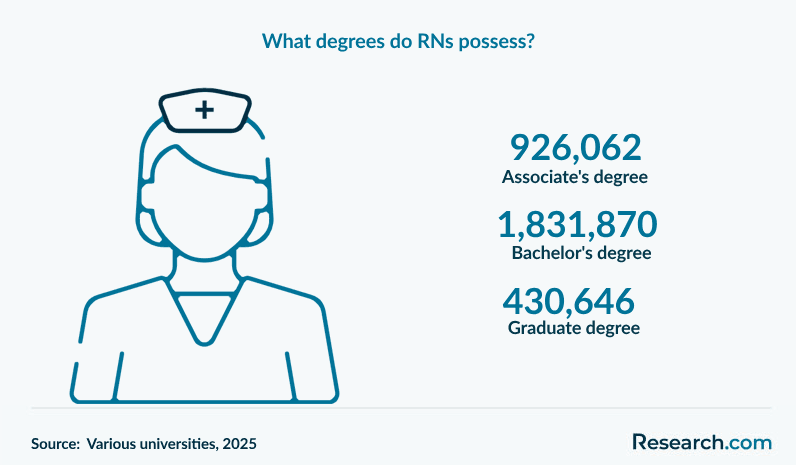
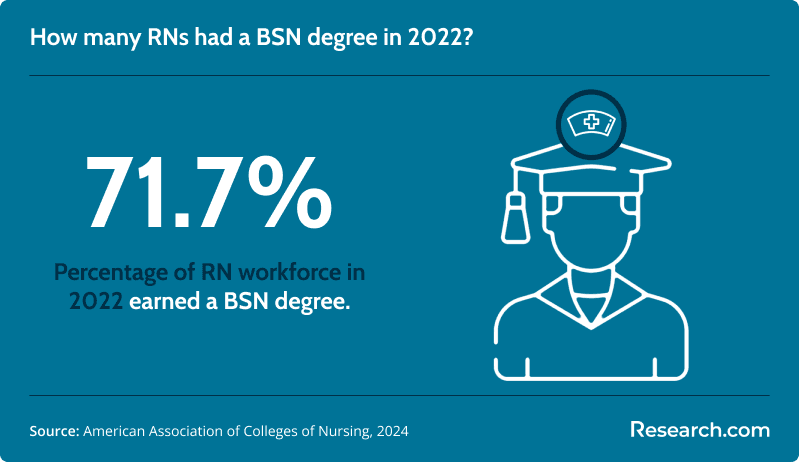
More than 70% of RNs now hold a baccalaureate degree or higher, which reflects the growing role of bachelor’s-level education in the registered nursing workforce.
What are the core responsibilities of an RN nurse?
Registered nurses provide direct patient care, coordinate with healthcare teams, monitor changes in condition, educate patients, and help carry out treatment plans. BSN-prepared nurses perform many of the same bedside duties, but their education may prepare them for broader responsibilities in leadership, care coordination, population health, and quality improvement.
| Responsibility | How RNs Commonly Use It | How BSN Preparation May Expand It |
| Assessment | Collect vital signs, evaluate symptoms, monitor patient status, and report changes. | Apply broader clinical reasoning and systems awareness in complex cases. |
| Medication and treatment | Administer medications, support procedures, and document care. | Contribute to safety initiatives, medication-use improvement, and evidence-based protocols. |
| Care planning | Implement and update nursing care plans with the healthcare team. | Coordinate care across disciplines and settings, especially for patients with complex needs. |
| Patient education | Teach patients about medications, discharge instructions, and disease management. | Design or support broader education strategies for families, communities, and patient populations. |
| Leadership | Mentor new staff or serve as a charge nurse with experience. | Prepare for formal leadership, supervision, quality improvement, and policy-related work. |
If your long-term plan includes the highest levels of nursing leadership or advanced practice, a BSN can become a stepping stone rather than an endpoint. Nurses exploring doctoral options may want to compare flexible routes such as online DNP programs without clinicals, while carefully checking admissions, accreditation, and clinical requirements.
Where do RNs typically work, and how does that compare to BSNs?
RNs work across hospitals, clinics, long-term care facilities, home health agencies, outpatient practices, schools, public health departments, and ambulatory care settings. BSN-prepared nurses work in many of the same environments, but they may have stronger access to positions involving leadership, education, care coordination, community health, and quality improvement.
| Work Setting | Common RN Duties | How BSN Preparation May Be Used |
| Hospitals | Bedside care, medication administration, patient monitoring, documentation, and team communication. | Charge roles, unit-based leadership, complex case coordination, and quality initiatives. |
| Outpatient clinics | Triage, patient education, medication support, and follow-up coordination. | Chronic disease management, care coordination, and population health projects. |
| Long-term care | Resident assessment, medication administration, care-plan implementation, and family communication. | Staff supervision, care standards, infection prevention, and compliance-related responsibilities. |
| Home health | In-home assessment, education, wound care, and patient monitoring. | Case management, interdisciplinary coordination, and outcomes tracking. |
| Public health and community care | Patient outreach, education, screenings, and preventive care support. | Program planning, community health assessment, and population-focused interventions. |
Because over 70% of RNs now hold a baccalaureate degree or higher, nurses who want mobility across settings should consider whether a BSN will make them more competitive in their preferred region and specialty.
What should you consider when choosing an RN to BSN program?
The right RN to BSN program is not always the cheapest, fastest, or highest-ranked option. It is the program that fits your license status, transfer credits, work schedule, state requirements, budget, and career plan.
| Selection Factor | What to Check | Why It Matters |
| Accreditation | Confirm recognized nursing accreditation, such as CCNE or ACEN, and institutional accreditation. | Accreditation can affect employer acceptance, graduate school eligibility, and financial aid access. |
| State authorization | Ask whether the program accepts students from your state and whether any practica can be completed locally. | Online availability does not automatically mean the school is authorized for every state. |
| Transfer credits | Request a preliminary transcript review before committing. | Transfer policies can significantly change your completion time and total cost. |
| Clinical or practicum expectations | Ask whether the program requires in-person clinicals, community projects, virtual simulations, or employer-based experiences. | Requirements can affect scheduling, travel, and workplace permissions. |
| Tuition and fees | Compare per-credit tuition, term-based tuition, technology fees, books, background checks, and graduation fees. | Advertised tuition rarely shows the full cost of attendance. |
| Student support | Review advising, tutoring, faculty access, writing support, and technical help. | Working nurses often need responsive support to stay on track. |
| Graduate-school alignment | Check whether the curriculum meets admissions expectations for MSN, DNP, or NP programs. | A weak fit can slow later advancement. |
If you already know you want doctoral-level practice or leadership, comparing RN to BSN programs alongside future options such as DNP schools online can help you avoid choosing a bachelor’s program that limits your next step.
How does a BSN degree impact long-term career growth?
A BSN can improve long-term career growth by making nurses more competitive for promotions, leadership roles, specialized units, graduate school, and non-bedside opportunities. It does not guarantee a raise or promotion, but it can remove a common barrier when employers prefer or require bachelor’s-level preparation.
The demand for registered nurses is expected to grow by 6% from 2023 to 2033, outpacing the average for all occupations. About 194,500 annual openings are projected, with many openings connected to retirements or nurses leaving the occupation.
| Career Goal | How a BSN Can Help | When an ADN May Still Be Enough |
| Start working as an RN quickly | A BSN is useful but may take longer upfront. | An ADN can be a practical first step if you plan to bridge later. |
| Move into hospital leadership | BSN coursework supports management, quality, and systems thinking. | Experience may help, but some employers still prefer a BSN. |
| Enter public health or care coordination | BSN programs often include population health and care-transition concepts. | Some roles may accept ADN-prepared RNs with relevant experience. |
| Apply to graduate nursing programs | A BSN is commonly the direct academic foundation for MSN or DNP study. | Bridge programs may be needed for ADN-prepared nurses. |
| Increase salary potential | Can support access to higher-paying roles over time. | Salary can still be strong with experience, specialty, location, and overtime. |
If nursing is not the only healthcare-related career you are considering, compare education costs, licensure steps, and job settings across fields. For example, students interested in behavioral health may research options such as the Cheapest online LPC programs as a separate pathway into mental health services.
What graduate degree options can build on a BSN?
A BSN can prepare nurses for graduate education in advanced clinical practice, healthcare leadership, nursing education, informatics, public health, and research-informed care. The right graduate path depends on whether you want direct patient care authority, management responsibility, teaching roles, or specialized practice.
| Graduate Option | Typical Purpose | Best For |
| MSN | Advanced nursing study in leadership, education, informatics, or clinical specialization. | BSN-prepared nurses who want advancement without immediately pursuing a doctorate. |
| DNP | Practice-focused doctoral preparation for advanced clinical leadership and systems improvement. | Nurses aiming for high-level practice, leadership, or advanced roles. |
| NP pathway | Preparation for nurse practitioner roles, depending on specialty and state requirements. | Nurses who want advanced clinical responsibility and patient management roles. |
| Direct-entry MSN | Graduate nursing pathway for qualified students entering nursing from another academic background. | Career changers comparing accelerated routes into nursing and advanced preparation. |
For readers comparing nontraditional graduate entry routes, Research.com’s guide to direct-entry online MSN programs explains how some programs support students moving into nursing from another field.
What challenges should you expect when pursuing a BSN?
A BSN can be valuable, but it is not effortless. Working nurses often underestimate the time, writing, technology, and project-management demands of RN to BSN study. Traditional BSN students also need to manage clinical requirements, prerequisites, competitive admissions, and tuition costs.
| Common Challenge | Why It Creates Problems | Better Approach |
| Choosing only by speed | The fastest program may not fit your learning style, schedule, or graduate-school plans. | Compare pace, support, accreditation, and workload before enrolling. |
| Ignoring accreditation | Unrecognized accreditation can affect employment, transfer credit, and graduate admissions. | Verify nursing and institutional accreditation directly through official sources. |
| Underestimating online workload | Online programs still require reading, writing, group work, projects, and deadlines. | Ask for sample course expectations and weekly time estimates. |
| Assuming no clinicals means no practice work | Some programs replace traditional clinicals with community projects, simulations, or practicum-style assignments. | Ask exactly what fieldwork, projects, or workplace-based activities are required. |
| Focusing only on tuition | Fees, books, transcript evaluations, technology costs, and repeated courses can raise the total price. | Request a full cost estimate based on your transfer credits. |
Students looking for lower-cost options can start by reviewing the most affordable accredited online RN to BSN programs, then verify current tuition, fees, and accreditation before applying.
Can a BSN help you move toward nurse practitioner roles?
Yes. A BSN is commonly an important academic step toward nurse practitioner preparation because NP programs generally require advanced graduate education beyond the registered nurse level. The BSN helps build the foundation in clinical reasoning, leadership, research use, and evidence-based practice that students need before moving into more specialized graduate coursework.
However, a BSN alone does not make someone a nurse practitioner. NP roles require graduate-level education, supervised clinical preparation, national certification, and state-specific licensure or authorization. If your goal is family practice or another NP specialty, compare cost, accreditation, clinical placement support, and state requirements carefully. Research.com’s guide to the cheapest online NP programs can help you begin that comparison.
Does a BSN improve patient care quality compared with an RN pathway?
A BSN can support stronger patient-care quality because the curriculum expands beyond core bedside skills into evidence-based practice, leadership, public health, communication, and systems thinking. The practical value depends on how nurses apply that education in real care settings.
- Evidence-based practice. BSN programs emphasize using research and clinical evidence to guide care decisions.
- Critical thinking. Additional coursework can strengthen decision-making in complex or rapidly changing patient situations.
- Care coordination. BSN-prepared nurses often study how to manage transitions across providers, units, and care settings.
- Leadership preparation. BSN coursework can help nurses lead teams, support safety initiatives, and contribute to quality improvement.
- Patient education. Broader training can improve how nurses explain care plans, prevention strategies, and discharge instructions.
- Outcome connection. Studies show that healthcare facilities with higher percentages of BSN nurses have better patient outcomes, including lower mortality rates and fewer complications.
Can accelerated BSN programs create a faster career advantage?
Accelerated BSN programs can be useful for qualified students who want to enter nursing faster than a traditional bachelor’s timeline would allow. These programs usually compress coursework and clinical preparation into a more intensive schedule, so they are best for students who can handle a demanding pace and have already completed required prerequisites or a prior degree.
The advantage is speed. The risk is overload. Before enrolling, ask how clinical placements are arranged, whether the program is approved in your state, how many hours per week students typically spend on coursework, and what support exists if you fall behind. For program comparisons, review Research.com’s guide to the best accelerated BSN programs online.
Are self-paced RN to BSN programs a good option for advancement?
Self-paced RN to BSN programs can work well for disciplined nurses who have unpredictable schedules, strong independent study habits, and enough prior experience to move efficiently through competency-based coursework. They may be less ideal for students who need fixed deadlines, frequent live instruction, or close peer interaction.
| Self-Paced Programs May Fit If... | Consider a Structured Program If... |
| You can study consistently without weekly reminders. | You need regular class meetings or instructor-led pacing. |
| Your work schedule changes often. | Your schedule is stable and you prefer predictable deadlines. |
| You have strong writing and online learning skills. | You want more real-time discussion and guided feedback. |
| You want to move faster when you already know the material. | You are returning to school after a long break and want more structure. |
To compare flexible formats, see Research.com’s overview of the best self-paced RN to BSN degree programs.
How can you verify RN to BSN accreditation and quality?
To verify quality, confirm both institutional accreditation and nursing program accreditation. For nursing, recognized accreditors include the Commission on Collegiate Nursing Education (CCNE) and the Accreditation Commission for Education in Nursing (ACEN). Do not rely only on a school’s marketing page; check accreditor directories, state board information, and program disclosures.
- Confirm nursing accreditation. Look for CCNE or ACEN accreditation and verify it through the accreditor, not only through the school website.
- Check institutional accreditation. This can affect federal financial aid, credit transfer, and graduate-school eligibility.
- Review state authorization. Make sure the program can enroll students from your state and that any required practice experiences are allowed where you live.
- Ask about outcomes. Request graduation rates, retention rates, student support data, and career services information when available.
- Evaluate faculty credentials. Faculty experience in nursing practice, leadership, and online teaching can affect learning quality.
- Think ahead. If you may pursue advanced practice later, compare whether the BSN curriculum supports admissions expectations for programs such as the best direct entry NP programs.
Is a BSN more expensive than an RN degree?
Yes. A BSN is generally more expensive than an RN pathway through an associate degree or diploma because it usually requires more credits and a longer time in school. The full cost difference depends on the institution, transfer credits, tuition model, fees, financial aid, employer reimbursement, and whether you study full time or part time.
Sample ROI Scenario
- An RN with an associate degree may earn around $77,600 annually, based on the U.S. median wage.
- A BSN graduate may earn approximately $80,000 or more per year, with higher pay possible in specialized or leadership roles.
- After 5 years, an RN might earn around $388,000 if there are no significant raises.
- In the same period, a BSN-prepared nurse might earn around $400,000 or more, creating an estimated difference of roughly $12,000 over five years.
This example is useful for comparison, but it is not a guaranteed outcome. Your actual return depends on tuition paid, debt, scholarships, employer reimbursement, local pay scales, raises, overtime, and the roles you qualify for after graduation.
| Cost Factor | Question to Ask Before Enrolling |
| Transfer credits | How many credits will the school accept from my prior nursing program? |
| Tuition model | Is tuition charged per credit, per term, or through another structure? |
| Clinical or practicum costs | Will I need travel, background checks, immunizations, or employer-site approval? |
| Employer benefits | Does my workplace offer tuition reimbursement or preferred-school discounts? |
| Time away from work | Will the schedule reduce my ability to work overtime or full-time hours? |
| Graduate plans | Will this BSN meet requirements for the MSN, DNP, or NP programs I may apply to later? |
Can you complete an RN to BSN degree in six months?
Some accelerated and competency-based RN to BSN programs may allow highly prepared students to finish quickly, but a six-month timeline is usually realistic only for nurses with substantial transfer credit, a current RN license, strong academic readiness, and enough time to complete intensive coursework. Fast does not always mean better.
Before choosing a short program, ask whether the school has term-based tuition, how many courses must be completed, what happens if you need more time, whether projects or practica are required, and whether the program is accredited. For a focused comparison, review Research.com’s guide to a 6-month RN to BSN program.
Can a BSN speed up your path to advanced specialty roles?
A BSN can make the path to advanced specialty roles more direct because many graduate nursing programs use it as the academic starting point for advanced practice, leadership, education, or specialty preparation. It also helps nurses build the research, communication, and systems-level thinking needed in high-responsibility roles.
For example, nurses interested in psychiatric mental health roles may eventually pursue graduate preparation beyond the BSN. If compensation is part of your planning, Research.com’s guide to psych NP salary can help you compare potential outcomes by location.
Can an RN to BSN program without clinicals meet your goals?
An RN to BSN program without traditional clinical placements may meet your goals if you are already licensed, actively practicing, and looking for advanced academic preparation rather than initial hands-on nursing training. These programs often use leadership projects, community-based assignments, simulations, case studies, or workplace applications instead of conventional clinical rotations.
They may not be the best fit if you want extensive in-person clinical exposure, plan to change specialties immediately, or need a program with specific practicum experiences for future graduate applications. Always ask what “no clinicals” actually means in the curriculum. To compare these options, see Research.com’s guide to RN to BSN online with no clinicals.
Common mistakes to avoid when comparing RN and BSN pathways
| Mistake | Why It Can Hurt You | What to Do Instead |
| Assuming RN and BSN mean the same thing | You may misunderstand licensure, degree requirements, and employer expectations. | Remember: RN is the license; BSN is a degree. |
| Choosing the cheapest program without checking accreditation | Low tuition is not helpful if employers or graduate schools question the credential. | Verify institutional and nursing accreditation before applying. |
| Ignoring transfer-credit rules | You may pay for courses you thought would transfer. | Request a written transfer evaluation. |
| Assuming online means easier | Online nursing courses can be writing-heavy and deadline-driven. | Ask about weekly workload, assignments, and support. |
| Looking only at salary averages | Pay varies widely by location, shift, specialty, and employer. | Compare local job postings and employer requirements. |
| Forgetting future graduate plans | A weak BSN fit may complicate MSN, DNP, or NP admission later. | Choose a program aligned with your next degree goal. |
Questions to ask before choosing an RN or BSN route
- Do I want the fastest route to RN licensure, or do I want the broadest long-term credential from the beginning?
- Will hospitals or employers in my target area prefer or require a BSN?
- Can I afford the program without taking on debt that outweighs likely salary gains?
- Does the program have recognized nursing accreditation and institutional accreditation?
- How many of my credits will transfer into an RN to BSN program?
- Are clinicals, practica, simulations, or community projects required?
- Can I complete coursework while working my current schedule?
- Will this degree support graduate nursing options later?
- What support does the school provide for advising, writing, technology, and career planning?
- What happens if I need to slow down or pause enrollment?
Here's What Graduates Have to Say About their RN to BSN degree
Completing my RN to BSN changed how I was viewed at work. I felt more confident clinically, and I began receiving more leadership responsibilities, including opportunities to support newer nurses. The biggest benefit was feeling that I could contribute more meaningfully to patient care. - Anne
The BSN gave me access to roles I had not been considered for before. It was not only about having another credential; the program helped me understand evidence-based care more deeply and gave me better tools for complex patient situations. - Gina
I was concerned about returning to school while working full time, but the RN to BSN format made it manageable. It helped me pursue management and quality improvement opportunities while still meeting my family and work responsibilities. - Erwin
References:
- Bsn Nurse Salary. (2025, January). ZipRecruiter. Retrieved January 31, 2025, from https://www.ziprecruiter.com/Salaries/Bsn-Nurse-Salary
- Education | NCSBN. (n.d.). NCSBN. https://www.ncsbn.org/nursing-regulation/education.page
- Occupational Outlook Handbook - Registered Nurses. (2025, January). Bureau of Labor Statistics. Retrieved January 31, 2025, from https://www.bls.gov/ooh/healthcare/registered-nurses.htm
- The role of Registered Nurse in Ambulatory Care - ANA Position Statement. (2018, June 13). ANA. https://www.nursingworld.org/practice-policy/nursing-excellence/official-position-statements/id/role-of-registered-nurse-in-ambulatory-care/
Key Insights
- RN is a license; BSN is a degree. You can become a registered nurse through different educational routes, but the BSN provides broader bachelor’s-level preparation.
- The ADN route can be faster. Many students choose it to enter nursing in 2 to 3 years, then complete an RN to BSN later.
- The BSN offers stronger long-term flexibility. It can support leadership roles, specialty practice, graduate school, and competitiveness in employers that prefer bachelor’s-prepared nurses.
- Salary differences are real but not automatic. RNs earn a median annual wage of $77,600, while BSN nurses often earn between $80,000 and $90,000, but location, experience, specialty, and employer policies matter.
- Licensure is required either way. All registered nurses must meet state requirements and pass the NCLEX-RN; a BSN does not replace the RN license.
- Program choice affects ROI. Before enrolling, verify accreditation, transfer credits, practicum expectations, total cost, employer reimbursement, and whether the degree supports your next career step.
- The best path depends on your timeline. Choose ADN if fast entry and lower upfront cost are your priorities; choose BSN if you want broader advancement options or plan to pursue graduate nursing.
Other Things You Should Know about RN vs. BSN Degrees
Yes. Many RN-to-BSN programs accept transfer credits from an ADN or diploma RN license, and some award 30 to 60 semester credits for prior nursing coursework. Schools usually require official transcripts, an active RN license, and completion of general education prerequisites before upper-division BSN classes.
Yes, an RN can work while pursuing a BSN in 2027. Many programs offer part-time or online courses to accommodate working nurses, allowing them to balance work and study effectively. Be sure to check specific program options for flexibility.