
2027 Benefits of Pursuing a Bachelor of Science in Nursing (BSN)

Co-Founder and Chief Data Scientist
Did you know the United States faces a projected shortage of 200,000–450,000 nurses by 2027? With healthcare demand growing and hospitals raising educational standards, a bachelor of science degree in nursing or a BSN has become more valuable than ever.
This article breaks down the benefits of pursuing a BSN degree, what you can expect from the program, and how it can boost your salary, job security, and career advancement opportunities.
What are the benefits of a bachelor of science degree in nursing?
- With a BSN, registered nurses earn a median salary of $93,600 per year.
- The role has a strong job outlook, with 193,000 RN openings expected annually through 2032.
- BSN graduates qualify for career paths in leadership, public health, informatics, education, and advanced practice nursing.
What can you do with a Bachelor of Science in Nursing (BSN) degree?
A bachelor of science degree in nursing is more than just a credential—it’s a career accelerator. Graduates are prepared not only for traditional bedside care but also for roles in leadership, research, public health, and advanced practice training. With the U.S. facing a projected shortfall of 200,000 to 450,000 registered nurses by 2025 (McKinsey & Company), the demand for BSN-prepared nurses has never been higher.
Completing this program positions you at the forefront of solving one of healthcare’s biggest challenges while opening doors to higher-paying positions, job stability, and the foundation for graduate-level education.
Where can you work with a BSN degree?
Graduates of BSN programs have one of the widest ranges of employment opportunities in the healthcare field. A BSN qualifies you for direct patient care in hospitals, clinics, and long-term care facilities, but it also expands access to specialized and leadership roles. With more than 197,200 registered nurse job openings expected every year through 2033, the career outlook is solid and diverse.
Many BSN-prepared nurses also find opportunities in public health, education, government agencies, and even corporate healthcare environments such as insurance, consulting, or pharmaceuticals.
Top employing industries for BSN graduates include:
- General medical and surgical hospitals
- Outpatient care centers
- Nursing and residential care facilities
- Home healthcare services
- Government health services
Top states employing BSN graduates:
- California
- Texas
- Florida
- New York
- Pennsylvania
These states consistently rank at the top due to their large healthcare systems, higher population density, and ongoing demand for qualified nurses in the middle of a nationwide shortage.
How much can you earn with a BSN degree?
According to the U.S. Bureau of Labor Statistics (BLS), the median annual wage for registered nurses (including BSN-prepared RNs) was $93,600 as of May 2024. With a workforce shortage projected to leave tens of thousands of RN positions unfilled by 2025 (HRSA), healthcare organizations are offering competitive pay and incentives to attract BSN-trained nurses. Salaries vary by state, employer, and years of experience, but holding a BSN typically places nurses at the higher end of the pay scale.
Here’s how different sources report RN/BSN salaries:
- Zippia: Average RN salary around $57,564 per year
- Salary.com: Typical range $81,220 to $94,480 per year
- ZipRecruiter: Average salary $87,868 per year
- Indeed: Average salary $92,486 per year
- Payscale: Average hourly rate $36.01/hour (~$76,940 per year)
- Glassdoor: Estimated average salary $99K per year
The combination of high demand and limited supply is pushing employers to pay more—meaning BSN graduates are entering a market where their skills directly translate into financial stability and career growth.
- 10 Core Subjects in a Bachelor of Science in Nursing (BSN) Degree for 2027 Core Subjects
- Will a BSN degree help me earn more than an ADN? BSN vs. ADN Pay
- Do hospitals prefer or require nurses with a BSN? Hospital Preferences
- Does having a BSN actually improve patient outcomes? Patient Outcomes
- Can I get into leadership or specialty roles faster with a BSN? Leadership & Roles
- Is a BSN required to pursue advanced degrees like MSN or DNP? Advanced Degrees
- Will earning a BSN make me more secure in my nursing job? Job Security
- Does earning a BSN expand my career options outside clinical care? Does earning a BSN expand my career options outside clinical care?
- Can networking and professional growth be better in a BSN program? Can networking and professional growth be better in a BSN program?
- Will earning a BSN make it easier to get or maintain my nursing license? Will earning a BSN make it easier to get or maintain my nursing license?
- What should I consider when choosing a BSN program? What should I consider when choosing a BSN program?
- Is a BSN Program a Sound Financial Investment? Is a BSN Program a Sound Financial Investment?
10 Core Subjects in a Bachelor of Science in Nursing (BSN) Degree for 2027
A Bachelor of Science in Nursing is more than a longer route to becoming a registered nurse. It is a broader nursing degree that combines patient care, biological science, clinical judgment, research, public health, and leadership. That matters because employers increasingly expect nurses to work with complex patients, use evidence in care decisions, communicate across teams, and adapt to changing healthcare technology.
This guide explains the major subjects you can expect in a BSN curriculum, how those courses connect to real nursing work, and how a BSN compares with an ADN for salary, hospital hiring, licensure, leadership, job security, and future graduate study. It is written for students comparing nursing degree options, working RNs considering an RN-to-BSN pathway, and career changers deciding whether the extra time and cost of a BSN are justified. Nurses planning graduate study can also compare BSN preparation with online BSN-to-MSN bridge options.
Quick Answer: What Do BSN Students Study?
BSN students study the science of the human body, the causes and treatment of illness, medication safety, hands-on nursing care, mental health, public health, research, and leadership. These subjects prepare graduates for the NCLEX-RN, entry-level registered nursing practice, hospital employment, specialty nursing, and later graduate education such as MSN or DNP programs.
| BSN subject area | What it teaches | Why it matters in practice |
| Anatomy and physiology | Body systems and normal function | Helps nurses recognize abnormal findings and communicate clearly with providers |
| Microbiology | Microorganisms, infection, and immunity | Supports infection prevention, sterile technique, wound care, and patient safety |
| Pharmacology | Drug actions, side effects, calculations, and administration | Reduces medication risk and improves patient teaching |
| Nursing fundamentals | Basic care, communication, ethics, and the nursing process | Builds the foundation for safe bedside care and clinical rotations |
| Pathophysiology | How disease changes normal body function | Improves assessment, clinical reasoning, and early recognition of complications |
| Health assessment | Patient interviews, physical exams, and documentation | Helps nurses identify needs, track changes, and advocate for timely care |
| Community and public health nursing | Population health, prevention, epidemiology, and health equity | Prepares nurses to work beyond hospital walls in prevention and community care |
| Nursing research and evidence-based practice | Research evaluation and use of clinical evidence | Supports safer care decisions, quality improvement, and graduate study |
| Leadership and management | Team coordination, policy, finance, ethics, and conflict resolution | Prepares nurses for charge nurse, management, and systems-level roles |
| Mental health nursing | Psychiatric care, crisis response, and therapeutic communication | Strengthens whole-person care in emergency, hospital, community, and outpatient settings |
Anatomy and Physiology
Anatomy and physiology gives BSN students the language and framework for understanding the human body. Anatomy focuses on body structures, while physiology explains how those structures work. Students commonly study systems such as the cardiovascular, respiratory, muscular, nervous, digestive, endocrine, and renal systems.
This course is important because nurses constantly connect symptoms to body function. A patient’s shortness of breath, irregular pulse, weakness, confusion, swelling, or pain only makes clinical sense when the nurse understands the underlying body systems. Strong anatomy and physiology preparation also helps nurses communicate efficiently with physicians, advanced practice providers, therapists, pharmacists, and other members of the care team.
Microbiology
Microbiology introduces students to bacteria, viruses, fungi, parasites, immune response, transmission, and infection control. In a nursing context, this subject is not simply a laboratory science requirement. It directly affects day-to-day safety decisions.
BSN students use microbiology when learning sterile technique, isolation precautions, wound care, catheter care, specimen handling, antibiotic stewardship, and prevention of healthcare-associated infections. Nurses who understand how organisms spread are better prepared to protect patients, coworkers, families, and vulnerable populations.
Pharmacology
Pharmacology teaches how medications work, how the body absorbs and processes them, how drugs are classified, and what adverse effects nurses must monitor. Students also practice dosage calculations, safe administration procedures, patient education, and medication reconciliation.
This is one of the most practice-critical BSN subjects because medication administration is a major nursing responsibility. Nurses must verify orders, assess contraindications, recognize side effects, educate patients, and report concerns quickly. Pharmacology also strengthens the nurse’s role in preventing medication errors and supporting adherence to treatment plans.
Nursing Fundamentals
Nursing fundamentals is often where students begin thinking like nurses. The course introduces basic patient care, hygiene, mobility, nutrition, vital signs, communication, documentation, safety, infection prevention, ethics, and legal responsibilities.
Students also learn the nursing process: assessment, diagnosis, planning, implementation, and evaluation. That process becomes the structure for clinical reasoning throughout the program. Fundamentals courses are usually closely tied to skills labs and early clinical experiences, giving students the opportunity to practice safe, respectful, and professional care before moving into more complex settings.
Pathophysiology
Pathophysiology explains what happens when normal body function breaks down. Students study how illness develops at the cellular, tissue, organ, and system levels and how those changes appear as signs, symptoms, lab findings, and complications.
This course connects science to clinical judgment. For example, understanding fluid imbalance, inflammation, heart failure, shock, diabetes, infection, or respiratory failure helps nurses anticipate what may happen next instead of reacting only after a patient deteriorates. Pathophysiology is one reason BSN education is valued for critical thinking and complex patient care.
Health Assessment
Health assessment trains students to collect useful patient information through interviews, observation, physical examination, vital signs, symptom analysis, and documentation. Students learn head-to-toe assessment methods as well as focused assessments for specific conditions.
The value of this subject is practical: nurses are often the first clinicians to notice a meaningful change. A strong assessment can identify pain, infection, respiratory distress, neurological decline, medication reactions, mental health concerns, fall risk, or signs of neglect. BSN programs also emphasize communication and cultural awareness so students learn to gather information respectfully from patients with different backgrounds and health beliefs.
Community and Public Health Nursing
Community and public health nursing expands the focus from one patient at a bedside to families, neighborhoods, schools, workplaces, and entire populations. Students learn about epidemiology, health promotion, disease prevention, vaccination efforts, disaster response, public health policy, and the social determinants of health.
This subject is especially relevant as healthcare systems work to prevent illness, manage chronic disease, and reach underserved communities. BSN-prepared nurses may use this training in public health departments, school nursing, home health, community clinics, outreach programs, emergency preparedness, and health education. Nurses interested in maternal and reproductive health can also explore career paths connected to a graduate certificate in nurse midwifery.
Nursing Research and Evidence-Based Practice
Nursing research and evidence-based practice teaches students how to read studies, evaluate the quality of evidence, understand research design, interpret findings, and apply current knowledge to patient care. The goal is not to turn every BSN student into a full-time researcher. The goal is to prepare nurses to question unsafe habits, use credible evidence, and participate in quality improvement.
This course also supports future graduate study. Nurses who later pursue advanced practice, education, informatics, leadership, or policy roles need to understand how evidence is produced and how it should be used responsibly in clinical decisions.
Leadership and Management in Nursing
Leadership and management courses prepare BSN students to coordinate care, guide teams, solve conflicts, understand healthcare finance, improve quality, and make ethical decisions in complicated environments. These courses are increasingly important because nurses are not only task performers; they are patient advocates, care coordinators, safety monitors, and system navigators.
BSN graduates may not move into management immediately, but leadership training helps them communicate with interdisciplinary teams, prioritize care, delegate appropriately, and contribute to unit-level improvements. It also lays the groundwork for charge nurse, nurse manager, educator, quality improvement, and administrative roles.
Mental Health Nursing
Mental health nursing focuses on psychiatric conditions, substance use, crisis intervention, therapeutic communication, safety planning, trauma-informed care, and psychopharmacology. Students learn to assess emotional distress, suicide risk, behavioral changes, and the effects of mental illness on physical health.
This subject matters in nearly every setting, not only psychiatric units. Patients experiencing anxiety, depression, grief, psychosis, withdrawal, trauma, or emotional crisis may appear in emergency departments, medical-surgical units, maternity care, pediatrics, community clinics, and long-term care. BSN graduates need mental health training to provide safer, more complete, patient-centered care.
Will a BSN degree help me earn more than an ADN?
In general, a BSN can improve earning potential compared with an Associate Degree in Nursing, although salary still depends on location, employer, experience, shift differentials, specialty, union contracts, and certifications. According to Zippia, nurses with a bachelor’s degree earn an average of $63,583 per year, compared with $55,268 for nurses whose highest degree is an associate degree. That difference is over $8,000 annually and can exceed more than $300,000 across a 35-year career. The BLS reports a median annual wage of $93,600 for registered nurses, with BSN-prepared nurses often better positioned for roles at the higher end of pay ranges.
The financial advantage usually comes from access to more options. An ADN can qualify graduates for RN licensure after passing the NCLEX-RN, but a BSN may be preferred for specialty units, hospital roles, leadership tracks, public health positions, and graduate program admission. For working nurses, the most important question is not only “Will I earn more right away?” but “Will this degree expand the roles I can compete for over the next decade?”
| Factor | ADN route | BSN route |
| Typical purpose | Enter RN practice more quickly | Prepare for broader clinical, leadership, public health, and graduate pathways |
| Short-term cost | Often lower upfront cost | Often higher total tuition and time commitment |
| Hospital competitiveness | May be accepted, depending on employer and market | More commonly preferred for hospital and Magnet-designated settings |
| Advancement potential | May require later bridge education | Better aligned with specialty, leadership, and MSN/DNP pathways |
| Best fit | Students who need the fastest lower-cost path to RN licensure | Students or RNs who want stronger long-term mobility and graduate-school readiness |
The chart below illustrates how education level is connected to nursing compensation. It should be read as a general salary comparison, not a promise of individual earnings.
Do hospitals prefer or require nurses with a BSN?
Many hospitals prefer BSN-prepared nurses, and some require the degree for certain roles or expect ADN-prepared nurses to complete a BSN within a set timeframe. The American Association of Colleges of Nursing reports that more than 77% of employers express a strong preference for BSN-prepared nurses, and many Magnet-designated hospitals require the credential.
The preference is tied to patient complexity and quality expectations. BSN curricula include leadership, research, public health, and evidence-based practice in addition to clinical nursing. These areas are valuable in hospitals that track outcomes, reduce readmissions, prevent medication errors, manage interdisciplinary care, and meet accreditation or quality standards. Nurses comparing specialization options may also want to review salary considerations for a graduate certificate in nursing informatics.
The BLS identifies hospitals as the largest employer of nurses, with growth projected through 2032. Because hospitals employ so many RNs, their hiring preferences heavily influence the value of a BSN. Bridge pathways, including accelerated medical assistant to RN online programs, can be useful for career changers, but nurses who want hospital-based advancement should understand whether a future BSN will be expected.
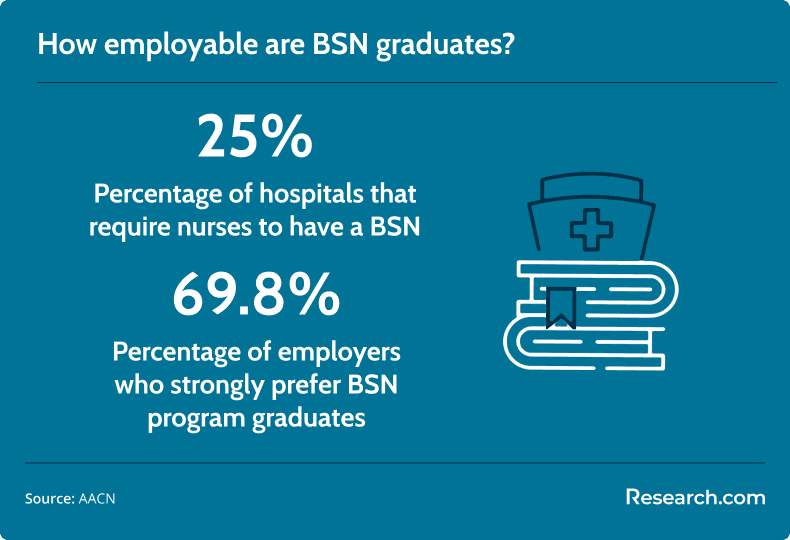
The employer-preference data summarized below shows why BSN planning matters: 25% of hospitals now require a BSN, while nearly 70% of employers strongly prefer BSN graduates.
Does having a BSN actually improve patient outcomes?
Research has repeatedly linked higher proportions of BSN-prepared nurses with better patient outcomes, including lower mortality rates, fewer complications, and stronger recovery outcomes. Post University notes that survival after cardiac arrest is significantly higher when care teams include BSN-educated nurses, while Mercer University emphasizes the role of BSN training in critical thinking and evidence-based practice.
The practical reason is straightforward: BSN programs add depth beyond task-based clinical training. Students learn to interpret research, identify system-level risks, understand community factors, lead care teams, and evaluate quality. Those skills can affect bedside decisions and broader hospital practices. Even nurses who enter the profession through an accelerated online paramedic to RN bridge program may find that BSN-level education strengthens both career options and patient-care judgment.
Can I get into leadership or specialty roles faster with a BSN?
A BSN can shorten the route to many leadership and specialty roles because it signals broader preparation in communication, research, care coordination, ethics, and systems thinking. Employers often look for those skills when selecting nurses for charge roles, specialty units, quality projects, management pipelines, and community health positions.
Bryant & Stratton College describes the BSN advantage as including leadership, communication, and evidence-based practice preparation. For nurses who later want advanced practice, a BSN can also support entry into graduate programs or post-master’s credentials, including options such as the most affordable online post-master’s pediatric nurse practitioner certificate programs.
| Role or pathway | How a BSN helps | What to verify |
| Charge nurse | Supports delegation, prioritization, and unit coordination | Employer experience requirements and unit policies |
| Nurse manager | Builds preparation in staffing, budgeting, quality, and team leadership | Whether an MSN is preferred for advancement |
| Specialty RN roles | Strengthens applications for areas such as pediatric, oncology, critical care, and public health nursing | Required certifications, clinical experience, and orientation length |
| Public health nurse | Provides population health, prevention, and community assessment training | State or county hiring rules and public health experience expectations |
| Graduate nursing student | Meets the usual academic foundation for MSN or DNP admission | Program accreditation, prerequisites, GPA rules, and licensure requirements |
The salary chart below shows how BSN-aligned advancement can connect to higher-paying leadership and specialty roles. It should be used as a planning tool rather than a guaranteed salary forecast.
Is a BSN required to pursue advanced degrees like MSN or DNP?
For most nurses, yes. A BSN is typically the standard academic foundation for graduate nursing study, including Master of Science in Nursing and Doctor of Nursing Practice programs. MSN and DNP curricula build on undergraduate preparation in research, leadership, community health, assessment, and professional nursing practice.
Some RN-to-MSN options exist, but they generally include BSN-level coursework before students move into graduate content. Nurses who want to become nurse practitioners, nurse anesthetists, clinical nurse specialists, nurse educators, administrators, or policy leaders should plan carefully around BSN prerequisites. Those considering management-focused credentials can also review career options with a nursing leadership graduate certificate.
The key takeaway is that a BSN may not be the final credential, but it is often the degree that keeps the advanced-degree door open.
Will earning a BSN make me more secure in my nursing job?
A BSN can improve career resilience because it aligns with rising employer expectations and creates more options if one role, unit, or facility changes. The United States faces a projected shortage of 200,000 to 450,000 registered nurses by 2025, and healthcare systems continue to emphasize educational preparation, quality outcomes, and workforce flexibility. The Institute of Medicine has recommended that 80% of the nursing workforce hold a BSN or higher, and many employers use that direction when shaping hiring and promotion standards.
Job security should not be understood as a guarantee. A BSN does not prevent layoffs, staffing changes, burnout, or local market shifts. It does, however, make a nurse more competitive for a wider set of roles, including hospital positions, specialty units, public health, care coordination, leadership tracks, and graduate study. Magnet-designated hospitals also often require or strongly prefer BSN-prepared nurses.
Nurses interested in pediatric advanced practice may also compare salary and career outcomes for pediatric nurse practitioner graduate certificate holders when planning long-term education after the BSN.
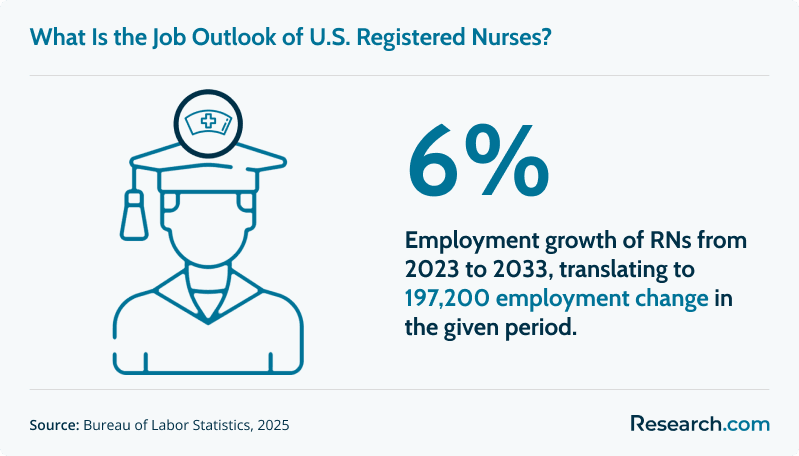
The employment outlook graphic below shows why nursing remains a durable career field: the Bureau of Labor Statistics projects 6% RN employment growth from 2023 to 2033, with nearly 197,200 jobs added.
Does earning a BSN expand my career options outside clinical care?
Yes. A BSN can open doors beyond direct bedside care because the degree includes public health, leadership, research, communication, quality improvement, and systems-based thinking. Those areas are useful in settings where nursing knowledge is applied to operations, policy, education, technology, prevention, or population health.
| Non-bedside option | How nursing knowledge is used | Why a BSN can help |
| Public health nursing | Health education, outreach, prevention, vaccination support, and community assessment | BSN programs usually include population health and social determinants of health |
| Nursing informatics | Clinical workflow, documentation systems, data quality, and technology adoption | BSN training supports evidence-based practice and interdisciplinary communication |
| Insurance or case management | Care coordination, utilization review, patient education, and discharge planning | Employers may value BSN preparation for complex decision-making |
| Healthcare quality improvement | Safety projects, infection control, outcome tracking, and process redesign | Research and leadership coursework are directly relevant |
| Corporate wellness or health education | Prevention programs, screening events, coaching, and employee health initiatives | Community health and communication training translate well |
The broader curriculum is why the AACN describes BSN education as preparation for a wider scope of nursing contribution. Nurses entering through accelerated LVN-to-BSN online programs may be especially interested in this flexibility because the degree can support roles outside traditional hospital bedside work.
Can networking and professional growth be better in a BSN program?
BSN programs can provide stronger professional networking than shorter entry-level routes because students often complete varied clinical rotations, interact with faculty who have advanced credentials, collaborate with peers from different healthcare backgrounds, and participate in research, leadership, or community projects.
Networking is not just about meeting people. It is about being seen in professional settings where supervisors, preceptors, instructors, and clinical partners can observe your reliability, communication, clinical judgment, and growth. Those relationships can lead to recommendations, specialty interviews, mentoring, committee opportunities, and graduate-school guidance.
Online BSN students should be intentional about building these connections. Good strategies include attending virtual office hours, joining professional nursing organizations, volunteering for group projects, asking preceptors for feedback, keeping a record of clinical achievements, and staying in contact with faculty after graduation.
Will earning a BSN make it easier to get or maintain my nursing license?
Both ADN and BSN graduates must pass the NCLEX-RN to become licensed registered nurses. A BSN does not replace the licensing exam, and state Boards of Nursing determine licensure requirements. However, BSN programs are usually designed to meet broad RN education standards, including clinical experience, nursing theory, ethics, public health, leadership, and professional practice expectations.
A BSN may also help with long-term mobility because it can make a nurse more competitive for employers in different states or healthcare systems. Nurses who enter through pathways such as accelerated EMT-to-RN bridge programs online should confirm how their program supports NCLEX eligibility, state clinical-hour rules, and any future BSN transfer or bridge options. Compact-license rules and license endorsement still depend on state regulations, so students should verify requirements directly with the relevant Board of Nursing.
The NCLEX-RN pass-rate chart below shows the importance of strong preparation. First-time U.S.-educated candidates, many of whom complete BSN programs, have an 88.8% pass rate, which is much higher than rates for repeat or internationally educated candidates.
2025 NCLEX-RN Pass Rates (January–June, NCSBN Data)

What should I consider when choosing a BSN program?
The best BSN program is not always the cheapest, fastest, or most heavily advertised option. It is the program that is accredited, approved for your licensure goals, realistic for your schedule, transparent about costs, and strong enough in clinical placement, NCLEX preparation, and student support.
| Decision factor | What to check | Why it matters |
| Accreditation and approval | Confirm institutional accreditation, nursing program accreditation, and state Board of Nursing approval | These affect licensure, financial aid, transfer credit, graduate admission, and employer acceptance |
| Clinical placements | Ask where clinicals occur, who arranges them, and whether placements are guaranteed | Clinical access can determine whether you progress on time |
| NCLEX preparation | Review how the program prepares students for testing and remediation | Licensure depends on passing the NCLEX-RN |
| Schedule format | Compare campus, hybrid, online theory courses, evening/weekend options, and part-time tracks | The wrong format can make completion difficult for working students |
| Transfer credit | Ask how prior college credits, ADN coursework, LPN/LVN experience, or military healthcare training are evaluated | Generous transfer policies may reduce time and cost |
| Total cost | Include tuition, fees, books, uniforms, background checks, testing fees, supplies, transportation, and lost work hours | Sticker tuition alone does not show the full price |
| Student support | Look for tutoring, advising, clinical coordination, writing support, mental health resources, and career services | Nursing programs are demanding, and support can affect persistence |
Working RNs who need flexibility may want to compare online RN-to-BSN programs designed for manageable scheduling. However, “easy” should never mean low-quality. Prioritize accreditation, licensure alignment, faculty support, and clear clinical or practice-experience requirements.
Is a BSN Program a Sound Financial Investment?
A BSN can be a strong investment when it improves your access to better roles, hospital employment, specialty practice, leadership, or graduate education. But the return is not automatic. The degree makes the most financial sense when the program cost is reasonable, the school has strong completion and licensure support, and your career goals require or benefit from BSN preparation.
Before enrolling, compare tuition and fees against expected borrowing, employer tuition assistance, scholarship options, transfer credits, and how soon you can realistically graduate. If your long-term plan includes advanced nursing practice, administration, or doctoral study, it may also help to understand later pathways such as online DNP programs with more flexible formats.
| Question to ask | Why it matters |
| Is the nursing program accredited and approved for RN licensure in my state? | Without the right approval, you may face problems with NCLEX eligibility, employment, or graduate admission |
| What is the true total cost after fees and supplies? | Tuition alone can understate the financial commitment |
| Will my employer reimburse part of the program? | Tuition assistance can change the return on investment significantly |
| How many of my previous credits will transfer? | Transfer credit can reduce both time and cost |
| Does the program help secure clinical placements? | Unclear placement responsibilities can delay graduation |
| What roles do graduates typically pursue? | Career outcomes should match your goals, not just the school’s marketing language |
Common Mistakes to Avoid When Choosing a BSN Program
- Choosing a program before checking accreditation. Accreditation and state approval should be verified before you apply, not after you enroll.
- Looking only at tuition. Add fees, books, uniforms, exams, technology, transportation, childcare, and reduced work hours to estimate the real cost.
- Assuming every online program works for every state. Licensure rules, clinical requirements, and authorization can vary by state.
- Ignoring clinical placement details. Ask whether the school finds placements or whether students must locate their own sites.
- Relying only on rankings or advertising. A program must fit your licensure needs, schedule, finances, and career goals.
- Assuming a BSN guarantees a specific salary. Earnings vary by geography, employer, specialty, experience, shift, and local labor market.
- Underestimating time demands. Nursing courses, labs, exams, care plans, and clinical hours can be difficult to balance with full-time work.
What Graduates Say About Completing a Bachelor of Science in Nursing
- : "Completing my BSN online allowed me to keep my full-time job while moving forward academically. The coursework strengthened how I use research and how I lead on my unit, and those skills helped me move into a better role. I also value knowing that BSN preparation is connected to stronger patient outcomes. — Shiela"
- : "The online BSN format helped me balance school with raising my children. It required discipline, but the structure made progress possible. Courses in pharmacology, patient safety, and clinical judgment gave me more confidence in the decisions I make with patients every day. — Darien"
- : "My BSN program connected me with classmates, instructors, and clinical professionals from different parts of healthcare. The experience changed how I understood community health and policy, and it helped me move into public health sooner than I expected. — Maricel"
References:
- AACN – American Association of Colleges of Nursing. Nursing Shortage Fact Sheet.
- Bryant & Stratton College. The BSN Advantage: Why a BSN is Important.
- Bureau of Labor Statistics. Occupational Employment and Wages, May 2022: Registered Nurses.
- Bureau of Labor Statistics. Registered Nurses: Occupational Outlook Handbook.
- Glassdoor. Registered Nurse Salaries.
- Indeed. Nurse Salaries.
- Kaplan Test Prep. NCLEX Pass Rates: What You Need to Know.
- McKinsey & Company. Reimagining the Nursing Workload: Finding Time to Close the Workforce Gap.
- Mercer University. Benefits of a BSN Degree.
- National Council of State Boards of Nursing. NCLEX Pass Rates.
- NurseJournal.org. Reasons Why RNs Should Pursue Their BSN Degree.
- Payscale. Registered Nurse (RN) Hourly Rate.
- Post University. Why a BSN Degree Matters: Key Benefits for Nurses.
- RegisteredNursing.org. Nursing Shortage Fact Sheet.
- Salary.com. Registered Nurse (RN) Salary.
- University of St. Augustine for Health Sciences. Nursing Shortage: Causes, Impacts, and Solutions.
- ZipRecruiter. RN Resume Keywords and Skills.
- ZipRecruiter. RN Salary.
- Zippia. Nurse Jobs.
- Zippia. Nurse Salaries.
- Zippia. Pediatric Nurse Salaries.
- Zippia. Public Health Nurse Salaries.
- Zippia. Registered Nurse Charge Nurse Salaries.
- Zippia. Nurse Manager Salaries.
Key Insights
- A BSN curriculum is built around clinical science, safe patient care, research, public health, mental health, and leadership—not just bedside skills.
- An ADN can lead to RN licensure, but a BSN often provides stronger long-term access to hospital roles, specialty practice, leadership, and graduate education.
- Salary data shows a bachelor’s degree average of $63,583 compared with $55,268 for an associate degree, but individual earnings depend on location, experience, employer, and specialty.
- Hospitals increasingly value BSN-prepared nurses; more than 77% of employers strongly prefer them, while 25% of hospitals require a BSN and nearly 70% strongly prefer BSN graduates.
- A BSN is usually the expected foundation for MSN and DNP programs, even when RN-to-MSN bridge pathways are available.
- Program choice matters. Always verify accreditation, state approval, clinical placement support, NCLEX preparation, transfer policies, and total cost before enrolling.
- The strongest reason to choose a BSN is career flexibility: it can support bedside nursing, specialty care, public health, informatics, leadership, case management, and future advanced practice.
Other Things You Should Know About Bachelor of Science in Nursing Degree (BSN) Degree Programs
BSN graduates must pass the NCLEX-RN, the national licensing exam used by state boards of nursing in the United States. Graduates qualify after completing an approved BSN program and meeting their state board’s eligibility rules before they can receive an RN license.
In 2027, BSN students will learn about cutting-edge technologies such as telehealth, digital patient records, and AI-driven diagnostic tools. Courses will focus on integrating these technologies into patient care, increasing efficiency, and improving outcomes in healthcare settings.


