2027 Best Online RN to BSN Programs Without Statistics

Co-Founder and Chief Data Scientist
More than 69% of the registered nurse workforce now holds a bachelor's degree or higher, making the BSN the clear standard for career advancement. For many experienced RNs like you, however, one prerequisite often stands in the way: the statistics course. This requirement can feel like a frustrating roadblock or a source of real anxiety.
That’s why our career planning experts, with over 10 years of experience, created this guide. We’ve done the research to show you the best accredited online RN to BSN programs without statistics. This is your direct path to earning the credential you need to achieve your career goals.
What are the benefits of enrolling in online RN to BSN programs without statistics?
- It opens the door to leadership and specialized roles like nurse manager or informatics specialist, allowing you to guide patient care on a larger scale.
- The degree significantly increases your earning potential, with BSN-prepared nurses earning an average of $102,263 annually.
- The flexibility of online RN to BSN programs without statistics allows you to complete coursework on your schedule, fitting your education around your demanding career.
What can I expect from online RN to BSN programs without statistics?
You can expect a curriculum designed for working nurses, typically lasting 12 to 24 months. The coursework moves beyond clinical skills to focus on key professional areas. These include nursing leadership, community health, and evidence-based research, preparing you for systems-level thinking in healthcare.
The practicum is project-based, not a repeat of bedside clinicals. You’ll apply new knowledge directly to your work, perhaps by shadowing a nurse leader or developing a quality improvement proposal. It’s a practical experience designed to build on your existing expertise.
Where can I work with an online RN to BSN degree without statistics?
Employers value an accredited BSN, and don’t check for specific prerequisites like statistics, which means this degree opens the same doors as any other BSN program. A BSN expands your career options well beyond the hospital floor.
- Hospitals and Medical Centers: You become qualified for leadership roles like Charge Nurse or Nurse Manager in acute care settings.
- Outpatient Clinics: This degree allows you to manage patient care in specialized environments, such as oncology or cardiology clinics.
- Public Health Agencies: You can work in community health, focusing on education, disease prevention, and local wellness programs.
- Healthcare Informatics: The degree provides a pathway to roles that manage clinical data and information systems to improve patient outcomes.
- Long-Term Care Facilities: You can take on key leadership positions, such as Director of Nursing, in skilled nursing or assisted living centers.
How much can I make with an online RN to BSN degree without statistics?
With a BSN, you can expect your earning potential to increase significantly. The average annual pay for a BSN-prepared nurse is $102,263. However, your specific salary will depend on several key factors.
- Geographic Location: Salaries vary by state and city, with metropolitan areas on the coasts typically offering the highest pay to offset the cost of living.
- Type of Facility: Large, private hospitals and specialized surgical centers often have higher pay scales than smaller clinics or public health organizations.
- Years of Experience: Your deep experience as an RN is a powerful asset that you can leverage when negotiating your salary for a new role.
- Leadership Responsibilities: Moving into a role like Nurse Manager, which involves overseeing staff and managing budgets, commands a higher salary, with a median of over $101,000 per year.
- Specialized Skills: Developing expertise in a high-demand area like informatics can boost your income, with informatics nurses earning a median salary of over $85,000.
- List of the Best Online RN to BSN Programs Without Statistics for 2027 List of Programs
- How long does it take to complete online RN to BSN programs without statistics? Completion Time
- How do online RN to BSN programs without statistics compare to traditional on-campus programs? How do online RN to BSN programs without statistics compare to traditional on-campus programs?
- What is the average cost of online RN to BSN programs without statistics? Program Cost
- What are the financial aid options for students enrolling in online RN to BSN programs without statistics? Financial Aid
- What are the prerequisites for enrolling in online RN to BSN programs without statistics? What are the prerequisites for enrolling in online RN to BSN programs without statistics?
- What courses are typically offered in online RN to BSN programs without statistics? What courses are typically offered in online RN to BSN programs without statistics?
- Do Employers Value Online RN to BSN Programs Without Statistics? Do Employers Value Online RN to BSN Programs Without Statistics?
- What types of specializations are available in online RN to BSN programs without statistics? Specializations
- How to Choose the Best Online RN to BSN Program Without Statistics How to Choose the Best Online RN to BSN Program Without Statistics
- What career paths are available for graduates of online RN to BSN programs without statistics? Career Paths
- What is the job market for graduates of online RN to BSN programs without statistics? Job Market
- How Can I Overcome Common Challenges in Online RN to BSN Programs Without Statistics? How Can I Overcome Common Challenges in Online RN to BSN Programs Without Statistics?
Best Online RN to BSN Programs Without a Statistics Requirement for 2027
If you are a licensed RN with an associate degree or nursing diploma, an online RN to BSN program can help you move into leadership, public health, case management, informatics, or graduate nursing study without stepping away from your current job. For many working nurses, the obstacle is not nursing coursework itself; it is an additional statistics prerequisite that may delay enrollment, add cost, or create anxiety for students who have been away from college math for years.
This guide focuses on online RN to BSN programs that reduce or remove that barrier while still helping nurses complete a bachelor’s-level nursing curriculum. You will find a program list, cost and timeline considerations, admissions expectations, financial aid options, online-versus-campus trade-offs, career outcomes, and practical questions to ask before applying.
Quick answer: Are online RN to BSN programs without statistics worth considering?
Yes, for many licensed RNs, an online RN to BSN program without a separate statistics requirement can be a practical way to finish a BSN faster and avoid an extra prerequisite. The degree value still depends on accreditation, total cost, transfer credit policy, course format, employer recognition, and whether the curriculum prepares you for your target role. A program that skips statistics is not automatically easier or lower quality; it should still include evidence-based practice, leadership, community health, and nursing research content.
How these programs were evaluated
Because a BSN is a major financial and professional commitment, program comparisons should be based on transparent information rather than marketing claims. Research.com reviews institutional and program data using sources such as the IPEDS database, Peterson's database, the College Scorecard database, and The National Center for Education Statistics.
These sources help verify institutional characteristics, student outcomes, costs, and other decision points. To understand how Research.com evaluates programs, review the full Research.com methodology.
1. Illinois State University — Online RN to BSN
Illinois State University offers an online RN to BSN pathway for registered nurses who need a flexible schedule but still want instruction from faculty connected to the university’s campus-based nursing programs. The 8-week online course format can help working nurses make steady progress without committing to a traditional semester load.
- Program Length: 1-2 years
- Required Credits to Graduate: 31
- Tuition: Cost information available upon request
- Accreditation: Higher Learning Commission (HLC)
2. University of Texas at El Paso — RN to BSN Online Degree
The University of Texas at El Paso provides an accelerated online completion option for employed RNs who want advising support and a clear route to the BSN. The program can be completed in as few as 2.5 semesters, making it a fit for nurses who can handle a faster academic pace.
- Program Length: As little as 2.5 semesters
- Required Credits to Graduate: 120
- Cost per Credit: $336.12
- Accreditation: Southern Association of Colleges and Schools (SACS)
3. College of St. Scholastica — Online RN to BS in Nursing
The College of St. Scholastica offers an RN to BS in Nursing shaped by Benedictine values and a service-focused approach to healthcare. The program is designed for registered nurses who want to strengthen leadership skills, serve vulnerable communities, and keep open the option of moving into a Doctor of Nursing Practice pathway later.
- Program Length: ~2 years
- Required Credits to Graduate: 120
- Cost per Credit: $426
- Accreditation: Higher Learning Commission (HLC)
4. Eastern Michigan University — Online RN to BSN
Eastern Michigan University delivers a fully online RN to BSN curriculum centered on clinical judgment, leadership, and broader healthcare systems thinking. The program may appeal to nurses who want coursework that connects patient care with cultural, social, economic, and organizational factors.
- Program Length: 1-2 years
- Required Credits to Graduate: 30
- Cost per Credit: $1,038.87 (In-State); $1,055.40 (Out-of-State)
- Accreditation: Higher Learning Commission (HLC)
5. Schreiner University — Online RN to BSN
Schreiner University offers a fully online RN to BSN that can be completed in just one year. Its 7-week course structure is built for working nurses, and the program removes two common admissions barriers by not requiring chemistry or statistics for admission.
- Program Length: As little as 1 year
- Required Credits to Graduate: 33
- Cost per Credit: $262
- Accreditation: Southern Association of Colleges and Schools Commission on Colleges (SACSCOC)
6. Gardner–Webb University — Davis RN-BSN
Gardner-Webb University provides an online RN-BSN completion route that combines nursing leadership, clinical competence, social awareness, and a Christian educational framework. Nurses planning future graduate study may also value the school’s transition options toward MSN or DNP study.
- Program Length: ~1 year
- Required Credits to Graduate: 30
- Cost per Credit: $385
- Accreditation: Southern Association of Colleges and Schools Commission on Colleges (SACSCOC)
7. Augsburg University — RN to BSN Completion
Augsburg University offers a BSN completion program with emphasis on transcultural nursing, health equity, and community-based learning. The program may be a strong match for RNs who want a curriculum connected to population health and who may later pursue the Master of Arts in Nursing.
- Program Length: ~1 year
- Required Credits to Graduate: 32-36
- Cost per Credit: $1,277.56
- Accreditation: Higher Learning Commission (HLC)
8. Bemidji State University — Nursing B.S. (RN Completion)
Bemidji State University offers an online RN completion program with coursework connected to rural health, family health, and palliative care. Its small-class environment, mentoring structure, and banded tuition model may be especially useful for nurses who want predictable costs and personalized academic support.
- Program Length: 3-5 semesters
- Required Credits to Graduate: 32
- Cost per Credit: $339.52
- Accreditation: Higher Learning Commission (HLC)
| Program | Best fit | Key planning point |
| Illinois State University | RNs who want 8-week online sessions | Ask for full tuition and fee details before comparing cost |
| University of Texas at El Paso | Nurses seeking a fast completion timeline | Confirm whether the 2.5-semester pace fits your work schedule |
| College of St. Scholastica | RNs interested in service-oriented nursing leadership | Review how the BS curriculum connects to future DNP goals |
| Eastern Michigan University | Nurses who want systems-level and leadership coursework | Compare in-state and out-of-state tuition carefully |
| Schreiner University | RNs specifically avoiding chemistry or statistics admission barriers | Prepare for 7-week courses and a fast academic pace |
| Gardner–Webb University | Nurses considering MSN or DNP study later | Ask how graduate transition options work |
| Augsburg University | RNs focused on transcultural nursing and health inequities | Check community immersion expectations |
| Bemidji State University | Nurses interested in rural health and cost predictability | Review banded tuition rules and transfer credit evaluation |
How long does it take to finish an online RN to BSN program without statistics?
Most online RN to BSN programs without statistics take 12 to 18 months for full-time students and about 24 months for part-time students. The main time savings usually comes from avoiding an additional statistics prerequisite that could otherwise add a full semester before you begin upper-division nursing coursework.
Your best pace depends on your work schedule, family responsibilities, clinical workload, and tolerance for compressed courses. A full-time or accelerated plan may work if your employer offers scheduling flexibility, while a part-time route may be safer if you work rotating shifts or have limited study time. Nurses who want the shortest realistic timeline can compare options in an accelerated online RN to BSN guide before applying.
| Study pace | Typical completion time | Best for | Main risk |
| Accelerated | As little as 2.5 semesters or 1 year in some programs | RNs with strong time management and predictable schedules | Heavy weekly workload and limited recovery time between courses |
| Full-time | 12 to 18 months | Nurses who want steady progress without stretching the degree too long | Work-school balance can become difficult during demanding terms |
| Part-time | Around 24 months | RNs balancing shifts, family care, or multiple jobs | Longer time to graduation and potential tuition policy changes |
Online RN to BSN vs. on-campus RN to BSN: Which format is better?
Online and campus-based RN to BSN programs can lead to the same BSN credential, but the learning experience is different. The better option is the one you can complete successfully while maintaining your nursing license, work performance, finances, and personal responsibilities.
Online RN to BSN programs
Online RN to BSN programs are usually the better fit for working nurses who need asynchronous coursework, flexible weekly study windows, and no regular commute. The number of fully online programs has grown by over 25% in the last decade, and many now include advising, digital library access, virtual tutoring, and faculty office hours. This pathway is intended for licensed RNs; students who have not yet entered nursing should start by comparing the fastest routes to becoming a nurse.
On-campus RN to BSN programs
Campus programs may work better for students who prefer scheduled classes, in-person accountability, direct peer interaction, and immediate access to campus facilities. They can be harder to manage for nurses with variable shifts, long commutes, or family obligations, but they may offer a stronger sense of structure for students who do not enjoy self-paced online learning.
| Factor | Online RN to BSN | On-campus RN to BSN |
| Scheduling | Often more flexible for rotating shifts | Usually tied to fixed class meeting times |
| Interaction | Discussion boards, video meetings, email, and virtual advising | Face-to-face class discussion and campus access |
| Commute | No routine campus travel for online coursework | Travel time and parking may add cost and stress |
| Self-discipline required | High | Moderate to high, with more external structure |
| Best fit | Licensed RNs with work or family constraints | Students who learn best through in-person structure |
How much do online RN to BSN programs without statistics cost?
The average total tuition for online RN to BSN programs is approximately $28,500, though total tuition may range from under $9,000 to over $51,000. Public in-state universities are often the lowest-cost option, with average tuition around $9,600, while private universities average closer to $34,000 for the entire program.
The tuition number alone does not tell you what you will actually pay. Working nurses should calculate the net cost after transfer credits, employer reimbursement, scholarships, fees, books, technology charges, and any required clinical or practicum-related expenses. Similar tuition differences appear in other online degree markets, including programs such as an online psychology graduate program with no GRE requirement, where institutional type and available aid can substantially change out-of-pocket cost.
| Cost factor | Why it matters | Question to ask |
| Per-credit tuition | Small rate differences add up across 30 or more credits | Is tuition the same for online, in-state, and out-of-state students? |
| Transfer credits | Accepted credits can reduce both time and cost | How many ADN or diploma credits will apply toward the BSN? |
| Fees | Technology, graduation, course, and student service fees can raise the total | Can the school provide a full program cost estimate in writing? |
| Employer reimbursement | This may sharply reduce the amount you pay yourself | Does my employer require a grade minimum, service commitment, or annual cap? |
| Course repeats or withdrawals | Retaking courses can increase cost and delay graduation | What happens financially if I need to pause or repeat a course? |
What financial aid is available for online RN to BSN students?
Most RN to BSN students use more than one funding source. The strongest strategy is to start with money that does not need to be repaid, then consider federal aid, and use private loans only after comparing all lower-cost options. Students in many online graduate and professional programs, including online master's programs in political science, often follow the same basic funding sequence.
- Employer Tuition Reimbursement: For many working RNs, this is the first benefit to investigate. Ask HR whether reimbursement is paid upfront or after grades are posted, whether there is an annual limit, and whether you must remain employed for a set period after graduation.
- Federal Student Aid: Submitting the FAFSA is the usual starting point for federal loans and grants. Over 45% of RNs have used federally assisted student loans to continue their education.
- Nursing-Specific Scholarships: Professional organizations, foundations, hospitals, and state nursing groups may offer awards for licensed nurses completing the BSN.
- Institutional Grants and Scholarships: Contact each school’s financial aid office directly because some RN to BSN programs have aid that is not obvious on the main tuition page.
- Private Loans: Private borrowing can be more expensive and less flexible than federal aid, so compare interest rates, repayment terms, and borrower protections before signing.
What are the admissions requirements for online RN to BSN programs without statistics?
Admissions requirements are usually designed for licensed nurses who already completed foundational nursing education. Even when a program does not require statistics, it may still require proof of RN licensure, previous college coursework, minimum grades, and general education completion. This structured admissions approach is common across professional online degrees, including an online MBA in energy, where applicants must meet specific academic and professional criteria before enrollment.
- Active RN License: Applicants typically need a current, unencumbered Registered Nurse license in the United States.
- Accredited Associate's Degree or Diploma: Your prior nursing program may need accreditation through ACEN or CCNE.
- Minimum GPA: Many schools expect a cumulative GPA of 2.5 to 3.0 from earlier college coursework.
- Completed Prerequisite Courses: A program may waive statistics but still expect courses such as English Composition or Anatomy & Physiology, often completed during ADN study.
- Professional Resume and References: Some schools request work history, clinical background, or references to understand your readiness for upper-division nursing coursework.
Before applying, ask for a transcript review. This is the only reliable way to know which credits transfer, which requirements remain, and whether the program truly lets you begin without taking statistics first.
What courses are included in online RN to BSN programs without statistics?
RN to BSN coursework builds on your RN preparation by moving beyond bedside tasks into leadership, quality improvement, population health, research use, and healthcare systems. Even without a standalone statistics course, you should expect to work with evidence, outcomes, and data-informed decision-making.
The goal is not to turn every RN into a statistician. It is to help nurses interpret research, recognize credible evidence, and apply findings safely in practice. Advanced online programs in other fields, such as online PhD programs in cybersecurity, use the same idea: specialized coursework should develop higher-level judgment, not just technical facts.
- Nursing Research and Evidence-Based Practice: This course helps students evaluate clinical studies, judge the quality of evidence, and apply research findings to patient care without necessarily requiring advanced statistical computation.
- Leadership and Management in Nursing: Students learn how to guide teams, manage resources, support staff, and understand the operational realities of healthcare organizations.
- Community and Public Health Nursing: This area focuses on prevention, health promotion, vulnerable populations, and care delivery beyond acute-care hospital settings.
- Health Informatics: Coursework explores electronic health records, clinical data systems, patient safety, workflow improvement, and the use of technology in care coordination.
- Ethics and Legal Issues in Nursing: Students examine professional standards, patient rights, ethical conflicts, legal responsibilities, and advocacy in modern nursing practice.
Do employers respect online RN to BSN programs without statistics?
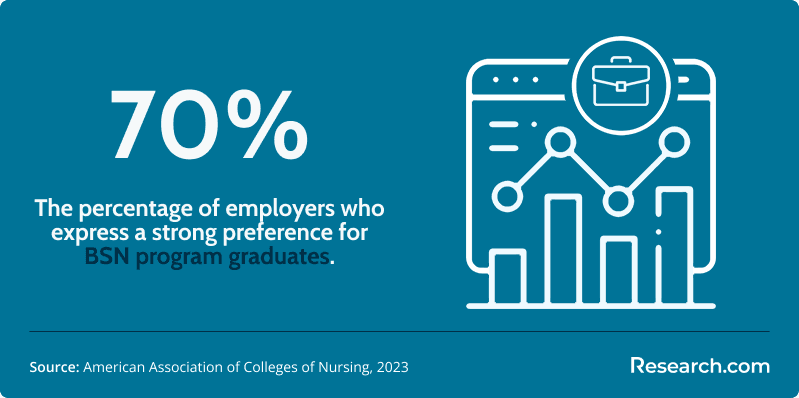
Employers generally focus on whether the nursing program is accredited, whether the degree is from a recognized institution, and whether the graduate can apply BSN-level competencies in practice. A missing standalone statistics requirement is less important than the presence of evidence-based practice, nursing research, leadership, community health, and quality improvement coursework.
A BSN can also support longer-term planning. Nurses who later want advanced practice roles may use the BSN as a foundation for graduate options, including affordable online psychiatric nurse practitioner programs.
What specialization areas are available in online RN to BSN programs?
RN to BSN programs do not always offer formal majors within the BSN, but many allow students to shape projects, electives, or capstones around a professional interest. Choose a focus area based on the work you want after graduation, not just the course title that sounds most interesting.
- Nursing Leadership and Management: This focus supports goals such as charge nurse, assistant nurse manager, nurse manager, or quality improvement leadership by emphasizing staffing, budgeting, policy, and team development.
- Nursing Informatics: This area prepares nurses to work with electronic health records, clinical documentation, reporting tools, and technology-supported care improvement.
- Public Health Nursing: Students focus on community health, prevention, education, outreach, and population-level interventions.
- Case Management: This track emphasizes care coordination, discharge planning, chronic disease support, utilization review, and continuity of care.
- Nursing Education: This focus can help nurses move into staff development, patient education, preceptor roles, or future graduate study in nursing education.
| Interest area | Possible BSN focus | Common next step |
| Leading a unit or team | Nursing Leadership and Management | Charge nurse or nurse manager responsibilities |
| Improving systems and technology | Nursing Informatics | EHR optimization or clinical data projects |
| Serving communities | Public Health Nursing | Community health or nonprofit healthcare work |
| Coordinating complex care | Case Management | Discharge planning or chronic care coordination |
| Teaching patients or staff | Nursing Education | Preceptor, staff educator, or graduate education pathway |
How to choose the best online RN to BSN program without statistics
The right program is not simply the fastest or cheapest one. It is the program that accepts the most relevant transfer credit, fits your work schedule, meets recognized accreditation standards, stays within your budget, and supports your career goal after graduation.
Use the criteria below before you submit an application.
- Accreditation: Confirm that the nursing program is accredited by the Commission on Collegiate Nursing Education (CCNE) or the Accreditation Commission for Education in Nursing (ACEN). Institutional accreditation also matters for financial aid and transferability.
- Total Net Cost: Compare the final amount you will pay after transfer credits, employer reimbursement, scholarships, and fees—not just the advertised tuition rate.
- Program Length and Course Pace: Decide whether you can manage accelerated 7-week or 8-week classes, or whether a slower part-time plan would protect your work-life balance.
- Student Support: Ask about advising, tutoring, faculty access, technical support, writing help, and career services. Support is especially important when comparing the most manageable online RN to BSN programs for working adults.
- Curriculum Relevance: Review whether the program includes leadership, informatics, public health, quality improvement, and capstone options tied to your career plans.
Questions to ask before enrolling
| Question | Why it matters |
| Does the program require statistics before or during enrollment? | Some schools waive it as a prerequisite but include related content elsewhere. |
| How many credits will transfer from my ADN or diploma program? | Transfer credit affects both cost and graduation timeline. |
| Is the nursing program CCNE- or ACEN-accredited? | Accreditation can affect employer acceptance and graduate school eligibility. |
| Are courses asynchronous, synchronous, or mixed? | Live meeting requirements may conflict with shift work. |
| What is the total program cost, including fees? | Advertised tuition may exclude technology, course, and graduation fees. |
| Does the program include clinical, practicum, or community-based projects? | You need to know whether experiences can be completed near your home. |
What careers can you pursue after an online RN to BSN program without statistics?
A BSN does not replace RN licensure; it expands the professional roles for which an RN may be considered. Many BSN-prepared nurses remain in direct patient care while taking on more leadership, coordination, education, informatics, or community health responsibilities. Some use the degree as preparation for graduate nursing study.
1. Nurse Manager
Nurse managers supervise nursing staff within a unit, service line, or department. Their work may include staffing, budgeting, performance improvement, policy implementation, patient safety oversight, and team development.
Median salary: $101,340 per year.
2. Case Manager
Case managers coordinate care plans for patients with complex, chronic, or long-term needs. They communicate with patients, families, providers, payers, and community resources to support continuity of care.
Median salary: $77,590 per year.
3. Informatics Nurse Specialist
Informatics nurse specialists connect clinical practice with healthcare technology. They may support electronic health record implementation, workflow improvement, documentation quality, data integrity, and clinical system optimization.
Median salary: $85,290 per year.
4. Public Health Nurse
Public health nurses work in community settings, government agencies, schools, nonprofits, and outreach programs. Their responsibilities often include education, prevention, screening, wellness programming, and support for underserved populations.
Median salary: $75,990 per year.
5. Clinical Research Nurse
Clinical research nurses support trials involving treatments, medications, devices, and care protocols. They help protect participants, maintain accurate records, coordinate study procedures, and support reliable data collection.
Median salary: $81,530 per year.
Industry data shows that 17.3% of nurses who enter the profession with a BSN later complete a master’s degree. Students who already hold a non-nursing bachelor’s degree and want a different route into nursing may compare short online direct-entry MSN programs.
What is the job outlook for RN to BSN graduates?
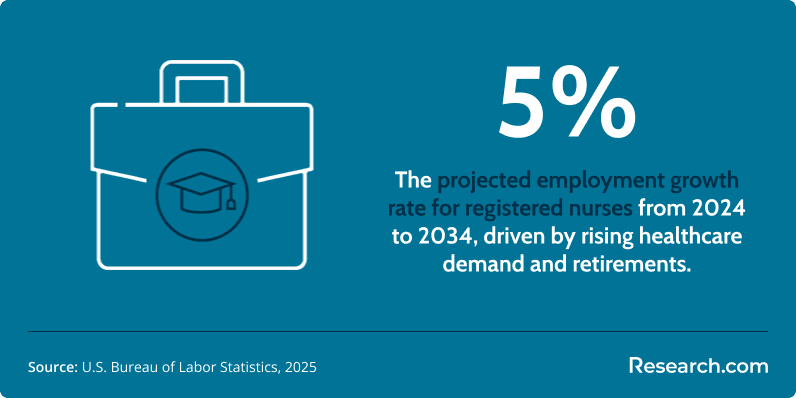
The labor market for registered nurses remains strong. The U.S. Bureau of Labor Statistics projects 5% employment growth for registered nurses through 2034, which is faster than the average for all occupations. BLS also projects about 189,100 job openings for RNs each year.
A BSN can improve competitiveness for hospitals, magnet-oriented healthcare systems, leadership tracks, public health roles, and graduate nursing programs. It does not guarantee a specific salary or promotion, but it can strengthen your qualifications when you target desirable employers, locations, and specialties. Nurses comparing work settings can also review the best places to work and live as a registered nurse.
What graduates say about online RN to BSN programs without statistics
- Erin: "I had already taken on many charge nurse duties, but the formal role required a BSN. I did not want an extra statistics course to slow me down after being out of school for so long. Choosing an online program without that added barrier helped me focus on leadership coursework and finish in just over a year."
- Jade: "Math had always made me nervous, and statistics was the reason I kept postponing my BSN. Once I found a program that did not make it a separate requirement, I finally applied. The instructors were supportive, and completing the degree changed how I saw my own ability to succeed academically."
- Rosalie: "I work at a rural hospital, and commuting to a university was not realistic. The online format made the BSN possible, and the community health coursework connected directly to the needs I see in my town every week."
How to handle common challenges in an online RN to BSN program
Online RN to BSN students often struggle less with nursing concepts than with time management, technology, writing expectations, and motivation after long shifts. The best way to reduce risk is to plan your study routine before classes begin rather than waiting until you fall behind.
- Build a weekly study schedule around your shifts: Block specific hours for reading, discussion posts, papers, and exams. Treat those hours like work shifts.
- Use support services early: Contact faculty, writing centers, online tutoring, and advisors before a problem affects your grade.
- Confirm technology requirements: Make sure your laptop, internet access, webcam, browser, and software meet program expectations.
- Avoid overloading your first term: If you have been away from school for years, start with a manageable course load and increase later if needed.
- Connect assignments to your current practice: Using real workplace examples can make leadership, informatics, and community health projects more relevant.
If you are still comparing nursing education options more broadly, resources on the most accessible nursing schools can help you understand admissions expectations and academic support structures.
Common mistakes to avoid when choosing an online RN to BSN without statistics
| Mistake | Why it can hurt you | Better approach |
| Choosing a school only because it does not require statistics | You may overlook accreditation, cost, transfer credit, and student support | Use the statistics waiver as one factor, not the whole decision |
| Comparing only tuition per credit | Fees, transfer rules, and repeated courses can change the real price | Ask each school for a complete written cost estimate |
| Assuming online means self-paced | Many online courses still have weekly deadlines and group projects | Review course calendars and synchronous meeting requirements |
| Ignoring employer reimbursement rules | You may miss free money or violate repayment conditions | Get HR policies in writing before enrolling |
| Skipping accreditation checks | Employer acceptance and graduate school options may be affected | Verify institutional and nursing program accreditation before applying |
| Taking an accelerated schedule without a time plan | Fast courses can become overwhelming during busy work periods | Match course pace to your shifts, family responsibilities, and study habits |
References:
- American Association of Colleges of Nursing. (2023). Data spotlight: Declines in RN to BSN program enrollments. Retrieved from AACN Nursing
- American Association of Colleges of Nursing. (2023). Data spotlight: RN to baccalaureate program characteristics. Retrieved from AACN Nursing.
- American Association of Colleges of Nursing. (n.d.). Impact of education on nursing practice. Retrieved from AACN Nursing.
- American Association of Colleges of Nursing. (2024). Schools of nursing enrollment increases across most program levels, signaling strong interest in nursing careers. Retrieved from AACN Nursing.
- Health Resources and Services Administration. (2022). National sample survey of registered nurses: Education and training report. Retrieved from HRSA.
- Journal of Nursing Regulation. (2023). Nurse licensure compact: Evidence from practice and policy. Retrieved from Journal of Nursing Regulation.
- Nursing World. (n.d.). RN to BSN resources. Retrieved from Nursing World.
- ZipRecruiter. (2024). BSN nurse salary. Retrieved from ZipRecruiter.
Key Insights
- Online RN to BSN programs without statistics can help licensed RNs avoid an extra prerequisite, but the program must still include strong evidence-based practice and nursing research content.
- Most programs take 12 to 18 months full time or around 24 months part time; accelerated options can be faster but require disciplined weekly study time.
- Total cost varies widely, from under $9,000 to over $51,000, so compare net cost after transfer credits, employer reimbursement, scholarships, and fees.
- Accreditation is non-negotiable. Prioritize programs with recognized nursing accreditation and clear institutional accreditation.
- The best program is the one that fits your schedule, accepts your prior credits, supports your career goals, and provides enough advising and academic support for working nurses.
- A BSN can support advancement into nurse management, case management, informatics, public health, clinical research, and graduate nursing pathways, but salary and promotion outcomes are never guaranteed.
Other Things You Should Know About Online RN to BSN Programs Without Statistics
Most online RN to BSN programs accept up to 90 semester credits from an ADN or diploma nursing program, plus transfer general-education credits. Schools usually require a valid RN license and a regionally accredited associate degree before admission. Up to 30 credits are then completed through upper-division BSN coursework.
Yes, many online RN to BSN programs without statistics require clinical practice hours, which are typically completed locally. These placements aim to enhance hands-on skills and are crucial for graduation, even if the program is mostly online in 2027.