
2027 Fastest Way to Become a Radiology Tech

Co-Founder and Chief Data Scientist
Radiologic technology is one of the more direct ways to enter patient care without committing to a four-year degree first. The important decision is not only how to become a radiology tech quickly, but how to choose a legitimate program that prepares you for certification, clinical work, and any state license you may need. This guide explains the shortest credible route, what the job involves, what training can cost, how ARRT certification works, where online learning fits, and how to decide whether this healthcare path is worth the time and expense for you.
Quick Answer: Fastest Route to Becoming a Radiology Tech
The fastest recognized path is usually a one- to two-year accredited radiologic technology program that includes classroom instruction, required in-person clinical rotations, and preparation for the ARRT certification exam. Most students choose an associate degree, although some certificate programs may qualify if they meet ARRT and state rules. Look for JRCERT accreditation or clear confirmation that the program satisfies certification and licensing requirements in the state where you plan to work.
- Radiology techs, also known as radiologic technologists, use imaging equipment such as X-ray, CT, and MRI systems to help medical providers diagnose injuries and health conditions.
- The median annual wage for radiologic techs is approximately $75,250 as of May 2023.
- The field can offer a defined training pathway, steady healthcare employment, specialization options, and advancement into imaging management, education, or related clinical roles.
- Fastest pathway to become a certified radiology tech
- Daily responsibilities of radiology techs
- Radiology tech education costs
- Financial aid for online and hybrid programs
- State licensing requirements
- Advanced ARRT certifications
- Radiology tech job demand
- Medical billing and coding as an added skill
- Supplemental certifications for career flexibility
- Radiology tech education ROI
- Salary potential for experienced radiology techs
- Leadership paths for radiology techsSalary factors to compare
- Diagnostic medical sonography as a related path
- Public health education for broader healthcare roles
- Alternative careers with radiology tech training
- Why biology knowledge matters in imagingRelated career options
- AI and radiology technology
- Continuous learning and cross-training
- Complementary degrees for radiology techs
- Business and leadership trainingComplementary degree optionsCross-training optionsTechnology trendsAdditional considerations
What is the fastest way to become a radiology tech for 2027?
The quickest dependable route is to enroll in an accredited radiologic technology program, usually at the associate level, that combines didactic coursework with supervised clinical practice. Community colleges, hospital-based programs, and technical schools may offer accelerated or hybrid formats, but the clinical portion must happen in person. If you are researching flexible college formats, online associate degree options can help you understand how remote coursework is structured, but radiology tech training cannot be completed entirely online.
A short program only helps if it leads to the credentials employers and licensing boards recognize. Typical coursework includes anatomy, patient care, radiographic positioning, radiation protection, imaging procedures, image critique, and equipment operation. Clinical rotations are just as important because they teach students how to work with real patients, imaging teams, radiologists, and safety protocols in hospitals or outpatient settings.
After completing an eligible program, graduates generally take the American Registry of Radiologic Technologists certification exam. The ARRT exam measures knowledge of patient care, imaging procedures, radiation safety, and technical standards. Because many employers and states rely on ARRT certification, an unapproved shortcut can create delays instead of helping you enter the workforce faster.
| Pathway | Best fit | Why it may be faster | Risk to check first |
| Accredited certificate program | Learners who already meet prerequisites or want concentrated technical training | May take less time than a full degree | Confirm that it satisfies ARRT and state licensing rules |
| Accredited associate degree | Most first-time students preparing for entry-level radiologic technology roles | Provides a one- to two-year route with general education, imaging coursework, and clinical practice | Admission may be selective because programs have limited clinical placements |
| Bachelor’s degree | Students planning for management, education, advanced imaging, or longer-term career mobility | Offers broader academic and professional preparation | Usually requires more time and money than the fastest entry-level pathway |
What does a radiology tech do daily?
Radiology techs are responsible for much more than operating imaging equipment. They prepare patients, position the body correctly, capture images that physicians can interpret, follow radiation safety procedures, and communicate with radiologists, nurses, physicians, and other healthcare staff. The role requires technical precision, physical stamina, calm communication, and a strong commitment to patient safety.
Common daily duties include:
- Getting patients ready for imaging: Technologists explain the exam, answer basic procedure questions, help patients move safely, and position the correct body part for the required view.
- Using imaging systems: They operate X-ray equipment and, with additional training or credentials, may work with CT, MRI, mammography, or other imaging modalities.
- Evaluating image usability: Images must be clear, properly aligned, and complete enough for a physician or radiologist to interpret, so attention to detail is essential.
- Applying radiation protection practices: Techs use shielding, exposure controls, and established safety procedures to reduce unnecessary radiation exposure.
- Maintaining accurate documentation: Procedure notes and records support patient care, billing, regulatory compliance, and communication across the care team.
- Coordinating with clinical staff: Radiology techs help ensure that the correct images are captured for diagnosis, treatment decisions, follow-up exams, or emergency care.
How much does it cost to become a certified radiology tech?
Your total cost will depend on the credential, school type, location, program length, and whether you attend a public college, private school, hospital-based program, or technical institution. Tuition is only part of the expense. Students should also budget for textbooks, uniforms, lab supplies, immunizations, background checks, drug screening, transportation to clinical sites, certification exam fees, and possible income loss if they reduce work hours while enrolled.
| Education option | Estimated cost stated | Who it may suit | What to verify |
| Certificate program | $5,000 to $25,000 | Students looking for a shorter, focused path into entry-level imaging work | Make sure the credential supports ARRT certification eligibility and state licensure |
| Associate degree | $6,000 to $40,000 | Learners seeking the common entry route with general education, radiology coursework, and clinical rotations | Compare total price, clinical placement support, completion outcomes, and transfer potential |
| Bachelor’s degree | $30,000 to $50,000 | Students considering advanced practice, supervision, management, or graduate study later | Decide whether the added time and cost align with your career goals |
| Additional expenses | Textbooks and supplies can average $500 to $1,500 annually; clinical training fees may range from $1,000 to $2,000; ARRT exam and certification fees may be between $200 and $400 | All radiologic technology students | Ask the school for a written estimate of every required program cost |
Certificate Programs
Certificate programs may be one of the quicker and lower-cost trade school-style healthcare pathways for students who want targeted career training instead of a broader academic credential. Still, fast is not the same as eligible. A program that is inexpensive but does not qualify graduates for certification or licensure can cost more in the long run because it may block employment.
Associate Degree
An associate degree is often the most practical starting point for new students because it packages radiologic technology courses, general education, labs, and supervised clinical experience into one credential. Students comparing accessible two-year programs may also review associate degree options with manageable admissions or coursework structures, but radiology programs often have competitive entry requirements and mandatory clinical expectations.
Bachelor’s Degree
A bachelor’s degree is rarely the shortest way to start as a radiology tech, but it can help with future roles in supervision, teaching, imaging administration, or specialty practice. If a four-year credential is part of your plan, affordable online bachelor’s degree options can help you compare cost-conscious formats, though radiology-specific clinical training still has to be completed through approved hands-on sites.
Other Costs
Before you commit, ask whether tuition includes lab charges, clinical placement fees, uniforms, background checks, drug testing, immunizations, certification review materials, graduation fees, and technology costs. It can also be useful to compare admission difficulty and program structure through resources such as radiology tech programs that may be easier to enter, but accreditation, exam eligibility, and clinical quality should carry more weight than convenience alone.
Can you get financial aid for an online radiology tech program?
Yes, financial aid may be available when the institution and program meet aid eligibility requirements. Most students start by completing the FAFSA, which is used to determine eligibility for federal grants, subsidized loans, and other forms of assistance. If you are comparing healthcare credentials by payoff and training length, reviewing associate degrees with strong earning potential can help place radiologic technology alongside other two-year options.
Radiology tech students may also find scholarships from professional organizations, school-based grants, state aid, monthly payment plans, and employer tuition reimbursement. Organizations such as the American Society of Radiologic Technologists and similar healthcare groups may offer awards tied to financial need, academic performance, or commitment to the imaging profession.
Be cautious when schools advertise an “online radiology tech program.” In most cases, the online portion covers lectures, assignments, discussion boards, or general education classes. The required clinical training takes place in person. Before enrolling, ask where clinical rotations are located, whether the school arranges placements, whether you are expected to secure your own site, and whether the program is approved for your state.
Financial aid research can also benefit students exploring related science fields. For example, learners considering the most approachable biology degree paths may also be able to compare grants, scholarships, and institutional aid options.
Are state-specific licenses needed for radiology techs?
Many states require radiology techs to obtain a license before they can practice. Because rules differ by state, you should check the licensing board in the state where you plan to work before choosing a school. A program that meets one state’s requirements may not automatically satisfy another state’s standards.
Licensing commonly depends on ARRT certification or ARRT exam eligibility, but states may add their own applications, fees, documentation, background checks, or exams. Since radiologic imaging involves radiation exposure and patient safety, licensing helps regulators confirm that technologists have completed appropriate education and demonstrated competency.
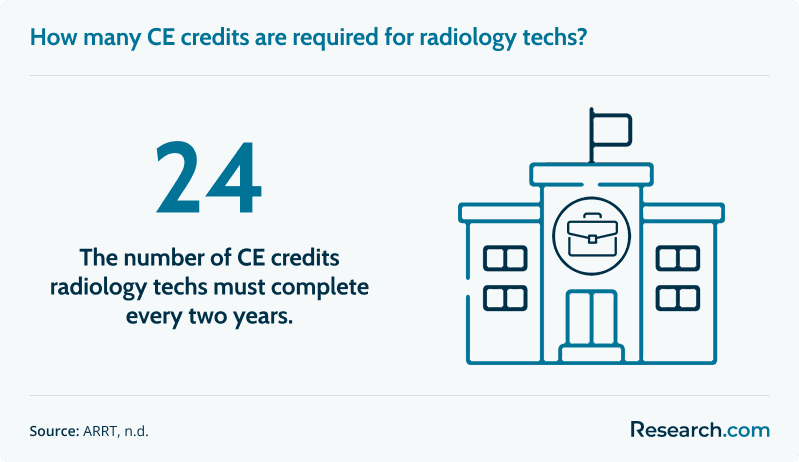
Credential maintenance also matters. Many states require ongoing education to keep a license or certification active. Depending on credential and jurisdiction, radiology techs may need to complete continuing education requirements of 12 to 24 credits every two years. Continuing education keeps technologists current with imaging technology, safety standards, patient care practices, and changing professional expectations.
| Question to ask before enrolling | Why the answer matters |
| Is the program accredited or otherwise accepted for ARRT eligibility? | ARRT eligibility is often required for jobs, licensure, or both. |
| Will this program meet the rules in the state where I want to work? | State licensing standards vary, and relocation can complicate credentialing. |
| Does the school arrange clinical placements? | Delayed or unavailable clinical rotations can extend the time it takes to graduate. |
| What support is offered for exam preparation and job placement? | Strong advising, review resources, and employer connections can reduce post-graduation delays. |
What advanced certifications can radiology techs pursue?
Once radiology techs have entry-level credentials and practical experience, they can pursue advanced ARRT certifications in specialized imaging areas. Specialization can broaden job options, improve schedule flexibility in some departments, and support higher earning potential, especially where employers need technologists trained on advanced equipment.
Common specialty certification areas include:
- CT (Computed Tomography): CT technologists perform cross-sectional imaging used frequently in emergency departments, inpatient care, outpatient diagnostics, and trauma evaluation.
- MRI (Magnetic Resonance Imaging): MRI technologists use magnetic fields and radio waves to create detailed images, requiring careful screening, safety practices, and patient communication.
- Mammography: Mammography focuses on breast imaging for screening and diagnostic evaluation.
- Interventional Radiography: Interventional technologists assist with image-guided procedures that support minimally invasive diagnosis or treatment.
- Bone Densitometry: Bone densitometry measures bone mineral density and supports evaluation of osteoporosis and fracture risk.
The right specialty depends on your regional job market, the equipment used by local employers, the type of patients you prefer working with, and the pace of work you want. CT may fit technologists who like urgent or high-volume settings, while MRI may appeal to those who prefer complex imaging, detailed safety screening, and longer patient interactions.
Is radiology tech a high-demand career for 2027?
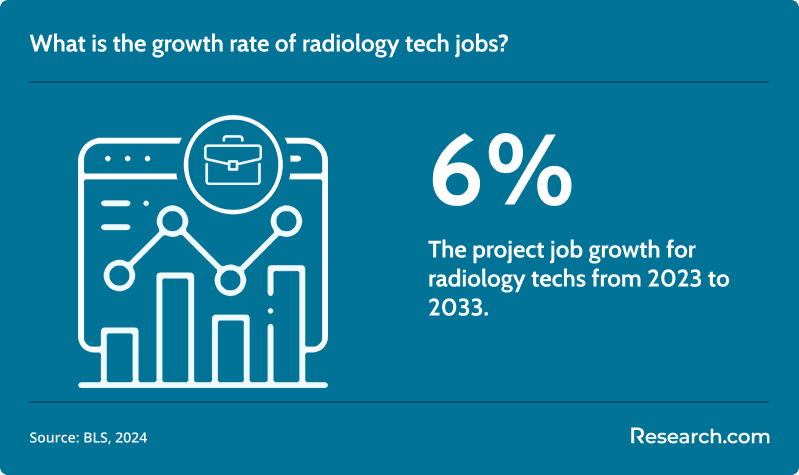
Radiologic technology remains a strong allied health option because diagnostic imaging is deeply embedded in modern medical care. According to the U.S. Bureau of Labor Statistics, employment for radiologic techs is projected to grow 6% between 2023 and 2033, which is faster than the average for all occupations. Demand is supported by imaging needs tied to injury diagnosis, chronic disease monitoring, and care for aging patients who often require more diagnostic services.
Imaging services are also expanding beyond traditional hospital departments into outpatient centers, urgent care clinics, and specialized diagnostic facilities. These settings need trained technologists who can produce clear images efficiently while protecting patients and following safety protocols. As imaging systems become more advanced, employers also value workers who can adapt to new equipment, software, digital workflows, and quality-control tools.
This career may be a good match if you want a hands-on healthcare role with patient interaction, technical equipment, and a defined education pathway. It may be a poor fit if your goal is fully remote work, if you do not want to stand or move patients during shifts, or if you are uncomfortable helping people who may be anxious, injured, in pain, or medically unstable.
Should radiology techs consider additional training in medical billing and coding?
Medical billing and coding is not a standard requirement for radiology tech positions, but it can be useful for technologists who want to understand documentation, reimbursement, charge capture, coding workflows, and imaging department operations. This type of knowledge may help if you later pursue quality assurance, scheduling, department coordination, or administrative work. If your goal is to combine clinical imaging experience with healthcare operations skills, a low-cost online medical billing and coding program may be worth comparing.
Can supplemental certifications enhance your radiology tech career?
Additional credentials can help when they clearly support your next career move. Training in patient care, EHR systems, safety procedures, or healthcare administration may strengthen your profile for outpatient imaging centers or mixed clinical-administrative roles. However, collecting certificates without a strategy can waste money. If you are comparing allied health credentials, the cost of online medical assistant certification can provide a useful benchmark, but radiologic technology has separate clinical, certification, and licensure expectations.
Is the Return on Investment for Radiology Tech Education Worth It?
Radiology tech education can produce a favorable return when students choose an accredited program with reasonable costs, reliable clinical placement, and a clear path to certification and employment. The best value usually comes from keeping debt low, completing rotations without delay, passing the certification exam, and building skills in modalities that local employers need.
| ROI factor | Why it changes the value | What to investigate |
| Program cost | Lower total costs can reduce the time needed to recover your investment. | Compare the full price, not only the tuition listed on the website. |
| Accreditation and exam eligibility | The wrong program can leave you unable to sit for certification or qualify for licensure on time. | Verify ARRT eligibility and state approval before paying an application fee or deposit. |
| Clinical placement | Dependable clinical access helps students finish on schedule. | Ask whether the school assigns clinical sites or expects students to locate their own placements. |
| Specialization potential | Advanced credentials may improve job flexibility and salary potential. | Ask local employers which imaging modalities are hardest to staff in your area. |
If you are comparing radiologic technology with other healthcare education investments, it can help to contrast the timeline and cost with more advanced routes, such as a pharmacy degree online. Each path has different prerequisites, clinical expectations, licensure rules, costs, and career outcomes.
What is the salary potential for experienced radiology techs?
Radiology tech pay can increase with experience, location, specialty credentials, modality, shift type, and employer setting. Entry-level radiology techs typically earn an average annual salary of about $73,410. By comparison, the average medical assistant salary is $43,350, which is one reason radiologic technology may attract students seeking a higher-paying allied health option.
Mid-career radiology techs can earn salaries ranging from $76,000 to $84,000 annually. Technologists who move into MRI or interventional radiography may earn more, with salaries exceeding $80,000 and potentially reaching $100,000 or higher. Pay also varies by state; California, Massachusetts, and Hawaii may offer higher wages because of demand and cost-of-living differences.
No salary is guaranteed. Before choosing a school, review job postings in your area, speak with clinical instructors or imaging managers, and ask whether local employers hire new graduates directly into CT, MRI, or other specialty tracks.
Can Radiology Techs Transition into Leadership Roles?
Yes. Experienced radiology techs can move into positions such as lead technologist, imaging supervisor, department manager, quality assurance specialist, clinical educator, or healthcare operations professional. These roles require more than strong imaging skills. Employers usually look for communication ability, scheduling judgment, compliance knowledge, budgeting awareness, staff training experience, and the ability to make sound decisions under pressure.
If leadership is part of your long-term plan, start building proof before you apply for management roles. Offer to precept students, participate in protocol updates, document workflow improvements, and learn how your department handles safety audits, accreditation, staffing, patient throughput, and equipment maintenance. Technologists considering administrative growth can review higher-paying healthcare administration careers to see how clinical experience can support broader management opportunities.
Could Expanding into Diagnostic Medical Sonography Enhance Your Career?
Diagnostic medical sonography can be a valuable related pathway for radiology techs who want to add an imaging modality that uses ultrasound instead of ionizing radiation. It may fit professionals who enjoy anatomy, hands-on patient interaction, and real-time image capture. However, sonography is not a casual add-on; it has its own education standards, clinical competencies, and credentialing expectations. To compare the route more carefully, review accredited diagnostic medical sonography programs.
Could Further Public Health Education Enhance a Radiology Tech’s Career?
Public health training may help radiology techs who want to move beyond direct imaging into quality improvement, screening programs, healthcare policy, research support, or population health. An affordable online MPH program can build skills in epidemiology, data analysis, program planning, and evidence-based decision-making. This path is most relevant for technologists who want a broader healthcare role rather than a career focused only on imaging procedures.
What other careers can you pursue with a radiology tech background?
Radiologic technology can become a launch point for several related careers. Some professionals deepen their expertise within imaging, while others move toward teaching, administration, sales, radiation therapy, or another healthcare profession. A radiology background can also help when exploring adjacent clinical fields, including some of the lower-stress nursing roles, although nursing requires separate education and licensure.
| Career direction | How radiology tech experience helps | Additional preparation to expect |
| Radiologist assistant or advanced imaging support | Builds on image acquisition, patient care, procedure knowledge, and collaboration with radiologists | Advanced education, clinical experience, and role-specific credentials |
| Healthcare administration | Provides practical insight into imaging workflows, staffing, compliance, and patient flow | Management coursework, healthcare administration training, or leadership experience |
| Radiation therapy | Uses knowledge of anatomy, positioning, imaging, and radiation safety | Radiation therapy education and credentialing |
| Medical imaging sales | Technical familiarity helps professionals explain imaging equipment, workflow value, and clinical use cases | Sales training, product knowledge, and relationship-building skills |
| Education and clinical training | Experienced technologists can mentor students and teach imaging procedures or safety practices | Teaching experience, advanced credentials, or a higher degree may be preferred |
Some students discover they prefer a different clinical focus or patient population. If you are interested in speech, hearing, language, or communication disorders, you may want to compare radiology with a communication disorders degree online.
The chart below shows how radiology techs are distributed across different industries.
How does a strong foundation in biology enhance radiology tech performance?
Biology helps radiology techs understand the body structures they are imaging and the clinical reasons those images matter. Knowledge of anatomy, physiology, pathology, and disease processes can improve positioning, patient communication, collaboration with clinical teams, and understanding of how imaging supports diagnosis and treatment. Students who enjoy science and want broader preparation may consider an online bachelor’s degree in biology as a complement to imaging training or as a bridge to research, education, or advanced healthcare study.
How is AI impacting the work of radiology techs for 2027?
Artificial intelligence is changing radiology, but it does not remove the need for trained technologists. AI tools may support image quality checks, exam prioritization, positioning guidance, workflow routing, and detection of possible abnormalities. Radiology techs remain central to patient preparation, equipment operation, safety, image acquisition, communication, and quality control.
How AI Can Support Radiology Techs
- Image quality support: AI-enabled systems may flag technical issues or identify images that need additional review.
- Workflow efficiency: Automated tools can help prioritize studies, reduce repeated manual steps, and move images through the system faster.
- Decision support: AI may highlight possible findings for radiologists, but medical interpretation remains the responsibility of qualified clinicians.
What Radiology Techs Need to Watch
- Training requirements: Technologists may need continuing education on AI-enabled equipment, data quality, and site-specific digital workflows.
- Patient communication: Patients may ask whether AI is being used, so techs should know how to explain the process accurately within their professional scope.
- Role changes: The job may involve more troubleshooting, workflow monitoring, technology adaptation, and ensuring that images are captured correctly the first time.
What Radiology Tech Graduates Say About the Career
Radiologic technology gave me a practical healthcare career where I can work with patients, use advanced equipment, and contribute to medical decisions through the images I produce. Miranda
Moving into MRI made the work more interesting for me. It brings together science, safety, communication, and patient care, and specialty credentials have helped me keep advancing. John
I came into radiology technology after working in an office job, and the change was clear right away. The role is active, technical, and connected to real patient outcomes. Ava
How Can Continuous Learning and Cross-Training Elevate a Radiology Tech’s Career?
Continuous learning matters because imaging equipment, digital systems, safety protocols, and employer expectations continue to evolve. Radiology techs can strengthen their careers through modality certifications, professional workshops, equipment training, and cross-training that matches employer needs.
Cross-training should be tied to a specific goal. For example, technologists who want broader front-line patient care exposure may compare options such as accelerated medical assistant programs, while those aiming for imaging specialization may be better served by CT, MRI, mammography, or interventional radiography credentials. The best choice depends on whether you want clinical depth, schedule flexibility, leadership preparation, or a future degree pathway.
How Can Complementary Degrees Enhance a Radiology Tech’s Career?
Complementary degrees can help radiology techs shift toward research, teaching, management, healthcare analytics, or advanced clinical roles. A science degree can deepen knowledge of anatomy, physiology, and disease, while an administration-focused degree can support supervisory or operational work. Students who want a faster way to broaden their science background may explore the fastest online bachelor’s degree options in biology as one possible complement.
Can Business and Leadership Training Propel Radiology Techs Forward?
Business and leadership education can help radiology techs who want to supervise imaging teams, improve department workflows, manage budgets, or contribute to organizational planning. Clinical experience gives future leaders a practical understanding of patient care, but management also requires communication, finance, compliance, staffing, and conflict-resolution skills. A structured online health administration degree can support technologists who want to move from direct imaging into department or facility leadership.
Common Mistakes to Avoid When Choosing a Radiology Tech Path
| Mistake | Why it creates problems | Better decision |
| Picking the shortest program before verifying accreditation | You could finish school without being eligible for certification or state licensure. | Check ARRT eligibility, JRCERT status, and state approval before enrolling. |
| Comparing schools by tuition only | Books, fees, clinical costs, transportation, supplies, and exam charges can change the real price. | Request a complete written cost breakdown from every program. |
| Assuming “online” means fully remote | Radiologic technology requires hands-on clinical experience in approved healthcare settings. | Ask where clinical rotations occur, how they are scheduled, and who arranges them. |
| Overlooking state licensing requirements | A program may not meet the rules in the state where you intend to work. | Contact the state licensing board before applying. |
| Treating salary estimates as guarantees | Pay depends on location, employer, experience, credentials, modality, and schedule. | Study local job postings and ask clinical sites what credentials they prefer. |
References
- BLS. (2024). Occupational Employment and Wage Statistics: Radiologic Technologists and Technicians. BLS.
- BLS. (2024). Occupational Outlook Handbook: Radiologic and MRI Technologists. BLS.
- Data USA. (2023). Radiologic technologists and technicians. Data USA.
- Radiology Training Programs. (n.d.) Tuition & costs for radiology training programs. radiologytrainingprograms.com.
Key Insights
- The fastest legitimate route is usually an accredited one- to two-year radiologic technology program with required clinical rotations, followed by the ARRT certification exam.
- Speed should never outrank eligibility. Before enrolling, confirm accreditation, ARRT exam eligibility, clinical placement arrangements, and state licensure approval.
- Published cost ranges include $5,000 to $25,000 for certificate programs, $6,000 to $40,000 for associate degrees, and $30,000 to $50,000 for bachelor’s degrees, plus additional costs for supplies, clinical training, and certification.
- Specializing in CT, MRI, mammography, interventional radiography, or bone densitometry can expand job options and may improve salary potential depending on employer demand.
- AI is becoming part of imaging workflows, but radiology techs remain essential for patient care, positioning, safety, equipment operation, image capture, and quality assurance.
- The best ROI usually comes from choosing an affordable eligible program, completing clinical requirements on time, passing certification, and building skills that match hiring needs in your local market.
Other Things You Should Know About Becoming a Radiology Tech
An accelerated radiography program requires supervised clinical rotations in hospitals or imaging centers, usually totaling at least 1,000 hours. Students must complete competencies in patient positioning, radiation safety, equipment operation, and image evaluation before graduation and ARRT certification eligibility.
To enroll in a radiology tech program in 2026, most institutions require a high school diploma or GED, completing specific science courses such as biology and chemistry, and passing entrance exams or interviews. Some programs may also require prior healthcare experience or CPR certification.


