
2027 How to Become a Radiology Technician in Ohio

Co-Founder and Chief Data Scientist
Becoming a radiology technician in Ohio is a practical healthcare career path for people who want direct patient contact, hands-on technology work, and a faster route into the medical field than many advanced clinical careers require. The decision matters because the path is regulated: you need the right education, clinical training, certification, and Ohio licensure before you can legally work in many radiologic imaging roles.
Ohio offers a strong healthcare employment base through hospitals, outpatient imaging centers, specialty clinics, and large health systems. The average annual salary for radiologic technologists in Ohio is $65,260, according to recent labor statistics, but earnings vary by experience, location, shift, employer type, and imaging specialty. This guide explains how to become a radiology technician in Ohio, what to look for in a program, how licensing works, where the best opportunities tend to be, and how to make a smart long-term career decision.
Quick Answer: How do you become a radiology technician in Ohio?
To become a radiology technician in Ohio, you generally need to complete an accredited radiologic technology program, gain supervised clinical experience, pass the American Registry of Radiologic Technologists (ARRT) certification exam, and apply for Ohio licensure before practicing. Most students choose an associate degree program because it is the common entry route into radiologic technology, though bachelor’s degree options may support advancement later.
Key Things to Know About Becoming a Radiology Technician in Ohio
- Ohio’s radiology technician job market is expected to grow by 7% over the next decade, which points to continued need for trained imaging professionals across healthcare settings.
- The average annual salary for radiology technicians in Ohio ranges from $55,000 to $65,000, with higher pay often linked to experience, modality training, shift differentials, and specialized credentials.
- Columbus State Community College and Cuyahoga Community College are among the Ohio institutions known for accredited radiologic technology programs and clinical partnerships.
- The most important program decision is not simply cost or location. Students should verify accreditation, clinical placement quality, ARRT exam preparation, graduation requirements, and whether the program meets Ohio licensing expectations.
- Radiologic technology is a patient-care career, not only a technical role. Strong communication, safety judgment, positioning skills, and professionalism matter as much as operating imaging equipment.
- Education required to become a radiology technician in Ohio
- Essential skills for Ohio radiology technicians
- Ohio licensing and certification requirements
- Radiology technician salary in Ohio
- Ohio job outlook for radiology technicians
- Industries and workplaces hiring radiology technicians
- Financial aid options for radiology technician students in Ohio
- Dual certification benefits for Ohio radiology technicians
- Radiology technology trends affecting the profession
- Ultrasound specialization and career growth
- Typical workday for a radiology technician in Ohio
- Challenges to expect in this career path
- Legal and ethical best practices in Ohio
- Career advancement and professional development options
- Combining radiology and nursing credentials: when it may make sense; also review the professional development section and Key Insights.
What level of education is required to become a radiology technician in Ohio?
Most Ohio radiology technician candidates begin with a radiologic technology program that combines classroom instruction, laboratory practice, and supervised clinical rotations. The common route is an associate degree, although some students pursue a bachelor’s degree if they want broader healthcare preparation, leadership potential, or a foundation for future graduate study.
A strong program should teach anatomy, patient positioning, radiation protection, image production, equipment operation, patient care, medical ethics, and quality assurance. Clinical training is especially important because radiology technicians must learn to produce diagnostic images safely while working with real patients who may be injured, anxious, elderly, pediatric, or medically fragile.
For Ohio students, accreditation should be a priority. Graduation from an appropriate accredited program is central to eligibility for ARRT certification and Ohio licensure. Before enrolling, ask the school whether the program prepares graduates for the ARRT exam and Ohio radiologic technologist licensing process. Do not assume that every healthcare imaging program has the same recognition.
| Education option | Best for | Typical value | Decision cautions |
| Associate degree in radiologic technology | Students seeking the standard entry path into radiography | Combines technical coursework with clinical training and can prepare students for ARRT certification | Clinical placement policies, accreditation, and exam pass preparation vary by school |
| Bachelor’s degree with radiologic technology focus | Students who want broader healthcare preparation or future leadership options | May support advancement into education, management, advanced modalities, or related healthcare roles | Usually requires more time and tuition, so students should compare return on investment carefully |
| Certificate or post-primary training | Current imaging professionals adding a modality or specialty | Can help technologists move into CT, MRI, mammography, nuclear medicine technology, or other focused areas | Often requires a prior credential or clinical background |
Program quality matters more than speed alone. A shorter or easier admissions process can be attractive, but students should check whether the program includes enough clinical hours, strong faculty support, modern imaging equipment exposure, and transparent graduate outcomes. If you are comparing healthcare imaging and physician-level diagnostic careers, reviewing the average salary for radiologist can also help you understand the difference between technologist roles and radiologist physician careers.
How long does the path usually take?
The timeline depends on the credential and whether you study full time or part time. Many students spend time completing prerequisites before entering the professional radiologic technology sequence. After graduation, candidates still need to complete certification and Ohio licensing steps before practicing independently.
| Stage | What happens | What to verify |
| Prerequisites and admission | Students complete required courses and apply to a selective radiologic technology program | Minimum grades, observation requirements, background checks, immunizations, and application deadlines |
| Radiologic technology coursework | Students study imaging science, anatomy, patient care, radiation safety, and positioning | Accreditation status, lab access, faculty experience, and student support |
| Clinical rotations | Students train in hospitals, clinics, or imaging centers under supervision | Clinical site locations, scheduling expectations, transportation needs, and competency requirements |
| Certification and licensure | Graduates pursue ARRT certification and complete Ohio licensing requirements | Exam eligibility, application instructions, fees, renewal rules, and continuing education expectations |
What essential skills do you need to be a radiology technician in Ohio?
Radiology technicians need a mix of technical accuracy, patient-care judgment, and safety discipline. The job requires producing clear diagnostic images, following physician orders, positioning patients correctly, minimizing radiation exposure, and documenting procedures accurately. Small errors can affect diagnosis, repeat imaging, patient comfort, or safety.
Technical confidence is important, but it is not enough. Ohio radiology technicians also work with patients who may be scared, in pain, confused, or unable to move easily. Explaining procedures clearly, protecting patient dignity, and adjusting communication to the patient’s needs are core parts of the role.
| Skill area | Why it matters | How to build it |
| Patient positioning | Correct positioning helps produce usable images and reduces the need for repeat exposure | Practice in lab simulations, clinical rotations, and supervised competency checks |
| Radiation safety | Technologists must protect patients, themselves, and other staff from unnecessary exposure | Master shielding principles, exposure settings, ALARA practices, and facility protocols |
| Attention to detail | Patient identity, imaging order, side markers, positioning, and image quality all require precision | Use checklists, repeat verification habits, and quality-control feedback |
| Communication | Patients cooperate better when they understand what will happen and why positioning matters | Practice plain-language explanations and calm, respectful patient interaction |
| Physical stamina | The role may involve standing, moving equipment, assisting patients, and working long shifts | Learn safe body mechanics and ask for assistance when transfers require support |
| Digital imaging literacy | Modern departments rely on digital systems, image storage, and electronic records | Get comfortable with PACS workflows, documentation systems, and secure data handling |
As imaging departments adopt more digital tools, radiology technicians will also need to understand workflow technology, data privacy, and quality-control processes. AI-assisted tools may help with image review, protocol selection, or workflow prioritization, but technologists still need sound judgment and accountability.
Who is a good fit for this career?
- People who want a healthcare role with direct patient contact and clear technical responsibilities.
- Students who are comfortable with anatomy, equipment, safety rules, and structured procedures.
- Workers who can stay calm under pressure, especially in emergency, trauma, or high-volume imaging environments.
- Detail-oriented learners who are willing to complete continuing education as technology and standards change.
Who may want to consider a different path?
- Students who strongly prefer desk-based work with little patient interaction.
- People who are uncomfortable helping position patients, working around illness or injury, or following strict safety procedures.
- Applicants who want to avoid licensure, certification exams, or ongoing continuing education.
- Those seeking physician-level diagnostic authority; that path is different from technologist training and requires medical school and physician residency.
What are the licensing or certification requirements for radiology technicians in Ohio?
Ohio radiology technicians must meet credentialing expectations before practicing legally. The central credential is certification through the American Registry of Radiologic Technologists (ARRT). ARRT certification shows that a candidate has completed an appropriate educational pathway, met professional standards, and passed an exam covering areas such as patient care, radiation protection, image production, procedures, and image evaluation.
Ohio also requires state licensure for radiologic technologists. The Ohio radiologic technologist licensing process generally involves documenting education and certification, submitting an application, and paying required fees. Licenses require renewal every two years, and renewal includes continuing education so technologists stay current with professional standards and imaging practices.
| Requirement | What it means | Why it matters |
| Accredited education | Complete a recognized radiologic technology program with clinical training | Supports eligibility for certification and helps ensure adequate patient-safety preparation |
| ARRT certification | Pass the national certification exam and meet ARRT professional standards | Validates entry-level competence and is commonly expected by employers |
| Ohio state licensure | Apply for authorization to practice in Ohio | Required for legal practice in covered radiologic technology roles |
| Renewal every two years | Maintain the license through required renewal steps and continuing education | Keeps the technologist aligned with changing regulations, safety practices, and technology |
Licensing details can change, so students should confirm requirements directly with their program and the Ohio licensing authority before graduation. This is especially important for online, hybrid, transfer, or out-of-state programs. A program may be convenient and affordable but still create problems if it does not meet Ohio requirements.
Step-by-step path to licensure readiness
- Confirm that your target program is properly accredited and designed for radiologic technology licensure preparation.
- Ask whether graduates are eligible to sit for the ARRT exam.
- Complete all required classroom, lab, and clinical competencies.
- Prepare for and pass the ARRT certification exam.
- Submit Ohio licensure documentation, fees, and any required proof of credentials.
- Track renewal deadlines and complete continuing education before the license expires.
If you are comparing radiography with closely related entry paths, this guide on how do I become a Xray technician can help clarify terminology, education steps, and credential expectations.
How much can radiology technicians earn in Ohio?
Radiology technician salary in Ohio depends on experience, employer type, specialty, shift, location, and credentials. Entry-level radiology technicians in Ohio can often expect starting salaries in the $40,000 to $50,000 range annually. With experience and additional certifications, especially in imaging areas such as MRI or CT scans, salaries can rise beyond $65,000.
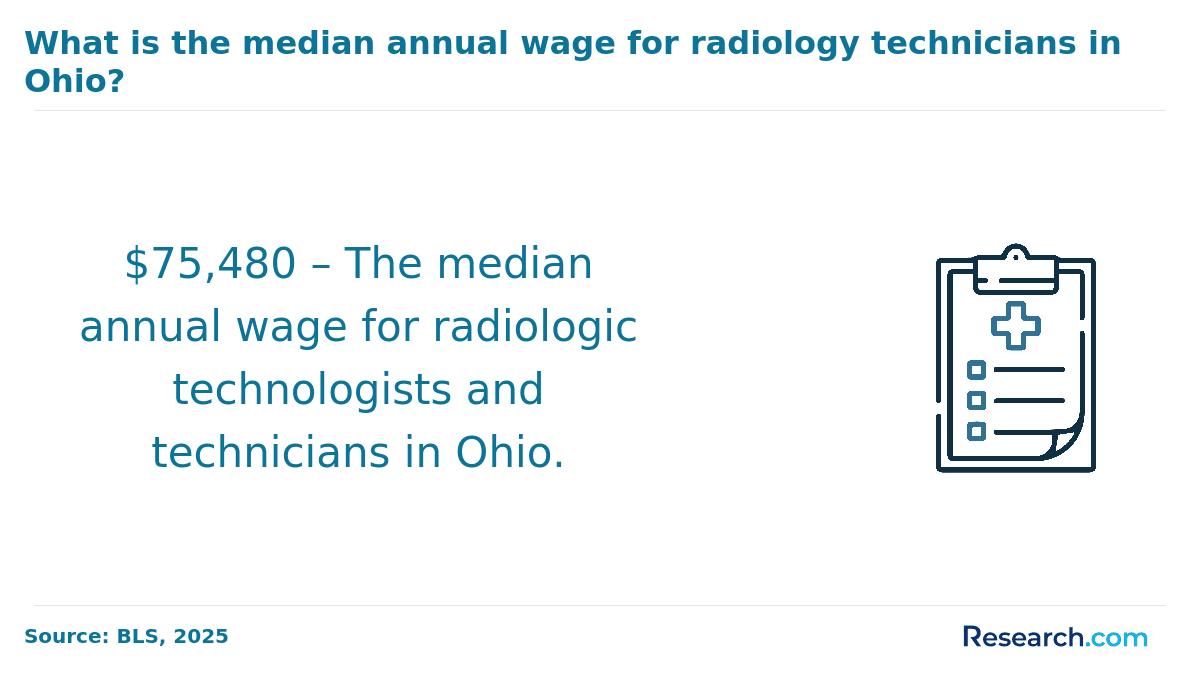
The average annual salary for radiologic technologists in Ohio is $65,260, while the average annual salary for radiology technicians in Ohio ranges from $55,000 to $65,000. These figures should be treated as planning benchmarks rather than guarantees. Individual offers may be higher or lower based on local labor demand, union or nonunion status, overtime, call pay, weekend shifts, and benefits.
| Career stage or setting | Ohio salary information stated | What can influence pay |
| Entry-level radiology technician | $40,000 to $50,000 annually | First employer, clinical experience, shift schedule, location, and initial credential |
| Typical Ohio radiology technician range | $55,000 to $65,000 annually | Experience, modality, workload, and employer pay scale |
| Average annual salary for radiologic technologists in Ohio | $65,260 | Statewide mix of roles, employer types, and experience levels |
| Experienced or specialized technologist | Beyond $65,000 | CT, MRI, mammography, leadership duties, private imaging centers, overtime, and advanced credentials |
Benefits also matter. A job with a slightly lower base salary may offer stronger health insurance, retirement contributions, paid leave, tuition support, or predictable scheduling. Government facilities, nonprofit hospitals, and large private systems may structure compensation differently, so compare total compensation rather than salary alone.
Students exploring radiologic technology as a skilled healthcare occupation may also want to compare it with all the trades to understand how training length, licensing, pay stability, and hands-on work differ across career paths.
What is the job outlook for radiology technicians in Ohio?
The radiology technician job growth Ohio outlook is expected to remain steady, with projected growth of 7% over the next decade. Demand is supported by ongoing needs in diagnostic imaging, outpatient care, hospital systems, and healthcare services for aging populations.
Radiologic technologists are likely to remain important because imaging is central to diagnosis, treatment planning, emergency care, orthopedic evaluation, surgical preparation, and chronic disease monitoring. Technology may change how images are captured, stored, reviewed, and prioritized, but healthcare teams still need trained professionals to position patients safely, produce quality images, follow protocols, and communicate with patients.
What will shape employment opportunities?
- Healthcare access patterns: More imaging services are delivered outside traditional hospital departments through outpatient centers and specialty clinics.
- Advanced modality demand: Technologists who add CT, MRI, mammography, or other credentials may have more flexibility.
- Digital imaging systems: Employers value workers who can use PACS, electronic health records, and department workflow tools accurately.
- Geography: Columbus, Cleveland, and Cincinnati may offer more openings, while rural areas may have fewer employers but different staffing needs.
- Continuing education: Workers who keep up with safety, technology, and modality changes may be better positioned for advancement.
For students who want an accessible starting point, comparing admissions requirements across programs can be useful. Research.com’s guide to an easiest radiology program may help applicants understand how selectivity, prerequisites, and program structure differ.
Which industries provide the best opportunities for radiology technicians?
Radiology technicians in Ohio work in several healthcare settings. The best choice depends on whether you prioritize salary, benefits, schedule stability, specialization, patient variety, or advancement. Hospitals often provide broad case exposure and emergency imaging experience. Outpatient centers may offer more predictable schedules. Specialty imaging practices may provide experience with advanced equipment and focused procedures.
| Work setting | Potential advantages | Possible trade-offs |
| Large hospital systems and major medical centers | Broad clinical exposure, multiple departments, advanced equipment, and clearer promotion ladders | May involve nights, weekends, holidays, high patient volume, and urgent cases |
| Outpatient imaging centers | Potentially more predictable schedules and focused imaging workflows | May offer less trauma or emergency experience than hospitals |
| Government healthcare facilities | Structured pay systems, job stability, and strong benefits may be available | Hiring processes may be more formal and slower |
| Corporate diagnostic labs and imaging companies | May offer flexible scheduling, productivity incentives, or modality-specific experience | Work pace and performance expectations may be high |
| Nonprofit and community health organizations | Mission-driven care and service to underserved populations | Salary structures may differ from private-sector employers |
Urban healthcare markets such as Cleveland, Columbus, and Cincinnati often have larger health systems, specialty facilities, and more imaging departments. However, students should not overlook regional hospitals or community-based facilities, especially if they want a specific schedule, lower commute burden, or closer patient relationships.
Questions to ask before accepting a radiology technician job
- Which imaging modalities will I use most often?
- Will the employer support CT, MRI, mammography, or other post-primary certification?
- How are call shifts, weekends, holidays, and overtime handled?
- What is the patient volume per shift?
- Are new technologists assigned mentors?
- What safety protocols, dosimetry monitoring, and quality-control processes are in place?
- Does the employer offer tuition assistance or continuing education support?
What financial aid options can support your radiology technician education in Ohio?
Radiologic technology education can involve tuition, fees, textbooks, uniforms, background checks, health screenings, transportation to clinical sites, certification exam costs, and licensure expenses. Students should compare the full cost of attendance, not just advertised tuition.
Ohio students may be able to use federal financial aid, state aid, school scholarships, healthcare workforce scholarships, employer tuition assistance, payment plans, and work-study options when available. Eligibility depends on the school, program format, enrollment status, income, academic progress, and whether the program participates in aid programs.
| Funding option | How it may help | What to check |
| Federal financial aid | Can help cover tuition and eligible education costs for qualifying students | Whether the school and program are eligible and what repayment obligations apply to loans |
| State or institutional grants | May reduce out-of-pocket cost without requiring repayment if conditions are met | Application deadlines, income rules, enrollment minimums, and renewal requirements |
| Scholarships | Can support students entering healthcare, allied health, or imaging fields | Essay requirements, GPA rules, residency criteria, and whether awards are renewable |
| Employer tuition assistance | Healthcare employers may help current employees move into radiology roles | Work commitments, reimbursement timing, eligible schools, and grade requirements |
| Payment plans | Can spread tuition payments across a term | Fees, due dates, and whether clinical or program fees are included |
Students interested in lower-cost healthcare entry points before radiologic technology may also review the best medical assistant programs in Ohio. Medical assisting is not the same career as radiologic technology, but it can help some students build healthcare experience before applying to a selective imaging program.
Ways to reduce education costs
- Complete prerequisites at a lower-cost accredited institution if credits will transfer.
- Ask programs for a written list of all required fees, clinical expenses, uniforms, and exam costs.
- Compare commute distance to clinical sites because transportation can become a hidden cost.
- Ask whether the program has employer partnerships, tuition assistance pathways, or scholarship lists.
- Avoid choosing a program solely because it is cheaper if it does not support ARRT eligibility or Ohio licensure.
What are the benefits of pursuing dual certification for radiology technicians in Ohio?
Dual certification can help radiology technicians become more versatile. In imaging, this often means adding a post-primary modality such as CT, MRI, mammography, or another specialty after building a radiography foundation. Some professionals also explore credentials in adjacent patient-care fields, including nursing, when they want broader clinical responsibility.
Dual credentials can support career flexibility, but they are not automatically the best choice for everyone. Additional education costs time and money, and some credentials lead to very different job responsibilities. Before pursuing another credential, clarify whether it aligns with your target role, employer needs, schedule, and salary goals.
| Dual credential direction | When it may make sense | When to be cautious |
| Radiography plus CT or MRI | You want advanced imaging work and stronger mobility within imaging departments | You should confirm clinical experience requirements and employer demand before enrolling |
| Radiography plus mammography | You are interested in breast imaging, women’s health, and preventive screening services | You should understand patient communication demands and modality-specific regulations |
| Radiography plus nursing | You want broader patient-care responsibility, interdisciplinary roles, or possible leadership pathways | Nursing requires a separate education and licensing path and should not be treated as a quick add-on |
| Radiography plus healthcare administration or informatics | You want to move toward management, workflow improvement, imaging systems, or data-related roles | You may need experience first to make the credential valuable in hiring decisions |
For professionals considering a broader clinical pathway, learning how to become a nurse in Ohio can help clarify whether nursing is a realistic addition or a separate career transition.
What are the latest trends and emerging technologies in radiology?
Radiology is becoming more digital, data-driven, and integrated with broader healthcare technology. Film-based workflows have largely given way to digital imaging, PACS, electronic health records, and rapid image sharing. For new Ohio radiology technicians, this means technical training should include both equipment use and digital workflow accuracy.
Artificial intelligence is also influencing radiology departments. AI tools may assist with workflow prioritization, image quality support, pattern detection, or administrative efficiency. These tools do not remove the need for trained technologists. Instead, they increase the importance of image quality, correct protocol use, data integrity, and professional judgment.
Telemedicine and teleradiology are also relevant. Images may be captured in one location and reviewed by radiologists elsewhere. That makes secure image transmission, accurate patient documentation, and consistent imaging protocols especially important in rural and multi-site healthcare systems.
Technology skills Ohio radiology technicians should build
- Comfort using digital imaging equipment and PACS workflows.
- Understanding of patient data privacy and secure image handling.
- Ability to follow standardized protocols across hospital, outpatient, and remote-review settings.
- Readiness to learn AI-supported tools without relying on them as a substitute for professional judgment.
- Commitment to continuing education as equipment, regulations, and department workflows evolve.
The main takeaway: technology is changing the workflow, but it is not eliminating the need for skilled radiology technicians. Employers still need professionals who can work safely with patients, produce diagnostic-quality images, and adapt to new systems.
How can ultrasound specialization advance your radiology career in Ohio?
Ultrasound can broaden an imaging career because it uses sound waves rather than ionizing radiation and is used in many clinical areas, including obstetrics, vascular evaluation, abdominal imaging, and point-of-care assessments. For a radiology technician, adding ultrasound knowledge may create access to different departments, patient populations, and procedure types.
This path should be planned carefully. Ultrasound is not simply an extension of X-ray positioning; it requires real-time image acquisition, anatomy recognition, probe handling, patient communication, and modality-specific training. Students should confirm certification expectations, clinical requirements, and whether employers in their target Ohio market value the added specialty.
If you want to explore this specialization in detail, review Research.com’s guide on how to become an ultrasound technician in Ohio.
What does a typical day look like for radiology technicians in Ohio?
A radiology technician’s day depends on the employer, shift, and imaging department. In a hospital, the day may include scheduled imaging, emergency cases, portable bedside exams, surgical imaging support, and urgent physician requests. In an outpatient imaging center, the workflow may be more appointment-based and predictable.
| Part of the day | Common responsibilities | Why it matters |
| Start of shift | Review the schedule, check orders, inspect equipment, and confirm room readiness | Prevents delays and supports patient safety |
| Patient preparation | Verify identity, explain the procedure, assess mobility, and answer basic questions | Builds trust and reduces positioning errors |
| Imaging procedure | Position the patient, select appropriate settings, capture images, and follow radiation-safety rules | Produces diagnostic-quality images while limiting unnecessary exposure |
| Image review and documentation | Check image quality, label images correctly, document the exam, and send images through digital systems | Helps radiologists interpret images efficiently and accurately |
| Team communication | Coordinate with radiologists, nurses, physicians, transport staff, and other technologists | Keeps patient care moving, especially in urgent or complex cases |
| End of shift | Clean equipment, complete documentation, hand off pending cases, and report issues | Maintains compliance and prepares the department for the next team |
Students who want a broader look at entry-level patient-care roles in Ohio can compare this path with how to become a medical assistant in Ohio. Medical assistants and radiology technicians both support patient care, but radiology technicians have more specialized imaging, radiation-safety, and licensure requirements.
What challenges should you expect as a radiology technician in Ohio?
Radiologic technology can be rewarding, but students should enter the field with realistic expectations. The training can be competitive, clinical schedules can be demanding, and the work requires precision under pressure.
| Common challenge | Why it happens | Better way to prepare |
| Competitive program admission | Radiologic technology programs often have limited seats and clinical placement capacity | Complete prerequisites early, maintain strong grades, and apply to more than one appropriate program |
| Clinical scheduling pressure | Rotations may occur at different sites or times and may not match a typical class schedule | Plan transportation, childcare, work hours, and finances before the clinical phase begins |
| Physical demands | Technologists stand for long periods and may assist patients with limited mobility | Use proper body mechanics and learn safe transfer practices |
| Emotional stress | Patients may be injured, frightened, or seriously ill | Build calm communication habits and learn when to ask for clinical support |
| Technology changes | Digital imaging, AI tools, and new protocols continue to evolve | Choose continuing education strategically and stay active in professional learning |
| Geographic differences in job availability | Urban areas may have more facilities, while rural areas may have fewer openings | Research local employers before choosing a program or clinical site |
Another challenge is financial planning. Students may focus on tuition but underestimate lost work hours during clinical rotations, parking, fuel, health requirements, testing fees, and licensure costs. Building a full budget before enrollment can prevent avoidable stress later.
Common mistakes to avoid
- Choosing a program without confirming accreditation and ARRT eligibility.
- Assuming the cheapest program will produce the best return on investment.
- Ignoring clinical site locations and transportation requirements.
- Waiting until graduation to learn about Ohio licensure steps.
- Assuming online coursework alone is enough for a hands-on imaging profession.
- Overlooking continuing education requirements after becoming licensed.
- Expecting salary outcomes to be guaranteed rather than influenced by employer, location, credentials, and experience.
What legal and ethical best practices should radiology technicians follow in Ohio?
Radiology technicians in Ohio work with regulated equipment, protected health information, and patients who depend on safe imaging practices. Legal and ethical standards are not optional; they are part of competent practice.
Technologists must maintain Ohio licensure and ARRT certification requirements as applicable, follow facility policies, protect patient privacy under HIPAA, and use radiation safely. The ALARA principle—keeping radiation exposure “As Low As Reasonably Achievable”—remains a key standard in radiologic practice.
| Best practice | What it means in daily work | Risk if ignored |
| Verify patient identity and order accuracy | Confirm the patient, exam, body part, and clinical instructions before imaging | Wrong-patient or wrong-procedure errors |
| Use radiation protection consistently | Apply appropriate exposure settings, shielding practices, distance, and time principles | Unnecessary exposure or repeat imaging |
| Protect patient privacy | Handle digital images, records, and conversations securely | HIPAA violations and loss of patient trust |
| Respect patient dignity | Explain procedures, drape appropriately, and communicate with empathy | Patient distress, complaints, or refusal to cooperate |
| Document accurately | Record completed exams, technical notes, and relevant patient limitations | Incomplete medical records and care delays |
| Stay within scope of practice | Perform authorized imaging tasks without diagnosing or giving unsupported interpretations | Professional discipline and patient harm |
As departments use more cloud-based systems, remote image review, and AI-supported workflows, data security and ethical technology use will become even more important. Technologists should understand how their facility handles access controls, image transmission, audit trails, and reporting errors.
What career and professional development opportunities exist for radiology technicians in Ohio?
Radiology technicians can advance by gaining experience, adding post-primary certifications, moving into advanced imaging modalities, becoming lead technologists, training students, working in quality assurance, or transitioning into management. Professional development should be intentional: the best next step depends on your current credential, employer needs, and long-term career goals.
ARRT credentials remain important for many imaging pathways. Technologists may pursue additional qualifications in areas such as computed tomography (CT), mammography, MRI, or nuclear medicine technology, depending on eligibility and clinical access. Continuing education is also part of maintaining licensure renewal every two years.
| Advancement path | What it can lead to | Good fit for |
| CT or MRI specialization | Advanced modality roles and broader imaging department flexibility | Technologists who enjoy complex imaging protocols and technology-heavy work |
| Mammography | Focused work in breast imaging and preventive screening | Technologists with strong patient communication and attention to detail |
| Lead technologist or supervisor | Team coordination, scheduling input, quality monitoring, and department leadership | Experienced technologists who enjoy mentoring and operations |
| Clinical education | Training students or new hires in imaging procedures and professional standards | Technologists who communicate clearly and model safe practice |
| Quality assurance or informatics | Protocol improvement, image quality review, workflow systems, and data-focused roles | Detail-oriented professionals interested in systems and process improvement |
Professional organizations such as the Ohio Society of Radiologic Technologists (OSRT) can support networking, continuing education, professional updates, and mentorship. Hospitals and medical centers across Ohio, including Cleveland Clinic and OhioHealth, may also provide internal training, tuition support, and advancement pathways for qualified employees.
If salary growth is a major part of your planning, compare Ohio earnings with national patterns using Research.com’s guide to average radiologic technologist salary.
How can merging radiology and nursing credentials enhance your radiology career in Ohio?
Combining radiologic technology and nursing credentials can create a wider clinical profile, especially for professionals interested in interventional radiology, procedural care, care coordination, leadership, or patient education. The combination can improve communication with physicians and nurses because the professional understands both imaging workflow and broader patient-care protocols.
However, nursing is a separate licensed profession with its own education, clinical requirements, exam expectations, and scope of practice. It should be pursued because it fits a clear career goal, not because it seems like a simple add-on. For some technologists, CT, MRI, mammography, management, or informatics may be a more direct advancement route.
If you are considering this interdisciplinary direction, review how to get a nursing license in Ohio before committing to a second credential pathway.
What do radiology technicians say about their careers in Ohio?
My radiology technician training at Ohio State University gave me the structure and clinical preparation I needed for hospital work in Columbus. The coursework was challenging, but it helped me become comfortable with patient positioning, safety expectations, and fast-paced imaging requests. What keeps me in the field is the immediate connection between careful imaging and better patient care. - Annie
The University of Cincinnati helped me build a strong foundation in imaging procedures and patient communication. Starting in a regional hospital exposed me to many types of cases, and that variety helped me gain confidence quickly. I value this career because it lets me serve my community while continuing to improve a specialized healthcare skill set. - Jimmy
Kent State University prepared me for both the technical and human sides of radiologic technology. When I began working in northeastern Ohio, I found that ongoing education and supportive colleagues made a real difference. This profession requires accuracy, but it also requires compassion because every image belongs to a patient who needs answers. - Bianca
Related Articles for Nearby States
- 2027 How to Become a Radiology Technician in Indiana
- 2027 How to Become a Radiology Technician in Kentucky
- 2027 How to Become a Radiology Technician in West Virginia
- 2027 How to Become a Radiology Technician in Pennsylvania
- 2027 How to Become a Radiology Technician in Michigan
- 2027 How to Become a Radiology Technician in Illinois
- 2027 How to Become a Radiology Technician in Virginia
- 2027 How to Become a Radiology Technician in Tennessee
- 2027 How to Become a Radiology Technician in North Carolina
- 2027 How to Become a Radiology Technician in Missouri
References:
- American Registry of Radiologic Technologists. (2025). Credential statistics & census. American Registry of Radiologic Technologists.
- AMN Healthcare. (n.d.). Top-5 highest paying states for radiologic technologist. AMN Healthcare.
- HCTN. (n.d.). Radiologic technologists: Highest salaries by state. Health Carousel Travel Nursing. HCTN.
- Medical Professionals. (n.d.). Rad tech salary range in the US by state and modality. Medical Professionals.
- Nurse.org. (2025). Radiology tech salary by state | 2025. Nurse.org.
Key Insights
- To work as a radiology technician in Ohio, plan for accredited education, clinical training, ARRT certification, and Ohio licensure rather than treating the career as an informal technical job.
- The average annual salary for radiologic technologists in Ohio is $65,260, while many Ohio radiology technician salaries fall in the $55,000 to $65,000 range; entry-level roles may start around $40,000 to $50,000 annually.
- Ohio’s projected 7% job growth over the next decade suggests stable demand, but job availability and pay can differ significantly between hospitals, outpatient centers, government facilities, and rural or urban markets.
- The best program is not always the fastest or cheapest. Confirm accreditation, ARRT eligibility, Ohio licensure alignment, clinical placement quality, and total program cost before enrolling.
- Specializing in CT, MRI, mammography, ultrasound, informatics, or leadership can improve long-term career flexibility, but each option should be matched to employer demand and your preferred work environment.
- Common mistakes include ignoring licensure requirements, underestimating clinical schedule demands, focusing only on tuition, and assuming salary outcomes are guaranteed.
- Radiology technology is becoming more digital and AI-supported, but patient positioning, safety judgment, communication, and ethical practice remain central to the profession.
Other Things You Should Know About Becoming a Radiology Technician in Ohio
The Ohio Department of Health regulates radiologic licenses in Ohio through the Bureau of Environmental Health and Radiation Protection. Applicants must meet state education standards, complete approved clinical training, and hold the required credential for the imaging duties they perform, such as radiography or limited x-ray work.
Radiology technicians in Ohio must complete 24 hours of continuing education every two years to maintain their certification. This includes specific coursework in radiation safety and patient care, as mandated by the Ohio Medical Board.


