
2027 How to Become a Nurse in Ohio

Co-Founder and Chief Data Scientist
Becoming a nurse in Ohio is a practical career path for people who want a healthcare role with clear licensure rules, multiple entry points, and steady demand across hospitals, clinics, long-term care, home health, and advanced practice settings. Ohio has more than 130,000 registered nurses, and registered nurses in the state earn an average annual salary of $84,430—well above the state average for all occupations. Even with projected registered nursing job growth of 3.4% through 2032, the state is expected to see more than 7,000 openings each year, largely because employers must replace workers who retire, transfer, or leave the field.
This guide explains how to become a nurse in Ohio, including education options, licensing steps, compact license rules, continuing education, online program considerations, career advancement, and common mistakes to avoid. It is written for first-time nursing students, career changers, licensed practical nurses planning to become RNs, and current nurses considering graduate study or specialized roles.
Quick Answer: How do you become a nurse in Ohio?
To become a nurse in Ohio, you must complete an Ohio Board of Nursing-approved nursing program, pass the correct NCLEX exam, submit a license application, complete fingerprinting and a background check, and maintain your license through required continuing education. Registered nurses typically earn an ADN or BSN and pass the NCLEX-RN, while licensed practical nurses complete a practical nursing program and pass the NCLEX-PN.
- Ohio has faced serious workforce concerns, including a projected shortage of more than 20,000 unfilled nursing positions by 2025, driven by healthcare demand, an aging population, and retirements.
- Registered nurses in Ohio earn approximately $84,430 per year on average, although pay varies by experience, specialty, employer, shift, and location. Larger metro areas such as Columbus and Cleveland often offer higher wages because of demand and local labor markets.
- The Bureau of Labor Statistics projects 3.4% growth for registered nursing jobs in Ohio from 2022 to 2032, with 7,630 average annual openings expected during that period.
- Ohio nurses can work in urban hospitals, rural clinics, long-term care facilities, outpatient centers, home health, telehealth, education, leadership, and advanced practice roles.
- Online coursework, hybrid nursing programs, accelerated tracks, simulation tools, telehealth, and electronic health records continue to shape how nurses are educated and how they deliver care.
- Steps to become a nurse in Ohio
- Education requirements for Ohio nurses
- Nursing roles legally recognized in Ohio
- Ohio nursing license requirements
- Types of nursing licenses in Ohio
- Compact nursing license rules in Ohio
- Whether you can work as a nurse without a license
- LPN program options in Ohio
- Interdisciplinary healthcare career options
- Easiest LPN programs to enter
- Nurse practitioner opportunities in Ohio
- Continuing education and certification options
- Alternative healthcare roles for nurses
- Current state of nursing in Ohio
- Benefits of online nursing programs
- Legal and ethical considerations
- Nursing job outlook in Ohio
- Transitioning to nurse midwifery
- How to choose an Ohio nursing program
- Professional resources and networking
- How to judge nursing program quality
What are the steps to becoming a nurse in Ohio?
The basic path to nursing in Ohio depends on the license you want, but the sequence is straightforward: choose a role, complete the right education, pass the required exam, apply for licensure, and keep your credentials active. The biggest decision early on is whether you want to become an LPN, RN, or advanced practice nurse.
| Step | What you need to do | Why it matters |
| 1. Choose your nursing role | Decide whether your first target is LPN, RN, APRN, or another healthcare support role. | Your choice determines the degree, exam, timeline, scope of practice, and career options available to you. |
| 2. Complete an approved program | Enroll in a practical nursing, ADN, BSN, MSN, DNP, or PhD program that aligns with your goals. | Graduating from an appropriate program is required before you can sit for the relevant licensure exam. |
| 3. Pass the NCLEX | RNs take the NCLEX-RN, while LPNs take the NCLEX-PN. | The exam verifies that you have the minimum knowledge and judgment needed for safe entry-level practice. |
| 4. Apply through the Ohio Board of Nursing | Submit the application, education documentation, exam information, and required background check materials. | Ohio requires formal licensure before you can legally practice as a nurse in the state. |
| 5. Maintain your license | Complete required continuing education and renew your license on schedule. | Ongoing learning helps nurses stay current with safety standards, technology, regulations, and clinical practice changes. |
- Start with the right education level. An Associate Degree in Nursing usually takes two years, while a Bachelor of Science in Nursing is commonly structured as a four-year degree. Many employers increasingly prefer the BSN because it includes broader preparation in leadership, public health, research, and care coordination.
- Plan for licensure from the beginning. Before enrolling, confirm that your program is approved for Ohio licensure eligibility. Graduation alone is not enough if the program does not meet state requirements.
- Use the Nurse Licensure Compact strategically. Ohio participates in the Nursing Licensure Compact, which can help eligible nurses practice across compact states without applying for a separate license in each one.
- Budget time for continuing education. Ohio nurses must complete 24 continuing education units every two years to maintain licensure.
Nursing in Ohio is also changing. Telehealth, remote monitoring, electronic documentation, interdisciplinary care teams, and advanced practice roles are making digital confidence and communication skills more important. Students who want long-term mobility should choose programs that prepare them for both bedside care and technology-supported care delivery.
If you are comparing nursing with adjacent entry-level healthcare careers, reviewing the CNA salary by state can help you understand how nursing assistant roles differ from licensed nursing positions in pay, scope, and advancement potential.
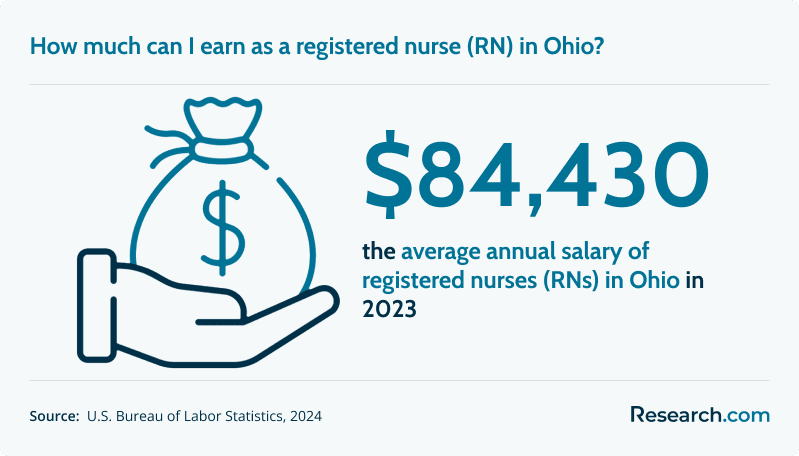
In 2023, registered nurses in Ohio earned about $84,430 per year, which is substantially higher than the average annual pay for all occupations in the state.
What are the educational requirements for becoming a nurse in Ohio?
Ohio nursing education is not one-size-fits-all. Some students want the fastest route into licensed practice, while others want a bachelor’s degree, graduate credentials, or advanced practice authority. The best choice depends on your timeline, finances, prior college credits, career goals, and whether you want to work while enrolled.
| Credential | Typical purpose | Common timeline stated in this guide | Best fit |
| Practical nursing certificate or diploma | Prepares students for LPN practice and the NCLEX-PN | Usually about one year | Students seeking a faster entry into basic nursing care roles |
| Associate Degree in Nursing | Prepares graduates for RN licensure through the NCLEX-RN | Typically two years | Students who want a shorter RN pathway and may later complete a BSN |
| Bachelor of Science in Nursing | Provides RN preparation plus broader coursework in leadership, research, community health, and complex care | Typically four years | Students who want stronger long-term mobility or plan to pursue graduate nursing education |
| Master of Science in Nursing | Prepares nurses for advanced clinical, leadership, education, or specialty practice roles | Often an additional two years after the BSN | RNs aiming for roles such as nurse practitioner or clinical nurse specialist |
| Doctor of Nursing Practice | Focuses on advanced clinical practice, systems leadership, and evidence-based improvement | Usually three to four years | Nurses pursuing the highest level of practice-focused nursing education |
| PhD in Nursing | Emphasizes research, theory, academic scholarship, and knowledge development | Varies by program | Nurses interested in research, faculty roles, or academic leadership |
- ADN programs are often offered by community colleges and prepare graduates for entry-level RN licensure. They can be cost-effective, but students should check transfer policies if they plan to complete a BSN later.
- BSN programs offer broader preparation and may improve competitiveness for hospital roles, leadership tracks, and graduate admission.
- MSN programs are designed for licensed nurses who want advanced clinical or professional roles. Some students explore accelerated NP online degree options when they already meet prerequisites and want a shorter route.
- DNP programs are practice-focused doctorates often selected by nurses who want advanced clinical leadership, systems improvement, or high-level practice preparation.
- PhD programs are usually best for nurses who want to conduct research, teach in higher education, or contribute to nursing science.
Accreditation and state approval should come before convenience, cost, or brand recognition. A program should be recognized by the Ohio Board of Nursing when licensure eligibility is the goal. Students should also pay attention to national nursing accreditation, clinical placement support, NCLEX outcomes, and whether online coursework still includes required in-person clinical experiences.
Two formats are especially important for career changers and working adults:
- Accelerated programs: Some programs are designed for students who already have a degree in another field and can often be completed in 12 to 18 months.
- Online and hybrid programs: These may offer flexible didactic coursework, but nursing still requires clinical learning. Always ask where clinicals take place and who arranges them.
If your long-term goal is advanced practice, compare the prerequisites, clinical requirements, and state authorization details of options such as 1 year nurse practitioner programs online before assuming a shorter program is the best fit.
What types of nurses can legally practice in Ohio?
Ohio recognizes several nursing and nursing-adjacent roles, each with a different legal scope, education requirement, and level of independence. Understanding these differences can prevent costly mistakes, especially if you are comparing LPN, RN, and nurse practitioner pathways.
| Role | Education and exam pathway | Typical responsibilities | Decision point |
| Licensed Practical Nurse | Completion of a practical nursing program and passage of the NCLEX-PN | Basic nursing care, patient monitoring, medication-related duties within scope, and support under supervision | Good for faster entry, but advancement usually requires additional education |
| Registered Nurse | ADN or BSN plus passage of the NCLEX-RN | Assessment, care planning, medication administration, patient education, coordination, and clinical judgment | Best general nursing license for broad employment options |
| Advanced Practice Registered Nurse | Graduate nursing education, national certification, and advanced practice authorization | Advanced assessment, diagnosis, treatment planning, specialty care, prescribing authority where permitted, and care management | Best for experienced nurses seeking more autonomy and specialization |
| Certified Nursing Assistant | State-approved training and competency testing | Hands-on support with daily care tasks under supervision | Helpful entry point into healthcare, but not a licensed nurse role |
- Registered Nurses: RNs are central to patient care in Ohio hospitals, clinics, long-term care, home health, and specialty settings. They usually complete an ADN or BSN, then pass the NCLEX-RN. Earlier projections cited 7% growth for RNs from 2019 to 2029.
- Licensed Practical Nurses: LPNs usually complete a shorter program, often about one year, and pass the NCLEX-PN. They commonly work in long-term care, clinics, rehabilitation, and other settings where practical nursing support is needed.
- Advanced Practice Registered Nurses: APRNs include nurse practitioners, clinical nurse specialists, nurse anesthetists, and nurse midwives. They need graduate education and national certification in their area of practice.
- Certified Nursing Assistants: CNAs are important members of the care team, but they are not licensed nurses. CNA experience can help students decide whether nursing is a good fit before committing to a longer program.
Ohio’s nursing roles are likely to continue shifting as telehealth, chronic disease management, rural access needs, and team-based care expand. Students should choose the lowest credential that meets their immediate goal—but avoid choosing a short program if it delays the career they actually want.
In 2023, the highest-earning nursing occupation in Ohio was nurse anesthetist, with average annual earnings of $210,760. Nurse midwives followed with an average annual salary of $124,140. The chart below provides additional detail.
What are the licensing requirements for nurses in Ohio?
Ohio nursing licensure is designed to verify education, exam readiness, legal eligibility, and public safety. The exact application requirements depend on whether you are applying as an RN, LPN, APRN, or another regulated role, but most applicants should expect education verification, testing, fingerprinting, and a background check.
- Complete the required education. RNs typically complete an ADN or BSN, while LPNs complete a practical nursing program. Advanced practice nurses need graduate-level nursing education and specialty certification.
- Pass the correct national exam. RN applicants take the NCLEX-RN. LPN applicants take the NCLEX-PN. APRNs must meet additional certification requirements in their advanced practice role.
- Submit an application to the Ohio Board of Nursing. The application includes documentation such as proof of education, exam-related information, and identity/background materials.
- Complete fingerprinting and background checks. Ohio requires these safeguards for nursing applicants to help protect patients and identify disqualifying histories.
- Pay the required fee. The application fee typically ranges from $75 to $100, depending on the license type.
- Renew and complete continuing education. Ohio nurses must keep licenses current and complete required continuing education within the renewal cycle.
| Requirement | Why it exists | Common mistake to avoid |
| Board-approved education | Confirms the program prepares students for Ohio practice standards | Choosing a program before verifying state approval |
| NCLEX-RN or NCLEX-PN | Measures entry-level nursing competence | Waiting until graduation to learn exam eligibility rules |
| Background check and fingerprinting | Supports patient safety and public trust | Assuming past legal issues will not matter during review |
| License renewal and continuing education | Keeps nurses current with practice changes and regulations | Missing renewal deadlines or completing nonqualifying CE |
Licensure requirements can change, especially as telehealth, multistate practice, and advanced practice roles evolve. Before applying, prospective nurses should confirm current instructions directly with the Ohio Board of Nursing rather than relying only on school marketing materials or third-party summaries.
What types of nursing licenses are available in Ohio?
Ohio offers several nursing license pathways, and each one leads to a different scope of practice. Choosing the right license is less about which one sounds most prestigious and more about the care you want to provide, the time you can invest, and how far you want to advance.
- Registered Nurse license: This license is for graduates of eligible nursing programs who pass the NCLEX-RN. RNs assess patients, deliver and coordinate care, administer medications, educate patients, and work with physicians and interdisciplinary teams. Students may begin with an ADN and later complete a BSN; many fast track RN to BSN online programs are available to Ohio residents.
- Licensed Practical Nurse license: LPNs complete a shorter practical nursing pathway and pass the NCLEX-PN. They provide basic nursing care, monitor patients, and assist RNs and physicians in hospitals, nursing homes, clinics, and other settings.
- Advanced Practice Registered Nurse authorization: APRNs include nurse practitioners, clinical nurse specialists, nurse anesthetists, and nurse midwives. These roles require graduate nursing education and national certification. APRNs may diagnose, treat, prescribe, and manage care within their legal scope.
Ohio also recognizes specialized healthcare certifications and roles such as Dialysis Technicians, Community Health Workers, and Medication Aides. These are not interchangeable with RN or LPN licensure, so students should be clear about whether a program leads to a nursing license, a certificate, or a support role.
Technology is also changing expectations. Nurses increasingly need comfort with electronic health records, telehealth visits, patient portals, remote monitoring tools, and data-informed care coordination. Specialized credentials in leadership, informatics, case management, geriatrics, critical care, or community health may strengthen career options after licensure.
If you are considering graduate practice, comparing average nurse practitioner salaries by state can help you evaluate whether the extra education aligns with your financial and career goals.
Can a Compact nurse practice in Ohio?
Yes. Ohio is a Nurse Licensure Compact state, which means eligible nurses with a multistate license from another compact state may practice in Ohio without obtaining a separate Ohio license. This is especially useful for travel nurses, telehealth nurses, nurses who live near state borders, and employers that need to respond quickly to staffing shortages.
Under the compact model, a nurse maintains one multistate license in the primary state of residence and may practice in 40 other compact states, including Ohio. The compact can reduce administrative delays, but it does not remove the nurse’s responsibility to follow the laws and scope of practice rules of the state where the patient is located.
| If you have... | Can you practice in Ohio? | What to verify first |
| A valid multistate license from an NLC state | Generally yes, if Ohio practice is allowed under compact rules | Primary state of residence, license status, and any practice restrictions |
| A single-state license from another state | Not automatically | Whether you need Ohio licensure by endorsement or another application route |
| An Ohio license | Yes, within Ohio scope and license status | Renewal status, continuing education, and compact eligibility if multistate practice is desired |
Compact practice is not a shortcut around professional standards. Nurses still need to understand documentation requirements, employer policies, mandatory reporting, telehealth rules, and patient privacy obligations. Those planning to move from RN practice into advanced roles may also want to compare graduate options such as the most affordable online BSN to DNP degree programs.
Can you practice as a nurse without a license in Ohio?
No. You cannot legally practice as a nurse in Ohio without the appropriate license. Calling yourself an RN or LPN, performing licensed nursing functions, or accepting nursing responsibilities without authorization can create legal risk, employment consequences, and serious patient safety concerns.
Ohio requires nursing licensure because nurses make clinical judgments, administer medications, monitor changes in condition, document care, and communicate with providers about patient needs. Licensure confirms that a person has completed required education, passed the relevant exam, and met background check standards.
There are healthcare roles that do not require an RN or LPN license, but they have different titles and scopes. For example, nursing assistants and orderlies are not the same as licensed nurses, and employment of nursing assistants and orderlies was expected to rise by 4% from 2022 to 2032. These roles can be a useful starting point, but they do not authorize independent nursing practice.
Students should also be cautious with informal job titles. If a position description asks you to perform licensed nursing tasks before you are licensed, ask the employer to clarify the legal scope, supervision, and credential required. When in doubt, verify with the Ohio Board of Nursing.
What are the options for LPN programs in Ohio?
LPN programs are a common first step for students who want to enter nursing more quickly than a traditional RN pathway allows. These programs generally focus on practical nursing fundamentals, patient care skills, pharmacology basics, clinical judgment, and preparation for the NCLEX-PN.
When comparing LPN programs, prioritize approval status, NCLEX-PN preparation, clinical placement quality, schedule format, cost, and graduate support. A program that is easy to enter is not necessarily the best choice if it has weak clinical partnerships or poor exam preparation. To compare accredited options, review online LPN programs in Ohio.
What interdisciplinary opportunities can broaden your healthcare career in Ohio?
Nursing experience can open doors beyond traditional bedside roles. Ohio healthcare employers need professionals who understand patient care, workflow, compliance, medication safety, documentation, population health, and care coordination. Nurses who want a broader career may move toward pharmacy, healthcare administration, informatics, case management, quality improvement, public health, or revenue cycle roles.
Interdisciplinary moves make the most sense when they build on your existing strengths. For example, a nurse interested in medication management and patient counseling may want to learn how to become a pharmacist in Ohio, while a nurse interested in systems and documentation may consider health information or billing-related paths.
What is the easiest LPN program to get into?
The easiest LPN program to enter is not always the smartest program to choose. A less selective admissions process may help you start sooner, but you still need a program that is properly approved, prepares you for the NCLEX-PN, offers real clinical experience, and fits your schedule and budget.
Before applying, ask each school about prerequisites, waitlists, clinical site availability, graduation rates, NCLEX-PN preparation, tutoring, and financial aid. Students seeking accessible admissions can review What is the easiest LPN program to get into? for a more focused comparison.
What are the nurse practitioner career opportunities in Ohio?
Nurse practitioner roles can be a strong advancement path for RNs who want more clinical responsibility, specialization, and autonomy. In Ohio, nurse practitioners may work in primary care, acute care, family practice, women’s health, pediatrics, geriatrics, psychiatric-mental health, specialty clinics, rural health settings, and hospital systems.
This path requires graduate nursing education, national certification, and compliance with Ohio advanced practice requirements. It is usually best for nurses who enjoy assessment, diagnostic reasoning, long-term patient management, and higher accountability. For a detailed pathway, review the nurse practitioner education requirements in Ohio.
What are the continuing education and certification options for nurses in Ohio?
Ohio nurses must complete continuing education to renew their licenses, but continuing education should be more than a compliance task. The right courses can help nurses move into specialty practice, leadership, case management, informatics, education, quality improvement, or advanced clinical roles.
- Licensure renewal education: Required coursework helps nurses remain current with standards, safety expectations, and regulatory obligations.
- Specialty certification preparation: Certifications in areas such as critical care, pediatrics, geriatrics, emergency nursing, or oncology can demonstrate focused expertise.
- Technology and telehealth training: Digital care delivery and electronic documentation make technology skills increasingly important.
- Leadership and management education: Nurses aiming for charge nurse, manager, director, or administrative roles may benefit from coursework in supervision, budgeting, quality, and healthcare operations.
Nurses who want to shorten the time needed to enter or advance in the field can also compare accelerated nursing programs and determine whether those routes fit their prior education and licensure goals.
Can nurses transition to alternative healthcare roles in Ohio?
Yes. Nurses can transition into alternative healthcare roles when they want to use clinical knowledge without staying in the same bedside or direct patient care position. Common directions include health information management, medical billing and coding, care coordination, utilization review, clinical education, quality improvement, risk management, and healthcare administration.
These transitions can be especially appealing for nurses seeking different schedules, less physical strain, or more administrative responsibility. However, moving away from direct care may require additional training in coding systems, compliance, data privacy, software platforms, or healthcare finance. Nurses interested in the administrative side of care can explore how to become a medical biller and coder in Ohio.
What is the state of nursing in Ohio?
Nursing in Ohio remains a large and essential workforce, but demand varies by region, employer type, specialty, and care setting. The state has major hospital systems and academic medical centers as well as rural clinics, long-term care facilities, home health agencies, rehabilitation centers, and community-based providers that rely heavily on nurses.
Employment and workforce demand
The most recent data cited in this guide shows that employment of RNs in Ohio is projected to grow by about 3.4% from 2022 to 2032. That growth rate is modest, but openings remain significant because healthcare employers must replace nurses who retire, leave the occupation, or move into other roles. Earlier workforce discussions also noted more than 150,000 licensed nurses in Ohio.
Shortage pressure and burnout risks
Some Ohio employers report difficulty filling nursing positions, especially in rural communities, underserved urban areas, long-term care, geriatrics, and specialized units. Shortages can increase workloads, affect scheduling, and contribute to burnout. Students should consider not only where jobs exist, but also what patient ratios, onboarding, mentorship, and shift expectations look like.
Cost of living and location choices
Ohio can be attractive for nurses because many communities offer a lower cost of living than more expensive states. Still, salary should be evaluated locally. A role in Columbus, Cleveland, or Cincinnati may pay differently than one in a rural county, and commuting costs, housing, shift differentials, and benefits can change the real value of an offer.
Where nurses work in Ohio
- Hospitals and health systems remain major employers for RNs and specialized nurses.
- Long-term care facilities continue to need LPNs, RNs, nursing assistants, and nurse leaders.
- Outpatient clinics, ambulatory care centers, home health agencies, and rehabilitation providers offer alternatives to traditional hospital shifts.
- Telehealth and remote patient support create additional opportunities for nurses who are comfortable with technology and virtual communication.
- Nurses interested in leadership may consider advanced nursing degrees, certificates, or related graduate study such as one year MHA programs available online to Ohio residents.
In 2023, registered nurses made up the largest share of the nurse workforce shown here, with 133,300 workers. The chart below shows more information about employment levels.
How can online nursing programs benefit your career in Ohio?
Online and hybrid nursing programs can help Ohio students manage school around work, caregiving, military obligations, or geographic limitations. They are especially useful for RN-to-BSN, MSN, DNP, and some certificate pathways where licensed nurses already have clinical experience.
However, nursing cannot be learned entirely through online lectures. Even when coursework is online, programs must still provide clinical experiences, simulation, skills practice, or supervised placements as required by the credential. Before enrolling, ask who arranges clinical placements, where they occur, and whether the program meets Ohio licensure or advancement requirements. To compare flexible options, review the best online nursing programs in Ohio.
What are the legal and ethical considerations for nursing practice in Ohio?
Ohio nurses must practice within their authorized scope, protect patient confidentiality, document accurately, report concerns when required, and follow professional standards. Ethical nursing practice also requires informed communication, respect for patient dignity, cultural awareness, safe delegation, and accountability when errors or unsafe conditions occur.
Legal and ethical issues often arise in everyday decisions: whether a task can be delegated, how to handle medication errors, when to report abuse or neglect, how to document patient refusal, and how to protect health information in electronic systems. Because requirements can change, nurses should regularly review requirements for nursing licensure in Ohio and employer policies that affect their role.
What is the job outlook for nursing in Ohio?
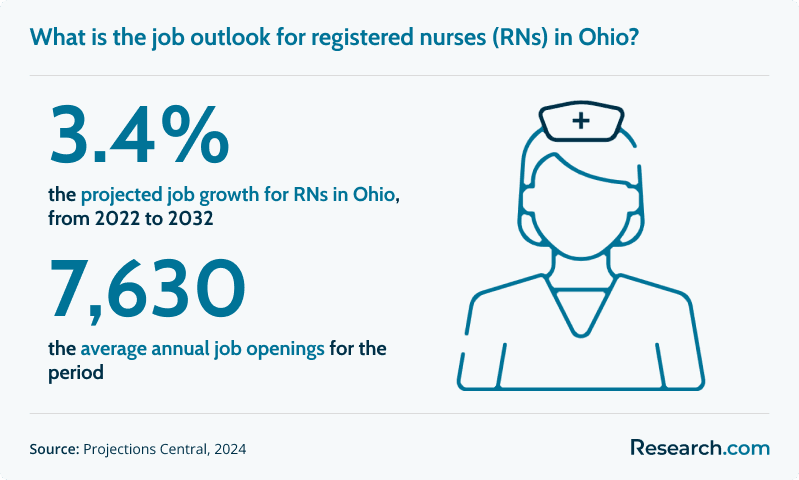
The nursing job outlook in Ohio is steady rather than explosive. Registered nursing employment is projected to grow 3.4% from 2022 to 2032, and experts expect 7,630 average annual openings throughout that period. For job seekers, that means opportunity exists, but the strongest candidates will be those who match employer needs in clinical skill, specialty readiness, communication, reliability, and technology use.
| Career factor | What it means for Ohio nurses | How to respond |
| Modest projected growth | New positions may not expand rapidly in every market | Apply broadly and consider high-need settings such as long-term care, rural health, and specialty units |
| High annual openings | Replacement demand creates steady hiring needs | Build a strong resume, clinical references, and NCLEX readiness early |
| Specialty demand | Critical care, geriatrics, primary care, and advanced practice may offer stronger prospects | Use certifications, preceptorships, and continuing education to differentiate yourself |
| Technology adoption | Telehealth and electronic records are now routine in many settings | Develop digital documentation, remote care, and patient communication skills |
What are the career advancement opportunities for nurses in Ohio?
Ohio nurses can advance by deepening clinical expertise, earning higher degrees, moving into leadership, or shifting into education and systems-focused roles. Advancement should be planned around the type of work you want, not just the next credential available.
- Graduate nursing education: An MSN or DNP can prepare nurses for roles such as nurse practitioner, clinical nurse specialist, nurse educator, or advanced clinical leader.
- Specialty certification: Credentials in critical care, geriatrics, pediatrics, emergency care, oncology, or another specialty can make nurses more competitive and support higher-responsibility assignments.
- Leadership roles: Experienced nurses may move into charge nurse, nurse manager, director of nursing, or chief nursing officer positions.
- Education and training: Nurses who enjoy teaching may become preceptors, clinical instructors, staff development specialists, or nurse educators.
- Systems and quality roles: Opportunities also exist in informatics, case management, utilization review, quality improvement, risk management, and patient safety.
Advancement usually requires more than years of experience. Employers often look for strong documentation habits, reliable communication, mentoring ability, evidence-based practice, and comfort with data and technology.
How can I transition to nurse midwifery in Ohio?
Nurse midwifery is an advanced practice route for nurses interested in pregnancy, birth, reproductive health, patient education, and family-centered care. The transition generally requires graduate-level education, supervised clinical preparation, national certification, and alignment with Ohio practice requirements.
Before choosing a program, compare midwifery coursework, clinical site availability, faculty experience, board preparation, and whether the program supports students in your state. Speaking with practicing nurse midwives can also clarify the realities of call schedules, liability, collaboration, and patient population needs. For a focused pathway, see how to become a nurse midwife in Ohio.
How to Choose the Right Nursing Program in Ohio
The right Ohio nursing program is the one that leads to the license or credential you actually need, fits your life realistically, and gives you strong preparation for clinical practice. Do not choose based only on convenience, tuition, or advertising claims.
| Question to ask | Why it matters | Red flag |
| Is the program approved for Ohio licensure? | Approval affects your ability to sit for the NCLEX and become licensed. | The school is vague about Ohio Board of Nursing approval. |
| Is the program accredited by a recognized nursing accreditor? | Accreditation can affect transfer, graduate admission, and employer confidence. | The school emphasizes speed but does not clearly explain accreditation. |
| What are the NCLEX outcomes? | Exam preparation is a practical measure of program effectiveness. | The program avoids sharing pass-rate information or support resources. |
| How are clinical placements handled? | Nursing students need supervised clinical experiences, even in online programs. | Students must find placements with little school support. |
| What is the full cost? | Fees, supplies, uniforms, background checks, testing, travel, and lost work time can add up. | The school promotes low tuition but does not explain total expenses. |
| Can credits transfer or stack? | Many nurses move from LPN to RN, ADN to BSN, or BSN to MSN/DNP. | Credits do not transfer well or the pathway is unclear. |
Students pursuing advanced practice should compare clinical hours, certification preparation, faculty support, and specialty options. For example, those considering nurse practitioner roles can review the best NP programs in Ohio to understand how program formats and specialties differ.
Common mistakes to avoid when choosing a nursing program
- Choosing without checking approval and accreditation. A convenient program is not helpful if it does not support licensure or advancement.
- Looking only at tuition. Books, equipment, fees, travel, clinical requirements, exam costs, and reduced work hours can change affordability.
- Assuming online means fully remote. Nursing programs often require in-person labs, simulations, or clinical placements.
- Ignoring NCLEX support. A program should help students prepare for licensure exams, not simply deliver coursework.
- Relying only on rankings. Rankings can be useful, but your best program depends on licensure fit, schedule, cost, support, and clinical access.
- Assuming salary outcomes are guaranteed. Pay depends on employer, region, specialty, experience, shift, and credentials.
What should prospective nurses ask before enrolling?
- Does this program qualify graduates for the Ohio license I want?
- What NCLEX exam will I be eligible to take after graduation?
- Where do students complete clinical requirements?
- Does the school arrange placements, or must students find them?
- What is the total estimated cost, including fees and supplies?
- Can I work while enrolled, or is the schedule too intensive?
- What support exists for tutoring, exam prep, remediation, and advising?
- Will my credits transfer if I later pursue an RN, BSN, MSN, or DNP?
- What percentage of graduates find nursing employment, and in what settings?
- Does the program meet requirements for students who live outside Ohio or plan compact-state practice?
What professional resources and networking opportunities support nursing careers in Ohio?
Professional networks can help Ohio nurses find mentors, continuing education, policy updates, job leads, and specialty communities. Local and statewide nursing associations, employer-based councils, specialty organizations, alumni networks, conferences, webinars, and online professional groups can all support career growth.
Networking is especially valuable for students seeking clinical placements, new graduates looking for first jobs, and experienced nurses exploring leadership or advanced practice. Nurses who want to understand foundational practical nursing routes can also review how to become an LVN in Ohio for related entry-path information.
What factors determine the quality of Ohio nursing programs?
Strong nursing programs show evidence of quality through approval, accreditation, exam preparation, clinical partnerships, faculty support, graduate outcomes, and student services. The best program is not necessarily the largest or most famous; it is the one that prepares students well for safe practice and licensure.
- State approval: Confirms the program is aligned with Ohio licensure expectations.
- Recognized accreditation: Supports academic quality and may affect future degree pathways.
- NCLEX performance: Helps indicate how well students are prepared for licensure.
- Clinical placement strength: Quality clinical experiences build confidence and employability.
- Faculty access: Responsive instructors and advisors can make a major difference in difficult courses.
- Student outcomes: Graduation, licensure, and employment data help reveal whether students are being supported effectively.
For a broader comparison of institutions and program outcomes, review the best nursing schools in Ohio.
Related Articles for Nearby States
- 2027 How to Become a Nurse in Indiana
- 2027 How to Become a Nurse in Kentucky
- 2027 How to Become a Nurse in West Virginia
- 2027 How to Become a Nurse in Pennsylvania
- 2027 How to Become a Nurse in Michigan
- 2027 How to Become a Nurse in Illinois
- 2027 How to Become a Nurse in Virginia
- 2027 How to Become a Nurse in Tennessee
- 2027 How to Become a Nurse in North Carolina
- 2027 How to Become a Nurse in Missouri
Key Insights
- Ohio nursing offers several entry points: LPN for faster entry, ADN or BSN for RN licensure, and MSN/DNP pathways for advanced practice and leadership.
- Registered nurses in Ohio earn an average annual salary of $84,430, and 7,630 average annual RN openings are expected from 2022 to 2032 despite projected growth of 3.4%.
- Licensure is mandatory. You cannot legally practice as an RN or LPN in Ohio without completing the required education, passing the correct NCLEX exam, and receiving authorization to practice.
- Ohio’s Nurse Licensure Compact participation can help eligible nurses practice across state lines, but compact nurses must still follow Ohio’s practice rules when caring for Ohio patients.
- Program choice matters. Always verify Ohio Board of Nursing approval, accreditation, clinical placement support, NCLEX preparation, total cost, and transfer options before enrolling.
- Online nursing programs can be useful, especially for degree completion and graduate study, but students should confirm clinical requirements and state eligibility before committing.
- Career advancement usually requires a plan: specialty certification, graduate education, leadership training, technology skills, or a move into advanced practice, administration, informatics, or education.
References:
- allnursingschools.com (n.d.). How to become a nurse in Ohio. allnursingschools.com
- nursing.ohio.gov (n.d.). Care Beyond Boundaries with a Multistate License. nursing.ohio.gov
- trustedhealth.com (n.d.). Ohio Nurse Licensing Guide. trustedhealth.com
- U.S. Bureau of Labor Statistics. (2023, September 6). Occupational outlook handbook - Nursing assistants and orderlies. Retrieved February 16, 2024, from BLS.
Other Things You Need to Know About Nursing in Ohio
In 2027, you need to complete an approved nursing program, pass the NCLEX-RN exam, and submit an application with the Ohio Board of Nursing. Additionally, a background check is required. Continuing education may be necessary for license renewal.
Ohio requires a criminal records check through the Bureau of Criminal Investigation and, if needed, the FBI before the Ohio Board of Nursing can issue a nursing license. Applicants must submit fingerprints and complete the check as part of the licensure process.
In 2027, the Ohio Board of Nursing approves programs like the University of Cincinnati and Ohio State University for nursing education. These programs meet state requirements and prepare students to sit for the NCLEX-RN exam, essential for licensure.


