2027 How to Become a Medical Biller & Coder in Ohio

Co-Founder and Chief Data Scientist
Medical billing and coding in Ohio is a practical healthcare career path for people who want to work in healthcare without providing direct patient care. The role sits at the center of documentation, insurance claims, reimbursement, compliance, and patient records. As Ohio hospitals, physician groups, specialty clinics, telehealth providers, and revenue cycle departments rely more heavily on accurate digital records, trained billing and coding professionals help keep healthcare operations financially and administratively sound.
This guide is for Ohio students, career changers, healthcare support workers, and remote-work seekers who want to understand whether medical billing and coding is a realistic next step. You will learn what education is required, whether certification is necessary, how to compare programs, what salaries and job prospects look like, which employers hire in Ohio, what challenges to expect, and how to build a path toward advancement.
Quick Answer: How do you become a medical biller and coder in Ohio?
To become a medical biller and coder in Ohio, you generally need a high school diploma or equivalent, training in medical terminology and coding systems, and preferably a professional certification such as CPC, CCS, or CBCS. Ohio does not require a state license for medical billing and coding, but many employers prefer candidates who complete a certificate or associate degree program and pass a national certification exam.
The field may appeal to people who are detail-oriented, comfortable with healthcare technology, and interested in administrative healthcare work. Reported Ohio salary figures commonly fall between $38,000 and $45,000 annually, with higher earnings possible for experienced or certified professionals. Demand is supported by healthcare growth, electronic health record use, and the need for accurate reimbursement.
Key Things to Know About Becoming a Medical Biller & Coder in Ohio
- Ohio does not issue a separate state license for medical billers and coders; professional certification is the main credential employers recognize.
- Training options include short certificate programs, associate degree programs, and online programs designed to prepare students for national certification exams.
- The job outlook in Ohio remains positive, with an estimated 7% growth over the next decade, while some recent reports indicate that demand for medical billing professionals in Ohio may grow by nearly 8% over the next decade.
- Average annual salaries for medical billers and coders in Ohio typically range between $38,000 and $45,000, although pay varies by location, employer type, certification, and experience.
- Ohio State University, Cuyahoga Community College, and Herzing University are among the Ohio institutions associated with medical billing and coding education pathways, training resources, or healthcare administration preparation.
- Education requirements for medical billing and coding in Ohio
- Certification requirements for Ohio medical billers and coders
- How to prepare for a billing and coding certification exam
- Ohio licensing rules for medical billers and coders
- Financial aid options for Ohio medical billing and coding students
- Reasons to consider this career in Ohio
- Major Ohio employers for billing and coding professionals
- Medical billing and coding salary in Ohio
- Job outlook for Ohio medical billing and coding careers
- Challenges to expect in the field
- Alternative careers for Ohio medical billers and coders
- Career advancement opportunities in Ohio
- How Ohio’s healthcare system supports billing and coding careers
- Moving from billing and coding into clinical healthcare roles
- How to choose the best medical billing and coding program in Ohio
- Ohio compared with other states for billing and coding careers
What are the education requirements for Medical Billing & Coding in Ohio?
The minimum education needed to enter medical billing and coding in Ohio is typically a high school diploma or equivalent. However, most job seekers improve their chances by completing formal training that covers medical terminology, anatomy, diagnostic and procedural coding, insurance claims, healthcare privacy rules, reimbursement methods, and electronic health record systems.
Ohio does not set a separate academic requirement for medical billing and coding jobs. Instead, employers usually evaluate whether applicants understand standard coding systems, can work accurately with patient and insurance data, and are prepared for certification or entry-level revenue cycle work.
| Education path | Typical fit | What it usually covers | Decision point |
| High school diploma or equivalent plus on-the-job training | Applicants seeking an entry-level administrative role first | Basic office procedures, claims support, patient account tasks, and employer-specific software | May be faster, but can limit access to coding-focused jobs without additional training or certification |
| Certificate program | Students who want focused preparation without a longer degree | Medical terminology, ICD and CPT concepts, billing procedures, compliance basics, and exam preparation | A strong option when the goal is to qualify for certification as efficiently as possible |
| Associate degree program | Students who want broader healthcare administration preparation | Coding, billing, anatomy, healthcare documentation, records management, general education, and administrative topics | May be useful for advancement into health information, office management, or revenue cycle roles |
| Online program | Working adults, parents, rural students, or career changers needing flexibility | Similar billing and coding content delivered remotely, often with practice exams and virtual support | Requires self-discipline and careful review of accreditation, certification alignment, and student support |
Community colleges in Ohio commonly offer certificate programs that can take about one year of study. Associate degree options, including programs at institutions such as Cuyahoga Community College, commonly take two years and include broader coursework that can support future advancement.
Professional certification from organizations such as the American Academy of Professional Coders (AAPC) or the American Health Information Management Association (AHIMA) is not legally required in Ohio, but it often helps candidates demonstrate readiness to employers. Because healthcare billing continues to change through electronic health records, telehealth billing, payer policy updates, and compliance requirements, students should choose programs that teach current coding practices rather than only basic office administration.
Who is this training best for?
- People who enjoy detailed work and can maintain accuracy under deadlines.
- Students who want a healthcare role that does not require bedside care.
- Career changers looking for a structured path into healthcare administration.
- Workers interested in remote or hybrid administrative healthcare roles, where available.
Who should consider a different healthcare path?
- People who prefer constant face-to-face patient interaction may be better suited to clinical support roles.
- Students who dislike rules, documentation, audits, or repetitive data review may find the work frustrating.
- Applicants who want quick earnings growth without continued learning should understand that coding guidelines and payer rules change often.
Do you need certification to work as a Medical Biller & Coder in Ohio?
Certification is not a legal requirement to work as a medical biller or coder in Ohio. Still, it is one of the most important ways to strengthen your application. Many employers use certification as evidence that a candidate understands coding rules, documentation standards, reimbursement workflows, and professional ethics.
The right certification depends on the kind of work you want to do. Some credentials focus more heavily on coding, while others include both billing and coding fundamentals.
| Certification | Organization | Best suited for | What it signals to employers |
| Certified Professional Coder (CPC) | AAPC | Students aiming for physician office, outpatient, or professional services coding | Knowledge of procedure and service coding used in many healthcare settings |
| Certified Coding Specialist (CCS) | AHIMA | Candidates interested in complex coding, including inpatient and outpatient records | Ability to work with detailed clinical documentation and higher-complexity coding scenarios |
| Certified Billing and Coding Specialist (CBCS) | NHA | Entry-level applicants seeking a balanced billing and coding credential | Familiarity with claims processing, coding basics, insurance, and administrative billing functions |
Most certification pathways require candidates to pass an exam. Some programs also recommend practical experience, externship exposure, or completion of a formal training curriculum before testing. A strong program should clearly state which exam it prepares students for and whether exam fees, practice materials, or voucher support are included.
The chart below shows the salary potential for medical billers per number of certifications.
How can aspiring Medical Billers & Coders in Ohio prepare for certification?
Certification preparation should begin before the exam application. The most successful candidates build a study plan around the exam blueprint, coding practice, time management, and realistic testing conditions. Ohio students can prepare through community college courses, online programs, employer training, workshops, and professional resources from AAPC, AHIMA, NHA, and the Ohio Health Information Management Association (OHIMA).
- Choose the certification that matches your target role, such as CPC for professional coding, CCS for more advanced coding settings, or CBCS for broader billing and coding preparation.
- Review the official exam content outline so you know which topics carry the most weight.
- Strengthen your foundation in medical terminology, anatomy, reimbursement, insurance processes, and compliance before attempting advanced coding practice.
- Complete timed practice exams to identify weak areas and build test-day stamina.
- Practice coding realistic cases, including documentation that may be incomplete, unclear, or payer-specific.
- Join a study group or professional chapter if you need accountability and feedback.
- Schedule the exam only after your practice scores show consistent readiness.
Students who need flexibility can compare medical billing and coding online programs that prepare learners for certification while allowing them to study around work or family responsibilities. When reviewing online options, look closely at accreditation, faculty support, coding practice tools, exam alignment, and whether the program includes career services.
Certification preparation mistakes to avoid
- Studying only definitions instead of practicing real coding scenarios.
- Choosing a credential before understanding which employers in your area prefer it.
- Ignoring exam rules, allowed manuals, retake policies, or testing format.
- Assuming completion of a program automatically means certification has been earned.
- Waiting until the final week to learn coding guidelines or reimbursement concepts.
Healthcare occupations have been associated with projected 12% growth, and that broader healthcare momentum makes certification preparation more valuable for candidates who want to compete for administrative healthcare roles in Ohio.
What is the licensing process for medical billers & coders in Ohio?
Ohio does not require medical billers and coders to hold a state license. This is an important distinction: licensure is a government authorization to practice a regulated profession, while certification is a professional credential awarded by an industry organization after meeting its requirements.
For billing and coding, employers generally care more about training, certification, accuracy, software familiarity, confidentiality, and knowledge of payer rules than state licensure. A candidate can legally work in Ohio without a state-issued billing or coding license, but certification may still be preferred or required by specific employers.
| Credential type | Applies to Ohio medical billing and coding? | What it means |
| State license | No formal state license is required | A government-issued authorization used for regulated professions such as nursing and other clinical roles |
| Professional certification | Commonly preferred by employers | An industry credential showing exam-based knowledge in billing, coding, or health information topics |
| Program certificate | Helpful but not the same as certification | A school-issued completion document showing that coursework was finished |
Understanding licensure can still be useful if you plan to move into a licensed healthcare profession later. For example, students comparing administrative and clinical pathways can review how to get a nursing license in Ohio to see how state-regulated clinical careers differ from billing and coding certification pathways.
Key Takeaways:
- Ohio does not require a dedicated state license for medical billing and coding work.
- National certification is the main credential that can improve employability.
- A school certificate and a professional certification are not the same thing.
- Knowledge of healthcare credentialing can help if you later move into compliance, clinical education, nursing, or regulated healthcare roles.
Are there financial aid programs for Medical Billers & Coders in Ohio?
Ohio students may be able to use grants, workforce funding, scholarships, employer tuition support, or federal aid to reduce the cost of medical billing and coding training. Eligibility depends on the school, program length, credential type, enrollment status, income, workforce status, and whether the program qualifies for aid.
Cost planning matters because tuition is only one part of the total price. Students may also need to pay for textbooks, coding manuals, certification exam fees, technology, background checks, transportation, and retake fees if an exam is not passed on the first attempt.
| Funding option | Potential amount stated | Who may benefit | What to verify before enrolling |
| Ohio College Opportunity Grant (OCOG) | Up to $2,200 per academic year | Low-income students enrolled in eligible degree or certificate programs | Whether the medical billing and coding program and school qualify |
| Healthcare Workforce Initiative (HWI) | Up to $5,000 | Students preparing for high-demand healthcare fields, often with attention to underserved areas | Eligibility rules, approved programs, application deadlines, and service expectations |
| Workforce Innovation and Opportunity Act (WIOA) | Up to $8,000 | Displaced workers, unemployed workers, or adults seeking retraining or upskilling | Whether your local workforce board approves the school and program |
| Local community college scholarships | Ranges from $500 to $2,500 | Students attending institutions such as Columbus State Community College and Cuyahoga Community College | Scholarship deadlines, GPA rules, program restrictions, and renewal conditions |
| Employer tuition assistance | Varies by employer | Current healthcare employees moving into billing, coding, or revenue cycle roles | Whether you must remain employed for a period after receiving assistance |
Before borrowing money or paying out of pocket, ask the school whether the program is eligible for federal aid, state aid, WIOA funding, scholarships, payment plans, or employer reimbursement. Also compare outcomes such as certification pass support and job placement help, not just tuition.
Students evaluating the career payoff can also review how much does medical coding pay to better understand how training costs compare with expected earnings.
Why Become a Medical Biller & Coder in Ohio
Ohio can be a strong state for entering medical billing and coding because it has large health systems, community hospitals, outpatient practices, specialty care providers, pediatric facilities, academic medical centers, and administrative healthcare employers. The role is also more accessible than many clinical healthcare careers because it does not require a state license or years of direct patient-care training.
| Potential advantage | Why it matters | What to consider |
| Accessible entry point | Training can begin with a certificate or associate degree rather than a long clinical program | Certification may still be important for stronger job prospects |
| Healthcare employer base | Ohio includes major systems such as Cleveland Clinic and OhioHealth | Competition may be stronger near large metro areas |
| Career flexibility | Skills can transfer into revenue cycle, health information, compliance, and office management | Advancement usually requires experience, stronger technical skills, or additional credentials |
| Lower barrier than licensed clinical roles | No Ohio-specific license is required for billing and coding | Students seeking direct patient care may need a different path |
| Remote-work potential | Some coding and billing functions can be performed remotely depending on employer policy | Remote jobs often require proven accuracy, experience, and secure technology practices |
This path is worth considering if you want healthcare stability, structured work, and opportunities to build expertise over time. It is less ideal if you want a highly social job, dislike documentation, or are not willing to keep up with coding and payer changes.
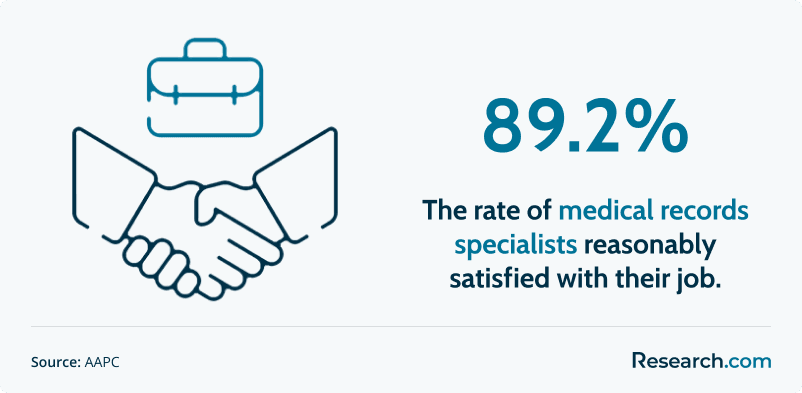
Many billers are happy with their jobs, and the image below shows figures to support this.
What are the top employers for Medical Billers & Coders in Ohio?
Medical billing and coding professionals in Ohio may find opportunities in hospitals, outpatient centers, physician practices, specialty clinics, insurance-related organizations, billing companies, academic medical centers, and remote revenue cycle departments. Large healthcare systems often have structured billing teams, compliance departments, coding quality reviews, and advancement ladders.
- Cleveland Clinic – A large healthcare network with complex documentation, specialty services, and technology-driven administrative operations that can create demand for skilled coding and revenue cycle staff.
- OhioHealth – A nonprofit health system with hospitals and clinics where billing and coding professionals support claims, reimbursement, documentation workflows, and patient account accuracy.
- University Hospitals – A Cleveland-based system connected to research, education, and advanced care, offering settings where accurate coding and compliant documentation are essential.
- ProMedica – A broad healthcare provider network with inpatient and outpatient services that may require billing, coding, claims follow-up, and revenue cycle support.
- Nationwide Children's Hospital – A pediatric-focused employer where coding accuracy is especially important because children’s services, specialties, and payer rules can require careful documentation review.
| Employer setting | Common work focus | Best fit for |
| Hospitals and health systems | Facility coding, documentation review, claims accuracy, compliance, and revenue cycle operations | Coders who want complex cases and long-term advancement options |
| Physician practices | Professional services coding, appointment-related billing, claims submission, and denials follow-up | Entry-level professionals who want closer exposure to provider workflows |
| Specialty clinics | Procedure-specific coding, payer authorization, and specialty documentation | Workers who want to build expertise in a focused area |
| Billing service companies | Claims processing for multiple clients, accounts receivable, and payer communication | People comfortable handling varied workflows and productivity expectations |
| Remote revenue cycle teams | Coding, auditing, claim review, and documentation support through secure digital systems | Experienced professionals with strong accuracy and self-management skills |
The chart below gives you a good idea of which industries or employers pay more for medical billers and coders.
How much do Medical Billers & Coders earn in Ohio?
Medical billing and coding pay in Ohio depends on credentials, employer type, experience, city, remote-work eligibility, specialty knowledge, and whether the role is primarily billing, coding, auditing, or revenue cycle analysis. Reported figures in the source set for this article place the average annual salary at approximately $45,000, with a typical range between $35,000 and $60,000.
Entry-level positions may start around $30,000, while seasoned professionals can earn upwards of $60,000. Columbus and Cleveland may offer higher compensation than some rural areas because larger healthcare systems and specialty providers often have more complex billing and coding needs.
| Factor | How it can affect pay | What candidates can do |
| Experience | Employers often pay more for coders who can work accurately with less supervision | Build a portfolio of coding practice, seek internships or entry-level billing roles, and track productivity improvements |
| Certification | Credentials such as CPC or CCS may strengthen salary prospects | Select a credential that matches your target work setting |
| Employer type | Hospitals, specialty practices, and revenue cycle organizations may differ in pay structure | Compare total compensation, benefits, training, and advancement paths |
| Location | Metro areas may offer more openings and higher wages, but competition can also be stronger | Compare opportunities in Columbus, Cleveland, regional hospitals, and remote roles |
| Specialization | Expertise in complex coding, auditing, compliance, or revenue cycle analytics can support advancement | Continue training after the first credential rather than stopping at entry-level knowledge |
Students asking is medical billing and coding a good career should look beyond average salary. The better question is whether the expected pay, training cost, certification requirements, work style, and advancement potential match your goals.
What is the job outlook for Medical Billing & Coding in Ohio?
The job outlook for medical billing and coding in Ohio is supported by the state’s healthcare infrastructure, continued use of electronic health records, insurance complexity, telehealth billing, and the ongoing need for clean claims and compliant documentation. The role remains important because providers cannot be paid correctly unless services are documented, coded, submitted, and followed up accurately.
Within the cited source material, Ohio medical billing and coding demand is described as positive, with an estimated 7% growth over the next decade and other recent reports indicating demand may grow by nearly 8% over the next decade. The U.S. Bureau of Labor Statistics is also cited as anticipating a 22% increase in medical billing and coding jobs nationwide by 2030, while similar roles like medical assistants are projected to grow by approximately 19%.
These figures should be treated as planning indicators rather than guarantees. Local hiring can vary based on hospital budgets, payer changes, outsourcing, remote hiring competition, automation, and employer preference for certified candidates.
Trends affecting Ohio billing and coding jobs
- Electronic health records: Employers expect workers to navigate digital documentation systems with speed and accuracy.
- Telehealth billing: Remote care services can introduce different documentation and reimbursement requirements.
- Automation and AI: Software can assist with code suggestions, but human review remains important for compliance, payer rules, and documentation quality.
- Denials management: Providers need staff who can identify claim errors, appeal denials, and reduce reimbursement delays.
- Remote competition: Work-from-home roles can expand opportunities, but they may also attract applicants from outside a local area.
Workers who want to remain competitive should continue learning after graduation. Flexible options such as medical billing and coding online courses with financial aid may help students or working adults update their skills without leaving their current jobs.
What are the challenges for Medical Billers & Coders in Ohio?
Medical billing and coding can be stable and flexible, but it is not an easy “data entry only” job. Accuracy, speed, compliance, and constant learning are central to the work. Ohio professionals may face heavy workloads, changing payer rules, software updates, and pressure to reduce claim denials.
| Challenge | Why it matters | Better way to handle it |
| Shortages in qualified personnel | Teams may experience heavier workloads when employers cannot find enough trained staff | Build certification-ready skills and learn productivity tools early |
| Evolving technology | Electronic records, automated coding suggestions, and AI-assisted workflows can change daily tasks | Treat software literacy as a core skill, not an optional bonus |
| Changing regulations and payer rules | Incorrect coding or documentation can cause denials, compliance problems, or payment delays | Use official updates, employer training, and continuing education to stay current |
| Financial pressure on providers | Claim errors and slow reimbursement can affect the cash flow of clinics and hospitals | Learn denials management, documentation review, and payer follow-up strategies |
| Remote-work expectations | Remote roles often require independent work, secure data handling, and proven accuracy | Develop strong time management and privacy habits before applying for remote positions |
Common mistakes students should avoid
- Choosing a program without checking accreditation, employer recognition, or certification alignment.
- Focusing only on tuition while ignoring exam fees, books, software, and coding manuals.
- Assuming every online program provides enough practice to pass a national certification exam.
- Believing that remote jobs are automatically available to beginners.
- Skipping medical terminology and anatomy because billing seems more administrative than clinical.
- Relying only on salary averages instead of researching local job postings and required credentials.
What alternative career paths can Medical Billers & Coders in Ohio pursue?
Medical billing and coding can lead to several related healthcare administration careers. Professionals who understand documentation, payer rules, patient records, and reimbursement can move into health information, compliance, revenue cycle, practice management, and data-focused roles. Completing an associates in medical billing and coding program can provide a broader foundation for these transitions.
| Alternative role | Typical focus | Ohio salary figure stated | Why billing and coding experience helps |
| Health Information Technician | Organizing, securing, and maintaining health information data | Approximately $44,000 annually, with a projected growth rate of 8% over the next decade | Coding experience supports accurate records and data quality |
| Medical Office Manager | Overseeing daily clinic operations, staffing, budgeting, patient flow, and administrative systems | Around $58,000 per year | Billing knowledge helps managers understand revenue, claims, and patient account issues |
| Clinical Documentation Specialist | Improving documentation accuracy for billing, quality reporting, and compliance | About $51,000 | Coders understand how documentation affects reimbursement and reporting |
| Revenue Cycle Analyst | Analyzing billing performance, denials, reimbursement trends, and process efficiency | Approximately $66,000 in Ohio | Billing and coding knowledge provides context for financial and operational data |
The strongest transitions usually happen when professionals add skills in auditing, data analysis, compliance, leadership, or health information systems. Billing and coding can be the starting point, but advancement requires intentional upskilling.
What are the opportunities for career advancement in Ohio for medical billers and coders?
Advancement in Ohio medical billing and coding usually comes from combining experience with additional credentials, specialized knowledge, and stronger technology skills. Entry-level workers may begin in claims processing, billing support, charge entry, or coding assistant roles, then move into coding specialist, auditor, lead coder, revenue cycle supervisor, compliance coordinator, or analyst positions.
| Career stage | Possible roles | Skills to build |
| Entry level | Billing clerk, coding assistant, patient account representative, claims follow-up assistant | Medical terminology, insurance basics, accuracy, productivity, and confidentiality |
| Certified early career | Medical coder, billing specialist, reimbursement specialist, denials specialist | Coding guidelines, payer rules, EHR workflows, and claim correction |
| Experienced specialist | Senior coder, coding auditor, clinical documentation support specialist, specialty coder | Auditing, specialty coding, compliance, documentation improvement, and provider communication |
| Leadership or analytics | Revenue cycle analyst, coding supervisor, medical office manager, compliance coordinator | Reporting, process improvement, leadership, data interpretation, and training others |
Some professionals also use billing and coding as a bridge into other healthcare fields. For example, a worker who becomes interested in nutrition services, clinical education, or patient counseling might explore allied health pathways such as how to become a registered dietician in Ohio. The key is to understand which roles require a new degree, certification, or state license before making the transition.
How does Ohio’s healthcare landscape support careers in medical billing and coding?
Ohio’s healthcare system includes large academic medical centers, regional hospitals, pediatric facilities, outpatient networks, community clinics, physician groups, and specialty practices. Each of these settings depends on accurate documentation and reimbursement processes, which creates a continuing need for trained administrative healthcare workers.
Billing and coding professionals support this system by translating healthcare services into standardized codes, helping claims move through payer systems, correcting documentation issues, and reducing avoidable denials. Their work affects provider revenue, patient account accuracy, compliance reporting, and operational efficiency.
Ohio’s broader healthcare education pipeline also gives students room to compare administrative and clinical options. Some students who begin with billing and coding later research clinical routes, including programs at the top nursing schools in Ohio, while others remain in health information, revenue cycle, or compliance roles.
Can Medical Billers & Coders Transition Into Clinical Roles?
Yes, medical billers and coders in Ohio can move into clinical roles, but they usually need additional education, supervised clinical training, and the required license or certification for the new profession. Billing and coding experience can be helpful because it gives workers a strong understanding of medical terminology, documentation, provider workflows, insurance, and compliance. It does not replace clinical training.
For example, someone moving toward nursing, advanced practice, medical assisting, pharmacy, or another direct patient-care field must meet that profession’s admission, training, exam, and licensure requirements. Those considering advanced nursing can review how to become a nurse practitioner in Ohio to understand how different the clinical credentialing process can be from billing and coding certification.
What are the best programs for medical billing and coding in Ohio?
The best medical billing and coding program in Ohio is not simply the cheapest or fastest option. It is the program that fits your schedule, prepares you for the credential employers value, provides enough hands-on coding practice, offers student support, and has transparent costs and outcomes.
Students often compare community colleges such as Cuyahoga Community College and Columbus State Community College with online schools and private training providers. Some students also look at related healthcare programs, including medical assistant certification in Ohio programs, when deciding whether they prefer an administrative or clinical support path.
Questions to ask before choosing a program
- Is the institution accredited, and is the program recognized by employers?
- Which certification exam does the curriculum prepare students for?
- Are coding manuals, exam vouchers, software access, and practice tests included in the price?
- Does the program teach current billing, coding, compliance, EHR, and telehealth billing concepts?
- Are classes online, in person, hybrid, synchronous, or self-paced?
- What support is available if you struggle with coding practice?
- Does the school provide career services, resume help, externship options, or employer connections?
- Can credits transfer into an associate degree or related healthcare program later?
- What are the refund rules, completion expectations, and certification pass support?
| Program feature | Why it matters | Red flag |
| Certification alignment | Shows whether coursework matches the credential you plan to pursue | The program promises job readiness but does not name a recognized exam |
| Accreditation and reputation | Helps protect transferability, aid eligibility, and employer confidence | The school is unclear about institutional accreditation |
| Coding practice | Realistic case work builds exam readiness and workplace accuracy | The curriculum is mostly reading with little applied coding |
| Total cost transparency | Prevents surprise expenses for books, manuals, or exams | Tuition is advertised without required fees or materials |
| Student support | Beginners often need help with terminology, anatomy, and coding guidelines | No tutoring, instructor access, or exam preparation support is available |
How does medical billing and coding in Ohio compare with other states?
Ohio offers a balanced environment for medical billing and coding: accessible training options, major healthcare employers, no state-specific licensing requirement, and reported annual salaries that commonly range from $38,000 to $45,000. Compared with states that have higher costs of living, Ohio may offer a more manageable financial starting point, although salaries can also be lower than in some higher-cost markets.
Like many states, Ohio does not require a special state license for billing and coding. Certification expectations generally follow national employer standards. What may differ by state is the density of large healthcare systems, remote job competition, salary levels, cost of living, and availability of local training programs.
| Comparison factor | Ohio | What to compare if considering another state |
| Licensing | No Ohio-specific license is required for medical billing and coding | Whether the state has any employer-specific or regulatory requirements |
| Salary | Commonly reported between $38,000 and $45,000 annually | Local wages, cost of living, commuting costs, and remote-work availability |
| Education access | Community colleges, online programs, and healthcare training providers are available | Accreditation, certification alignment, and transfer options |
| Employer base | Major systems in areas such as Cleveland and Columbus support healthcare hiring | Number of hospitals, specialty practices, billing companies, and insurer-related employers |
| Career mobility | Billing and coding can support movement into health information, revenue cycle, and clinical pathways with additional training | Whether the state has strong healthcare education pipelines and licensure support |
Students comparing professional timelines may also find it useful to review other Ohio healthcare credentialing paths, such as how long does it take to become a pharmacist in Ohio, to understand how billing and coding differs from licensed clinical careers that require much longer training.
What Medical Billers & Coders in Ohio Say About Their Careers
- Medical billing and coding gave me a healthcare role where I could build a career through accuracy, consistency, and continued learning. I like knowing that clean documentation and correct claims help local providers keep patient care moving. Cailee
- The work can be demanding because payer rules, software, and documentation expectations change often. At the same time, those changes have pushed me to become more confident with healthcare data and problem solving. AJ
- For me, the appeal is stability and structure. Ohio has enough healthcare employers that I can see different directions for growth, from coding to revenue cycle work to office administration. Tyler
Related Articles for Nearby States
- 2027 How to Become a Medical Biller & Coder in Indiana
- 2027 How to Become a Medical Biller & Coder in Kentucky
- 2027 How to Become a Medical Biller & Coder in West Virginia
- 2027 How to Become a Medical Biller & Coder in Pennsylvania
- 2027 How to Become a Medical Biller & Coder in Michigan
- 2027 How to Become a Medical Biller & Coder in Illinois
- 2027 How to Become a Medical Biller & Coder in Virginia
- 2027 How to Become a Medical Biller & Coder in Tennessee
- 2027 How to Become a Medical Biller & Coder in North Carolina
- 2027 How to Become a Medical Biller & Coder in Missouri
Key Insights
- Ohio does not require a state license for medical billing and coding, but certification can make a major difference in employability.
- A certificate program can be the fastest focused route, while an associate degree may provide more room for advancement into health information, management, or revenue cycle roles.
- Reported Ohio salaries commonly range from $38,000 to $45,000 annually, with higher earnings tied to experience, credentials, specialization, employer type, and location.
- Major Ohio healthcare employers, including Cleveland Clinic, OhioHealth, University Hospitals, ProMedica, and Nationwide Children's Hospital, rely on accurate billing, coding, documentation, and reimbursement workflows.
- Students should compare programs by accreditation, certification alignment, total cost, coding practice, student support, and career services—not tuition alone.
- Remote work is possible in this field, but beginners should not assume remote jobs are guaranteed; employers often prefer proven accuracy and experience.
- The best long-term strategy is to treat billing and coding as a skill-building career: earn a relevant credential, gain experience, keep up with technology and payer rules, and add specialization over time.
References:
- AAPC. 2025 Medical Coding and Billing Salary Report by Credential.
- AMBCI. Medical Billing & Coding Salary Info.
- Glassdoor. Salary: Medical Billing Coding in Ohio 2025.
- Goodwin College. Medical Billing and Coding Job Outlook.
- NurseJournal.org. Are Medical Billers and Coders in Demand?
- Salary.com. Medical Coding and Billing Salary in Ohio.
- SalaryExpert. Medical Billing & Coding Specialist Salary Ohio, United States.
- ZipRecruiter. Medical Coding Salary in Ohio: Hourly Rate (April, 2025).
Other Things You Should Know About Becoming a Medical Biller & Coder in Ohio
In Ohio, medical billers & coders are not required by law to complete continuing education. However, maintaining professional certifications such as those from AAPC or AHIMA may require completing continuing education units (CEUs) to remain certified and competitive in the field.
Ohio employers expect proficiency in ICD-10-CM for diagnoses, CPT for procedures, and HCPCS Level II for supplies and services. For hospital coding, many jobs also require familiarity with ICD-10-PCS. These code sets are standard in claims processing, auditing, and reimbursement.