2027 Best Online Associate in Medical Billing and Coding Programs

Co-Founder and Chief Data Scientist
An online associate degree in medical billing and coding is designed for students who want a healthcare career that focuses on records, insurance claims, compliance, and reimbursement rather than direct patient care. The decision matters because employers increasingly expect medical records specialists to understand electronic health records, coding systems, payer rules, privacy standards, and workflow technology. A short online medical coding training program may be enough for some entry-level goals, but an associate degree can provide a broader academic foundation and more room for advancement.
This guide explains how online medical billing and coding associate degrees work, how employers may view them, what they cost, which courses and skills to expect, and how to compare programs. It also covers accreditation, certification preparation, salary expectations, career pathways, common mistakes, and practical questions to ask before enrolling.
The field remains relevant because healthcare organizations rely on accurate documentation to bill correctly, protect patient information, and support care delivery. The Bureau of Labor Statistics projects employment of medical records specialists to grow by 7% between 2024 and 2034, making this a practical option for students who want a structured route into healthcare administration.
Online Medical Billing and Coding Table of Contents
- Can you earn a medical billing and coding associate degree fully online?
- Do employers respect online medical billing and coding degrees?
- Are online associate degrees accepted internationally?
- Online vs. campus associate degrees in medical billing and coding
- 2027 best online associate degrees in medical billing and coding
- How much does an online medical billing and coding associate degree cost?
- Admission, skill, and technology requirements
- Courses commonly included in the degree
- Why program length matters
- How to choose the right online program
- Continuing education options after the associate degree
- Whether an advanced healthcare degree makes sense
- How pharmacy knowledge can support coding work
- Why hands-on experience still matters in an online program
- Using the degree as a bridge to healthcare administration
- How additional healthcare education can expand career options
- Career advancement after an online associate degree
- Job market trends and salary expectations
- Long-term implications of choosing this career
- Finding affordable, high-quality online programs
Quick Answer: Is an Online Associate Degree in Medical Billing and Coding Worth Considering?
Yes, an online associate degree in medical billing and coding can be worth considering if you want entry-level healthcare administrative work, need flexible scheduling, and prefer a credential that includes general education plus career-specific training. The strongest programs are accredited, prepare students for coding or billing certification exams, include practical coding exercises, and teach electronic health records, reimbursement, compliance, and healthcare privacy rules.
The degree is not the only route into the field. Some students may be better served by a shorter certificate, especially if they already have healthcare experience or need the fastest possible path to employment. However, an associate degree may be more useful for students who want transfer options, broader healthcare administration preparation, or a foundation for later bachelor’s-level study.
Can you get a degree completely online?
You can complete many associate degree programs in medical billing and coding online. Colleges use learning management systems, digital textbooks, coding software, virtual discussions, recorded lectures, and remote assessments to deliver coursework. Because billing and coding are documentation-heavy fields, many required skills translate well to an online learning format, especially as healthcare technology continues to reshape medical records and administrative work.
Online programs can be synchronous, asynchronous, or a mix of both. In a synchronous course, students attend live sessions at set times. In an asynchronous course, students view recorded lectures and complete weekly work by deadlines. A cited study found that 54.4% of students prefer watching recorded classes uploaded to the university’s website, YouTube channel, or online learning platform (Smith & Jones, 2024). The same research noted that students also favored interactive digital slides (61.20%) and virtual annotation tools (28.40%) because these tools made online learning more convenient.
The most important condition is accreditation. Students should verify that both the institution and, when applicable, the program meet recognized quality standards. Accreditation affects employer recognition, transfer credit, financial aid eligibility, and future education options. This principle also applies to other specialized healthcare programs, including the best speech language pathology programs.
Will employers take my online degree seriously?
Employers can take an online medical billing and coding associate degree seriously when it comes from an accredited school and prepares students for recognized industry credentials. The delivery format matters less when the transcript, curriculum, institution, and skills are credible. However, not all online credentials are viewed equally, and applicants should be realistic about employer perceptions.
Research cited in the original article found that applicants with traditional degrees had a 14.2% callback rate, while applicants with online-only credentials had a 9.1% response rate (Hansen, 2024). Callback rates do not measure long-term career success by themselves, but they suggest that some employers may still make assumptions about online education.
The practical takeaway is not to avoid online education. It is to choose carefully. Hiring managers often care about the school’s reputation, accreditation, work readiness, and evidence of competence. According to the National Association of Colleges and Employers, 41% of hiring managers value where students earned their degrees rather than how they completed the coursework. That pattern can affect both associate-level programs and advanced online options such as online health education programs and online doctor of health administration programs.
How to make an online degree more credible to employers
- Choose an accredited institution. Accreditation helps show that the school follows recognized academic standards.
- Prepare for certification. Programs aligned with exams such as CPC, CBC, CCA, CCS, or related credentials may strengthen your resume.
- Build a coding portfolio. Save de-identified practice projects, coding exercises, claim review samples, or capstone work when your school allows it.
- Gain practical experience. Internships, externships, simulations, volunteer record-management work, or entry-level healthcare office experience can reduce employer concerns.
- List tools and systems clearly. Employers want to know whether you have practiced with electronic health records, coding references, billing workflows, and privacy procedures.
Are online degrees recognized all over the world?
An online associate degree in medical billing and coding is not automatically recognized in every country. Recognition depends on the country, employer, healthcare system, credential evaluator, and local regulatory requirements. Medical coding systems, payer rules, and healthcare documentation standards can vary widely, so a U.S.-based program may not transfer directly to international employment without additional training.
Accreditation still matters. In the United States, students often look for institutional accreditation and program alignment with organizations connected to health information and coding education. The Commission of Accreditation for Health Informatics and Information Management Education (CAHIIM) and the American Academy of Professional Coders (AAPC) are nationally known organizations connected to medical billing, coding, health informatics, and professional certification pathways.
CAHIIM is associated with accreditation in health informatics and health information education. AAPC is widely known for professional certifications and also connects with learners who complete online certificate programs in medical billing and coding. Students planning to work outside the United States should ask employers or credential evaluators whether the degree, certification, and coding system will be accepted in the target country.
Online vs. Traditional Associate Degree in Medical Billing and Coding
A medical billing and coding associate degree often takes about two years, though the exact timeline depends on credit load, transfer credits, part-time enrollment, accelerated terms, and program structure. Both online and campus programs can prepare students for medical records, billing, coding, reimbursement, and healthcare office roles. The better choice depends on schedule, learning style, budget, and access to local clinical or administrative experience.
Graduates may work in hospitals, clinics, insurers, physician offices, professional and technical services, administrative support services, and other healthcare-related environments. Some students also use the degree as an entry point into broader healthcare or public health degree jobs.
| Factor | Online Associate Degree | Traditional Campus Associate Degree |
| Best for | Working adults, caregivers, rural students, and learners who need schedule flexibility | Students who prefer in-person structure, campus support, and face-to-face networking |
| Course delivery | Recorded lectures, live virtual sessions, online assignments, coding software, and discussion boards | Classroom lectures, in-person labs, campus resources, and scheduled meetings |
| Flexibility | Often higher, especially in asynchronous programs | Usually lower because classes meet at fixed times and locations |
| Cost considerations | May reduce commuting, parking, and relocation expenses, though technology fees may apply | May include campus fees, transportation, housing, or commuting costs |
| Practical experience | May use virtual simulations, remote projects, local externships, or capstones | May offer in-person labs, local employer connections, or campus-arranged placements |
| Employer perception | Strongest when accredited and certification-aligned | May still benefit from traditional employer familiarity |
Is an online degree cheaper?
An online associate degree may cost less overall, but it is not automatically cheaper. Some schools charge the same tuition for online and campus students, while others use separate online rates. For example, if a school charges $76 per Credit and the degree requires 60 credits, students can expect to pay at least $2,280 per academic year under the estimate provided in the original article.
Residency rules can also change the price. Out-of-state students often pay more at public colleges, but some schools offer one flat online tuition rate regardless of location. Students should also check technology fees, proctoring fees, software subscriptions, books, coding manuals, graduation fees, and whether any campus visits are required.
Is an online degree as good as a regular degree?
An online degree can be academically comparable to a campus degree when the institution is accredited, the curriculum is rigorous, and students receive enough practice with coding, billing, documentation, compliance, and electronic records. The credential should not be judged by format alone. A weak campus program is still weak, and a strong online program can be valuable.
Students should focus on measurable quality signals: accreditation, certification exam alignment, graduation support, instructor qualifications, employer partnerships, software exposure, transfer policies, and student outcomes. The Bureau of Labor Statistics reported an average annual figure of $47,180 for this field in the cited material, which is more than three times the federal minimum wage. Individual earnings can vary by employer, location, experience, specialty, and certification.
2027 Best Medical Billing and Coding Associate Degree Online
The following programs were identified using available indicators such as academic rating, enrollment rate, affordability, accreditation, and other program-level factors. Use this list as a starting point, not a final decision. Before applying, confirm tuition, accreditation status, certification preparation, transfer rules, and whether program requirements have changed.
| School | Program Focus | Credits | Cost per Credit | Accreditation Listed |
| Central Texas College | Medical coding and billing associate in applied science | 60 | $100 (in-district), $124 (out-of-district) | Southern Association of Colleges and Schools Commission on Colleges |
| Northland Community and Technical College | Medical coding specialist associate in applied science | 60 | $187.53 (in-state), $211.55 (out-of-state) | Higher Learning Commission |
| Highland Community College | Medical coding associate in applied science | 65 | $76 | Higher Learning Commission |
| Keiser University | Medical administrative billing and coding associate of science | 60 | $367 | Commission on Accreditation for Health Informatics and Information Management Education |
| Central Maine Community College | Medical coding and electronic health records associate in applied science | 60 62 | $96 (in-state), $192 (out-of-state) | New England Commission of Higher Education |
1. Central Texas College
Central Texas College offers an online associate in applied science in medical coding and billing for students preparing for entry-level coding, billing, and health information work. The program includes instruction from experienced faculty and is designed to help students prepare for certification exams while earning college credit that may support later education.
- Program Length: Two years
- Tracks/concentrations: Medical terminology, medical software applications, medical coding, healthcare informatics, and insurance and reimbursement
- Cost per Credit: $100 (in-district), $124 (out-of-district)
- Required Credits to Graduate: 60
- Accreditation: Southern Association of Colleges and Schools Commission on Colleges
2. Northland Community and Technical College
Northland Community and Technical College provides an online medical coding specialist associate in applied science program for students who want preparation for entry-level national coding certification exams. Coursework covers billing-related procedures, medical terminology, anatomy and physiology, and human disease.
- Program Length: Two years
- Tracks/concentrations: Health information management, medical billing and insurance, medical coding, and medical terminology
- Cost per Credit: $187.53 (in-state), $211.55 (out-of-state)
- Required Credits to Graduate: 60
- Accreditation: Higher Learning Commission
3. Highland Community College
Highland Community College offers an associate in applied science in medical coding for students aiming to work as medical coders in healthcare organizations. The program prepares students for the Certified Coding Associate (CCA) or Certified Coding Specialist (CCS) exams administered by the America Health Information Management Association (AHIMA). It also includes a capstone requiring clinical hours in an approved coding facility, giving students applied practice before graduation.
- Program Length: Two years
- Tracks/concentrations: Medical terminology, health information compliance, medical coding, reimbursement methodologists
- Cost per Credit: $76
- Required Credits to Graduate: 65
- Accreditation: Higher Learning Commission
4. Keiser University
Keiser University offers an online associate of science in medical administrative billing and coding for students who want training in insurance claims, reimbursement, compliance, and administrative functions. The curriculum teaches students to assign codes accurately for diagnostic procedures and other healthcare services and prepares them for the AAPC credentialing examination.
- Program Length: Two years
- Tracks/concentrations: Medical law and ethics, medical insurance procedures, medical coding
- Cost per Credit: $367
- Required Credits to Graduate: 60
- Accreditation: Commission on Accreditation for Health Informatics and Information Management Education
5. Central Maine Community College
Central Maine Community College offers a medical coding and electronic health records associate in applied science program for students entering the field, updating existing skills, or preparing for bachelor’s-level study. The program emphasizes ethics, health insurance plans, coding guideline application, medical records, and insurance reimbursement calculations.
- Program Length: Two years
- Tracks/concentrations: Medical terminology, health information management, medical coding, and reimbursement methodologies
- Cost per Credit: $96 (in-state), $192 (out-of-state)
- Required Credits to Graduate: 60 62
- Accreditation: New England Commission of Higher Education
How much does medical billing and coding associate degree online cost?
The estimated cost of pursuing an associate degree ranges from $3,596 to $15,620 (National Center for Education Statistics, 2024). The cited estimate for an online degree ranges from $4,500 to $16,700 per academic year. Actual cost depends on tuition rate, number of credits, residency status, books, fees, transfer credits, financial aid, and whether the program requires certification exam costs or specialized software.
| Online Learning | In-campus Learning | |
| Public In-state | $2,280 | $3,900 |
| Public Out-of-state | $4,365 | $7,050 |
| Private | $11,010 | $18,000 |
| *Values are estimates |
Cost factors to review before enrolling
- Tuition and required credits. Compare total program cost, not just the per-credit rate.
- Mandatory fees. Ask about registration, technology, online learning, lab, proctoring, graduation, and student services fees.
- Books and coding resources. Some programs require coding manuals, e-books, software, or online platforms.
- Residency rules. Public colleges may charge different rates for in-state and out-of-state students, although some online programs use one rate for all distance learners.
- Transportation and campus visits. Online study may reduce commuting costs, but some programs may still require occasional in-person activities.
- Certification exam costs. Ask whether exam preparation, vouchers, or practice tests are included in tuition.
Is an online medical billing and coding degree worth it?
An online associate degree may be worth it for students who want healthcare administrative work, prefer remote or flexible study, and need a credential that can support both entry-level employment and future education. The Bureau of Labor Statistics projects an average of 14,200 medical records specialist job openings per year between 2024 and 2034.
The return on investment depends on cost, completion time, career goals, and whether the program leads to marketable skills. Students who choose a low-cost accredited program, transfer prior credits, and prepare for certification may reduce risk. Students who borrow heavily for a program without strong outcomes, recognized accreditation, or certification alignment may face a weaker payoff.
The degree can also serve as a foundation for online healthcare administration programs. A healthcare administration path can lead to administrative roles in hospitals, clinics, and other healthcare facilities. The cited average annual salary for this broader management direction is $117,960 per year (Bureau of Labor Statistics, 2024).
What are the requirements for an online associate degree in medical billing and coding?
Program requirements include admissions documents, academic readiness, computer access, and the ability to learn detailed healthcare terminology and coding rules. The work is detail-oriented because medical records specialists help organize patient information, support reimbursement, and protect health data.
The need for accurate records has grown alongside patient access to digital health information. More than 44 million Americans can now readily access their health data online, and patients increasingly identify errors involving diagnoses, medical history, medications, and other details.
Medical records specialists help prepare, manage, retrieve, and review records so clinicians, insurers, and administrative teams can use accurate information. In billing and coding, small errors can affect claims, compliance, and patient trust.
Admission Requirements
Admissions requirements differ by school, but most online associate degree programs ask for the following:
- Application form. Applicants typically submit personal information, academic history, contact details, and intended program information.
- High school diploma or equivalent. Most colleges require a diploma, GED certificate, or equivalent credential.
- Transcripts. Schools may request official high school transcripts and transcripts from any prior colleges attended.
- Minimum GPA. Some programs set a minimum GPA, often around 2.0 or higher on a 4.0 scale.
- Personal statement. Certain colleges ask students to explain their interest in medical billing and coding, career plans, and reasons for choosing the program.
Core Skills Students Need to Build
| Skill | Why It Matters in Medical Billing and Coding |
| Attention to detail | Coders and billing specialists must review documentation carefully so claims, records, and codes are accurate. |
| Medical terminology | Understanding diagnoses, procedures, anatomy, diseases, and treatments is essential for correct code selection. |
| Coding system knowledge | Students need practice with systems such as ICD-10-CM and CPT because these codes support billing, reporting, and reimbursement. |
| Information management | Healthcare records must be organized, updated, stored, and retrieved according to privacy and retention rules. |
| Technology proficiency | Students work with electronic health records, coding software, billing platforms, learning systems, and common office tools. |
| Ethical and legal judgment | Billing and coding professionals handle protected health information and must follow privacy, compliance, and confidentiality rules. |
What are the technological requirements of students for online learning?
Online students need reliable internet access and a computer that can run the school’s learning management system, video platform, digital resources, and any required software. A webcam and noise-canceling headset can also help with live classes, presentations, advising sessions, or remote proctoring.
Recommended Operating Systems
- Windows 10 or newer
- macOS 10.14 or newer
- Linux Ubuntu, Elementary OS, or Mint
Hardware Specifications
- The device must not be more than five years old
- Processor: At least 2GHz
- Hard Drive: At least 32 GB
- Memory (RAM): At least 4 GB
- Ethernet (LAN) connection or wireless adapter (Wi-Fi)
- Sound card with speakers
Courses to Expect in Online Associate Degree in Medical Billing and Coding
Course titles vary by college, but most medical billing and coding associate degree programs cover healthcare language, coding systems, reimbursement, records management, legal requirements, and office procedures. Strong programs combine theory with repeated practice so students can apply codes to realistic documentation.
| Course Area | What Students Usually Learn |
| Medical Terminology | Common healthcare vocabulary, abbreviations, body systems, diseases, procedures, and treatments. |
| Medical Coding | How to use coding systems such as ICD-10-CM and CPT to assign codes for diagnoses, procedures, and services. |
| Health Information Management | How patient records are collected, stored, retrieved, protected, retained, and used in electronic health record environments. |
| Reimbursement Methodologies | Insurance claims, billing workflows, payment models, reimbursement rules, forms, and payer requirements. |
| Healthcare Law and Ethics | Privacy rules, HIPAA-related concepts, patient rights, consent, confidentiality, and ethical decision-making. |
| Medical Office Procedures | Scheduling, patient registration, insurance verification, record management, office software, and administrative workflows. |
Some programs also include internships, externships, simulation labs, capstones, or coding practice modules. These applied experiences are especially useful for students who do not already work in healthcare.
The Importance of Completing Your Degree in a Shorter Timeframe
Finishing an online medical billing and coding associate degree sooner can help students enter the workforce, change careers, or qualify for advancement faster. Accelerated programs may allow students to graduate in as little as six months, but the faster pace requires careful planning, consistent study time, and the ability to absorb technical material quickly.
A shorter program can also reduce certain costs, including term-based fees, transportation needs, or lost time away from work. However, speed should not come at the expense of accreditation, certification preparation, coding practice, or academic support. A fast program that does not prepare students for real billing and coding work may be a poor investment.
Students comparing accelerated options can review pathways to get an associate's degree in 6 months, then confirm whether the medical billing and coding curriculum is complete, credible, and realistic for their schedule.
Things to Look for in an Online Associate Degree in Medical Billing and Coding
The best online program is not always the cheapest, fastest, or highest-ranked. It is the program that matches your career goal, budget, schedule, certification plans, and future education needs.
| Selection Factor | What to Ask Before You Enroll |
| Accreditation | Is the college institutionally accredited, and is the program aligned with relevant health information or coding standards? |
| Curriculum depth | Does the program cover medical terminology, coding systems, reimbursement, healthcare law, electronic records, and billing workflows? |
| Certification preparation | Does coursework prepare students for exams such as Certified Professional Coder (CPC), Certified Professional Biller (CBC), CCA, CCS, or related credentials? |
| Flexibility | Are courses asynchronous, synchronous, or hybrid, and can you manage the deadlines while working or caring for family? |
| Practical experience | Are internships, externships, virtual simulations, capstones, or applied coding projects included? |
| Cost and financial aid | What is the full cost after tuition, fees, books, software, exam costs, and financial aid are included? |
| Transfer options | Can credits apply toward a bachelor’s degree in health information management, healthcare administration, or a related field? |
| Career support | Does the school offer resume help, certification guidance, job boards, employer connections, or interview preparation? |
Common mistakes to avoid
- Choosing a program without checking accreditation. This can affect employer trust, transfer credits, and financial aid.
- Comparing only tuition. Fees, books, software, coding manuals, and exam costs can change the true price.
- Assuming every online program prepares students for certification. Ask which exams the curriculum supports and whether practice tests are included.
- Ignoring transfer policies. If you may pursue a bachelor’s degree later, confirm credit transfer rules before enrolling.
- Relying only on rankings. Rankings can help narrow options, but they do not replace program-specific research.
- Expecting guaranteed remote work. Remote billing and coding jobs exist, but many employers prefer experience, certification, and proven accuracy.
- Underestimating the workload. Coding requires memorization, rules-based reasoning, precision, and regular practice.
What Continuing Education Options Can Further Elevate My Credentials?
Continuing education can help medical billing and coding graduates move beyond entry-level work. Common next steps include professional certifications, bachelor’s degrees in healthcare administration or health information management, compliance training, medical auditing education, and specialized coding credentials.
Students who want to explore broader healthcare pathways can review online medical degree programs to compare academic options. The right choice depends on whether your goal is coding specialization, health information management, healthcare operations, compliance, billing leadership, or preparation for graduate study.
Should I Pursue an Advanced Degree in Healthcare After My Associate Degree?
An advanced healthcare degree can make sense if your long-term goal goes beyond coding production work. A bachelor’s degree may support advancement into health information management, healthcare administration, compliance, revenue cycle management, or supervisory positions. Graduate or professional programs may be appropriate only for students pursuing more specialized clinical, administrative, or executive goals.
Before committing to a higher degree, compare accreditation, curriculum relevance, cost, time to completion, transfer credit, and expected career outcomes. Some students interested in pharmacy-related healthcare education begin by reviewing options such as the cheapest PharmD programs, but this path is very different from medical billing and coding and should be evaluated carefully against career goals and financial commitments.
How Can Complementary Pharmaceutical Knowledge Benefit Your Medical Billing and Coding Career?
Pharmacy-related knowledge can help billing and coding professionals better understand medication claims, drug-related documentation, reimbursement issues, and the connection between clinical information and administrative processing. This does not mean every coder needs pharmacy school, but additional familiarity with pharmaceutical terminology and workflows may be useful in environments where medication coding and claims are common.
Students curious about pharmacy education can start with Research.com’s guide, What degree do you need to be a pharmacist?. Use it as background research rather than as a default next step, because pharmacist education and medical billing and coding lead to very different credentials and responsibilities.
How Can Gaining Hands-On Experience Beyond the Online Curriculum Enhance My Competitiveness?
Hands-on experience helps students turn coursework into job-ready skills. Employers want accuracy, familiarity with documentation, comfort with software, and the ability to follow compliance rules. Online learners can build this experience through internships, externships, simulation labs, capstone projects, mock claims, coding case studies, or entry-level healthcare office work.
Some students also add adjacent healthcare training to strengthen their understanding of clinical workflows. For example, a certified medical assistant accelerated program may expose learners to patient-facing processes that help them understand documentation from a different angle. This is optional, but it can be useful for students who want broader healthcare context.
How Can My Medical Billing and Coding Degree Enhance My Transition to Healthcare Administration?
A medical billing and coding associate degree can provide a practical foundation for healthcare administration because students learn how documentation, reimbursement, compliance, and patient records affect healthcare operations. These concepts are central to clinics, hospitals, insurers, and revenue cycle departments.
Students who want to move into management should consider whether they need a bachelor’s degree, supervisory experience, certifications, or additional business coursework. Comparing the fastest online healthcare administration degrees can help students identify programs that build on technical billing and coding knowledge while adding leadership, finance, policy, and operations training.
How Can Supplementary Healthcare Education Enhance My Career?
Additional healthcare education can widen career options when it is chosen strategically. Useful areas may include compliance, health information management, healthcare administration, medical auditing, revenue cycle management, or clinical terminology. The goal is to add skills that match the jobs you want, not to collect unrelated credentials.
Students interested in deeper clinical or pharmaceutical study can compare options such as the fastest PharmD programs. This type of path requires careful cost and career analysis because it serves a different professional purpose than billing and coding.
Taking the Next Steps in Your Medical Billing and Coding Career
After choosing an online associate degree program, students should map out the next steps before classes begin. That includes identifying certification goals, planning study time, budgeting for fees and exam costs, and looking for ways to gain practical experience.
Graduates may pursue entry-level roles in hospitals, clinics, insurance companies, physician offices, medical billing firms, and other healthcare organizations. Some may later use the degree as a starting point for a healthcare management degree, especially if they want to supervise teams, manage records departments, or work in healthcare operations.
Step-by-step plan for students
- Define your goal. Decide whether you want billing, coding, health records, revenue cycle, compliance, or future administration work.
- Verify accreditation. Check the school’s accreditation through official sources before applying.
- Compare total cost. Include tuition, fees, books, software, certification exams, and lost work time.
- Ask about certification alignment. Confirm which exams the curriculum prepares you for and whether exam support is included.
- Review transfer options. If a bachelor’s degree is possible later, confirm how credits transfer.
- Plan for experience. Look for internships, simulations, capstones, entry-level healthcare office roles, or volunteer opportunities.
- Build a resume while enrolled. Track software used, coding practice completed, healthcare law topics studied, and any projects or externships.
What career advancement opportunities are available after completing an online associate degree in medical billing and coding?
An associate degree can qualify graduates for entry-level work, but advancement often depends on certification, experience, accuracy, specialization, and further education. Students should think of the degree as a foundation rather than an endpoint.
- Professional certifications: Credentials such as Certified Professional Coder (CPC), Certified Coding Specialist (CCS), or Certified Inpatient Coder (CIC) can support credibility and may improve job prospects.
- Bachelor’s degree in health information management: A HIM degree can help graduates pursue roles such as health information manager or medical records director.
- Healthcare administration pathway: Additional education or credentials can support movement into administrative roles in hospitals, clinics, insurance companies, or revenue cycle departments.
- Medical auditing or compliance specialization: Extra training can prepare professionals to review coding accuracy, billing compliance, payer rules, and documentation quality.
- Remote work opportunities: Experienced and certified professionals may find remote positions, although remote work is not guaranteed for new graduates.
Job Market Trends and Salary Expectations
Medical billing and coding is shaped by healthcare demand, electronic records, payer rules, compliance requirements, and ongoing pressure to reduce billing errors. The Bureau of Labor Statistics projects 7% growth in medical records specialist jobs between 2024 and 2034, which supports steady demand for workers who can manage health information accurately.
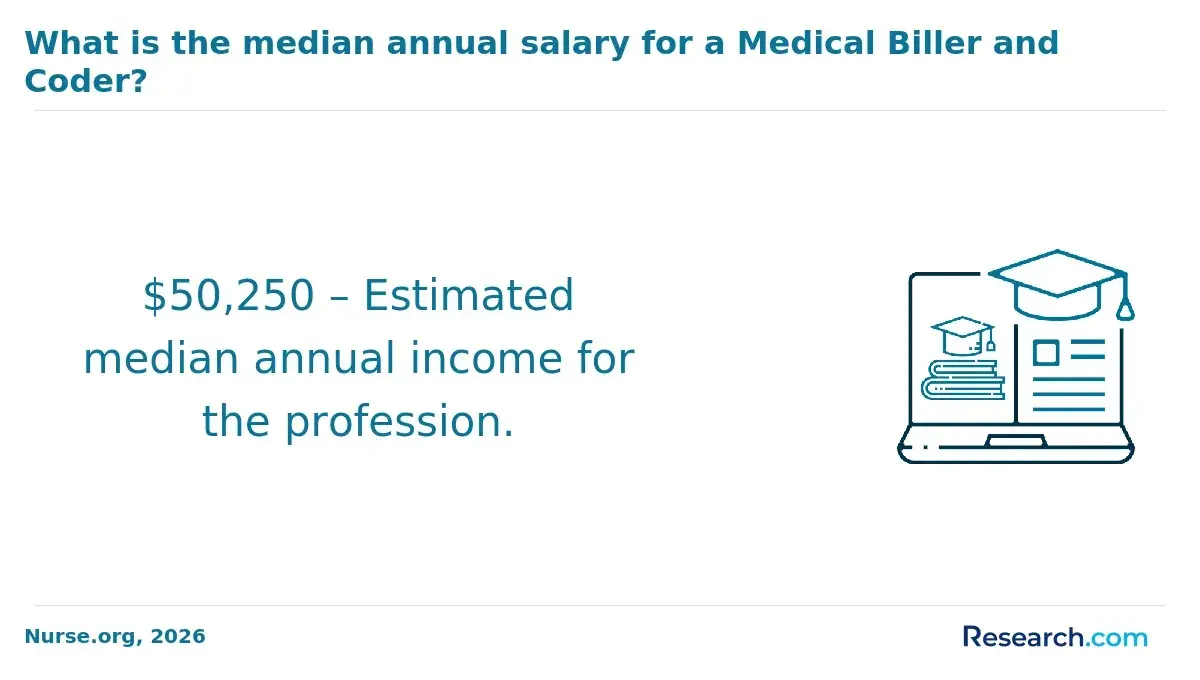
The original article cites an average salary of $50,250 per year for graduates with an associate degree in medical billing and coding (BLS, 2026). It also cites an earlier Bureau of Labor Statistics figure of $47,180 annually. Salary can vary by state, employer type, certification, experience, specialty, remote status, and job duties. For a more detailed review, see Research.com’s guide to medical billing and coding salary requirements.
Current trends affecting medical billing and coding
- Electronic health records are central to the job. Coders and billing specialists need comfort with digital records, documentation systems, and data quality standards.
- Compliance knowledge is increasingly important. Healthcare organizations need staff who understand privacy, reimbursement rules, and proper documentation.
- Certification can influence competitiveness. Employers may prefer applicants who have validated coding or billing knowledge through recognized credentials.
- Remote work is possible but competitive. Many remote roles expect experience, strong productivity, and low error rates.
- Technology is changing workflows. Automation and AI-assisted tools may support coding and claims review, but workers still need judgment, regulatory awareness, and quality control skills.
What Are the Long-Term Career Implications of Pursuing a Medical Billing and Coding Degree?
A medical billing and coding degree can lead to a stable administrative healthcare path, but students should understand the trade-offs. The work can offer flexibility, clear skill development, and entry into healthcare without a clinical degree. It can also involve repetitive tasks, productivity expectations, changing rules, payer denials, and the need for ongoing learning.
Before enrolling, ask whether you enjoy detail-focused work, healthcare documentation, rules-based problem solving, and computer-based workflows. Students who are still deciding whether the field fits their goals can review Research.com’s guide on is medical billing and coding a good career to weigh job satisfaction, salary expectations, advancement opportunities, technology changes, and regulatory pressures.
Finding Affordable and High-Quality Online Medical Billing and Coding Programs
Affordability should be evaluated alongside quality. A low tuition rate is helpful only if the program is accredited, teaches the right skills, supports certification preparation, and provides credible student support. A higher-cost program may still be a poor choice if it does not clearly improve outcomes.
Students can start by comparing a low cost medical coding and billing online program that balances budget-friendly tuition with solid curriculum design. Look for recognized accreditation, transparent costs, clear course descriptions, practical coding experience, financial aid options, and transfer pathways.
Questions to ask schools before applying
- Is the institution accredited, and by which accrediting body?
- Does the program prepare students for CPC, CBC, CCA, CCS, CIC, or other relevant credentials?
- What is the total program cost after tuition, fees, books, software, and exams?
- Are courses asynchronous, live, or a mix of both?
- What coding systems, software, and electronic records tools will students use?
- Does the program include an internship, externship, capstone, or simulation experience?
- Can credits transfer into a bachelor’s program?
- What academic tutoring, career services, and certification support are available?
- What are the graduation, placement, or certification exam outcomes the school can document?
Key Insights
- An online associate degree can be a practical route into healthcare administration. It is best suited for students who want billing, coding, records, reimbursement, or revenue cycle work without pursuing direct clinical practice.
- Accreditation is non-negotiable. It affects credibility, financial aid, transfer options, and employer confidence.
- Program quality matters more than format. A strong online program should include coding systems, reimbursement methods, healthcare law, electronic health records, and repeated applied practice.
- Cost comparisons must include more than tuition. Fees, books, software, certification exams, residency rules, and transfer credits can significantly change the true price.
- Certification preparation can improve competitiveness. Students should ask which exams the program supports before enrolling.
- Career growth usually requires more than the degree alone. Certifications, experience, specialization, and further education can open paths into auditing, compliance, health information management, or healthcare administration.
- Remote work is possible but not automatic. New graduates should be prepared to prove accuracy, productivity, software skills, and coding knowledge.
- The best program is the one that fits your goal. A fast certificate, associate degree, bachelor’s pathway, or specialized credential may each be right depending on your timeline, budget, and career plan.
References:
- Delta Technical College. (2025). Medical Coding Enrollment and Outcomes 2024-2025. https://www.deltatechnicalcollege.com/programs/medical-coding-training/enrollment-and-outcomes/
- Hansen, J. (2024). Digital displacement: The persistent wage and hiring gap between traditional and online education. Journal of Labor Economics, 42(S1), 115-134. https://doi.org/10.1086/728451
- Indeed. (2025). Highest paid Medical Coding Specialties. https://www.indeed.com/q-highest-paid-medical-coding-specialties-jobs.html?vjk=795086efe3d3cc33
- National Association of Colleges and Employers. (2024). Job Outlook 2024. https://www.naceweb.org/job-outlook/executive-summary/job-outlook-2024-executive-summary/
- National Center for Education Statistics. (2024). Digest of Education Statistics. https://nces.ed.gov/programs/digest/d23/tables/dt23_330.10.asp
- Nurse.org. (2026). Medical Billing and Coding Salary by State. https://nurse.org/healthcare/medical-billing-coding-salary/
- Smith, A., & Jones, B. (2024). Digital pedagogy in the post-pandemic era: Student preferences for visual aids. Journal of Educational Technology Research, 12(2), 45-59. https://doi.org/10.1016/j.jetr.2024.01.008
- U.S. Bureau of Labor Statistics. (2025). Employment Projections 2024-2034. https://www.bls.gov/emp/
- U.S. Bureau of Labor Statistics. (2025). Medical Records Specialists. Occupational Outlook Handbook. https://www.bls.gov/ooh/healthcare/medical-records-and-health-information-technicians.htm
Other Things You Should Know About Online Associate in Medical Billing and Coding Programs
Yes, many reputable colleges and universities offer fully online programs for medical billing and coding associate degrees. These programs provide the same comprehensive curriculum and training as their on-campus counterparts, allowing students to complete their coursework at their own pace.
Graduates with an online associate degree in medical billing and coding are entering a field with a strong job outlook. According to the U.S. Bureau of Labor Statistics, employment in this sector is projected to grow 8% from 2022 to 2032, driven by an increasing demand for healthcare services.
Yes, many accredited programs require a practicum or externship, often 80 to 160 supervised hours, to give students hands-on experience with billing software, claims processing, and coding workflows. Some schools let students complete the placement at a local clinic, hospital, or billing office.
To ensure the program is accredited, verify that it is recognized by accrediting bodies such as the Commission on Accreditation for Health Informatics and Information Management Education (CAHIIM). Accreditation ensures the program meets industry standards and can affect certification eligibility.
Typical courses include medical terminology, medical coding, health information management, reimbursement methodologies, healthcare law and ethics, and medical office procedures. These courses provide a comprehensive foundation for the field.