2027 What You Can Do with a Healthcare Management Degree

Co-Founder and Chief Data Scientist
A healthcare management degree is designed for people who want to lead the business, operational, financial, and policy side of healthcare rather than provide direct clinical care. It can prepare graduates for roles in hospitals, clinics, medical groups, insurance organizations, public health agencies, consulting firms, health technology companies, and nonprofit healthcare organizations.
This guide is for students comparing healthcare management degrees, working professionals considering a move into healthcare leadership, and healthcare employees who want to advance into administration. You will learn what the degree covers, what jobs it can lead to, how much programs may cost, which credentials can strengthen your resume, how online degrees are viewed, and how to judge whether the investment fits your career goals.
The decision matters because healthcare is large, complex, and changing quickly. The industry is projected to have 28% job growth from 2024 to 2034, according to the U.S. Bureau of Labor Statistics. In 2024, U.S. healthcare spending accounted for 17.3% of the U.S. economy, with total revenue of $4.5 trillion. That scale creates demand for managers who understand finance, compliance, staffing, technology, patient experience, and quality improvement.
Quick answer: Is a healthcare management degree worth considering?
A healthcare management degree can be worth considering if you want a non-clinical leadership career in healthcare and are willing to build business, compliance, data, and people-management skills. It is especially useful for students targeting healthcare administration, medical group management, revenue cycle leadership, operations, quality improvement, health informatics, or executive roles. The strongest return usually comes from choosing an accredited program, controlling tuition costs, gaining healthcare experience while enrolled, and matching your degree level to your target job.
Key benefits of earning a healthcare management degree
- Broad career options: Graduates can work across hospitals, clinics, long-term care facilities, health systems, insurance organizations, public health programs, nonprofits, technology companies, consulting firms, and government or military healthcare settings.
- Leadership salary potential: With a healthcare management graduate degree, upper-level annual salaries exceeding $127,000 in the U.S. are possible, and some senior leadership roles report higher averages.
- Flexible study options: Online healthcare management programs can reduce travel and housing costs, make it easier to continue working, and allow students to interact with classmates, faculty, and healthcare settings through virtual coursework, projects, and applied experiences.
- Healthcare management degree careers
- What a healthcare management degree covers
- Healthcare management degree costs
- Qualifications for healthcare management careers
- Examples of healthcare management degree programs in the U.S.
- Healthcare management certifications
- Skills gained in healthcare management programs
- Online, hybrid, or campus: choosing the right format
- Healthcare management salary potential
- One-year master's programs in healthcare management
- MBA opportunities in healthcare management
- Funding a healthcare management degree
- Healthcare management degree ROIFinancial aid planning
- Demand for healthcare management graduates
- Long-term career and salary growth
- Pharmacy education and healthcare management
- Employer recognition of online healthcare management degrees
- How to evaluate healthcare management programs
- Trends in healthcare administration
- Clinical education as a career advantage
- Accreditation for online healthcare management programs
- Health informatics in healthcare managementHealthcare administration trendsHealth informatics overviewProgram evaluation checklist
What can you do with a healthcare management degree?
A healthcare management degree can lead to administrative, operational, financial, compliance, technology, research, and leadership roles. Some jobs are available with an associate or bachelor’s degree, while director and executive positions commonly prefer or require graduate education plus healthcare experience.
| Career path | What the role focuses on | When this path may fit you |
| Healthcare administrator | Oversees daily operations in hospitals, clinics, long-term care facilities, hospice organizations, or other healthcare settings. | Choose this route if you want a broad management role involving staffing, budgets, compliance, patient flow, and service quality. |
| Medical group manager | Manages the administrative and financial operations of a multi-physician practice or clinic network. | This path fits people interested in outpatient care operations, physician relations, scheduling, billing, and patient access. |
| Revenue cycle manager | Leads billing, coding, reimbursement, collections, and financial workflow processes. | Consider this option if you are detail-oriented and interested in healthcare finance, payer rules, and operational efficiency. |
| Compliance officer | Helps healthcare organizations follow regulations, privacy rules, reporting requirements, and ethical standards. | This is a good fit if you like policy, risk management, documentation, and accountability. |
| Health informatics specialist | Implements or manages systems such as electronic health records, telehealth platforms, and healthcare data security tools. | Choose this if you want a role at the intersection of healthcare, data, technology, and process improvement. |
| Quality improvement specialist | Designs and evaluates initiatives related to patient safety, clinical outcomes, satisfaction, and workflow quality. | This path is strong for analytical thinkers who want to improve how care is delivered. |
| Clinical research coordinator | Coordinates the administrative and operational side of clinical trials and research studies. | This may fit you if you are interested in research operations, study logistics, regulatory documentation, and patient coordination. |
| Healthcare consultant | Advises healthcare organizations on strategy, revenue cycle management, operations, technology, or efficiency. | Consider consulting if you enjoy problem-solving, project-based work, and working with multiple organizations. |
| Public health manager | Runs programs related to maternal and child health, infectious disease control, environmental health, or community health initiatives. | This is a strong option if you want to work at the population or community level rather than inside one facility. |
| Hospital department director | Leads departments such as nursing, radiology, emergency services, or other hospital units. | This route usually fits experienced healthcare professionals who want to move into department-level leadership. |
Other possible roles include data analyst, educator or instructor, global health program manager, healthcare policy analyst, international healthcare consultant, medical mission coordinator, military healthcare administrator, military clinical operations manager, military public health officer, nurse manager, pharmaceutical product manager, researcher, and supply chain manager. If you are considering military healthcare operations, a logistics management degree may also support roles involving supply chains, personnel movement, facilities, and resource planning.
What graduates say about online healthcare management study
-
: "
“Studying healthcare management online allowed me to balance my work and studies seamlessly. The flexibility of online learning meant I could study at my own pace and still meet deadlines. The experience was truly enriching and has opened up numerous opportunities in my career." Simona
"
-
: "
“The online healthcare management course was a game-changer for me. It provided me with a deep understanding of the healthcare industry, all from the comfort of my home. The virtual interactions with professors and peers were as engaging as any physical classroom, making the learning experience very fulfilling." Alvin
"
-
: "
“Pursuing my healthcare management degree online was one of the best decisions I’ve made. The course was comprehensive, and the online platform made complex concepts accessible and understandable. It’s amazing how connected I felt to the course and my classmates, despite the distance." Theodore
"
Key findings for prospective students
- The healthcare management industry is expected to have 28% job growth from 2024 to 2034, and 2024 total revenue reached $4.5 trillion, which signals substantial career activity across the sector.
- Upper-level annual salaries for healthcare management degree holders can exceed $127,000 in the U.S., although individual outcomes depend on education, experience, employer, location, and role level.
- Chief Operating Officers can expect to earn an average of more than $192.000 per year, making executive operations one of the higher-paying management paths listed in this guide.
- Technology, insurance models, regulation, patient expectations, and healthcare delivery changes are reshaping the work of administrators.
- New and existing specializations are developing as healthcare organizations respond to digital transformation, workforce pressures, quality goals, and system complexity.
What is a healthcare management degree?
A healthcare management degree is an academic program focused on the business and leadership functions of healthcare organizations. Unlike clinical programs that train students to diagnose or treat patients, healthcare management programs train students to coordinate people, budgets, policies, systems, and services that support patient care.
| Degree feature | What it usually means |
| Purpose | Prepares students for healthcare administration, operations, and leadership roles. |
| Core subjects | Common coursework includes healthcare finance, healthcare law, operations, policy, ethics, leadership, quality improvement, and organizational behavior. |
| Degree types | Common options include a Bachelor of Science (BSM) and a Master of Healthcare Administration (MHA). |
| Career outcomes | Graduates may pursue healthcare administration, medical group practice management, hospital administration, revenue cycle, compliance, consulting, and related roles. |
| Job outlook | The article source data lists a very strong outlook, including projected 18% growth between 2024 and 2034. |
The right degree level depends on your current background. A bachelor’s degree can help you enter healthcare operations or administrative roles. A graduate degree, such as an MHA or healthcare-focused MBA, is more common for people aiming for senior management, consulting, executive, or system-level leadership positions.
What is the cost of healthcare management degrees?
Healthcare management degree costs vary by school, degree level, residency status, delivery format, transfer credits, and whether the institution is public or private. Tuition is only one part of the total cost, so students should also account for fees, books, technology, commuting, housing, lost work hours, and internship requirements.
| Program level or example | Listed cost | How to interpret it |
| Undergraduate, state residents | $9,573 | This figure may be lower than nonresident pricing, but students should verify whether fees and online course charges are included. |
| Undergraduate, out-of-state residents | $24,812 | Out-of-state tuition can change the return on investment, especially for students who plan to borrow. |
| Vocational | $22,871 | Shorter or career-focused programs may still require careful comparison against transferability and employer recognition. |
| Graduate, state residents | $11,769 | Graduate pricing should be compared with expected role advancement, employer tuition support, and completion time. |
| Graduate, out-of-state residents | $21,001 | Students should ask whether online learners pay separate resident, nonresident, or distance-learning rates. |
| Healthcare Management MBA | $46,000 average | An MBA may be useful for broader business leadership, but the value depends on career goals and employer expectations. |
| Master in Health Care Management at Harvard T. H. Chan School of Public Health | $92,500 entire program | Higher-cost programs should be assessed using outcomes, network strength, employer access, and personal financing limits. |
Cost questions to ask before enrolling
- Is the listed tuition per credit, per term, per year, or for the entire program?
- Are online students charged technology, clinical placement, graduation, or program fees?
- How many transfer credits will the school accept?
- Does the program require travel, campus residencies, internships, or unpaid practicum hours?
- What percentage of students receive scholarships, assistantships, employer reimbursement, or other support?
- What happens financially if you need to reduce your course load or pause enrollment?
What qualifications are needed for a career in healthcare management?
Healthcare management jobs usually require a mix of education, healthcare knowledge, business judgment, communication ability, and practical experience. Some entry-level roles may focus on administrative coordination, scheduling, billing, or operations support, while leadership positions often expect a bachelor’s or graduate degree plus measurable management experience.
| Qualification | Why it matters in healthcare management |
| Education | A bachelor’s degree, such as a BSHM, can support entry and mid-level roles; an MHA, MBA, or related graduate degree may help with leadership advancement. |
| Healthcare experience | Internships, administrative roles, clinical background, military healthcare experience, or practice operations experience can help translate coursework into real workplace competence. |
| Business acumen | Managers must understand budgeting, staffing, resource allocation, productivity, payer relationships, and financial trade-offs. |
| Analytical and problem-solving ability | Healthcare leaders use data to evaluate patient flow, staffing, quality, costs, reimbursement, and operational bottlenecks. |
| Communication and interpersonal skills | Administrators must work with clinicians, patients, executives, vendors, payers, regulators, and community partners. |
| Leadership skills | Managers guide teams through change, resolve conflicts, set goals, and keep operations aligned with patient-centered priorities. |
| Ethical and patient-centered judgment | Healthcare decisions affect safety, access, privacy, equity, and trust, so ethical decision-making is essential. |
| Licensure or certification | Not every job requires a license, but specific roles may prefer or require credentials such as CHE or CPHM. |
| Technology skills | Familiarity with electronic health records, data tools, privacy requirements, and healthcare technology is increasingly important. |
| Adaptability | Healthcare rules, technology, payment models, and patient expectations change frequently, so managers must keep learning. |
Students who want to strengthen their technical profile may also explore data-focused education. For example, the best online data analytics programs can help students build skills that support healthcare reporting, forecasting, quality improvement, and operations analysis.
What are the best healthcare management degree programs available in the U.S.?
The “best” healthcare management program depends on your degree level, career goal, budget, schedule, location, and preferred learning format. The programs below are examples cited in the source material and should be evaluated against accreditation, curriculum, cost, internship access, alumni outcomes, and employer connections.
| School | Program or focus | Accreditation listed |
| University of Alabama at Birmingham | BS in Health Care Management with flexible tracks, fast-track options, advising, and preparation for mid-level leadership roles. | SACSCOC |
| University of Cincinnati | Online associate degree in healthcare management designed for business-side healthcare careers, with flexible scheduling and bachelor’s transfer options. | HLC |
| University of Michigan | MHSA program emphasizing professional excellence, applied learning, internships, and residential and online formats. | CAHME |
| University of Minnesota | MHA program with a high ranking, alumni network, career-focused curriculum, 100% job placement, and in-person and online formats. | CAHME |
| University of North Carolina Chapel Hill | MHA program offered in residential and online formats, combining classroom learning with practical experience for leadership preparation. | CAHME |
| University of Pennsylvania | Wharton MBA in Healthcare Management with specialized healthcare coursework, internship preparation, and broad business training. | CAHME |
| University of Southern California | MHA program that develops future leaders across five key areas and includes optional specializations. | CAHME |
| University of Texas at Dallas | MS in Healthcare Leadership and Management with a strong curriculum, faculty expertise, and innovation-focused opportunities. | AACSB |
| University of Virginia | Online BPHM designed for working adults from varied backgrounds, with flexibility and individual advising. | CAHME |
| University of Washington | MHA program with a leadership-focused curriculum, real-world internship, and career services. | CAHME |
Healthcare management also overlaps with behavioral health, counseling, psychology, social services, and population health. Students considering interdisciplinary careers may find it useful to compare healthcare administration with the different types of psychology degrees when planning minors, double majors, or graduate specializations.
How do certifications enhance a healthcare management career?
Certifications can help healthcare management professionals document specialized expertise, qualify for niche roles, and show commitment to professional development. They do not replace a degree or work experience, but they can strengthen a resume when aligned with a specific career path such as compliance, finance, revenue cycle, quality, informatics, practice management, or long-term care administration.
| Certification area | Examples | Best fit |
| Leadership and management | Certified Healthcare Executive (CHE), Fellow of the American College of Healthcare Executives (ACHE), Certified Medical Practice Executive (CMPE), Lean Six Sigma Green Belt/Black Belt | Professionals pursuing executive leadership, medical practice leadership, process improvement, or quality management roles. |
| Finance and revenue cycle | Certified Healthcare Financial Professional (CHFP), Certified Revenue Cycle Executive (CRCE), Certified Healthcare Business Consultant (CHBC), Certified Coding Specialist (CCS) | Candidates interested in budgeting, reimbursement, billing, collections, coding, compliance, or healthcare consulting. |
| Quality and compliance | Certified in Healthcare Compliance (CHC), Certified Professional in Healthcare Quality (CPHQ), Certified Risk Management Professional (CRMP), Certified HIPAA Professional (CHP) | Professionals focused on regulatory compliance, privacy, risk, patient safety, and quality improvement. |
| Clinical and technology | Certified Healthcare Data Analyst (CHDA), Certified Healthcare Informatics Specialist (CHIS), Certified Health Project Manager (CHPM), Clinical Research Coordinator (CRC) | Students and professionals who want roles involving analytics, informatics, project management, or clinical research operations. |
| Specialized roles | Certified Physician Practice Manager (CPHM), Certified Long-Term Care Administrator (CLTC), Certified Assisted Living Director (CALD), Certified Case Manager (CCM) | Managers targeting physician practices, long-term care, assisted living, or care coordination. |
Because credentials vary in eligibility rules, exams, renewal requirements, and employer recognition, review each certifying organization carefully before paying fees. You can also compare certificates with broader graduate options such as the best online graduate certificate programs if you want a more formal academic credential or a stackable pathway toward a degree.
What skills are developed through healthcare management education?
Healthcare management programs are most useful when they develop both business skills and healthcare-specific judgment. Employers usually want graduates who can analyze problems, communicate across professional groups, manage resources, understand regulations, and keep patient needs central to operational decisions.
| Skill area | How it is used in healthcare management |
| Analytical skills | Interpreting data to identify performance gaps, forecast needs, and support evidence-based decisions. |
| Change management | Helping departments adapt to new regulations, technologies, staffing models, or care delivery strategies. |
| Communication | Writing reports, leading meetings, resolving conflicts, and explaining decisions to patients, staff, executives, and external stakeholders. |
| Compassion and empathy | Understanding how operational decisions affect patients, families, clinicians, and support staff. |
| Creativity and flexibility | Finding practical solutions when staffing, budgets, regulations, or patient needs change quickly. |
| Leadership | Motivating teams, setting priorities, managing accountability, and guiding departments toward shared goals. |
| Management and organization | Planning projects, tracking schedules, allocating resources, monitoring performance, and coordinating workflows. |
| Patient care orientation | Supporting safety protocols, service quality, patient experience, and care coordination from an administrative perspective. |
| Problem-solving | Diagnosing operational issues and choosing realistic interventions based on data, constraints, and stakeholder input. |
| Research and continuous learning | Staying current with healthcare policy, best practices, payment changes, technology, and management methods. |
| Stress and time management | Balancing competing priorities in fast-moving healthcare environments where decisions often have immediate consequences. |
| Technical skills | Using healthcare software, EHR systems, dashboards, analytics tools, and privacy-aware digital workflows. Students interested in deeper security knowledge can review cyber security degree cost considerations. |
| Teamwork | Collaborating with clinicians, administrators, vendors, payers, and community partners. |
| Healthcare law and policy awareness | Understanding legal and regulatory requirements that shape organizational policies and implementation decisions. |
How to choose the right format for your healthcare management degree?
Healthcare management students can usually choose among campus-based, hybrid, and fully online programs. The right format depends on your schedule, location, work responsibilities, learning style, need for networking, and access to internships or practicum experiences.
| Format | Advantages | Trade-offs | Best for |
| Online | Flexible scheduling, no routine commute, easier to keep working, and often suitable for adult learners or career changers. | Requires strong self-discipline, careful review of practicum requirements, and proactive networking. | Working professionals, parents, military learners, and students who do not live near a suitable campus. |
| Hybrid | Combines online convenience with some in-person connection, labs, residencies, or networking opportunities. | May require travel on specific dates and can be difficult for students with unpredictable work schedules. | Students who want flexibility but still value periodic face-to-face engagement. |
| Campus-based | Direct access to faculty, classmates, campus resources, local internships, and in-person networking. | Less flexible and may involve commuting, relocation, or housing costs. | Traditional students, local learners, and students who benefit from structured in-person schedules. |
Online healthcare management programs can be especially practical for students who need to continue working while earning a credential. However, flexibility should not be the only deciding factor. Review accreditation, faculty expertise, curriculum relevance, career services, internship access, graduation requirements, and post-graduation outcomes.
If online study is your preferred route, compare healthcare management programs online based on academic rigor, cost transparency, support services, and how well each program matches your target role.
What is the salary potential of healthcare management degree graduates?
Salary outcomes in healthcare management vary widely by job title, employer size, region, degree level, experience, certifications, and leadership responsibility. Entry-level administrative roles may pay far less than executive positions, while specialized functions such as revenue cycle, operations, and health system leadership can command higher compensation.
Some salary data are shown in the following chart:
| Role | Primary responsibility | Average salary listed |
| Administrative Coordinator | Provides administrative support in a healthcare setting. | $41,000 per year |
| Administrative Services and Facilities Managers | Manages healthcare-related services and facilities operations. | $99,290 per year |
| Business Office Manager (Healthcare) | Oversees business functions within a healthcare facility. | $84,434 per year |
| Case Specialist | Coordinates and manages patient care processes. | $39,646 per year |
| Chief Operating Officer | Directs operations across a healthcare organization. | $192,440 per year |
| Director of Healthcare Services | Leads healthcare services within a facility or organization. | $80,298 per year |
| Healthcare Administrator | Manages operations for a healthcare facility. | $104,280 per year |
| Healthcare Specialist | Works in a specialized healthcare support or management area. | $53,766 per year |
| Medical Office Manager | Runs administrative operations for a medical office. | $50,000 per year |
| Patient Care Manager | Coordinates patient care within a healthcare setting. | $65,369 per year |
| Patient Care Specialist | Supports specialized patient care functions. | $34,157 per year |
| Program Director | Leads a healthcare program or service line. | $80,664 per year |
Can a one-year master's program in healthcare management accelerate my career?
A one-year master’s program can accelerate progress for students who already have relevant healthcare, business, clinical, or management experience and can handle an intensive schedule. These programs compress advanced coursework into a shorter timeline, often covering strategy, healthcare policy, financial stewardship, leadership, operations, and technology integration.
The main advantage is speed. The main risk is overload. Before choosing an accelerated option, confirm whether you can balance coursework with work, family obligations, internships, and networking. If the program is too compressed for your schedule, a part-time format may produce better results. Professionals seeking a time-efficient graduate route can compare an MHA online 1 year program against traditional MHA and MBA options.
What advanced career opportunities can an MBA in healthcare management unlock?
An MBA with a healthcare management focus can be useful for professionals who want broad business leadership training rather than a degree focused primarily on healthcare administration. It may support roles in hospital administration, integrated health systems, consulting, payer organizations, regulatory strategy, operations leadership, and executive management.
The MBA path is strongest when you want to work across finance, strategy, marketing, operations, analytics, and organizational leadership. By contrast, an MHA may be a better match if you want deeper healthcare administration preparation. Students comparing the two should review curriculum, alumni outcomes, internships, employer relationships, and the types of MBA jobs in healthcare each program tends to support.
How can I secure funding for my healthcare management degree?
Funding a healthcare management degree should start with a full cost estimate, not just the posted tuition. Students should compare federal aid, institutional scholarships, grants, employer tuition reimbursement, military benefits, payment plans, assistantships, and lower-cost public or online options.
- Complete the required financial aid forms early: Missing deadlines can reduce access to grants, scholarships, and loans.
- Ask employers about tuition reimbursement: Healthcare organizations may support degrees tied to leadership, administration, compliance, data, or quality improvement.
- Compare total program cost: Include tuition, fees, books, technology, travel, residencies, and lost income if you reduce work hours.
- Use transfer credits strategically: Accepted credits can shorten completion time and reduce borrowing.
- Consider lower-cost stepping stones: Career-focused options such as medical coding and billing training may help some students enter healthcare administration before committing to a full degree.
What is the return on investment for a healthcare management degree?
The return on investment for a healthcare management degree depends on the difference between what you spend and what the credential helps you achieve. A high-cost program may be worthwhile if it leads to meaningful advancement, strong employer access, and durable skills. A lower-cost program may offer better value if it is accredited, respected, and aligned with your goals.
| ROI factor | What to evaluate |
| Total cost | Tuition, fees, materials, technology, commuting, housing, travel, and interest on loans. |
| Time to completion | Accelerated programs may reduce time out of the workforce, while part-time programs may help students keep income stable. |
| Career fit | The degree should match your target roles, such as administration, revenue cycle, compliance, informatics, operations, or executive leadership. |
| Outcomes evidence | Review graduation rates, job placement statistics, alumni roles, employer partnerships, and career services. |
| Accreditation and reputation | Accreditation supports credibility, while employer familiarity and alumni networks may affect hiring outcomes. |
| Additional credentials | Certifications, internships, analytics training, or specialized tracks can improve marketability when chosen strategically. |
Some students also compare healthcare management with adjacent professional pathways. For example, the best online PharmD programs may be relevant for learners weighing administrative careers against pharmacy-focused clinical and leadership options.
Are healthcare management degree holders in demand?
Healthcare management graduates are positioned in a field shaped by an aging population, complex care delivery, expanding technology, reimbursement pressures, and the ongoing need for quality and affordable healthcare. Demand is not identical in every region or role, but the overall environment favors professionals who combine healthcare knowledge with management, finance, analytics, and communication skills.
- Demand drivers: Growth is supported by population aging, organizational complexity, and the need to coordinate care efficiently.
- Work settings: Graduates may work in hospitals, clinics, consulting firms, public health agencies, long-term care, physician groups, insurance organizations, and technology companies.
- Salary potential: The source data notes average annual salary exceeding $127,000 in the US for some healthcare management degree holders, with higher earnings possible in advanced roles.
- Stability: Healthcare is often viewed as comparatively resilient because people need care across economic cycles, but individual job security still depends on employer finances, performance, and market conditions.
- In-demand skills: Employers value analytics, communication, leadership, financial management, regulatory knowledge, and technology literacy.
- Job growth: The U.S. Bureau of Labor Statistics (BLS) projects job growth of 18% for healthcare occupations in general from 2024 to 2034.
- Role examples: Career options include health and social services manager, clinical director, hospital chief executive officer, hospital administrator, director of nursing, and hospital chief financial officer.
How does a healthcare management degree impact long-term salary and career potential?
A healthcare management degree can support long-term advancement by giving professionals a framework for managing budgets, teams, operations, compliance, strategy, and service quality. The degree alone does not guarantee promotion, but it can make candidates more competitive when paired with healthcare experience, measurable accomplishments, leadership ability, and specialized skills.
Over time, graduates may move from coordinator or department-level roles into director, administrator, consulting, or executive positions. Students who want to compare administrative tracks with other high-earning healthcare options can review the best paying medical jobs with a bachelor's degree to understand alternative routes and salary trade-offs.
Can advanced pharmacy education complement healthcare management strategies?
Advanced pharmacy education can complement healthcare management when a professional’s goals involve medication systems, pharmacy operations, drug procurement, clinical therapeutics, formulary management, patient safety, or interdisciplinary leadership. This combination may be valuable in hospitals, integrated health systems, managed care, pharmaceutical organizations, and medication-related quality initiatives.
Students considering this route should be clear about the commitment required. Pharmacy education is a distinct professional pathway, not simply an add-on credential. Programs such as doctor of pharmacy programs may be relevant for learners who want clinical pharmacy expertise alongside administrative or strategic responsibilities.
Will employers recognize my online healthcare management degree?
Many employers recognize online healthcare management degrees when they are earned from accredited, reputable institutions and when graduates can demonstrate relevant skills and experience. In most hiring situations, accreditation, school reputation, work history, internships, and demonstrated competence matter more than whether coursework was delivered online or on campus.
| Employer concern | What you should verify |
| Accreditation | Look for recognized accreditation, including agencies referenced in the source material such as ACEHMA or SACSCOC where applicable. |
| University reputation | Established institutions may carry stronger employer recognition, especially for leadership-track jobs. |
| Relevant experience | Internships, healthcare employment, projects, certifications, and measurable achievements can make an online degree more compelling. |
| Job requirements | Review postings for your target roles to see whether employers prefer a bachelor’s, MHA, MBA, certification, clinical background, or specific experience. |
| Career level | Entry and mid-level roles may be more flexible, while some senior leadership roles may place heavier weight on program reputation and executive experience. |
| Learning style | Choose the format that helps you complete the program successfully and build relationships, not just the format that looks convenient. |
Continuous learning, professional development, accredited education, and relevant experience are all important. If your goal is healthcare executive leadership through a business route, you may also want to ask, “Is an MBA in healthcare administration worth it?" The answer depends on your target role, cost, school quality, and existing background.
What do you look for in a healthcare management degree program?
The best healthcare management degree is the one that fits your career target, budget, schedule, academic background, and desired work setting. Rankings can be useful, but they should not replace your own due diligence.
| Selection factor | What to ask |
| Accreditation | Is the institution or program accredited by a reputable agency such as ACEHMA or SACSCOC where applicable? |
| Curriculum | Does the program cover finance, law, operations, policy, leadership, analytics, quality improvement, and healthcare technology? |
| Specializations | Are there tracks in informatics, long-term care, compliance, public health, revenue cycle, or executive leadership? |
| Faculty expertise | Do instructors have practical healthcare leadership, policy, finance, clinical, technology, or consulting experience? |
| Format | Is the program online, hybrid, or campus-based, and does that format fit your work and learning style? |
| Internship or practicum | Does the school help students secure applied experience, or are students expected to find placements independently? |
| Reputation and alumni network | Where do graduates work, and can you speak with alumni before enrolling? |
| Student support | Are advising, tutoring, career counseling, interview preparation, and networking services available to online and campus students? |
| Tuition and financial aid | What is the full cost, and what grants, scholarships, loans, employer benefits, or payment options are available? |
Common mistakes to avoid
- Choosing a program without checking accreditation: Accreditation affects transfer credits, employer confidence, and sometimes eligibility for future credentials.
- Comparing tuition only: Fees, travel, books, technology, residencies, and lost work time can change the real cost.
- Assuming all online programs are equal: Online programs differ widely in faculty access, career services, internship support, and employer recognition.
- Ignoring experience requirements: A degree may open doors, but management roles still reward healthcare experience and leadership accomplishments.
- Relying only on rankings: A highly ranked program is not automatically the best fit if it is too expensive, too rigid, or poorly matched to your goals.
- Overlooking transfer policies: Generous transfer credit can reduce cost and completion time.
- Assuming salary outcomes are guaranteed: Salaries depend on role, region, employer, experience, credentials, and performance.
What are the emerging trends in healthcare administration
Healthcare administration is being reshaped by technology, cost pressure, policy changes, workforce challenges, and patient expectations. These trends make formal preparation more important for students considering a healthcare administration degree and a long-term career in healthcare leadership.
Digital transformation and telehealth expansion
Healthcare organizations continue to integrate digital tools into patient access, scheduling, care coordination, documentation, and follow-up. Telehealth has expanded remote access to care, which means administrators must understand platform selection, staffing, privacy, reimbursement, workflow design, and patient experience.
Artificial intelligence and data analytics
AI and analytics are increasingly used for forecasting, operational efficiency, clinical decision support, population health, and personalized patient engagement. Healthcare managers do not need to be software engineers, but they do need to understand data governance, ethical use, privacy, bias risk, and how to evaluate whether a tool actually improves outcomes or operations.
Value-based care models
Healthcare payment and performance models continue to emphasize quality, outcomes, coordination, and cost-effectiveness. Administrators working in value-based environments need skills in performance measurement, care coordination, patient engagement, finance, reporting, and quality improvement.
Can complementary clinical education enhance my healthcare management career?
Clinical education can strengthen a healthcare management career when your role requires close collaboration with clinicians or a deep understanding of patient care workflows. Administrators with clinical insight may be better prepared to evaluate staffing models, service design, quality initiatives, patient safety concerns, and frontline operational barriers.
However, clinical education is not necessary for every healthcare management role. It is most useful when tied to a clear goal, such as pharmacy leadership, nursing administration, clinical operations, care coordination, or service-line management. For example, an accelerated PharmD program may make sense for someone pursuing pharmacy-centered leadership, but it would be excessive for many general administration roles.
Is my online healthcare management degree program accredited by recognized organizations?
Accreditation is one of the first items to verify before enrolling in an online healthcare management program. It helps confirm that the school or program meets established quality standards for curriculum, faculty, assessment, and student support. It can also affect credit transfer, graduate school admission, employer confidence, and eligibility for certain credentials.
Do not rely only on a school’s marketing language. Check accreditation directly through the accreditor or recognized databases, ask the admissions office which accrediting body applies, and confirm whether accreditation covers the institution, the specific program, or both. Students interested in information management should also review standards tied to a CAHIIM accredited health information management degree online to understand how specialized accreditation can affect health data and informatics careers.
What is the role of health informatics in healthcare management?
Health informatics is now central to healthcare management because many operational decisions depend on accurate data, secure systems, electronic health records, analytics, and digital communication tools. Managers use informatics to improve scheduling, staffing, patient access, billing, quality reporting, population health, and care coordination.
What is health informatics?
Health informatics focuses on collecting, storing, protecting, analyzing, and using healthcare information to improve patient care and healthcare services. It combines technology, analytics, clinical context, and management decision-making.
How health informatics improves healthcare management
- Better decision-making: Analytics tools help managers identify trends, anticipate demand, and allocate resources more effectively.
- Streamlined operations: Electronic health records and practice management systems can reduce administrative burden and support coordinated workflows.
- Improved patient care: Timely access to accurate patient information can support safer, faster, and more coordinated treatment decisions.
- Regulatory compliance: Informatics systems help organizations manage privacy, security, documentation, and reporting expectations, including HIPAA-related responsibilities.
Common applications in healthcare organizations
- Resource optimization: Predictive analytics can help forecast admissions, adjust staffing, and manage supplies.
- Telehealth operations: Informatics supports secure communication, scheduling, documentation, and follow-up for virtual care.
- Population health management: Aggregated data can help identify community health patterns and guide targeted programs.
- Financial management: Billing and reimbursement systems can reveal cost-saving opportunities and revenue cycle problems.
Career opportunities combining informatics and management
- Health Informatics Manager
- Chief Information Officer (CIO) in healthcare settings
- Data Analytics Specialist for healthcare organizations
- Population Health Manager
These roles combine analytical thinking with leadership, communication, compliance awareness, and healthcare operations knowledge. Students who want flexible preparation in this area can compare the best health informatics programs online with broader healthcare management programs that include informatics coursework.
Key insights
- A healthcare management degree is best suited for people who want to lead healthcare operations, finance, compliance, technology, quality, or administration rather than provide direct clinical care.
- The strongest degree choice depends on your goal: a bachelor’s degree can support entry and mid-level roles, while an MHA or healthcare MBA may be more appropriate for senior leadership, consulting, or executive tracks.
- Costs vary substantially, with listed examples ranging from $9,573 for undergraduate state residents to $92,500 for the entire Master in Health Care Management at Harvard T. H. Chan School of Public Health.
- Salary potential is broad. Listed roles range from $34,157 per year for Patient Care Specialist to $192,440 per year for Chief Operating Officer.
- Online healthcare management degrees can be respected by employers when they come from accredited institutions and are supported by relevant experience, internships, projects, and job-ready skills.
- Certifications are most valuable when they match a specific path, such as revenue cycle, compliance, quality improvement, informatics, practice management, or long-term care.
- Before enrolling, verify accreditation, total cost, transfer credit policy, internship support, career outcomes, faculty experience, and whether the curriculum matches your intended role.
- Avoid choosing based only on rankings, tuition, convenience, or promised salary outcomes. The better decision is the program that fits your budget, schedule, career target, and ability to gain practical healthcare experience.
References:
- Centers for Medicare & Medicaid Services. (2024). NHE Fact Sheet. Retrieved from https://www.cms.gov/data-research/statistics-trends-and-reports/national-health-expenditure-data/nhe-fact-sheet
- Indeed Editorial Team. (2024). Jobs for Healthcare Management Graduates. Indeed healthcare management jobs.
- Indeed. (2024). Healthcare manager salary in United States. Indeed healthcare manager salary data.
- McKinsey and Company. (2024). What to expect in US healthcare in 2024 and beyond. McKinsey and Company healthcare outlook.
- PayScale. (2024a). Bachelor of Science (BS / BSc), Health Care Management Jobs by Salary. PayScale bachelor’s salary data.
- PayScale. (2024b). Healthcare Manager Salary. PayScale healthcare manager salary data.
- PayScale. (2024c). Master of Business Administration (MBA), Health Care Administration Jobs by Salary. PayScale MBA healthcare administration salary data.
- PayScale. (2024d). Master of Science (MS), Health Care Management Jobs by Salary. PayScale MS healthcare management salary data.
- Salary.com. (2024a). Healthcare Management Salary in the United States. Salary.com healthcare management salary data.
- Salary.com. (2024b). Healthcare Management Salary in the United States. Salary.com benchmark salary page.
- Salary.com. (2024c). Healthcare Manager Salary. Salary.com healthcare manager salary data.
- Salary.com. (2024d). Salaries for Healthcare Administrative Jobs | Salary.com. Salary.com healthcare administrative salaries.
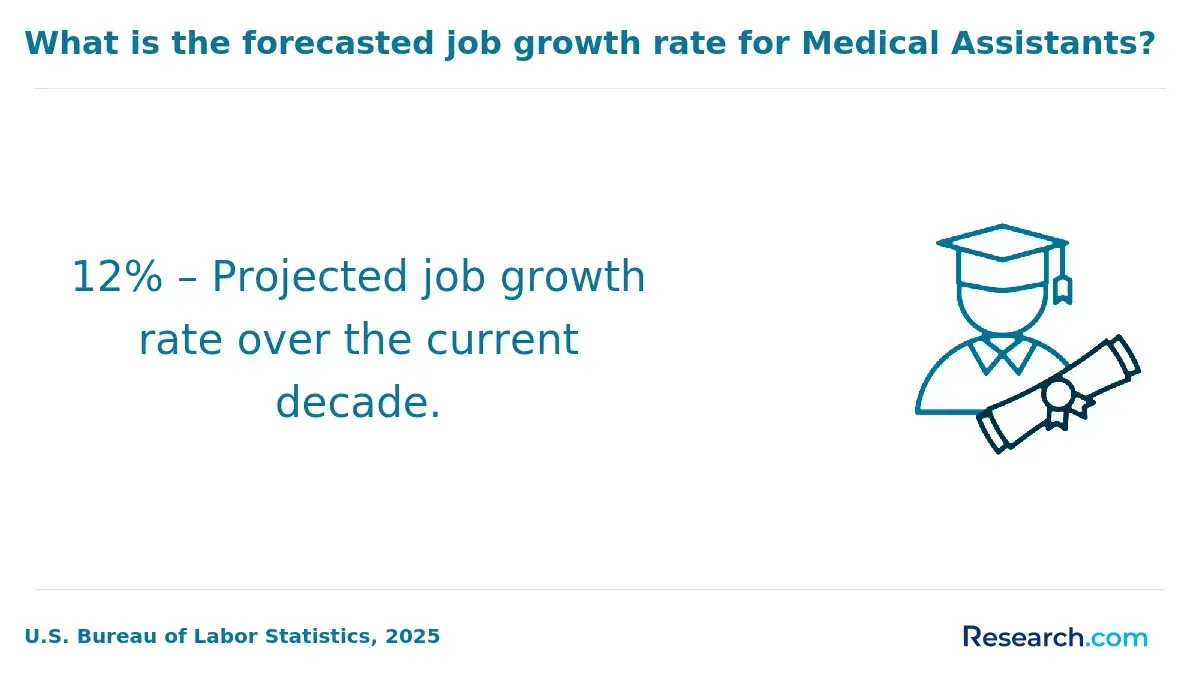
- U.S. Bureau of Labor Statistics. (2025). Medical Assistants. https://www.bls.gov/ooh/healthcare/medical-assistants.htm
- U.S. Bureau of Labor Statistics medical assistants page U.S. Bureau of Labor Statistics. (2024, May 15). Medical and Health Services Managers. Occupational Outlook Handbook. Retrieved from https://www.bls.gov/ooh/management/medical-and-health-services-managers.htm
Other Things You Should Know About Healthcare Management Degrees
In 2027, a healthcare management degree opens doors to a variety of leadership roles, such as hospital administrator, health services manager, and clinical department director. With this degree, you can manage private practices, oversee healthcare system operations, or guide healthcare policy development.
A healthcare management program in 2027 prepares students by offering courses on healthcare policies, financial management, and organizational behavior. It incorporates technology training to handle healthcare IT systems and emphasizes leadership skills crucial for healthcare administration roles.
In 2027, healthcare management is shaped by trends such as telehealth expansion, advanced data analytics for personalized care, integration of AI technologies, and a focus on patient-centered approaches. Managers are required to adapt to these innovations to improve healthcare delivery and operational efficiency.
A healthcare management degree program prepares students to address the unique challenges of the healthcare industry by providing a comprehensive education in healthcare policies, ethics, and organizational management. Students learn to navigate regulatory environments, improve healthcare delivery systems, and manage financial operations. The program includes case studies, internships, and simulations that offer hands-on experience in real-world healthcare settings. Additionally, courses on leadership, strategic planning, and quality improvement equip students with the skills to lead healthcare organizations effectively. This multifaceted approach ensures graduates are well-prepared to tackle the dynamic and complex nature of healthcare management.