2027 Most Affordable Master’s in Health Science Degrees

Co-Founder and Chief Data Scientist
Choosing a master’s in health science is often a value question: will the degree help you move into a better healthcare role without taking on more debt than the outcome justifies? This guide is for working healthcare professionals, recent graduates, career changers, and students comparing affordable graduate programs in health science, healthcare administration, health education, informatics, safety management, public health, and related fields.
You will learn what an affordable master’s in health science can prepare you to do, how online and campus programs compare, what programs may cost, which admissions requirements to expect, what careers are commonly connected to the degree, and how to evaluate quality before enrolling. The goal is not just to list programs, but to help you decide whether this path fits your career plans, schedule, and budget.
Quick answer: Is an affordable master’s in health science worth considering?
An affordable master’s in health science can be worth considering if you want graduate-level preparation for healthcare leadership, health education, research support, informatics, public health, safety management, or healthcare operations roles and you can choose a properly accredited program with a total cost that fits your expected return. The degree is especially practical for students who already work in healthcare and want broader administrative, analytical, or population-health skills.
What are the main benefits of an affordable master’s in health science?
- The degree can support career paths with strong salary potential. The median annual salary for health scientists is around $70,320; for health services managers, it’s approximately $104,280.
- Graduates may pursue roles such as health educator, medical scientist, health informatics specialist, public health professional, or medical and health services manager.
- Online programs can make graduate study more manageable for working adults by reducing commute time and, in some cases, lowering costs compared with campus-based study.
What can you expect from an affordable master’s in health science?
An affordable master’s in health science is usually an interdisciplinary graduate degree that connects healthcare systems, research methods, public health, leadership, policy, data, and ethics. Unlike a narrowly clinical degree, it often prepares students for non-licensure or leadership-focused roles across healthcare organizations, community programs, research settings, government agencies, and health-related businesses.
Career outcomes depend heavily on the concentration you choose. A healthcare administration track may fit students aiming for management roles, while health education or community health may be better for those interested in prevention programs and public outreach. Health informatics is more data- and technology-focused, while safety management or emergency medical care concentrations may align with specialized operational roles.
Labor market indicators remain favorable in several related fields. The Bureau of Labor Statistics expects medical scientists to grow by 6% from 2021 to 2031. Health educators are projected to see 7% job growth from 2022 to 2032. Healthcare management roles are projected to grow by 28%, making leadership preparation one of the strongest reasons students consider this degree.
Where can graduates with a master’s in health science work?
Graduates can work in hospitals, outpatient care centers, physicians’ offices, public health agencies, research organizations, community health programs, universities, insurance organizations, health technology companies, and government health departments. The best work setting depends on whether your program emphasizes administration, research, informatics, education, public health, nutrition, emergency care, or safety.
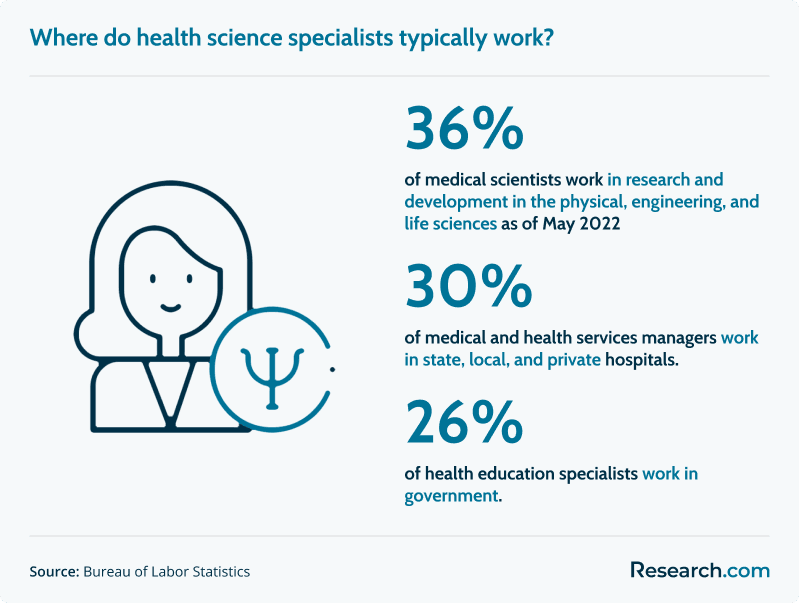
Hospitals are a major employer for medical and health services managers. According to the BLS, hospitals employ 137,410 medical and health services managers. Physicians’ offices and outpatient care centers also employ many professionals in this field. States with high employment levels include California, Texas, Florida, New York, and Massachusetts.
For medical scientists, scientific research and development services account for 42,550 jobs, while general medical and surgical hospitals employ around 18,900. States with the highest employment levels for these roles include California, Massachusetts, Texas, New York, and New Jersey. Health education specialists commonly work in general medical and surgical hospitals, local government, and individual and family services, with large employment levels in California, Texas, Florida, Georgia, and New York.
How much can you make with an affordable master’s in health science?
Salary varies by job title, state, employer, experience level, and specialization. BLS data shows that medical and health services managers have a median annual wage of $104,830, and the top earners make over $209,990. Medical scientists have a median annual wage of $99,930, with the highest earners making more than $170,260. Health education specialists have a median annual wage of $59,990, with potential earnings exceeding $106,210.
Location can make a major difference. In New York, medical and health services managers can earn a median annual wage of $171,620, one of the highest figures in the country. These numbers show that the degree can lead to financially viable career options, but students should not assume any salary is guaranteed. Program quality, experience, employer type, certification, and local demand all matter.
| Career area | Relevant degree focus | Salary or outlook detail stated in this guide |
| Medical and health services management | Healthcare administration, leadership, policy, operations | Median annual wage of $104,830; projected growth of 28% |
| Medical science and research | Research methods, epidemiology, biostatistics, laboratory or clinical research support | Median annual wage of $99,930; projected growth of 6% from 2021 to 2031 |
| Health education | Health promotion, community health, behavior change, public health education | Median annual wage of $59,990; projected growth of 7% from 2022 to 2032 |
- 2027 best affordable master’s in health science degrees
- How long does an affordable master’s in health science take?
- Online vs. on-campus affordable master’s in health science programs
- Average cost of an affordable master’s in health science
- Financial aid options for health science graduate students
- Admissions requirements and prerequisites
- Common courses in master’s in health science programs
- Popular specializations in health science master’s programs
- How to choose the best affordable master’s in health science
- Ethics and cultural competence in health science careers
- Career paths for graduates
- Job market for master’s in health science graduates
- Accreditation standards and quality checks
- Internships and mentorship opportunities
- Using a master’s in health science to move into healthcare administration
- Research and analytical skills developed in the degree
- Hands-on training and certifications
- Short-term medical certifications that may strengthen your profile
- Accelerated programs and career speed
- Using health science preparation for behavior analysis careers
- Online medical degree courses that can expand your expertise
- Challenges that may affect outcomes
- Technology, health informatics, and current trends
2027 Best Affordable Master’s in Health Science Degrees
The programs below are included for students comparing affordability, flexibility, credit requirements, concentration options, and accreditation. While this guide focuses on health science programs, some students may also compare related paths such as healthcare administration, public health, safety management, informatics, and even adjacent organizational fields such as organizational psychology when planning long-term career mobility.
Use this list as a starting point, not a final decision. Before applying, verify current tuition, fees, admission requirements, course delivery format, accreditation status, and whether the curriculum aligns with your target role.
How do we rank schools?
Research.com rankings are developed through structured research and data analysis. To understand the ranking process in more detail, review our methodology section. The sources used to create this ranking include:
- IPEDS database,
- Peterson’s database (including their Distance Learning Licensed Data Set),
- College Scorecard database, and
- National Center for Education Statistics.
1. Fort Hays State University
Fort Hays State University offers an affordable graduate option through its MLS Concentration in Health Sciences. The program is designed for students who want graduate-level health science knowledge with a flexible structure. Its curriculum blends theory and applied learning, which can suit working professionals seeking advancement as well as full-time students preparing for broader healthcare-related roles.
- Program Length: About 2 years
- Tracks/Concentrations: Corporate Communications, Digital Cinema Production, Global Management, Global Studies, Political Leadership and Public Service, Political Science, Public Administration
- Cost per Credit: $260.96 (Resident/Regional), $669.57 (Non-Resident)
- Required Credits to Graduate: 31 credit hours
- Accreditation: Higher Learning Commission
2. Western Carolina University
Western Carolina University’s Master of Health Sciences is delivered 100% online and is designed for students from backgrounds such as healthcare administration, education, clinical practice, and related fields. Core study includes healthcare policy, epidemiology, statistics, and research methodology. Students can choose from four concentration areas and complete a capstone that applies program learning to a practical health science problem.
- Program Length: About 2 years
- Tracks/Concentrations: Health Education, Health Management, Emergency Medical Care, Nutrition
- Cost per Credit: $277.92 (In-State), $873.42 (Out-of-State)
- Required Credits to Graduate: 33 Credit Hours
- Accreditation: Commission on Accreditation of Allied Health Education Programs
3. Florida Gulf Coast University
Florida Gulf Coast University offers a Master of Science in Health Science for baccalaureate graduates in healthcare and related areas. The program emphasizes leadership, administration, professionalism, and the ability to respond to changing healthcare delivery challenges. It may be a fit for students seeking preparation for administrative or leadership-oriented health service roles.
- Program Length: About 2 years
- Cost per Credit: $373.38 for FL residents; $1,300.66 for non-FL-residents
- Required Credits to Graduate: 45 credit hours
- Accreditation: Southern Association of Colleges and Schools Commission on Colleges
4. Northern Illinois University
Northern Illinois University provides an online Master of Science in Health Sciences for students who already hold a bachelor’s degree in a health-related field. The program is built for professionals who want to move toward leadership, management, education, quality improvement, or evidence-based practice roles. Its 30-credit structure includes 15 hours of electives, giving students room to shape the degree around their career goals.
- Program Length: About 2 years
- Cost per Credit: $505.00 (Domestic), $874.24 (International)
- Required Credits to Graduate: 30 Credit Hours
- Accreditation: Higher Learning Commission
5. The University of Texas Rio Grande Valley
The University of Texas Rio Grande Valley offers a Master of Science in Health Sciences with several concentration options. The program is intended for professionals seeking advanced knowledge in health science disciplines, with particular value for students who want a concentration closely aligned with healthcare administration, laboratory sciences, nutrition, health informatics, or health professions education technology.
- Program Length: About 2 years
- Tracks/Concentrations: Health Care Administration, Clinical Laboratory Sciences, Nutrition, Health Informatics, Health Professions Education Technology
- Cost per Credit: Resident: $444.44
- Required Credits to Graduate: 36 credit hours
- Accreditation: Southern Association of Colleges and Schools’ Commission on Colleges
6. Nova Southeastern University
Nova Southeastern University’s online Master of Health Science is designed for health professionals who want flexible graduate study and a wide selection of concentrations. The program may appeal to students who want to specialize in an area such as telehealth, health law, risk management, health informatics, or healthcare leadership while continuing to work.
- Program Length: About 2 years but may vary based on concentration and pace
- Tracks/Concentrations: Health Care Risk Management, Higher Education, Telehealth, Sports Medicine, Health Care Administration and Leadership, Health Informatics, Health Law, Generalist
- Cost per Credit: $471
- Required Credits to Graduate: Ranges from 31 to 43 credit hours, depending upon concentration
- Accreditation: Southern Association of Colleges and Schools Commission on Colleges
7. Indiana University Online
Indiana University Online offers a Master of Science in Applied Health Science with a major in Safety Management. This program is best suited for professionals who want to lead workplace safety and health programs, evaluate hazards, manage risk, and design safety systems in business, industry, and healthcare-related environments.
- Program Length: About 2 years
- Tracks/Concentrations: Safety Management
- Tuition Cost: $16,359.90 (In-State), $19,369.80 (Out-of-State) for the entire program
- Required Credits to Graduate: 30 Credit Hours
- Accreditation: Higher Learning Commission
8. Lindenwood University
Lindenwood University offers a master’s in health science program in online and on-campus formats. The program focuses on health science, wellness, sport science, fitness, and healthcare administration-related study. It can fit students whose career plans involve health promotion, performance, wellness leadership, nutrition-related support, or health and fitness management.
- Program Length: About 2 years
- Tracks/Concentrations: Fitness and Wellness, Sport Science and Performance, Advance Health and Well-Being, Fitness and Wellness Specialization, Healthcare Administration Specialization
- Cost per Credit: $551 (Online), $663 (On-Campus)
- Required Credits to Graduate: 30 to 33 Credit Hours, depending on whether online or on-campus
- Accreditation: Higher Learning Commission,
9. Minnesota State University
Minnesota State University’s Master of Science in Applied Health Science is structured for students interested in health education and health promotion. The curriculum is designed to support preparation for credentialing as a Certified Health Education Specialist (CHES) or a Master Certified Health Education Specialist (MCHES), making it especially relevant for students targeting community health, school health, public health, or clinical education roles.
- Program Length: About 2 years
- Cost per Credit: $551.45
- Required Credits to Graduate: 30 Credit Hours
- Accreditation: Higher Learning Commission (HLC)
10. Touro University
Touro University offers an MS in Health Sciences through a MS in Health Science pathway with public health and health education concentration options. The curriculum is aligned with Council on Education for Public Health (CEPH) requirements and is designed for students who want to assess, plan, implement, and evaluate public health programs.
- Program Length: Typically 1.5 years
- Tracks/Concentrations: Public Health, Health Education
- Cost per Credit: $500
- Required Credits to Graduate: 36 Credit Hours
- Accreditation: WASC Senior College and University Commission (WSCUC)
What graduates say about affordable master’s in health science programs
“Choosing an affordable master’s in health science changed what was possible for my career. I gained practical management knowledge that I could use immediately, and the lower cost made graduate school realistic without creating overwhelming financial pressure.” Emily
“The online format helped me keep working while completing my degree. Because I was employed in health policy at the same time, I could connect coursework to real workplace problems instead of treating school as something separate from my career.” Raj
“My program exposed me to health systems, research, and innovation in ways I had not experienced before. The applied projects were especially useful because they helped me understand how health science concepts show up in actual organizations.” Carlos
Key findings for students comparing affordable health science master’s programs
- Employment for medical scientists is expected to grow by 6% from 2021 to 2031, while health education specialists could see a 7% increase from 2022 to 2032. Medical and health services management roles are projected to grow by 28% in the same period.
- Graduates can enter multiple healthcare sectors. Medical and health services managers held about 509,500 jobs in 2022, and health education specialists held about 60,400 jobs.
- Health scientists earn an average hourly wage of $33.82. Medical and health services managers have a median annual wage of $104,280, while health educators earn a median annual wage of $56,500.
- Some programs have notably low tuition. Fort Hays State University lists a cost per credit of $260.96 for residents.
- Common graduate courses include Healthcare Policy and Administration, Epidemiology, Biostatistics, Healthcare Ethics, Research Methods in Health Science, and Health Promotion and Education.
- Many schools offer online options, including masters in health informatics pathways, which can help working professionals study without leaving their jobs.
How long does it take to complete an affordable master’s degree in health science?
Most affordable master’s in health science programs take about two years to complete. That timeline is common at schools such as Fort Hays State University, Western Carolina University, and Florida Gulf Coast University. Students comparing this path with healthcare management degrees may also want to review the career prospects after an MBA in healthcare management to decide whether a health science or business-oriented graduate program better fits their goals.
Credit requirements affect the timeline. Fort Hays State University requires 31 credit hours, Western Carolina University requires 33 credit hours, and Florida Gulf Coast University requires 45 credit hours. A student taking courses full time may finish faster than a student studying part time while working. Some programs also include capstones, practicums, research projects, or concentration-specific requirements that can influence completion time.
| Program pace | Best for | Trade-off |
| Full-time study | Students who can prioritize school and want to finish quickly | Less flexibility for full-time work or family responsibilities |
| Part-time study | Working professionals who need a manageable course load | Longer time to graduation and possible extended fees |
| Accelerated format | Students who can handle intensive coursework | Less room for schedule disruptions and heavier short-term workload |
How does an affordable online master’s degree in health science compare to an on-campus program?
An online affordable master’s in health science can be a strong option when the institution is properly accredited, the curriculum matches your career goals, and the student support services are adequate. According to a cited discussion of online and traditional degrees, when online programs are regionally accredited, 76% of academic leaders see them as equal to on-campus degrees. The equivalency perception rises to 89% among academic leaders when the online program is connected to an institution that also offers on-campus options.
Employers generally focus on the reputation and accreditation of the institution, the relevance of the degree, and the skills a graduate can demonstrate. Online learning can provide flexibility and may reduce relocation or commuting costs, but it is not automatically easier. Students must be comfortable with self-directed learning, online communication, and time management.
| Factor | Online master’s in health science | On-campus master’s in health science |
| Schedule flexibility | Usually stronger for working adults | Often more fixed around class meeting times |
| Networking | Depends on virtual events, faculty access, and cohort design | May offer more informal in-person networking |
| Hands-on learning | May require local placements, simulations, or virtual projects | May provide easier access to campus labs or local partners |
| Cost considerations | May reduce commuting and relocation expenses | May involve campus fees, travel, or housing costs |
| Best fit | Self-motivated students balancing school with work | Students who prefer face-to-face learning and campus resources |
What is the average cost of an affordable master’s degree in health science?
The average cost of a master’s degree in health science in the United States is approximately $11,066 for state residents and $20,134 for out-of-state students. Some programs listed in this guide fall below or near those figures. Fort Hays State University charges $260.96 per credit for residents, which results in an estimated tuition cost of around $8,090 for the full program. Western Carolina University charges $277.92 per credit for in-state students.
When comparing cost, do not evaluate tuition alone. Fees, books, software, clinical or practicum expenses, travel, technology requirements, graduation fees, and lost work hours can change the real price of the degree. Online programs may reduce commuting or relocation expenses, but they can still carry additional fees.
The chart below compares average tuition costs for master’s programs in health sciences in the United States, including the difference between in-state and out-of-state tuition.
What financial aid options are available for affordable master’s in health science students?
Students considering an affordable master’s in health science should build a funding plan before applying. This is true whether you are pursuing a general health science degree or comparing a specialized graduate path such as a master’s in child development. Common funding options include:
- Federal Student Loans: Direct Unsubsidized Loans are available through the U.S. Department of Education for eligible graduate students.
- Scholarships: Schools, professional associations, nonprofit organizations, and private funders may offer merit-based awards, including awards for health science students.
- Grants: Need-based funding may be available and does not require repayment when award conditions are met.
- Graduate Assistantships: Some universities provide tuition support and stipends in exchange for research, teaching, or administrative work.
- Work-Study: Eligible students may qualify for federally supported part-time work that helps cover education expenses.
- Tuition Reimbursement Programs: Healthcare employers may help pay for graduate education when the degree is related to the employee’s role or advancement path.
- Fellowships: Competitive awards may support graduate study, research, or academic projects.
- Military and Veterans Benefits: Service members, veterans, and eligible family members may be able to use benefits such as the Post-9/11 GI Bill.
How to reduce the cost of a health science master’s degree
- Ask whether online students pay in-state, resident, or separate online tuition rates.
- Compare total program cost, not just cost per credit.
- Look for employer tuition assistance before borrowing.
- Check whether transfer credits or prior graduate credits are accepted.
- Confirm whether the program requires travel, campus residencies, labs, or practicum-related expenses.
- Apply early for institutional scholarships and assistantships because funds may be limited.
What are the prerequisites for enrolling in an affordable master’s degree in health science?
Admissions requirements vary by institution and concentration, but most programs expect applicants to show they can succeed in graduate-level health science coursework. Students coming from biology, public health, psychology, healthcare administration, nursing, allied health, or related fields may have a smoother transition, while career changers may need prerequisite coursework. Those comparing health science with more specialized psychology routes, including a psychology doctoral degree, should review prerequisites carefully because program expectations can differ significantly.
- Bachelor’s Degree: Most programs require a four-year degree from an accredited institution, often in a related field such as biology, public health, psychology, or another health-related discipline.
- Minimum GPA: Many schools set a minimum undergraduate GPA, often around a 3.0 or higher.
- Test Scores: Some programs may ask for GRE scores, although waivers are increasingly common.
- Letters of Recommendation: Applicants are often asked for two or three recommendations from professors, supervisors, or professional mentors.
- Personal Statement: Schools commonly request an essay explaining your interest in health science, career goals, and reasons for applying.
- Relevant Experience: Some programs prefer healthcare, research, community health, education, or administrative experience.
- Prerequisite Courses: Depending on the concentration, applicants may need prior coursework in statistics, biology, health science, or a related subject.
What courses are typically included in an affordable master’s degree in health science?
Master’s in health science programs usually combine research, population health, policy, leadership, ethics, and applied health topics. Students interested in behavioral and psychological aspects of wellness may also find overlap with health psychology, especially in courses related to health behavior, prevention, and patient education.
- Biostatistics: Students learn statistical tools used to interpret health data and research findings.
- Epidemiology: Coursework examines how diseases and health conditions are distributed across populations.
- Healthcare Policy and Management: Students study healthcare systems, policy decisions, organizational operations, and leadership issues.
- Ethics in Health Science: This course explores patient rights, confidentiality, informed consent, equity, and ethical decision-making.
- Environmental Health: Students examine how environmental factors affect health risks and public safety.
- Health Informatics: Coursework introduces health data systems, information technology, and digital tools used in healthcare delivery.
- Research Methods: Students learn how to design studies, collect data, evaluate evidence, and communicate findings.
What types of specializations are available in an affordable master’s degree in health science?
Specializations matter because they shape both your coursework and your likely career options. A student who wants to manage healthcare departments should not choose the same concentration as a student who wants to work in community health education or health data systems. Common specializations include:
- Biostatistics: Focuses on using statistics to support biological and health-related decision-making.
- Epidemiology: Concentrates on disease patterns, risk factors, prevention, and population-level health trends.
- Community Health: Prepares students to design, implement, and evaluate health programs in local settings.
- Health Policy and Administration: Fits students who want to work in healthcare leadership, operations, or policy analysis.
- Environmental Health: Examines how environmental exposures and conditions affect public health.
- Global Health: Focuses on health challenges that cross national borders and require international or systems-level responses.
- Health Informatics: Connects healthcare and information technology to improve care delivery, reporting, and decision-making.
- Health Education and Behavior: Develops skills for teaching, coaching, and designing behavior-change programs for individuals and communities.
| If your goal is... | Consider this specialization | Why it fits |
| Managing healthcare teams or departments | Health Policy and Administration | Emphasizes leadership, operations, policy, and organizational decision-making |
| Working with health data and digital systems | Health Informatics | Builds skills in healthcare information systems and data use |
| Leading prevention and wellness programs | Community Health or Health Education and Behavior | Focuses on outreach, education, health behavior, and program planning |
| Analyzing disease patterns | Epidemiology or Biostatistics | Strengthens research, statistical, and population-health analysis skills |
How to choose the best affordable master’s degree in health science
The best affordable master’s in health science is not simply the cheapest program. It is the program that combines acceptable cost, recognized accreditation, relevant curriculum, strong support, and a realistic path to your intended role. Use the following criteria to compare programs before you apply:
- Accreditation: Confirm institutional accreditation and, when relevant, programmatic accreditation connected to your concentration or career goal.
- Curriculum fit: Review required courses and electives to make sure they match your target role, not just the general phrase “health science.”
- Faculty expertise: Look for faculty with experience in healthcare administration, public health, research, informatics, health education, or your intended specialization.
- Flexibility: Choose a delivery format that matches your schedule, especially if you work full time or have family responsibilities.
- Career services: Ask about employer partnerships, internship support, resume help, networking events, and job search resources.
- Student support: Online and adult learners should look for advising, tutoring, library access, technology support, and responsive faculty communication.
- Alumni network: A useful alumni network can help with mentorship, informational interviews, referrals, and career exploration.
Questions to ask before enrolling
- What is the total estimated cost, including fees and required materials?
- Is tuition different for online, in-state, out-of-state, or international students?
- Does the program require a capstone, practicum, internship, thesis, or campus visit?
- What jobs do recent graduates obtain, and does the school publish outcomes?
- Are courses taught by full-time faculty, adjuncts, practitioners, or a mix?
- Will this degree meet requirements for any credential, certification, or licensure I plan to pursue?
- How often are courses offered, and can I graduate on my preferred timeline?
The role of ethics and cultural competence in health science careers
Health science professionals often work with people, systems, and data that affect patient care and public well-being. That makes ethics and cultural competence central to the field. A graduate who understands privacy, informed consent, fairness, access, and cultural context is better prepared to contribute responsibly in healthcare organizations and public health programs.
Why ethics matters in health science
Health science work can involve sensitive patient information, competing resource needs, research participation, organizational policy, and decisions that affect vulnerable populations. Graduate programs often address bioethics, healthcare law, confidentiality, informed consent, and ethical leadership so students can evaluate decisions through both professional and legal lenses.
Why cultural competence matters
Cultural competence means working effectively with people from different linguistic, socioeconomic, racial, ethnic, religious, and community backgrounds. In practice, that can include designing accessible education materials, recognizing barriers to care, communicating respectfully, and avoiding one-size-fits-all health interventions. These skills are especially important in health education, community health, healthcare management, and patient-facing program design.
Career value of ethical and culturally responsive practice
Hospitals, community health centers, government agencies, and healthcare organizations need professionals who can lead responsibly in diverse settings. Students considering online study should also confirm that the institution is credible; one useful next step is learning how accredited online universities are evaluated and recognized by employers and professional organizations.
What career paths are available for graduates of affordable master’s degrees in health science?
Graduates may pursue many roles, but the right path depends on concentration, prior experience, employer expectations, and whether a role requires licensure or certification. A master’s in health science often supports leadership, education, research, data, and program roles rather than direct clinical licensure.
- Health Services Manager: Oversees operations in healthcare facilities, with salaries ranging from $70,000 to $120,000 annually.
- Epidemiologist: Studies disease patterns and public health threats, with salaries typically between $60,000 and $100,000.
- Biostatistician: Applies statistics to health research and data analysis, earning between $70,000 and $110,000.
- Health Policy Analyst: Evaluates and helps shape health policies, with salaries ranging from $50,000 to $90,000.
- Community Health Educator: Designs and delivers wellness and prevention programs, with potential earnings from $45,000 to $65,000.
- Health Informatics Specialist: Works with healthcare data systems and digital records, with salaries between $60,000 and $90,000.
What is the job market for graduates with affordable master’s in health science degrees?
The job market is strongest for students who match their degree concentration to a clear career path. Health education specialists are projected to grow by 7% from 2022 to 2032, with about 6,600 job openings expected each year during that period. Medical and health services managers are projected to grow by 28% in the same period, with approximately 54,700 annual job openings anticipated.
Medical scientists are also projected to grow, with an expected increase of 10% from 2022 to 2032. Demand is connected to factors such as an aging population, chronic disease, and the need for research into conditions such as cancer and Alzheimer’s. For students interested in healthcare data and digital systems, master’s in health informatics online programs may be worth comparing because electronic health records and health IT systems continue to shape healthcare operations.
What accreditation standards and quality checks should you look for?
Accreditation is one of the most important safeguards when selecting an affordable master’s in health science. Confirm that the institution holds recognized accreditation, then check whether your specific program or concentration has additional professional standards. This is especially important if your career plan involves certification, licensure, employer reimbursement, doctoral study, or regulated healthcare work.
Also evaluate whether the program regularly updates its curriculum, uses qualified faculty, provides practical experience, and publishes meaningful student outcomes. Some students may supplement a health science degree with related credentials, such as training connected to medical billing and coding price, but those credentials should be chosen for a specific career reason rather than as random add-ons.
How can internships and mentorship opportunities amplify your career growth in health science?
Internships, practicums, capstones, and mentorships can make a health science master’s degree more valuable because they connect classroom concepts with real healthcare problems. Through applied experience, students can build communication skills, leadership confidence, data interpretation ability, and professional contacts.
Mentorship is especially helpful for students changing careers or moving from clinical work into administration, informatics, education, or research. A mentor can help clarify which roles are realistic, what skills employers expect, and which certifications or experiences matter most. Students exploring adjacent healthcare education options may also compare specialized routes such as an online pharmacy degree, depending on their long-term goals.
How can a Master’s in Health Science accelerate your transition into healthcare administration?
A master’s in health science can support a move into healthcare administration when the program includes leadership, policy, operations, quality improvement, finance, and strategic planning coursework. This path is often strongest for applicants who already have healthcare experience and want to shift from frontline, technical, educational, or support roles into management.
If your main goal is administration, compare health science programs with MHA and healthcare management options. A focused healthcare administration curriculum may be more direct for some students. For a related pathway, review this guide on how to become healthcare administrator fast.
How can a master’s in health science degree enhance your research and analytical skills?
Research and analysis are major strengths of many master’s in health science programs. These skills are useful in public health, health education, medical research, healthcare quality improvement, policy work, and informatics.
- Data collection and analysis proficiency: Courses in biostatistics and epidemiology help students collect, interpret, and analyze health data.
- Critical thinking and problem-solving: Research projects train students to examine complex health issues, evaluate evidence, and propose practical solutions.
- Research design and methodology expertise: Students learn how to structure studies, use sampling methods, develop surveys, and interpret results.
- Ethical evaluation: Coursework helps students understand ethical responsibilities in research involving individuals, communities, and health data.
- Literature review and scholarly writing: Graduate research strengthens the ability to read academic literature, synthesize evidence, and write clearly for professional or policy audiences.
How can integrated hands-on training and certifications enhance your career in health science?
Coursework builds a foundation, but applied training helps students prove they can use what they have learned. Internships, lab practicums, simulations, capstones, and employer-based projects can improve readiness for real health science work. Short-term certifications may also help when they align with a specific role.
For example, students seeking practical clinical support exposure may review 6 weeks medical assistant programs. However, certifications should support your target career. A student aiming for health informatics, for instance, may benefit more from data or systems training than from a patient-care support credential.
What are the best short-term medical certification programs to enhance career prospects?
Short-term medical certifications can complement a master’s in health science when they add concrete skills tied to your career plan. They are most useful for students who want to strengthen a resume, gain exposure to clinical environments, or add an applied credential while completing a broader graduate degree.
Common options include phlebotomy, EKG technician, and medical billing and coding. These credentials can be completed within a few months and may help students seeking roles in hospitals, outpatient care centers, healthcare administration support, or clinical operations. They are not substitutes for a master’s degree, but they can show job-ready skills in a specific area.
For a broader list of options, review Research.com’s guide to medical certificate programs, which explains short-term credentials that may fit different healthcare career goals.
Can accelerated programs fast-track your career in health science?
Accelerated programs can reduce time to completion, but they are not the best fit for every student. They work best for learners who can manage a heavier workload, have strong time-management skills, and already understand their career direction. The benefit is speed; the trade-off is intensity.
Students focused specifically on administration may also compare accelerated MHA options. For example, 1-year MHA programs online may provide a more direct path for those who want healthcare leadership preparation in a shorter format.
Can a Master’s in Health Science bridge to behavior analysis careers?
A master’s in health science may support movement into behavior-related work when paired with relevant coursework, supervised experience, and any required credentials. Skills in research design, data analysis, population health, and intervention evaluation can transfer well to settings where behavior, health outcomes, and evidence-based decision-making overlap.
However, behavior analysis careers may have specific certification or licensure requirements. Students should confirm those requirements before assuming a health science degree is sufficient. For related career possibilities, see What can you do with a master's in behavior analysis?.
What online medical degree courses can broaden your expertise in health science?
Targeted online medical coursework can help health science students deepen knowledge in a specific area without changing their primary degree plan. These courses may cover clinical terminology, healthcare technology, patient management, diagnostics, digital health, or specialized healthcare practices.
Students who want to compare online options can start with this overview of online medical degree courses. The best supplemental course is one that fills a real gap in your background, supports your concentration, or helps you qualify for a specific role.
What challenges might impact the outcomes of an affordable master’s in health science?
An affordable degree can still be a poor investment if the program lacks recognized accreditation, has limited student support, does not match your career goals, or carries hidden costs. Online students may also face challenges with isolation, time management, limited networking, and fewer informal faculty interactions.
Another common issue is choosing a broad health science degree when a more targeted program would be better. If you want healthcare administration, compare health science with MHA programs. If you want informatics, compare health science with informatics degrees. If you want licensure-based clinical practice, confirm whether the program actually meets those requirements. For more on administrative outcomes, review this guide to master's in healthcare administration jobs.
Common mistakes to avoid
- Choosing a school before checking accreditation.
- Comparing only cost per credit instead of total program cost.
- Assuming every online program has the same employer recognition.
- Enrolling in a concentration that does not match your target job.
- Ignoring whether a role requires separate certification or licensure.
- Assuming salary outcomes are guaranteed because a program advertises strong careers.
- Overlooking practicum, internship, capstone, or campus residency requirements.
Technology in health science and the role of health informatics
Technology now shapes nearly every part of healthcare, from electronic health records and telemedicine to data analytics, remote monitoring, patient portals, and healthcare operations. For master’s in health science students, this means digital fluency is becoming increasingly important even outside dedicated informatics roles.
Health informatics connects healthcare, data, and technology
Health informatics focuses on organizing, analyzing, and using health information to improve care delivery and organizational decisions. Students who pursue this area may learn about health information systems, data governance, analytics, clinical workflows, and technology implementation. Graduates may pursue roles such as health IT managers, data analysts, and informatics specialists.
Technology affects healthcare administration
Healthcare administrators increasingly rely on data systems to manage operations, quality, compliance, staffing, finance, and patient experience. A health science program with technology-related coursework can help students understand how digital tools influence decision-making across hospitals and health organizations.
Telemedicine and remote healthcare are now core delivery issues
Telemedicine became especially visible after the COVID-19 pandemic, but its relevance extends beyond emergency conditions. Health science graduates who understand virtual care platforms, remote consultations, patient portals, and remote monitoring may be better prepared to support modern healthcare delivery models.
Research and analytics rely on digital tools
Health scientists increasingly use statistical software, data visualization, electronic datasets, and big-data methods to examine health trends, track outbreaks, support clinical research, and evaluate programs. Students who want deeper preparation in this area can compare health informatics online degree programs, which focus directly on the relationship between healthcare and information systems.
Key Insights
- An affordable master’s in health science is strongest when it matches a specific goal, such as healthcare administration, health education, research, informatics, public health, safety management, or community health.
- Most programs take about two years, but credit requirements, pacing, capstones, practicums, and accelerated formats can change the timeline.
- Affordability should be measured by total cost, not just tuition per credit. Fees, technology, travel, books, and lost work time can affect the real price.
- Online programs can be credible when properly accredited, but students should evaluate support services, employer recognition, networking opportunities, and hands-on requirements.
- Career outcomes vary widely. Management, research, informatics, and health education roles can offer strong opportunities, but salaries are not guaranteed and depend on location, experience, employer, and specialization.
- Accreditation, curriculum fit, faculty expertise, career support, and practical experience are more important than rankings alone.
- Students should avoid broad enrollment decisions. First identify the job you want, then choose the concentration, format, and program that best supports that outcome.
References:
- BLS. (2023a). Health Education Specialists: Occupational Outlook Handbook:: U.S. Bureau of Labor Statistics.
- BLS. (2023b, September 6). Medical and Health Services Managers: Occupational Outlook Handbook:: U.S. Bureau of Labor Statistics.
- BLS. (2023c, September 6). Medical Scientists: Occupational Outlook Handbook:: U.S. Bureau of Labor Statistics.
- Glassdoor. (2023). Salary: Health Scientist in United States 2023 | Glassdoor.
- Salary.com. (2023). Health Scientist Salary | Salary.com.
- Zippia. (2023, July 21). Medical Scientist Demographics and Statistics [2023]: Number of medical scientists in the US.
- ZipRecruiter. (2023). Health Scientist Salary: Hourly Rate December 2023 USA. ZipRecruiter.
Other things you should know about affordable master’s degrees in health science
Financial aid options for 2027 affordable Master’s in Health Science programs include federal student loans, scholarships specific to health sciences, grants, and work-study opportunities. It is advisable to check each program’s financial aid office for specific scholarships or grants beneficial to health science students.
Most low-cost Master’s in Health Science programs require a bachelor’s degree from an accredited institution, a minimum GPA of 2.75 to 3.0, official transcripts, and a personal statement. Some also ask for GRE scores, although many programs waive the exam in 2027.