
2027 Most Affordable Online Associate's in Surgical Tech Programs

Co-Founder and Chief Data Scientist
Choosing an online associate degree in surgical technology is really a decision about three things: whether the program is accredited, whether you can complete the required hands-on clinical training, and whether the total cost makes sense for the career outcome. Surgical technology can be an efficient route into the operating room because many associate programs take two years or less, and some online or hybrid options keep tuition comparatively low. Surgical technologists earn a median annual wage of $62,830 for 2027, and employment is projected to grow 6% over the next decade.
This guide is for students who want a practical, lower-cost path into healthcare without committing to a four-year degree. You will learn what online surgical tech programs actually include, which affordable programs are worth comparing, how clinical requirements work, what accreditation means for certification, and how to judge whether a program is a good financial and career fit.
Quick answer: Is an online associate degree in surgical tech worth it?
An online associate degree in surgical technology can be worth it if the program is accredited, includes approved in-person clinical training, prepares graduates for certification, and has tuition that fits your budget. The “online” part usually applies to lectures and general education courses; students still complete labs, simulations, and clinical rotations in person because surgical technology is a hands-on operating room profession.
The best-value programs are usually community colleges or hybrid programs with CAAHEP accreditation, clear clinical placement policies, transparent tuition, and strong certification exam preparation. Students should avoid any program that cannot explain whether graduates qualify for the Certified Surgical Technologist exam or whether clinical sites are available in their area.
What are the benefits of getting an online associate's degree in surgical tech?
- Many online or hybrid associate programs in surgical technology are designed for completion in 18 to 24 months, which can help students enter the healthcare workforce faster than a traditional four-year path.
- Students enrolled at online-only institutions tend to borrow less in federal student loans than students attending traditional colleges, which may reduce long-term repayment pressure.
- Nearly 70% of online college students work while enrolled, making flexible coursework especially useful for learners who need to maintain income while completing prerequisites, lectures, or general education classes.
What can I expect from an online associate's degree in surgical tech?
An online associate degree in surgical technology prepares students to support surgeons, nurses, and surgical teams before, during, and after operations. Coursework commonly covers anatomy, medical terminology, microbiology, surgical procedures, aseptic technique, patient safety, and surgical instruments. The online format is usually used for lecture-based classes, while labs and clinical rotations must be completed in person at approved hospitals, outpatient surgery centers, or other clinical facilities.
Accreditation should be one of the first things you verify. Many quality programs are accredited through the Commission on Accreditation of Allied Health Education Programs (CAAHEP). This matters because graduates who plan to take the Certified Surgical Technologist (CST) exam often need to complete an eligible accredited program. Before enrolling, ask the school exactly which certification exams the program prepares students for and whether graduates in your state meet local employer or regulatory expectations.
| Program feature | What it means for students | Why it matters |
| Online coursework | Lectures, readings, assignments, and exams may be completed remotely. | This can make the program easier to manage for working adults and students with family responsibilities. |
| In-person labs | Students practice sterile technique, surgical setup, and instrument handling in a supervised environment. | Operating room skills cannot be learned fully through online modules alone. |
| Clinical rotations | Students train in real healthcare settings under supervision. | Clinical experience is essential for graduation, certification readiness, and employer confidence. |
| Accreditation | The program has been reviewed against recognized educational standards. | Accreditation can affect certification eligibility, transfer options, and employer acceptance. |
Where can I work with an online associate's degree in surgical tech?
Most surgical technologists work in operating rooms, where they prepare sterile fields, organize instruments, assist during procedures, and help maintain a safe surgical environment. According to the US Bureau of Labor Statistics (BLS), around 75,000 surgical technologists work in general medical and surgical hospitals.
Graduates may also find opportunities in settings where surgical or procedural care is performed, including:
- outpatient care centers
- ambulatory surgical facilities
- physician offices that perform minor surgeries
- labor and delivery units
- dental surgery offices
- specialty surgical clinics
- healthcare staffing agencies
How much can I make with an online associate's degree in surgical tech?
An online associate degree can lead to the same types of surgical technology roles as a campus-based program, provided the program meets accreditation, clinical, and certification expectations. The median annual wage for surgical technologists is $62,830 for 2027. Pay varies by employer type, region, experience level, shift, and certification status. Surgical technologists in outpatient care centers often earn more, with a median salary of $64,440, while those working in hospitals earn slightly less on average.
Certification can also influence hiring and advancement opportunities. Surgical technologists who hold the Certified Surgical Technologist (CST) credential may be more competitive for positions that require or prefer formal certification. Geography matters as well. In high-demand states like California, the annual mean range is $75,020, which is higher than the national average of $62,480. Salary outcomes are not guaranteed, so students should compare local job postings, employer requirements, and regional wage data before choosing a program.
- Most Affordable Online Associate’s in Surgical Tech Programs 2027
- How long does it take to complete an online associate’s degree in surgical tech?
- How does an online associate’s degree in surgical tech compare to an on-campus program?
- What is the average cost of an online associate’s degree in surgical technology?
- What are the financial aid options for students enrolling in an online associate’s degree in surgical tech program?
- What are the prerequisites for enrolling in an online associate’s surgical tech program?
- What courses are typically in an online associate’s degree in surgical tech program?
- What types of specializations are available for online associate's in surgical tech?
- What additional certifications can enhance my surgical tech career prospects?
- How do you choose the best online associate’s degree in a surgical tech program?
- Can I expand my healthcare career with complementary certifications?
- How does an online surgical tech program differ from an online kinesiology degree?
- Can further education in healthcare administration enhance career prospects?
- What is the job market for graduates with an online associate’s degree in surgical tech?
- What emerging trends are shaping the future of surgical technology education?
Most Affordable Online Associate’s in Surgical Tech Programs for 2027
How do we rank schools?
Affordability matters, but the cheapest program is not always the best choice for surgical technology. Students also need to consider accreditation, clinical training access, certification preparation, and program structure. A low tuition price is only valuable if the program helps you graduate, qualify for the right exam, and compete for local surgical tech jobs.
To build this list, our team reviewed affordability and education quality using information from trusted sources, including the IPEDS database, College Scorecard, Peterson’s Database, and the National Center for Education Statistics (NCES).
For more detail about our evaluation process, visit our methodology.
1. Madisonville Community College Surgical Technology Program
Madisonville Community College offers an Associate in Applied Science (AAS) in Surgical Technology through a partnership with Hopkinsville Community College. The program is selective and combines classroom learning with supervised clinical experience. Students complete a minimum of 120 surgical cases, following the Core Curriculum for Surgical Technology. With relatively low tuition and possible Work Ready Kentucky Scholarship eligibility, this option may appeal to Kentucky students seeking a structured, accredited route into the field.
- Program Length: Approximately 2 years
- Cost per Credit Hour: $189 (in-state); $260 (out-of-state)
- Required Units to Graduate: 62–66
- Accreditation: CAAHEP
2. Northcentral Technical College Surgical Technology Associate Degree
Northcentral Technical College (NTC) in Wausau, Wisconsin, offers a Surgical Technology Associate Degree with a strong emphasis on practical preparation. Students train in simulated operating room environments, including use of a synthetic cadaver and a modern surgical suite. NTC’s “Attend Your Way” format gives students options for in-person, online, or hybrid participation, which can help learners choose the structure that best fits their schedule and learning style.
- Program Length: Approximately 2 years
- Cost per Credit Hour: $149.50 (in-state); $224.25 (out-of-state)
- Required Units to Graduate: 62
- Accreditation: CAAHEP
3. University of Arkansas – Pulaski Technical College Surgical Technology Program
The University of Arkansas – Pulaski Technical College offers a Surgical Technology program designed to prepare students for entry-level Certified Surgical Technologist roles. Admission is competitive, with up to 20 full-time students selected annually. Applicants are evaluated using criteria that include a cumulative GPA of 2.0 or higher and an interview assessment. The smaller cohort model may be a good fit for students who want a focused learning environment and can commit to full-time study.
- Program Length: Approximately 2 semesters
- Cost per Credit Hour: $145 (in-state); $250 (out-of-state)
- Required Units to Graduate: 60
- Accreditation: CAAHEP
4. Rochester Community and Technical College Surgical Technology Associate of Applied Science Degree
Rochester Community and Technical College (RCTC) offers a Surgical Technology Associate of Applied Science (AAS) program with long-standing accreditation and extensive clinical training connections. The program began in 1977 and has maintained continuous CAAHEP accreditation through the Accreditation Review Council on Education in Surgical Technology and Surgical Assisting (ARC/STSA). Students learn in a dedicated lab and complete clinical rotations at Mayo Clinic Hospitals in Rochester and other hospitals in southeastern Minnesota.
- Program Length: Approximately 2 years
- Cost per Credit Hour: $149.50 (in-state); $224.25 (out-of-state)
- Required Units to Graduate: 60
- Accreditation: CAAHEP
5. Southeast Community College Associate of Science in Surgical Technology
Southeast Community College offers a Surgical Technology program with both in-person and online options. The online route is not fully remote; students still attend required in-person labs at designated locations so they can build operating room skills under supervision. This structure may work well for students who want online coursework but can travel for scheduled hands-on training.
Students must sit for the National Certification Examination before graduation. Graduates who pass receive certification from the National Board of Surgical Technology and Surgical Assisting, a credential recognized in all 50 states.
- Program Length: Approximately 2 years
- Estimated Total Tuition: $9,962
- Required Units to Graduate: 60
- Accreditation: CAAHEP
6. Southern Maine Community College Surgical Technology Associate Degree Program
Southern Maine Community College (SMCC) runs its Surgical Technology Associate Degree program in collaboration with Maine Medical Center (MMC). Students first complete 22 general education credits at SMCC in areas such as biology, English, and social sciences. They then move into a one-year, full-time clinical phase at MMC, gaining hands-on experience in operating rooms and ambulatory surgery centers. This model is best for students who can commit to an intensive clinical year after foundational coursework.
- Program Length: Approximately 2 years
- Cost per Credit Hour: $96 (in-state); $192 (out-of-state)
- Required Units to Graduate: 67
- Accreditation: CAAHEP
7. Concorde Career College Surgical Technologist Program
The Surgical Technology Associate Degree program at Concorde Career College is an accelerated, skills-focused option for students who want intensive hands-on preparation. Students complete 120 different surgical cases across multiple specialties, giving them broad exposure to operating room procedures. The program is offered at 14 campuses nationwide and is CAAHEP-accredited. Concorde also provides certification exam preparation and pays for the first attempt at the National Certifying Examination for Surgical Technologists.
- Program Length: 17 months
- Cost per Credit Hour: Varies per campus, $597-$628
- Required Hours to Graduate: 74 credit hours and 570 clinical hours
- Accreditation: CAAHEP
8. Rasmussen University Surgical Technologist Associate's Degree
Rasmussen University offers a Surgical Technology program that uses surgical suite labs to mirror real operating room conditions. Students complete 120 different surgical cases across several specialties, helping them practice procedure flow, instrumentation, and patient safety expectations. Rasmussen also offers self-directed assessments that may allow students to show mastery in certain areas and move through parts of the program more efficiently.
- Program Length: As few as 21 months
- Cost per Credit Hour: $385
- Required Units to Graduate: 92
- Accreditation: CAAHEP
9. Simi Institute for Careers & Technology Surgical Technology Program
Simi Institute for Careers & Technology (SICE) offers a Surgical Technologist Associate Degree pathway through a partnership with Excelsior University. The curriculum includes anatomy, microbiology, surgical procedures, infection control, and other core topics. Students also participate in mock surgery labs that simulate operating room conditions. SICE offers scholarships ranging from 20% to 70% of tuition costs through the Rotary Club of Simi Sunrise.
- Program Length: 16 months
- Estimated Total Tuition: $11,100
- Required Units to Graduate: 61
- Accreditation: CAAHEP
10. Saint Joseph’s University Associate Degree in Surgical Technology
Saint Joseph’s University offers a hybrid Associate Degree in Surgical Technology that combines online instruction with hands-on training in a Simulation Center. The format is designed to help students practice surgical skills in a controlled setting before entering clinical environments.
The program also offers guaranteed clinical placements, which can be a major advantage for students who worry about finding approved sites. Saint Joseph’s University reports a 100% pass rate on the Certified Surgical Technologist (CST) exam for the 2023–2024 year and an 88% job placement rate after graduation.
- Program Length: Approximately 2 years
- Cost per Credit Hour: $697
- Required Units to Graduate: 65
- Accreditation: CAAHEP
How long does it take to complete an online associate’s degree in surgical tech?
Most online associate degrees in surgical technology take 16 to 24 months. That timeline usually includes online coursework, lab practice, and in-person clinical rotations. Some schools offer accelerated degree programs online; for example, Concorde Career College has a degree completion option that can be finished in as little as 8 months for students who already have a surgical tech diploma.
The schedule depends on whether you attend full time or part time, how prerequisites are handled, and when clinical placements are available. Students who already completed biology, anatomy, physiology, or general education courses may finish faster, while students who need to complete all prerequisites first may need additional time.
| Timeline factor | How it affects completion |
| Prerequisites | Missing science or medical terminology requirements can add time before admission or delay clinical placement. |
| Clinical rotation availability | Students may need to wait for approved sites, background clearance, or health documentation approval. |
| Full-time vs. part-time enrollment | Full-time students usually finish faster, while part-time students may need a longer timeline but gain more schedule flexibility. |
| Accelerated format | Accelerated programs can shorten the path, but they may require a heavier weekly workload and more rigid clinical scheduling. |
How does an online associate’s degree in surgical tech compare to an on-campus program?
Accredited online degrees in surgical technology are usually hybrid programs rather than fully remote programs. They may offer online lectures and flexible assignments, but students still need in-person labs and clinical training. This format can reduce commuting for lecture courses and help working students manage their schedules more easily.
As of 2027, nearly 70% of surgical technology students opt for hybrid or fully online programs, showing that flexible delivery has become a major factor in how students choose healthcare training.
Campus-based programs offer more face-to-face structure, direct access to lab spaces, and regular interaction with instructors and classmates. That environment can be better for students who prefer fixed schedules, immediate feedback, and frequent in-person practice.
Both formats can be strong choices if they are properly accredited and include high-quality clinical experience. Accreditation by organizations such as CAAHEP is important because it can affect eligibility for healthcare certifications and certification exams.
| Factor | Online or hybrid surgical tech program | On-campus surgical tech program |
| Best for | Students who need flexibility for work, family, or commuting limits. | Students who want a structured schedule and regular in-person instruction. |
| Hands-on training | Still required through labs and clinical rotations. | Built into the campus schedule and local clinical partnerships. |
| Flexibility | Often higher for lectures and assignments. | Usually lower because classes and labs meet at set times. |
| Main risk | Clinical placement may be difficult if the school does not have strong local partners. | Commuting, scheduling, and campus attendance may be harder for working adults. |
What is the average cost of an online associate’s degree in surgical technology?
The price of an online associate degree in surgical technology can vary significantly. Programs may cost from $4,000 to over $47,000, depending on the school, program length, student residency, fees, clinical requirements, and included services.
Do not compare programs by tuition alone. A lower tuition rate may not include uniforms, surgical instruments, background checks, immunizations, certification exam fees, travel to clinical sites, or lab fees. A more expensive program may include exam preparation, clinical placement support, or additional student services. The best comparison is total estimated cost through graduation, not just cost per credit.
| Cost category | What to ask before enrolling |
| Tuition | Is the quoted amount per credit, per term, or total program tuition? |
| Fees | Are lab, technology, clinical, background check, and graduation fees included? |
| Clinical expenses | Will I pay for travel, parking, uniforms, immunizations, or drug screening? |
| Certification costs | Does the program include the certification exam fee or exam preparation materials? |
| Financial aid eligibility | Can students use federal aid, grants, scholarships, or employer tuition benefits? |
Students should also verify that any lower-cost program is accredited and accepted by employers or certification bodies in their state. Affordable tuition is helpful only if the credential supports the career outcome you want.
What are the financial aid options for students enrolling in an online associate’s degree in surgical tech program?
Students in eligible online or hybrid surgical technology associate programs may be able to use grants, loans, scholarships, employer benefits, or payment plans. The most important first step is confirming whether the school and program qualify for the type of aid you plan to use.
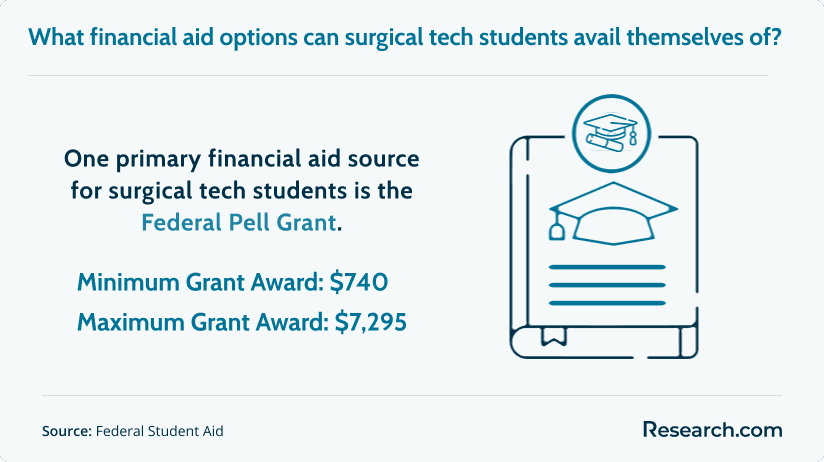
One major federal option is the Federal Pell Grant, which does not have to be repaid if eligibility requirements are met. For the 2024–2025 academic year, the maximum Pell Grant award is $7,395 and the minimum is $740, based on financial need and enrollment status.
Federal student loans may also be available. Dependent undergraduate students have an annual loan limit of $5,500, with up to $3,500 subsidized. Independent students may qualify for higher borrowing amounts.
Employer tuition reimbursement can be another useful option, especially for students already working in healthcare. According to a 2025 report, the most common reimbursement amount ranges between $5,000 and $5,999. Students should ask employers whether reimbursement applies to associate degrees, certification programs, required textbooks, or clinical-related costs.
What are the prerequisites for enrolling in an online associate’s surgical tech program?
Most surgical technology associate programs require applicants to have a high school diploma or GED. Many schools also recommend or require a minimum GPA of 2.0 to 2.5. Official transcripts are typically required so the admissions office can confirm prior coursework and academic eligibility.
Science preparation is especially important. Programs often expect students to have completed biology, anatomy, physiology, or related foundational courses. Some also require or recommend medical terminology because surgical technology students must quickly learn the language of procedures, instruments, anatomy, and patient care. If these courses were not completed before admission, some schools allow students to take them during the first term.
Clinical eligibility requirements are also common. Before entering hospitals or surgical centers, students may need to pass a criminal background check and drug screening, provide proof of immunizations such as hepatitis B and MMR, and meet facility health documentation standards. These requirements are set to protect patients and comply with clinical site policies.
Competitive programs may request an interview, personal statement, or letters of recommendation. Online students may also need to demonstrate basic computer skills because assignments, instructor communication, testing, and learning materials are managed through digital platforms.
What courses are typically in an online associate’s degree in surgical tech program?
Many 1-year associate degree programs online and longer associate programs combine general education, science, and career-specific surgical technology courses. The goal is to prepare students for operating room responsibilities while building the communication, safety, and clinical judgment skills expected in healthcare settings.
Common courses include:
- Anatomy and Physiology: Introduces body systems, structure, and function so students can understand surgical procedures and patient positioning.
- Medical Terminology: Builds fluency in healthcare and surgical vocabulary used in charts, communication, and procedures.
- Microbiology: Covers microorganisms, infection risks, and the scientific basis for sterile practice.
- Surgical Procedures: Explains common operations, instrument sequences, surgical team roles, and procedural steps.
- Sterile Processing and Aseptic Technique: Teaches how to maintain sterile fields and handle instruments safely.
- Surgical Pharmacology: Reviews medications, anesthesia concepts, and drug-related safety considerations used around surgery.
- Patient Care and Safety: Focuses on patient positioning, transport, communication, and protection from avoidable harm.
- Clinical Practicum or Externship: Requires supervised, in-person training in an approved healthcare facility.
Some programs also include healthcare ethics, medical law, professional communication, or career preparation courses to help students transition from school to the operating room.
What types of specializations are available for online associate's in surgical tech?
Most online associate programs in surgical technology provide generalist training because entry-level surgical technologists need broad operating room skills. However, some programs offer electives, clinical exposure, or specialty modules that help students build familiarity with specific surgical areas.
Common specialty areas include cardiovascular surgery, orthopedic surgery, neurosurgery, obstetrics and gynecology (OB/GYN), and plastic or reconstructive surgery. A cardiovascular focus involves procedures related to the heart and blood vessels, while orthopedic surgery centers on bones, joints, and musculoskeletal procedures. Specialty exposure can help students identify which surgical environment fits their interests and strengths.
Not all affordable online degrees include formal specialization tracks, so students should ask whether specialty experience is available through electives or clinical rotations. Specialized skills may support employability in hospitals or surgical centers that perform complex procedures. For example, professionals assisting in neurosurgery have an average salary of $84,000-$270,000 per year. Because salary varies widely by employer, role, geography, and experience, students should treat specialty salary figures as context rather than a guaranteed outcome.
What additional certifications can enhance my surgical tech career prospects?
Additional credentials can help surgical technologists show employers that they are committed to ongoing professional development. Depending on career goals, graduates may consider certifications or training in surgical instrumentation, sterile processing, infection control, operating room safety, or advanced technical skills. These credentials may be especially useful for technologists who want to move into specialty surgical settings, supervisory work, or roles with more responsibility.
Students who want broader allied health options can also compare related pathways, such as affordable medical assistant programs. Medical assisting is a different career path, but it can help students understand outpatient care, clinical workflows, and patient-facing healthcare roles before deciding how far they want to specialize.
How do you choose the best online associate’s degree in a surgical tech program?
The best online surgical technology associate program is not simply the one with the lowest tuition. It is the program that fits your location, schedule, certification goals, clinical needs, and budget while meeting recognized education standards. Start with accreditation. As of 2023, over 396 surgical tech programs in the U.S. were CAAHEP-accredited, which gives students many options but also makes it important to verify a school’s current status before applying.
Next, compare the format. Some programs are mostly online except for labs and clinical rotations, while others require regular campus visits. Since surgical technology is one of the degrees you can get online that pay well, accelerated timelines can be attractive, but students should make sure they can handle the workload and clinical schedule.
Affordability is important, especially because tuition varies widely and some low-cost programs start around $4,000. But students should also compare fees, exam costs, equipment, travel, and whether financial aid applies.
Finally, evaluate outcomes. Ask for graduation rates, CST exam pass rates, job placement data, and clinical site information. Some top programs report CST exam pass rates above 90%, which may signal strong preparation, but students should confirm whether those figures are current and how the school calculates them.
| Question to ask | Why it matters |
| Is the program currently CAAHEP-accredited? | Accreditation can affect certification eligibility and employer acceptance. |
| Where will I complete clinical rotations? | Clinical placement determines whether you can finish the program without relocating or excessive travel. |
| What is the total program cost? | Tuition alone may not include fees, supplies, testing, or clinical requirements. |
| Does the program prepare students for the CST exam? | Certification can strengthen employability and may be required or preferred by employers. |
| What are recent graduation, pass, and placement outcomes? | Outcomes help you judge whether students complete the program and move into jobs. |
Can I expand my healthcare career with complementary certifications?
Yes, but complementary credentials should be chosen strategically. Surgical technologists who want more administrative flexibility may look at medical billing, coding, healthcare operations, or related allied health training. For example, the cheapest medical billing and coding courses may help students understand reimbursement systems, documentation, and coding practices. These skills are not a substitute for surgical technology training, but they can support career mobility into hybrid clinical-administrative roles.
Before paying for an add-on credential, check whether it is recognized by employers, whether it has accreditation or industry value, and whether it supports a clear next step. A certificate is most useful when it aligns with a specific job title, promotion path, or employer requirement.
How does an online surgical tech program differ from an online kinesiology degree?
An online surgical technology program is a career-focused healthcare program built around operating room support. Students learn sterile technique, surgical instruments, procedure flow, infection control, and clinical teamwork. It requires in-person skills training and clinical rotations because graduates are preparing for direct surgical care environments.
An online kinesiology degree is broader and focuses on human movement, exercise science, biomechanics, wellness, and physical performance. Kinesiology may lead to careers in fitness, rehabilitation support, health promotion, or preparation for graduate study. Students who want a faster path into operating room work should compare surgical technology programs; students interested in movement science, exercise, or rehabilitation-related careers may find kinesiology more aligned with their goals.
Can further education in healthcare administration enhance career prospects?
Further education in healthcare administration can be useful for surgical technologists who want to move beyond hands-on operating room support into leadership, scheduling, compliance, operations, or department coordination. Clinical experience can be valuable in administrative roles because it gives professionals firsthand knowledge of patient flow, sterile procedures, staffing needs, and surgical team workflows.
Students interested in management should consider whether a healthcare administration degree online fits their long-term plans. This type of program may build skills in resource planning, policy, healthcare finance, operations, and interdisciplinary communication. It is most relevant for surgical technologists who want to grow into supervisory or administrative positions rather than remain exclusively in the scrub role.
What career paths are available for graduates of an online associate’s degree in surgical tech program?
The most direct career path is surgical technologist. In this role, graduates help prepare operating rooms, organize sterile instruments, maintain sterile fields, and support surgeons and nurses during procedures. The work requires attention to detail, physical stamina, calm communication, and the ability to anticipate what the surgical team needs next.
Some graduates enter related roles in sterile processing, where they clean, decontaminate, assemble, and sterilize surgical instruments. Others use experience to move toward surgical first assistant roles, which involve more direct participation during procedures and usually require additional training, certification, or education.
An associate degree can also serve as a foundation for further study. Some surgical technologists later pursue bachelor’s degrees in health sciences, nursing, healthcare administration, or other clinical fields. Others consider physician assistant studies or specialized allied health pathways after gaining operating room experience.
| Career path | Typical focus | When it may make sense |
| Surgical technologist | Operating room preparation, sterile technique, instrument handling, and intraoperative support. | Best for graduates who want direct surgical team involvement. |
| Sterile processing technician | Instrument decontamination, sterilization, inventory, and infection prevention support. | May fit students interested in behind-the-scenes patient safety and surgical supply workflows. |
| Surgical first assistant | More advanced support during surgery, often requiring additional training or credentials. | Appropriate for experienced surgical technologists seeking greater responsibility. |
| Healthcare administration pathway | Operations, scheduling, compliance, department coordination, or supervisory work. | Useful for technologists who want leadership or non-bedside advancement. |
What is the job market for graduates with an online associate’s degree in surgical tech?
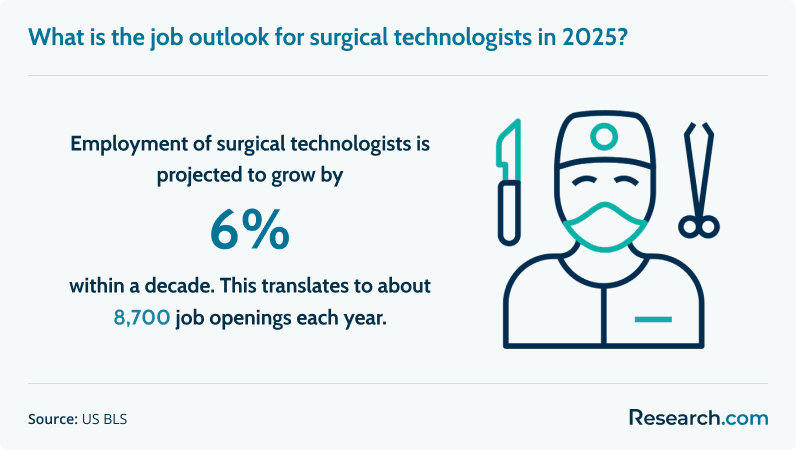
The job market for surgical technologists is supported by ongoing surgical demand, workforce replacement needs, and growth in outpatient procedures. The US BLS projects 6% employment growth for surgical technologists from 2023 to 2033, faster than the average for all occupations. That growth is expected to create approximately 8,700 job openings each year, including openings from workers who change occupations or leave the labor force, such as through retirement.
Hospitals remain major employers, but outpatient care centers and ambulatory surgical centers are also important hiring settings. Students should research their local market before enrolling because certification preferences, shift schedules, wages, and clinical hiring needs can vary by region.
Here's What Graduates Have to Say About Their Surgical Tech Associate's Degree
I enrolled in the online Surgical Tech program while working 30 hours a week at a veterinary clinic. Being able to replay lectures helped me study after long shifts, and my instructors answered questions quickly when I needed help understanding sterile technique. Once I started my hospital clinical rotation, the coursework finally connected to real operating room practice. —Tasha
I did not expect an online program to feel so practical. The virtual surgical tray exercises helped me memorize instruments and understand procedure order before I entered the OR. I was anxious at first, but the preparation made the transition much easier. —Luis
As a mother of two, I was not sure online surgical tech training would be realistic. The weekly discussion boards made the class feel connected, and I found classmates who wanted to study together on Zoom. It required discipline, but finishing the program became one of my proudest accomplishments. —Jessie
What emerging trends are shaping the future of surgical technology education?
Surgical technology education is changing as operating rooms become more technology-driven. Programs are increasingly using simulation, virtual tools, and augmented learning environments to help students practice decision-making before entering clinical settings. These tools do not replace in-person training, but they can help students learn instrument recognition, procedure sequencing, and safety protocols more efficiently.
Robotics-assisted surgery and minimally invasive procedures are also influencing what students need to understand. Surgical technologists are expected to adapt to new instruments, imaging systems, and team workflows. Programs that regularly update their curriculum and expose students to current surgical environments may better prepare graduates for modern operating rooms.
Students considering accelerated or related healthcare pathways may also compare options such as quickest PharmD online programs, although pharmacy and surgical technology lead to very different roles. The broader lesson is the same: choose programs based on accreditation, hands-on requirements, career fit, and realistic time commitment.
Common mistakes to avoid when choosing an online surgical tech program
- Assuming “online” means fully remote: Surgical technology requires hands-on labs and clinical rotations. If you cannot attend required in-person components, the program will not work for you.
- Skipping accreditation verification: Always confirm current CAAHEP accreditation or other relevant approval before applying.
- Comparing only tuition: Include fees, supplies, clinical travel, uniforms, background checks, immunizations, and certification exam costs.
- Ignoring clinical placement details: Ask whether the school places students or expects students to find their own sites.
- Assuming certification eligibility: Confirm which exam graduates qualify for and whether the program meets employer expectations in your state.
- Relying only on rankings: A highly ranked program may not be the best fit if it is too expensive, too far from clinical sites, or incompatible with your schedule.
- Expecting guaranteed salary outcomes: Wage data provides useful context, but actual pay depends on location, employer, experience, credentials, and shifts.
Key Insights
- An online associate degree in surgical technology is usually a hybrid program: coursework may be online, but labs and clinical rotations must be completed in person.
- Accreditation is one of the most important decision factors because it can affect certification exam eligibility and employer acceptance.
- Surgical technologists earn a median annual wage of $62,830 for 2027, and the field is projected to grow 6% over the next decade.
- Program cost varies widely, from $4,000 to over $47,000, so students should compare total cost rather than tuition alone.
- Clinical placement access can make or break the student experience. Before enrolling, confirm where and how you will complete required surgical cases or clinical hours.
- Students who want the best return should prioritize accredited, affordable programs with transparent outcomes, certification preparation, and realistic scheduling.
- Surgical technology can be a strong entry point into healthcare, with possible advancement into sterile processing leadership, surgical first assisting, specialty surgical areas, or healthcare administration.
References:
- American Society of Anesthesiologists. (2025). Workforce shortage: Message from AST president. Association of Surgical Technologists. https://www.ast.org/workforceresource/WorkforceShortage-MessagefromASTPresident.pdf
- Bureau of Labor Statistics. (2024, April 17). Occupational employment and wages, May 2023: 29-2055 Surgical technologists. U.S. Department of Labor. https://www.bls.gov/oes/2023/may/oes292055.htm
- Bureau of Labor Statistics. (2024, April 17). Occupational employment and wages, May 2023: 29-2055 Surgical technologists. U.S. Department of Labor. https://www.bls.gov/oes/2023/may/oes292055.htm
- Bureau of Labor Statistics. (2024, April 17). Surgical technologists. U.S. Department of Labor. https://www.bls.gov/ooh/Healthcare/Surgical-technologists.htm
- Georgetown University Center on Education and the Workforce. (n.d.). The working learners' report. https://cew.georgetown.edu/cew-reports/workinglearners
- New York Post. (2025, April 17). The market for this middle-class health care job is booming—but nobody’s heard of it. https://nypost.com/2025/04/17/lifestyle/the-market-for-this-middle-class-health-care-job-is-booming-but-nobodys-heard-of-it/
Other Things You Should Know About Affordable Online Associate’s in Surgical Tech Programs
No. Surgical tech associate programs require in-person clinical training to meet CAAHEP or ABHES standards. Most programs require a clinical practicum in hospitals or surgical centers, usually after coursework, and students must complete a set number of supervised lab and operating-room hours before graduation.
Financial aid for these programs in 2027 includes federal grants, scholarships specific to surgical technology, and low-interest loans. Fill out the FAFSA to access federal aid options and check with individual schools for program-specific scholarships or work-study opportunities.





