2027 Best Online MHA Programs with No GRE Requirement

Co-Founder and Chief Data Scientist
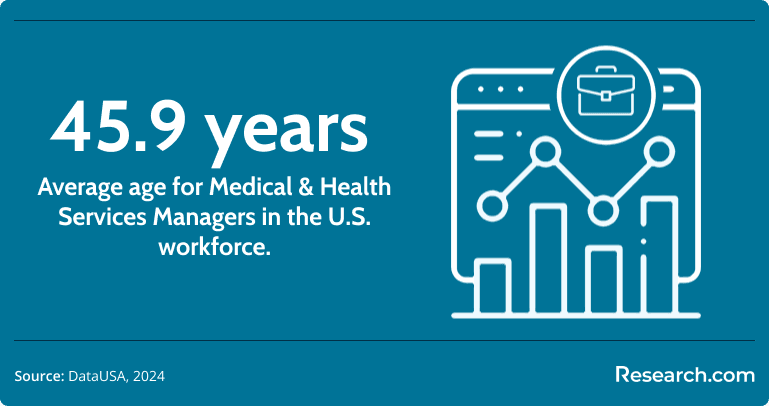
The average age for a health services manager is 45.9 years. For professionals with that level of real-world experience, a standardized test like the GRE can feel like an outdated roadblock to a necessary career step. The good news is that top universities increasingly agree, shifting their focus from test scores to proven expertise.
This shift creates a clear path forward. To help you navigate it, our career planning experts, with over 10 years of experience, built this guide. While other resources focus on specific certifications or accreditation details, this guide is your comprehensive plan for choosing the right degree. It’s more than a list of top online MHA programs no GRE; it’s a strategic plan for your next move.
What are the benefits of getting an online MHA program with no GRE requirement?
- You can advance into a high-demand leadership career, managing healthcare delivery in settings from major hospitals to outpatient clinics.
- The degree significantly boosts your earning potential, with medical and health services managers earning a median salary of $117,960 per year.
- An online format offers the flexibility to earn your master's degree and advance your career without having to leave your current position.
What can I expect from an online MHA program with no GRE requirement?
You should expect a challenging curriculum that is built for working professionals. These programs focus on solving the real-world financial, operational, and ethical problems you'll face in a leadership role. Don't mistake the flexibility of an online format for a lack of academic rigor; the coursework is demanding.
Most top online MHA programs no GRE use a cohort model, where you move through classes with the same group of peers. This structure is excellent for building strong professional relationships. Other programs are self-paced, offering maximum flexibility to fit your schedule.
A critical part of the experience is virtual networking. Success requires actively engaging with your professors and classmates in discussions and group projects. This is how you build the professional connections that will serve your career long after you've graduated.
Where can I work with an online MHA program with no GRE requirement?
According to the U.S. Bureau of Labor Statistics, the largest employers of medical and health services managers include:
- Hospitals: Employing 30% of managers in state, local, and private facilities.
- Physician Offices: Making up 12% of management roles in private and group practices.
- Nursing and Residential Care Facilities: Comprising 9% of the job market for healthcare leaders.
- Government: Accounting for 7% of roles in public health departments and federal agencies.
- Outpatient Care Centers: Representing another 7% in a rapidly growing sector.
Beyond these core employers, MHA graduates are increasingly sought after in health technology, insurance, pharmaceuticals, and management consulting, where their expertise in operations and strategy is highly valued.
How much can I make with an online MHA program with no GRE requirement?
Salaries vary based on the industry sector, your experience, and geographic location, not on the program's GRE admission policy. As of May 2024, the median annual wages for medical and health services managers in the top industries were as follows:
- Government: $132,620
- Hospitals: $130,690
- Outpatient Care Centers: $106,990
- Offices of Physicians: $100,780
- Nursing and Residential Care Facilities: $99,250
- List of the Best Online MHA Programs with No GRE Requirement for 2027 List of Programs
- How long does it take to complete an online MHA program with no GRE requirement? Completion Time
- How does an online MHA program with no GRE requirement compare to an on-campus program? How does an online MHA program with no GRE requirement compare to an on-campus program?
- What is the average cost of an online MHA program with no GRE requirement? Program Cost
- What are the financial aid options for students enrolling in an online MHA program with no GRE requirement? Financial Aid
- What are the prerequisites for enrolling in an online MHA program with no GRE requirement? What are the prerequisites for enrolling in an online MHA program with no GRE requirement?
- What courses are typically in an online MHA program with no GRE requirement? What courses are typically in an online MHA program with no GRE requirement?
- What types of specializations are available in an online MHA program with no GRE requirement? What types of specializations are available in an online MHA program with no GRE requirement?
- What challenges might I face in an online MHA program with no GRE requirement? What challenges might I face in an online MHA program with no GRE requirement?
- How to Choose the Best Online MHA Program with No GRE Requirement How to Choose the Best Online MHA Program with No GRE Requirement
- What career paths are available for graduates of an online MHA program with no GRE requirement? Career Paths
- What is the job market for graduates of an online MHA program with no GRE requirement? Job Market
Best Online MHA Programs With No GRE Requirement for 2027
Choosing an online Master of Health Administration program is a high-stakes decision: you are weighing tuition, accreditation, admissions requirements, career fit, and whether the degree can help you move into healthcare leadership without pausing your career. For many applicants, the GRE is an unnecessary barrier, especially if they already have professional experience in healthcare, business, operations, technology, public health, or another management-related field.
This guide explains how online MHA programs with no GRE requirement work, what they cost, how long they take, which schools are worth comparing, and how to evaluate whether a program is the right investment for your goals. It is designed for working professionals, clinical staff moving into administration, career changers entering healthcare management, and applicants comparing flexible graduate options such as online colleges with flexible start schedules.
Quick answer: Is an online MHA with no GRE worth considering?
Yes, an online MHA with no GRE requirement can be a practical route into healthcare leadership if the program is properly accredited, aligned with your career goals, and affordable for your financial situation. The absence of a GRE requirement does not automatically mean lower academic quality. Strong programs usually replace test scores with a more holistic review of your bachelor’s degree, work history, resume, recommendation letters, statement of purpose, and leadership potential.
The best choice is not always the cheapest or fastest program. A good online MHA should teach healthcare finance, operations, law and ethics, analytics, quality improvement, strategic leadership, and organizational management while also offering career support, faculty with industry experience, and a format you can realistically complete while working.
How we evaluate schools
Because a graduate degree can affect your finances and career options for years, Research.com uses a data-informed ranking process that emphasizes transparency and comparability. Our review draws from established education data sources, including the IPEDS database, Peterson's database, the College Scorecard database, and The National Center for Education Statistics.
These sources help compare online MHA programs with no GRE requirement using factors such as institutional quality, affordability, completion expectations, and available program information. For a fuller explanation of how Research.com evaluates programs, see our ranking methodology.
Online MHA programs with no GRE requirement: side-by-side comparison
| School | Program | Length | Credits | Total Tuition | Accreditation |
| University of California-Los Angeles | Online Master of Healthcare Administration (MHA) | 2 years | 66 quarter credits | $62,700 | Council on Education for Public Health (CEPH) |
| Ohio University | Online Master of Health Administration | 2 years | 36 credits | $24,840 | Higher Learning Commission (HLC) |
| The George Washington University | Online Master of Health Administration (MHA) | 2 to 4 years | 45 credits | $87,525 | Commission on Accreditation of Healthcare Management Education (CAHME) |
| Purdue University | Online Master of Health Administration | 2 years | 40 credits | $30,000 (in-state); $34,000 (out-of-state) | Higher Learning Commission (HLC) |
| Sacred Heart University | Master of Health Administration | 2 years | 37 credits | $26,825 | Commission on Accreditation of Healthcare Management Education (CAHME) |
| Methodist University | Online Master of Health Administration | 18 months | 36 credits | $19,620 | Southern Association of Colleges and Schools Commission on Colleges (SACSCOC) |
| Bellevue University | Master’s in Healthcare Administration | 2 years | 36 credit hours | $24,480 | Higher Learning Commission (HLC) |
| Franklin University | Master of Healthcare Administration (MHA) | 14 months | 36 semester hours | $24,120 | Higher Learning Commission (HLC) |
| Weber State University | Executive Master of Health Administration (Online) | 16 months | 39 credits | $35,000 | Commission on Accreditation of Healthcare Management Education (CAHME) |
| University of Cincinnati Online | Master of Health Administration (Executive) - MHA | 5 to 8 semesters | 40 semester credits | $30,160 (in-state); $30,760 (out-of-state) | Commission on Accreditation of Healthcare Management Education (CAHME) |
1. University of California-Los Angeles Fielding - Online Master of Healthcare Administration (MHA)
The University of California-Los Angeles offers an online MHA built around leadership, analytics, and value-based care in modern healthcare organizations. Students complete two on-campus immersions and a capstone tied to a real issue faced by a partner organization, giving the program a practical management focus rather than a purely theoretical structure.
- Program Length: 2 years
- Required Credits to Graduate: 66 quarter credits
- Total Tuition: $62,700
- Accreditation: Council on Education for Public Health (CEPH)
2. Ohio University - Online Master of Health Administration
Ohio University emphasizes the connection between patient-centered care and responsible organizational management. Its online MHA includes four concentration options, allowing students to shape the degree around leadership, analytics, project management, or quality improvement while also earning a graduate certificate as part of the program.
- Program Length: 2 years
- Concentrations: Health Care Leadership ; Business Analytics ; Project Management ; and Quality Improvement
- Required Credits to Graduate: 36 credits
- Total Tuition: $24,840
- Accreditation: Higher Learning Commission (HLC)
3. The George Washington University - Online Master of Health Administration (MHA)
The George Washington University designs its online MHA for professionals preparing for senior healthcare leadership in domestic and global settings. A defining feature is the required set of four immersion experiences, including one at a national or international health organization.
- Program Length: 2 to 4 years
- Required Credits to Graduate: 45 credits
- Total Tuition: $87,525
- Accreditation: Commission on Accreditation of Healthcare Management Education (CAHME)
4. Purdue University - Online Master of Health Administration
Purdue University focuses on healthcare business strategy, operational decision-making, and leadership skills for early- and mid-career professionals. Its stackable graduate certificate structure may appeal to students who want to build credentials in stages while progressing toward the MHA.
- Program Length: 2 years
- Required Credits to Graduate: 40 credits
- Total Tuition: $30,000 (in-state); $34,000 (out-of-state)
- Accreditation: Higher Learning Commission (HLC)
5. Sacred Heart University - Master of Health Administration
Sacred Heart University offers an MHA for clinical and non-clinical professionals who want a broad administrative foundation. The curriculum covers policy, planning, informatics, and leadership, with asynchronous eight-week courses that can help working students manage their schedules.
- Program Length: 2 years
- Required Credits to Graduate: 37 credits
- Total Tuition: $26,825
- Accreditation: Commission on Accreditation of Healthcare Management Education (CAHME)
6. Methodist University - Online Master of Health Administration
Methodist University structures its online MHA around performance improvement, evidence-based management, and leadership tools for healthcare organizations. The program may fit students looking for a shorter timeline and a curriculum aimed at mid- to senior-level administrative responsibilities.
- Program Length: 18 months
- Required Credits to Graduate: 36 credits
- Total Tuition: $19,620
- Accreditation: Southern Association of Colleges and Schools Commission on Colleges (SACSCOC)
7. Bellevue University - Master’s in Healthcare Administration
Bellevue University uses a cohort model in which students take one course at a time. The program highlights applied learning in organizational design, health IT, quality management, and administrative problem-solving, with instruction from professionals familiar with the healthcare field.
- Program Length: 2 years
- Required Credits to Graduate: 36 credit hours
- Total Tuition: $24,480
- Accreditation: Higher Learning Commission (HLC)
8. Franklin University - Master of Healthcare Administration (MHA)
Franklin University offers an MHA that combines quality-of-care priorities with budgeting, finance, and leadership concerns. Its curriculum includes skill-focused microcredentials, which can help students document competencies in areas such as global health and healthcare finance.
- Program Length: 14 months
- Required Credits to Graduate: 36 semester hours
- Total Tuition: $24,120
- Accreditation: Higher Learning Commission (HLC)
9. Weber State University - Executive Master of Health Administration (Online)
Weber State University offers an accelerated executive MHA for working professionals seeking a faster route through graduate study. The program can be completed in 16 months and emphasizes leadership, relationship management, and critical thinking, with one tuition rate for all students regardless of residency.
- Program Length: 16 months
- Required Credits to Graduate: 39 credits
- Total Tuition: $35,000
- Accreditation: Commission on Accreditation of Healthcare Management Education (CAHME)
10. University of Cincinnati Online - Master of Health Administration (Executive) - MHA
The University of Cincinnati executive MHA is intended for mid-career professionals preparing for higher-level administrative roles. The program draws on the College of Allied Health Sciences and the Lindner College of Business, giving students exposure to both health systems and business management perspectives.
- Program Length: 5 to 8 semesters
- Required Credits to Graduate: 40 semester credits
- Total Tuition: $30,160 (in-state); $30,760 (out-of-state)
- Accreditation: Commission on Accreditation of Healthcare Management Education (CAHME)
How long does an online MHA with no GRE requirement take?
Most online MHA programs take 18 to 24 months for full-time students. Part-time students, especially those balancing full-time jobs or family responsibilities, commonly need 30 to 36 months. Your actual timeline depends on credit requirements, course load, term length, transfer policies, required immersions, and whether the program uses accelerated, cohort-based, or self-paced scheduling.
When an accelerated MHA makes sense
An accelerated format can be useful if you already have healthcare or management experience, can handle condensed coursework, and want to qualify for leadership opportunities sooner. However, faster is not automatically better. Before choosing one of the fastest online master of health administration programs, confirm that the program still includes the core management training employers expect: finance, analytics, law, ethics, operations, quality improvement, and strategy.
| Program Pace | Typical Fit | Trade-Off to Consider |
| Accelerated | Experienced professionals with strong time management and a clear career goal | Less scheduling flexibility and heavier weekly workload |
| Full-time standard pace | Students who want steady progress without the intensity of an accelerated format | May still be demanding alongside full-time work |
| Part-time | Working adults, caregivers, and students paying as they go | Longer time to graduation and possibly slower career transition |
Online MHA vs. on-campus MHA: which format is better?
An online MHA and an on-campus MHA can lead to the same graduate credential when they are offered by the same institution and meet the same academic standards. Employers are generally more concerned with the school, accreditation, curriculum, experience, and skills you bring than with whether you completed classes online or in person.
The main difference is learning format. Online programs are built for flexibility, often allowing students to complete coursework around clinical shifts, administrative roles, family obligations, or geographic limitations. Campus programs provide more face-to-face structure and may be better for students who prefer scheduled classroom interaction. Applicants who are still exploring their academic readiness may also compare admissions expectations through resources such as accessible healthcare administration degree options before committing to graduate-level study.
| Factor | Online MHA | On-Campus MHA |
| Flexibility | Best for working adults and students outside commuting range | Best for students who can attend scheduled classes in person |
| Networking | Requires intentional outreach through discussions, group work, alumni events, and professional platforms | More spontaneous interaction through classes, campus events, and local internships |
| Immersions | Some programs require short campus or field-based sessions | In-person learning is built into the entire format |
| Employer perception | Strong when the program is accredited and reputable | Strong when the program is accredited and reputable |
How to build a network in an online MHA program
Networking online does not happen by accident. To get value beyond the coursework, participate actively in discussion boards, volunteer for meaningful roles in group projects, attend virtual career events, request informational interviews, and connect with faculty and classmates through professional channels. If the program offers optional or required residencies, treat them as career-building opportunities rather than simple attendance requirements.
How much does an online MHA program with no GRE cost?
Online MHA tuition varies substantially by school. The average total tuition is around $36,000, but the range is wide: some programs cost as little as $20,000, while others exceed $87,000. Tuition is only one part of the total price, so you should also check technology fees, course materials, graduation fees, online platform costs, and travel expenses for any required campus immersions.
A low-cost program can be a smart choice, but only if it is credible and fits your goals. A higher-priced program may be worth considering if it offers stronger accreditation, career services, alumni access, executive networking, or a curriculum that closely matches your target role. The goal is not simply to minimize tuition; it is to avoid paying for a degree that does not help you advance.
Some graduate applicants compare MHA admissions and costs with business school expectations, including resources on MBA average GMAT scores, because both MHA and MBA pathways can lead to management roles. The better comparison is career fit: an MHA is usually more targeted for healthcare systems, while an MBA may be broader across industries.
Financial aid options for online MHA students
Graduate students may have several ways to reduce out-of-pocket costs. The right mix depends on your employment status, credit profile, school policies, and whether your employer supports education benefits.
- Federal Loans: Many students begin by submitting the Free Application for Federal Student Aid (FAFSA) to determine eligibility for federal graduate loan options.
- Employer Tuition Reimbursement: Hospitals, clinics, insurers, public health agencies, and health systems may help employees pay for graduate study, especially when the degree supports internal leadership needs.
- Private Loans: Private lenders may cover remaining costs, but students should compare interest rates, repayment terms, and borrower protections carefully.
- Program-Specific Scholarships: Some universities and departments offer scholarships for MHA students, so review each program’s financial aid page rather than relying only on general university awards.
How to think about ROI beyond salary
Return on investment should include more than pay increases. Leadership roles may also come with stronger benefits, retirement options, professional development support, and more stable advancement paths. For clinical managers, available data shows that 77% of managers receive medical benefits, 71% receive dental, and 65% have vision coverage through their employer.
If affordability and community mission are major priorities, you may also want to compare schools and scholarship opportunities through resources such as HBCUs offering healthcare administration programs. The strongest financial plan usually combines tuition comparison, employer support, federal aid, scholarship searches, and a realistic estimate of how the degree connects to your target role.
Admission requirements for online MHA programs with no GRE
No-GRE MHA programs typically evaluate applicants through a holistic admissions process. Instead of relying on standardized test scores, admissions teams look for evidence that you can handle graduate-level work and contribute meaningfully to a healthcare leadership program.
Common requirements include:
- A bachelor's degree from an accredited institution.
- Relevant professional experience, which may be in healthcare, business, operations, technology, nonprofit work, public service, or another related field.
- Two to three letters of recommendation.
- A personal statement explaining your goals and fit for healthcare administration.
- A current resume showing work history, leadership responsibilities, and measurable accomplishments.
You do not always need an undergraduate degree in healthcare. Many MHA students enter from nursing, allied health, business, information technology, project management, finance, social services, or military backgrounds. What matters is whether you can explain why healthcare administration is the logical next step.
How to strengthen your application without a GRE score
Your resume and statement of purpose carry more weight when there is no test score. Use them to show progression, responsibility, and readiness for leadership. Instead of listing job duties only, describe problems you helped solve, budgets or teams you supported, process improvements you contributed to, or patient-facing systems you understand.
Age and experience can be advantages. With the average age of a health services manager being 45.9 years, many applicants are not starting over; they are building on years of workplace knowledge. A strong application makes that experience visible and connects it directly to the program’s curriculum.
What courses are included in an online MHA curriculum?
An MHA is best understood as a management degree designed specifically for healthcare organizations. It combines business fundamentals with the legal, ethical, operational, financial, and patient-care realities of hospitals, clinics, public health agencies, long-term care organizations, insurers, and health technology environments.
Typical core courses include:
- Healthcare Finance: Budgeting, reimbursement, revenue cycles, financial reporting, and resource allocation in healthcare settings.
- Health Law and Ethics: Regulatory requirements, patient rights, compliance, privacy, liability, and ethical decision-making.
- Strategic Planning and Marketing: Organizational growth, service-line planning, community engagement, and competitive positioning.
- Operations Management: Workflow design, patient safety, process improvement, staffing, and quality systems.
- Health Informatics and Data Analytics: Using data, health information systems, and performance metrics to improve decisions and outcomes.
How MHA coursework connects to healthcare employment sectors
MHA coursework is designed for administrative responsibility in settings such as hospitals, physician practices, outpatient centers, public agencies, consulting firms, long-term care organizations, and health technology teams. Finance and operations courses help students manage budgets and workflows, while analytics courses prepare them to interpret performance data and support evidence-based decisions.
Unlike clinical degrees or narrower credentials such as a fast-track online nutrition degree, an MHA focuses on managing systems, teams, budgets, policies, and strategy. That broad administrative lens is what makes the degree useful across multiple healthcare sectors.
Common specializations in online MHA programs
Specializations allow students to connect the MHA to a specific career direction. Not every program offers concentrations, and some use electives or certificates instead, so compare the actual course list rather than relying only on program titles.
- Health Informatics and Analytics: Focuses on healthcare data, digital systems, reporting, technology adoption, and analytics-driven decision-making.
- Senior Services and Long-Term Care: Prepares students for administrative roles in organizations serving older adults and patients needing ongoing support.
- Population Health: Centers on community health outcomes, prevention, wellness strategy, and system-level interventions.
- Healthcare Leadership and Strategy: Builds broad executive skills for managing departments, service lines, facilities, or health system initiatives.
Choosing a specialization strategically
A specialization should match both your interests and the labor market you want to enter. If you already work in IT, analytics, project management, or electronic health record implementation, informatics may be a practical fit. If you are in nursing, allied health, or clinic operations, leadership, quality improvement, or operations-focused electives may connect more directly to your next promotion.
Students who want a deeper data and technology pathway may also compare MHA options with accelerated online master’s programs in health informatics. The right choice depends on whether you want broad healthcare administration training or a more specialized informatics credential.
Challenges of online MHA programs with no GRE requirement
The flexibility of an online MHA can be a major advantage, but it also shifts more responsibility to the student. The biggest challenges are time management, sustained motivation, online collaboration, and networking from a distance. Students working in healthcare may also face unpredictable schedules, overtime, rotating shifts, or emotional fatigue from clinical environments.
| Challenge | Why It Matters | Better Strategy |
| Underestimating weekly workload | Graduate courses often require reading, writing, group projects, and applied analysis every week | Block study time before the term starts and reduce optional commitments during heavy courses |
| Choosing only by speed | A short program can become overwhelming if you are working full time | Compare pace, term length, assignment volume, and support services |
| Weak online networking | Career value often comes from relationships as well as coursework | Attend virtual events, contact alumni, join professional associations, and build faculty relationships |
| Skill gaps in healthcare administration | Career changers may need more exposure to coding, billing, compliance, or clinical operations | Use electives, certificates, or supplemental options such as affordable online medical billing and coding courses when relevant |
How to choose the best online MHA program with no GRE requirement
The best online MHA is the one that fits your career target, budget, schedule, and learning style while meeting credible academic and industry standards. Use the following process before enrolling.
- Confirm accreditation. At minimum, verify that the institution is properly accredited. For healthcare management specifically, also check whether the program has Commission on Accreditation of Healthcare Management Education accreditation when that matters for your career goals.
- Match the curriculum to your target role. Look for courses in healthcare finance, operations, law and ethics, analytics, quality improvement, leadership, and strategy.
- Check faculty experience. Programs are stronger when instructors understand current healthcare systems, not only academic theory.
- Compare total cost, not tuition alone. Include fees, travel, textbooks, technology, and the financial impact of reducing work hours if necessary.
- Review career services and alumni access. Ask whether online students receive the same advising, employer connections, job boards, and networking opportunities as campus students.
- Ask about flexibility before you apply. Confirm whether courses are asynchronous, synchronous, cohort-based, accelerated, or self-paced.
Questions to ask before enrolling
| Question | Why It Matters |
| Is the institution accredited, and is the MHA program CAHME-accredited? | Accreditation affects credibility, employer perception, and academic quality signals. |
| Are online students eligible for the same career services as campus students? | Career support can influence internships, promotions, interviews, and alumni connections. |
| Are there required campus visits or immersions? | Travel requirements can affect cost, scheduling, and feasibility. |
| What experience level is the program designed for? | Executive programs may assume more professional background than general MHA programs. |
| Can I complete the program part time? | Part-time options matter for students balancing demanding healthcare jobs. |
| What outcomes do graduates typically pursue? | Program fit is stronger when alumni enter roles similar to your goals. |
Why CAHME accreditation matters
CAHME accreditation is an important quality marker for graduate healthcare management education. It signals that a program has gone through a specialized review process focused on healthcare management curriculum, faculty, student outcomes, and professional relevance.
That said, not every legitimate MHA program has CAHME accreditation. Some programs hold institutional accreditation or other relevant accreditation, such as HLC, SACSCOC, or CEPH. The safest approach is to understand what your target employers value. If you are aiming for competitive hospital, health system, consulting, or fellowship roles, CAHME accreditation may carry extra weight.
Career paths for online MHA graduates
An MHA can support advancement into management and leadership roles across healthcare delivery, administration, consulting, technology, policy, and operations. Job titles differ by employer, but many roles fall into a few common categories.
- Clinical Manager: Oversees staffing, budgets, quality goals, workflows, and daily operations for a clinical department such as surgery, nursing, rehabilitation, or cardiopulmonary services.
- Practice Administrator: Manages the business operations of a physician practice, outpatient clinic, specialty group, or ambulatory care site.
- Health Information Manager: Supervises patient data, privacy procedures, electronic health records, reporting systems, and information governance.
- Healthcare Consultant: Helps healthcare organizations improve operations, strategy, compliance, technology implementation, cost control, or service delivery.
Salary expectations
Healthcare leadership roles can offer strong earning potential, although salaries vary by role, location, employer, experience, and responsibility level. For example, the average salary for a clinical manager is over $106,000, and top earners in the 90th percentile make more than $155,000 annually. States with high employment levels, including California and Texas, offer many healthcare management opportunities.
Behavioral health leadership opportunities
Behavioral health is an important area for healthcare administration because mental health clinics, treatment centers, community programs, and integrated care models all need capable managers. An MHA can help professionals lead operations, budgeting, compliance, staffing, and quality improvement in these settings. Those interested in combining administrative and clinical preparation may also explore pathways such as the shortest online master’s programs in clinical mental health counseling.
Job outlook for graduates of online MHA programs
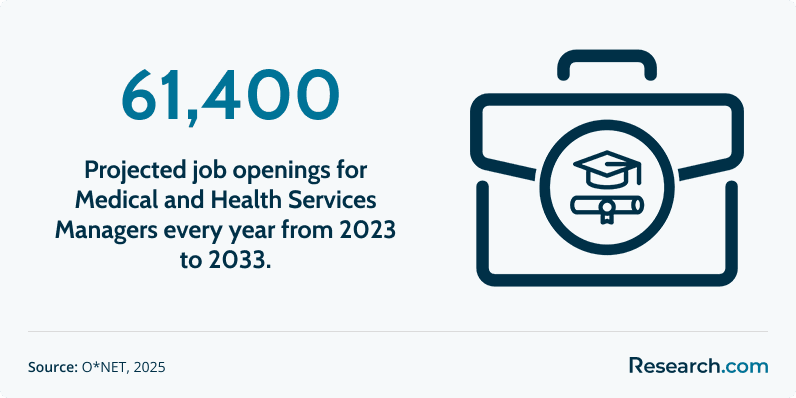
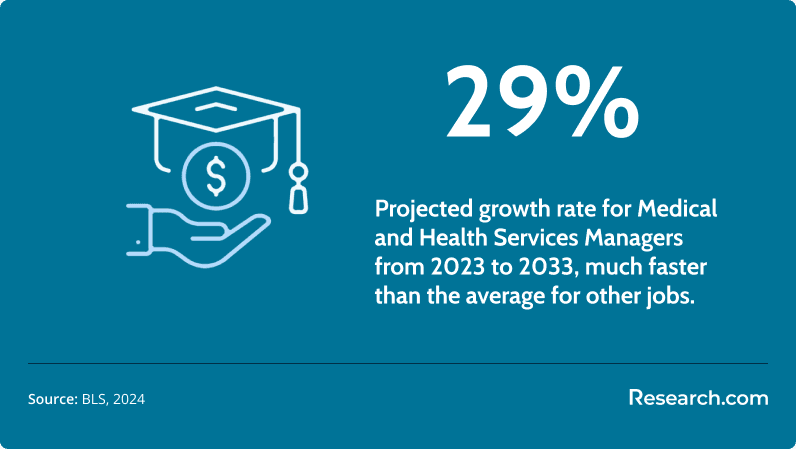
The labor market for healthcare managers is strong. The U.S. Bureau of Labor Statistics projects employment for medical and health services managers to grow by 29% between 2023 and 2033, which is much faster than the average for all occupations. This reflects the ongoing need for administrators who can manage complex organizations, control costs, improve quality, coordinate care, and respond to changing patient needs.
Demand does not mean every graduate will automatically receive a leadership role. The strongest candidates usually combine an accredited degree, relevant work experience, measurable accomplishments, digital fluency, financial knowledge, and the ability to lead teams through change.
Current trend: care is moving beyond the hospital
One major force shaping healthcare management is the shift toward care delivered outside traditional inpatient settings. As the population ages, more services are being organized through outpatient care, home health, telehealth, long-term care, and community-based models. Managers in these environments must coordinate distributed teams, maintain quality standards, manage reimbursement challenges, and use data to monitor outcomes.
For MHA graduates, this means leadership opportunities may increasingly appear outside large hospital campuses. Understanding the roles of frontline care workers can also help administrators manage teams more effectively; for example, some leaders review credentials such as a fast-track online home health aide certification to better understand workforce preparation in home-based care.
What students say about online MHA programs with no GRE requirement
- Soren: "After more than a decade as a respiratory therapy supervisor, I understood patient care but needed formal leadership training. The no-GRE admissions process let my experience speak for me. I studied after hospital shifts, applied the coursework immediately, and later moved into a director role in cardiopulmonary services."
- Linnea: "Coming from project management in tech, I was unsure whether healthcare programs would take my background seriously. The application process looked at my transferable skills, and the informatics courses helped me connect technology work to health systems. I now manage EMR implementation projects for a regional provider."
- Rhys: "My undergraduate GPA was not perfect, and I did not want a standardized test to define my ability. A no-GRE MHA program gave me a chance to show my work ethic, goals, and professional growth. The coursework was demanding, but completing it changed how I saw my leadership potential."
Common mistakes to avoid when choosing an online MHA
| Mistake | Why It Can Hurt You | What to Do Instead |
| Choosing a program only because it has no GRE | Admissions convenience does not guarantee quality or career value | Compare accreditation, curriculum, outcomes, faculty, and support services |
| Focusing only on tuition | Fees, travel, lost work time, and weak career support can change the real cost | Calculate total cost and compare it with expected career benefits |
| Ignoring accreditation | Some employers may discount degrees from poorly recognized programs | Verify institutional accreditation and consider CAHME accreditation for healthcare management roles |
| Assuming online means easier | Online graduate courses require self-direction and consistent weekly effort | Choose a format that matches your schedule and learning style |
| Skipping career research | An MHA is broad, and not every concentration fits every goal | Identify target job titles before selecting electives or specializations |
| Relying only on rankings | A highly ranked school may still be wrong for your budget, timeline, or goals | Use rankings as a starting point, then verify fit with your own criteria |
References:
- Data USA. (n.d.). Medical & health services managers. Retrieved September 4, 2025, from https://datausa.io/profile/soc/medical-health-services-managers
- O*NET OnLine. (n.d.). 11-9111.00 - Medical and Health Services Managers. Retrieved September 4, 2025, from https://www.onetonline.org/link/summary/11-9111.00
- Payscale. (n.d.). Clinical Manager Salary. Retrieved September 4, 2025, from https://www.payscale.com/research/US/Job=Clinical_Manager/Salary
- U.S. Bureau of Labor Statistics. (2024, April 3). Occupational Employment and Wages, May 2023: 11-9111 Medical and Health Services Managers. Retrieved September 4, 2025, from https://www.bls.gov/oes/2023/may/oes119111.htm
- U.S. Bureau of Labor Statistics. (2024, September 4). Occupational Outlook Handbook: Medical and Health Services Managers. Retrieved September 4, 2025, from https://www.bls.gov/ooh/management/medical-and-health-services-managers.htm
- Zippia. (n.d.). Clinical Care Manager Demographics and Statistics in the US. Retrieved September 4, 2025, from https://www.zippia.com/clinical-care-manager-jobs/demographics/
- ZipRecruiter. (n.d.). Clinical Manager Salary. Retrieved September 4, 2025, from https://www.ziprecruiter.com/Salaries/Clinical-Manager-Salary
Key Insights
- An online MHA with no GRE requirement can be a credible path to healthcare leadership when the program is accredited, rigorous, and aligned with your target role.
- No-GRE admissions usually shift attention to your work experience, resume, recommendations, personal statement, and leadership readiness.
- Most online MHA programs take 18 to 24 months full time, while part-time students often need 30 to 36 months.
- Total tuition varies widely, with an average around $36,000 and a range from about $20,000 to more than $87,000, so students should compare full program cost rather than tuition alone.
- CAHME accreditation is especially valuable for healthcare management programs, but students should also verify institutional accreditation and employer expectations in their target market.
- The best program is not simply the fastest, cheapest, or easiest to enter. It is the one that gives you the right mix of credibility, flexibility, curriculum depth, career support, and return on investment.
- Healthcare management demand is strong, with BLS projecting 29% growth for medical and health services managers between 2023 and 2033, but graduates still need relevant experience and practical skills to compete for leadership roles.
Other Things You Should Know About Online MHA Programs with No GRE Requirement
In 2027, many Online MHA Programs offer various specializations despite having no GRE requirement. Options often include healthcare leadership, health informatics, and policy management. These specializations allow students to tailor their education to specific career paths within healthcare administration.
In 2027, Online MHA Programs without GRE requirements maintain quality through accreditation by bodies such as the Commission on Accreditation of Healthcare Management Education (CAHME) and rigorous coursework designed to meet industry standards. Faculty expertise and comprehensive curricula also contribute to maintaining educational standards.
No. Many online MHA programs admit students from nonclinical backgrounds, but most require a bachelor’s degree from an accredited institution and a minimum GPA, often around 3.0. Some programs also prefer work experience in healthcare, business, or public service, even when GRE scores are not required.