
2027 Best Online Master of Health Administration (MHA) Programs

Co-Founder and Chief Data Scientist
Doctors and nurses are not the only essential personnel in medical facilities like hospitals and outpatient care centers. The role of healthcare administrators is significant, as these managers ensure that medical facilities have reliable operations, promoting patient safety and timely treatment. After all, over 3 million deaths each year occur due to unsafe care.
This guide helps aspiring healthcare administrators receive quality education, as it offers a list of the best online master of health administration (MHA) programs along with key facts for each. It also presents essential information for every prospective student, such as typical program duration, average education cost, admission requirements, and available specializations.
What are the benefits of getting an online master of health administration program?
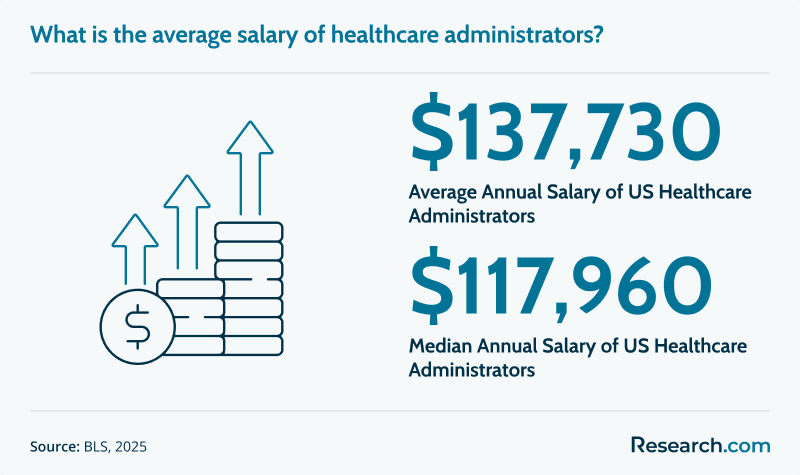
- The average annual salary of healthcare administrators is $137,730, while their median annual salary is $117,960.
- Earning an online master of health administration degree enables graduates to pursue careers as healthcare administrators, clinical managers, practice administrators, or health policy analysts.
- An online master of health administration offers better flexibility, a more dynamic online learning experience, and typically lower costs than traditional on-campus programs.
What can I expect from an online master of health administration program?
Prospective students enrolling in an online Master of Health Administration (MHA) program can expect a well-rounded curriculum focused on developing leadership, management, and analytical skills tailored to healthcare settings. Core topics often include healthcare finance, organizational behavior, human resource management, healthcare law and ethics, policy, marketing, informatics, and strategic management.
Many programs incorporate real-world learning through capstone projects or consulting assignments, allowing students to apply classroom knowledge to current healthcare challenges. This hands-on approach fosters both professional growth and problem-solving skills.
Online MHA programs are designed with flexibility in mind, making them ideal for working professionals. Most offer asynchronous lectures, sometimes combined with live sessions or optional on-campus immersions. Depending on the program and pace, students can complete their degree in one to two years.
Graduates are prepared for leadership roles across hospitals, clinics, insurance firms, government agencies, and other healthcare organizations. They’re equipped to improve healthcare delivery, quality, and operational efficiency.
Online learning platforms further support a balance between work and study, offering flexible pacing and collaborative tools. The format is especially useful for clinicians or medical professionals looking to enhance their business and strategic skills in healthcare administration.
Where can I work with an online master of health administration program?
Graduates of an online Master of Health Administration program can work in a wide range of healthcare-related settings, taking on leadership and administrative roles that influence patient care, organizational strategy, and healthcare delivery.
The typical employment settings include the following:
- Hospitals and Health Systems: MHA graduates often work in executive or departmental leadership roles within hospitals, overseeing operations, finance, quality assurance, or patient services.
- Outpatient Clinics and Medical Group Practices: In these settings, graduates manage day-to-day administrative functions, including scheduling, budgeting, and staff coordination.
- Long-Term Care and Assisted Living Facilities: These facilities employ MHA holders as administrators responsible for regulatory compliance, facility management, and resident care standards.
- Health Insurance Companies: Graduates may work in roles focused on policy development, provider relations, claims analysis, or healthcare strategy and planning.
- Public Health Agencies: Local, state, and federal health departments hire MHA graduates to manage public health programs, conduct community health assessments, and develop population health strategies.
How much can I make with an online master of health administration program?
Based on data from the United States Bureau of Labor Statistics (BLS), the average yearly salary of healthcare administrators is $137,730, while their median yearly salary is $117,960. These are remarkable figures, considering that the collective median yearly salary of all jobs in the country is $49,500.
The average salary range of healthcare administrators is $69,680 to $219,080. Entry-level roles typically receive salaries that are at the lower end of the given spectrum. On the other hand, seasoned administrators working for large enterprises in a high-demand state like New York, the District of Columbia, or Delaware earn considerably more than the average yearly salary.
- Best Online Master of Health Administration Programs for 2027 List of Programs
- How long does it take to complete an online master of health administration program? Completion Time
- How does an online master of health administration program compare to an on-campus program? How does an online master of health administration program compare to an on-campus program?
- What is the average cost of an online master of health administration program? Average Cost
- What are the financial aid options for students enrolling in an online master of health administration program? Financial Aid
- What are the prerequisites for enrolling in an online master of health administration program? Requirements
- What courses are typically in an online master of health administration program? What courses are typically in an online master of health administration program?
- What types of specializations are available in online master of health administration programs? What types of specializations are available in online master of health administration programs?
- How to choose the best online master of health administration program? How to choose the best online master of health administration program?
- What career paths are available for graduates of online master of health administration programs? Career Paths
- What is the job market for graduates with an online master of health administration program? Job Market
- How does an online MHA compare to other advanced healthcare degrees? How does an online MHA compare to other advanced healthcare degrees?
- Can complementary credentials boost my online MHA career? Can complementary credentials boost my online MHA career?
- How Does Accreditation Influence the Value of an Online MHA? How Does Accreditation Influence the Value of an Online MHA?
Best Online Master of Health Administration Programs for 2027
Choosing an online Master of Health Administration is not just a question of convenience. It is a career decision that can affect your leadership options, tuition costs, professional network, and readiness for healthcare management roles. The best online MHA programs help working professionals build skills in healthcare finance, policy, operations, quality improvement, data-informed decision-making, and organizational leadership without requiring them to leave their jobs.
This guide is for nurses, clinicians, healthcare staff, early-career administrators, and career changers comparing online MHA programs. You will learn which programs stand out, how online and campus formats differ, what admissions committees usually expect, how much programs can cost, what careers graduates pursue, and how to judge whether an MHA is the right graduate degree for your goals.
If you are comparing flexible online degrees across very different fields, such as a fast-track Christian studies online degree, remember that delivery format should never be the only deciding factor. For healthcare administration, accreditation, applied experience, employer recognition, and alignment with your target role matter just as much as speed or convenience.
Quick Answer: What Is the Best Online MHA Program?
The best online Master of Health Administration program is the one that matches your career stage, budget, schedule, and preferred healthcare sector. For many students, a strong choice will be regionally accredited, aligned with healthcare management competencies, include applied projects or residencies, and offer career support connected to hospitals, health systems, public agencies, consulting firms, or healthcare technology organizations.
Students who want maximum employer recognition should pay close attention to programmatic accreditation, especially CAHME accreditation where available. Students seeking a shorter timeline may prefer accelerated or executive formats, while those who need more flexibility should compare asynchronous coursework, part-time pacing, and residency requirements before applying.
How Research.com Evaluates Online MHA Programs
An online MHA requires a substantial commitment of time, tuition, and professional focus. To make the comparison more useful, our ranking process weighs publicly available institutional data, accreditation signals, program structure, affordability, and academic quality indicators.
Our research team reviewed information from established education data sources, including the IPEDS database, College Scorecard, Peterson's database, and the National Center for Education Statistics. We also prioritized accredited programs because accreditation can affect credit transfer, financial aid eligibility, employer confidence, and graduate school credibility. For a fuller explanation of how rankings are developed, see our methodology page.
Best Online Master of Health Administration Programs
| Rank | School and Program | Best For | Program Length | Credits or Units | Cost | Accreditation |
| 1 | University of North Carolina at Chapel Hill — Executive Master of Healthcare Administration | Experienced professionals who want an executive-style MHA with applied leadership work | 2 to 3 years | 49 credits | $1,146.12 per credit in-state; $2,140.56 per credit out-of-state | Commission on Accreditation of Healthcare Management Education |
| 2 | University of Pennsylvania — Nursing and Healthcare Leadership | Nurses preparing for advanced administrative, clinical leadership, or nurse management roles | 20 months | 10 course units | $75,569 to $75,856 total cost | Commission on Collegiate Nursing Education |
| 3 | University of North Carolina Wilmington — Master of Healthcare Administration Online | Students looking for a fully online, competency-aligned MHA with a shorter completion option | 1 year | 48 credits | $16,584.96 total cost | Commission on Accreditation of Healthcare Management Education |
| 4 | Johns Hopkins University — Master of Science in Health Care Management | Working professionals who want a healthcare management degree with business and consulting components | 2 years | 30 credits | $1,985 per credit | Association to Advance Collegiate Schools of Business |
| 5 | George Washington University — Online Master of Health Administration | Healthcare professionals who want online coursework with required in-person immersion experiences | 2 to 4 years | 45 to 50 credits | $1,945 per credit | Commission on Accreditation of Healthcare Management Education |
| 6 | Boston College — Master of Healthcare Administration | Students who want asynchronous study with full-time or part-time pacing | 2 years | 43 to 45 credits | $1,510 per credit | New England Commission of Higher Education |
| 7 | George Mason University — Health Systems Management MHA | Working professionals interested in healthcare quality or executive leadership concentration options | 30 months | 42 credits | $895 per credit | Commission on Accreditation of Healthcare Management Education |
| 8 | Ohio State University — Master of Health Administration | Early- and mid-career professionals who want a full-time, practice-oriented program | 2 years | 60 credits | $1,050 per credit in-state; $1,622 per credit out-of-state | Commission on Accreditation of Healthcare Management Education |
| 9 | Drexel University — Master of Health Administration | Students seeking a healthcare leadership curriculum with business, policy, and management projects | 2 years | 45 to 46 credits | $1,030 per credit | Commission on Accreditation of Healthcare Management Education |
| 10 | Florida Atlantic University — Executive Master of Health Administration | Working professionals who want a cohort-based executive program with crisis and disaster management coursework | 15 months | Not specified in the provided program details | $900 per credit | Association to Advance Collegiate Schools of Business |
1. University of North Carolina at Chapel Hill — Executive Master of Healthcare Administration
The University of North Carolina at Chapel Hill offers an Executive Master of Healthcare Administration built for professionals who want to keep working while preparing for higher-level leadership. The program blends online coursework, team-centered learning, practical assignments, reflective work, in-person experiences, and a final capstone. Students study areas such as healthcare policy, economics, leadership, and strategic management.
- Program length: 2 to 3 years
- Credits required: 49
- Cost per credit: $1,146.12 in-state; $2,140.56 out-of-state
- Accreditation: Commission on Accreditation of Healthcare Management Education
2. University of Pennsylvania — Nursing and Healthcare Leadership
The University of Pennsylvania offers an online Nursing and Healthcare Leadership program for nurses moving toward roles such as nurse manager, clinical director, healthcare administrator, or senior nursing leader. The part-time format runs over 20 months and includes leadership coursework, electives, and a capstone tied to national nursing leadership competencies.
- Program length: 20 months
- Credits required: 10 course units
- Total cost: $75,569 to $75,856
- Accreditation: Commission on Collegiate Nursing Education
3. University of North Carolina Wilmington — Master of Healthcare Administration Online
The University of North Carolina Wilmington provides a fully online MHA that covers healthcare systems, strategy, informatics, population health, and management practice. The curriculum is aligned with the National Center for Healthcare Leadership's competency model and uses personalized learning tools such as gap analysis to help students identify strengths and development needs.
- Program length: 1 year
- Credits required: 48
- Total cost: $16,584.96
- Accreditation: Commission on Accreditation of Healthcare Management Education
4. Johns Hopkins University — Master of Science in Health Care Management
The online Master of Science in Health Care Management from Johns Hopkins University is designed for working professionals who want management training grounded in healthcare. Students complete business-oriented and healthcare-specific coursework in law, marketing, analytics, and strategy, along with electives and a consulting practicum that connects classroom learning to organizational problems.
- Program length: 2 years
- Credits required: 30
- Cost per credit: $1,985
- Accreditation: Association to Advance Collegiate Schools of Business
5. George Washington University — Online Master of Health Administration
The George Washington University online MHA, also known as MHA@GW, combines virtual coursework with applied learning and two required in-person immersions. Students study topics such as healthcare finance, decision management, and health economics, then complete an applied organizational research project intended to address a real healthcare management issue.
- Program length: 2 to 4 years
- Credits required: 45 to 50
- Cost per credit: $1,945
- Accreditation: Commission on Accreditation of Healthcare Management Education
6. Boston College — Master of Healthcare Administration
Boston College offers an online MHA with asynchronous coursework and both full-time and part-time options. The program includes 12 courses totaling 43–45 credits in seven-week modules. Core areas include health policy, healthcare leadership, quality management, and strategy for innovation, while electives allow students to study topics such as medical device regulations or project management.
- Program length: 2 years
- Credits required: 43 to 45
- Cost per credit: $1,510
- Accreditation: New England Commission of Higher Education
7. George Mason University — Health Systems Management MHA
George Mason University offers an online Master of Health Administration in Health Systems Management for working professionals who want to strengthen strategic, analytical, and ethical decision-making skills. The CAHME-accredited program runs for 30 months and allows students to choose either a Healthcare Quality concentration or an Executive Concentration.
- Program length: 30 months
- Credits required: 42
- Concentrations:
- Healthcare Quality
- Executive Concentration
- Cost per credit: $895
- Accreditation: Commission on Accreditation of Healthcare Management Education
8. Ohio State University — Master of Health Administration
Ohio State University offers a two-year, full-time MHA for early- and mid-career professionals. The program uses a competency-based curriculum and emphasizes practical learning through case analysis, clinical rotations, site visits, capstones, and leadership development activities.
- Program length: 2 years
- Credits required: 60
- Cost per credit: $1,050 in-state; $1,622 out-of-state
- Accreditation: Commission on Accreditation of Healthcare Management Education
9. Drexel University — Master of Health Administration
Drexel University offers an MHA that combines healthcare knowledge with business and management training. Coursework addresses project coordination, financial management, public policy, strategic planning, epidemiology, health economics, and applied management projects, making it a fit for students preparing for broader administrative responsibility.
- Program length: 2 years
- Credits required: 45 to 46
- Cost per credit: $1,030
- Accreditation: Commission on Accreditation of Healthcare Management Education
10. Florida Atlantic University — Executive Master of Health Administration
Florida Atlantic University offers a 15-month Executive MHA in a fully online cohort format. Students move through the same course sequence with their cohort, study crisis and disaster management through a concentration option, and complete Lean Six Sigma Green Belt certification as part of the program experience.
- Program length: 15 months
- Credits required: Not specified in the provided program details
- Cost per credit: $900
- Accreditation: Association to Advance Collegiate Schools of Business
How Long Does It Take to Complete an Online Master of Health Administration?
Most online MHA students finish in 2 to 3 years, but the actual timeline depends on credit load, course sequencing, work obligations, residency requirements, and whether the school uses a cohort or flexible pacing model. Some students complete faster through intensive accelerated formats, while part-time students may take longer to balance school with full-time employment.
| Enrollment Format | Typical Timeline | Who It Fits Best | Trade-Offs |
| Full-time online MHA | 18 to 24 months | Students who can handle a heavier academic load | Faster completion, but less flexibility for demanding jobs or family commitments |
| Part-time online MHA | 28 to 36 months or longer | Working professionals who need a manageable pace | More sustainable schedule, but a longer time before graduation |
| Accelerated online MHA | 12 to 18 months | Highly organized students who can commit significant weekly time | Shorter timeline, but coursework can be intense and less forgiving |
| Flexible or self-paced model | Varies by student pace | Students who want more control over completion speed | Requires strong self-direction and careful planning |
Students who want a shorter graduate route in a related field can also compare accelerated online Master of Science in Healthcare Management programs. These programs may focus more narrowly on management and can be a better fit for learners who want speed and targeted healthcare business training.
Online MHA vs. On-Campus MHA: Which Format Is Better?
Online and on-campus MHA programs usually pursue the same broad goal: preparing students to lead healthcare organizations. The difference is how students learn, build relationships, access resources, and complete applied experiences. The better option depends on your schedule, location, learning style, and need for face-to-face networking.
| Factor | Online MHA | On-Campus MHA | Best Choice If... |
| Schedule | Often includes asynchronous coursework and flexible weekly deadlines | Usually follows fixed class meeting times | Choose online if you work full-time; choose campus if you prefer structure |
| Classroom Experience | Uses recorded lectures, discussion boards, virtual meetings, and digital collaboration tools | Relies on in-person lectures, class discussion, and direct faculty interaction | Choose online if you are comfortable learning independently; choose campus if you learn best through live discussion |
| Networking | Can connect students across regions and healthcare settings | May provide stronger local relationships with nearby hospitals and health systems | Choose based on whether you want national or local professional connections |
| Applied Learning | Capstones, consulting projects, or internships may be completed remotely or locally | Practicums and site-based projects may be easier to coordinate through campus partners | Choose online if you already work in healthcare; choose campus if you need local placement support |
| Cost and Access | May reduce commuting, housing, and relocation expenses | May involve housing, transportation, and campus-based costs | Choose online if relocation is not realistic; choose campus if the in-person experience is worth the added cost |
When an Online MHA Makes Sense
- You already work in healthcare and want to apply assignments to your current organization.
- You cannot relocate for graduate school.
- You need part-time or asynchronous study.
- You value a broader peer network that may include professionals from different states and healthcare systems.
When an On-Campus MHA May Be Better
- You want frequent face-to-face interaction with faculty and classmates.
- You are changing careers and need stronger placement support or local internship connections.
- You learn better in a structured classroom setting.
- You want full access to campus-based events, research centers, and professional networking activities.
A fast-track online MBA in healthcare management can be a practical alternative for students who want broader business training with a healthcare concentration instead of a dedicated MHA curriculum.
What Does an Online Master of Health Administration Cost?
The average total tuition for an online Master of Health Administration commonly falls between approximately $12,000 and $40,000, depending on the institution, credit requirements, residency rules, and program format. Many lower-cost programs charge about $400 to $700 per credit hour and require 30 to 40 credits.
Programs at higher-priced or more resource-intensive institutions may exceed $30,000 to $40,000, especially when they include longer curricula, executive formats, specialized services, or required residencies. Online study can reduce expenses tied to relocation and commuting, but students should still account for fees, books, technology costs, and possible travel.
| Cost Category | What to Check | Why It Matters |
| Tuition | Per-credit rate, total credits, in-state or out-of-state pricing, and flat-rate online tuition | A lower per-credit rate may not save money if the program requires substantially more credits |
| Fees | Technology, online learning, graduation, student services, and program fees | Fees can significantly change the true cost of attendance |
| Residency Travel | Required campus visits, lodging, transportation, and meals | Hybrid or immersion requirements can add costs even in mostly online programs |
| Course Materials | Books, software, case materials, and database access | Healthcare analytics and management courses may require specialized tools |
| Time to Completion | Full-time, part-time, accelerated, or cohort pacing | Longer enrollment can increase fees and delay career advancement |
- Public universities: Online MHA programs at public schools often cost between $20,000 and $40,000, with lower prices sometimes available to in-state residents. Some institutions charge the same online tuition rate regardless of state residency.
- Private universities: Private school programs may cost $40,000 to $60,000 or more, though some offer stronger advising, alumni networks, or executive-style services.
- Additional expenses: Students should budget for technology fees, course materials, software subscriptions, and occasional travel for immersions, capstones, or presentations.
Salary potential is one way students evaluate return on investment, but it should not be treated as guaranteed. The states with the highest average annual salaries for healthcare administrators shown in the chart below are New York ($179,160), the District of Columbia ($170,710), and Delaware ($164,190). These figures can help students compare graduate investment across leadership pathways, including healthcare administration, nursing leadership, and fast-track RN to MSN online options.
Financial Aid Options for Online MHA Students
Online MHA students may be able to combine several funding sources, including federal loans, school scholarships, employer support, military benefits, and payment plans. Similar funding routes may also apply to students comparing accelerated online healthcare MBA programs, though eligibility rules vary by institution and program.
| Funding Option | How It Works | What to Ask Before Relying on It |
| Federal student aid | Students submit the Free Application for Federal Student Aid (FAFSA) to determine eligibility for federal graduate loans such as Direct Unsubsidized Loans and Graduate PLUS Loans | Is the program eligible for federal aid, and what will repayment look like after graduation? |
| University scholarships and grants | Schools may offer merit-based, need-based, program-specific, or online learner awards | Are awards renewable, and do they require full-time enrollment or a minimum GPA? |
| Employer tuition assistance | Employers may reimburse or sponsor tuition when the degree supports current or future job duties | Is there a work commitment after graduation, and are grades or course approvals required? |
| Military and veteran benefits | Eligible students may use GI Bill®, Yellow Ribbon Program, or military tuition assistance benefits | Does the school participate, and how much of the total cost is covered? |
| Graduate assistantships | Some programs offer teaching or research support roles, though these are less common for fully online students | Can the assistantship be completed remotely, and how many hours are required? |
| Private scholarships | Healthcare associations, nonprofits, and professional groups may support students entering healthcare administration | What are the deadlines, membership rules, and award restrictions? |
| State-based aid | Some states offer grants or loan forgiveness programs tied to public service or healthcare work | Does the program meet state eligibility rules, and is there a service obligation? |
| Tuition payment plans | Schools may allow students to divide tuition into monthly payments during a term | Are there setup fees, late fees, or limits on which charges can be included? |
Online MHA Admission Requirements and Prerequisites
Admission requirements vary, but most online MHA programs evaluate academic preparation, professional experience, leadership potential, and communication skills. Executive programs may expect applicants to bring healthcare or management experience, while some traditional MHA programs accept recent graduates.
- Bachelor’s degree: Applicants typically need a bachelor’s degree from an accredited institution. Majors in health sciences, business, public health, or related fields may be helpful but are not always required.
- Minimum GPA: Many schools set a minimum undergraduate GPA, commonly around 2.75 to 3.0, while more selective programs may expect stronger academic records.
- Professional experience: Executive and mid-career tracks may prefer or require 1–3 years of healthcare or management experience. Entry-level programs may admit students with limited work history.
- Recommendations: Programs often ask for one to three references from supervisors, faculty members, or professional mentors.
- Statement of purpose: Applicants usually explain why they want to study health administration, what leadership goals they have, and why the specific program fits those goals.
- Resume or CV: Schools commonly request a current resume showing education, employment, leadership, service, certifications, and relevant skills.
- GRE or GMAT: Many programs are test-optional or offer waivers based on GPA or work experience, but some may still require standardized test scores.
- English proficiency: International applicants whose first language is not English may need TOEFL or IELTS scores.
According to the College Board, 46.43% of healthcare administrators have a bachelor's degree, 25% hold a master's or professional degree, and 10.71% have an associate degree. This variety shows that students enter healthcare leadership from different academic starting points, much like learners exploring a fast-track online addiction psychology degree may arrive with varied educational backgrounds.
Common Courses in an Online Master of Health Administration
An online MHA curriculum typically combines healthcare management, business decision-making, law, ethics, policy, and applied leadership. The strongest programs help students connect theory to operational problems such as staffing, budgeting, quality improvement, patient safety, compliance, and health information systems.
| Course Area | What Students Learn | Why It Matters in Healthcare Leadership |
| Health Systems and Policy | How healthcare delivery systems are organized, financed, regulated, and reformed | Administrators must understand the policy environment shaping access, reimbursement, and compliance |
| Healthcare Finance | Budgeting, financial statements, resource allocation, and fiscal planning | Leaders often make decisions that affect margins, staffing, equipment, and service lines |
| Health Law and Ethics | Patient rights, organizational liability, regulatory duties, privacy, and ethical decision-making | Compliance and ethical judgment are central to safe and accountable healthcare operations |
| Healthcare Economics | Cost, demand, incentives, market behavior, and access issues in healthcare | Administrators need to evaluate efficiency, affordability, and sustainability |
| Strategic Planning in Healthcare | Environmental analysis, organizational goals, market positioning, and long-range planning | Health systems need leaders who can respond to competition, regulation, and community needs |
| Healthcare Informatics | Health information systems, data use, analytics, and technology-enabled decision support | Modern administrators increasingly rely on data to improve operations and patient outcomes |
| Organizational Behavior in Healthcare | Leadership styles, communication, team dynamics, culture, and change management | Healthcare organizations are complex workplaces where collaboration affects performance |
| Quality Improvement and Patient Safety | Performance measurement, risk management, safety systems, and process improvement methods | Leaders are responsible for reducing errors and improving care quality |
| Human Resource Management in Healthcare | Recruitment, retention, labor issues, training, performance evaluation, and workforce planning | Staffing strategy directly affects patient access, quality, and organizational stability |
| Capstone, Internship, or Practicum | Applied work on a real or simulated healthcare management problem | Experiential learning helps students show employers that they can translate coursework into practice |
Applied projects are especially important in health professions education. Students comparing administrative degrees with clinical leadership certificates, such as a fast-track women's health nurse practitioner post-graduate certificate online, should examine how each program verifies hands-on competence.
Online MHA Specializations: Which Concentration Should You Choose?
Specializations allow MHA students to focus on the settings, populations, or functions that match their career goals. A concentration is most useful when it connects directly to the type of role you want after graduation.
| Specialization | Focus | Good Fit For |
| Healthcare Informatics | Health information systems, analytics, data governance, and technology-supported decisions | Students interested in data, digital health, EHR optimization, or analytics management |
| Health Policy and Management | Policy analysis, regulation, health reform, and program implementation | Students targeting public agencies, advocacy groups, consulting, or policy roles |
| Long-Term Care Administration | Nursing homes, assisted living, aging services, and long-term care regulation | Students interested in elder care operations and residential care leadership |
| Hospital Administration | Hospital operations, budgeting, staffing, service lines, and patient-centered delivery | Students who want to manage departments or advance within hospital systems |
| Public Health Administration | Community health programs, disease prevention, outreach, and population health strategy | Students interested in public health agencies, nonprofits, or community programs |
| Health Finance and Economics | Reimbursement, budgeting, financial planning, cost analysis, and payment systems | Students aiming for finance, revenue cycle, payer, or executive support roles |
| Global Health Management | International health systems, global disparities, disease management, and cross-border programs | Students interested in international NGOs, global health organizations, or multinational health initiatives |
| Healthcare Quality and Patient Safety | Performance improvement, risk reduction, safety systems, and quality measurement | Students pursuing quality director, compliance, patient safety, or process improvement roles |
If your long-term goal is to lead or launch business ventures outside healthcare delivery, an MHA may be too specialized. In that case, compare business-focused routes such as accelerated online entrepreneurship MBA programs, which emphasize management, marketing, accounting, sales, and venture development.
How to Choose the Best Online MHA Program
The strongest online MHA for one student may be a poor fit for another. Before applying, compare programs through the lens of career goals, accreditation, total cost, flexibility, applied learning, and employer connections.
- Confirm institutional and programmatic accreditation. Make sure the school is regionally accredited. If healthcare management employer recognition is important to you, review whether the program has accreditation from the Commission on Accreditation of Healthcare Management Education.
- Match the curriculum to your target role. Hospital operations, healthcare finance, informatics, policy, and long-term care roles require different strengths. Do not choose a program only because it sounds prestigious.
- Check the real schedule. Ask whether courses are asynchronous, synchronous, cohort-based, accelerated, or self-paced. A flexible program on paper may still require live sessions or intensive group projects.
- Evaluate faculty and practitioner access. Faculty with healthcare leadership experience can help students connect theory to real administrative problems.
- Look for applied learning. Capstones, consulting projects, internships, practicums, and organizational research projects can make your degree more useful in interviews and promotions.
- Calculate total cost, not just tuition. Include fees, books, technology, travel, lost work time, and interest on loans.
- Review career support. Ask about employer partnerships, alumni networks, job-search coaching, resume support, interview preparation, and placement transparency.
Questions to Ask Before You Apply
| Question | Why It Matters |
| Is the school regionally accredited, and does the program have healthcare management accreditation? | Accreditation affects credibility, aid eligibility, and employer confidence |
| Are there required campus visits or immersions? | Travel can change the real cost and feasibility of an online program |
| Can working students realistically complete the program part-time? | Overloaded schedules increase the risk of poor performance or stopping out |
| Does the program require a practicum, capstone, consulting project, or internship? | Applied work can strengthen your resume and professional portfolio |
| What career outcomes does the school publish? | Transparent outcomes help you judge whether the program supports your goals |
| Will employer tuition assistance or military benefits apply? | Funding rules can differ by school, program, and enrollment status |
Common Mistakes to Avoid
- Choosing based only on ranking. A highly ranked program may not fit your schedule, budget, or target sector.
- Ignoring accreditation. Accreditation is one of the first things to verify before investing in a graduate degree.
- Comparing only per-credit tuition. Total credits, fees, and residency travel can change the final cost.
- Assuming online means self-paced. Many online programs still use cohorts, live sessions, group assignments, or fixed deadlines.
- Overlooking applied experience. A program without meaningful projects or practical work may be less useful for career advancement.
- Expecting salary outcomes to be automatic. An MHA can support advancement, but pay depends on role, employer, location, experience, and performance.
Career Paths for Online MHA Graduates
An online MHA prepares graduates for administrative, operational, policy, consulting, and systems-focused roles in healthcare. Graduates may work for hospitals, physician groups, long-term care organizations, public health agencies, insurers, consulting firms, and healthcare technology companies.
| Career Path | Typical Responsibilities | Best Fit For |
| Health Services Manager or Healthcare Administrator | Oversees departments or facilities, including planning, budgeting, staffing, compliance, and operations | Students who want broad healthcare leadership responsibility |
| Hospital Administrator | Manages hospital operations, financial planning, staffing, regulatory requirements, and care delivery standards | Students focused on hospital or health system leadership |
| Healthcare Operations Manager | Improves workflows, coordinates services, manages operational systems, and supports efficiency initiatives | Students interested in process improvement and service delivery |
| Clinical Manager | Supervises a clinical department such as surgery, radiology, or outpatient services | Clinicians or administrators who want department-level leadership |
| Practice Administrator | Runs the business side of physician offices or group practices, including staffing, billing, scheduling, and finances | Students interested in ambulatory care or physician practice management |
| Health Policy Analyst | Researches, evaluates, and explains health policies for agencies, advocacy organizations, or research groups | Students who enjoy policy, analysis, and public-sector work |
| Medical and Health Services Consultant | Helps healthcare organizations solve problems related to performance, compliance, strategy, and operations | Students who want project-based work across multiple organizations |
| Health Informatics Manager | Oversees health information systems, analytics workflows, data security, and technology adoption | Students with interests in healthcare data and digital systems |
| Managed Care Executive | Works on provider networks, contracts, cost control, care coordination, and insurance strategy | Students interested in payer organizations and managed care |
| Public Health Administrator | Directs community health programs, health education, prevention initiatives, and public health response efforts | Students focused on population health and community impact |
For a deeper discussion of value, career payoff, and trade-offs, read our guide on whether a master's in healthcare administration is worth it. The degree can be useful for professionals pursuing management roles, but outcomes depend on experience, location, employer type, and how well the program matches the student's goals.
Job Market Outlook for Online MHA Graduates
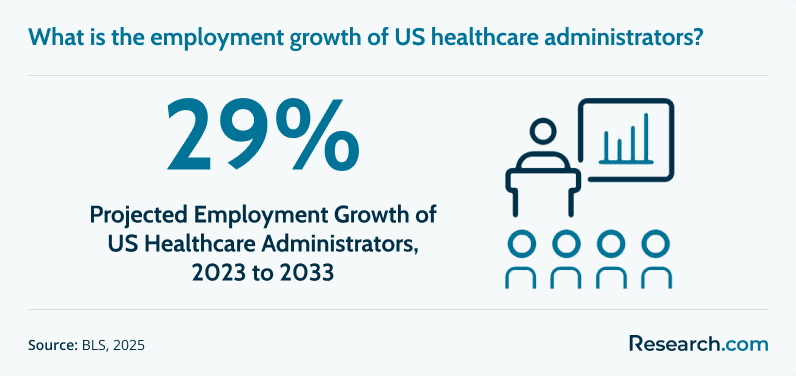
The employment outlook for medical and health services managers is strong compared with the overall labor market. According to the BLS, employment of medical and health services managers is projected to grow 29% from 2023 to 2033, far above the national average of 4%. The number of employed healthcare administrators is expected to rise from 562,700 in 2023 to around 723,300 by 2033.
Pay can be competitive with other graduate healthcare business pathways, including roles discussed in our MBA in healthcare management salary guide. However, salary varies by employer, state, specialization, leadership level, and prior healthcare experience.
Current job postings also suggest broad employer demand. Indeed lists over 18,000 job openings for healthcare administration roles. This count does not include every related position that MHA graduates may pursue, such as policy analyst, health services consultant, operations manager, or managed care leader.
The largest employers of medical and health services managers are hospitals (30%), offices of physicians (12%), and nursing and residential care facilities (9%). The states with the highest employment levels for these professionals are California (57,310), Texas (51,030), and Florida (35,950).
The chart below shows the industries with the highest employment levels for healthcare administration.
Current Trends Affecting Healthcare Administration Students
Healthcare administration is changing as organizations respond to staffing pressure, cost control, technology adoption, quality improvement demands, and patient safety priorities. Online MHA students should look for programs that address these realities directly rather than offering only general management theory.
- Data and analytics are becoming core management tools. Administrators increasingly use dashboards, quality metrics, financial data, and operational analytics to make decisions.
- AI and automation are changing workflows. Healthcare leaders need enough technical fluency to evaluate tools, manage implementation risk, protect data, and understand how automation affects staff and patients.
- Quality improvement remains central. Patient safety, performance measurement, and process redesign are not optional topics for future administrators.
- Employer expectations are more practical. Many organizations value graduates who can manage budgets, lead teams, communicate with clinicians, and solve operational problems from day one.
- Flexible education is now mainstream. Online and hybrid MHA formats make graduate study more accessible, but students must still verify accreditation, applied learning, and career support.
Online MHA vs. Other Advanced Healthcare Degrees
An online MHA is primarily an administrative leadership degree. It focuses on strategy, finance, operations, policy, quality, and organizational management. Other advanced healthcare degrees may prepare students for clinical practice, research, pharmacy, public health, or specialized care delivery.
| Degree | Main Focus | Best For |
| Master of Health Administration | Healthcare leadership, operations, finance, policy, and organizational strategy | Students who want management roles in healthcare organizations |
| MBA in Healthcare Management | General business training with healthcare-focused electives or concentration coursework | Students who want broader business mobility across healthcare and non-healthcare sectors |
| Public Health Graduate Degree | Population health, prevention, epidemiology, community health, and policy | Students interested in public health agencies, nonprofits, research, or community programs |
| Clinical Professional Degree | Patient care, diagnosis, treatment, or clinical decision-making | Students pursuing licensed clinical practice or advanced patient-facing roles |
| PharmD | Pharmaceutical sciences, medication therapy, patient care, and clinical pharmacy practice | Students who want pharmacy-focused clinical expertise, such as those comparing a PharmD online program |
Can Additional Credentials Strengthen an MHA Career?
Complementary credentials can help MHA graduates build specialized expertise, especially in areas such as analytics, quality improvement, informatics, compliance, project management, finance, or clinical operations. The best add-on credential depends on the role you want, not simply on what looks impressive on a resume.
For example, an administrator working in population health, wellness programming, or preventive care may benefit from coursework connected to nutrition and community health. In that case, exploring a bachelor's degree in nutrition science may provide context for patient wellness initiatives. Other students may be better served by certifications in healthcare quality, informatics, Lean Six Sigma, project management, or compliance.
How Accreditation Affects the Value of an Online MHA
Accreditation helps verify that a school or program meets recognized standards for curriculum quality, faculty qualifications, student support, assessment, and continuous improvement. For online MHA students, accreditation can influence financial aid eligibility, employer confidence, transfer options, and the credibility of the degree.
Students should check both institutional accreditation and, where relevant, programmatic accreditation. Institutional accreditation applies to the college or university as a whole. Programmatic accreditation, such as healthcare management accreditation, evaluates the specific degree. Before enrolling, verify accreditation directly with the school and recognized accrediting bodies rather than relying only on marketing language. For additional comparison help, review our guide to accredited online healthcare administration degree options.
What Graduates Say About Online MHA Programs
- : "My online MHA was useful because the assignments were tied to real problems I was already seeing in a large health system. Courses in finance and strategic planning gave me tools I could bring back to work immediately, and that practical connection made the degree feel worthwhile. — Terry"
- : "The online format helped me study with healthcare professionals from different parts of the country. Their perspectives made policy and administration discussions much richer, and the program was demanding without making full-time work impossible. — Andre"
- : "I expected online learning to feel disconnected, but group projects and virtual discussions created more interaction than I anticipated. Working with classmates from different healthcare settings helped me understand operational and policy challenges beyond my own organization. — Randy"
Key Insights
- The best online MHA depends on fit, not just ranking. Compare accreditation, cost, pacing, applied learning, and career support before choosing.
- Most online MHA programs take 2 to 3 years. Accelerated options may finish in 12 to 18 months, while part-time students often need 28 to 36 months or longer.
- Accreditation matters. Regional accreditation is essential, and CAHME accreditation can be especially valuable for healthcare management credibility.
- Total cost is more than tuition. Fees, software, books, residency travel, and loan interest can change the real price of a degree.
- Online programs work best for self-directed learners. Flexibility is valuable, but online MHA students still need strong time management and comfort with virtual collaboration.
- Applied experience is a major differentiator. Capstones, practicums, consulting projects, and internships can help students prove leadership readiness.
- The job outlook is strong but not automatic. BLS projects 29% growth for medical and health services managers from 2023 to 2033, but individual outcomes depend on experience, role, employer, and location.
- Choose your specialization strategically. Informatics, finance, policy, quality, hospital administration, and long-term care concentrations lead toward different career paths.
References:
- BLS. Occupational employment and wage data for medical and health services managers. BLS
- BLS. Occupational employment statistics by industry for May 2024. BLS
- BLS. Occupational Outlook Handbook profile for medical and health services managers. BLS
- College Board. Education information for medical and health services managers. College Board
- World Health Organization. Patient safety fact sheet. World Health Organization
- Zippia. Health care administrator demographics and statistics in the United States. Zippia
Other Things You Should Know About Online Master of Health Administration Programs
Yes. Many online MHA programs use a mix of asynchronous lectures and live synchronous sessions through video conferencing. Programs may require one to three scheduled evening meetings each week, plus group projects and virtual office hours, to support interaction with faculty and classmates.
Yes, many of the top online MHA programs in 2027 offer financial aid options, including scholarships, grants, and federal student loans. Eligibility for these options varies by program and often depends on financial need or academic performance, so checking specific programs' offerings is recommended.


