2027 Fastest Way To Become a Counselor in Florida

Co-Founder and Chief Data Scientist
Becoming a counselor in Florida is not just a matter of earning a degree and applying for a job. The state has specific education, supervised experience, exam, and training requirements, and small planning mistakes can add months to the process. The biggest delays usually happen when students enroll in a program that does not match Florida licensure rules, start supervision before registering correctly, or underestimate the time needed to document clinical hours.
This guide explains the fastest realistic route to becoming a licensed counselor in Florida. It is designed for prospective graduate students, career changers, bachelor’s degree holders exploring mental health roles, and working professionals comparing online, accelerated, and traditional counseling programs. You will learn which steps cannot be skipped, where you may be able to save time, how employers view fast-track preparation, and how to decide whether an accelerated path is a smart choice for your situation.
Quick answer: the fastest path to counseling licensure in Florida
The fastest route to becoming a Licensed Mental Health Counselor in Florida is to complete a qualifying 60-credit master’s degree, finish the required practicum or internship during the program, pass the National Clinical Mental Health Counseling Exam, register as a Registered Mental Health Counselor Intern, complete the required post-master’s supervised experience, finish Florida-specific training courses, and submit a complete licensure application to the state board. Online or accelerated programs may help you finish coursework sooner, but they do not remove Florida’s supervision, exam, or state training requirements.
Key benefits of pursuing counseling in Florida
- Florida’s counseling workforce is expected to remain important as mental health awareness, addiction treatment needs, school-based support, and community services continue to shape demand.
- Salary estimates vary by role and source, but many counselor roles in Florida are commonly discussed in the approximate $50,000 to $55,000 range, with higher earnings possible in licensed, specialized, private practice, or telehealth settings.
- Florida offers multiple counseling-related career entry points, from bachelor’s-level behavioral health roles to licensed clinical practice, making it possible to build experience while progressing toward advanced credentials.
- What is the fastest way to become a licensed counselor in Florida?
- What counseling jobs can you get in Florida with a bachelor’s degree?
- Are accelerated counseling degree programs available in Florida?
- Can online counseling programs help you finish faster?
- What problems do fast-track counseling students need to plan for?
- How do Florida employers evaluate fast-track counseling graduates?
- Can online or accelerated counseling programs lower your costs?
- Is Florida a strong job market for counselors?
- Why consider school counseling in Florida?
- What do counselors earn in Florida?
- How do counseling and social work education paths differ in Florida?
- Is substance abuse counseling a useful specialization in Florida?
- Is the fast route to becoming a Florida counselor worth it?
- What continuing education is required after licensure?
What is the fastest way to become a licensed counselor in Florida?
The fastest licensure path is the one that meets Florida’s rules the first time. You can save time by choosing the right graduate program, preparing for the exam early, registering as an intern promptly after graduation, and documenting supervision carefully. You cannot speed up the process by skipping required coursework, reducing required client-contact hours, or counting supervision that was not approved under Florida rules.
Florida’s licensed mental health counselor pathway generally includes these core steps:
- Complete a qualifying 60-credit master’s degree: Florida requires a master’s program that satisfies state counseling education standards. A CACREP-accredited mental health counseling program is the cleanest route. If the program is not CACREP-accredited, it must include at least 60 semester hours and cover 12 required content areas, including topics such as counseling theories, human growth, ethics, and substance abuse. The program must also include a practicum or internship with at least 700 hours, including 280 client-contact hours.
- Use your graduate practicum strategically: The required university-sponsored practicum or internship gives you early real-client experience before graduation. Students who treat this as serious professional preparation often transition more smoothly into post-master’s supervised work.
- Pass the National Clinical Mental Health Counseling Exam: Florida requires the NCMHCE through the NBCC unless an applicant qualifies through an endorsement route after already passing the NCE. Preparing during the final part of graduate school can reduce the gap between graduation and internship progress.
- Register as a Registered Mental Health Counselor Intern: After graduation, you must apply to the state, identify a qualified supervisor, and receive intern registration before your post-master’s supervised hours can count toward licensure.
- Complete post-master’s supervised experience: Florida requires 1,500 hours of face-to-face counseling and 100 hours of supervision over 100 weeks. This means the clinical experience portion takes at least two years even if you work efficiently.
- Finish Florida-specific training: Before full licensure, applicants must complete an 8-hour Florida laws and rules course, a 3-hour HIV/AIDS course or affidavit, and a 2-hour domestic violence course through board-approved providers.
- Submit a complete licensure application: After completing supervision, exam, and required training, submit documentation to the Florida Board of Clinical Social Work, Marriage & Family Therapy, and Mental Health Counseling. A complete application is typically processed within approximately 30 days.
| Licensure stage | Fastest smart move | Common delay to avoid |
| Choosing a master’s program | Verify CACREP accreditation or confirm that the curriculum meets Florida’s 60-credit and 12-content-area requirements. | Assuming any counseling-related master’s degree qualifies for LMHC licensure. |
| Graduate practicum or internship | Track the 700 required hours and 280 client-contact hours carefully. | Waiting until graduation to check whether clinical training meets state expectations. |
| Exam preparation | Plan for the NCMHCE before or soon after graduation. | Delaying exam study until supervised hours are nearly complete. |
| Registered intern status | Apply promptly and confirm your supervisor is qualified before counting hours. | Starting clinical work before your registration and supervision arrangement are in place. |
| Post-master’s experience | Maintain organized logs for 1,500 face-to-face counseling hours and 100 supervision hours over 100 weeks. | Reconstructing records months later or counting hours that do not meet Florida rules. |
Digital systems for applications, recordkeeping, and supervision logs may make the process easier to manage, but applicants should still rely on official board guidance and written confirmation from programs or supervisors. For a broader look at roles, credentials, and career options, review Research.com’s guide to counseling career requirements.
What counseling careers can you pursue in Florida with only a bachelor’s degree?
A bachelor’s degree alone does not qualify you to become a fully licensed mental health counselor in Florida. However, it can qualify you for entry-level behavioral health, case management, crisis support, residential treatment, or addiction services roles. These jobs can be valuable if you want to test the field before committing to graduate school or build experience for a future counseling master’s application.
| Bachelor’s-level role | Typical work setting | How it helps future counselors |
| Substance Abuse Counselor | Rehabilitation programs, treatment centers, recovery organizations | Builds experience with addiction recovery, relapse prevention, group support, and client documentation. Additional certification or supervision may be required. |
| Behavioral Health Technician | Hospitals, residential facilities, community agencies, nonprofit programs | Offers exposure to treatment planning, client monitoring, crisis response, and interdisciplinary care teams. |
| Mental Health Case Manager | Community mental health agencies, social service organizations, public programs | Develops skills in resource coordination, advocacy, intake support, service planning, and client follow-up. |
| Crisis or Residential Counselor | Crisis lines, group homes, emergency programs, residential treatment facilities | Strengthens communication, de-escalation, safety planning, and direct-support skills with clients in high-need situations. |
Credentials such as Certified Behavioral Health Technician (CBHT) or Certified Addiction Counselor (CAC) can improve employability for some bachelor’s-level positions. These roles are also useful for confirming whether you are comfortable with emotionally demanding work, irregular schedules, documentation requirements, and client-facing responsibility before pursuing a graduate degree.
If your long-term goal is independent clinical practice, bachelor’s-level work should be treated as a stepping stone rather than a substitute for licensure. To compare counseling licenses, job titles, and professional outcomes, see Research.com’s overview of licensed professional counselor careers.
Are there accelerated counseling degree programs in Florida?
Yes. Some Florida counseling programs are structured for students who want to move through graduate coursework efficiently. The key question is not only whether a program is fast, but whether it satisfies Florida licensure standards and provides enough supervised field training to prepare you for real clinical work.
| Program example | Format and timeline details stated | Licensure-related considerations |
| Florida Gulf Coast University | FGCU offers a CACREP-accredited Master of Arts in Clinical Mental Health Counseling that can be completed in as little as two years. The program includes 1,000 hours of field experience. Tuition for Florida residents is approximately $290.60 per credit hour. | CACREP accreditation and substantial field experience can simplify the education review process for Florida LMHC applicants. |
| Barry University | Barry University offers a CACREP-accredited Master of Education in Clinical Mental Health Counseling through a 60-credit curriculum at its Boca Raton campus. Its accelerated format is designed for motivated students. Tuition is $371.82 per credit hour for in-state students. | A 60-credit CACREP-accredited curriculum aligns with the core academic structure expected for Florida licensure. |
| Nova Southeastern University and other institutions | Nova Southeastern University and other schools offer flexible accelerated and online options that may be completed in as little as 18 months depending on transfer credits and course load. | Students should verify field placement support, Florida licensure alignment, and whether the shorter schedule affects internship quality. |
Accelerated programs work best for students who can manage intensive reading, clinical skill development, field placement obligations, and exam preparation at the same time. They are less ideal for students who need a slower academic pace, extensive career exploration, or significant scheduling flexibility beyond what the program allows.
Graduate-level counseling education can also lead to doctoral study, research, supervision, teaching, or advanced clinical specialization. If you are thinking beyond master’s-level practice, compare options such as an online PhD in counseling and other low-cost counseling doctorate pathways before deciding how far you want to go academically.
Are online counseling programs in Florida faster than traditional ones?
Online counseling programs can be faster for some Florida students, but online delivery alone does not guarantee a shorter path to licensure. The actual timeline depends on course sequencing, start dates, practicum availability, internship placement support, whether courses are offered year-round, and how quickly you can move into post-master’s supervised work after graduation.
| Program feature | How it may save time | What to verify before enrolling |
| Asynchronous coursework | Students can complete lectures and assignments around work or family obligations instead of attending fixed class sessions. | Make sure deadlines, live skills labs, residencies, or synchronous supervision requirements fit your schedule. |
| No commute | Online delivery eliminates travel time, parking, and campus scheduling constraints. | Confirm whether the program requires occasional campus visits or in-person intensives. |
| Multiple start dates | Rolling or year-round starts may reduce the wait between admission and the first term. | Ask whether core clinical courses are available every term or only once per year. |
| Digital advising and administration | Online systems can make registration, advising, communication, and document submission more efficient. | Find out how quickly the school responds to field placement problems, licensure questions, or transfer evaluations. |
| Local field placement | Some online students can complete practicum or internship hours near where they live. | Ask whether the school finds placements for you or expects you to secure them independently. |
Online study may be especially practical for adults changing careers, students outside major metro areas, or learners who need to keep working while completing a master’s degree. The trade-off is that students must be highly organized and proactive. In counseling, the clinical placement is as important as the classroom format, so a fast online curriculum is only useful if the practicum and internship requirements can be completed without bottlenecks.
What challenges do fast-track counseling students face?
Accelerated counseling programs can shorten the academic portion of the journey, but they also compress difficult material and clinical growth into a tighter schedule. Counseling is a skill-based profession; students need time to practice interviewing, assessment, treatment planning, ethical decision-making, documentation, and self-reflection.
- Compressed coursework: Fast-track students may cover dense clinical, ethical, diagnostic, and theoretical material in a shorter time frame. This requires consistent study habits and strong time management.
- Less time to absorb clinical feedback: Practicum and internship experiences are not just hour requirements. They are where students learn how to respond to real clients, use supervision, and improve therapeutic judgment.
- Burnout risk: Balancing graduate courses, fieldwork, paid employment, family responsibilities, and exam preparation can become overwhelming if the program pace is too aggressive.
- Supervision and placement pressure: Students in condensed programs need field placements and supervisors lined up early. A delayed internship can erase the time saved through accelerated coursework.
- Licensure misalignment: Students must verify that their coursework, practicum, internship, and post-master’s supervision meet Florida’s specific requirements. A short program that does not align with state rules can become the slowest option.
| Common mistake | Why it causes delays | Better approach |
| Choosing based only on speed | A short program may lack the right accreditation, field placement structure, or Florida-specific licensure alignment. | Compare accreditation, curriculum, practicum hours, internship support, exam preparation, and graduate outcomes. |
| Assuming online means easier | Online programs still require clinical skill practice, fieldwork, deadlines, and supervision. | Treat online study as flexible, not lightweight. Build a weekly schedule before classes begin. |
| Waiting to plan supervision | Post-master’s hours count only when completed under the correct registration and supervision structure. | Identify qualified supervisors and understand Registered Mental Health Counselor Intern requirements before graduation. |
| Ignoring documentation | Missing logs, unclear hour records, or incomplete certificates can slow final licensure review. | Keep organized records for coursework, clinical hours, supervision, exam results, and required trainings. |
| Focusing only on tuition | Fees, books, technology, travel for residencies, unpaid internship time, and lost work hours can change the total cost. | Calculate the full cost of attendance and the opportunity cost of reduced work hours. |
As programs respond to Florida’s mental health workforce needs, stronger advising, better digital supervision tracking, and more coordinated field placement support may become increasingly important. The chart below adds another factor to consider: student debt, which can affect career flexibility after graduation.
How do employers in Florida view fast-track counselors?
Florida employers generally care less about whether a program is labeled “fast-track” and more about whether the graduate is clinically prepared, properly supervised, ethical, reliable, and eligible for licensure. A fast program from a well-structured, accredited institution can be viewed positively. A rushed program with weak field training can raise concerns.
Some hiring managers are cautious because counseling competence develops through repeated supervised practice with different client populations. Employers may ask whether a graduate has worked with trauma, substance use, crisis situations, children, families, culturally diverse clients, or high-acuity cases. They may also look closely at documentation habits, professional boundaries, and readiness to work within agency procedures.
Other employers appreciate fast-track graduates because they often show persistence, adaptability, and urgency to enter the workforce. This can matter in areas where agencies struggle to recruit enough clinicians. Programs that partner with clinics, hospitals, schools, or community mental health organizations may give accelerated students a stronger employment advantage because employers have seen their training firsthand.
| What employers may value | How fast-track students can demonstrate it |
| Licensure readiness | Know your Florida intern registration status, supervision plan, exam progress, and remaining requirements. |
| Clinical judgment | Discuss supervised cases appropriately, explain how you use feedback, and show awareness of scope of practice. |
| Documentation skills | Be prepared to describe experience with treatment plans, progress notes, risk assessment, referrals, and confidentiality. |
| Cultural responsiveness | Show experience or training with Florida’s diverse communities and underserved populations. |
| Resilience and ethics | Explain how you manage caseload stress, boundaries, supervision, mandated reporting, and client safety. |
Are fast-track and online counseling programs in Florida more affordable?
Online and accelerated counseling programs can reduce certain costs, but they are not automatically cheaper. The final price depends on tuition, fees, transfer credit policies, field placement requirements, residency travel, technology costs, books, and whether you can keep working while enrolled.
- Tuition range: Some online master’s counseling degrees in Florida are described as costing about $9,500 to $20,000, and some may extend in-state rates to distance learners.
- Shorter enrollment period: Accelerated coursework can reduce the number of semesters in which students pay tuition-related fees, although the per-term workload may be heavier.
- Work-compatible scheduling: Asynchronous or part-time options can allow students to maintain income while progressing through the degree.
- Lower commuting or relocation costs: Online students may avoid daily travel, parking, and the cost of moving near campus.
- Financial aid access: Accredited programs may qualify students for federal or state aid, scholarships, and grants, but eligibility should be verified directly with the school.
| Cost factor | Question to ask the school |
| Tuition | Is tuition charged per credit, per term, or by program, and does the rate change for online or out-of-state students? |
| Fees | Are there clinical placement fees, technology fees, graduation fees, residency fees, or exam preparation charges? |
| Transfer credits | How many credits can transfer, and will transferred credits still satisfy Florida licensure expectations? |
| Field placement | Does the program arrange practicum and internship sites, or must students find their own? |
| Residency requirements | Are there required in-person weekends, labs, intensives, or campus visits? |
| Financial aid | Is the program eligible for federal financial aid, scholarships, grants, or employer tuition assistance? |
Affordability should be evaluated alongside licensure fit. A cheaper program that does not meet Florida requirements, delays field placement, or provides limited advising can cost more in the long run. Students comparing lower-cost programs can start with Research.com’s guide to affordable online colleges for counseling degrees.
Is there a demand for counselors in Florida?
Florida has ongoing demand for counseling professionals across mental health, addiction treatment, school support, family services, and community care. Demand is shaped by population growth, provider shortages in underserved communities, greater willingness to seek mental health care, and the expansion of telehealth and integrated behavioral health services.
- National growth context: Employment for substance abuse, behavioral disorder, and mental health counselors is projected to grow by 19% between 2023 and 2033 nationwide. Florida reflects many of the same pressures because residents continue to need accessible behavioral health care.
- Broad behavioral health ecosystem: Psychology, social work, marriage and family therapy, and counseling-related fields employ over 24,000 people and support thousands of organizations statewide.
- Shortage areas: Rural communities and underserved urban neighborhoods often have fewer licensed providers, which can create opportunities for new counselors willing to work in high-need settings.
- Rising service needs: The pandemic, financial stress, substance use concerns, and increased mental health awareness have contributed to more people seeking support.
- High-need specialties: School counseling, addiction recovery, and family therapy continue to be important areas for students considering where to focus training and supervised experience.
Demand does not guarantee immediate employment or a specific salary. Employers still evaluate licensure status, clinical readiness, documentation skills, supervision needs, and fit with client populations. Candidates who gain experience in underserved settings, crisis work, substance abuse treatment, school-based services, or telehealth may be better positioned for a wider range of roles.
What advantages does a school counseling career offer in Florida?
School counseling can be a strong fit for professionals who want to support students’ academic progress, social-emotional development, college and career planning, and crisis response. In Florida, school counselors work within educational systems, so the training route and certification expectations differ from clinical mental health counseling. This path is often best for people who prefer working with children, adolescents, families, teachers, and school administrators rather than focusing primarily on clinical therapy in private practice or community mental health settings.
Before choosing this specialization, compare the requirements for school-based roles with the LMHC pathway. Ask whether your program prepares you for state certification, supervised school experience, and the day-to-day realities of school schedules, caseloads, and student support services. For a focused roadmap, review Research.com’s guide on how to become a school counselor in Florida.
How much do counselors get paid in Florida?
Counselor pay in Florida depends on license level, specialty, work setting, city, experience, and whether the counselor works in an agency, school, hospital, nonprofit, private practice, or telehealth environment. Salary figures also vary by data source and date, so students should compare multiple sources and avoid treating any estimate as guaranteed income.
| Role or pay category | Florida salary information stated | What affects earnings |
| Overall counselor salary | The state average is described as around $57,449 as of mid-2025, with many counselors earning between $50,300 and $65,286 annually. | Role, location, experience, licensure status, employer type, and client population. |
| Licensed Mental Health Counselors | LMHCs average $74,613 per year, with top earners making over $83,000. | Independent licensure, specialization, private practice opportunities, and higher-acuity clinical experience. |
| School and substance abuse counselors | These roles often pay near or somewhat below the state average depending on district funding, employer type, and specialization. | Public funding, credential requirements, caseload, setting, and specialty training. |
| Entry-level counseling-related workers | Workers without advanced credentials may start between $14.38 and $21.54 per hour, or around $30,000 to $45,000 annually. | Education level, certification, prior behavioral health experience, shift schedule, and employer. |
| Private practice and telehealth counselors | In cities such as Miami, Orlando, and Tampa, private and telehealth counselors may earn between $30 and $50 per hour. | Client volume, insurance participation, specialization, business expenses, and referral network. |
| Counselors with specialized credentials | Advanced training in high-need areas can support above-average earnings. | Demand for the specialty, employer need, supervision qualifications, and clinical reputation. |
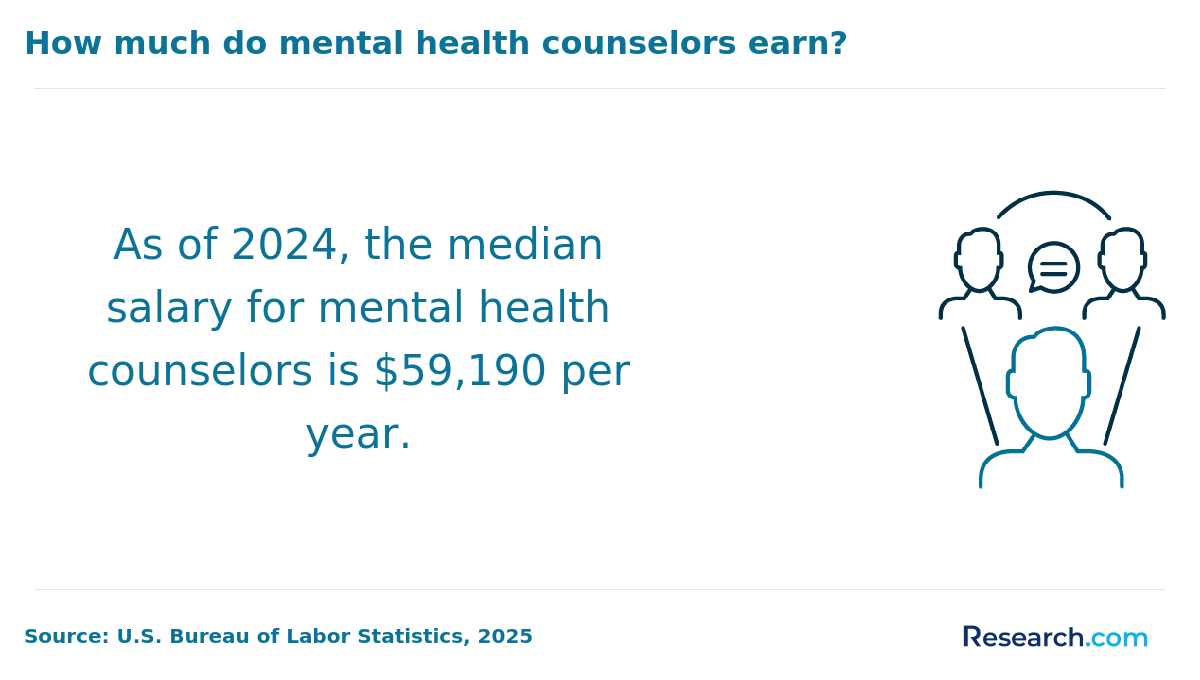
Florida wages may be slightly below some national figures, but telehealth, licensure mobility, and workforce development efforts may influence future opportunities. Students should evaluate salary alongside debt, supervision requirements, cost of living, and the time needed to reach independent licensure. The image below summarizes mental health counselor pay ranges by setting and experience level.
How do Florida counseling and social work educational requirements compare?
Counseling and social work both lead to helping professions, but they are not interchangeable pathways. Counseling programs typically emphasize therapeutic theories, assessment, diagnosis, counseling skills, ethics, and supervised clinical practice for mental health treatment. Social work education includes clinical practice for some students, but it also places strong emphasis on systems, advocacy, case management, community resources, policy, and social conditions affecting clients.
| Factor | Counseling path | Social work path |
| Primary training focus | Clinical counseling skills, therapy models, assessment, ethics, and mental health treatment. | Client systems, social services, advocacy, community resources, policy, and clinical or macro practice depending on program track. |
| Typical graduate direction | Master’s-level counseling degree for LMHC preparation. | Social work degree route aligned with social work licensure and practice roles. |
| Best fit for | Students who want a therapy-centered identity and a counseling licensure pathway. | Students who want flexibility across clinical care, case management, advocacy, agencies, hospitals, or community systems. |
| Decision point | Choose this route if your main goal is counseling practice under Florida mental health counseling rules. | Choose this route if you want social work’s broader service, systems, and advocacy orientation. |
Because the education and licensure structures differ, students should not assume that credits, internships, or supervised experience will transfer cleanly between professions. If you are comparing the two, start with the academic benchmarks explained in Research.com’s guide to Florida social worker educational requirements.
Is specializing in substance abuse counseling beneficial in Florida?
Substance abuse counseling can be a practical specialization in Florida because addiction treatment often overlaps with mental health counseling, crisis services, family support, criminal justice referrals, and community recovery programs. Students interested in this area should look for training in evidence-based addiction treatment, co-occurring disorders, relapse prevention, group counseling, motivational interviewing, ethics, and referral coordination.
This specialization may be especially useful for bachelor’s-level workers who want to enter behavioral health before graduate school, master’s students choosing practicum sites, and licensed counselors who want to expand their clinical focus. However, job duties and credential expectations vary by employer, so candidates should confirm whether a role requires a specific addiction credential, state-recognized certification, supervised experience, or a clinical license.
For a step-by-step overview of this pathway, see Research.com’s guide on how to become a substance abuse counselor in Florida.
Is taking the fast route to become a counselor in Florida worth it?
The fast route can be worth it if you choose a properly aligned program, can handle an intensive academic and clinical schedule, and are prepared to move quickly into Registered Mental Health Counselor Intern status after graduation. It is not worth it if speed causes you to compromise accreditation, supervision quality, field placement support, or your ability to learn core counseling skills safely.
| The fast route may be a good fit if... | You may want a slower path if... |
| You already understand counseling as a career and are committed to clinical work. | You are still deciding between counseling, social work, psychology, school counseling, or another helping profession. |
| You can manage a heavy graduate workload while completing practicum or internship requirements. | You need more time for work, caregiving, health, or financial reasons. |
| You are organized enough to track hours, applications, exams, certificates, and supervision records. | You struggle with self-directed scheduling or administrative details. |
| You have access to reliable field placements and qualified supervision. | Your local area has limited placement sites or you need the school to provide extensive support. |
| You want to enter high-need areas such as substance abuse treatment, trauma care, youth services, or telehealth-supported practice. | You want extra time to explore specialties before choosing a clinical direction. |
Registering early as a Registered Mental Health Counselor Intern is one of the most important time-saving steps after graduation because it allows qualifying supervised work to count toward the 1,500 hours of face-to-face psychotherapy and 100 hours of supervision required for licensure. Those hours must be completed over 100 weeks, so planning matters more than rushing.
Students comparing counseling with marriage and family therapy may also want to review accelerated family therapy options. Research.com’s guide to the shortest online MFT programs can help you understand how another therapy-focused pathway compares.
What are the continuing education and professional development requirements for maintaining licensure in Florida?
Licensure is not the end of the professional development process. Florida counselors must complete continuing education to renew and maintain their licenses, and required topics commonly include ethics, legal responsibilities, and state-specific practice standards. Counselors should verify current renewal rules directly with the Florida board because requirements can change.
Continuing education is also a career strategy, not only a compliance task. Training in telehealth, trauma-informed care, multicultural counseling, addiction treatment, risk assessment, supervision, and emerging clinical practices can help counselors stay effective and competitive. To keep your renewal plan aligned with state rules, review current LPC license requirements in Florida before each renewal cycle.
What counselors in Florida say about their careers
“Choosing an accelerated route helped me enter Florida’s counseling workforce sooner. The demand for mental health support made it possible to find steady work, and the day-to-day impact with clients has been the most meaningful part of the career.” – Leo
“Working with Florida’s diverse communities has challenged me to grow clinically and personally. Moving quickly into the field exposed me to cultural, family, and community issues that made my training feel real.” – Julie
“The accelerated path got me started, but ongoing training is what keeps me confident. Workshops, certifications, and professional development have helped me stay current and sharpen my counseling approach.” – Lindsay
Key insights
- The fastest legitimate path to Florida counseling licensure still requires a qualifying 60-credit master’s degree, the NCMHCE, Registered Mental Health Counselor Intern status, 1,500 face-to-face counseling hours, 100 supervision hours, 100 weeks of supervised experience, and required Florida training courses.
- Accelerated and online programs can shorten coursework time, but they do not eliminate Florida’s supervision or licensure requirements.
- CACREP accreditation, field placement support, and Florida curriculum alignment are more important than program speed alone.
- Bachelor’s degree holders can enter behavioral health through roles such as substance abuse counselor, behavioral health technician, case manager, or crisis/residential counselor, but independent clinical counseling requires graduate education and licensure.
- Online programs may save time and money through flexible scheduling, no commuting, and year-round options, but students must verify practicum, internship, residency, and licensure details before enrolling.
- Florida employers evaluate fast-track graduates by clinical readiness, supervision history, documentation skills, ethical judgment, and licensure progress rather than speed alone.
- The fast route is worth considering if you are organized, committed, and prepared for an intensive workload. A slower route may be better if you need more time to build skills, explore specialties, or manage personal obligations.
Related Articles for Nearby States
- 2027 Fastest Way to Become a Counselor in Georgia
- 2027 Fastest Way To Become a Counselor in Alabama
- 2027 Fastest Way To Become a Counselor in South Carolina
- 2027 Fastest Way To Become a Counselor in Mississippi
- 2027 Fastest Way To Become a Counselor in Tennessee
- 2027 Fastest Way To Become a Counselor in North Carolina
- 2027 Fastest Way To Become a Counselor in Louisiana
- 2027 Fastest Way to Become a Counselor in Kentucky
- 2027 Fastest Way To Become a Counselor in Arkansas
- 2027 Fastest Way To Become a Counselor in Virginia
References:
- American Counseling Association. (2024). Counseling Workforce Survey. ACA
- Community Care. (2021). ‘Disconnect’ between fast-track social work training and real-world practice, review finds. Community Care
- Council for Accreditation of Counseling and Related Educational Programs. (2024). CACREP Vital Statistics. CACREP
- Counseling Psychology. (2025). Fastest Online Counseling Master’s Degrees: A Guide to Accelerated Programs. Counseling Psychology
- Florida Department of Health. (n.d.). Licensed Mental Health Counselor. Florida DOH
- Florida International University. (n.d.). Licensing in Florida. FIU
- Online Counseling Programs with edX. (n.d.). How to Become a Counselor in Florida. OCP with edX
- Online MFT Programs. (2023). Florida Masters in Counseling Programs. MFT Programs
- Palm Beach Atlantic University. (2025). How to Become a Clinical Mental Health Counselor in Florida. PBAU
- Tahler, H. (n.d.). How To Become A Licensed Therapist In Florida (By License Type). MyWellBeing
Other Things You Need to Know About the Fastest Way to Become a Counselor in Florida
Florida applicants for LMHC licensure must complete at least 1,000 hours of supervised practice during a post-master’s internship. The Board of Clinical Social Work, Marriage and Family Therapy, and Mental Health Counseling in Florida also requires 100 hours of supervision during that internship, with weekly supervision meetings documented.
To become a counselor in Florida in 2027, you need a master's degree with coursework in areas like human development, counseling techniques, and ethics. Specific credit hours in these domains are required by the Florida Board of Clinical Social Work, Marriage & Family Therapy, and Mental Health Counseling.