2027 How to Become a School Counselor in Florida

Co-Founder and Chief Data Scientist
Becoming a school counselor in Florida is not just a matter of earning a counseling degree. To work in Florida public schools, you must meet state educator certification rules, complete supervised school-based experience, pass the required exam, and keep your credential active through renewal. Missing one requirement can delay hiring, even for candidates who already have graduate counseling training.
This guide explains the Florida school counselor pathway in practical terms: the degree you need, how long preparation usually takes, certification steps, renewal rules, alternative routes, salary expectations, job outlook, advancement options, and how this credential differs from LPC licensure. It is designed for prospective graduate students, career changers, current educators, and counseling professionals deciding whether school counseling in Florida is the right next move.
Quick answer: How do you become a school counselor in Florida?
To become a school counselor in Florida, you generally need a graduate degree in school counseling or guidance and counseling, supervised internship experience in a school setting, a successful application through the Florida Department of Education, a Level 2 background screening, and a passing score on the Florida Teacher Certification Examination School Counseling PK–12 Subject Area Exam. Florida school counselors must also renew their professional credentials every five years.
Key things to know before you start
- A master’s degree is the standard entry credential. Florida’s certification pathway is built around graduate-level preparation in school counseling or a closely related field.
- Field experience matters as much as coursework. Programs typically include at least 600 clock hours of supervised internship experience with pre-K-12 students.
- Certification is separate from clinical counseling licensure. School counseling certification authorizes work in school settings; LPC licensure follows a different clinical practice pathway.
- Renewal is ongoing. Florida school counselors must complete continuing education or in-service requirements to keep credentials active.
- Planning ahead prevents delays. Before enrolling, confirm accreditation, internship placement support, exam preparation, and whether the program meets Florida Department of Education expectations.
- What degree do I need to become a school counselor in Florida?
- Are there school counseling specializations in Florida?
- How long does it take to complete a school counseling degree in Florida?
- What certification is required to work as a school counselor in Florida?
- Can I transfer my Florida school counseling license between states?
- How often do Florida school counselors need to renew their credentials?
- What are the alternative pathways to become a school counselor in Florida?
- What are effective strategies for preparing for Florida’s school counselor certification exam?
- Can school counselors transition into school psychology roles in Florida?
- What is the average salary of school counselors in Florida?
- What is the job outlook for school counselors in Florida?
- What are the career advancement opportunities for school counselors in Florida?
- What are the key differences between school counseling certification and LPC licensure in Florida?
- Common mistakes to avoid when pursuing Florida school counselor certification
- References
What degree do I need to become a school counselor in Florida?
Florida school counselor candidates should plan for graduate study. The typical qualifying degree is a master’s degree in school counseling, guidance and counseling, or a closely aligned counselor education field that includes school counseling coursework and supervised practice in a school environment.
The most important degree requirements include:
- Graduate-level school counseling preparation: Candidates usually need a master’s degree in school counseling or guidance and counseling. The curriculum should cover counseling theory, human development, group counseling, career development, assessment, ethics, crisis response, and school-based student support.
- Supervised internship experience: Florida-focused preparation generally includes at least 600 clock hours of supervised internship experience in a school setting, giving candidates direct practice with pre-K-12 students.
- Accredited institution: The degree should come from an accredited college or university. Many students also compare whether programs align with CACREP standards because CACREP-accredited preparation can help demonstrate that the curriculum follows recognized counseling education expectations.
- Possible additional coursework: Applicants who do not hold a Florida Professional Teaching Certificate may need coursework tied to educator preparation expectations, such as reading instruction or ESOL, depending on the program and certification review.
If you are comparing counseling careers more broadly, it can also help to understand the longer professional timeline for other counseling credentials. Research.com’s guide on how long it takes to become a licensed counselor explains how graduate study, supervised experience, and licensing steps can vary by counseling role.
| Requirement | What it means for Florida candidates | Why it matters |
| Master’s degree | Graduate study in school counseling, guidance and counseling, or a related counseling field | Establishes the academic foundation required for certification review |
| School-based internship | At least 600 clock hours of supervised experience is commonly required in preparation programs | Shows that candidates can work directly with students in educational settings |
| Accredited program | Degree should be awarded by an accredited institution; CACREP alignment may strengthen program quality review | Helps avoid certification delays caused by insufficient or unclear coursework |
| Florida-specific coursework | Some candidates may need educator-related courses such as reading instruction or ESOL | Supports compliance with Florida school and educator expectations |
Are there school counseling specializations in Florida?
School counseling programs in Florida are usually designed around K-12 student development, but many also let students build skills in areas that reflect current school needs. Rather than thinking of specializations as separate licenses, treat them as emphasis areas that can make you more prepared for particular school populations or responsibilities.
Common areas of focused preparation include:
- K-12 school counseling: Preparation for academic planning, career development, social-emotional support, family collaboration, and classroom guidance across elementary, middle, and high school settings.
- Multicultural and diversity counseling: Training in culturally responsive counseling, equity issues, socioeconomic differences, and student support for diverse school communities.
- Prevention and early intervention: Coursework and fieldwork focused on identifying student concerns early and connecting students to academic, behavioral, mental health, or family support before problems intensify.
- Individual and group counseling: Skill development for one-on-one student sessions, small-group counseling, classroom lessons, consultation with teachers, and communication with caregivers.
- Leadership and advocacy: Preparation to use data, advocate for student needs, improve school counseling programs, and participate in policy or systems-level work.
- Clinical experience in schools: Practicum and internship placements that help candidates apply counseling skills in real K-12 environments before certification.
Students who are interested in counseling but not sure they want to work in schools may want to compare related paths. For example, Research.com’s guide on how to become a therapist explains alternatives for people who want a broader mental health role outside the K-12 system.
The chart below highlights the number of CACREP-accredited specialty programs available, reflecting the breadth of training options in the field.
How long does it take to complete a school counseling degree in Florida?
A Florida school counseling master’s degree typically takes 2 to 2.5 years for full-time students. Programs commonly require 60 to 72 graduate credit hours and combine counseling coursework with supervised practicum or internship experience.
Part-time students should expect a longer timeline, often 3 or 4 years, because internship scheduling, work obligations, and course sequencing can slow progress. Students without prior education coursework may also need extra classes before they can complete certification requirements.
| Pathway factor | Typical expectation | How it can affect your timeline |
| Full-time enrollment | Usually 2 to 2.5 years | Fastest standard route for students who can carry a full graduate course load |
| Part-time enrollment | Often 3 or 4 years | Better for working adults, but course sequencing may add semesters |
| Credit requirements | 60 to 72 graduate credit hours | Higher-credit programs can take longer, especially if summer enrollment is limited |
| Field experience | Minimum 600 to 700 hours of internship or practicum in school settings | Placement availability and school schedules can shape completion dates |
| Certification exams | Florida Teacher Certification Examination requirements may apply | Retesting or delayed exam scheduling can postpone certification |
Before enrolling, ask each program when internships begin, whether placements are arranged by the school or the student, whether evening or hybrid coursework is available, and how the program supports students preparing for Florida certification exams.
What certification is required to work as a school counselor in Florida?
Florida public school counselors need the Florida Educator Certificate in School Counseling. This is a state educator certification, not a private counseling license. It confirms that the counselor has met Florida’s education, examination, background screening, and professional standards for school-based practice.
The certification process generally includes these steps:
- Complete qualifying graduate preparation. Finish a master’s-level school counseling or guidance and counseling program that includes the required coursework and supervised school-based experience.
- Apply through the Florida Department of Education. Submit the certification application, official transcripts, and required fees through the state certification system.
- Pass the required subject exam. Candidates must pass the Florida Teacher Certification Examination School Counseling PK–12 Subject Area Exam.
- Complete fingerprinting and a Level 2 background check. Florida requires background screening because school counselors work directly with minors.
- Receive and maintain the certificate. Candidates who meet all requirements receive a certificate that must be renewed according to Florida’s five-year cycle.
| Certification step | What to prepare | Common delay to avoid |
| Application | Official transcripts, application materials, and fee payment | Submitting incomplete or unofficial academic records |
| Exam | FTCE School Counseling PK–12 Subject Area Exam preparation | Waiting until graduation to study or register |
| Background screening | Fingerprinting and Level 2 criminal background review | Assuming a previous background check automatically applies |
| Experience review | Documentation of practicum and internship hours | Choosing a program that does not clearly document school-based fieldwork |
| Renewal planning | Continuing education or in-service credits before expiration | Waiting until the final month of the five-year credential period |
Looking ahead, digital credentialing, online transcript review, and stronger documentation of competencies may make certification administration more efficient, but candidates should still verify current rules directly with the Florida Department of Education before making enrollment or employment decisions.
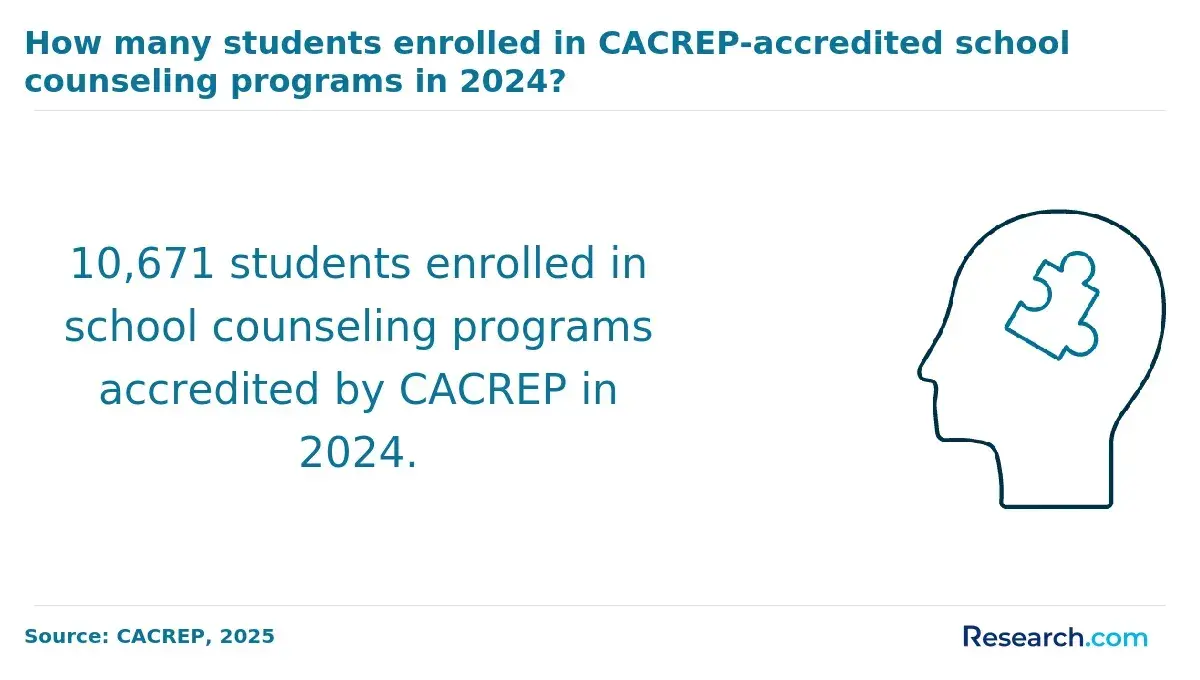
The image below illustrates the number of students currently enrolled in CACREP-accredited programs, offering insight into the pipeline of future counseling professionals.
Can I transfer my Florida school counseling license between states?
A Florida school counseling credential does not automatically transfer to every other state. School counselor certification is controlled by each state, and receiving states may require their own application, coursework review, exams, background checks, or temporary credential process.
Florida has pathways for some out-of-state educators to become certified in Florida, but that does not mean another state must accept a Florida credential without additional review. If you expect to move, check the destination state’s educator certification office before choosing a graduate program or job.
When seeking certification in another state, Florida-certified school counselors may need to provide:
- Official transcripts from graduate and undergraduate institutions.
- Verification of the Florida Educator Certificate in School Counseling.
- Documentation of a master’s degree in school counseling or a related field.
- Proof of supervised field experience or employment as a school counselor.
- Fingerprinting and background check results that meet the receiving state’s rules.
- Passing scores on state-specific exams, which may include ethics, pedagogy, or professional knowledge tests.
- Additional coursework if the new state requires content not covered in the Florida pathway.
- Letters of recommendation or evidence of professional standing.
- A provisional or temporary certificate while state-specific requirements are completed.
The best strategy is to keep detailed records: syllabi, internship evaluations, hour logs, supervisor information, exam results, and certificate copies. These documents can make out-of-state review easier if you relocate.
How often do Florida school counselors need to renew their credentials?
Florida school counselors must renew their professional credentials every five years. Renewal is not a formality; it is the state’s way of confirming that educators remain current in professional practice and meet continuing education expectations.
Key renewal rules include:
- Renewal cycle: The professional certificate is valid for five years and should be renewed before it expires.
- Continuing education requirement: Counselors must complete six semester hours of college credit or 120 in-service points.
- Students with disabilities requirement: Renewal must include at least one semester hour focused on teaching students with disabilities.
- Approved coursework: Credits must come from accredited institutions or approved programs and must be documented properly, typically with a minimum grade of “C.”
- Online application: Renewal is completed through the Florida Department of Education’s Certification Online system, generally during the final year of the certification period.
- Renewal fee: A nonrefundable $75 fee is required when the renewal application is submitted.
- Documentation: Counselors must keep proof of completed coursework, in-service points, or qualifying college-level teaching experience.
- District process: Florida public school employees typically submit renewal materials through their district personnel office rather than directly to the state.
- Background screening: A new background check is generally not required unless the counselor changes employment or returns after a break, when updated fingerprinting may be needed.
- Late renewal: Florida accepts late renewal applications within one year after expiration if all renewal requirements were completed before the certificate expired.
The chart below highlights how Florida ranks among the states with the highest number of school counselors, reflecting its strong commitment to student support services.
What are the alternative pathways to become a school counselor in Florida?
Florida’s school counseling pathway is most straightforward for students who complete a qualifying master’s degree in school counseling. However, career changers, teachers, and mental health professionals may have options that use prior graduate work, educator preparation, or temporary certification while they complete remaining requirements.
| Alternative pathway | Who it may fit | Important caution |
| Transition certificate programs | Professionals who already hold a mental health-related graduate degree | May still require about 18 credits in school counseling and supervised internship experience |
| Master’s degree for non-education majors | Career changers from psychology, social work, human services, or unrelated fields | Additional prerequisites and 600 hours of supervised internship may be required |
| Temporary certification | Candidates who pass the Florida Subject Area Exam and need time to complete final requirements | The temporary certificate is a three-year certificate and should not be treated as a permanent credential |
| Educator Preparation Institute | Non-education majors who need pedagogy and field-based preparation | Not every EPI pathway is designed for school counseling, so confirm eligibility before enrolling |
| Reciprocity or National Board Certification | Experienced out-of-state counselors or NBPTS-certified professionals | Florida may still require state exam passage or additional review |
| Relevant work experience | Experienced educators with graduate credentials | Work experience rarely replaces all coursework; documentation must be carefully reviewed |
If you already have a counseling graduate degree and need targeted coursework, compare certificate options carefully. Research.com’s best online graduate counseling certificate programs ranking can help you identify programs that may complement an existing degree, although you should always confirm Florida certification fit before enrolling.
What are effective strategies for preparing for Florida’s school counselor certification exam?
The Florida school counselor certification exam should be treated as a professional readiness exam, not just a graduation requirement. A strong study plan should cover counseling theory, school counseling program models, ethics, legal responsibilities, crisis response, academic advising, career development, assessment, consultation, and Florida-specific educator expectations.
Effective preparation strategies include:
- Start before your final semester. Build exam review into your internship year so you can connect test content to real school counseling scenarios.
- Use the exam competencies as your study outline. Do not rely only on general counseling textbooks; align your review with the FTCE School Counseling PK–12 content areas.
- Take practice exams under timed conditions. This helps identify weak areas and builds pacing for test day.
- Create a case-based study routine. Practice applying ethical codes, referral procedures, intervention planning, and consultation strategies to student scenarios.
- Study Florida school responsibilities. Review the counselor’s role in academic planning, student records, mandated reporting, family communication, and collaboration with teachers and administrators.
- Ask recent graduates what surprised them. Alumni and internship supervisors can often point out topics that are easy to underestimate.
Students trying to move efficiently from preparation to employment may also find Research.com’s guide on the fastest way to become a counselor in Florida useful for planning early career steps without overlooking required credentials.
Can school counselors transition into school psychology roles in Florida?
School counselors can move toward school psychology, but the transition usually requires additional education and a separate credential. The two roles overlap in student support, consultation, and intervention planning, but school psychologists typically receive deeper training in psychoeducational assessment, behavioral evaluation, eligibility processes, and data-based intervention.
A Florida school counselor interested in school psychology should expect to research additional graduate coursework, supervised school psychology fieldwork, and state certification requirements. Some professionals pursue a specialist-level program, dual coursework, or a post-master’s pathway if available.
| Role | Main focus | Credential implication |
| School counselor | Academic planning, career readiness, social-emotional support, counseling, family and teacher collaboration | Requires Florida school counseling certification for public school roles |
| School psychologist | Assessment, behavioral consultation, intervention planning, eligibility support, psychological services in schools | Requires separate school psychology preparation and certification |
For a detailed breakdown of that pathway, see Research.com’s guide on how to become a school psychologist in Florida.
What is the average salary of school counselors in Florida?
Salary estimates for Florida school counselors vary by source, role definition, district, and experience level. One figure cited for Florida school counselors is a median salary of around $66,135. Another salary estimate cited in the job outlook discussion reports average salaries around $45,143 annually, with top earners exceeding $61,000 and experienced counselors potentially earning up to $76,993.
Because salary data can differ depending on whether the source counts elementary, secondary, career, academic, or educational counselors together, candidates should compare district salary schedules rather than relying on one statewide number.
Factors that commonly influence school counselor pay in Florida include:
- District and location: Urban and higher-cost districts may offer different salary scales than rural districts.
- Years of experience: Public school compensation often increases as counselors advance on district salary schedules.
- Education level: Additional graduate credits, specialist degrees, or advanced credentials may affect placement on salary schedules.
- Public versus private school employment: Public schools often use formal salary schedules, while private schools may set compensation more independently.
- High-need skills: Bilingual ability, crisis response training, college and career readiness expertise, or experience with high-need student populations may strengthen a candidate’s competitiveness.
-
: "
“Starting out, the financial package was modest, but I appreciated the structured salary scale that grew with my experience and additional certifications. Knowing that my efforts could translate into financial growth motivated me to pursue further specialization.”
"
This reflection from a Florida-trained school counselor shows why applicants should evaluate compensation as part of a longer career plan. Starting salary matters, but so do district raise schedules, benefits, loan repayment options, cost of living, and opportunities to move into lead or district-level roles.
What is the job outlook for school counselors in Florida?
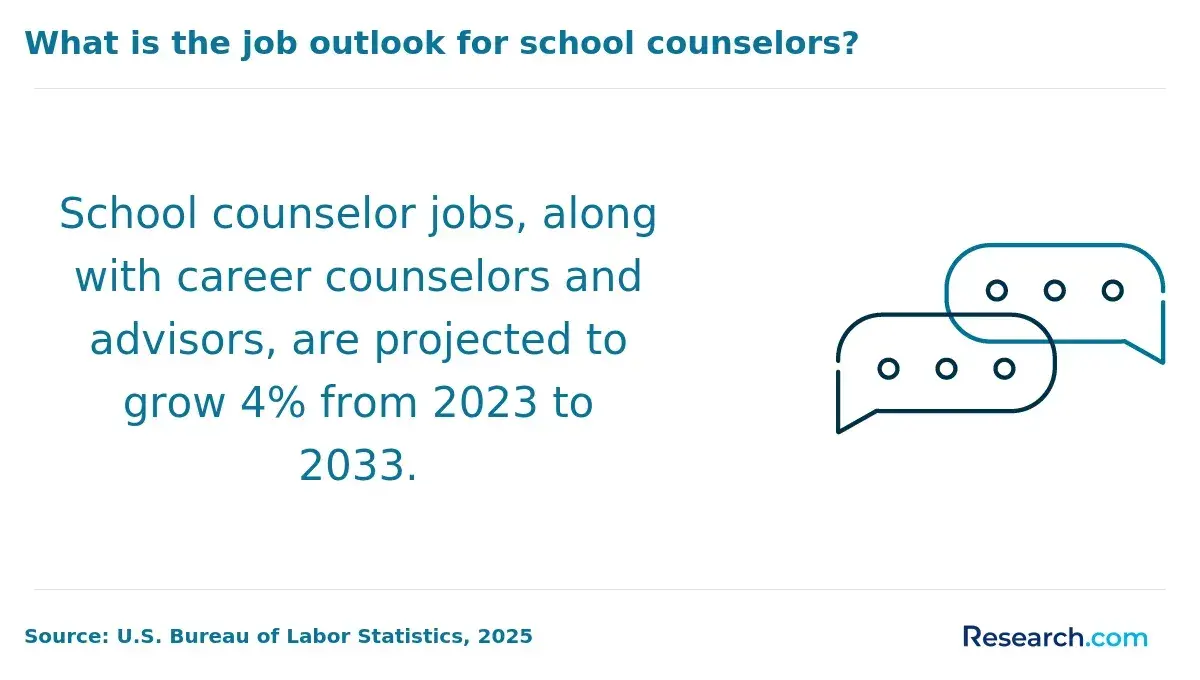
The job outlook for school counselors in Florida is described as steady, with employment growth projected at 4% from 2023 to 2033, matching national trends. Demand is shaped by student enrollment, mental health needs, academic and career readiness initiatives, and the staffing priorities of public, private, and charter schools.
Several forces support ongoing demand:
- Population growth and student enrollment: Florida’s school-age population in urban and suburban areas contributes to the need for student support professionals.
- Student mental health needs: Schools increasingly rely on counselors to help identify concerns, provide short-term support, coordinate referrals, and collaborate with families and staff.
- Academic and career readiness expectations: Counselors play a central role in graduation planning, course selection, college preparation, career exploration, and postsecondary transitions.
- Multiple school settings: Public, private, and charter schools may all hire school counselors, though requirements and compensation structures can vary.
- Moderate competition: Demand is stable, but candidates with strong internship experience, exam readiness, bilingual skills, and data-informed counseling practice may stand out.
Graduate school is a major investment, so prospective students should weigh job stability against tuition, time out of the workforce, and local hiring conditions. Research.com’s article on whether a master’s in counseling is worth it can help you think through the return-on-investment side of the decision.
What are the career advancement opportunities for school counselors in Florida?
School counseling can lead to roles beyond direct student caseloads. Advancement usually depends on experience, district leadership needs, additional graduate education, data skills, professional development, and involvement in counseling organizations.
Common advancement options include:
- Lead or head school counselor: Coordinates counseling services within a school, mentors colleagues, and helps manage caseload distribution, program planning, and student support procedures.
- District-level counseling coordinator: Oversees counseling initiatives across multiple schools and supports consistency in counseling programs, policies, and professional development.
- College and career readiness specialist: Focuses on graduation pathways, college planning, scholarship awareness, workforce preparation, and postsecondary transition advising.
- Program developer or evaluator: Designs, reviews, and improves counseling programs using student outcome data and schoolwide needs assessments.
- Professional development facilitator: Trains other counselors in areas such as ethics, crisis response, documentation, career advising, or comprehensive school counseling models.
- Mentor counselor: Supports new school counselors through induction, supervision, peer coaching, and practical guidance.
- Postsecondary academic advisor: Moves into college or university advising, student success, retention, or career services roles.
- Association leadership: Participates in advocacy, policy conversations, conferences, and professional standards through organizations such as the Florida School Counselor Association.
For counselors who want to advance without overpaying for graduate education, Research.com’s most affordable online school counseling degrees ranking can help frame cost-conscious program comparisons.
What are the key differences between school counseling certification and LPC licensure in Florida?
Florida school counseling certification and LPC licensure lead to different professional settings. School counseling certification is for professionals serving students in educational environments. LPC licensure is a clinical mental health credential that can support broader counseling practice, including settings outside K-12 schools and, when all requirements are met, private practice.
| Credential | Primary work setting | Main purpose | Key distinction |
| Florida school counseling certification | K-12 schools, especially public school systems | Supports students’ academic, career, and social-emotional development in school settings | Issued as an educator credential for school-based roles |
| LPC licensure in Florida | Clinical counseling settings, agencies, community mental health, and potential private practice | Supports diagnosis-informed counseling and broader mental health services | Requires a separate clinical licensure pathway with additional supervised clinical and examination requirements |
If your long-term goal is private practice or clinical mental health counseling rather than K-12 student support, review the LPC licensure requirements in Florida before choosing a program. Some students pursue school counseling first and later add clinical credentials, but that route can require extra coursework and supervised clinical hours.
Related Articles for Nearby States
- 2027 How to Become a School Counselor in Georgia
- 2027 How to Become a School Counselor in Alabama
- 2027 How to Become a School Counselor in South Carolina
- 2027 How to Become a School Counselor in Mississippi
- 2027 How to Become a School Counselor in Tennessee
- 2027 How to Become a School Counselor in North Carolina
- 2027 How to Become a School Counselor in Louisiana
- 2027 How to Become a School Counselor in Kentucky
- 2027 How to Become a School Counselor in Arkansas
- 2027 How to Become a School Counselor in Virginia
Common mistakes to avoid when pursuing Florida school counselor certification
Most certification delays are preventable. Before you commit to a program, make sure you understand how the degree, internship, exam, and certification review connect.
| Mistake | Why it causes problems | Better approach |
| Choosing a program without checking Florida certification alignment | A counseling degree may not automatically meet school counseling certification requirements | Ask the program to confirm how graduates qualify for Florida school counseling certification |
| Focusing only on tuition | Low tuition can be offset by poor advising, limited internship support, or extra required coursework | Compare total cost, placement support, exam preparation, completion timeline, and graduate outcomes |
| Assuming online programs always meet Florida requirements | Online coursework may be acceptable, but field placement and certification alignment still matter | Confirm Florida eligibility in writing before enrolling in an online or out-of-state program |
| Waiting too long to plan internship hours | School placements depend on district calendars, supervisor availability, and program approval | Ask about placement procedures during admissions, not after completing coursework |
| Confusing school counseling certification with LPC licensure | The credentials lead to different scopes of practice and work settings | Choose your program based on whether you want K-12 school practice, clinical practice, or both |
| Relying only on rankings | A highly ranked program may not be the best fit for your state, budget, schedule, or internship needs | Use rankings as a starting point, then verify accreditation, fieldwork, exam support, and certification outcomes |
Questions to ask before choosing a Florida school counseling program
- Does the program explicitly prepare graduates for Florida school counseling certification?
- Is the institution accredited, and is the counseling program aligned with CACREP or comparable professional standards?
- How many supervised school-based internship hours are included?
- Who arranges internship placements: the university, the student, or both?
- Does the program support placements in Florida districts if the coursework is online?
- What is the typical full-time and part-time completion timeline?
- What exam preparation support is provided for the FTCE School Counseling PK–12 Subject Area Exam?
- Are additional reading, ESOL, or educator preparation courses required for students without teaching certification?
- What are the total costs, including fees, textbooks, background checks, exam fees, and travel to internship sites?
- How do graduates perform in certification and hiring processes?
References:
- CareerHerd. (2025). Becoming a School Counselor in Florida [2025 Certification Guide]. CareerHerd
- Council for Accreditation of Counseling and Related Educational Programs. (2023). Results from a national survey of accredited programs. CACREP
- Florida Department of Education. (n.d.). Educator Certification: Certificate Pathways & Routes. Florida Department of Education
- Florida Atlantic University. (2025). School Counseling Program. Florida Atlantic University
- Florida International University. (2025). Counselor Education. Florida International University
- Online Counseling Programs with edX. (n.d.). How to Become a Counselor in Florida. Online Counseling Programs with edX
- Remnant Counselor Collective. (2025). School Counselor Licensure in Florida. Remnant Counselor Collective
- Team Simply.Coach. (2024). School Counselor Certification Requirements by State 2024. Simply.Coach
- University of Florida. (2025). School Counseling Track. University of Florida
- University of North Florida. (2025). Counselor Education in School Counseling (M.Ed.). University of North Florida
- Volusia County Schools. (n.d.). Pathways to School Counseling. Volusia County Schools
- Zippia. (2025). School counselor demographics and statistics in the US. Zippia
Key Insights
- Florida school counseling is a certified educator role. You need the Florida Educator Certificate in School Counseling to work as a school counselor in Florida public schools.
- Graduate preparation is the core requirement. Most candidates complete a master’s degree in school counseling or guidance and counseling with supervised school-based internship experience.
- The standard timeline is not instant. Full-time students typically need 2 to 2.5 years, while part-time students often need 3 or 4 years.
- Internship planning is critical. At least 600 clock hours of supervised school experience is commonly expected, and placement logistics can affect graduation and certification timing.
- Certification and LPC licensure are different decisions. Choose school counseling if you want K-12 student support; explore LPC licensure if your goal is clinical mental health counseling or private practice.
- Salary varies by district and data source. Reported Florida figures include a median salary around $66,135 and other estimates around $45,143 annually, with higher earnings tied to experience, location, and role.
- Career growth is possible. Experienced counselors can move into lead counselor, district coordinator, college and career readiness, program evaluation, training, advising, or professional association leadership roles.
- The safest next step is verification. Before enrolling, ask the program and the Florida Department of Education how the degree, internship, exams, and coursework map to current certification requirements.
Other Things You Need to Know About Becoming a School Counselor in Florida
The Florida Department of Education issues the Educator Certification credential for school counselors through its Bureau of Educator Certification. Applicants submit proof of the master’s degree, counselor preparation program, and required coursework before receiving a five-year professional certificate.
To become a school counselor in Florida, you must pass the Florida Teacher Certification Examinations (FTCE) which includes the General Knowledge Test, Professional Education Test, and the Subject Area Examination for Guidance and Counseling PK-12 by the Florida Department of Education.