
2027 Best Online Counseling Degree Programs

Co-Founder and Chief Data Scientist
As the need for mental health professionals rises for 2027, online counseling degree programs offer a flexible solution. Yet, with many options, choosing the right program can be overwhelming.
In this article, our research team simplifies the process by presenting the best online counseling degrees, outlining their features, accreditation, faculty, and career prospects. This can help aspiring counselors make informed decisions about their education and career paths.
What are the benefits of getting a Counseling degree online?
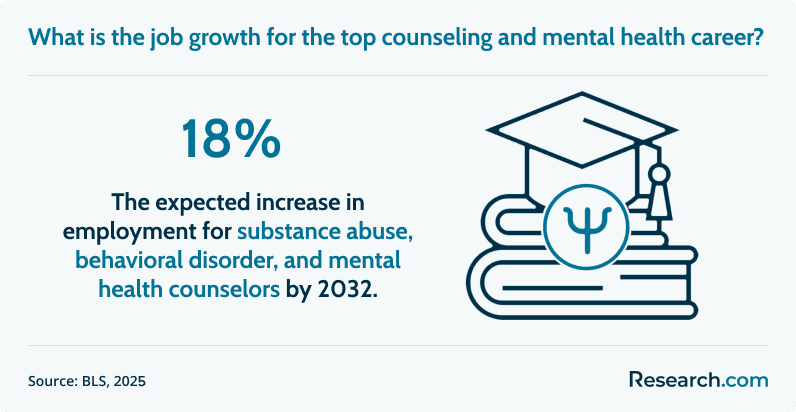
- With a projected 18% increase in employment for substance abuse, behavioral disorder, and mental health counselors by 2032, individuals holding online counseling degrees can anticipate ample career prospects in the US.
- Typically, graduates of online counseling degree programs receive median annual salaries ranging from $49,770 to $78,000.
- The flexibility of online counseling degree programs allows you to customize your training, making a meaningful impact on individuals and communities in need of support and guidance.
What can I expect from an online counseling degree program?
An online counseling degree program equips students with the skills to enact positive transformations in individuals' lives. Graduates can pursue careers as substance abuse counselors, social workers, community service managers, or probation officers. They provide support to diverse populations including children, couples, families, and those grappling with substance abuse or mental health issues.
Given the escalating prevalence of conditions like depression, anxiety, and relationship challenges intensified by the pandemic and socioeconomic factors, the demand for counselors is expected to soar. Projections indicate a 18% increase in demand for substance abuse, behavioral disorder, and mental health counselors by 2032.
Where can I work with an online counseling degree?
An online counseling degree prepares you for diverse career paths, offering opportunities in traditional counseling settings like private practice, community mental health centers, hospitals, and employee assistance programs. Additionally, you can leverage telehealth and online counseling platforms to provide virtual services, either through established companies or independently.
Specialized fields such as substance abuse counseling, career counseling, military and veteran counseling, and grief counseling offer further avenues for professional growth. With the flexibility of online education, you can tailor your training to suit your interests and goals, ultimately making a meaningful impact on individuals and communities in need of support and guidance.
How much can I make with an online counseling degree?
According to the US Bureau of Labor Statistics (BLS), substance abuse, behavior disorder, and mental health counselors earned a median annual wage of $50,730 in 2024, with an expected 45,800 occupational openings by 2034, indicating a favorable job outlook.
The American Counseling Association (ACA) reports a higher median annual income of $78,000 for counselors in private practice, though this figure may vary due to factors such as location and experience. These statistics highlight the potential for a lucrative career in counseling, with opportunities for growth and advancement, particularly in private practice settings.
- 2027 List of the Best Online Counseling Degree Programs Best Programs
- How long does it take to complete an online counseling degree? Completion Time
- How does an online counseling degree compare to an on-campus program? Online vs. On-Campus
- What is the average cost of an online counseling degree program? Program Cost
- What are the financial aid options for students enrolling in an online counseling degree program? Financial Aid
- What are the prerequisites for enrolling in an online counseling degree program? Program Prerequisites
- What courses are typically in an online counseling degree program? Program Courses
- What types of specializations are available in online counseling degree programs? What types of specializations are available in online counseling degree programs?
- How to build a professional network while earning an online counseling degree? How to build a professional network while earning an online counseling degree?
- How to choose the best online counseling degree program? How to choose the best online counseling degree program?
- What career paths are available for graduates of online counseling degree programs? What career paths are available for graduates of online counseling degree programs?
- What is the job market for graduates of online counseling degree programs? What is the job market for graduates of online counseling degree programs?
- What are the most effective study strategies for succeeding in an online counseling degree program? What are the most effective study strategies for succeeding in an online counseling degree program?
- How is technology transforming counseling practice? How is technology transforming counseling practice?
- How do online counseling degree programs build cultural competence and inclusivity? How do online counseling degree programs build cultural competence and inclusivity?
- How do licensing choices influence career outcomes and salary potential? How do licensing choices influence career outcomes and salary potential?
- How do online counseling degree programs bolster career support and job placement services? How do online counseling degree programs bolster career support and job placement services?
2026 List of the Best Online Counseling Degree Programs
If you want to work in counseling, mental health support, addiction services, or a related helping profession, an online degree can be a practical way to get started. The challenge is choosing a program that fits your goals, budget, and state licensing rules. Some online degrees are designed for direct entry into counseling-adjacent jobs, while others are better suited as preparation for graduate study and eventual licensure.
This guide breaks down the best online counseling degree programs, what they prepare you for, how much they may cost, how long they usually take, and what to check before you enroll. You’ll also find a clear comparison of program types, common admissions expectations, career paths, and the biggest mistakes students make when selecting a counseling program online.
Quick answer: Are online counseling degrees worth it?
Yes, an online counseling degree can be worth it if you need flexibility, want a lower-cost path to a counseling-related career, or are planning to continue into graduate study. The key is to match the program to your career goal. A bachelor’s degree may help you qualify for entry-level roles or prepare for a master’s program, but it usually does not lead directly to licensure as a counselor on its own. If licensure is your goal, check state rules carefully before enrolling.
How we rank schools
Our ranking approach for the best online counseling degree programs is based on publicly available data from trusted education sources and school-provided information. We review institutions that offer counseling-related online degrees and evaluate them using academic quality, affordability, enrollment indicators, and related program metrics.
Public data sources used include the following:
When comparing programs, we look at factors such as academic standing, cost, flexibility, and the relevance of the curriculum to counseling and human services careers.
Best online counseling degree programs
1. Central Michigan University
Central Michigan University offers an online BS program with a psychology major for students who want a broad foundation in human behavior. The curriculum covers human development, mental health, and core psychological concepts, which can be useful for students planning to continue into graduate school or pursue human services roles.
- Program Length: Four years
- Tracks/concentrations: Business Psychology, Mental Health
- Cost per Credit: $440
- Required Credits to Graduate: 21 to 36
- Accreditation: American Psychological Association (APA)
2. Crown College
Crown College provides an online BS in Psychology/Counseling for students who want to build skills in behavior, communication, and human services. The program also offers a pathway for students interested in a Drug and Alcohol Counseling minor or a future graduate degree.
- Program Length: Three to seven years
- Tracks/concentrations: Drug and Alcohol Counseling
- Cost per Credit: $425
- Required Credits to Graduate: 126
- Accreditation: Higher Learning Commission (HLC)
3. Toccoa Falls College
Students enrolled in Toccoa Falls College's online BS in counseling psychology study foundational counseling concepts alongside biblical perspectives on human personality and well-being. The program is designed for students seeking a faith-based approach to helping others and may appeal to those interested in ministry-related or service-oriented work.
- Program Length: Four years
- Tracks/concentrations: Counseling in Ministry, Social Work, Sport Psychology
- Cost per Credit: $350
- Required Credits to Graduate: 126
- Accreditation: Southern Association of Colleges and Schools Commission on Colleges (SACSCC)
4. Grand Canyon University
Grand Canyon University offers an online BS in counseling for students interested in working with individuals from different backgrounds and in different counseling settings. The curriculum includes clinical mental health, school counseling, addiction counseling, and a Christian counseling focus.
- Program Length: Four years
- Tracks/concentrations: Clinical Mental Health, School Counseling, Addiction Counseling, Christian Focus
- Cost per Credit: $465
- Required Credits to Graduate: 120
- Accreditation: National Addiction Studies Accreditation Commission (NASAC)
5. Faulkner University
Faulkner University offers an online BS in counseling psychology for students who want a broad introduction to mental health, counseling methods, and the study of behavior. The degree can serve as a stepping stone toward graduate study in counseling or marriage and family therapy.
- Program Length: Four years
- Tracks/concentrations: None
- Cost per Credit: $325
- Required Credits to Graduate: 121
- Accreditation: SACSCC
6. University of Cincinnati-Main Campus
Students who want to support individuals affected by addiction may consider the University of Cincinnati's online BS in substance abuse counseling. The program uses a research-based curriculum and is available full time or part time. Graduates may meet licensure requirements for addictions counseling in Ohio and some other states, depending on local regulations.
- Program Length: Four years
- Tracks/concentrations: Substance Abuse
- Cost per Credit: $566 (in-state); $581 (out-of-state)
- Required Credits to Graduate: 60 to 120
- Accreditation: HLC
7. East Central University
East Central University offers an online BA in human services counseling for students interested in family support, social services, and correctional settings. The school allows students to transfer up to 94 credits, which can shorten the time to completion. The program includes a counseling track for students aiming at entry-level counseling roles and a rehabilitation track for those interested in disability services. An in-person internship is required.
- Program Length: Two to four years
- Tracks/concentrations: Counseling, Rehabilitation
- Cost per Credit: $322 (in-state); $634 (out-of-state)
- Required Credits to Graduate: 124
- Accreditation: HLC
8. University of Massachusetts Global
Students preparing for graduate study in clinical counseling or marriage and family therapy may consider the University of Massachusetts Global's online BA in psychology. The program combines general education, psychology core courses, four specialization courses, and a psychology capstone. Topics include community issues, mental health, and aging.
- Program Length: Four years
- Tracks/concentrations: Clinical Counseling, Marriage and Family Therapy
- Cost per Credit: $500
- Required Credits to Graduate: 120
- Accreditation: Western Association of Schools and Colleges Senior Colleges and University Commission (WSCUC)
9. Oral Roberts University
Oral Roberts University offers a fully online BA in Christian Caregiving and Counseling for students preparing for ministry-based helping roles. The program focuses on pastoral care, helping skills, crisis intervention, developmental psychology, and Christian leadership, and it can prepare graduates for lay counseling roles in churches and related organizations.
- Program Length: Three to four years
- Tracks/concentrations: Issues and Identity of the Caregiver, Pastoral Approaches to Counseling, Developing Helping Skills, Crisis Intervention, Developmental Psychology, Christian Leadership
- Cost per Credit: $450
- Required Credits to Graduate: 124
- Accreditation: HLC
10. University of Mary
The University of Mary's online BS in addiction counseling is designed for students who want to understand addictive behavior and support vulnerable populations. The curriculum covers prevention, treatment planning, and the dynamics of addiction. The program may support licensure in North Dakota after graduation, but licensing rules vary by state, so students should confirm requirements where they plan to practice.
- Program Length: Two to four years
- Tracks/concentrations: Addiction Prevention
- Cost per Credit: $480
- Required Credits to Graduate: 124
- Accreditation: Council for Accreditation of Counseling and Related Educational Programs (CACREP)
What online counseling graduates say about the experience
- Gemma: "Balancing full-time work and a counseling degree once felt unrealistic. Online study made it manageable because I could fit classes around my schedule. I still built real relationships with classmates and instructors, and that support helped me move into school counseling. Today I use those skills every day to support students."
- Mark: "As a single parent, on-campus classes did not feel possible. The online format let me attend lectures and discussions after bedtime routines, and I connected with other students who understood the same challenges. The program also reminded me that caring for myself was part of becoming a better counselor. That mindset has stayed with me in private practice."
- Trisha: "I worried that online learning would feel impersonal, but it was more interactive than I expected. Video discussions and forums helped me connect with professors and classmates in meaningful ways. It also strengthened my communication and technology skills, which are important in my current online therapy work."
Key findings about online counseling degree programs
Online counseling degrees are flexible, but they are not all the same. Some are built for broad preparation in psychology or human services, while others focus more narrowly on addiction, school support, or faith-based counseling. The right choice depends on whether you want a job after the bachelor’s degree, a path to graduate school, or preparation for a specific helping role.
Here are the biggest takeaways from the programs above:
- Program costs vary widely, even among schools with similar degrees.
- Transfer credit policies can make a major difference in completion time.
- Accreditation matters for aid, transfer, and future licensure planning.
- Some programs are better for graduate school preparation than direct job entry.
- State licensing rules matter more than program marketing language.
How long does it take to complete an online counseling degree?
An online bachelor’s degree in counseling usually takes two to four years for full-time students. If you study part time, transfer credits in, or need to complete prerequisites first, the timeline can stretch longer. Some students need as long as seven years, especially when balancing school with work or family responsibilities.
Completion time depends on several factors:
- Whether you study full time or part time
- How many transfer credits the school accepts
- Whether you enter with completed prerequisites
- How often the program offers courses
- Whether an internship or practicum is required
If speed matters, compare transfer policies and course scheduling before enrolling. A program with a lower sticker price may still take longer to finish if course access is limited.
How does an online counseling degree compare with an on-campus program?
In many cases, the academic content is similar. Students may cover the same core topics, complete similar assignments, and study with the same faculty standards. The biggest difference is format: online programs offer more flexibility, while campus-based programs usually provide more face-to-face interaction and easier access to in-person networking.
Online learning tends to work best for adults who need to keep working, parents with busy schedules, and students who live far from a campus. On-campus study may be better for those who want a more structured environment or expect to rely heavily on in-person peer support.
| Factor | Online program | On-campus program |
| Schedule | More flexible; often better for working adults | Fixed class times and on-site attendance |
| Networking | Built through virtual discussion, internships, and alumni tools | Usually easier through daily campus interaction |
| Convenience | No commute for most coursework | Requires travel to campus |
| Hands-on training | May rely on local placements, simulations, or hybrid requirements | Often easier to coordinate on site |
| Best for | Career changers, working students, distance learners | Students who prefer in-person learning |
What is the average cost of an online counseling degree?
According to the National Center for Education Statistics (NCES), annual tuition for online undergraduate study at public and private institutions can differ substantially. Costs also change based on whether a school charges in-state rates, program fees, or differential tuition for online students.
Beyond tuition, students should budget for technology fees, course materials, and any required travel for internships or in-person intensives. Some online programs reduce transportation costs, but others still include mandatory field placements or lab-like fees.
| Online Learning | On-campus Learning | |
| Public | $10,000 | $9,400 |
| Private non-profit | $15,000 | $18,300 |
| Private for-profit | $17,000 | $37,000 |
Source: NCES, 2024
What financial aid can help pay for an online counseling degree?
Several forms of aid may lower the cost of an online counseling degree. Start with FAFSA, then check whether the school offers institutional aid or whether your state has additional grant programs.
Federal aid
- Free Application for Federal Student Aid (FAFSA). This is the first step for federal grants and loans.
- Pell Grant. This need-based aid is available to eligible undergraduate students with significant financial need.
- Federal Direct Loans. These include subsidized and unsubsidized options, depending on eligibility.
State and school-based aid
- State grants. Many states offer their own aid programs through higher education agencies.
- Institutional scholarships. Colleges may offer scholarships for online students, not just campus students.
- Work-study. Some students can earn funds through approved part-time work.
Professional scholarships
- ACA. The American Counseling Association offers scholarships in some cases based on merit, need, or counseling focus.
- National Board for Certified Counselors (NBCC). NBCC offers scholarship support for counselor education and professional development.
- Mental health organizations. Other counseling-related associations may also offer awards or grants.
What are the admissions requirements for an online counseling degree?
Admissions requirements vary by school, but most bachelor’s-level programs ask for standard academic records and a basic application package. Competitive programs may also look for evidence that you understand the counseling field and can handle the demands of online study.
- Application. You will usually need to submit a formal application through the school’s admissions system.
- Test scores. Some schools still request ACT or SAT scores, though policies vary. Note that the original text lists a minimum ACT score of 2.8 or SAT score of 1200, which appears inconsistent with standard test formats, so students should verify the school’s current admissions policy directly.
- Official transcripts. Schools usually review high school and prior college records to evaluate academic readiness and transfer credit and course codes.
- Letters of recommendation. Many programs ask for two to three letters.
- Essays. Some schools require one or more essays about your goals, experience, and interest in counseling.
Strong counseling students also tend to bring personal qualities that support client work and professional growth:
- Empathy. Helps build trust and understand clients’ experiences.
- Interpersonal skills. Important for long-term helping relationships.
- Communication. Critical for listening, interviewing, and explaining support clearly.
- Critical thinking. Helps evaluate problems and choose appropriate approaches.
- Open-mindedness. Supports respectful work with people from different backgrounds.
What courses are usually included in an online counseling degree?
Most undergraduate counseling programs cover the theory and practice of helping relationships, along with the psychology behind human behavior. Course names vary by school, but the subjects below are common in online bachelor’s programs:
- Introduction to Counseling. Covers counseling history, ethics, theory, and licensure basics.
- Methods of Counseling. Focuses on core helping techniques and the structure of counseling sessions.
- Crisis Intervention. Introduces short-term response models and tools for supporting people in acute distress.
- General Psychology. Explores human behavior, development, neuroscience, and psychopathology.
Course selection depends on the school and concentration, so it is smart to review the catalog before enrolling. If you are comparing related paths, you may also want to look at child psychology and other behavioral science options that can support future counseling study.
What specializations can you choose in online counseling degree programs?
Specialization matters because it can shape the jobs you qualify for later and the graduate programs that make sense for you. Some online counseling degrees offer broad preparation, while others focus on a specific population or service setting.
- Clinical Mental Health Counseling. Prepares you to support individuals and families facing anxiety, depression, trauma, and related concerns.
- Addiction Counseling. Focuses on substance use, relapse prevention, family impact, and recovery support. A degree in substance abuse counseling is especially relevant if you want to work in treatment or recovery settings.
- School Counseling. Centers on student academic, social, and emotional support.
- Marriage and Family Therapy. Emphasizes relationship systems, couples work, and family dynamics.
- Career Counseling. Trains you to help clients with education and career planning, job search support, and transitions.
Some programs also offer niche options such as:
- Military and Veteran Counseling. Supports service members, veterans, and families.
- Grief Counseling. Focuses on loss and bereavement support.
- LGBTQ+ Counseling. Addresses identity, community, and mental health needs in LGBTQ+ populations.
- Trauma Counseling. Emphasizes evidence-based support for people affected by trauma.
How can you network while studying online?
One drawback of online learning is that networking does not happen automatically. You have to be intentional. The good news is that online students can still build strong connections through classes, fieldwork, faculty, and professional organizations.
- Participate actively in discussions. Thoughtful posts and replies can help professors and classmates remember you.
- Attend virtual events. Webinars and online conferences from groups like the American Counseling Association can help you meet professionals and stay current.
- Use internships and practicums strategically. These are some of the best places to develop references and job leads.
- Join professional organizations. Groups such as the ACA, the National Board for Certified Counselors (NBCC), or the National Association of Social Workers (NASW) can support your career development.
- Build relationships with faculty. Professors can become mentors, references, or guides for graduate study.
- Keep your LinkedIn profile updated. Make it easy for employers and alumni to see your background and goals.
If your priority is speed, some students look for the fastest way to become a counselor through accelerated study paths, but you should compare time savings against field placement and licensure requirements.
Are online counseling degrees a good choice for career changers?
Yes, especially if you already work full time or have family responsibilities. Online programs are often a better fit for career changers than traditional campus schedules because they make it easier to keep earning while you study.
For students returning to school after time away, transfer credit can significantly reduce completion time. Some programs also offer lower-cost or more specialized options, such as a cheap bachelor's degree in substance abuse counseling online, which may be appealing if you are trying to change careers without taking on unnecessary debt.
Career changers should think carefully about the end goal. If you want immediate entry into a counseling-adjacent role, choose a program aligned with human services or addiction support. If you plan to become a licensed counselor later, make sure the bachelor’s program leads cleanly into an accredited graduate path.
How to choose the best online counseling degree program
The best program is not always the cheapest or the most recognizable. It is the one that fits your licensure path, your schedule, and the type of work you want to do after graduation. Before enrolling, compare each school using the factors below.
1. Accreditation
Accreditation affects transferability, financial aid, and employer confidence. Look for recognized institutional accreditation such as HLC, SACSCC, or WSCUC, and check whether the counseling program itself has a specialized credential such as CACREP or APA when relevant to your goals.
2. Field experience
Hands-on training matters in counseling-related education. Practicum or internship requirements can help you apply what you learn, but they can also affect scheduling and completion time. If a program requires fieldwork, ask where placements happen and whether you must secure them yourself.
3. Licensure alignment
If licensure is part of your plan, the curriculum must line up with your state’s rules. Do not assume every “counseling” degree leads to the same outcome. Ask whether the program prepares students for licensure, which license it supports, and in which states that pathway is most relevant.
4. Cost and total value
Look at the full cost, not just tuition. Add fees, books, technology, travel, and possible lost income if the schedule is difficult to manage. A more expensive program can still be a better value if it offers stronger transfer credit policies, better advising, or licensure alignment.
5. Flexibility and support
Check whether courses are asynchronous, whether part-time enrollment is allowed, and how much academic support is available. Students who work or care for family members often need more than just flexible class times; they also need responsive advising and clear degree planning.
| What to compare | Why it matters | What to ask |
| Accreditation | Impacts aid, transfer, and credibility | Is the school and program properly accredited for my goals? |
| Fieldwork | Affects practical experience and licensure planning | Are practicum or internship placements built in? |
| Transfer credit policy | Can shorten time to degree | How many previous credits will count? |
| Licensure alignment | Determines whether the degree supports your career plan | Does this program meet requirements in my state? |
| Total cost | Influences debt and return on investment | What will I pay after tuition, fees, and travel? |
Can genetic counseling complement an online counseling career?
Genetic counseling is a separate specialty, but it can complement counseling work in settings where family history, hereditary risk, and mental health concerns overlap. Counselors who understand the basics of genetic counseling may be better prepared to support clients facing inherited health concerns, complex family decisions, or long-term stress connected to medical information.
Students interested in that overlap may want to explore genetic counseling programs if they are considering a more specialized, science-heavy path.
What careers can you pursue after an online counseling degree?
Many graduates use an online counseling degree as a launch point into human services, behavioral health, or graduate study. The exact role you can pursue depends on the degree level, state rules, and whether you continue to a master’s program.
| Career path | Typical work | Notes |
| Substance Abuse, Behavioral Disorder, and Mental Health Counselors | Provide individual and group support, assess needs, and help create treatment plans | Usually requires graduate study and state licensure for independent practice |
| Marriage and Family Therapists | Work with couples and families to improve communication and resolve conflict | Licensure requirements are state-specific |
| Community Social or Health Workers | Connect people with services, education, and community resources | An online bachelor’s degree in social work can also be relevant here |
| Clinical and Counseling Psychologists | Assess mental health needs and provide therapy | Requires advanced graduate education |
| Psychiatric Technicians and Aides | Assist mental health professionals with patient care and monitoring | Often an entry point into behavioral health settings |
The median annual wages for these counseling and mental health professions vary significantly. Substance abuse, behavioral disorder, and mental health counselors earn around $49,710, while marriage and family therapists typically make $56,570 annually. Community health workers earn approximately $46,190, while clinical and counseling psychologists have a median income of $90,130 per year.
Psychiatric technicians and aides earn a median salary of $37,330 annually. These figures show that pay can differ a great deal depending on the role, education level, and setting.
What is the job outlook for counseling graduates?
Overall, the outlook is favorable for many counseling-related roles, especially those tied to mental health and substance use services. Demand continues to be supported by increased awareness of mental health needs, broader acceptance of telehealth, and the need for services in schools, clinics, hospitals, and community organizations.
According to the referenced labor data, substance abuse, behavioral disorder, and mental health counselors are projected to grow by 18% by 2032. Marriage and family therapists are expected to grow by 15%, community health workers by 14%, and clinical and counseling psychologists by 11%. Psychiatric technicians and aides are projected to grow by 9%.
Those numbers point to solid opportunities, but competition still depends on location, degree level, licensing, and clinical experience.
What skills do employers want in online counseling graduates?
Employers want more than subject knowledge. They want graduates who can communicate clearly, show empathy, work ethically, and use digital tools confidently. In online and hybrid settings, this often includes comfort with telehealth software, electronic records, secure communication systems, and virtual client engagement.
- Clear verbal and written communication
- Active listening and rapport-building
- Ethical judgment and confidentiality awareness
- Crisis response and de-escalation awareness
- Adaptability in online and hybrid environments
- Basic technology skills for telehealth and case management tools
If you want to continue your education later, programs such as affordable online master's in counseling programs can strengthen your preparation for licensure-track careers.
How can students succeed in an online counseling degree program?
Online study gives you flexibility, but it also requires strong time management and self-discipline. Students who do best usually build a routine early and treat school like a real commitment, not a flexible extra.
- Set a weekly study routine. Protect specific times for reading, assignments, and discussion posts.
- Use one organized workspace. A quiet area with stable internet and the right materials reduces distractions.
- Track deadlines carefully. Digital calendars and task apps can prevent missed due dates.
- Participate in class discussions. This helps with engagement and relationship-building.
- Use recordings and learning tools. Rewatch lectures or review multimedia content when topics are difficult.
- Ask for help early. Faculty and advisors can often solve problems before they become major setbacks.
What other academic paths can support a counseling career?
Some students use related degrees to build a more specialized practice later. For example, art therapy masters programs may appeal to people who want to combine counseling with creative expression. Other students may choose psychology, social work, or marriage and family therapy paths depending on the client groups they want to serve.
What challenges are unique to online counseling degrees?
Online counseling degrees can be a great fit, but they also come with trade-offs. Students may have fewer spontaneous networking opportunities, less immediate access to in-person labs or practica, and more responsibility for managing technology and deadlines on their own.
Some programs address these issues through live sessions, virtual simulations, local field placements, and structured advising. Before you apply, ask how the school handles practicum placement, technical support, and faculty access. If you are looking for a faster route into a licensed role, review how to become a licensed therapist online and compare it with your state’s requirements.
How can you evaluate whether an online counseling degree is cost-effective?
Cost-effectiveness is about more than tuition alone. A degree is more likely to be worth the investment if it helps you reach a realistic career goal, if the program is accredited, and if it reduces the time or cost of a later graduate degree.
To assess value, compare tuition, fees, transfer credit policies, fieldwork requirements, financial aid, and likely next steps after graduation. A lower-price degree may still be expensive if it does not support licensure or further study. Likewise, a higher-price program may offer better support and a clearer career path.
Some students compare options such as the cheapest online MFT program to identify a path that balances budget with long-term goals.
How is technology changing counseling practice?
Technology has become part of counseling practice, not just online education. Teletherapy, digital intake tools, electronic notes, and secure client platforms are now common in many settings. For students, that means counseling education increasingly needs to prepare them for both interpersonal work and digital tools.
Telehealth has expanded access for clients in rural areas, people with transportation barriers, and those who need more scheduling flexibility. At the same time, it raises new responsibilities around privacy, informed consent, and maintaining therapeutic rapport through a screen.
Digital tools also help counselors track progress, collect assessments, and manage administrative work more efficiently. Some AI-enabled systems may support scheduling or documentation, but they do not replace clinical judgment. Students who want to work in modern behavioral health settings should be comfortable using technology responsibly and ethically.
If you are interested in counseling paths that address relationship systems and family dynamics, you may also want to explore online MFT programs.
How do online counseling programs support cultural competence and inclusion?
Good counseling programs train students to work across differences in culture, language, identity, religion, family structure, and access to care. That training often appears in multicultural counseling coursework, ethics training, and case-based learning.
Students should look for programs that teach respectful communication, bias awareness, and practical strategies for serving diverse communities. Programs with strong field placements or community partnerships may also offer more useful exposure than classroom work alone. Students interested in substance use care can review the most affordable online substance abuse counseling programs to compare specialized training options.
How do licensure choices affect career outcomes and salary potential?
Licensure shapes what you can do, where you can work, and how much responsibility you can take on. Two students can earn similar degrees and end up with very different career options depending on whether they pursue counseling, social work, marriage and family therapy, or another license path.
Before choosing a degree, map the likely licensure route. Ask whether the program is designed to lead into a master’s degree, whether that master’s program meets state requirements, and how many supervised hours will be needed later. If you want to compare outcomes, resources like LCSW vs LPC salary can help you understand how licensure choices may influence future earnings and scope of practice.
What career support services should you look for?
Strong career support can make an online degree much more useful. The best programs do more than deliver coursework; they help students move toward internships, jobs, licensure planning, and graduate study.
Look for schools that offer resume help, interview practice, internship guidance, alumni connections, career fairs, and one-on-one advising. These supports matter most when you are trying to enter a competitive field with clear licensing or graduate-school requirements.
If salary growth is one of your goals, it is also worth reviewing guidance such as how to make a lot of money as a therapist so you can understand how specialization, education level, and setting may affect earnings over time.
Common mistakes to avoid when choosing an online counseling degree
- Choosing a program without checking accreditation. This can create problems with aid, transfer, or licensure planning.
- Assuming every counseling degree leads to licensure. Many bachelor’s programs are preparatory, not licensure-qualifying.
- Ignoring internship and practicum requirements. Fieldwork can affect where and how you complete the degree.
- Focusing only on tuition. Total cost includes fees, books, technology, and travel.
- Overlooking state rules. Licensing requirements differ from state to state.
- Relying only on rankings. A highly ranked school may still be a poor fit for your schedule or career path.
Questions to ask before you enroll
- Does this degree match the job I want after graduation?
- Will it prepare me for graduate study or licensure later?
- Is the school accredited in a way that supports my goals?
- How many transfer credits will the school accept?
- Are internships built into the program, and how are placements arranged?
- What are the total costs after fees and materials?
- What career support does the school offer?
- How do graduates usually use this degree?
References
- ACA. (n.d.). American Counseling Association | A professional home for counselors. ACA
- BLS. (2025). Occupational Outlook Handbook: Substance Abuse, Behavioral Disorder, and Mental Health Counselors. BLS
- Marquette University. (2025). Why clinical mental health counseling is one of the fastest-growing careers in America. Marquette University Online
- NCES. (2024). Price of Attending an Undergraduate Institution. Condition of Education. U.S. Department of Education, Institute of Education Sciences. NCES
- Social Work License Map. (2026). Counseling Licensure and Certification Requirements. Social Work License Map
- U.S. News & World Report. (2026). Online counseling master’s degree. U.S. News & World Report
Key Insights
- Online counseling degrees are most valuable when they align with a clear next step, such as graduate school, an entry-level human services role, or a specialization like addiction support.
- Accreditation is not optional if you care about financial aid, transfer credit, or future licensure planning.
- Cost should be judged by total value, not tuition alone, because fieldwork, fees, and completion time can change the real price.
- State licensing rules matter more than program labels, so always verify whether a degree actually supports your intended career path.
- Online programs can work well for career changers, working adults, and parents, but success depends on discipline, planning, and strong support systems.
- The best program for you is the one that balances flexibility, field experience, affordability, and long-term career outcomes.
Other Things You Should Know About Online Counseling Degree Programs
In 2027, leading online counseling degree programs offer diverse practicum and internship opportunities, including placements in community mental health centers, schools, and private practices. These experiences are designed to provide hands-on training to meet state licensure requirements, offering students a comprehensive understanding of real-world counseling work.
Look for regional institutional accreditation and, for counseling, programmatic accreditation from the Council for Accreditation of Counseling and Related Educational Programs, or CACREP. CACREP standards are widely used for licensure preparation and may affect eligibility for supervised practice and state licensing requirements after graduation.
Graduates of top online counseling degree programs in 2027 can pursue careers as licensed professional counselors, school counselors, or marriage and family therapists. Some may also find roles in academic advising, substance abuse counseling, or mental health advocacy within various organizations.
The counseling program integrates supervised counseling sessions by providing students with hands-on experience under the guidance of experienced professionals. These sessions offer a structured environment for students to apply theoretical knowledge, develop counseling skills, and gain practical insights into real-world client interactions. Through direct observation, feedback, and mentorship, students learn to navigate various counseling scenarios, build rapport with clients, and apply appropriate therapeutic techniques. This experiential learning approach not only enhances students' clinical competence but also fosters confidence and readiness to address diverse client needs in professional counseling settings.
Admission requirements often include a bachelor's degree, a minimum GPA of 3.0, and letters of recommendation. Some programs may also require GRE scores and a statement of purpose to assess applicants' readiness for graduate-level counseling studies in 2027.


