
2027 Best Online Master’s in School Counseling Degree Programs

Co-Founder and Chief Data Scientist
Choosing an online master’s in school counseling is usually a licensure decision as much as an education decision. The right program can prepare you to support students’ academic planning, college and career readiness, mental health needs, and social-emotional development. The wrong program can leave you short of state certification requirements, fieldwork hours, or employer expectations.
The need for qualified school counselors remains significant. Across the United States, schools serve over 49 million students with only 131,230 school counselors, leaving many districts far from the American School Counselor Association’s recommended 250-to-1 student-to-counselor ratio. For working adults, teachers, career changers, and education professionals, online programs can make graduate training more accessible while still requiring supervised in-school practice.
This guide explains what to expect from an online master’s in school counseling, how online and campus programs compare, what they cost, how licensure works, which programs stand out for 2027, and how to choose a degree that fits your state, budget, schedule, and long-term career goals.
Quick Answer: Is an Online Master’s in School Counseling Worth It?
An online master’s in school counseling can be worth it if the program is properly accredited, aligns with your state’s school counselor licensure or certification rules, includes approved practicum and internship placements, and fits your financial situation. Graduates commonly pursue roles in K-12 schools, college advising, student affairs, career counseling, community agencies, and related counseling support roles.
| Best fit | Use caution if | Before enrolling, confirm |
| You want to become a licensed or certified school counselor and need a flexible graduate program. | You assume any online counseling degree automatically qualifies you for licensure in your state. | State approval, CACREP or relevant accreditation, fieldwork requirements, and internship placement support. |
| You already work in education and need a part-time or online format. | You cannot complete in-person practicum or internship hours in a school setting. | Whether the school helps arrange local placements and whether your state accepts them. |
| You want a counseling-focused education career with strong student-facing responsibilities. | You want private clinical practice immediately after graduation without checking additional licensing requirements. | Whether the curriculum is school counseling, clinical mental health counseling, or a dual-track option. |
What are the benefits of getting an online Master’s in School Counseling degree?
- Career access in education settings: Graduates may work in public schools, private schools, colleges, universities, technical institutes, advising offices, and student support programs. Some experienced professionals may later move into leadership roles, including counseling center administration.
- Relevant counseling and student-support skills: Programs build skills in academic planning, crisis response, career readiness, group counseling, family collaboration, equity-focused student support, and data-informed school counseling programs.
- Flexible graduate study: Online coursework can help working adults complete a master’s degree without relocating. Most programs still require in-person school-based fieldwork, but lectures and assignments may be completed remotely.
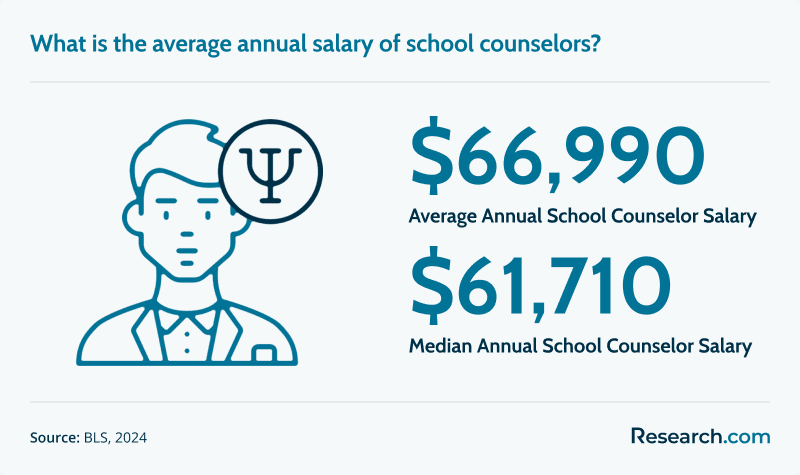
- Salary potential: The median annual salary of school counselors in the U.S. is $60,733.
- Broader career mobility: Counseling training can also support careers in academic advising, admissions, career development, youth services, community mental health organizations, and student affairs.
What can I expect from an online Master’s in School Counseling degree?
An online master’s in school counseling prepares graduate students to help learners succeed academically, socially, emotionally, and developmentally in P-12 or K-12 school environments. Although coursework is delivered online, the degree is not purely virtual: students usually complete supervised practicum and internship hours in approved school settings.
Most programs combine counseling theory with school-based application. Students learn how to run individual sessions, lead small groups, collaborate with teachers and families, interpret student data, develop prevention programs, and guide students through college and career planning.
- College and career readiness
- Restorative justice
- Trauma-informed practices
- Ethical and legal issues in school counseling
- Individual and group counseling methods
- Human development and student assessment
Many programs are designed around American School Counselor Association standards and may also hold Council for Accreditation of Counseling and Related Educational Programs (CACREP) accreditation. CACREP is especially important because some states, districts, and employers use it as a marker of curriculum quality and licensure preparation. Still, accreditation alone is not enough. You should verify that the program meets the school counselor requirements in the state where you plan to work.
Where can I work with an online Master’s in School Counseling degree?
Most graduates use this degree to pursue school counselor roles in elementary, middle, and high schools. Depending on state rules and employer requirements, graduates may also work in college access programs, academic advising, student affairs, career services, youth-serving nonprofits, community agencies, and related education support roles.
The U.S. Bureau of Labor Statistics projects a 4% job growth for school counselors through 2033, reflecting ongoing needs in academic planning, student development, and career readiness. District demand may vary by region, school funding, student enrollment, and local staffing shortages.
| Work setting | Typical focus | Important requirement to check |
| Public K-12 schools | Academic support, crisis response, career readiness, attendance, family collaboration, and schoolwide programs. | State school counselor certification or licensure. |
| Private schools | Student guidance, college planning, social-emotional support, and parent communication. | Employer requirements, which may differ from public school rules. |
| Colleges and universities | Advising, career development, student support, admissions, and campus counseling support roles. | Whether the role requires counseling licensure, advising experience, or student affairs training. |
| Community and nonprofit agencies | Youth support, prevention programs, family services, and referral coordination. | Whether clinical licensure or additional supervised experience is required. |
How much can I make with an online Master’s in School Counseling degree?
The median annual salary of school counselors in the U.S. is $60,733. Actual pay depends on the school system, state salary schedule, union contract, years of experience, local cost of living, credentials, and whether the role is in K-12 education, higher education, or a community organization.
- Location: Salaries differ by state and district. For example, in California, the median salary is $59,618, while in Washington, it is $68,419.
- Experience and role level: More experienced counselors may qualify for higher pay bands, lead counselor positions, department leadership, or district-level student support roles.
- Education and certifications: Some employers reward additional credentials. Certifications from organizations such as the National Board for Certified Counselors (NBCC) and the National Board for Professional Teaching Standards (NBPTS) may support professional growth, depending on the employer and state.
- Contract structure: School counselors may be paid on educator salary schedules, administrative schedules, or higher education staff schedules, which can affect annual compensation.
- Best Online Master’s in School Counseling Degree Programs for 2027
- How long does an online Master’s in School Counseling take?
- Online vs. on-campus Master’s in School Counseling programs
- Average cost of an online Master’s in School Counseling
- Financial aid options for online school counseling students
- Admission prerequisites for online school counseling master’s programs
- How to obtain licensure after an online Master’s in School Counseling
- How hands-on training works in online school counseling programs
- Challenges of online Master’s in School Counseling programs
- Using a school counseling master’s as a foundation for doctoral study
- How substance abuse counseling training can help school counselors
- Common courses in an online Master’s in School Counseling
- Specializations in online school counseling master’s programs
- Emerging trends in online school counseling curricula
- How programs address diversity, equity, and inclusion
- How to verify legitimacy and accreditation
- Return on investment for an online Master’s in School Counseling
- Student support and networking in online programs
- How to choose the best online Master’s in School Counseling
- Career paths for online Master’s in School Counseling graduates
- Student outcomes to review before enrolling
- Job market for online Master’s in School Counseling graduates
List of the Best Online Master’s in School Counseling Degree Programs for 2027
How do we rank schools?
A graduate counseling degree requires a substantial investment of time, money, and supervised practice. To help prospective students compare options, Research.com evaluates online master’s in school counseling programs using transparent education data and program-level factors.
Our ranking process uses current and comprehensive U.S. government and education databases, including:
- The Integrated Postsecondary Education Data System (IPEDS) database
- Peterson’s database, including the Distance Learning Licensed Data Set
- College Scorecard database
- National Center for Education Statistics
Research.com also weighs factors such as graduation rate, student-faculty ratio, and program focus. More details are available on our methodology page.
Program comparison
| Rank | School | Program format and focus | Credits | Cost per credit | Accreditation |
| 1 | Bradley University | Online Master of Arts in Counseling with a Professional School Counseling focus. | 60 credits | $1,039/credit | CACREP |
| 2 | Concordia University Chicago | Online Master of Arts in School Counseling with online, hybrid, and in-person learning components. | 48 credits | $505/credit | CACREP |
| 3 | Concordia University Irvine | Master of Arts in Education with a School Counseling concentration, available in blended or fully online formats. | 48 credits | $685/credit | CACREP |
| 4 | Concordia University-Nebraska | Fully online Master of Arts in School Counseling with eight-week courses and school-based field experiences. | 50 to 62 credits | $450/credit | Nebraska Department of Education and the National Council for Accreditation of Teacher Education |
| 5 | Lehigh University | Hybrid Master of Education in International School Counseling for professionals in international schools. | 48 credits | $630/credit | Middle States Commission on Higher Education |
| 6 | Our Lady of the Lake University | Fully online Master of Arts in Counseling with a School Counseling specialization. | 60 credits | $991/credit | Southern Association of Colleges and Schools (SACSCOC) |
| 7 | Salem College | Online Master of Education in School Counseling with internships and two weekend residencies. | 48 credits | $525/credit | Council for Accreditation of Education Preparation Standards and the North Carolina Professional Teaching Standards |
| 8 | University of Southern California | Interactive online Master of Education in School Counseling aligned with the ASCA National Model. | 49 credits | $2,354/credit | CACREP |
| 9 | University of the Cumberlands | Online Master of Arts in Education with a School Counseling concentration for licensed educators. | 45 credits | $315/credit | CACREP |
| 10 | Wake Forest University | Part-time online Master of Arts in Counseling with a School Counseling concentration. | 60 credits | $1,700/credit | CACREP |
1. Bradley University
Bradley University, based in Peoria, Illinois, offers an online Master of Arts in Counseling with a Professional School Counseling emphasis. The CACREP-accredited curriculum prepares students for school counseling responsibilities and includes specialized exposure to neuro counseling.
- Program Length: 2 years
- Tracks/concentrations: Professional School Counseling
- Cost per Credit: $1,039/credit
- Required Credits to Graduate: 60 credits
- Accreditation: CACREP
2. Concordia University-Chicago
Concordia University Chicago in River Forest, Illinois, offers a Master of Arts in School Counseling that combines online, hybrid, and in-person coursework. The program is designed for future counselors serving elementary, middle, and high school students and follows the American School Counselor Association framework.
- Program Length: 3 years or less
- Tracks/concentrations: Track One: Program requirements for individuals possessing a valid Illinois Educator’s License (PEL); Track Two: Program Requirements for individuals without a valid Illinois PEL
- Cost per Credit: $505/credit
- Required Credits to Graduate: 48 credits
- Accreditation: CACREP
3. Concordia University-Irvine
Concordia University Irvine in Irvine, California, offers a Master of Arts in Education with a School Counseling concentration. Students can choose a blended or fully online format and may follow either an accelerated or traditional pace. The cohort model supports preparation for counseling positions in public and private K-12 schools.
- Program Length: 26 months
- Tracks/concentrations: School Counseling
- Cost per Credit: $685/credit
- Required Credits to Graduate: 48 credits
- Accreditation: CACREP
4. Concordia University-Nebraska
Concordia University-Nebraska in Seward, Nebraska, offers a fully online Master of Arts in School Counseling. Courses run in eight-week sessions, and students complete school-based observation, a 100-hour practicum, and 450 hours of supervised internships.
- Program Length: Varies
- Tracks/concentrations: School Counseling
- Cost per Credit: $450/credit
- Required Credits to Graduate: 50 to 62 credits
- Accreditation: Nebraska Department of Education and the National Council for Accreditation of Teacher Education
5. Lehigh University
Lehigh University in Bethlehem, Pennsylvania, offers a hybrid Master of Education in International School Counseling. The program is built for professionals working in international schools and includes global counseling perspectives, at least 100 hours of fieldwork, two internships at a school outside the United States, and a capstone portfolio.
- Program Length: 2.5 years
- Tracks/concentrations: International School Counseling
- Cost per Credit: $630/credit
- Required Credits to Graduate: 48 credits
- Accreditation: Middle States Commission on Higher Education
6. Our Lady of the Lake University
Our Lady of the Lake University in San Antonio offers a fully online Master of Arts in Counseling with a School Counseling specialization. The curriculum covers counseling program models, collaboration in schools, curriculum development, planning and evaluation, and academic intervention strategies. Students complete 60 credits, 100 practicum hours, and 600 internship hours.
- Program Length: 11-38 months
- Tracks/concentrations: School Counseling
- Cost per Credit: $991/credit
- Required Credits to Graduate: 60 credits
- Accreditation: Southern Association of Colleges and Schools (SACSCOC)
7. Salem College
Salem College in Winston-Salem, North Carolina, offers an online Master of Education in School Counseling for students preparing for school counseling licensure. The cohort-based program begins in the fall, includes online coursework and internship experiences, and requires two weekend campus residencies.
- Program Length: 34 months
- Tracks/concentrations: School Counseling
- Cost per Credit: $525/credit
- Required Credits to Graduate: 48 credits
- Accreditation: Council for Accreditation of Education Preparation Standards and the North Carolina Professional Teaching Standards
8. University of Southern California
The University of Southern California in Los Angeles offers an interactive online Master of Education in School Counseling. The curriculum follows the American School Counselor Association’s National Model and integrates counselor education, community psychology, and philosophy. Graduates may qualify for recommendation for the California Commission on Teacher Credentialing Pupil Personnel Services: School Counseling (PPS-SC) Credential.
- Program Length: 2 years
- Tracks/concentrations: School Counseling
- Cost per Credit: $2,354/credit
- Required Credits to Graduate: 49 credits
- Accreditation: CACREP
9. University of the Cumberlands
The University of the Cumberlands in Williamsburg, Kentucky, offers an online Master of Arts in Education with a School Counseling concentration. The program is intended for licensed educators who want to add counseling preparation and does not lead to initial teaching licensure.
- Program Length: As little as 18 months
- Tracks/concentrations: School Counseling
- Cost per Credit: $315/credit
- Required Credits to Graduate: 45 credits
- Accreditation: CACREP
10. Wake Forest University
Wake Forest University in Winston-Salem, North Carolina, offers a part-time Master of Arts in Counseling with a School Counseling concentration. The CACREP-accredited program covers eight major counseling areas: human growth and development, social and cultural foundations, helping relationships, group work, career and lifestyle development, appraisal, research and program evaluation, and professional orientation.
- Program Length: 3 years
- Tracks/concentrations: School Counseling
- Cost per Credit: $1,700/credit
- Required Credits to Graduate: 60 credits
- Accreditation: CACREP
How long does it take to complete an online Master’s in School Counseling degree program?
Most online master’s in school counseling programs take about two years for full-time students, although timelines commonly range from 18 months to three years. Part-time enrollment, internship scheduling, credit requirements, and cohort structure can all change the graduation date.
| Timeline factor | How it affects completion | What to ask the program |
| Enrollment status | Full-time students usually finish sooner; part-time students may need three years or more. | Can I change from full-time to part-time if my work schedule changes? |
| Credit load | Programs with more credits or dual-track preparation can take longer. | How many credits are required for graduation and licensure preparation? |
| Fieldwork hours | Practicum and internship placements may extend the timeline if placements are limited. | When do field placements begin, and who secures the site? |
| Academic calendar | Summer courses and accelerated terms may shorten the program. | Are courses available year-round? |
If you are still comparing fields before committing to counseling, Research.com also offers career-change resources such as what you can do with an associate's in cybersecurity, which may be useful if you are weighing education and technology pathways before choosing a graduate direction.
How does an online Master’s in School Counseling degree program compare to an on-campus program?
Online and on-campus school counseling programs can lead to similar outcomes when they meet the same accreditation, curriculum, and licensure standards. The main differences are flexibility, student interaction, field placement logistics, and how much structure you need to stay on track.
| Comparison point | Online program | On-campus program |
| Schedule | Often better for working adults because lectures, discussions, or assignments may be asynchronous. | Usually follows set class times and campus-based meetings. |
| Interaction | Uses video meetings, discussion boards, online supervision, and virtual collaboration. | Offers more face-to-face contact with faculty and classmates. |
| Fieldwork | Typically completed in approved local schools, but students may need to coordinate placements carefully. | May benefit from established local school district partnerships. |
| Learning style | Best for disciplined, independent learners who can manage deadlines without frequent in-person reminders. | Best for students who prefer classroom structure and regular campus engagement. |
| Quality | Can be comparable if the program is accredited, licensure-aligned, and taught by qualified faculty. | Can be strong when curriculum, faculty, and clinical training meet professional standards. |
When comparing formats, start with accreditation. If you are unfamiliar with counseling program approval, Research.com’s guide to CACREP accreditation explains why this credential can matter for licensure, portability, and employer confidence.
What is the average cost of an online Master’s in School Counseling degree program?
The cost of an online master’s in school counseling depends on tuition rate, required credits, residency rules, fees, books, technology costs, travel for residencies, and unpaid or reduced-work hours during internships. Experts estimate that total tuition for an online counseling master’s program can range from $15,000 to over $60,000.
Private institutions often charge higher per-credit tuition than public universities, but public universities may apply different pricing for in-state and out-of-state students. Online programs may also carry technology fees, clinical placement fees, or residency travel expenses that are easy to overlook.
| Cost category | Why it matters | How to reduce risk |
| Tuition per credit | The advertised rate is usually the largest cost driver. | Compare total required credits, not only the per-credit price. |
| Fees | Online, technology, graduation, background check, and placement fees can add to the bill. | Ask for a complete cost sheet before applying. |
| Residencies | Hybrid programs may require travel, lodging, and missed work. | Confirm the number and location of required campus visits. |
| Internship schedule | Fieldwork may reduce your ability to work full time. | Ask whether placements can fit evenings, weekends, or school-day-only schedules. |
| Licensure expenses | Exams, fingerprinting, application fees, and state requirements may add post-graduation costs. | Budget for certification steps before your final term. |
If you are comparing school counseling with other graduate options, Research.com also provides guides to online MBA in finance programs and affordable online master’s programs in child and adolescent psychology. These are different career paths, but they can help you compare cost, flexibility, and long-term goals across fields.
The chart below shows the average tuition per credit hour for public and private four-year institutions.
What are the financial aid options for students enrolling in an online Master’s in School Counseling degree program?
Online graduate students may qualify for financial aid, but eligibility depends on the school, enrollment status, citizenship or residency status, and program approval. Before borrowing, compare grants, scholarships, tuition discounts, employer benefits, and loan repayment options.
Federal aid
- FAFSA: Completing the Free Application for Federal Student Aid (FAFSA) is the starting point for federal aid consideration and may also be required by schools when awarding institutional aid.
- Work-study programs: Eligible students may receive part-time employment opportunities through federally funded work-study programs.
- Loans: Federal student loans often provide borrower protections and repayment options that private loans may not offer. Borrow only after reviewing the total cost of attendance and expected repayment.
Other financial aid options
- Scholarships: Look for awards for graduate counseling students, educators, first-generation students, service-oriented professionals, and students committed to underserved communities.
- Grants: Some schools and government agencies offer grants that do not require repayment.
- Tuition assistance and payment plans: Universities may offer payment plans, educator discounts, partner district benefits, or employer tuition assistance coordination.
- Military benefits: Veterans and active-duty service members may be eligible for benefits such as the Yellow Ribbon Program.
What are the prerequisites for enrolling in an online Master’s in School Counseling degree program?
Admission requirements vary, but most online master’s in school counseling programs expect applicants to show academic readiness, communication skills, ethical maturity, and a clear interest in supporting students.
- Bachelor’s degree: Applicants generally need a bachelor’s degree from a regionally accredited institution. If you have not completed an undergraduate degree yet, Research.com’s guide to the most affordable online bachelor’s degree options can help you evaluate lower-cost pathways.
- Official transcripts: Schools usually require transcripts from all undergraduate and graduate institutions previously attended.
- Letters of recommendation: Recommendations often come from supervisors, faculty, or professionals who can speak to your readiness for counseling work.
- Personal statement: Essays may ask about your motivation, experience with students, equity commitments, and career goals.
- Interview: Some programs use video interviews to assess fit, communication style, and professional judgment.
- Application and fee: A completed application and non-refundable fee are commonly required.
- State-specific requirements: Some states require teaching experience, educator licensure, background checks, exams, or approved coursework before school counselor certification.
How Do I Obtain Licensure After Completing an Online Master’s in School Counseling Program?
Licensure or certification for school counselors is controlled by each state, not by the university alone. After graduation, you may need to complete state exams, supervised fieldwork documentation, background checks, application forms, and educator credentialing steps. Some states distinguish between school counseling certification and clinical counseling licensure, so verify the credential you actually need.
Before enrolling, contact your state education agency or licensing board and ask whether the program meets requirements for the state where you plan to work. If you are comparing counseling roles broadly, Research.com’s overview of types of counselors can help clarify how school counseling differs from clinical mental health, marriage and family therapy, substance abuse counseling, and related fields.
How is hands-on training incorporated in online Master’s in School Counseling programs?
Online school counseling programs typically deliver academic coursework remotely while requiring supervised practice in real schools. Hands-on training may include video-based skill demonstrations, live role-plays, simulated counseling sessions, recorded practice exercises, group supervision, practicum hours, and internships in approved school settings.
Because fieldwork is central to licensure readiness, ask whether the university assigns placements, approves student-selected sites, provides liability insurance guidance, and verifies that supervisors meet state qualifications. Students interested in comparing clinical training models in adjacent fields can also review Research.com’s guide to online marriage and family therapy degree programs.
What challenges might I face in an online Master’s in School Counseling program?
Online counseling students need strong time management, technology comfort, and self-advocacy. The hardest part is often not the online coursework itself, but balancing graduate study, employment, family obligations, and in-person school-based fieldwork.
- Placement coordination: Finding a qualified local school site can take time, especially in areas with strict district approval processes.
- Limited in-person networking: Online learners must be intentional about building relationships with faculty, supervisors, and classmates.
- Internship scheduling: School counseling hours often occur during the school day, which may conflict with full-time work.
- Licensure complexity: Requirements vary widely by state, and moving after graduation can complicate credential portability.
- Emotional demands: Coursework and fieldwork may involve crisis intervention, trauma, family stress, bullying, and student mental health concerns.
Understanding career expectations early can help you plan realistically. Research.com’s resource on counseling salaries and higher-paying counseling jobs can help you compare roles before committing to a specific counseling path.
Can a Master’s in School Counseling Serve as a Foundation for Doctoral Studies?
Yes. A master’s in school counseling can support later doctoral study in counselor education, educational leadership, psychology, school psychology, education policy, or related fields. Doctoral study may make sense for professionals who want to teach future counselors, conduct research, lead districtwide student support initiatives, or move into advanced administrative roles.
A school counseling master’s does not automatically qualify graduates for every psychology doctoral pathway or clinical psychology role. Admissions requirements vary by doctoral program, and clinical licensure may require different coursework and supervised experience. Students exploring advanced study can compare broader psychology options through Research.com’s guide to online doctorate degrees in psychology.
How Can Additional Substance Abuse Counseling Training Benefit School Counselors?
Substance abuse counseling training can strengthen a school counselor’s ability to identify risk factors, support prevention programs, coordinate referrals, and collaborate with families and community providers. This training is especially relevant for counselors working with adolescents, crisis teams, or schools addressing behavioral health concerns.
Additional coursework does not automatically authorize independent substance abuse counseling practice, so check state credentialing rules. To understand the training sequence for that specialty, review Research.com’s guide to how long it takes to become a substance abuse counselor.
What courses are typically in an online Master’s in School Counseling degree program?
Coursework in an online master’s in school counseling is designed to prepare students for ethical, developmentally appropriate, and school-based counseling practice. Programs commonly include theory, assessment, multicultural counseling, student development, prevention, crisis response, and program evaluation.
| Course area | What students learn |
| Professional counseling ethics and practice | Legal responsibilities, ethical decision-making, counselor identity, confidentiality, mandated reporting, and school counseling standards. |
| Social and cultural identity | How culture, disability, discrimination, socioeconomic status, language, power, privilege, and bias affect student experiences. |
| Human development across the lifespan | Cognitive, emotional, social, and behavioral development from childhood through adulthood. |
| Career development | College readiness, career exploration, academic planning, and decision-making support for diverse students. |
| Counseling techniques and relationships | Helping skills, rapport building, student interviewing, goal setting, and individual counseling approaches. |
| Group counseling | How to design, facilitate, and evaluate small-group interventions in school settings. |
| Student assessment and diagnosis | Assessment tools, referral processes, and ways to identify student needs while working within the school counselor role. |
| Research and program evaluation | Data analysis, needs assessments, outcome tracking, and evaluation of school counseling programs. |
What types of specializations are available in online Master’s in School Counseling degree programs?
Some programs offer a general school counseling track, while others allow students to add a concentration or related focus area. Choose a specialization only if it supports your target role and licensure plan.
- General School Counseling: Focuses on K-12 counseling, career readiness, group work, academic intervention, ethics, and collaboration with school communities.
- Clinical Mental Health Counseling: May combine school counseling with broader mental health coursework, but students must verify whether it leads to a separate clinical counseling license.
- Addiction Treatment and Recovery: Builds knowledge in substance use prevention, intervention, referral, and recovery support.
- Child and Adolescent Counseling: Centers on developmental needs, counseling techniques, and interventions for children and teenagers.
- Marriage, Couple, and Family Counseling: Explores family systems and relationship-based approaches that may support collaboration with families.
- Military Families and Culture: Prepares counselors to understand mobility, deployment, transition, and family stressors affecting military-connected students. Students with military backgrounds may also compare support services through Research.com’s list of military friendly online colleges.
- Bilingual School Counseling: Supports future counselors who want to serve English language learners and advocate for culturally and linguistically responsive practices.
What emerging trends are shaping online Master’s in School Counseling curricula?
School counseling programs are adapting to changes in student mental health needs, technology use, accountability expectations, and school climate concerns. Online programs increasingly include telebehavioral health concepts, virtual counseling ethics, digital communication boundaries, crisis response, trauma-informed supports, restorative practices, and data-informed program planning.
Technology is also changing how students practice skills. Some programs use virtual simulations, recorded counseling demonstrations, online supervision, and learning analytics to help students improve. Prospective students who are especially cost-sensitive can compare adjacent psychology options through Research.com’s guide to the most affordable online psychology degree programs.
How do online Master’s in School Counseling programs address diversity, equity, and inclusion?
Effective school counselors must be prepared to serve students across race, ethnicity, language, disability, religion, gender identity, socioeconomic background, family structure, and immigration experience. Strong programs do more than include one multicultural counseling course; they integrate equity-focused practice throughout assessment, counseling, career development, family collaboration, and program evaluation.
Look for programs that train students in culturally responsive counseling, implicit bias, disability advocacy, anti-bullying work, ethical referral practices, and support for underrepresented students. If you are comparing other student-support fields, Research.com’s guide to affordable online BCBA programs may be useful for understanding a different credential pathway focused on behavior analysis.
How can you verify the legitimacy and accreditation of your online Master’s in School Counseling program?
To verify an online master’s in school counseling, check both institutional accreditation and program-level approval. The university should be accredited by a recognized institutional accreditor, and the counseling program should clearly state whether it holds CACREP accreditation or state approval for school counseling preparation.
- Search the accreditor’s official database instead of relying only on marketing pages.
- Confirm that the program prepares graduates for school counselor licensure or certification in your state.
- Ask for licensure exam pass rates, graduation rates, field placement policies, and employment outcomes when available.
- Review whether online students receive the same faculty access, advising, and practicum support as campus students.
- Be cautious of programs that avoid direct answers about state eligibility.
For a broader discussion of online degree credibility, Research.com’s guide on whether online psychology degrees are legitimate and respected can help you evaluate signals of quality across online behavioral science programs.
What is the return on investment for an online Master’s in School Counseling degree program?
Return on investment depends on total cost, borrowed amount, time to completion, salary after graduation, licensure success, and whether the program leads to the role you want. Since the median annual salary of school counselors in the U.S. is $60,733, students should be careful about taking on debt that is difficult to repay on a school-based salary schedule.
| ROI question | Why it matters |
| Will this program meet my state’s credentialing rules? | A lower-cost program is not a good value if it does not qualify you for the job you want. |
| How much will I borrow? | Loan repayment can reduce the financial benefit of a graduate degree. |
| Can I keep working while enrolled? | Maintaining income can improve affordability, but internship hours may affect work schedules. |
| Does the school report outcomes? | Licensure, completion, and employment data can help you judge program effectiveness. |
| Does the degree support advancement? | Some graduates may pursue lead counselor, district support, advising, or administrative roles over time. |
If you are comparing timelines across psychology-related fields, Research.com’s guide to accelerated online psychology degree programs can help you think through speed, cost, and academic fit.
What student support and networking opportunities are available in online Master’s in School Counseling degree programs?
Strong online programs provide more than recorded lectures. Students should look for advising, placement coordination, technical support, writing support, faculty access, career services, peer cohorts, mentorship, and connections to professional counseling organizations.
- Academic advising: Helps students sequence courses and avoid delays before practicum and internship.
- Field placement support: Clarifies school site requirements, supervisor qualifications, and documentation.
- Career services: May include resume support, interview preparation, credentialing guidance, and job search resources.
- Faculty mentorship: Supports professional identity development and ethical decision-making.
- Peer networking: Cohorts, discussion groups, and virtual events can reduce isolation in online learning.
- Professional development: Webinars and association connections can help students understand current school counseling practice.
Students comparing cost-conscious counseling options can also review Research.com’s guide to the most affordable online counseling degree programs.
How to Choose the Best Online Master’s in School Counseling Degree Program
The best online master’s in school counseling is not always the cheapest, fastest, or highest-ranked. It is the program that meets your state’s requirements, gives you supervised school-based experience, fits your schedule, and offers a realistic total cost.
| Selection factor | What to verify | Red flag |
| Accreditation | Institutional accreditation, CACREP status, and state approval for school counselor preparation. | The program cannot explain whether graduates qualify for licensure in your state. |
| Licensure alignment | Required exams, field hours, background checks, and educator credential steps. | Admissions staff make broad promises without referring you to state rules. |
| Field placement | Who finds placements, what sites qualify, and whether local districts accept online students. | Students are fully responsible for finding placements with little support. |
| Format | Synchronous requirements, residencies, part-time options, and technology expectations. | The schedule conflicts with your job or family obligations. |
| Cost | Total tuition, fees, books, travel, internship costs, and likely borrowing. | The school advertises low tuition but does not disclose full attendance costs. |
| Curriculum | Ethics, counseling theory, assessment, group work, career development, multicultural counseling, and school counseling program design. | The curriculum is too general and lacks school counseling-specific preparation. |
| Faculty | Experience in K-12 counseling, counselor education, supervision, and school partnerships. | Faculty profiles show little connection to school counseling practice. |
Students seeking a faith-integrated counseling path may compare programs such as an accredited online Christian counseling degree, while those focused on child development and clinical psychology should also understand child psychologist requirements. These pathways are not identical to school counseling, so always compare licensure outcomes before applying.
Common mistakes to avoid
- Choosing a program before checking state requirements: Licensure rules differ, and online programs may not meet every state’s standards.
- Looking only at tuition per credit: Total credits, fees, residencies, and unpaid internship time affect the real cost.
- Assuming online means fully remote: School counseling programs normally require in-person practicum and internship hours.
- Ignoring placement support: A strong curriculum is not enough if you cannot secure approved fieldwork.
- Relying only on rankings: Rankings can help narrow choices, but licensure fit, affordability, and support services matter more.
- Confusing school counseling with clinical counseling: These tracks may lead to different credentials and career options.
What career paths are available for graduates of online Master’s in School Counseling degree programs?
Graduates most often pursue school counselor positions, but the degree can also support careers in advising, career development, youth services, and education support. Career options depend heavily on state credentialing, employer requirements, and whether the program includes clinical mental health preparation.
Careers in school and education settings
- School Counselor: Works with elementary, middle, or high school students on academic progress, career readiness, social-emotional concerns, behavioral challenges, crisis support, and student success planning. School counselors collaborate with teachers, administrators, families, and community partners.
- Guidance Counselor: This older term is still used in some schools, often for roles focused on academic scheduling, graduation planning, college applications, and career preparation.
- Career Counselor: Helps students explore interests, select courses, plan for college or technical training, and prepare for workforce entry.
- Academic Advisor: Supports students with course selection, degree planning, academic policies, and persistence strategies in college or university settings.
- Student Affairs Professional: Works in campus support offices, student success programs, residence life, orientation, or retention initiatives.
Careers beyond traditional schools
- Social Worker: Supports children and families facing barriers such as housing instability, neglect, foster care involvement, or family crisis. This role may require a social work degree or license. If this path interests you, Research.com explains how to become a school social worker.
- Substance Abuse Counselor: Provides support for individuals dealing with addiction and may specialize in adolescent or young adult populations. Additional credentialing may be required.
- Community Counselor: Works in community-based settings supporting individuals and families with personal, educational, career, or mental health concerns.
- Youth Program Coordinator: Designs and manages programs for student development, prevention, mentoring, or college access.
Meanwhile, the chart below shows the salary of guidance counselors by year.
What are the student outcomes for online Master’s in School Counseling programs?
Student outcomes help you judge whether a program delivers on its promises. Before enrolling, ask for graduation rates, licensure or certification pass rates, internship completion rates, employment outcomes, and information about where graduates work.
Programs that are transparent about outcomes are easier to evaluate. If a school cannot provide state licensure alignment, field placement details, or graduate success information, proceed carefully. Students who want to compare accreditation-focused counseling options can review Research.com’s resource on affordable CACREP-accredited online counseling programs.
What is the job market for graduates with an online Master’s in School Counseling degree program?
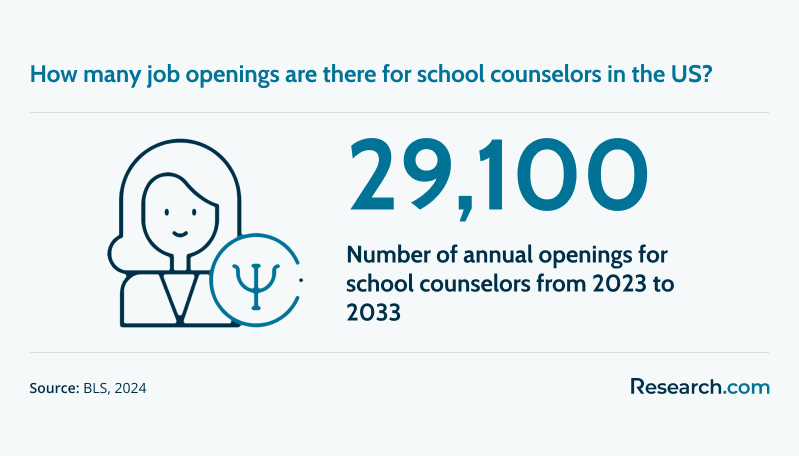
The job market for school counseling graduates is shaped by student enrollment, public school funding, mental health needs, college and career readiness priorities, and district staffing decisions. Employment in this field is projected to grow by 4% from 2023 to 2033, matching the average growth rate for all occupations. Over the next decade, an estimated 32,400 new school counselor positions will become available.
Graduates may find opportunities in public and private schools, especially if they meet state certification rules and have strong fieldwork experience. Candidates with skills in crisis response, data-informed counseling programs, college and career planning, family engagement, and culturally responsive practice may be better positioned for competitive roles.
The chart below shows the percent change in employment of school and career counselors and advisors from 2023 to 2033.
Key Insights
- An online master’s in school counseling can prepare students for school counselor roles, but licensure depends on state-specific rules, approved fieldwork, and program alignment.
- Do not choose a program based only on rankings or tuition. Accreditation, state approval, internship support, total cost, and graduate outcomes are more important.
- Most programs take about two years full time, with typical completion ranging from 18 months to three years.
- The median annual salary of school counselors in the U.S. is $60,733, while employment is projected to grow by 4% from 2023 to 2033.
- Online coursework can be flexible, but practicum and internship experiences are usually completed in person at approved schools.
- CACREP accreditation can be valuable, but it does not replace checking your state’s school counselor certification requirements.
- Before applying, ask each program about licensure eligibility, placement support, required residencies, total cost, financial aid, completion rates, and employment outcomes.
References:
- Bureau of Labor Statistics, U.S. Department of Labor. (2024). School and career counselors and advisors. Occupational Outlook Handbook. Retrieved February 7, 2025, from https://www.bls.gov/ooh/community-and-social-service/school-and-career-counselors.htm
- Bureau of Labor Statistics, U.S. Department of Labor. (2024). School and career counselors and advisors. Occupational Outlook Handbook. Retrieved February 7, 2025, from https://www.bls.gov/ooh/community-and-social-service/school-and-career-counselors.htm
- Hanson, M. (2024, August 31). Cost of online education vs. traditional education. Education Data Initiative. Retrieved February 10, 2025, from https://educationdata.org/cost-of-online-education-vs-traditional-education
- Salary.com. (2025). School counselor salary. Retrieved February 10, 2025, from https://www.salary.com/research/salary/benchmark/school-counselor-salary
- Zippia. (2024). Job outlook for school guidance counselors in the United States. Retrieved February 10, 2025, from https://www.zippia.com/school-guidance-counselor-jobs/trends
- ZipRecruiter. (n.d.). What is the average school counselor salary by state? Retrieved February 10, 2025, from https://www.ziprecruiter.com/Salaries/What-Is-the-Average-School-Counselor-Salary-by-State
Other Things You Should Know About the Best Online Master’s in School Counseling Degree Programs
CACREP-accredited school counseling master’s programs require at least 100 clock hours of practicum and 600 clock hours of internship. The internship must include supervised experience in a school setting, with direct and indirect service hours documented to meet state licensure requirements.
Applicants typically need a bachelor's degree in a related field, such as psychology or education. Some programs may also require relevant work experience or a minimum GPA. Standardized test scores, like the GRE, might be necessary if stipulated by the institution.
Synchronous programs require students to attend live online classes at specific times, promoting real-time interaction with peers and instructors. Asynchronous programs offer flexible scheduling, allowing students to access lectures and complete assignments at their own pace, ideal for those balancing work or family commitments.


