2027 Best Online MBA in Finance

Co-Founder and Chief Data Scientist
An online MBA in Finance is usually considered by professionals who want senior finance responsibilities without leaving the workforce for a full-time campus MBA. The decision is not only about finding a flexible program. You need to compare accreditation, tuition, finance coursework, admissions requirements, employer recognition, networking access, and whether the degree supports the career move you want to make. This guide explains what an online MBA in Finance includes, how long it takes, what it can cost, which programs are listed for 2027, and how to decide whether the investment fits your goals.
Quick answer: Is an online MBA in Finance a good choice?
An online MBA in Finance can be a strong option for working professionals who want graduate-level business training with deeper preparation in financial management, investment analysis, corporate finance, risk management, and strategic decision-making. It is most useful when the program is accredited, the curriculum matches your target role, the cost is manageable, and the online format gives you enough access to faculty, classmates, career services, and finance-focused networking.
- Common career targets include financial manager, investment manager, investment analyst, portfolio manager, corporate finance leader, and chief financial officer.
- Financial managers earn a median annual salary of $156,100.
- Online study can make the degree more accessible for students who need to keep working while completing MBA coursework.
What can I expect from an online MBA in Finance?
An online MBA in Finance combines the broad management foundation of an MBA with advanced coursework in finance. Most programs include core business classes in accounting, economics, analytics, leadership, strategy, marketing, and operations, followed by finance-focused courses in areas such as corporate finance, investments, financial markets, risk management, valuation, and capital budgeting.
The best programs are not simply online versions of lecture-based business courses. They use case studies, financial modeling assignments, simulations, group projects, and applied decision-making exercises to help students practice the kind of analysis used in corporate finance, banking, investment management, and consulting roles.
Where can I work with an online MBA in Finance?
Graduates with an online MBA in Finance may work in banks, investment firms, securities companies, consulting firms, corporate finance departments, healthcare systems, technology companies, energy organizations, startups, and government or nonprofit finance offices. The degree is flexible because nearly every organization needs professionals who can evaluate financial performance, allocate capital, manage risk, prepare budgets, analyze markets, and support long-term strategy.
How much can I make with an online MBA in Finance?
Compensation depends on your prior experience, location, industry, employer, and role. Entry-level roles after graduation may pay from $60,000 to $80,000 annually, with financial analyst positions often falling in this range. As professionals move into mid-level jobs such as financial manager or investment analyst, salaries commonly rise to between $80,000 and $120,000 per year. Senior roles can pay more: investment banker compensation can exceed $150,000 annually, while chief financial officer compensation can reach up to nearly half a million dollars.
These figures should be treated as planning benchmarks, not guarantees. An MBA can strengthen your qualifications, but salary outcomes still depend heavily on experience, market conditions, employer type, and your ability to translate the degree into measurable business impact.
- Best Online MBA in Finance Programs for 2027
- How long does an online MBA in Finance take?
- Online MBA in Finance vs. campus MBA
- Average cost of an online MBA in Finance
- Financial aid options
- Admissions requirements and prerequisites
- Typical online MBA in Finance courses
- Finance specialization options
- Is an online MBA in Finance worth the investment?
- Emerging trends in online finance MBA programs
- Challenges of earning the degree online
- Benefits of accelerated online MBA programs
- How to choose the right online MBA in Finance
- Accreditation and quality benchmarksProgram selection checklist
- Should you choose an accelerated MBA for faster advancement?
- Career paths for finance MBA graduates
- How the degree can support entrepreneurship
- Can accelerated programs maintain quality?
- Job market for online MBA in Finance graduates
- Advanced degrees after an MBA in Finance
- Quality metrics that signal program valueAdvanced degree optionsJob outlook detailsAdditional decision factors
Best Online MBA in Finance Programs for 2027
The strongest online MBA in Finance programs offer more than general business coverage. They combine management training with finance-specific coursework, clear student support, accessible faculty, reasonable completion timelines, and recognizable accreditation. When comparing programs, focus on whether the curriculum prepares you for your target role, whether the cost fits your expected return, and whether the school has enough career resources for online students.
How do we rank schools?
Program comparisons should consider curriculum depth, affordability, accreditation, flexibility, student support, and career relevance. Research.com uses education and institutional data sources such as the Integrated Postsecondary Education Data System, Peterson’s, College Scorecard, and the National Center for Education Statistics to support program evaluation.
- Integrated Postsecondary Education Data System, available through the IPEDS database
- Peterson’s database, including its Distance Learning Licensed Data Set
- College Scorecard database
- National Center for Education Statistics
| School and program | Program length | Finance focus | Estimated cost per credit | Credits | Accreditation |
| Johns Hopkins Carey Business School Flexible MBA with a specialization in Finance | 2 years | Finance | $1,800 | 54 | Middle States Commission on Higher Education (MSCHE) |
| Florida Institute of Technology MBA with a Concentration in Finance | 2 years | Finance | $816 | 36 | International Accreditation Council for Business Education (IACBE) |
| Mount Vernon Nazarene University MBA with a concentration in Finance | 19 months | Finance | $498 | 36 | The Higher Learning Commission |
| Bellevue University Master of Business Administration | 2 years | Finance | $660 | 36-39 | International Accreditation Council for Business Education (IACBE) |
| Webster University MBA with an emphasis in Corporate Finance | 2 years | Finance | $752 | 39-45 | Accreditation Council for Business Schools and Programs |
| Queens University of Charlotte Master of Business Administration | 2 years | Finance | $1,265 | 30 | Accreditation Council for Business Schools and Programs |
| Queens University of Charlotte McColl School of Business MBA | 2 years | Finance | $1,265 | 30 | Accreditation Council for Business Schools and Programs |
| Molloy University MBA in Finance | 2 years | Finance | $1,385 | 33 | International Accreditation Council for Business Education (IACBE) |
| Brenau University online MBA with a finance concentration | 1.5 years | Finance | $845 | 33 | Accreditation Council for Business Schools and Programs |
| Concordia University Ann Arbor MBA with a Concentration in Finance | 2 years | Finance | $725 | 36 | The Higher Learning Commission |
How to read this list
Do not choose a program based on one metric alone. A lower cost per credit can be attractive, but total price also depends on required credits, fees, transfer policies, and financial aid. A shorter program can save time, but it may require a heavier weekly workload. A recognizable university can help with credibility, but the finance curriculum and career support still need to match your goals.
How long does an online MBA in Finance take?
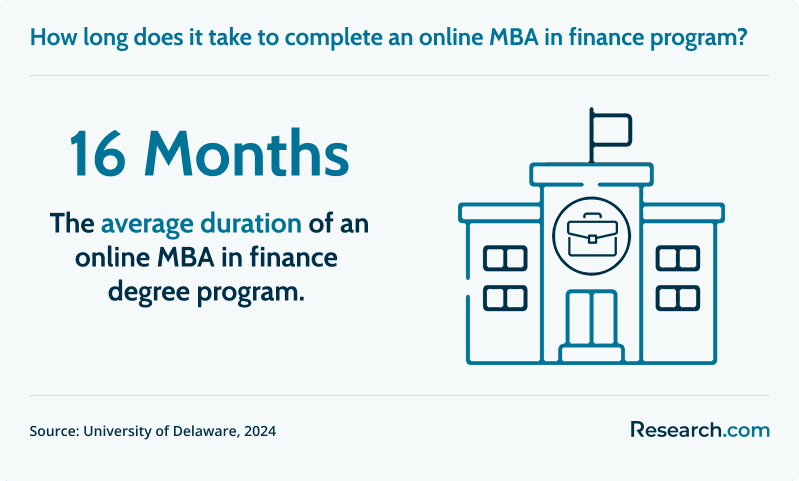
Most online MBA in Finance programs take one to two years to complete. Some schools offer accelerated formats, while others allow part-time enrollment for students who need a lighter course load. Course terms may be delivered in short sessions, including six-week terms or seven- to eight-week terms, depending on the institution.
Students who want the fastest possible business or finance credential can compare MBA timelines with accelerated finance programs online. Be careful when comparing across fields, however; a format used by the best online master’s in educational leadership degree programs may show how online scheduling works, but it does not indicate whether a finance MBA has the right business accreditation or finance curriculum.
How does an online MBA in Finance compare to an on-campus program?
An online MBA in Finance is usually designed for flexibility, while an on-campus MBA often provides more built-in structure and in-person interaction. The better choice depends on how you learn, how much schedule control you need, and how important face-to-face networking is for your career plan.
| Factor | Online MBA in Finance | On-campus MBA in Finance |
| Schedule | Often includes asynchronous coursework, live online sessions, or a mix of both. | Usually follows fixed class times and campus-based attendance expectations. |
| Best for | Working professionals, caregivers, military students, and students far from campus. | Students who want daily campus access, in-person clubs, and structured networking. |
| Networking | Requires active participation in virtual events, group projects, alumni platforms, and career services. | Often includes more frequent in-person contact with classmates, faculty, employers, and alumni. |
| Cost considerations | May reduce relocation and commuting costs; tuition varies widely by school. | May include campus-related expenses, relocation, and reduced ability to work full time. |
| Learning style | Works best for self-directed students who can manage deadlines independently. | Works well for students who prefer live classroom routines and immediate in-person feedback. |
When estimating affordability, compare finance MBA programs against similar business degrees rather than unrelated credentials. For example, the cheapest ABA certification online can be useful for students in behavior analysis, but it is not a reliable benchmark for MBA pricing. Likewise, career guides such as what you can do with a master's degree in sports psychology may help students exploring other fields, but they should not drive a finance MBA decision.
What is the average cost of an online MBA in Finance?
The cost of an online MBA in Finance varies widely by school, credit requirement, residency policy, fees, and program reputation. Total program costs can range from as low as $7,000 to over $100,000. Some affordable options may charge around $310 per credit hour for out-of-state students, while Carnegie Mellon University's online MBA can cost up to $141,320. Part-time online MBA programs average about $16,000 annually, though tuition at prestigious institutions may exceed $50,000 per year. Technology and distance learning fees can add several hundred to thousands of dollars to the final cost.
Cost factors to compare before enrolling
- Total credits: A lower per-credit rate may not mean a lower total cost if the program requires more credits.
- Fees: Ask about technology, graduation, library, residency, and distance learning fees.
- Transfer credits: Some programs may reduce costs if they accept eligible graduate transfer credits.
- Employer support: Tuition reimbursement can substantially change your out-of-pocket cost.
- Opportunity cost: Accelerated schedules may reduce time in school, but they can also limit overtime, travel, or job flexibility.
Students comparing high-earning graduate pathways may also review master’s in information systems jobs, especially if they are deciding between finance, analytics, cybersecurity, and business intelligence roles.
What are the financial aid options for students enrolling in an online MBA in Finance?
Students considering an online MBA in Finance should review every funding source before borrowing. Aid availability varies by school and student eligibility, but common options include:
- Scholarships: Universities, foundations, professional associations, and private organizations may offer merit-based or need-based awards that do not require repayment.
- Grants: Federal, state, institutional, or program-specific grants may be available based on financial need.
- Federal loans: Eligible students can submit the FAFSA to determine federal student loan options.
- Private loans: Lenders such as Sallie Mae, SoFi, and Ascent may offer graduate loans, but students should compare interest rates, repayment terms, and borrower protections carefully.
- Employer tuition reimbursement: Some employers help pay for MBA study when the degree supports business needs or promotion pathways.
- Military benefits: Eligible veterans and service members may be able to use GI Bill benefits for part or all of their education costs.
- Work-study programs: Some institutions offer graduate work-study opportunities that allow students to earn income while studying.
If cost is the main barrier and you are still early in your education, affordable online associate in business degree programs can provide a lower-cost starting point before a bachelor’s degree and later graduate study.
What are the prerequisites for enrolling in an online MBA in Finance?
Admissions requirements vary by institution, but most online MBA in Finance programs ask applicants to show academic readiness, professional maturity, and basic business potential.
- Bachelor’s degree: Applicants generally need a bachelor’s degree from an accredited institution. Some candidates enter with an online bachelor's degree in finance, while others come from accounting, economics, engineering, technology, liberal arts, or other fields.
- Minimum GPA: Some programs may require a specific GPA, such as 2.75 or higher.
- Work experience: Many MBA programs prefer or require two to three years of professional experience, although some schools, including Murray State University, do not require work experience for admission.
- Official transcripts: Schools usually require transcripts from all previously attended colleges and universities. International applicants may need additional academic records or credential evaluations.
- Resume: A professional resume helps admissions teams evaluate career progression, leadership experience, and readiness for graduate business study.
- GMAT or GRE: Some programs require test scores, while others provide waivers based on prior academics or work history. A GMAT score of 450 may be required by some programs, and La Salle University offers a GMAT waiver under certain conditions.
- Foundation courses: Students without prior business coursework may need prerequisite classes in accounting, economics, statistics, or finance.
What courses are typically in an online MBA in Finance?
Online MBA in Finance coursework is designed to build both managerial judgment and technical finance ability. Most programs combine core MBA subjects with finance electives.
| Course area | What students usually study | Why it matters |
| Financial management | Corporate finance strategy, capital budgeting, dividend policy, and risk management. | Prepares students to evaluate funding, investment, and value-creation decisions. |
| Investment analysis | Investment strategy, asset pricing models, and fundamental analysis. | Supports careers in portfolio management, research, banking, and wealth management. |
| Financial markets and institutions | Commercial banks, investment banks, and the structure of financial systems. | Helps students understand how capital moves through markets and institutions. |
| Accounting | Financial accounting and managerial accounting principles. | Strengthens the ability to read statements, evaluate performance, and support decisions. |
| Business analytics | Data analysis for business and financial decision-making. | Builds evidence-based problem-solving skills increasingly expected in finance roles. |
| Economics | Microeconomic and macroeconomic concepts. | Provides context for market behavior, pricing, policy changes, and business cycles. |
Students should look for applied projects that develop finance analysis skills, such as modeling, valuation, scenario analysis, and strategic recommendations.
What types of specializations are available in an online MBA in Finance?
Finance MBA concentrations help students align coursework with a specific career path. Common options include:
- Corporate finance: Focuses on budgeting, capital structure, mergers and acquisitions, valuation, financial modeling, and risk management. This path can support roles such as financial analyst, corporate treasurer, finance manager, or CFO.
- Investment management: Covers portfolio theory, asset allocation, security analysis, and alternative investments. It may fit students interested in asset management, wealth management, or investment research.
- Financial markets and institutions: Examines banks, investment firms, market structures, regulation, and financial intermediaries. This is useful for students pursuing banking, securities, or regulatory careers.
- Financial analytics: Emphasizes data, quantitative methods, modeling, and risk analysis. This option is useful for finance professionals who want to work more closely with analytics teams or data-heavy decision-making.
- International finance: Explores foreign exchange, international investment, global financial strategy, and cross-border risk. Students comparing adjacent credentials may also review online accounting certificate programs if they need accounting depth alongside finance training.
Is the online MBA in Finance investment worth it?
An online MBA in Finance is worth considering if it helps you qualify for roles with greater responsibility, improves your financial and strategic decision-making skills, and produces a realistic return compared with tuition and time commitment. It may not be worth it if the program is not accredited, requires heavy borrowing without a clear career plan, or duplicates skills you already have without opening new opportunities.
Before enrolling, compare your current salary, expected salary range, employer tuition support, debt tolerance, and promotion timeline. A broader discussion of graduate business ROI is available in Research.com’s guide to whether an MBA is worth it.
What are the emerging trends in online MBA in Finance?
Online MBA in Finance programs are increasingly shaped by digital delivery, finance technology, analytics, and employer demand for practical skills. Programs may include more work with real-time data, simulation-based assignments, financial technology concepts, blockchain applications, sustainable finance, and AI-supported learning tools. These additions can be valuable when they are integrated into rigorous finance coursework rather than added as surface-level buzzwords.
Students seeking a lower tuition path can also compare broader affordable MBA options, but they should verify that the finance coursework is deep enough for their target role.
What are the challenges of pursuing an online MBA in Finance?
The main challenge of an online finance MBA is that flexibility shifts more responsibility to the student. You may need to manage deadlines across compressed terms, participate actively in virtual discussions, schedule group work across time zones, and create networking opportunities that a campus program might provide more naturally.
- Time management: Finance coursework can be quantitative, and falling behind can make later modules harder.
- Networking effort: Online students need to use career events, alumni platforms, discussion boards, and faculty office hours intentionally.
- Technology dependence: Reliable internet, learning platforms, and technical support matter more in fully online programs.
- Self-direction: Students must be comfortable learning through readings, recorded lectures, live sessions, and independent projects.
Students comparing delivery models can review broader guidance on how to get an MBA online and evaluate online program quality.
What benefits do accelerated online MBA programs provide?
Accelerated online MBA programs can help motivated students finish faster and apply new skills sooner. They are most appealing to professionals who already have business experience, strong time-management habits, and a clear reason for completing the degree quickly. These programs often use condensed courses, intensive modules, and focused assignments that require steady weekly commitment.
Students interested in shorter timelines can compare accelerated online MBA programs and confirm whether finance electives are available within the accelerated schedule.
How to choose the best online MBA in Finance
The best online MBA in Finance is the program that fits your career goal, budget, schedule, and learning needs while meeting recognized academic standards. Use the following checklist before applying.
| Decision factor | What to verify | Why it matters |
| Accreditation | Confirm institutional accreditation and, when available, business accreditation such as AACSB, ACBSP, or IACBE. | Accreditation affects credibility, employer recognition, transferability, and financial aid eligibility. |
| Finance curriculum | Review required finance courses, electives, projects, and software exposure. | A general MBA with one finance elective may not be enough for specialized finance careers. |
| Total cost | Calculate tuition, fees, books, travel requirements, and borrowing costs. | Total cost is more important than advertised per-credit tuition alone. |
| Career services | Ask whether online students receive coaching, resume support, employer events, and alumni access. | Career outcomes depend partly on how well the school supports online learners. |
| Faculty background | Look for faculty with academic strength and relevant finance or industry experience. | Strong faculty can connect theory to real financial decision-making. |
| Flexibility | Check synchronous requirements, assignment deadlines, residency components, and course pacing. | A program is only flexible if it fits your work and personal schedule. |
Which accreditation and quality benchmarks should I consider?
Accreditation is one of the first quality checks for an online MBA in Finance. Institutional accreditation confirms that the university meets broad academic standards. Business-specific accreditation, such as AACSB, ACBSP, or IACBE, can add another layer of review for business programs. Also examine graduation rates, career outcomes, faculty credentials, employer relationships, student support, and whether online students receive the same academic resources as campus students.
Students comparing speed-focused formats may also find it useful to review accelerated business administration degree online options, but MBA-level accreditation and graduate career support should still be evaluated separately.
Is an accelerated online MBA in Finance the right choice for rapid career advancement?
An accelerated online MBA in Finance can be a good fit if you need the credential quickly for promotion, career transition, or employer reimbursement timelines. It is less suitable if you are new to business fundamentals, need extensive networking, or cannot commit to a demanding weekly workload. Before choosing the quickest MBA program, ask whether the shorter format still includes the finance courses, advising, and applied projects you need.
What career paths are available for graduates of an online MBA in Finance?
Online MBA in Finance graduates can pursue roles in corporate finance, investment management, banking, consulting, financial analytics, and executive leadership. The right path depends on prior experience, technical skills, industry knowledge, and professional network.
| Career path | Typical responsibilities | Best fit for |
| Financial analyst | Analyze performance, build forecasts, evaluate budgets, and support investment or business decisions. | Students moving into finance or advancing from analyst-level work. |
| Financial manager | Oversee reporting, planning, risk management, and finance team operations. | Professionals seeking management responsibility in corporate finance. |
| Investment analyst | Research securities, assess markets, evaluate portfolios, and recommend investment actions. | Students interested in asset management, banking, or investment firms. |
| Portfolio or wealth manager | Manage client or institutional assets and align portfolios with goals and risk tolerance. | Professionals who want client-facing or investment advisory work. |
| Treasurer or corporate finance leader | Manage liquidity, capital structure, financing decisions, and long-term financial strategy. | Experienced finance professionals targeting senior corporate roles. |
| Chief financial officer | Lead organizational finance strategy, reporting, capital allocation, risk, and executive decision-making. | Senior professionals with substantial leadership and finance experience. |
Some MBA graduates use finance skills in adjacent operational roles, including supply chain and transportation strategy; students considering that direction can review a logistics career path. Others may explore legal or compliance-adjacent education, but a paralegal certificate online ABA-approved serves a different career purpose and should not be treated as a substitute for finance graduate training.
How can an online MBA in Finance support entrepreneurial aspirations?
An online MBA in Finance can help entrepreneurs understand pricing, cash flow, capital raising, valuation, risk, financial planning, and growth strategy. These skills are useful for launching a startup, buying a business, managing investor expectations, or improving financial discipline inside an existing company. Students with entrepreneurial goals should look for programs with venture finance, strategy, accounting, analytics, and capstone projects that allow them to work on real business ideas.
If you are comparing entrepreneurship-focused paths, Research.com’s guide to what jobs you can get with a bachelor's in entrepreneurship can help clarify how entrepreneurship study differs from graduate finance training.
Can an online MBA in Finance be accelerated without compromising quality?
Yes, an online MBA in Finance can be accelerated without lowering quality if the program is accredited, the curriculum remains complete, faculty support is accessible, and student outcomes are transparent. The risk is not acceleration itself; the risk is choosing a condensed program that removes important finance coursework, limits advising, or provides weak career support. Students should compare workload expectations, course sequencing, faculty access, and capstone requirements before enrolling.
For a wider look at shorter business pathways, compare online business degrees with fast completion options.
What is the job market for graduates with an online MBA in Finance?
The job market for online MBA in Finance graduates includes opportunities in management consulting, financial services, technology, healthcare, energy, consumer packaged goods, and corporate finance departments. Finance managers are projected to see a 17% increase by 2033. Starting salaries for some roles range from $80,000 to over $200,000 depending on experience and position, and the median advertised salary for finance positions requiring an MBA was around $120,200.
Demand does not mean every graduate will receive the same result. Employers still evaluate relevant experience, leadership record, technical skills, communication ability, and fit for the role. Students should use the MBA to build a portfolio of applied finance work, not just earn the credential.
What advanced degrees can further enhance a finance career?
Some professionals pursue doctoral-level business education after an MBA, especially if they want senior consulting work, executive-level research skills, teaching opportunities, or deeper expertise in organizational strategy. A Doctorate in Business Administration can help experienced professionals strengthen research methods and strategic leadership capabilities. Students comparing affordable doctoral options can review DBA programs online.
What key quality metrics indicate a program's success?
Strong online MBA in Finance programs should be able to show evidence of student success. Look for graduation rates, retention rates, employment outcomes, salary movement, alumni engagement, employer partnerships, faculty credentials, and student satisfaction data. Rankings can be useful, but they should not replace your own review of cost, accreditation, curriculum, and career support. Executives comparing lower-cost graduate business options may also want to review cheap online executive MBA programs.
Common mistakes to avoid when choosing an online MBA in Finance
- Choosing without checking accreditation: Always confirm institutional and business accreditation before applying.
- Looking only at tuition per credit: Calculate total program cost, including required credits and fees.
- Assuming all online MBAs are equal: Some programs have deeper finance coursework, stronger faculty access, or better career services than others.
- Ignoring workload: Accelerated formats can be efficient, but they may be difficult for students with unpredictable work schedules.
- Skipping career services questions: Ask whether online students receive the same coaching, recruiting access, and alumni support as campus students.
- Assuming salary outcomes are guaranteed: Use salary data for planning, but remember that pay depends on experience, industry, location, and performance.
- Relying only on rankings: Rankings can narrow your list, but your final decision should be based on fit, cost, curriculum, and outcomes.
Questions to ask before applying
- Is the university institutionally accredited, and does the business school hold AACSB, ACBSP, or IACBE accreditation?
- How many finance electives are available online, and how often are they offered?
- Are classes asynchronous, synchronous, or a mix of both?
- What is the total estimated cost, including tuition, fees, books, and any residency requirements?
- Does the school publish graduation rates, job placement data, or salary outcomes for MBA students?
- Can online students access career coaching, employer events, alumni networks, and finance-focused recruiting support?
- Are GMAT or GRE scores required, optional, or waived under specific conditions?
- Will employer tuition reimbursement apply to this program?
- Can you handle the expected weekly workload while continuing to work?
- Does the curriculum support your target role: corporate finance, investment management, banking, analytics, consulting, or executive leadership?
Key Insights
- An online MBA in Finance is best for professionals who want advanced business leadership training with specialized finance skills while maintaining work flexibility.
- Most programs take one to two years, though accelerated and part-time formats can change the timeline significantly.
- Total program costs vary widely, from as low as $7,000 to over $100,000, so students should compare full cost rather than tuition per credit alone.
- Financial managers earn a median annual salary of $156,100, and finance managers are projected to see a 17% increase by 2033.
- The median advertised salary for finance positions requiring an MBA was around $120,200, but individual outcomes depend on experience, location, industry, and role.
- Common admissions requirements include a bachelor’s degree, transcripts, resume, possible work experience, and sometimes GMAT or GRE scores; some programs may require a GPA such as 2.75 or higher.
- The strongest programs combine accreditation, finance-focused coursework, applied projects, accessible faculty, online student support, and transparent career outcomes.
- Accelerated programs can be valuable for motivated students, but they should still be evaluated for curriculum depth, workload, faculty access, and career services.
References:
- AACSB. (2021, October). Business school data guide. Global Business Education Network | AACSB
- Career Paths in Quantitative Finance | Financial Mathematics | The University of Chicago. (n.d.). University of Chicago
- CFP Board. (2023). THE STANDARD OF EXCELLENCE. CFP Board
- Data Science. (n.d.). Data Science. NNLM.
- Financial Managers: Occupational Outlook Handbook: U.S. Bureau of Labor Statistics. (2022, September 8). U.S. Bureau of Labor Statistics
- How to Become a Credit Analysis Manager | Maryville Online. (n.d.). Maryville Online. Maryville Online
- Occupational Outlook Handbook: U.S. Bureau of Labor Statistics. (2023, February 6). U.S. Bureau of Labor Statistics
Other Things You Should Know About the Best Online MBA in Finance?
An online MBA in finance should hold AACSB accreditation, the most recognized business-school standard in the United States. Regional accreditation is also required. For a stronger credential, some finance MBA programs also carry specialized business accreditation, but AACSB is the key mark employers and universities check first.
The admission requirements typically include a bachelor's degree, a competitive GMAT or GRE score, professional resume, statement of purpose, and possibly an interview. Some programs may also require prerequisite finance courses or specific professional experience.
Yes, most top programs require 2-5 years of professional work experience before admission. Specific requirements can vary, so prospective students should verify details with each institution's 2027 admission policy for their chosen MBA in Finance program.