
2027 Best Online MBA in General Business Programs

Co-Founder and Chief Data Scientist
In today’s competitive market, employers seek Master of Business Administration (MBA) graduates for their ability to drive growth, adapt to evolving trends, and lead cross-functional teams. With increasing demand for business leaders who can navigate global challenges, earning an MBA in General Business offers a clear pathway to advancement and long-term career success.
An online MBA in General Business equips graduates with versatile skills in leadership, strategy, and decision-making—qualities valued across industries. The convenience and accessibility of online learning also make it easier to earn this advanced degree.
Get to know more about this degree, career path, and some of the best online MBA programs in general business in this guide.
What are the benefits of getting an online MBA in General Business degree?
- Graduates are equipped to adapt to varied business environments and are desirable candidates for a wide array of leadership and management positions across various industries.
- According to the U.S. Bureau of Labor Statistics, professionals in management occupations earn a median annual wage of around $122,000, with experienced MBA graduates often positioned for salaries above this range due to their advanced skills and qualifications.
- The online format is a major advantage for working professionals, allowing individuals to pursue an advanced degree without having to quit their jobs, relocate, or put their careers on hold.
What can I expect from an online MBA in General Business degree program?
- An online MBA in General Business provides a comprehensive education in core business disciplines, including management, finance, marketing, operations, and strategic planning.
- Unlike specialized MBA programs, this degree offers a broad, flexible curriculum that prepares students for leadership roles across multiple industries.
- Coursework often includes case studies, real-world projects, and collaborative assignments to develop problem-solving, communication, and decision-making skills.
- Many programs integrate electives, allowing students to tailor their studies to specific career goals.
- Delivered in a fully online format, these programs enable working professionals to advance their education without sacrificing career momentum, offering the flexibility to study from anywhere while building a strong foundation for long-term success in the business world.
Where can I work with an online MBA in General Business degree?
Graduates with an online MBA in General Business have versatile career options across a variety of industries, as the degree equips them with skills in leadership, management, finance, marketing, and strategic planning.
Typical work settings include:
- Corporate Enterprises. Overseeing operations, managing teams, and leading business growth initiatives.
- Financial Institutions. Managing investments, budgets, and financial strategies.
- Healthcare Organizations. Coordinating administrative functions and improving service efficiency.
- Technology Firms. Leading product development, marketing, or strategic partnerships.
- Consulting Agencies. Advising clients on business strategy, market expansion, and operational improvements.
- Entrepreneurship. Launching and managing new businesses with a focus on sustainable growth.
How much can I make with an online MBA in General Business degree?
Graduates with an online MBA in General Business can expect a significant increase in their earning potential.
According to a 2025 Corporate Recruiters Survey by the Graduate Management Admission Council (GMAC), the median starting salary for new MBA graduates in the U.S. was $120,000, a substantial premium over the median starting salary for those with a bachelor's degree, which was around $69,000.
These figures do not even include additional compensation like signing bonuses, which can further boost a graduate's total package. For example, a 2024 report from MIT Sloan found that their MBA class of 2024 had a median signing bonus of $30,000.
While salaries can vary widely based on industry, location, and prior experience, an MBA consistently proves to be a valuable investment, often leading to a substantial return on investment
- List of Best Online MBA in General Business Programs for 2027 List of Programs
- How long does it take to complete an online MBA in General Business degree program? Completion Time
- How does an online MBA in General Business degree compare to an on-campus program? How does an online MBA in General Business degree compare to an on-campus program?
- What is the average cost of an online MBA in General Business program? Average Cost
- What are the financial aid options for students enrolling in an online MBA in General Business program? Financial Aid
- What are the prerequisites for enrolling in an online MBA in General Business program? Requirements
- What courses are typically in an online MBA in General Business program? What courses are typically in an online MBA in General Business program?
- What types of specializations are available in online MBA in General Business programs? What types of specializations are available in online MBA in General Business programs?
- How to choose the best online MBA in General Business program? How to choose the best online MBA in General Business program?
- What career paths are available for graduates of online MBA in General Business programs? Career Paths
- What specialized certifications can complement an online MBA in General Business? What specialized certifications can complement an online MBA in General Business?
- Why Is Accreditation Critical for an Online MBA in General Business? Why Is Accreditation Critical for an Online MBA in General Business?
- What is the job market for graduates of online MBA in General Business degrees? Job Market
Best Online MBA in General Business Programs for 2026
Choosing an online MBA in General Business is usually a high-stakes decision: it affects your schedule, finances, career mobility, and professional network. A general business MBA is designed for professionals who want broad management training rather than a narrow technical specialization. It can be a strong fit if you want to move into leadership, change business functions, build confidence in finance and strategy, or prepare for broader executive responsibilities.
This guide explains how online MBA in General Business programs work, how long they take, what they cost, what admissions requirements to expect, and how to compare accredited programs. It also reviews career paths, labor-market signals, financial aid options, and common mistakes to avoid before enrolling.
Quick answer: Is an online MBA in General Business worth considering?
An online MBA in General Business can be worth considering if you need flexible graduate business training, want to keep working while studying, and value a broad curriculum in leadership, finance, marketing, operations, strategy, and data-informed decision-making. The best choice is usually an accredited program with clear career support, transparent tuition, strong faculty, and a format that matches your work schedule. It is not automatically the right option for everyone; students seeking a highly technical role may be better served by a specialized master’s degree or targeted certification.
How we rank online MBA programs
An online MBA requires a serious investment of time and money, so rankings should help readers compare practical program features rather than simply list well-known schools. Our ranking process reviews academic quality, online delivery, affordability, student support, institutional credibility, and available program data.
To build this guide, Research.com reviewed established datasets from the College Scorecard, the Integrated Postsecondary Education Data System, the National Center for Education Statistics, and Peterson’s, including its Distance Learning Licensed Data Set. More details are available in Research.com’s ranking methodology.
Best online MBA in General Business programs
| Rank | School | Program length | Credits | Cost information | Accreditation |
| 1 | University of Texas at Dallas Jindal School of Management | Completion in as few as 21 months to as long as six years | 53 credits | UT Dallas provides an estimate of $30,818 for residents and $60,307 for nonresidents in total tuition costs | Association to Advance Collegiate Schools of Business (AACSB) |
| 2 | Longwood University College of Business and Economics | As few as 10 months | 31 credits | $450 for in-state students and $460 for out-of-state enrollees | Association to Advance Collegiate Schools of Business |
| 3 | Washington State University Carson College of Business | Completion in as few as 22 months | 36 credits | $898 | Association to Advance Collegiate Schools of Business |
| 4 | Penn State World Campus | Approximately two to five years | 48 credits | $1,273 | Association to Advance Collegiate Schools of Business |
| 5 | Louisiana State University in Shreveport College of Business | As few as 10 months | 30 credits | $484 | Association to Advance Collegiate Schools of Business |
1. University of Texas at Dallas Jindal School of Management
The University of Texas at Dallas offers an online professional MBA built for working adults who want breadth, flexibility, and the option to tailor the degree. The program stands out for its wide selection of tracks, multiple ways to personalize the curriculum, optional international immersion, career support, and AACSB accreditation.
- Program Length: Completion in as few as 21 months to as long as six years
- Tracks/concentrations: Accounting; Business Analytics; Energy Management; Finance; Healthcare Leadership and Management; Information Technology Management; Innovation and Entrepreneurship; Internal Audit; International Management; Leadership in Organizations; Marketing; Real Estate; Strategic Management; Supply Chain Management; Systems Engineering and Management; Double Degree MS/MBA
- Cost per Credit: UT Dallas provides an estimate of $30,818 for residents and $60,307 for nonresidents in total tuition costs
- Required Credits to Graduate: 53 credits
- Accreditation: Association to Advance Collegiate Schools of Business (AACSB)
2. Longwood University College of Business and Economics
Longwood University offers a fully online MBA with a General Business track and an accelerated completion option. The curriculum emphasizes strategic thinking, managerial decision-making, technology’s role in leadership, and applied business practice. Students also use a business simulator, which can be useful for learners who want more than lecture-based coursework.
- Program Length: As few as 10 months
- Tracks/concentrations: MBA General Business track
- Cost per Credit: $450 for in-state students and $460 for out-of-state enrollees
- Required Credits to Graduate: 31 credits
- Accreditation: Association to Advance Collegiate Schools of Business
3. Washington State University Carson College of Business
Washington State University provides an online MBA in General Business for students who want a broad management foundation with room for customization. The program combines core business coursework with three electives, case analysis, strategic planning, and capstone work intended to prepare students for leadership across different business settings.
- Program Length: Completion in as few as 22 months
- Tracks/concentrations: MBA General Business track
- Cost per Credit: $898
- Required Credits to Graduate: 36 credits
- Accreditation: Association to Advance Collegiate Schools of Business
4. Penn State World Campus
Penn State World Campus offers an online MBA with a General Management focus. The program emphasizes integrated business thinking, collaboration, and applied engagement. Students complete group work and may pursue graduate certificates in areas such as Financial Engineering or Sustainability Strategy.
- Program Length: Approximately two to five years
- Tracks/concentrations: MBA General Business
- Cost per Credit: $1,273
- Required Credits to Graduate: 48 credits
- Accreditation: Association to Advance Collegiate Schools of Business
5. Louisiana State University in Shreveport College of Business
Louisiana State University in Shreveport, also known as LSU Shreveport, offers an online MBA in General Business with a fast-paced structure and multiple start dates. The program focuses on leadership development and core business capabilities, including economic analysis, financial management, organizational behavior, and data-driven decision-making.
- Program Length: As few as 10 months
- Tracks/concentrations: MBA General Business
- Cost per Credit: $484
- Required Credits to Graduate: 30 credits
- Accreditation: Association to Advance Collegiate Schools of Business
How long does an online MBA in General Business take?
Most online MBA in General Business programs take one to two years, but the actual timeline depends on the school’s calendar, your course load, transfer or waiver policies, and whether you enroll full time or part time.
| Format | Typical completion time | Best for | Trade-off |
| Accelerated online MBA | As little as 10 to 12 months | Students who can handle a heavier academic load and continuous enrollment | Less downtime between courses and fewer breaks |
| Standard full-time online MBA | About 18 months to 2 years | Learners who want steady progress without the most compressed schedule | Requires consistent weekly availability |
| Part-time online MBA | 2.5 to 3 years | Working professionals balancing employment, family, and school | Longer time before graduation and career payoff |
| Flexible or self-paced online MBA | Varies by school policy | Students with unpredictable schedules or seasonal work demands | Requires strong self-management and careful planning |
Before choosing a fast program, ask whether accelerated courses are shorter, heavier, or offered back-to-back. A 10-month MBA may be attractive, but it may not be realistic if you travel often, work long hours, or need time for family responsibilities.
Online MBA in General Business vs. on-campus MBA: which format is better?
An online MBA in General Business usually covers the same core subjects as an on-campus MBA, including leadership, accounting, finance, marketing, operations, organizational behavior, business analytics, and strategy. In many universities, online and campus students study with the same faculty and complete comparable learning outcomes. The major differences are delivery format, networking style, schedule structure, and access to in-person experiences.
Online learning has also become common across many fields. For example, students comparing an online bachelor’s degree in human services with a campus option often weigh the same core issues: accreditation, flexibility, faculty access, field requirements, and student support.
| Factor | Online MBA in General Business | On-campus MBA |
| Schedule flexibility | Often better for working adults, especially when courses are asynchronous | More fixed class times and commuting requirements |
| Networking | Virtual events, discussion boards, group projects, alumni platforms, and optional residencies | More frequent face-to-face interaction, campus events, and local employer access |
| Career services | May include remote coaching, résumé reviews, interview preparation, and online employer events | Often includes in-person recruiting events and campus-based networking |
| Learning experience | Requires self-discipline, written communication, and comfort with digital tools | Provides more immediate classroom interaction and campus immersion |
| Best fit | Professionals who need to keep working or cannot relocate | Students who want in-person networking, campus culture, and structured classroom engagement |
The flexibility of online MBA study is one reason enrollment has grown in AACSB-accredited institutions over the past six years:
- 2018-2019 - 14%
- 2019-2020 - 14%
- 2020-2021 - 25%
- 2021-2022 - 25%
- 2022-2023 - 25%
- 2023-2024 - 28%
Still, the online format is not automatically superior. Campus programs may offer stronger in-person networks, local internships, live case competitions, and easier access to faculty outside class. The right choice depends on how you learn, where you are in your career, and how much structure you need.
The chart below shows AACSB MBA enrollment patterns by delivery format:
What is the average cost of an online MBA in General Business?
The cost of an online MBA in General Business varies significantly by institution, residency status, credit requirement, program reputation, and fee structure. Education Data Initiative reports that the average cost of a Master of Business Administration program in the U.S is $60,410. Some premium programs, especially from elite institutions, can cost more than $100,000.
Tuition is only one part of the total price. Students should also check technology fees, books, course materials, graduation fees, residency or immersion travel, exam fees, and the income trade-off if they reduce work hours while studying.
| Cost factor | Why it matters | Question to ask before enrolling |
| Tuition model | Programs may charge by credit, by course, by term, or by total program price | Is the published cost the full program cost or only tuition? |
| Residency status | Public universities may charge different rates for residents and nonresidents | Will my location affect the amount I pay? |
| Fees | Technology, distance learning, graduation, and student service fees can raise the final bill | Which mandatory fees are not included in advertised tuition? |
| Required credits | A lower per-credit price may still cost more if the program requires more credits | How many credits are required to graduate? |
| Travel or residency requirements | Some online MBAs include optional or required campus visits or international experiences | Are travel, lodging, and meals part of the expected cost? |
| Employer support | Tuition reimbursement can reduce out-of-pocket costs | Does my employer cover accredited online MBA coursework? |
Online programs can sometimes reduce relocation, commuting, and opportunity costs, but they are not always cheaper than campus-based options. Students comparing business degrees with other technology-focused training, such as online cloud engineering bootcamps, should compare total cost, credential value, employer recognition, and career relevance rather than tuition alone.
Financial aid options for online MBA in General Business students
Online MBA students may qualify for several forms of financial support, but eligibility varies by school, enrollment status, citizenship status, academic profile, employer benefits, and program accreditation. Students considering advanced business pathways, including online DBA in management programs, should take the same approach: confirm aid eligibility before applying, not after admission.
Loans are common, but they should not be the first option students evaluate. Start with funding sources that do not need to be repaid.
| Funding option | How it can help | What to verify |
| Merit-Based Scholarships | May reward academic performance, leadership, professional achievement, or GMAT/GRE strength | Whether the school considers applicants automatically or requires a separate application |
| Need-Based Grants | Can reduce costs for students who meet financial need criteria | Whether funding comes from federal, state, institutional, or private sources |
| Diversity Scholarships | May support candidates from underrepresented backgrounds in business education | Eligibility requirements for awards such as the ROMBA LGBTQ+ Fellowship and Forté Foundation MBA Fellowship |
| Professional and Special Interest Scholarships | May be available through associations, industry groups, or mission-based organizations | Deadlines, essay requirements, membership rules, and renewal conditions |
| Employer Tuition Assistance | Can cover part or all of the cost when the degree supports your role or advancement plan | Annual caps, grade requirements, repayment clauses, and approved-school lists |
| Military Benefits | Programs like the GI Bill® may help eligible service members and veterans pay education expenses | Benefit remaining balance, school participation, and housing or fee coverage |
GMAC data shows that 28% of graduate management education (GME) candidates in the U.S. plan to use grants, fellowships, and scholarships to finance their GME program.
GMAC also reports that almost 50% of incoming GME students to U.S. programs typically receive merit-based scholarships or fellowships.
The following chart provides more context on financial assistance among MBA and other graduate management students in the U.S.:
Online MBA in General Business admission requirements
Admission requirements vary by university, but most online MBA in General Business programs evaluate academic preparation, professional experience, communication skills, and readiness for graduate-level business work.
- A bachelor's degree. Most programs require a bachelor’s degree from an accredited institution. A business background can help, but many schools admit students from other fields and may require leveling coursework in accounting, economics, statistics, or related subjects. Applicants with undergraduate business training, such as a fast-track online bachelor’s in supply chain management, may already meet some foundation expectations.
- Grade Point Average (GPA). Many programs require a minimum GPA of around 2.5 to 3.0 cumulative or in the last 60 credit hours.
- Professional work experience. Many online MBA programs prefer or require at least 2 to 4 years of relevant professional experience, especially when an applicant’s GPA is below a stated threshold. Strong work experience may also support a GMAT waiver request.
- Graduate Management Admission Test (GMAT)/Graduate Record Examinations (GRE). Some schools require standardized test scores, some waive them based on GPA or work history, and some online MBA programs do not require the GMAT or GRE at all.
- Application materials. Common requirements include official transcripts, an online application, a résumé or CV, recommendation letters, and sometimes an essay or personal statement.
- English proficiency. International applicants are commonly asked to submit Test of English as a Foreign Language (TOEFL), International English Language Testing System (IELTS), or similar scores.
- Conditional admission. Some students who do not meet all requirements may be admitted conditionally and asked to complete foundational coursework first.
Application volume is another reason to prepare early. GMAC year-to-year trends show that applications to online MBA programs in the U.S have steadily increased since 2022:
- 2022 - 19%
- 2023 - 58%
- 2024 - 64%
How to strengthen your application
- Request transcripts early, especially if you attended more than one college.
- Update your résumé to show measurable business impact, leadership, process improvement, revenue growth, cost savings, or team responsibility.
- Ask recommenders who can speak directly about your professional judgment and readiness for graduate study.
- Write a focused statement explaining why a general business MBA fits your next career step.
- Confirm whether the GMAT/GRE is required, optional, or waived before spending time and money on test preparation.
Common online MBA in General Business courses
A General Business MBA is built to develop broad managerial judgment. The curriculum usually combines quantitative analysis, leadership, strategy, communication, technology, and applied problem-solving.
| Course area | What students typically learn | Why it matters in business roles |
| Managerial Accounting and Finance | Financial reporting, budgeting, economic analysis, and decision-making using financial data | Managers need to understand costs, profitability, and investment trade-offs |
| Marketing and Strategy | Market positioning, competitive analysis, customer behavior, and strategic planning | Leaders must connect market choices to organizational goals |
| Organizational Behavior | Leadership, motivation, team dynamics, organizational culture, and management principles | Business results often depend on how well managers lead people and manage change |
| Management Information Systems | Technology use, business systems, digital operations, and information-based decision-making | Modern managers must understand how technology supports performance |
| Research Methods and Ethics | Business research, evidence-based analysis, ethical reasoning, and responsible decision-making | Executives need defensible decisions and ethical judgment |
| Economics for Managers | Microeconomic and macroeconomic concepts applied to organizational strategy | Managers must understand pricing, demand, competition, inflation, and market forces |
| Electives | Optional study in entrepreneurship, international business, supply chain, finance, digital transformation, or related areas | Electives help students align the degree with career goals; unlike role-specific healthcare pathways such as medical assistant to RN online bridge programs, an MBA usually develops broader business mobility rather than licensure preparation |
| Capstone or Integrative Experience | Strategic management project, business simulation, consulting assignment, or applied final project | Students demonstrate that they can integrate multiple business disciplines into one decision framework |
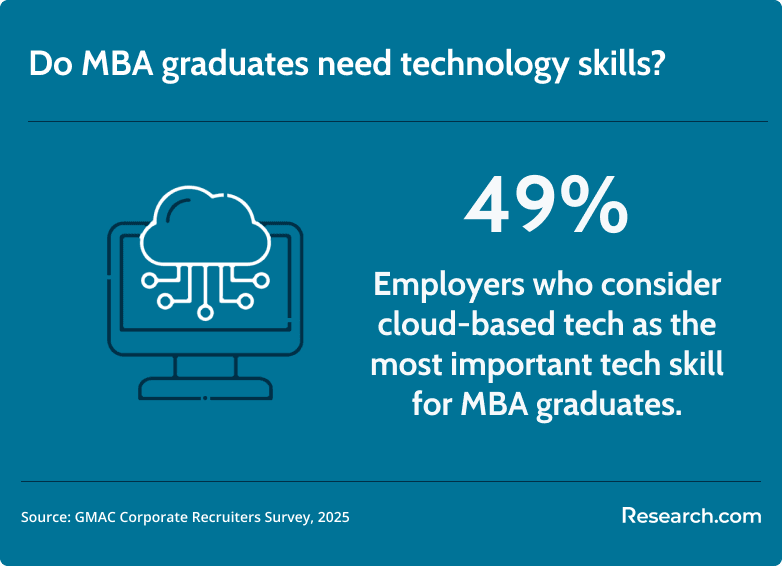
Students should look closely at how each program teaches technology and analytics. The 2024 Corporate Recruiters Survey from GMAC reports that employers value technology skills among current graduate management completers, including cloud-based technology (49%), statistical analysis skills (38%), and data visualization (37%).
Online MBA in General Business concentrations and specializations
A General Business MBA gives students a broad management base, but many online programs allow concentration coursework or elective clusters. The right specialization depends on the role you want after graduation, the skills missing from your current résumé, and the industry where you plan to compete.
| Specialization | Best fit | Typical focus |
| Finance | Students interested in financial management, investment analysis, risk, or executive finance roles | Financial markets, corporate finance, portfolio thinking, budgeting, and risk analysis |
| Business Analytics | Managers who want to make stronger decisions using data | Statistical methods, data modeling, dashboards, visualization, and evidence-based strategy; see this business analytics salary and career guide for related career context |
| Marketing | Professionals pursuing brand, growth, digital marketing, or customer strategy roles | Consumer behavior, market research, campaign strategy, brand management, and digital channels |
| Human Resources | Students planning to lead talent, culture, employee relations, or workforce strategy | Talent management, organizational behavior, employee relations, and labor considerations; this guide on whether an MBA in HR is a good option can help with the decision |
| Project Management | Professionals who coordinate complex initiatives across teams, budgets, and timelines | Project planning, scheduling, budgeting, risk, stakeholder communication, and execution |
| International Business | Students working with global teams, suppliers, customers, or markets | Global logistics, international trade, cross-cultural leadership, and multinational strategy |
| Entrepreneurship | Current or aspiring founders, innovators, and venture-focused professionals | Business development, innovation, startup planning, funding strategy, and small business operations |
| Leadership and Organizational Development | Managers moving into people leadership, change management, or executive roles | Team leadership, organizational growth, change strategy, and communication; it can be a natural next step after programs such as the fastest online bachelor’s degrees in organizational leadership |
If you are unsure which concentration to choose, review job descriptions for your target role and identify repeated skill requirements. Then compare those requirements with each program’s elective list, capstone options, and faculty expertise.
How to choose the best online MBA in General Business program
The best online MBA is not always the highest-ranked or most expensive one. It is the program that fits your career goal, budget, learning style, academic background, and time constraints while meeting recognized quality standards.
Decision checklist for comparing programs
- Accreditation. Prioritize schools with recognized institutional accreditation and business accreditation such as AACSB, Accreditation Council for Business Schools and Programs (ACBSP), or International Accreditation Council for Business Education (IACBE). Accreditation can affect employer confidence, transferability, aid eligibility, and academic quality assurance.
- Curriculum design. Review required courses, electives, analytics content, leadership training, and capstone structure. AACSB has noted that a well-rounded curriculum is central to what students want from business programs.
- Faculty background. Look for instructors with strong academic credentials, business experience, research activity, or industry ties in your field of interest.
- Online delivery. Check whether courses are asynchronous, synchronous, hybrid, cohort-based, self-paced, or accelerated.
- Career services for online students. Confirm that remote students receive coaching, résumé help, interview preparation, employer events, and alumni access.
- Networking structure. Look for group projects, virtual networking events, mentorship, residencies, alumni communities, and employer engagement.
- Total cost. Compare tuition, fees, books, travel, lost work time, and financial aid rather than only the advertised per-credit rate.
- Outcomes and transparency. Review graduation rates, retention, student satisfaction, employment support, and any available career outcome data.
Questions to ask an admissions advisor
- Is the MBA fully online, or are any campus visits required?
- Are classes live, asynchronous, or a mix of both?
- What is the average weekly time commitment per course?
- Can online students use the same career services as campus students?
- Does the program offer GMAT/GRE waivers?
- Are scholarships available for online MBA students?
- What happens if I need to pause enrollment for work or family reasons?
- Which electives are offered online every year, and which are only offered occasionally?
- Does the program include applied projects, simulations, consulting work, or a capstone?
- How active is the alumni network for online MBA graduates?
Common mistakes when choosing an online MBA
| Mistake | Why it can hurt you | Better approach |
| Choosing based only on rankings | A highly ranked program may not fit your schedule, budget, or target industry | Use rankings as one input, then compare accreditation, curriculum, cost, and support |
| Looking only at tuition | Fees, books, travel, and time away from work can change the total cost | Calculate the full estimated cost before applying |
| Ignoring accreditation | Weak accreditation can affect credibility and aid eligibility | Verify institutional and business accreditation before committing |
| Assuming online means easy | Online MBA programs can be rigorous and time-intensive | Ask about weekly workload and course pacing |
| Overlooking career services | The degree alone may not create advancement without networking and career strategy | Choose a program with career support for online learners |
| Picking a specialization too early | A narrow concentration may not match your eventual career direction | Review job postings and speak with mentors before selecting electives |
Career paths for online MBA in General Business graduates
An online MBA in General Business can support several management and leadership paths because the degree develops cross-functional business knowledge. Outcomes are not guaranteed, and career progress depends on prior experience, industry, location, networking, performance, and how well students translate MBA projects into job-ready evidence.
| Career path | What the role typically involves | Why a general business MBA can help |
| Management Consultant | Analyzing business problems, recommending process improvements, supporting strategy, and helping organizations execute change | Consulting requires structured problem-solving, financial awareness, communication, and strategic thinking |
| Financial Manager | Managing budgets, financial planning, reporting, investment decisions, and organizational financial health | MBA coursework in finance, accounting, and analytics can strengthen decision-making |
| Marketing Manager | Leading campaigns, brand strategy, market research, customer acquisition, and product positioning | General business training helps connect marketing decisions to finance, operations, and strategy |
| Operations Manager | Improving processes, coordinating logistics, managing production or service delivery, and increasing efficiency | Operations roles benefit from systems thinking, data analysis, and leadership skills |
| Human Resources Manager | Leading talent strategy, employee relations, workforce planning, performance management, and organizational culture | An MBA can support HR leaders who need business fluency and executive communication skills |
| Project Manager | Planning, budgeting, coordinating teams, managing timelines, and delivering projects across departments | MBA training supports stakeholder management, budgeting, risk analysis, and strategic alignment |
| Executive or senior leadership roles | Setting strategy, managing teams, overseeing functions, and making organization-wide decisions | An MBA may support long-term advancement toward roles such as Chief Financial Officer, Chief Executive Officer (CEO), or Chief Operating Officer (COO); students comparing later doctoral options may also review this DBA salary guide |
| Entrepreneurship | Launching, funding, managing, and growing a business | Entrepreneurs need skills in finance, marketing, operations, strategy, and leadership |
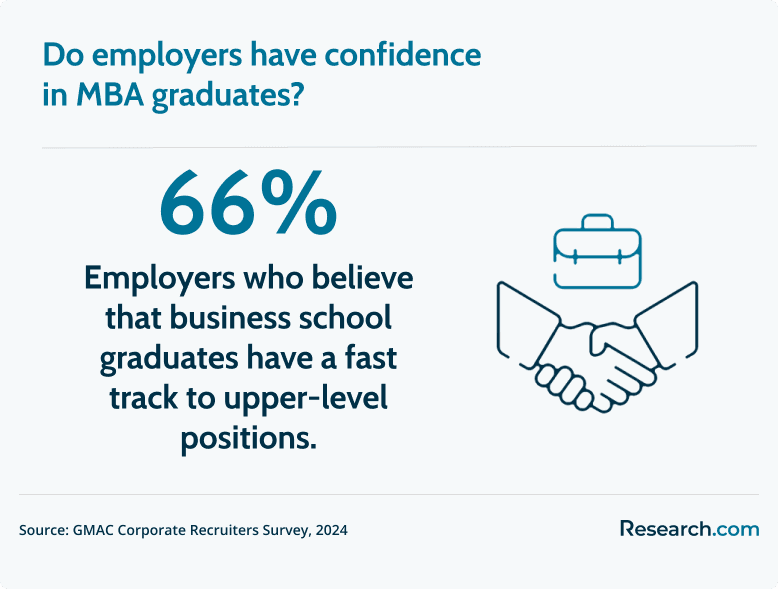
Employer views of graduate management education remain relevant. A GMAC 2024 survey of corporate recruiters shows that 40% of employers are confident that graduate management education programs prepare students to be successful in their organizations. In the same survey, 66% believe business school graduates tend to have a fast track to upper-level positions in companies.
Career outcomes improve when graduates keep building the business school skills employers expect now and in the future, especially in areas such as strategic thinking, leadership, technology fluency, and data-informed decision-making.
Certifications that can strengthen an online MBA in General Business
Certifications can make an MBA more targeted. A general business MBA signals broad management preparation, while a certification can demonstrate practical capability in a defined skill area. This is especially useful for students moving into project-heavy, analytics-focused, finance-oriented, HR, operations, or technology-adjacent roles.
| Credential area | When it may make sense | How it complements an MBA |
| Project management | You manage timelines, budgets, teams, vendors, or cross-functional initiatives | Pairs MBA strategy and leadership coursework with execution skills; students may also compare options such as an accelerated project management degree |
| Business analytics | You want to work with dashboards, reporting, forecasting, or data-supported decisions | Adds technical depth to MBA decision-making and strategy courses |
| Human resources | You plan to lead talent, employee relations, training, or workforce planning | Builds specialized credibility on top of broad organizational leadership training |
| Finance | You want roles involving budgeting, investment analysis, financial planning, or corporate finance | Supports the quantitative side of MBA finance and accounting coursework |
| Technology and digital transformation | You work in industries where AI, cloud tools, automation, or digital operations are reshaping management | Helps connect business strategy with the tools organizations use to compete |
Do not collect credentials without a strategy. Choose certifications that appear repeatedly in job postings for your target role or are valued by your employer or industry.
Why accreditation matters for an online MBA in General Business
Accreditation is one of the first items students should verify. It signals that a school or business program has been reviewed against recognized quality standards. For online MBA students, accreditation can affect academic credibility, employer recognition, financial aid access, and long-term confidence in the degree.
Business-specific accreditation, such as AACSB, ACBSP, or IACBE, is especially relevant when comparing MBA programs. It does not guarantee a job or salary outcome, but it gives students a stronger basis for evaluating curriculum quality, faculty standards, student support, and continuous improvement practices.
Students trying to control costs should not treat low price and quality as opposites. A carefully selected affordable accredited online MBA can be a practical option when it offers recognized accreditation, transparent pricing, and solid career support.
Job market outlook for online MBA in General Business graduates
The job market for MBA graduates is not uniform. Demand varies by industry, company size, geography, economic conditions, and the graduate’s prior work experience. A general business MBA can be valuable because it applies across functions, but today’s employers increasingly expect graduates to pair classic business fundamentals with digital fluency, adaptability, and evidence-based decision-making.
Employer demand and hiring signals
The 2024 GMAC Corporate Recruiters Survey shows that, globally, 36% of employers plan to increase hiring of MBA graduates. The survey identifies especially notable hiring interest in these sectors:
- Manufacturing - 44%
- Finance/accounting - 34%
- Products/services - 31%
- Technology - 29%
- Consulting - 29%
Current trends affecting MBA graduates
Economic uncertainty, tighter hiring in some technology and consulting firms, and AI-related disruption have changed how employers evaluate business graduates. The MBA credential still matters, but it is strongest when paired with applied skills: analytics, communication, strategic adaptability, technology awareness, and the ability to lead teams through change.
According to the 2024 GMAC Corporate Survey, 26% of employers across the globe say that AI is currently important for GME graduates, including MBA graduates. In the technology sector, AI also ranks as the second most important future skill for business school graduates.
How to prepare for the MBA job market
- Use class projects to create portfolio-ready examples of strategy, finance, analytics, and leadership work.
- Build relationships with classmates, faculty, alumni, and career advisors early rather than waiting until graduation.
- Choose electives that match real job postings in your target industry.
- Develop practical technology skills, especially in data analysis, visualization, cloud-based tools, and AI-aware business decision-making.
- Ask career services how online students connect with employers, alumni, and recruiters.
- Keep your résumé focused on measurable outcomes, not just job duties.
Preparation starts before the MBA. Some students build a foundation through undergraduate business or economics study, including options such as an accelerated online bachelor’s degree in economics, while others enter from engineering, healthcare, liberal arts, technology, or military backgrounds.
The chart below summarizes skills valued by global employers, based on the 2024 GMAC Corporate Recruiters Survey:
What graduates say about earning an online MBA in General Business
- Sylvia: "Completing my General Business MBA online helped me stay employed while building stronger finance and leadership skills. I was able to use course concepts at work almost immediately, which made the program feel practical rather than theoretical."
- Ezekiel: "The online format made graduate school possible while I was managing family and work responsibilities. Strategy and business analytics courses helped me see problems differently and gave me the confidence to pursue consulting opportunities."
- Alex: "My online MBA connected me with classmates from different industries and regions. The group projects and applied assignments helped me prepare for a broader leadership role and gave me a clearer view of global business challenges."
Key Insights
- An online MBA in General Business is best for professionals who want broad management training, career flexibility, and the ability to study while working.
- Program length varies widely. Accelerated options may take as few as 10 to 12 months, while part-time pathways may take 2.5 to 3 years.
- Cost should be evaluated as a full investment, not just tuition. Fees, books, residency requirements, travel, and work-time trade-offs can change affordability.
- Accreditation is critical. Look for recognized institutional accreditation and business accreditation such as AACSB, ACBSP, or IACBE.
- A general business curriculum should include finance, accounting, marketing, operations, leadership, strategy, analytics, ethics, and an applied capstone or integrative project.
- Specializations are useful when they match a clear career target. Finance, analytics, marketing, HR, project management, international business, entrepreneurship, and leadership are common options.
- Employer demand remains present, but graduates need more than the credential. Technology fluency, AI awareness, data visualization, statistical analysis, and strategic adaptability are increasingly important.
- The strongest program choice is the one that fits your career goal, schedule, budget, learning style, and need for networking and career support.
References:
- Association to Advance Collegiate Schools of Business (2024). Master's Enrollment Trends at AACSB Schools. https://www.aacsb.edu/insights/reports/2024/masters-enrollment-trends-at-aacsb-schools
- Graduate Management Admission Council (2024). Corporate Recruiters Survey – 2024 Report. https://www.gmac.com/-/media/files/gmac/research/employment-outlook/2024-corporate-recruiters-survey/2024_gmac_crs_report.pdf?rev=43588bfef9a549af9bb00a432a3d7b06
- Graduate Management Admission Council (October 2024). Application Trends Survey 2024 Report. https://www.gmac.com/-/media/files/gmac/research/admissions-and-application-trends/2024_ats.pdf
- Graduate Management Admission Council (March 2025). Demand for Graduate Management Education. https://www.gmac.com/-/media/files/gmac/research/geographic-trends/2025_gmac_demand-for-gme_report_final.pdf?rev=3c7ffe67024748c88be80e7c2880d9cd
- Hanson, M. (November 2024). Average Cost of a Master’s Degree. Education Data Initiative. https://educationdata.org/average-cost-of-a-masters-degree
- MIT Sloan (December 2024). 2024-2025 MBA Employment Report. https://mitsloan.mit.edu/sites/default/files/2024-12/MBA-Employment-Report-2024-2025.pdf https://educationdata.org/average-cost-of-a-masters-degree
- U.S. Bureau of Labor Statistics (n.d.). Occupational Employment and Wage Statistics, Industry: Cross-industry, Private, Federal, State, and Local Government, Period: May 2024. https://data.bls.gov/oes/#/industry/000000 Data retrieved August 2025
Other Things You Need to Know About Online MBA in General Business Degrees
Graduates of the 2027 Best Online MBA in General Business Programs typically advance to roles in management, consulting, and entrepreneurship. Many find opportunities with multinational corporations, tech firms, or startups, leveraging their enhanced skills in strategic decision-making and leadership. Career advancement is common, often accompanied by significant salary increases.
For 2027, top online MBA programs in General Business typically require a bachelor's degree, professional experience, and standardized test scores like the GMAT or GRE. Some may also require essays, recommendation letters, and interviews. Math skills are helpful but not always a specific requirement.
In 2027, the average cost of an online MBA in General Business ranges from $30,000 to $60,000. This investment varies by institution, reputation, program length, and additional fees. Prospective students should compare tuition and financial aid options to make informed decisions.


