2027 Best Online Bachelor's Degree Programs in Human Services

Co-Founder and Chief Data Scientist
A strong desire to help people is the foundation of a great career in human services. With the average age of community service specialists being 41.3, it's a field that welcomes people from all walks of life. But turning that passion into a stable profession requires a clear, strategic plan.
That’s why this guide is more than just a list. The career planning experts who created it have over 10 years of experience helping people build sustainable careers with purpose. Here is your expert-backed blueprint for earning an online human services degree and finding your place in a growing field.
What are the benefits of getting an online bachelor's degree program in human services?
- This degree provides a direct path to stable, professional jobs in growing non-profit, government, and healthcare sectors.
- Graduates can earn a solid income, with the average starting salary for human services professionals hovering around $45,000 a year.
- Earning your degree online offers the flexibility to fit your coursework around your existing work and family commitments.
What can I expect from an online bachelor's degree program in human services?
You can expect two core things from a quality program: a strong academic curriculum and a mandatory, real-world field experience. The coursework is delivered flexibly online, covering the essential theories, ethics, and practical skills you'll need on the job.
The most important component is the hands-on training. People often wonder how you get experience with an online degree, and the answer is simple: a structured internship. The best programs have dedicated coordinators who work with you to find an approved placement in a local organization. This isn't just a suggestion; it's a graduation requirement.
This blend of flexible online classes and required, in-person fieldwork is what makes a good online human services degree so effective. It’s designed to give you both the knowledge and the practical experience you need to step confidently into your first professional role.
Where can I work with an online bachelor's degree program in human services?
An online bachelor's degree in human services prepares you for roles in the key sectors that employ the vast majority of community-focused professionals. In 2023, the field of community health employed over 63,000 people.
The largest employers of community health workers include:
- Social Assistance: This sector is the largest employer, accounting for 21% of all jobs in the field.
- Ambulatory Healthcare Services: These employers, including outpatient clinics and physicians' offices, make up 19% of the workforce.
- Local Government: Public sector roles at the local level employ 17% of all community health workers.
- Hospitals: State, local, and private hospitals account for 10% of employment opportunities.
- Religious and Civic Organizations: These groups also make up 10% of the employers in the field.
How much can I make with an online bachelor's degree program in human services?
An online bachelor's degree in human services leads to careers with stable salaries that grow with experience. For community health workers, a common role for graduates, the earning potential breaks down like this:
- Average Annual Salary: The national average pay for a community health worker is approximately $44,925.
- Entry-Level Pay: Professionals in the 25th percentile, often those starting their careers, earn around $38,000 per year.
- Experienced Professional Pay: With experience, those in the 75th percentile can expect to make about $50,000 annually.
- Top-Tier Pay: The top earners in the field command salaries of over $58,000 a year.
- List of the Best Online Bachelor's Degree Programs in Human Services for 2027 List of Programs
- How long does it take to complete an online bachelor's degree program in human services? Completion Time
- How does an online bachelor's degree program in human services compare to an on-campus program? How does an online bachelor's degree program in human services compare to an on-campus program?
- What is the average cost of an online bachelor's degree program in human services? Program Cost
- What are the financial aid options for students enrolling in an online bachelor's degree program in human services? Financial Aid
- What are the prerequisites for enrolling in an online bachelor's degree program in human services? What are the prerequisites for enrolling in an online bachelor's degree program in human services?
- What courses are typically in an online bachelor's degree program in human services? What courses are typically in an online bachelor's degree program in human services?
- What types of specializations are available in an online bachelor's degree program in human services? What types of specializations are available in an online bachelor's degree program in human services?
- How to Choose the Best Online Bachelor's Degree Program in Human Services How to Choose the Best Online Bachelor's Degree Program in Human Services
- What career paths are available for graduates of an online bachelor's degree program in human services? Career Paths
- What is the job market for graduates of an online bachelor's degree program in human services? Job Market
- What are the career advancement and graduate study options after earning a human services degree? What are the career advancement and graduate study options after earning a human services degree?
- Can Integrating Psychology Specializations Boost Your Human Services Career? Can Integrating Psychology Specializations Boost Your Human Services Career?
Best Online Bachelor’s Degree Programs in Human Services for 2027
Choosing an online bachelor’s degree in human services is a practical decision for students who want to work with individuals, families, and communities but need a flexible path to a credential. The right program can prepare you for case management, community outreach, nonprofit services, substance abuse support, family services, and related roles. The wrong program can leave you with limited internship support, unclear transfer policies, or a degree that does not match your career goals.
This guide explains how online human services bachelor’s programs work, how long they take, what they cost, what to look for in accreditation and field experience, and how to compare programs based on career outcomes rather than marketing claims. It is designed for first-time college students, transfer students, working adults, career changers, and students planning to continue into counseling, social work, public health, psychology, or public policy.
Quick answer: Is an online bachelor’s in human services worth considering?
An online bachelor’s degree in human services can be a strong option if you want a flexible, career-focused degree for entry-level helping professions and plan to build practical experience through internships, volunteer work, or related employment. It is especially useful for students who want to work in community agencies, social service organizations, healthcare support programs, nonprofit settings, or public service roles. Before enrolling, confirm that the school is accredited, review internship requirements, compare the net price rather than only tuition, and ask whether the curriculum supports your intended career path or graduate school plans.
How we rank schools
Because a bachelor’s degree requires a major investment of time and money, our ranking process focuses on transparent, decision-useful information. Research.com reviews data from sources such as the IPEDS database, Peterson's database, the College Scorecard database, and the National Center for Education Statistics. These sources help evaluate online bachelor’s degree programs in human services using consistent education and institutional data. You can learn more about the ranking process on Research.com’s methodology page.
Online human services bachelor’s programs at a glance
| School and Program | Credits Required | Cost per Credit | Best Fit |
| Walden University - BS in Human Services | 181 quarter credits | $350 per quarter credit | Students interested in a globally oriented curriculum and a possible path toward graduate study |
| Purdue Global - Online Bachelor's Degree in Human Services | 180 quarter credits | $371 | Students who want concentrations and preparation for the optional HS-BCP credential exam |
| Southern New Hampshire University - Human Services Degree Online Bachelor’s Program | 120 credits | $342 | Students who want a broad human services degree with a capstone experience |
| Mount St. Mary's University - Bachelor of Science degree in human services | 120 credits | $580 | Working adults seeking advising, internships, and an interdisciplinary curriculum |
| East Tennessee State University - B.S. Human Services | 120 credits | In-State: $334; Out-of-State: $558 | Students preparing for graduate study in counseling, psychology, or social work |
| Old Dominion University - Human Services Online Program Bachelor of Science | 120 credits | In-State: $268; Out-of-State: $444 | Students interested in substance abuse counseling and practical documentation skills |
| Colorado State University Global - accelerated online Bachelor of Science in Human Services | 120 credits | $375 | Students looking for flexible pacing, applied skills, and career-aligned specializations |
| Liberty University - Bachelor of Science in Human Services | 120 credits | $390 | Students who want a faith-based program combining psychology, social work, and ethics |
| Ohio University - Bachelor of Applied Human and Consumer Sciences | 120 credits | In-State: $334; Out-of-State: $344 | Students interested in leadership, communication, diversity, and organizational work |
| Gardner-Webb University - Bachelor of Science in Human Services Degree Completion Program | 120 credits | $385 | Transfer students and degree-completion students seeking multiple concentration options |
1. Walden University - BS in Human Services
The Walden University BS in Human Services is built for students who want to understand social problems in a broader community and global context. The program may also appeal to students who are already thinking ahead to graduate school because select undergraduate coursework can be applied toward an MS in Human Services.
- Program Length: Varies
- Required Quarter Credits to Graduate: 181
- Cost per Quarter Credit: $350
- Accreditation: Higher Learning Commission (HLC)
2. Purdue Global - Online Bachelor's Degree in Human Services
Purdue Global offers an online bachelor’s program centered on applied human services work, including assessment, intervention, and evaluation for individuals and communities facing complex needs. Graduates complete coursework that meets eligibility requirements to sit for the optional Human Services—Board Certified Practitioner (HS-BCP) credential exam.
- Program Length: 3.5 years
- Concentrations: Child and Family Services; Gerontology; and Substance Abuse and Addiction
- Required Quarter Credits to Graduate: 180
- Cost per Credit: $371
- Accreditation: Higher Learning Commission (HLC)
3. Southern New Hampshire University - Human Services Degree Online Bachelor’s Program
Southern New Hampshire University structures its online human services bachelor’s program around advocacy, policy awareness, and support for individuals and families. Students complete a capstone that asks them to apply classroom learning to a practical human services problem.
- Program Length: 4 years
- Concentrations: Child and Family Services; Gerontology; and Substance Abuse
- Required Credits to Graduate: 120
- Cost per Credit: $342
- Accreditation: New England Commission of Higher Education (NECHE)
4. Mount St. Mary's University - Bachelor of Science degree in human services
Mount St. Mary’s University offers a human services program designed for adult learners who want a blend of sociology, psychology, education, ethics, and applied field experience. The program includes internships and advising support so students can shape their degree plan around professional goals.
- Program Length: 4 years
- Required Credits to Graduate: 120
- Cost per Credit: $580
- Accreditation: Middle States Commission on Higher Education (MSCHE)
5. East Tennessee State University - B.S. Human Services
East Tennessee State University provides a human services curriculum grounded in human and behavioral sciences. The degree can be a strong fit for students who want direct-service preparation now and may later pursue graduate study in areas such as counseling, psychology, or social work.
- Program Length: 4 years
- Note: This program requires a minor, with over 15 online options available.
- Required Credits to Graduate: 120
- Cost per Credit: In-State: $334; Out-of-State: $558
- Accreditation: Council for Standards in Human Services Education (CSHSE)
6. Old Dominion University - Human Services Online Program Bachelor of Science
Old Dominion University emphasizes practical preparation for entry-level human services work, including skills such as writing legally defensible case notes. The program is also recognized as an approved educational provider for Virginia’s Certified Substance Abuse Counselor (CSAC) credential.
- Program Length: 4 years
- Specialization: Substance Abuse Counseling
- Required Credits to Graduate: 120
- Cost per Credit: In-State: $268; Out-of-State: $444
- Accreditation: Southern Association of Colleges and Schools Commission on Colleges (SACSCOC)
7. Colorado State University Global - accelerated online Bachelor of Science in Human Services
Colorado State University Global offers an accelerated online human services program focused on case management, intervention methods, community development, administration, and workplace technology. Its structure may work well for students who want a flexible program with options to align electives or specializations with career plans.
- Program Length: Varies (Accelerated options available)
- Specializations: Healthcare Management; Project Management; Marketing; and more
- Required Credits to Graduate: 120
- Cost per Credit: $375
- Accreditation: Higher Learning Commission (HLC)
8. Liberty University - Bachelor of Science in Human Services
Liberty University combines psychology, social work concepts, ethics, and a faith-based perspective in its online BS in Human Services. Students complete either an internship or capstone, giving them a structured opportunity to connect coursework with practice.
- Program Length: 4 years
- Required Credits to Graduate: 120
- Cost per Credit: $390
- Accreditation: Southern Association of Colleges and Schools Commission on Colleges (SACSCOC)
9. Ohio University - Bachelor of Applied Human and Consumer Sciences
Ohio University offers a flexible applied program that develops leadership, communication, diversity, and organizational problem-solving skills. Students can tailor the degree through two emphasis areas, making it relevant for public outreach, service organizations, and community-facing roles.
- Program Length: 4 years
- Areas of Emphasis: Leadership and Organization; and Diversity and Communication
- Required Credits to Graduate: 120
- Cost per Credit: In-State: $334; Out-of-State: $344
- Accreditation: Higher Learning Commission (HLC)
10. Gardner-Webb University - Bachelor of Science in Human Services Degree Completion Program
Gardner-Webb University offers a degree-completion pathway for students who want to become stronger advocates, problem solvers, and service coordinators. The program includes several concentration options and prepares students with knowledge and skills connected to the Human Services-Board Certified Practitioner (HS-BCP) exam.
- Program Length: 4 years
- Concentrations: Nonprofit Leadership; Family Dynamics; Pre-Counseling; Substance Use and Abuse; Social Services; and Generalist
- Required Credits to Graduate: 120
- Cost per Credit: $385
- Accreditation: Southern Association of Colleges and Schools Commission on Colleges (SACSCOC)
How long does it take to complete an online bachelor’s degree in human services?
Most online bachelor’s programs in human services require 120 credits and take 4 years for full-time students. Part-time students usually take longer, but the slower pace can make it easier to continue working, caring for family, or managing other responsibilities while earning the degree.
The actual timeline depends on transfer credits, course load, school calendar, internship requirements, and whether the program uses standard terms, accelerated sessions, or self-paced options.
How transfer credits can shorten your timeline
If you previously attended college, earned an associate degree, completed military training, or hold other eligible credits, you may be able to reduce the number of courses you need. This is one reason many students compare shortest social sciences online degree options before choosing a program.
Ask each school for an official transcript evaluation before you enroll. That evaluation should show which credits apply to general education, major courses, electives, and residency requirements. This step is especially important for returning students because the number of credits accepted can change both cost and completion time. Data shows a bachelor's degree is the primary qualification for professionals in this field, with over 40,000 workers holding one.
| Student Situation | Likely Timeline Factor | What to Ask the School |
| No previous college credit | May need the full 120-credit sequence | Can I complete courses year-round to stay on track? |
| Associate degree or prior credits | Transfer credits may reduce time to completion | How many credits will apply directly to the major? |
| Working full time | Part-time enrollment may extend the timeline | What is the recommended course load for working adults? |
| Internship required | Field placement may affect graduation timing | When should I begin arranging my internship site? |
Online vs. on-campus human services programs: What is the difference?
A well-designed online human services degree should cover the same core academic content as an on-campus program from the same institution: human behavior, ethics, case management, diversity, policy, crisis response, and field practice. Employers generally focus on school accreditation, your experience, your communication skills, and your ability to work with clients rather than the physical location where you completed coursework.
The bigger difference is how you learn. Online programs require more independent planning, while campus programs offer more built-in structure and face-to-face interaction.
Online vs. campus comparison
| Format | Advantages | Trade-Offs | Best For |
| Online | Flexible scheduling, access from home, often easier to combine with work | Requires self-discipline, proactive communication, and comfort with technology | Working adults, parents, rural students, transfer students |
| On campus | In-person classes, campus activities, immediate access to local faculty and peers | Less schedule flexibility and possible commuting or housing costs | Students who prefer structured routines and face-to-face learning |
| Hybrid | Mixes online convenience with some in-person interaction | May still require travel to campus or scheduled meetings | Students who want flexibility but value occasional in-person contact |
Fieldwork matters more than format
Human services is a people-centered field, so a fully online program still needs to help you build real-world experience. Before enrolling, ask how the program supports internships, whether you can complete fieldwork near your home, what agencies students commonly use, and who supervises placement approval. A flexible online program is only useful if it also helps you gain credible, local practice experience.
What is the average cost of an online bachelor’s degree in human services?
Total tuition for an online bachelor’s degree in human services can range from about $30,000 to over $60,000. Published tuition is only one part of the financial picture, however. Your actual cost may change based on transfer credits, financial aid, course materials, technology fees, residency status, and whether you study full time or part time.
The most useful number is net price, which reflects tuition and required costs after grants and scholarships are applied. Use each school’s net price calculator and request a written financial aid estimate before making a final decision.
How to evaluate return on investment
A human services degree should be evaluated against both cost and career fit. Many graduates enter meaningful roles, but starting pay can be modest in some organizations. Benefits also matter. Industry data shows that while most community health worker jobs offer medical benefits, about 23% offer none.
When comparing programs, ask whether the degree will help you qualify for internships, entry-level roles, credential exams, or graduate programs. A lower-cost school may offer better value if it accepts more transfer credits and provides strong field placement support. A higher-cost option may be justified only if it clearly improves access to your intended career path, support services, or future education plans.
| Cost Factor | Why It Matters | Question to Ask |
| Tuition per credit | Determines the base cost of each course | Is the rate different for online, in-state, or out-of-state students? |
| Transfer credit policy | Accepted credits can reduce both time and tuition | How many of my previous credits will count toward graduation? |
| Fees and materials | Technology, books, and course fees can raise total cost | What required costs are not included in tuition? |
| Internship logistics | Fieldwork can affect transportation, schedule, and work hours | Can I complete my internship near where I live? |
| Financial aid | Grants and scholarships can lower net price | What aid is renewable each year? |
What financial aid options are available for online human services bachelor’s students?
Online students at eligible accredited institutions may qualify for several types of financial aid. The starting point is the Free Application for Federal Student Aid (FAFSA), which schools use to determine eligibility for federal aid and, in some cases, state and institutional aid.
- Grants: Grants are aid funds that usually do not need to be repaid and are often based on financial need.
- Scholarships: Scholarships also usually do not require repayment and may be awarded for academics, service, background, program interest, or other criteria.
- Student loans: Loans can help cover education costs, but they must be repaid with interest, so borrow only what you realistically need.
Financial aid considerations for new American students
Eligibility can be especially confusing for immigrants, refugees, asylees, permanent residents, and students with DACA status. Rules vary by aid source, so confirm details directly with each school’s financial aid office.
- Federal aid eligibility: Federal student aid generally requires U.S. citizenship or eligible non-citizen status, including permanent residents, refugees, and asylees.
- DACA student options: Students with DACA status are generally not eligible for federal aid, but they may qualify for state aid, institutional scholarships, or private scholarships.
- Best first step: Contact the financial aid office before applying or enrolling. Ask which aid sources match your status, state, program format, and enrollment level.
Ways to reduce the cost of the degree
- Complete the FAFSA early and update it every year you are enrolled.
- Request a transfer credit review before committing to a school.
- Ask employers about tuition assistance or education benefits.
- Compare total program cost, not just cost per credit.
- Prioritize grants and scholarships before borrowing loans.
- Ask whether part-time enrollment affects aid eligibility.
What are the admission requirements for an online bachelor’s in human services?
The basic admission requirement for most online bachelor’s programs in human services is a high school diploma or GED. Some schools may also request transcripts, an application form, a personal statement, test scores, or proof of previous college work, depending on their admissions policy.
Requirements vary, so do not assume that all online programs use the same process. Adult-friendly and transfer-friendly schools may place more weight on previous coursework, work history, military experience, community service, or professional goals.
How prior college or work experience can help
- Previous college credits: Prior coursework or an associate degree can be valuable if the school accepts those credits toward your bachelor’s degree. Ask for a transcript evaluation early.
- Holistic admission review: Some schools review the full application rather than relying only on grades. Relevant work, caregiving, volunteer service, or community experience can strengthen your profile.
- Related professional backgrounds: Applicants from public safety, healthcare support, education, nonprofit work, military service, or community programs may already have transferable skills. Students comparing an accelerated online public safety degree may find that some of their experience also aligns with human services work.
What courses are included in an online human services bachelor’s program?
An online human services curriculum usually combines social science theory with applied skills for working with clients, families, groups, and communities. Students commonly study ethics, diversity, human behavior, social welfare systems, crisis response, public policy, program planning, and professional documentation.
The best programs do more than explain helping professions. They teach students how to assess needs, make referrals, coordinate services, document interactions, communicate across cultures, and understand the limits of their professional role.
Common course areas
| Course Area | What You Learn | Why It Matters in Practice |
| Human behavior and development | How people change across the lifespan and how environment affects behavior | Helps you understand client needs in context |
| Case management | Intake, service planning, referrals, documentation, and follow-up | Prepares you for common entry-level human services roles |
| Ethics and professional boundaries | Confidentiality, mandated reporting, scope of practice, and ethical decision-making | Protects clients and helps you work responsibly |
| Cultural diversity | How identity, language, culture, and social systems affect service access | Improves communication and reduces barriers to care |
| Crisis intervention | How to respond to urgent client needs and connect people to appropriate resources | Builds readiness for high-pressure service environments |
| Technology and records | Client management platforms, electronic health records, and digital documentation | Reflects the administrative and compliance demands of modern agencies |
Skills employers often look for
- Core theories: Human services students study psychology, sociology, family systems, social problems, and community dynamics.
- Applied frameworks: Coursework often includes intake interviewing, referral planning, crisis intervention, and case coordination. Understanding case management vs social work can help you choose the right next step after graduation.
- Technical skills: Agencies increasingly expect staff to use electronic health records, client databases, telehealth tools, and secure documentation systems.
Students should also understand the labor market they are preparing to enter. Data for community and social service specialists shows an average male salary of $60,687 compared to $51,683 for females. Knowing how salary, benefits, credentials, and advancement work can help graduates advocate for themselves as well as for clients.
What specializations are available in online human services bachelor’s programs?
Specializations allow students to focus their degree on a population, service setting, or career direction. Not every school offers the same options, so choose a concentration based on the roles you want after graduation, not just the title that sounds most interesting.
- Gerontology: Focuses on aging, elder services, caregiver support, long-term care systems, and the needs of older adults.
- Substance Abuse: Introduces addiction, recovery support, prevention, referrals, and treatment systems.
- Child and Family Services: Prepares students to support families, children, youth, and caregivers through community and social service agencies.
- Community Health: Emphasizes health education, prevention, resource navigation, and population-level support.
How to choose a specialization
| If You Want To Work With... | Consider This Focus | Look For Courses In... |
| Older adults and caregivers | Gerontology | Aging services, long-term care, family support, end-of-life issues |
| People affected by addiction | Substance Abuse | Addiction studies, recovery systems, prevention, counseling foundations |
| Children, parents, and families | Child and Family Services | Family systems, child welfare, trauma, advocacy, community resources |
| Communities facing health barriers | Community Health | Health education, outreach, prevention, public health systems |
| Nonprofit or agency operations | Leadership or nonprofit services | Program planning, grants, supervision, organizational communication |
Why location can affect career strategy
Where you work can influence salary, benefits, job openings, and specialization value. Some regions may have more demand for community health workers, substance abuse support, family services, or aging-related programs.
- Geography matters: Pay can vary widely by state and employer type.
- High-paying examples: The average salary is $65,510 in the District of Columbia and $63,900 in New Mexico.
- Policy knowledge can be useful: Students who want to understand how funding, regulation, and public systems shape service access may also compare the fastest online public policy degree programs.
How to choose the best online human services degree program
The best online human services program is not simply the cheapest, fastest, or highest-ranked option. It is the program that is accredited, affordable for your situation, realistic for your schedule, supportive of internships, and aligned with your target role or graduate school plan.
- Confirm accreditation first. Accreditation affects financial aid eligibility, transferability, employer acceptance, and graduate school options. You can also review standards through the Council for Standards in Human Service Education (CSHSE). If a school lacks recognized institutional accreditation, be cautious.
- Review field placement support. Human services is practice-based. Ask whether the school helps online students locate internships, what sites are acceptable, who approves supervisors, and whether evening or weekend placements are possible.
- Compare transfer credit policies. Two schools with similar tuition may have very different total costs if one accepts more of your previous credits.
- Look at faculty experience and student support. Instructors with recent human services experience can connect theory to practice. Strong advising, mental health support, and career services also matter in a field where burnout is a concern; studies show up to 31% of behavioral health clinicians leave their jobs within two years.
- Match the curriculum to your goal. A student aiming for substance abuse services needs different coursework than someone preparing for nonprofit leadership, family services, community health, or graduate study.
- Ask direct questions before enrolling. A strong admissions team should be able to explain costs, credits, fieldwork, support, and outcomes without vague promises.
Questions to ask before you apply
| Question | Why It Matters |
| Is the institution regionally or otherwise properly accredited? | Accreditation affects financial aid, employer recognition, and future education options. |
| How many of my transfer credits will apply to the degree? | This determines your real timeline and cost. |
| Does the program require an internship or practicum? | Field experience can improve job readiness but may affect scheduling. |
| Who helps online students find local placement sites? | Online students need clear support for in-person requirements. |
| Does the program prepare students for any optional credentials? | Credential alignment may improve competitiveness for certain roles. |
| What career services are available to online students? | Resume help, interview coaching, and employer connections can support the transition into work. |
| What is the total estimated net price after aid? | Net price is more useful than published tuition alone. |
Common mistakes to avoid
- Choosing a program before checking accreditation.
- Comparing only tuition per credit instead of total net cost.
- Assuming every online program will arrange your internship for you.
- Ignoring whether credits transfer into or out of the program.
- Picking a specialization without checking local job demand.
- Assuming a bachelor’s degree automatically qualifies you for licensed counseling or clinical social work roles.
- Relying only on rankings instead of asking about fieldwork, advising, and outcomes.
What career paths are available with an online bachelor’s degree in human services?
An online bachelor’s degree in human services can prepare graduates for entry-level and early-career roles in community agencies, nonprofit organizations, healthcare support programs, public service settings, residential programs, schools, and advocacy organizations. It is usually not a clinical license by itself, but it can provide a foundation for direct service, case coordination, community outreach, and program support.
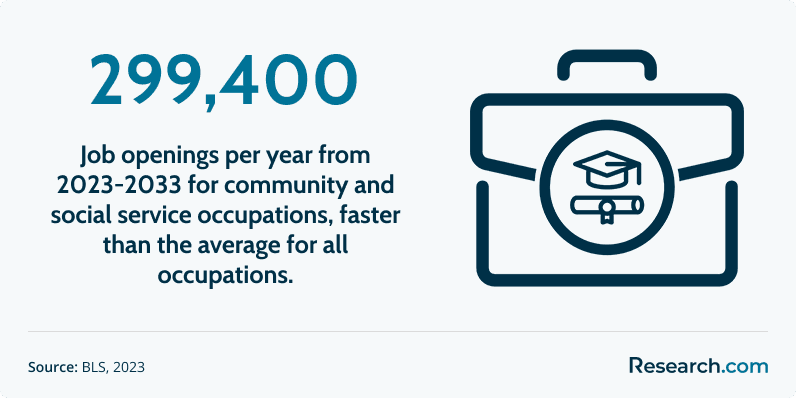
The outlook is favorable for related roles. Positions for community health workers are expected to grow by 13% over the next decade, which is much faster than the average for all occupations.
Common roles for graduates
| Role | Typical Responsibilities | Good Fit For |
| Case Manager | Assess client needs, coordinate services, make referrals, document progress | Graduates who want direct client contact and systems navigation experience |
| Community Health Worker | Connect communities with health resources, provide education, support outreach | Students interested in prevention, health access, and community wellness |
| Family Services Worker | Support families through service plans, referrals, education, and advocacy | Students focused on children, parents, caregivers, or family systems |
| Substance Abuse Support Specialist | Assist with recovery support, referrals, education, and program coordination | Students with coursework or specialization in addiction services |
| Program Coordinator | Organize services, support staff, track outcomes, communicate with partners | Career changers with administrative, project, or operations experience |
| Bilingual Caseworker | Support clients across languages and cultures while coordinating services | Multilingual graduates and new American professionals with community insight |
How different students can position themselves
- New graduates: Case manager or community outreach roles can build a strong foundation in direct service and local resource systems.
- Career changers: Program coordinator or nonprofit operations roles may allow you to use previous experience in management, communications, education, healthcare, or customer service.
- New American professionals: Bilingual and bicultural skills can be highly valuable in agencies serving immigrant, refugee, or multilingual communities.
Students who want a broader population-health focus may also consider a fast track public health degree online as a related pathway.
What is the job market like for human services graduates?
The job market for human services graduates is shaped by demand for community-based care, behavioral health support, social assistance, public health outreach, aging services, and nonprofit programs. For community health workers, about 7,500 job openings are projected each year for the next decade.
That demand creates opportunity, but graduates should be realistic. Some roles offer meaningful work and strong experience but modest starting salaries. Benefits, supervision quality, caseload size, advancement pathways, and workplace culture can vary significantly by employer.
The two realities of the field
The first reality is demand: communities need trained professionals who can connect people to services, reduce barriers, and coordinate support. The second reality is sustainability: human services work can be emotionally demanding, and compensation varies. A smart job search should evaluate the full offer, not just the job title.
Before accepting a position, compare salary, health benefits, paid time off, supervision, training, caseload expectations, promotion pathways, and whether the employer supports further credentials or graduate education. Long-term career growth often depends on choosing early roles that provide both experience and a realistic path forward.
Current trends affecting human services careers
- Technology-supported casework: Client databases, electronic health records, secure messaging, and virtual service delivery are increasingly part of daily work.
- Integrated care models: Human services professionals often collaborate with healthcare, behavioral health, housing, education, and public agencies.
- Credential awareness: Employers may prefer candidates who understand optional certifications, state-specific requirements, or graduate pathways.
- Burnout prevention: Caseload management, supervision, and workplace support are important factors when evaluating employers.
- Community and cultural competence: Agencies need staff who can build trust with diverse populations and reduce service access barriers.
What are the advancement and graduate study options after a human services bachelor’s degree?
A bachelor’s degree in human services can lead directly to entry-level service roles, but many graduates eventually pursue advanced education to move into clinical, supervisory, policy, or specialized positions. Common next steps include graduate study in social work, counseling, psychology, public health, public administration, or human services leadership.
Students interested in advanced behavioral health training may compare accredited online PsyD programs, especially if they want to understand psychological assessment, organizational leadership, and advanced practice topics. However, students should carefully review accreditation, state licensure rules, practicum requirements, and clinical training expectations before choosing any graduate program.
Potential next steps after graduation
| Goal | Possible Next Step | Important Caution |
| Clinical social work | Master of Social Work | Licensure requirements vary by state and usually include supervised experience. |
| Counseling roles | Graduate counseling program | A bachelor’s alone usually does not qualify graduates for licensed counseling practice. |
| Psychology-focused work | Graduate psychology study | Clinical roles often require advanced degrees and state licensure. |
| Public health outreach | Public health degree or certification | Choose programs aligned with community health, prevention, or health education goals. |
| Program leadership | Human services, nonprofit, public administration, or management graduate study | Leadership roles may also require experience, not just another degree. |
Can psychology specializations strengthen a human services career?
Psychology coursework can complement human services training by improving your understanding of behavior, motivation, trauma, development, communication, and client-centered support. This can be useful for case managers, family service workers, community health workers, and program staff who regularly interact with people facing complex personal and social challenges.
Some students explore an accelerated psychology degree online to build deeper knowledge in human behavior or prepare for graduate study. This path can make sense if your career goals involve counseling, behavioral health, research, assessment, or psychology-informed service design. It may be less necessary if your goal is immediate entry into general casework, outreach, or nonprofit support.
What graduates say about online bachelor’s programs in human services
- : "I started volunteering at a shelter before college, so I knew I wanted work that involved helping people directly. What I did not know was how to turn that interest into a career. The program helped me understand the professional side of the field, and the internship gave me agency experience before graduation. By the time I finished, I had both confidence and a job offer. — Kaelan"
- : "After 15 years in marketing, changing careers felt risky. I could not quit my job to go back to school full time, so the online format made the transition possible. I studied at night and used skills I already had, like project planning and communication, in a field that felt more meaningful to me. My background was treated as an advantage, not a setback. — Elara"
- : "I came to the United States with education from another country, but employers did not always know how to interpret it. This degree helped me understand how social support systems work here. It also showed me that speaking English and Arabic was a major strength. That language ability became one of the reasons I was hired to serve families in my community. — Zaire"
Key Insights
- An online bachelor’s degree in human services is best for students who want flexible preparation for direct-service, outreach, case management, nonprofit, or community support roles.
- Most programs require 120 credits and take 4 years full time, but transfer credits, accelerated formats, and part-time study can change the timeline.
- Total tuition can range from about $30,000 to over $60,000, but net price after aid is the number that matters most.
- Accreditation and internship support should be checked before cost, ranking, or convenience. A low-cost program is not a good value if it lacks recognized accreditation or practical fieldwork support.
- Specializations such as gerontology, substance abuse, child and family services, and community health are useful when they match your target population or employer type.
- Human services graduates can enter a growing job market, including community health worker roles expected to grow by 13% over the next decade, with about 7,500 job openings projected each year for the next decade.
- Starting salaries and benefits can vary, so evaluate job offers based on total compensation, supervision, caseload, advancement opportunities, and burnout risk.
- A bachelor’s degree is usually not enough for licensed clinical counseling, clinical social work, or psychologist roles. Students with those goals should plan for graduate education and state-specific licensure requirements.
References:
- Data USA. (n.d.). Miscellaneous community & social service specialists, including health educators & community health workers. Retrieved August 11, 2025, from https://datausa.io/profile/soc/miscellaneous-community-social-service-specialists-including-health-educators-community-health-workers
- IBISWorld. (2024). Healthcare & Social Assistance in the US - Number of Employees 2005–2030. Retrieved August 11, 2025, from https://www.ibisworld.com/united-states/employment/healthcare-social-assistance/1550/
- Momentum. (2025, April 4). HHS Announces Significant Restructuring, Streamlining Agency Functions and Slashing Workforce. Retrieved August 11, 2025, from https://momentum4all.org/policy-advocacy-news-april-4-2025
- National Center for Health Statistics. (2023, June 14). Mental health. U.S. Department of Health & Human Services, Centers for Disease Control and Prevention. Retrieved August 11, 2025, from https://www.cdc.gov/nchs/fastats/mental-health.htm
- Payscale. (n.d.). Average Community Health Worker Hourly Pay. Retrieved August 11, 2025, from https://www.payscale.com/research/US/Job=Community_Health_Worker/Hourly_Rate
- U.S. Bureau of Labor Statistics. (2024, April 17). Community Health Workers. Occupational Outlook Handbook. Retrieved August 11, 2025, from https://www.bls.gov/ooh/community-and-social-service/community-health-workers.htm
- U.S. Bureau of Labor Statistics. (2024, April 25). Occupational Employment and Wages, May 2023: 21-1094 Community Health Workers. Occupational Employment Statistics. Retrieved August 11, 2025, from https://www.bls.gov/oes/2023/may/oes211094.htm
- U.S. Department of Health & Human Services, Centers for Medicare & Medicaid Services. (2023). NHE Fact Sheet. Retrieved August 11, 2025, from https://www.cms.gov/data-research/statistics-trends-and-reports/national-health-expenditure-data/nhe-fact-sheet
- U.S. Department of Labor. (n.d.). 21-1094.00 - Community Health Workers. O*NET OnLine. Retrieved August 11, 2025, from https://www.onetonline.org/link/summary/21-1094.00
- Watson, T. S., & Lemon, K. N. (2021). Turnover among behavioral health staff in a public behavioral health system. Centers for Disease Control and Prevention. https://stacks.cdc.gov/view/cdc/104997/cdc_104997_DS1.pdf
- ZipRecruiter. (n.d.). Community Health Workers Salary. Retrieved August 11, 2025, from https://www.ziprecruiter.com/Salaries/Community-Health-Workers-Salary#TableView; related occupational profile: https://datausa.io/profile/soc/miscellaneous-community-social-service-specialists-including-health-educators-community-health-workers
Other Things You Should Know About Online Bachelor's Degree Programs in Human Services
Yes, financial aid options are available for 2027 online bachelor's degrees in human services, including federal student aid, scholarships, and grants. Many institutions offer need-based and merit-based financial assistance. Check with specific programs for details on available funding and eligibility requirements.
Yes. Employers and graduate schools often look for regional accreditation, and the Council for Standards in Human Service Education (CSHSE) also accredits some human services programs. Accreditation can affect transfer credit, eligibility for federal aid, and whether the degree meets licensure or certification requirements.