2027 Best Doctorate of Social Work (DSW) Degree Programs Online With No GRE Required

Co-Founder and Chief Data Scientist
An online Doctorate of Social Work can be a strong next step for experienced social workers who want to move beyond direct practice into advanced clinical leadership, teaching, policy, program design, administration, or applied research. The challenge is choosing a program that fits your schedule, budget, licensure goals, and career direction—especially if you want to avoid taking the GRE.
This guide focuses on online doctorate-level social work programs that do not require GRE scores, with attention to program length, tuition, credits, accreditation, specializations, admissions expectations, career outcomes, and practical decision points. It is designed for MSW-prepared professionals, licensed social workers, social service leaders, clinicians, educators, and policy-focused practitioners comparing whether a DSW or related social work doctorate is worth the investment.
Quick Answer: Are There Online DSW Programs With No GRE Required?
Yes. Several universities offer online or hybrid doctorate-level social work programs that do not require the GRE. These programs are generally intended for professionals who already hold an MSW or closely related graduate degree and have social work experience. Most programs evaluate applicants through graduate transcripts, professional experience, recommendations, writing samples, statements of purpose, interviews, and evidence of leadership or clinical readiness instead of standardized test scores.
What are the main benefits of earning an online doctorate in social work?
- Flexibility for working professionals: Many online DSW programs use asynchronous coursework, live virtual sessions, limited residencies, or part-time options so students can continue working while studying.
- Preparation for advanced roles: Doctoral-level study can strengthen your ability to lead agencies, supervise clinicians, teach, evaluate programs, influence policy, and develop evidence-informed interventions.
- Potential for higher-level compensation: Social workers earn an average salary of $58,380, and advanced education, specialized credentials, leadership responsibilities, and additional experience may support higher earning potential. Salary outcomes are not guaranteed and vary by role, location, employer, licensure, and sector.
What can I expect from a doctorate in social work degree program?
A doctorate in social work is an advanced graduate program for professionals who want to apply social work knowledge at a higher level of practice, leadership, scholarship, or systems change. Most DSW programs are practice-focused, while PhD programs in social work usually emphasize research and academic scholarship. Some programs blend both approaches, so it is important to review the curriculum before applying.
Students can expect coursework in advanced social work theory, applied research, leadership, ethics, policy, clinical practice, teaching, program evaluation, and organizational change. Many programs require a capstone, dissertation, portfolio, applied research project, or practice innovation project. Depending on the program, students may also complete virtual residencies, synchronous seminars, field-based assignments, or in-person immersions.
Where can I work with a doctorate degree in social work?
Graduates may work in universities, hospitals, mental health agencies, child welfare organizations, community nonprofits, government agencies, healthcare systems, advocacy organizations, private practice, consulting firms, and social service leadership roles. Common paths include clinical director, social work administrator, faculty member, policy analyst, program evaluator, consultant, advanced clinician, and organizational leader.
How much can I make with a doctorate degree in social work?
Pay depends heavily on the job title and work setting. Reported median annual wages for social workers range from around $53,940 for child, family, and school social workers to $62,940 for healthcare social workers. Social workers in advanced leadership, research, policy, or specialized clinical roles may earn more, and the highest 10% of social workers earn more than $94,910. A DSW can support advancement, but it does not automatically guarantee a specific salary.
- 2027 list of online doctorate in social work programs with no GRE required
- How long does an online doctorate in social work take?
- Online DSW vs. on-campus DSW: which format fits you?
- How much does an online doctorate in social work cost?
- Financial aid options for online DSW students
- Typical admissions requirements for online DSW programs
- Common courses in an online doctorate in social work
- Online DSW specializations to compare
- How to choose the best online doctorate in social work program
- How a doctorate in social work can address major societal challenges
- Career paths for doctorate of social work graduates
- Emerging trends shaping online DSW programs
- Whether accelerated social work pathways can improve career momentum
- DSW vs. clinical MSW: key differences
- DSW vs. psychology degree: how the pathways compare
- How a DSW builds on an MSW foundation
- Whether an online DSW can be a cost-effective investment
- Job market outlook for doctorate-level social work graduates
- Technology requirements for online DSW students
- How top online DSW programs compare
- How to balance work responsibilities with online doctoral study
- Social worker vs. therapist: key differences
- Skills gained by combining doctoral education with professional practice
- Common mistakes to avoid before enrolling
2027 List of the Best Online Doctorate of Social Work Programs With No GRE Required
How do we rank schools?
Research.com evaluates programs using a structured review process designed to help readers compare schools more clearly. Our team uses our methodology along with reputable education data sources, institutional information, and publicly available program details. Because graduate social work programs can differ significantly in purpose, format, cost, and admissions criteria, students should use rankings as a starting point—not the only factor in their decision.
- Integrated Postsecondary Education Data System
- Peterson's database, including the Distance Learning Licensed Data Set
- College Scorecard
- National Center for Education Statistics
Before applying, confirm institutional accreditation and program-specific requirements. A useful first step is learning how to verify an accredited online school, especially if you plan to use federal aid, transfer credits, pursue academic employment, or meet employer requirements.
At-a-Glance Comparison of Online Social Work Doctorate Programs With No GRE
| School | Program focus | Program length | Credits | Cost listed | Accreditation listed |
| University of Southern California | Social change and innovation | 24 months | 42 | $2,137 per credit | Western Association of Schools and Colleges (WASC) |
| University of Louisville | Social work leadership | One to two years | 44 | $1,582 per credit | Southern Association of Colleges and Schools Commission on Colleges (SACSCOC) |
| University of Pennsylvania | Clinical social work | Three Years | 44 | $7,291 per course unit | Middle States Commission on Higher Education (MSCHE) |
| Arizona State University | Social work research doctorate pathway | Two to three years | 60 | $1,700 per credit | Higher Learning Commission (HLC) |
| University of St. Thomas | Teaching, leadership, and social work education | Three Years | 45 | $1,200 per credit | HLC |
| University of Kentucky | Multiple DSW concentration options | Two Years | 42 | $737 per credit | SACSCOC |
| Capella University | Applied leadership and practice | Two to three years | 71 | $995 per credit | HLC |
| Barry University | Trauma-informed leadership and practice | Three Years | 48 | $8,100 per year | SACSCOC |
| University at Buffalo | Part-time advanced practice and applied science | Three Years | 39 | $9,600 per year | MSCHE |
| University of Tennessee, Knoxville | Advanced clinical practice for mental health social workers | Two Years | 48 | $700 in-state; $775 out-of-state | SACSCOC |
1. University of Southern California
The Suzanne Dworak-Peck School of Social Work offers an online DSW program with no GRE required. USC’s program is built around social change, innovation, organizational strategy, and applied leadership. Courses include topics such as financial management for social change and communication and influence for social good. Students complete a capstone project that connects doctoral learning to a practical social impact challenge. The program may also suit professionals who need a part-time option.
- Program Length: 24 months
- Tracks/concentrations: N/A
- Cost per Credit/Tuition: $2,137
- Required Credits to Graduate: 42
- Accreditation: Western Association of Schools and Colleges (WASC)
2. University of Louisville
The Raymond A. Kent School of Social Work and Family Science provides an online doctor of social work program without a GRE requirement. The curriculum is designed for master’s-prepared social workers who want advanced mentoring, leadership preparation, and training for social service administration or teaching. Students study ethical leadership, social service systems, evaluation, and scientific inquiry as applied to leadership and instruction.
- Program Length: One to two years
- Tracks/concentrations: social work leadership
- Cost per Credit/Tuition: $1,582
- Required Credits to Graduate: 44
- Accreditation: Southern Association of Colleges and Schools Commission on Colleges (SACSCOC)
3. University of Pennsylvania
The University of Pennsylvania offers a doctorate in clinical social work program for advanced practitioners and educators. The program is described as the nation’s first practice-focused social work doctorate centered solely on clinical social work. It uses an online hybrid format for working professionals and includes synchronous video instruction along with periodic campus immersions. Students complete a dissertation thesis on clinical social work issues with faculty guidance.
- Program Length: Three Years
- Tracks/concentrations: clinical social work
- Cost per Credit/Tuition: $7,291 per course unit
- Required Credits to Graduate: 44
- Accreditation: Middle States Commission on Higher Education (MSCHE)
4. Arizona State University
Arizona State University’s Watts College of Public Service and Community Solutions offers a PhD in social work that can be completed online. This doctorate is research-oriented and requires a written comprehensive exam, prospectus, and dissertation. The program allows 30 credit hours from a previously awarded MSW degree to count toward the doctorate. ASU does not require GRE scores, but applicants must show preparation through factors such as graduate GPA and experience in social work teaching or research.
- Program Length: Two to three years
- Tracks/concentrations: N/A
- Cost per Credit/Tuition: $1,700
- Required Credits to Graduate: 60
- Accreditation: Higher Learning Commission (HLC)
5. University of St. Thomas
The University of St. Thomas offers an online DSW program developed for social work educators, leaders, and practitioners interested in teaching in higher education. Students examine pedagogy, scholar-practitioner identity, leadership, and social justice. The banded dissertation model requires students to produce three connected scholarly works tied together by a shared theme, issue, pedagogy, or population.
- Program Length: Three Years
- Tracks/concentrations: N/A
- Cost per Credit/Tuition: $1,200
- Required Credits to Graduate: 45
- Accreditation: HLC
6. University of Kentucky
The University of Kentucky provides an online DSW program with specialization options. This program may appeal to students who want a more targeted doctoral pathway, because it offers concentrations in military behavioral health, social work education, clinical social work, and administrative leadership. During the concentration year, students complete five courses: three tied to the concentration and two connected to the capstone project.
- Program Length: Two Years
- Tracks/concentrations: military behavioral health, social work education, clinical social work, and administrative leadership
- Cost per Credit/Tuition: $737
- Required Credits to Graduate: 42
- Accreditation: SACSCOC
7. Capella University
Capella University offers an online program in DSW focused on leadership, advanced practice, critical thinking, applied theory, and project planning. Students complete 14 core courses, two virtual residencies, and a capstone project. This pathway is designed for professionals who want doctoral-level preparation connected to real-world social work management and practice challenges.
- Program Length: Two to three years
- Tracks/concentrations: N/A
- Cost per Credit/Tuition: $995
- Required Credits to Graduate: 71
- Accreditation: HLC
8. Barry University
Barry University’s School of Social Work offers a doctor of social work program delivered online. The program centers on trauma-informed leadership and practice, making it relevant for MSW practitioners who want to work with trauma-affected individuals, families, organizations, or communities. Barry also offers a DSW student association platform intended to support doctoral students through governance and peer connection.
- Program Length: Three Years
- Tracks/concentrations: trauma-informed leadership and practice
- Cost per Credit/Tuition: $8,100 per year
- Required Credits to Graduate: 48
- Accreditation: SACSCOC
9. University at Buffalo
The University at Buffalo offers an online part-time DSW program designed for experienced practitioners who need to keep working while earning a doctorate. The curriculum emphasizes applied science, evidence-informed practice, and the connection between research and direct service. Students also study how to integrate diversity, equity, and inclusion into professional practice settings.
- Program Length: Three Years
- Tracks/concentrations: N/A
- Cost per Credit/Tuition: $9,600 per year
- Required Credits to Graduate: 39
- Accreditation: MSCHE
10. University of Tennessee, Knoxville
The University of Tennessee offers an online doctor of social work program for experienced mental health practice social workers. The curriculum is aimed at scholar-practitioners who want to apply neurobehavioral science, advanced research, and clinical knowledge to social work practice. It also includes pedagogical elements for students considering future academic roles.
- Program Length: Two Years
- Tracks/concentrations: N/A
- Cost per Credit/Tuition: $700 (in-state), $775 (out-of-state).
- Required Credits to Graduate: 48
- Accreditation: SACSCOC
Key Findings
- Most online doctorate-level social work programs take about two to five years, depending on enrollment status, credits, dissertation or capstone structure, and residency requirements.
- Online DSW programs often cover similar doctoral-level topics as campus programs, but delivery format, live-session expectations, and networking experiences vary.
- Many universities prefer or require applicants to hold a master of social science degree or MSW from an accredited institution.
- A DSW may support advancement into leadership, teaching, advanced clinical, policy, or consulting roles, but salary growth depends on employer, role, licensure, geography, and experience.
- The demand for social workers is projected to grow by seven percent over the next decade.
How long does it take to complete an online doctorate in social work program?
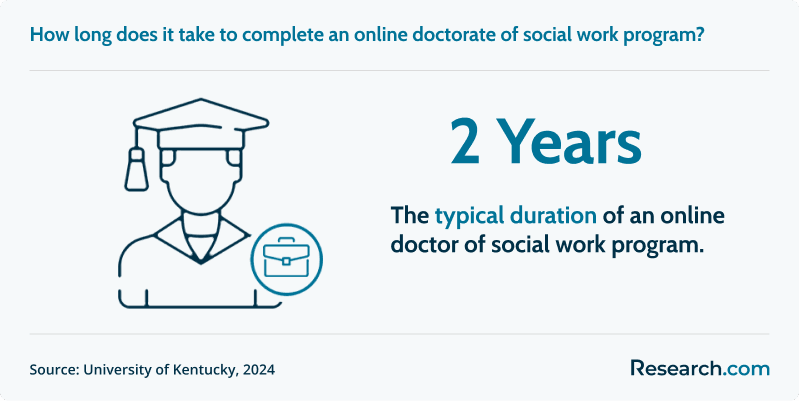
Many full-time online DSW programs can be completed in about 24 months or two years. Program length varies because credit requirements range from at least 36 credit hours to around 80 credit hours, depending on the university, specialization, capstone structure, dissertation expectations, and whether prior graduate credits are accepted. Part-time online DSW programs commonly take about three years.
When comparing timelines, look beyond the advertised completion time. Ask whether the program requires live classes, weekend intensives, campus visits, dissertation milestones, cohort sequencing, or continuous enrollment. Students comparing the workload of a DSW with other graduate healthcare pathways may also want to review related options such as affordable online DSW programs when evaluating cost and scheduling trade-offs across advanced professional degrees.
| Enrollment path | Typical completion time | Best fit | Trade-off |
| Full-time online DSW | About 24 months or two years | Students who can handle a heavier academic load | Less scheduling flexibility and greater weekly time demand |
| Part-time online DSW | About three years | Working professionals with full-time jobs or family obligations | Longer time before graduation and possible extended fees |
| Research-focused doctorate | Two to three years or longer, depending on dissertation progress | Students interested in research, teaching, or academic scholarship | Dissertation expectations may be more intensive |
How does an online doctorate of social work program compare to an on-campus program?
An online DSW is usually better for professionals who need flexibility, cannot relocate, or want to continue working while earning a doctorate. Campus-based programs may be better for students who want more face-to-face mentoring, local field connections, on-campus teaching opportunities, or direct access to faculty research groups.
| Factor | Online DSW | On-campus DSW |
| Schedule | Often includes asynchronous coursework, evening sessions, or limited residencies | Requires regular physical attendance and may have fixed class times |
| Location | Accessible from anywhere with reliable technology, unless residencies are required | Best for students who live near campus or can relocate |
| Networking | Relies on virtual discussions, group projects, video meetings, and online communities | Offers more spontaneous in-person interaction with faculty and peers |
| Cost considerations | May reduce commuting, relocation, and housing costs | May include campus fees, commuting, parking, or relocation expenses |
| Learning style | Works well for self-directed students with strong time management | Works well for students who prefer structured in-person accountability |
What is the average cost of an online doctorate in social work program?
The cost of an online DSW varies widely by institution, credit load, tuition model, residency requirements, and fees. For example, USC’s DSW costs about $89,750 for 42 credit hours, while UL’s program costs about $69,608 for 44 credit hours. An online DSW from UST costs about $54,000 for 45 credit hours. These examples show why students should calculate total program cost, not just per-credit tuition.
Also check whether tuition is charged per credit, per course unit, per term, or per year. Ask about technology fees, residency travel, books, graduation fees, payment plans, and whether tuition differs for in-state and out-of-state students.
| Cost item | Why it matters | Question to ask |
| Tuition | This is usually the largest expense and may be charged in different ways | Is tuition per credit, per course, per year, or per term? |
| Fees | Online, technology, student services, graduation, and residency fees can add up | Can the school provide a full fee schedule before enrollment? |
| Residency or immersion costs | Hybrid programs may require travel, lodging, and time away from work | How many in-person sessions are required? |
| Time away from work | Even online study can affect income, overtime, or client hours | How many hours per week should students expect? |
| Financial aid and employer support | Aid can reduce short-term cost, but loans must be repaid | What funding is available for doctoral social work students? |
What are the financial aid options for students enrolling in an online doctorate of social work program?
Online DSW students may be able to use several funding sources, but availability depends on enrollment status, school policy, employer benefits, and federal aid eligibility. Start early because some scholarships and assistantships have separate deadlines.
- FAFSA: Submitting the Free Application for Federal Student Aid (FAFSA) is the standard first step for federal student loans and other aid options for eligible students.
- Research and teaching assistantships: Some universities offer assistantships that may include stipends, tuition support, or teaching and research experience. These may be limited for fully online doctoral students, so ask directly.
- Employer tuition reimbursement: Healthcare systems, government agencies, nonprofits, universities, and large social service organizations may provide partial tuition support for employees whose studies align with organizational needs.
- Military education benefits: Active-duty service members may qualify for tuition assistance, while veterans and eligible military-connected students may be able to use GI Bill benefits.
- Professional association funding: Groups such as the National Association of Social Workers (NASW) and the Council on Social Work Education (CSWE) may provide scholarships, grants, awards, or funding information relevant to social work graduate students.
What are the prerequisites for enrolling in an online doctorate of social work program?
Admissions requirements differ by school, but most online DSW programs expect evidence that applicants are ready for doctoral-level professional study. GRE-free does not mean admission is easy; programs often place more weight on professional experience, writing ability, leadership goals, and graduate academic performance.
| Requirement | What programs usually look for | Why it matters |
| Technical readiness | Reliable computer access, strong internet, video conferencing ability, and comfort with online platforms | Online doctoral work requires frequent digital collaboration and independent learning |
| Master’s degree | Most programs require an MSW from an accredited institution; some may consider related graduate degrees | The doctorate builds on graduate social work theory, practice, research, and ethics |
| Social work license | Some programs prefer or require a current license, such as Licensed Clinical Social Worker, LCSW | Licensure can show professional readiness and ethical standing |
| Recommendations | Usually two to three letters from supervisors, faculty, or professional colleagues | Strong references help confirm leadership potential and academic preparation |
| Work experience | Many programs expect two to five years of relevant professional social work experience | DSW coursework often relies on applying doctoral concepts to practice settings |
If you still need a graduate credential before doctoral study, compare affordable online masters options carefully. Students comparing professional doctoral paths may also review DNP programs online to understand how doctoral admissions differ across helping and healthcare professions.
Because the full education path can include undergraduate, master’s, and doctoral study, some students benefit from exploring accelerated online bachelor degree programs earlier in their academic planning.
What courses are typically in an online doctorate of social work program?
Course titles differ by university, but online DSW curricula usually combine advanced practice knowledge with leadership, research, policy, ethics, and applied scholarship. The strongest program for you is the one whose courses match your intended role after graduation.
- Advanced Social Work Theory: Examines contemporary theories and how they guide practice, leadership, intervention design, and systems-level analysis.
- Leadership and Management in Social Work: Covers supervision, strategic planning, organizational change, program oversight, and leadership within human service settings.
- Social Policy and Advocacy: Studies policy development, policy analysis, legislative advocacy, and the role of social workers in improving systems and services.
- Clinical Practice with Complex Populations: Focuses on advanced interventions, assessment, supervision, and practice with diverse populations facing complex needs.
- Ethics and Professionalism in Social Work: Explores ethical decision-making, professional responsibility, boundaries, equity, and accountability in advanced practice. Related workplace ethics topics may also appear in online masters in human resources programs.
- Research Methods in Social Work: Introduces qualitative and quantitative approaches, evidence evaluation, program assessment, and applied research for practice and policy.
What types of specializations are available in an online doctorate of social work program?
Specializations help align doctoral training with a specific professional goal. Before choosing one, compare the required courses, faculty expertise, capstone expectations, and job outcomes tied to that concentration.
| Specialization | Best for students interested in | Typical focus |
| Clinical Social Work | Advanced practice, supervision, and clinical leadership | Complex cases, evidence-based interventions, trauma-informed care, and supervision |
| Social Policy and Advocacy | Policy analysis, legislative work, and systems change | Policy design, advocacy strategy, community organizing, and equity-focused reform |
| Addiction and Substance Use | Substance use treatment, prevention, and behavioral health leadership | Addiction theory, treatment models, prevention, and recovery support systems |
| Social Work Education | Teaching, curriculum design, and academic leadership | Pedagogy, assessment, online teaching, and scholarly writing |
| Trauma and Interpersonal Violence | Trauma-informed practice, crisis response, and survivor support | Trauma assessment, crisis intervention, violence prevention, and community support |
| Leadership and Administration | Agency management, executive leadership, and program oversight | Organizational strategy, budgeting, supervision, human resources, and evaluation |
Students focused on trauma and behavioral health may also compare social work doctoral options with affordable online colleges for psychology, especially if they are deciding between social systems-focused practice and psychology-centered training.
In the U.S., there are over 728,600 employed social workers across different specializations. This includes 355,300 child, family, and school social workers, 191,400 healthcare social workers, 113,500 mental health and substance abuse social workers, and 68,400 social workers in other areas of specialization. These categories show why specialization matters: a DSW focused on clinical leadership may lead to different opportunities than one focused on policy, education, or administration.
How do I choose the best online doctorate of social work program?
The best online DSW program is not automatically the highest-ranked or most recognizable one. It is the program that fits your career goal, accreditation needs, budget, schedule, learning style, and professional constraints.
- Clarify the role you want after graduation. A future faculty member, clinical director, policy advocate, private consultant, and nonprofit executive may need different doctoral training.
- Verify accreditation and licensure relevance. Check institutional accreditation and ask whether the program affects licensure, clinical supervision eligibility, academic employment, or employer requirements. If you are still comparing MSW options, review cheapest CSWE-accredited online MSW programs because CSWE accreditation is especially important at the MSW level for social work licensure pathways.
- Read the curriculum course by course. Do not rely only on the program title. Compare required courses, electives, capstone expectations, dissertation format, and whether the program is practice-focused or research-focused.
- Review faculty expertise. Look for faculty whose work aligns with your interests in clinical practice, child welfare, trauma, policy, military behavioral health, social work education, program evaluation, or administration.
- Calculate total cost. Include tuition, fees, books, software, travel, lost work time, and loan interest. Ask whether scholarships, assistantships, employer reimbursement, or payment plans are available.
- Ask about student support. Online doctoral students need access to advising, writing support, library services, technology help, career support, faculty mentoring, and peer connection.
Questions to ask before applying
- Is the program fully online, hybrid, or online with required residencies?
- Does the program require a dissertation, capstone, portfolio, or applied research project?
- How many hours per week do enrolled students usually spend on coursework?
- Are classes asynchronous, synchronous, or a mix of both?
- What percentage of students complete the program on time?
- How are doctoral students supported during the capstone or dissertation phase?
- What career paths do recent graduates pursue?
- Does the program align with my state’s licensure or supervision rules, if relevant?
How can a doctorate in social work contribute to addressing societal challenges?
A doctorate in social work can prepare professionals to respond to complex social problems through leadership, applied research, policy work, program design, and advanced practice. DSW graduates may help improve mental health services, strengthen trauma-informed systems, evaluate child welfare programs, address healthcare access barriers, develop community interventions, or advocate for policy change.
The value of doctoral training is often strongest when it connects scholarship with practice. For example, a DSW-prepared leader might use program evaluation to improve services for families, apply evidence-informed models in community mental health settings, supervise clinicians working with complex populations, or design organizational policies that better support underserved groups.
If you are still exploring where social work can lead, reviewing careers in social work can help you connect doctoral study with real job functions, industries, and advancement routes.
What career paths are available for graduates of doctorate of social work degree programs?
Doctorate-level social work graduates may pursue leadership, practice, academic, policy, consulting, and specialized clinical roles. The right path depends on your license, prior experience, doctoral concentration, and professional network.
| Career path | What the role may involve | Common work settings |
| Clinical Social Work Leader | Supervising clinicians, developing treatment protocols, leading practice improvement, and supporting complex case consultation | Hospitals, mental health clinics, community health centers, private practice groups |
| Social Work Administrator | Managing programs, leading agencies, overseeing staff, shaping policies, and evaluating service delivery | Nonprofits, government agencies, healthcare organizations, social service agencies |
| Academic Faculty | Teaching, advising students, conducting research, publishing scholarship, and supporting curriculum development | Universities, colleges, research centers, higher education organizations |
| Policy Analyst or Advocate | Analyzing social policies, recommending reforms, supporting legislation, and advocating for communities | Government agencies, nonprofits, think tanks, advocacy organizations |
| Consultant | Advising organizations on practice models, program design, evaluation, trauma-informed systems, or leadership strategy | Consulting firms, nonprofits, healthcare systems, educational institutions |
| Mental Health Practitioner | Providing advanced services, designing specialized treatment programs, and delivering therapy within scope of licensure | Mental health clinics, hospitals, private practices, community organizations |
Students specifically interested in executive leadership may also compare social work doctoral programs with online PhD organizational leadership programs, particularly if their goal is broader organizational strategy rather than social work-specific practice.
What emerging trends are shaping online DSW programs?
Online DSW programs are increasingly shaped by digital learning tools, remote collaboration, applied analytics, and the need for practice-ready leadership. Some programs are using virtual simulations, online case discussions, collaborative research projects, and data-informed program evaluation assignments to help students connect theory with practice. Artificial intelligence tools may also influence coursework through personalized learning support, adaptive assessments, research assistance, and ethical discussions about technology in human services.
Because program features change over time, students should review current curriculum pages, technology expectations, residency requirements, and accreditation information. Comparing the best DSW programs online can help identify which schools are incorporating updated delivery models while still maintaining academic rigor.
Can accelerated social work education pathways boost my career advancement?
Accelerated pathways can help motivated students reach advanced roles faster, but speed should not come at the expense of licensure preparation, field education quality, faculty support, or long-term affordability. For students who have not yet earned an MSW, one-year MSW programs online may shorten the path toward doctoral study if they meet accreditation, admissions, and state licensure needs.
An accelerated route makes the most sense when you already have strong academic preparation, relevant experience, a clear career goal, and enough time each week to manage compressed coursework. It may be a poor fit if you need more field support, are changing careers, or cannot safely balance full-time work with intensive study.
How does a DSW degree differ from a clinical MSW program?
A clinical MSW is usually the key graduate degree for social work practice and licensure preparation, while a DSW is an advanced doctorate for professionals who already have graduate-level social work training and want to deepen their expertise. A clinical MSW typically emphasizes assessment, therapy methods, case management, field education, and licensure-related competencies. A DSW more often focuses on leadership, advanced practice, teaching, applied research, policy, program evaluation, and organizational change.
| Factor | Clinical MSW | DSW |
| Main purpose | Prepares students for professional social work practice and often clinical licensure pathways | Builds advanced expertise for leadership, teaching, policy, consulting, and higher-level practice |
| Typical student | Career changers or bachelor’s-prepared students entering graduate social work | Experienced MSW-prepared professionals |
| Curriculum focus | Direct practice, field education, assessment, intervention, and ethics | Leadership, applied research, advanced practice, policy, and program design |
| Credential level | Master’s degree | Doctoral degree |
How does a DSW compare to a psychology degree?
A DSW and a psychology degree can both relate to mental health, human behavior, and helping professions, but they are not interchangeable. A DSW is grounded in social work values, systems thinking, social justice, community context, policy, and practice leadership. Psychology degrees often place greater emphasis on psychological assessment, diagnosis, therapy, human cognition, experimental research, or clinical psychology training, depending on the degree level.
If you are deciding between these paths, compare your preferred work: social systems, community programs, policy, and social service leadership usually point toward social work, while psychological testing, clinical psychology, or experimental research may point toward psychology. For a broader breakdown, review this psychology degree vs social work degree comparison.
How does a DSW build on an MSW foundation to advance career opportunities?
An MSW builds core professional competence in social work practice, ethics, field education, policy, and human behavior. A DSW extends that foundation by adding advanced leadership, practice innovation, teaching preparation, applied research, organizational strategy, and policy analysis. This can help experienced professionals move from practitioner roles into positions where they shape programs, supervise teams, influence systems, or train future social workers.
If you are earlier in the field and weighing options before doctoral study, it can help to review what can you do with an MSW degree before deciding whether a doctorate is necessary for your goals.
Is an online DSW program a cost-effective investment?
An online DSW can be cost-effective for students who choose a program aligned with a clear career goal, avoid excessive debt, use employer support or scholarships, and gain access to roles that justify the cost. It may be less cost-effective if the degree does not change your job prospects, if you already qualify for your target role with an MSW, or if the total debt would be difficult to repay on your expected salary.
| When a DSW may be worth it | When to reconsider |
| You need a doctorate for teaching, senior leadership, consulting, or advanced practice credibility | Your desired role only requires an MSW and licensure |
| Your employer offers tuition reimbursement or advancement incentives | You would rely entirely on high-interest debt without a salary plan |
| The curriculum directly matches your concentration area | The program is prestigious but poorly aligned with your goals |
| You can complete the program without leaving the workforce | The workload would reduce your income or harm professional performance |
Students considering broader social science pathways may also compare cost-focused alternatives such as cheapest sociology degrees online, especially if their interests are more research, policy, or social systems oriented than practice-focused social work.
What is the job market for graduates with doctorate degrees in social work?
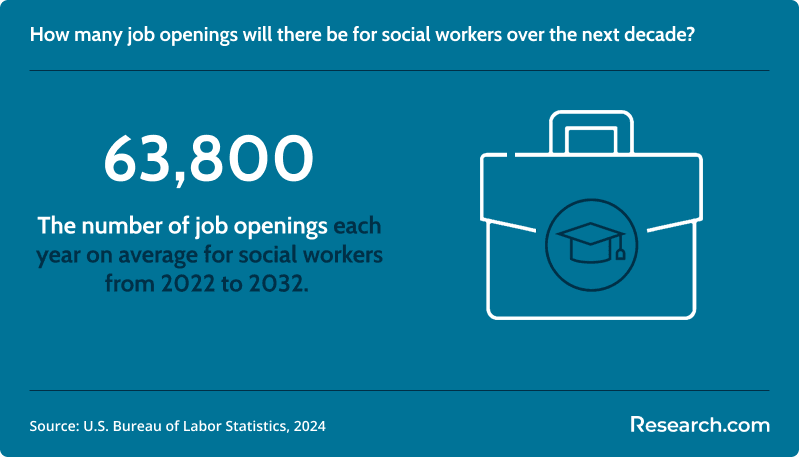
The demand for social workers is projected to increase by seven percent from 2022 to 2032. This projection includes about 63,800 job openings for those with a social work degree each year on average over the next decade. Demand is connected to mental health needs, healthcare integration, social determinants of health, child welfare, family support, and services for vulnerable populations.
Doctorate-level graduates do not compete only for general social worker roles. Many target positions in leadership, higher education, consulting, clinical supervision, policy, or program evaluation. These roles may be more competitive and may require specific experience, licensure, publications, administrative accomplishments, or teaching background in addition to the doctorate.
What are the technological requirements for completing an online DSW program?
Online doctoral study requires more than basic internet access. Students need a reliable setup for live classes, research, presentations, group work, document storage, and secure communication with faculty and classmates.
- Reliable Internet Connection: A stable high-speed connection is necessary for streaming lectures, joining live discussions, uploading assignments, and participating in virtual meetings. Many programs recommend broadband with download speeds of at least 10 Mbps.
- Computer or Device Specifications: Students typically need a current laptop or desktop with updated software. Many online DSW programs recommend at least 8 GB of RAM and a recent operating system such as Windows 10 or higher or macOS 10.15 or higher. A webcam, microphone, speakers, or headset is also important for video participation.
- Learning Management System Access: Programs commonly use platforms such as Blackboard, Canvas, or Moodle for assignments, readings, grades, videos, and discussion boards. New students should complete tutorials before classes begin.
- Productivity Software: Word processing, spreadsheet, and presentation tools such as Microsoft Office or Google Workspace are commonly needed for papers, data work, and presentations. Some universities provide access to these tools.
- Specialized Research Software: Research or evaluation courses may require tools such as SPSS, NVivo, or other qualitative and quantitative analysis programs. Ask whether software is included or available at a student discount.
- Backup and Security: Use secure cloud storage, an external drive, or both. Keep antivirus and security software current, especially when handling sensitive research, client-related scenarios, or field-based materials.
How do top online DSW programs compare to one another?
Top online doctorate-level social work programs differ most in focus, format, tuition, credits, and final project requirements. The best choice depends on whether your goal is clinical expertise, social work education, administrative leadership, trauma-informed practice, research, or social innovation.
Program focus and specialization
- University of Southern California: Best aligned with students interested in social change, innovation, leadership, and applied intervention strategy.
- University of Louisville: Strong fit for professionals focused on social work leadership, administration, and teaching-related preparation.
- University of Pennsylvania: Best suited for advanced practitioners interested in clinical social work, doctoral scholarship, and educator preparation.
- Barry University: A targeted option for trauma-informed leadership and practice.
- University of Kentucky: Useful for students who want defined concentration options, including military behavioral health, social work education, clinical social work, and administrative leadership.
Program length and flexibility
- Arizona State University: Offers a two to three years pathway and is more research-oriented because it is a PhD in social work.
- University at Buffalo: Designed as a part-time program, making it a strong option for working professionals who need a structured but flexible pace.
- University of St. Thomas: Uses a three-year structure focused on preparing social work educators and leaders.
Cost comparison
- University of Kentucky: Listed at $737 per credit, making it one of the lower per-credit options in this list.
- University of Tennessee, Knoxville: Lists $700 for in-state students and $775 for out-of-state students.
- Capella University: Lists $995 per credit and requires 71 credits.
- University of Pennsylvania: Uses a course-unit tuition model listed at $7,291 per course unit.
For a broader cost-focused comparison, review online DSW programs and compare each school’s total program price, not just advertised tuition.
How can I balance professional responsibilities with my online DSW studies?
Balancing doctoral study with social work practice requires planning before the first course begins. DSW students often manage demanding jobs, client responsibilities, supervision duties, family obligations, and emotionally intensive work. A realistic schedule is essential.
- Block weekly study time: Treat coursework like a recurring professional obligation, not something to complete only when time is left over.
- Use asynchronous flexibility strategically: Watch lectures, read, and draft assignments during your most reliable energy windows.
- Set expectations at work: If possible, discuss peak academic periods, residencies, or capstone demands with supervisors early.
- Create a dedicated study system: Keep readings, notes, assignment deadlines, research files, and citation tools organized from the start.
- Build peer support: Cohort relationships can help with accountability, troubleshooting, and motivation.
- Protect recovery time: Social work is emotionally demanding; burnout can undermine both academic and professional performance.
If you are still at the master’s level and want a less selective entry point before doctoral study, compare options such as what is the easiest online MSW program while still checking accreditation, licensure alignment, and field placement quality.
What Are the Key Differences Between a Social Worker and a Therapist?
The distinction between a social worker vs. therapist matters because the roles overlap but are not identical. Social workers may provide therapy if they hold the appropriate clinical license, but they also often coordinate services, advocate for clients, connect people with resources, manage cases, assess social systems, and work on policy or community-level change. Therapists generally focus more directly on counseling, psychotherapy, behavioral interventions, and mental health treatment, depending on their license and training.
If your goal is primarily psychotherapy, confirm the licensure pathway in your state before choosing a doctoral program. If your goal is broader social service leadership, program development, advocacy, or systems change, a DSW may align more closely with your professional direction.
What unique skills can I gain from combining education with professional practice?
One advantage of earning a DSW while continuing to work is that doctoral learning can be tested immediately in professional settings. Students can connect theory, research, policy, leadership, and practice in real time.
- Applying theory to practice: Doctoral coursework can help refine interventions, supervision models, and program strategies in your current workplace.
- Strengthening leadership judgment: Managing doctoral deadlines while working can build decision-making, prioritization, and communication skills.
- Improving policy and advocacy work: Advanced policy study can support stronger advocacy, grant writing, community engagement, and organizational reform.
- Integrating research with service delivery: Applied research and evaluation skills can help you assess whether programs are effective and equitable.
- Expanding professional networks: Online cohorts, faculty mentoring, conferences, and collaborative projects can connect you with professionals outside your local area.
- Demonstrating long-term professional commitment: Completing doctoral training while practicing can show employers and colleagues that you are prepared for higher-level responsibility. Students still preparing for doctoral admissions may begin by comparing CSWE accredited MSW programs.
Common mistakes to avoid before enrolling in an online DSW program
| Mistake | Why it can hurt you | Better approach |
| Choosing a program only because it does not require the GRE | A no-GRE policy does not guarantee strong curriculum fit, affordability, or career value | Compare outcomes, faculty, curriculum, support, and total cost |
| Ignoring accreditation details | Accreditation affects financial aid, employer recognition, transferability, and professional credibility | Verify institutional accreditation and licensure relevance before applying |
| Looking only at tuition per credit | Total cost can change based on credits, fees, residencies, and time to completion | Calculate full program cost and ask for a written estimate |
| Assuming online means self-paced | Many online DSW programs follow cohorts, live class schedules, deadlines, and residency requirements | Ask about synchronous sessions, weekly workload, and attendance rules |
| Picking a specialization without a career plan | A concentration may narrow your preparation or fail to support your target role | Match the specialization to job postings, faculty expertise, and long-term goals |
| Assuming a doctorate guarantees higher pay | Salary depends on role, employer, location, experience, and licensure | Compare the degree cost with realistic job opportunities in your market |
Resources
- University of Kentucky. (2024). Online DSW Curriculum. https://socialworkonline.uky.edu/programs/dsw-doctorate-social-work/curriculum
- University of Louisville. (2024). Tuition: Fall 2023 and Spring 2024. https://louisville.edu/bursar/tuition
- University of Southern California. (2024). Tuition and Financial Aid. https://dworakpeck.usc.edu/admissions/tuition-and-financial-aid
- University of St. Thomas. (2024). GRADUATE FINANCIAL AID. https://www.stthomas.edu/financialaid/graduate/cost/2023-24-tuition-and-fee-rates
- U.S. Bureau of Labor Statistics. (2024). Occupational Outlook Handbook: Social Workers. https://www.bls.gov/ooh/community-and-social-service/social-workers.htm
Key Insights
- Online DSW programs with no GRE are available, but strong applicants still need graduate preparation, relevant experience, recommendations, writing ability, and a clear professional purpose.
- A DSW is usually best for experienced social workers seeking leadership, teaching, advanced clinical supervision, policy, consulting, or program innovation—not for students who only need initial licensure preparation.
- Program costs vary widely. Compare total cost, credits, fees, residency travel, time to completion, and financial aid before deciding whether the degree is worth it.
- Accreditation and licensure alignment are non-negotiable. Verify institutional accreditation and ask how the program fits your state, employer, or academic career requirements.
- The strongest program is the one that matches your intended role. Clinical leaders, educators, policy advocates, trauma specialists, and administrators should look for different curriculum strengths.
- Do not choose based only on rankings or the no-GRE label. Ask detailed questions about curriculum, faculty support, capstone expectations, technology requirements, student outcomes, and workload.
Other Things You Should Know About Doctorate of Social Work (DSW) Degree Programs Online With No GRE Required
In 2027, online DSW students can apply for federal financial aid, scholarships specific to social work, and grants offered by professional social work organizations. Additionally, some schools offer tuition assistance programs for eligible students, tailored for online formats.
Several programs offer an online DSW degree that can be completed without residency requirements. However, some institutions may still include brief residency components for seminars or practical experiences. Aspiring students should verify the specific format with each program.
Most reputable online DSW programs seek accreditation through the Council on Social Work Education (CSWE), which is the main accreditor for social work education in the United States. A CSWE-accredited DSW signals that the program meets national quality standards and may matter for employer review and state licensure paths.


![2027 Best Advanced Standing Online MSW Programs [CSWE Accredited] thumbnail](https://research.com/resized/uploads/Online_Advanced_Standing_MSW_301dbd5368.jpg?format=thumbnail)