
2027 BSW vs. MSW: Explaining the Difference

Co-Founder and Chief Data Scientist
Deciding between a Bachelor of Social Work (BSW) and a Master of Social Work (MSW) is really a decision about the kind of social work career you want, how quickly you want to enter the field, and whether you plan to pursue clinical licensure. A BSW can help you qualify for many entry-level human services and case management roles. An MSW can move you into advanced practice, clinical work, supervision, policy, healthcare, school social work, and higher-responsibility positions.
This guide explains the practical differences between a BSW and an MSW, including program length, admissions, coursework, field education, licensure, salary expectations, job outlook, online program considerations, and when each path makes sense. It is written for students choosing a first degree, BSW graduates considering advanced standing MSW programs, career changers entering social work from another field, and working professionals comparing the return on investment of graduate study.
Quick answer: BSW vs. MSW
A BSW is usually the better starting point if you want to enter social services sooner, build a foundation in generalist practice, and work in roles such as case management, community outreach, child welfare support, or social services coordination. An MSW is usually necessary if your goal is clinical social work, therapy, advanced school or medical social work, social work supervision, policy leadership, or eligibility for higher-level licensure such as Licensed Clinical Social Worker (LCSW), depending on state requirements.
Key things you should know about BSW vs. MSW:
- A BSW teaches broad, entry-level social work practice, while an MSW provides advanced preparation for clinical, specialized, supervisory, and policy-focused roles.
- MSW graduates generally have access to more advanced responsibilities and stronger earning potential than professionals whose highest social work degree is a BSW.
- U.S. employment for social workers is projected to grow by 7% over the next decade, creating continued demand across healthcare, mental health, schools, government, and social service organizations.
- BSW vs. MSW: what is the real difference?
- How long does a BSW or MSW take for 2027?
- Do you need a BSW before applying to an MSW program?
- What jobs can you get with a BSW compared with an MSW?
- What do students study in BSW and MSW programs?
- Can a BSW qualify you for Licensed Social Worker status?
- Does an MSW include more clinical preparation than a BSW?
- Why consider an online MSW program?
- When does a doctorate in social work make sense?
- Generalist vs. specialized social work education: which fits your goals?
- How should you build your social work education timeline?
- Is an MSW required for advanced clinical practice?Timeline planning reference
- How are social workers different from psychologists?
- Which industries tend to pay social workers more?
- Can psychology doctoral study strengthen social work practice?
- What is the employment outlook for social workers?
- Can interdisciplinary graduate education support a social work career?Labor market context
- Can certifications improve your social work career options?
- What should you know about admissions and accreditation?
- How should you compare online MSW programs?Admissions checklistCertification planningJob outlookAdditional decision factors
What is the difference between a BSW and an MSW in social work?
The main difference is level of preparation. A BSW is an undergraduate social work degree designed to prepare students for generalist, entry-level practice. An MSW is a graduate degree designed for advanced practice, including clinical social work, specialized services, supervision, program leadership, policy work, and preparation for higher-level licensure in many states.
| Factor | BSW | MSW |
| Degree level | Undergraduate bachelor’s degree | Graduate master’s degree |
| Primary focus | Generalist social work practice | Advanced clinical, administrative, policy, or specialized practice |
| Typical roles | Case manager, child welfare specialist, outreach coordinator, social services assistant | LCSW, medical social worker, school social worker, supervisor, policy analyst |
| Clinical therapy preparation | Limited; usually not enough for independent therapy roles | Much stronger preparation for assessment, treatment planning, counseling, and supervised clinical practice |
| Licensure potential | May qualify for LSW or similar entry-level licensure in some states | Often required for LCSW or advanced clinical licensure pathways |
| Best fit | Students who want to enter the field sooner and work in direct service or case management | Students who want clinical practice, leadership, higher responsibility, or specialization |
Education and curriculum differences
A BSW introduces students to the core knowledge base of the profession: human behavior, social welfare systems, ethics, policy, case management, diversity, and supervised field education. These programs usually emphasize generalist practice, meaning students learn to work with individuals, families, groups, organizations, and communities across many service settings.
An MSW builds on that foundation. Students usually complete advanced coursework in clinical practice, evidence-based interventions, research, policy analysis, trauma-informed care, leadership, or a chosen concentration. Field education is also more advanced, especially for students preparing for mental health, medical, school, or clinical practice settings.
Career differences
A BSW can qualify graduates for important entry-level roles, including caseworker, social services coordinator, child welfare support worker, mental health assistant, and community outreach specialist. These positions are meaningful and often client-facing, but long-term advancement can be limited without graduate education.
An MSW can expand access to clinical, supervisory, healthcare, school, and policy-oriented roles. If you are weighing educational investment the same way students compare options such as the cheapest RN to BSN program, the key question is not only cost. You should also compare licensure eligibility, field placement quality, graduation timeline, and whether the degree aligns with your target role.
Licensure and advancement differences
Licensing rules differ by state, but a BSW may qualify graduates for entry-level licensure such as LSW in some locations. That level of credentialing typically supports generalist practice rather than independent clinical treatment.
An MSW is commonly required for clinical licensure pathways, including LCSW. Professionals pursuing that route usually need graduate education, supervised post-degree clinical hours, and a licensing exam. Because the rules are state-specific, students should verify requirements with the licensing board in the state where they plan to practice before enrolling.
How long does it take to earn a BSW or an MSW for 2027?
The timeline depends on whether you study full time or part time, whether you already hold a BSW, and whether the program offers advanced standing or accelerated options. In general, a BSW takes about four years of full-time undergraduate study. An MSW can take as little as 12–18 months for eligible advanced standing students or as long as 3–4 years for part-time students in traditional programs.
| Path | Typical completion time | Best for |
| Traditional BSW, full time | 4 years | First-time college students pursuing social work from the undergraduate level |
| Traditional BSW, part time | 5–6 years, depending on course load | Students balancing school with work, caregiving, or other obligations |
| Accelerated BSW | Some universities offer fast-track programs that allow students to complete their degree in 3 years | Highly organized students who can manage a heavier course load |
| Traditional MSW, full time | 2 years | Students with a bachelor’s degree in another field or BSW graduates not using advanced standing |
| Traditional MSW, part time | 3–4 years | Working adults who need a slower pace |
| Advanced standing MSW | 12–18 months | Students who already earned a qualifying BSW |
| Accelerated MSW | Some universities offer 1-year intensive MSW programs for highly motivated students. | Students who can handle a demanding schedule and meet program prerequisites |
How long does a BSW take?
A traditional BSW usually takes four years for full-time students. The degree includes general education requirements, social work major courses, electives, and supervised fieldwork. Students looking for more flexible or lower-cost options can compare the cheapest online BSW programs, especially if they need to study while working or caring for family.
- Full-time students: 4 years
- Part-time students: 5–6 years, depending on course load
- Accelerated BSW programs: Some universities offer fast-track programs that allow students to complete their degree in 3 years
How long does an MSW take?
A full-time traditional MSW generally takes 2 years. Students with a BSW may qualify for advanced standing and finish faster because they have already completed foundational social work coursework and field education.
- Traditional MSW program, full time: 2 years
- Traditional MSW program, part time: 3–4 years
- Advanced standing MSW program: 12–18 months for students who already hold a BSW
- Accelerated MSW programs: Some universities offer 1-year intensive MSW programs for highly motivated students.
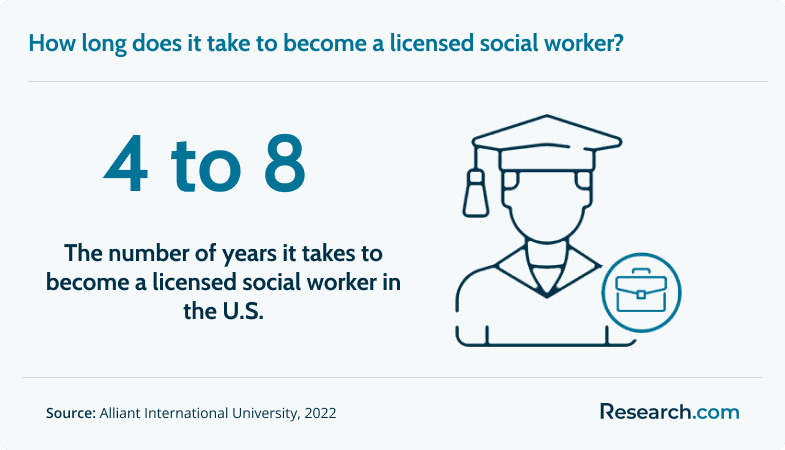
For many students, the fastest complete route is a BSW followed by an advanced standing MSW, which may allow both degrees to be completed in about 5 years total. A broader pathway to licensed social work can take around 4 to 8 years, depending on the license level, supervised experience requirements, state rules, and whether the student studies full time or part time.
Is a BSW required to pursue an MSW degree?
No. You do not always need a BSW to apply to an MSW program. Many MSW programs admit students with bachelor’s degrees in psychology, sociology, education, criminal justice, public health, human services, liberal arts, or other fields. These students usually enter a traditional MSW track and complete foundational social work coursework before moving into advanced practice. By contrast, students who want a much shorter entry point into healthcare support work may compare alternatives such as medical assistant programs, although that path leads to a different type of career.
A BSW can still be a major advantage. Graduates of accredited BSW programs may qualify for Advanced Standing MSW programs, which can reduce the master’s timeline to as little as 12 to 18 months instead of two years. This option exists because BSW graduates have already studied core social work theory, ethics, policy, practice methods, and field education.
| Your background | Likely MSW route | What to check before applying |
| Bachelor’s degree in social work | Advanced standing MSW may be available | Whether your BSW is accredited and recent enough for advanced standing eligibility |
| Bachelor’s degree in psychology, sociology, education, or related field | Traditional MSW track | Prerequisite coursework, volunteer experience, GPA expectations, and field placement requirements |
| Bachelor’s degree in an unrelated field | Traditional MSW track may still be possible | Whether the program values human service experience, essays, references, and career-change rationale |
What career paths are available with a BSW vs. an MSW?
BSW and MSW graduates often work in similar service systems, but not at the same level of responsibility. BSW roles commonly focus on intake, case management, advocacy, resource navigation, outreach, and support services. MSW roles may include assessment, clinical services, supervision, program design, policy analysis, and leadership. If you are asking, “What can I do with a social worker degree?” the answer depends heavily on your degree level and state licensing rules.
Common BSW career paths
- Case Manager – Assesses client needs, coordinates care plans, and connects people with housing, healthcare, employment, benefits, or community resources.
- Child Welfare Specialist – Works with children and families affected by safety concerns, foster care involvement, family instability, or crisis situations.
- School Social Work Assistant – Supports school-based service teams by helping students and families access interventions, referrals, and behavioral support.
- Mental Health or Substance Abuse Technician – Provides supervised support in behavioral health or addiction recovery settings, often assisting with daily programming and client monitoring.
- Community Outreach Coordinator – Organizes community programs, builds partnerships, supports advocacy campaigns, and connects underserved groups with services.
Common MSW career paths
- Licensed Clinical Social Worker (LCSW) – Provides psychotherapy, mental health assessment, crisis response, treatment planning, and counseling in settings such as private practice, hospitals, or community clinics.
- Medical Social Worker – Helps patients and families manage illness, discharge planning, care transitions, hospice needs, rehabilitation, and access to medical or financial support.
- School Social Worker – Provides counseling, crisis intervention, family engagement, attendance support, behavioral planning, and student advocacy in educational settings.
- Social Work Supervisor or Program Manager – Oversees teams, case quality, compliance, service delivery, funding requirements, and program outcomes.
- Policy Analyst or Advocate – Researches social problems, evaluates programs, drafts policy recommendations, and advocates for legislative or systems-level change.
| Career option | Typical degree level | Average annual salary stated | Main responsibilities |
| Case manager | BSW | $52,521 | Client assessment, service planning, referrals, documentation, resource coordination |
| Child welfare specialist | BSW | $50,572 | Family support, child safety monitoring, foster care coordination, crisis response |
| School social work assistant | BSW | $40,367 | Student support, family referrals, administrative support for school social work services |
| Community outreach coordinator | BSW | $56,174 | Program outreach, community education, partnership building, advocacy |
| Licensed Clinical Social Worker | MSW | $94,158 | Therapy, diagnosis-related practice where permitted, crisis intervention, treatment planning |
| Medical social worker | MSW | $89,510 | Patient advocacy, discharge planning, care coordination, family support |
| Social work supervisor | MSW | $94,019 | Team leadership, program oversight, compliance, supervision, quality improvement |
| Policy analyst | MSW | $114,483 | Research, policy development, legislative advocacy, program evaluation |
The practical takeaway is that a BSW can get you into the field, but an MSW can change the level at which you practice. BSW graduates often work in front-line, generalist roles. MSW graduates are more likely to qualify for clinical, supervisory, healthcare, school-based, or policy positions, especially when they meet licensure requirements.
The chart below compares average annual salaries across selected BSW and MSW career paths.
What are the core subjects covered in BSW and MSW programs?
BSW and MSW programs share a commitment to ethics, service, advocacy, and evidence-informed practice, but the depth is different. A BSW builds a broad professional foundation. An MSW moves into advanced practice, specialization, clinical reasoning, leadership, and research. This progression is similar in concept to how 1-year nurse practitioner programs focus on advanced clinical preparation after prior healthcare training, although nursing and social work have different licensure systems.
| Subject area | How it appears in a BSW | How it appears in an MSW |
| Human behavior | Foundational study of individuals, families, groups, communities, and social environments | Advanced application to clinical assessment, trauma, family systems, or specialized populations |
| Practice methods | Generalist interviewing, case planning, advocacy, and resource coordination | Clinical practice, leadership, program design, policy practice, or specialized interventions |
| Policy | Introduction to social welfare systems and advocacy | Policy analysis, reform strategies, legislative advocacy, and systems change |
| Research | Basic research literacy and use of evidence in practice | Program evaluation, data analysis, applied research, and evidence-based decision-making |
| Field education | Introductory supervised experience in social service settings | Advanced placements aligned with clinical, healthcare, school, policy, or leadership goals |
Typical BSW subjects
- Human Behavior and the Social Environment – Examines how development, relationships, culture, institutions, and inequality shape well-being.
- Case Management and Interviewing Skills – Teaches students to gather information, identify needs, build service plans, and connect clients to support.
- Social Welfare Policy and Advocacy – Reviews the history, structure, and impact of social policies, especially on vulnerable and marginalized communities.
- Fieldwork and Practicum Experience – Places students in agencies, schools, healthcare organizations, or community programs to apply classroom learning under supervision.
- Social Work Ethics and Professionalism – Introduces confidentiality, boundaries, professional judgment, and the NASW Code of Ethics.
Typical MSW subjects
- Advanced Clinical Practice and Psychotherapy – Covers assessment, treatment planning, therapeutic models, and evidence-based interventions.
- Social Work Research and Data Analysis – Prepares students to evaluate programs, interpret data, and use research to improve services.
- Diversity, Equity, and Inclusion in Social Work – Develops culturally responsive, anti-oppressive, and equity-centered practice approaches.
- Trauma-Informed Care and Crisis Intervention – Trains students to support people affected by abuse, violence, addiction, loss, disasters, and acute distress.
- Policy Development and Social Justice Advocacy – Studies how policies are designed, implemented, evaluated, and changed to address systemic inequities.
Can you become a licensed social worker (LSW) with just a BSW?
Yes, a BSW can qualify you for Licensed Social Worker status in many states, but the exact credential name and requirements vary. A common pathway includes graduating from an accredited BSW program, applying through the state social work board, and passing the required licensing exam. In many cases, this level of licensure supports generalist roles in agencies, schools, hospitals, nonprofits, and government programs.
A BSW-level license usually does not authorize independent clinical therapy, mental health diagnosis, or private clinical practice. For clinical practice, many states require an MSW, supervised post-graduate clinical hours, and a higher-level credential such as Licensed Clinical Social Worker (LCSW). Before choosing a degree, check the licensing board in the state where you want to work, not only the state where the school is located.
Does an MSW degree involve more clinical training than a BSW?
Yes. An MSW generally includes more advanced clinical preparation than a BSW. BSW programs emphasize generalist social work: assessment, advocacy, case management, resource coordination, ethics, policy, and foundational intervention skills. That training is valuable, but it is not usually designed for independent psychotherapy or advanced mental health treatment.
MSW programs can include deeper training in diagnosis-related practice where permitted, treatment planning, therapeutic methods, crisis intervention, trauma-informed practice, substance use services, family systems, and clinical documentation. Students often complete field placements in behavioral health clinics, hospitals, schools, community mental health agencies, or other settings where they practice under supervision.
| Training area | BSW level | MSW level |
| Client interviewing | Introductory and generalist | Advanced assessment and intervention-focused |
| Case management | Core focus | Used alongside clinical, administrative, or specialized practice |
| Therapy preparation | Limited | Substantially stronger, especially in clinical concentrations |
| Field placement | Broad social service exposure | Advanced placement aligned with specialization and licensure goals |
| Independent clinical practice | Usually not available with BSW alone | Often part of the pathway after MSW, supervised hours, and licensing exams |
What are the benefits of enrolling in an online MSW program?
An online MSW can be a strong option for students who need graduate training but cannot relocate or attend campus several days per week. The best programs combine flexible online coursework with supervised field placements in approved local or regional agencies. Flexibility matters, but it should not come at the expense of accreditation, licensing alignment, faculty access, or field placement quality.
When comparing options, look beyond convenience. Confirm whether the program is accredited, whether it helps arrange placements, whether it offers your intended specialization, and whether graduates can pursue licensure in your state. Students who need lower-cost options can begin by reviewing affordable online MSW programs.
| Online MSW advantage | Why it matters | What to verify |
| Flexible schedule | Can help working adults continue employment while studying | Synchronous meeting times, practicum hours, and workload expectations |
| Local fieldwork | May let students complete supervised training near home | Whether the school finds placements or expects students to secure them |
| Specialization options | Can align coursework with clinical, school, healthcare, policy, or leadership goals | Whether the concentration supports your target license or role |
| Potential cost control | May reduce commuting or relocation expenses | Total tuition, fees, travel, technology costs, and lost work hours |
Should You Pursue a Doctorate in Social Work?
A doctorate in social work, such as a PhD or DSW, is not required for most direct practice roles, but it can make sense for professionals who want to lead systems-level change, teach, conduct research, design programs, influence policy, or move into high-level administration. A PhD is often more research-focused, while a DSW is commonly more practice- and leadership-oriented, though program models vary.
Doctoral study is a major commitment, so it should be tied to a clear goal. If your objective is clinical licensure, an MSW is usually the more direct route. If your objective is scholarship, executive leadership, program innovation, or university-level teaching, doctoral education may be worth exploring. Working professionals who need flexibility can compare online PhD social work options.
What is the difference between generalist vs. specialized social work education?
Generalist education prepares students to work across many populations and service systems. Specialized education prepares students for a narrower practice area, such as clinical mental health, child and family services, healthcare, school social work, substance use, policy, administration, or community development.
Generalist social work education
Generalist training is broad by design. Students learn to assess needs, build helping relationships, coordinate services, advocate for clients, understand policy, and work ethically across diverse settings. This is the dominant model in BSW education and may also appear in the foundation year of traditional MSW programs.
- Emphasizes work with individuals, families, groups, organizations, and communities.
- Develops skills in case management, interviewing, advocacy, and service coordination.
- Prepares graduates for public service, nonprofit, school support, community outreach, and human service roles.
- Introduces social problems such as poverty, housing instability, family stress, substance use, and mental health needs.
- Commonly forms the core of BSW programs.
Specialized social work education
Specialized training is more focused. Students choose a practice area and build advanced skills for the populations, settings, or systems they want to serve. This model is common in MSW programs and is especially important for students pursuing clinical practice or leadership roles.
- Concentrates on areas such as mental health, families and children, healthcare, schools, substance use, policy, administration, or community practice.
- May include advanced clinical methods, assessment, treatment planning, and intervention models.
- Can prepare graduates for supervisory, administrative, policy, research, or specialized direct practice responsibilities.
- Allows MSW students to align coursework and field placements with long-term career goals.
| Choose generalist preparation if... | Choose specialized preparation if... |
| You are exploring the field and want broad eligibility for entry-level roles. | You already know the population or setting you want to serve. |
| You want to build foundational social work skills before choosing a niche. | You need advanced preparation for clinical practice, healthcare, schools, leadership, or policy. |
| You are pursuing a BSW or the foundation portion of an MSW. | You are pursuing an MSW concentration or post-master’s specialization. |
How can I plan my social work education timeline for career success?
A strong education plan starts with the end goal. If you want entry-level case management or community service work, a BSW may be enough to begin. If you want clinical licensure, therapy, advanced school social work, medical social work, or leadership, plan for an MSW and any required supervised experience after graduation.
Students should compare program length, field placement expectations, state licensing rules, transfer credit policies, advanced standing eligibility, tuition, and whether they can study full time or part time. For a broader look at the schooling commitment, see How many years of school to be a social worker?.
Sample education planning sequence
- Choose your target role: case manager, school social worker, medical social worker, therapist, supervisor, policy advocate, or administrator.
- Check your state’s licensing rules for that role before selecting a school.
- Decide whether a BSW, traditional MSW, or advanced standing MSW fits your background.
- Compare accredited programs based on cost, field placement support, specialization, timeline, and graduate outcomes.
- Plan for fieldwork, exam preparation, supervised hours, and continuing education requirements.
Is an MSW Essential for Advanced Clinical Practice?
For advanced clinical practice, an MSW is typically a key requirement. Students who want to provide therapy, work toward independent clinical licensure, or pursue roles in mental health treatment should expect to complete graduate-level social work education, supervised clinical training, and state-specific licensing steps.
The decision should be based on your intended scope of practice. If you want to coordinate services or work in generalist human services, a BSW may be sufficient. If you want to diagnose and treat mental health conditions where permitted, provide psychotherapy, or pursue LCSW-level practice, review Do you need an MSW to become a LCSW? for a closer comparison of degree and licensure requirements.
What distinguishes social work careers from those of psychologists?
Social workers and psychologists can both support mental health and well-being, but their training and professional lens differ. Social workers often focus on the person-in-environment perspective: family systems, community resources, social policy, advocacy, inequality, and practical support. Psychologists more often focus on psychological assessment, diagnosis, therapy, testing, and research, depending on their training and licensure.
Students comparing the difference between social worker and psychologist should look closely at degree requirements, licensure timelines, scope of practice, typical work settings, and whether they prefer systems-based social intervention or psychology-centered assessment and treatment.
Which industries pay the most for BSW vs. MSW graduates?
Pay varies by role, degree, license, employer, geography, and specialization. In general, roles requiring an MSW, clinical license, supervisory responsibility, or healthcare expertise may offer higher compensation than entry-level BSW roles. Among social workers, those employed by local government excluding education and hospitals earn around $64,550, while those in educational services, including state, local, and private employers, earn around $62,980. Social workers in state government earn around $54,600, while those in individual and family services earn around $48,550. Social workers in community food and housing, as well as vocational rehabilitation services, earn around $46,650.
Hospitals, hospice organizations, behavioral health providers, government agencies, and large social service systems may offer stronger opportunities for MSW graduates, especially when roles involve clinical care, supervision, compliance, program management, or specialized services. The chart below shows median annual wages for social workers in selected top industries.
| Industry or setting | Median annual wage stated | Degree level often associated with stronger opportunities |
| Local government, excluding education and hospitals | $64,550 | BSW or MSW, depending on position and license |
| Educational services, state, local, and private | $62,980 | Often MSW for school social worker roles, depending on state rules |
| State government | $54,600 | BSW or MSW, depending on role level |
| Individual and family services | $48,550 | BSW for many entry roles; MSW for clinical or supervisory roles |
| Community food and housing; vocational rehabilitation services | $46,650 | BSW or MSW, depending on service model |
How can a doctoral degree in psychology enhance my social work practice?
Advanced psychology education can deepen a social worker’s understanding of mental health, assessment, research, behavior, and therapeutic theory. This may be useful for professionals working in behavioral health leadership, integrated care, research, program design, or advanced clinical consultation. It is not the standard route for social work licensure, but it can support interdisciplinary expertise.
Before pursuing psychology doctoral study, compare the opportunity cost with your actual goal. If you want LCSW eligibility, an MSW pathway is usually more direct. If you want broader behavioral health leadership or advanced psychological training, reviewing online APA accredited PsyD programs may help you understand available options.
What is the job outlook for social workers?
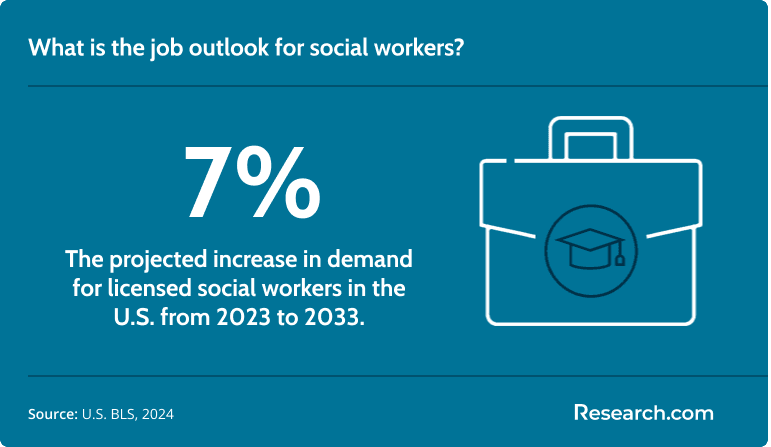
The outlook for social workers is favorable. Overall employment is expected to grow by 7% from 2023 to 2033, which is faster than the average for all occupations. Demand is connected to needs in mental health, substance abuse recovery, aging-related services, healthcare coordination, schools, public programs, and community support systems.
There are approximately 67,300 job openings for social workers each year, reflecting both occupational growth and replacement needs when workers retire or leave the field. Clinical roles are not the only area of opportunity. Students interested in policy, administration, systems change, and community development can also explore macro social work jobs.
Can interdisciplinary education complement my social work career?
Interdisciplinary education can be valuable when it supports a specific social work goal. For example, organizational psychology can help social workers understand leadership, workplace behavior, team dynamics, program change, employee well-being, and systems improvement. That knowledge can be useful for supervisors, administrators, consultants, and nonprofit leaders.
The key is to avoid collecting degrees without a plan. If your goal is agency leadership or organizational change, an affordable online organizational psychology masters may complement social work training. If your goal is clinical licensure, prioritize an accredited MSW and state licensing requirements first.
Can additional certifications enhance my social work career?
Certifications can strengthen a social work career when they match your population, setting, and scope of practice. They may signal specialized preparation in areas such as trauma, substance use, school services, gerontology, healthcare, case management, supervision, or behavioral intervention. However, certifications should supplement—not replace—degree and licensure requirements.
For example, social workers who support clients with developmental or behavioral needs may consider training in behavior analysis. Programs such as BCBA online programs can be relevant for professionals whose roles involve behavioral assessment and intervention, but students should confirm credential requirements and whether the certification fits their legal scope of practice.
| Certification decision question | Why it matters |
| Does the credential align with my target population? | A trauma certification, for example, may be useful in crisis, child welfare, or behavioral health settings. |
| Is the credential recognized by employers in my area? | Some certifications are widely valued; others may have limited labor market impact. |
| Does it support licensure, continuing education, or advancement? | The strongest certifications help with a real professional requirement or promotion path. |
| Will it expand my scope of practice legally? | Many certifications do not change what you are legally allowed to do. |
What should I know about admissions requirements and accreditation for social work degrees?
Admissions requirements vary by school and degree level. BSW programs commonly review high school or transfer transcripts, GPA, essays, prerequisite courses, volunteer or work experience, and readiness for professional fieldwork. MSW programs usually require a bachelor’s degree, transcripts, letters of recommendation, a personal statement, and sometimes human services experience or prerequisite coursework.
Accreditation is one of the most important factors in choosing a social work program. Students should look for programs accredited by the Council on Social Work Education (CSWE), because accreditation can affect field placement eligibility, licensure pathways, transfer options, financial aid, and employer recognition. The same level of care is useful when comparing other graduate fields, such as affordable online master's psychology programs.
Questions to ask before enrolling
- Is the BSW or MSW program accredited by the appropriate social work accreditor?
- Does the program meet education requirements for licensure in the state where I want to work?
- How are field placements assigned, supervised, and evaluated?
- Can online students complete fieldwork near their home communities?
- What concentrations or certificates are available?
- What is the total cost, including tuition, fees, books, travel, technology, and lost work time?
- Does the school publish outcomes such as graduation rates, licensure exam results, or employment support?
What are the key factors to consider when selecting an online MSW program?
The best online MSW program is not simply the easiest to enter or the cheapest to attend. It is the program that is accredited, affordable for your situation, compatible with your schedule, aligned with your state’s licensure rules, and strong enough in field education to prepare you for the work you want to do.
Students looking for accessible admissions options can review the easiest MSW program to get into, but admission flexibility should be weighed against accreditation, practicum support, specialization, faculty quality, student services, and long-term licensure goals.
| Selection factor | What to look for | Common mistake to avoid |
| Accreditation | Program recognition that supports professional standards and licensing pathways | Assuming all online MSW programs meet licensure requirements |
| Field placement support | Clear process for securing supervised practicum sites | Enrolling before knowing who is responsible for finding placements |
| State licensure alignment | Curriculum and fieldwork that match the state where you plan to practice | Choosing a program based only on national reputation |
| Total cost | Tuition, fees, books, technology, travel, and unpaid field hours | Comparing tuition only and ignoring hidden costs |
| Program format | Part-time, full-time, synchronous, asynchronous, advanced standing, or traditional options | Selecting a schedule that conflicts with work or family obligations |
| Specialization | Clinical, healthcare, school, policy, leadership, child and family, or community practice tracks | Picking a general program when your career goal requires a specific concentration |
| Student support | Advising, career services, licensing guidance, writing support, and faculty access | Assuming online students receive the same support without confirming it |
Common mistakes when choosing between a BSW and an MSW
| Mistake | Why it can hurt you | Better approach |
| Choosing based only on salary expectations | Salary varies by license, location, employer, role, and experience. | Compare realistic local job postings and state licensing rules. |
| Ignoring accreditation | Non-accredited programs may create problems for licensure or graduate admission. | Confirm accreditation before applying or paying deposits. |
| Assuming a BSW allows therapy practice | BSW roles are usually generalist and non-clinical. | Pursue an MSW if your goal is clinical practice or LCSW eligibility. |
| Overlooking field placement requirements | Practicum hours can affect your work schedule, commute, and finances. | Ask how placements are arranged and how many hours are required. |
| Relying only on rankings | A highly ranked program may not fit your budget, state, schedule, or specialization needs. | Use rankings as one data point, not the full decision. |
| Assuming online means easier | Online MSW programs still require rigorous coursework and field education. | Evaluate workload, deadlines, live class requirements, and practicum expectations. |
Key Insights
- A BSW is a strong entry point for generalist social work roles, especially case management, outreach, child welfare support, and human services coordination.
- An MSW is the more appropriate path for students who want clinical practice, LCSW eligibility, advanced school or medical social work, supervision, policy leadership, or specialized practice.
- A BSW is not always required for MSW admission, but it can shorten the master’s timeline through advanced standing options that may take 12–18 months.
- The median annual salary for social workers is approximately $58,380, but pay differs by role, industry, license, employer, and location.
- Employment for social workers is projected to grow by 7% from 2023 to 2033, with about 67,300 openings each year.
- Accreditation and state licensure alignment should be checked before choosing any BSW, MSW, or online MSW program.
- The best choice is goal-dependent: choose a BSW if you want to enter the field sooner; choose an MSW if your career requires advanced clinical, leadership, or specialized credentials.
Resources:
- Alliant International University. (2022). How Long Does It Take to Become a Social Worker? https://www.alliant.edu/blog/how-long-does-it-take-become-social-worker
- Glassdoor. (2025). How much does a Medical Social Worker make? https://www.glassdoor.com/Salaries/medical-social-worker-salary-SRCH_KO0,21.htm
- Salary.com. (2025). Social Work Supervisor Salary in the United States. https://www.salary.com/research/salary/posting/social-work-supervisor-salary
- U.S. Bureau of Labor Statistics. (2024). Occupational Outlook Handbook: Social Workers. https://www.bls.gov/ooh/community-and-social-service/social-workers.htm#tab-1
- ZipRecruiter. (2025). Social Work Case Manager Salary. https://www.ziprecruiter.com/Salaries/Social-Work-Case-Manager-Salary#Yearly
Other things you should know about BSW vs. MSW
Yes, BSW coursework can sometimes be transferred into an MSW program, but it depends on the specific program and the university's policies. Many MSW programs offer advanced standing for BSW graduates, allowing them to skip the generalist portion of the curriculum and move directly into specialized courses. However, transfer credits must be evaluated for their relevance, and students may still need to meet specific requirements set by the program. It’s best to check with individual MSW programs for detailed transfer policies.
Most CSWE-accredited BSW programs require at least 400 hours of supervised field education, usually completed in two placements or one extended practicum. These hours are part of the degree, not an extra requirement, and they are typically tied to agency-based social work practice.


