
2027 Best Master’s in Social Work (MSW) Degree Programs

Co-Founder and Chief Data Scientist
An MSW is a major career decision, not just another graduate credential. It can qualify you for advanced social work roles in healthcare, mental health, schools, child welfare, public agencies, nonprofits, policy, advocacy, and clinical practice, but it also requires a serious investment of time, tuition, fieldwork hours, and emotional energy.
The timing matters. As of 2024, there were approximately 810,900 social workers in the workforce. The field is projected to grow by 6% between 2024 and 2034, which is significantly faster than the average for all occupations.
This guide explains what a master’s degree in social work is, how long it can take, what it may cost, what jobs it can lead to, and how to compare traditional, hybrid, and online options. It also covers licensure, admissions, field placements, scholarships, common mistakes, and how an MSW compares with related paths such as psychology or an online social work degree.
Master’s Degree in Social Work Table of Contents
- What is a master’s degree in social work?
- Cost of Master’s Degree in Social Work
- Master’s Degree in Social Work Jobs
- Master’s Degree in Social Work Requirements
- What to Look for in a Master’s Degree in Social Work Program
- 2027 Best Master’s Degree in Social Work Programs
- How does geographical location influence career outcomes and compensation in social work?
- Should I Pursue a Doctoral Degree After My MSW?
- What scholarships and financial aid options are available for MSW students?
- What challenges might you encounter during your MSW journey?
- How do you decide between a career in social work and psychology?
- What are the advantages of earning a master’s degree in social work online?
- How can targeted career support services shape your MSW success?
- Are online MSW programs a viable alternative to traditional on-campus options?
- How to Choose the Right MSW Program for You
- What is the difference between an MSW and an LCSW?
- How are innovative practices and evolving policies shaping the future of social work?
- How can professional networking and additional certifications boost your MSW career?
Quick Answer: Is a Master’s Degree in Social Work Worth Considering?
A master’s degree in social work is worth considering if you want to qualify for advanced social work positions, pursue clinical licensure, move into leadership or policy work, or specialize in areas such as mental health, healthcare, child welfare, substance abuse, or school social work. It is less likely to be the right fit if you want a research-only psychology path, do not want to complete supervised fieldwork, or are not prepared for state licensure requirements in clinical roles.
Most MSW students should focus on four questions before enrolling: Is the program accredited? Does it support your intended licensure path? Can you complete the field placement requirements? And does the total cost make sense for the jobs you plan to pursue?
What is a master’s degree in social work?
A Master of Social Work, commonly called an MSW, is a graduate degree for students who want advanced preparation in social work practice, leadership, policy, advocacy, research, or clinical services. If you have already researched how long it takes to become a social worker, the MSW is typically the next academic step for roles that require graduate-level training.
An MSW curriculum usually combines theory, applied practice, ethics, human behavior, social welfare policy, research methods, social justice, cultural competence, and intervention strategies. Students learn how social systems affect individuals and communities, and they practice using evidence-informed approaches to support clients, families, organizations, and broader populations.
Field education is one of the defining features of an MSW. Instead of learning only in classrooms, students complete supervised placements in real service settings. These experiences help students connect theory to practice, test career interests, build professional judgment, and begin forming the kind of professional identity that is often strengthened through internships, service work, and related experience, as described in this discussion of professional identity development.
Who is an MSW best for?
- Students who want clinical social work careers: Many counseling, therapy, and mental health roles require an MSW plus post-graduate supervised hours and licensure.
- Professionals moving up in human services: Case managers, community outreach workers, nonprofit staff, and public service employees may use the MSW to qualify for higher-responsibility roles.
- People interested in systems-level change: Social work is not limited to one-on-one client support. MSW graduates may also work in policy, program evaluation, advocacy, administration, or research.
- Career changers with related experience: Applicants from education, healthcare, criminal justice, psychology, public health, or community services may find the MSW a practical bridge into direct service or leadership.
Who should think carefully before choosing an MSW?
- Applicants who want to avoid fieldwork: Field placements are central to MSW education, and they can be difficult to schedule around full-time work.
- Students focused only on income growth: MSW salaries vary widely by location, setting, specialization, and licensure. The degree can improve career options, but it does not guarantee a specific salary.
- Students who want to become psychologists: Psychology and social work overlap in some settings, but the education, licensure, and professional scope are different.
- Applicants who have not checked state rules: Licensure requirements differ by state, especially for clinical practice. Program format alone is not enough; licensure alignment matters.
What can you do with a master’s degree in social work?
An MSW can prepare graduates for many humanities and social sciences careers and jobs, especially roles focused on helping people navigate social, economic, family, health, and mental health challenges. Social workers may serve clients directly, coordinate services, manage programs, conduct research, influence policy, or advocate for communities. Students who are still early in the process may also benefit from reviewing the broader steps involved in becoming a social worker.
Common MSW career directions include clinical social work, healthcare social work, school social work, child and family services, nonprofit leadership, substance abuse treatment, community organizing, policy analysis, and social work research. Some graduates later pursue a Doctor of Social Work or a PhD in social work, depending on whether they want advanced practice leadership, academic research, or policy-focused work.
According to the latest U.S. Bureau of Labor Statistics (BLS) data released in late 2024 and updated for the 2024–2034 decade, the overall employment for social workers is projected to grow 6% through 2034.
Cost of Master’s Degree in Social Work
The price of an MSW depends on the school, credit requirements, residency status, delivery format, fees, and the amount of aid a student receives. According to 2024 data, the cost of a master’s degree program in social work typically ranges from about $12,500 to $70,000 annually.
How much does it cost to get a master’s degree in social work?
In the United States, the average cost of a two-year MSW program can range from $20,000 to $70,000 or more. Public universities, private universities, in-state tuition, out-of-state tuition, online delivery, scholarships, grants, and employer support can all change the final out-of-pocket cost.
Students looking for lower-cost options often compare public universities, transfer policies, part-time formats, and affordable online MSW programs. Typically, public universities have an average tuition and fees of $13,800 annually, while private universities have an average of $36,300. The average undergraduate tuition and fees for the social work program are $9,757 for state institutions.
| Social Work Degree Programs | In-State | Out-of-State |
| Undergraduate Tuition & Fee | $9,757 | $26,358 |
MSW cost factors students often miss
| Cost factor | Why it matters | Question to ask |
| Field placement schedule | Some placements may limit how many hours you can work for pay while enrolled. | Can I complete field hours near my home and around my work schedule? |
| Fees beyond tuition | Technology fees, placement fees, health fees, books, and travel can raise total cost. | What is the full estimated cost of attendance, not just tuition? |
| Residency rules | Public schools may charge different rates for in-state and out-of-state students. | Do online students pay the same tuition regardless of state residency? |
| Licensure preparation | A cheaper program may not be a good value if it does not support your state’s licensing path. | Does this program meet educational requirements for my target state? |
| Advanced standing eligibility | Students with a qualifying BSW may be able to reduce time and tuition. | Am I eligible for advanced standing, and how many credits would I need? |
Is a master’s degree in social work worth it?
An MSW can be worth it when the degree is required or strongly preferred for the kind of social work you want to do. Clinical social work, school social work, healthcare social work, advanced case management, program leadership, and policy roles may all become more accessible with graduate-level preparation.
The return on investment depends on your cost of attendance, debt, local salary market, licensure goals, and preferred work setting. A lower-cost accredited program may be a better choice than a highly expensive option if both meet your licensure and career needs. Students should compare net cost, field placement quality, licensure outcomes, and employer connections rather than choosing by reputation alone.
Master’s Degree in Social Work Jobs
MSW graduates work across healthcare systems, schools, mental health centers, public agencies, nonprofits, correctional settings, veterans services, community organizations, and research or policy groups. The degree is especially useful for roles that involve complex client needs, interdisciplinary collaboration, program design, supervision, clinical services, or advocacy.
Is a master’s degree in social work in high demand?
Yes, the employment outlook for social workers is positive overall, although demand differs by region, employer type, specialty, and licensure status. MSW-prepared professionals may be especially relevant in healthcare, behavioral health, child and family services, substance abuse treatment, higher education, hospitals, and community service organizations.
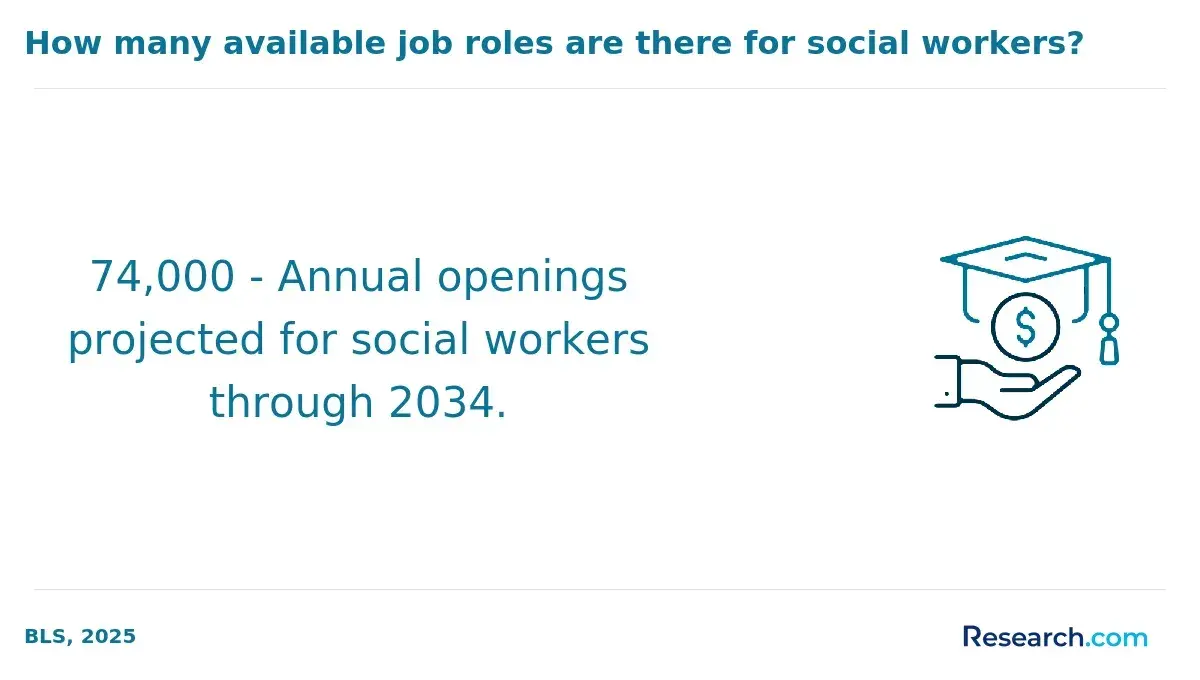
The demand for social workers is projected to grow by 6% from 2024 to 2034, which is faster than the average employment growth expected for all occupations (U.S. Bureau of Labor Statistics, 2025). This growth is driven by an aging population, increased demand for healthcare and social services, and greater recognition of the importance of mental health services.
High-demand areas often require specialized preparation. Clinical practice, child welfare, substance abuse counseling, medical social work, school-based services, and integrated behavioral health may require graduate coursework, supervised experience, state licensure, or additional certifications.
Students should not assume demand is identical everywhere. Before enrolling, review job postings in your target city or state, confirm whether roles require licensure, and identify which specializations employers request most often.
What jobs can you get with a master’s degree in social work?
| Role | Typical focus | Best fit for students interested in |
| School social worker | Supporting students, families, educators, attendance concerns, behavioral needs, crisis situations, and student advocacy. | Children, adolescents, education systems, family support, and school-based intervention. |
| Clinical social worker | Providing assessment, therapy, counseling, and treatment planning in settings such as hospitals, clinics, agencies, and private practice. | Mental health, direct client care, psychotherapy, and clinical licensure. |
| Medical social worker | Helping patients and families manage illness, disability, discharge planning, care coordination, grief, and access to services. | Healthcare, interdisciplinary teams, patient advocacy, and hospital or hospice settings. |
| Mental health counselor | Supporting individuals and families dealing with anxiety, depression, trauma, crisis, and other behavioral health concerns. | Counseling, behavioral health programs, community mental health, and trauma-informed care. |
| Substance abuse counselor | Working with individuals and families affected by drug or alcohol addiction, relapse risk, recovery planning, and treatment systems. | Addiction treatment, harm reduction, recovery support, and behavioral health services. |
| Nonprofit program director | Managing programs, staff, budgets, grants, outreach, evaluation, and community services. | Leadership, nonprofit management, service delivery, and community impact. |
| Policy analyst | Researching social problems, evaluating policy, interpreting data, and recommending program or legislative changes. | Advocacy, government, public policy, research, and systems-level reform. |
| Researcher | Studying social issues, analyzing outcomes, evaluating interventions, and contributing evidence for practice or policy. | Data, evaluation, academia, think tanks, and evidence-based practice. |
What kind of salary can I earn with a master’s degree in social work?
Graduate education can improve access to advanced roles, but pay still depends on specialization, licensure, employer, state, city, union coverage, and experience. As of early 2026, the base salary for a social worker with a Master’s in Social Work (MSW) typically ranges from $56,700 to $70,850, with an average base salary of approximately $63,030. (Salary.com, 2025). Master’s degree holders who pursue licensure (such as LCSWs) often see significantly higher figures. National averages for Licensed Clinical Social Workers now hover around $73,056, with top-tier clinical roles in high-demand urban areas often exceeding $100,000.
Master’s Degree in Social Work Requirements
MSW admissions requirements vary, but most programs evaluate academic preparation, professional readiness, communication skills, service experience, and fit with the program’s mission. As of the latest 2024–2025 CSWE academic reporting cycle, the number of accredited Master’s in Social Work (MSW) programs has reached 336, representing a steady increase in availability across the U.S.
The diversity of the social work student body is evolving, with a significant increase in representation from historically marginalized groups. According to the 2025 State of Social Work Report, the racial and ethnic breakdown of the current student and early-career workforce is as follows:
A master’s degree in social work typically takes two years to complete, although some programs may offer accelerated MSW programs with one-year option or a part-time program that can take longer. Students with a qualifying social work degree may also want to ask about advanced standing options, if available.
Admission Requirements
- Bachelor’s degree: Applicants usually need a bachelor’s degree from an accredited college or university. The degree does not always have to be in social work.
- GPA: Many MSW programs expect a minimum undergraduate GPA of 3.0 or higher, although some schools set different standards.
- Prerequisite courses: Programs may ask for prior coursework in areas such as psychology, sociology, statistics, or related social science subjects.
- Work or volunteer background: Experience in social services, human services, outreach, healthcare, education, or related psychology career paths can strengthen an application.
- Personal statement: Applicants are commonly asked to explain their goals, service experience, motivation for social work, and fit with the program.
- Letters of recommendation: Most schools request two to three letters from academic, professional, or service-related references.
- Entrance exam: Some programs may require an exam such as the GRE or MAT, though requirements vary by institution.
- Interview: Certain programs use interviews to assess readiness, communication skills, ethical awareness, and professional goals.
Skill Requirements
- Communication: Social workers must listen carefully, explain options clearly, document accurately, and communicate with clients, families, supervisors, agencies, and interdisciplinary teams.
- Empathy and compassion: Effective social work requires the ability to understand people’s experiences without losing professional boundaries.
- Critical thinking and problem-solving: MSW students learn to assess complex circumstances, weigh risks, use evidence, and adapt plans when client needs change.
- Cultural competence: Students must learn to serve people from varied backgrounds with respect, humility, and awareness of how culture, identity, and systems shape lived experience. This includes a commitment to understanding cultural difference.
- Collaboration and teamwork: Many social workers coordinate with physicians, nurses, therapists, teachers, case managers, legal professionals, and community partners.
- Time management and organization: Coursework, field hours, documentation, meetings, and client needs can overlap, so students need strong planning habits.
What to Look for in a Master’s Degree Program in Social Work
A strong MSW program should do more than offer graduate coursework. It should prepare you for your target role, support field education, align with licensure rules, provide qualified faculty, and make its costs and outcomes clear. As of the latest reporting cycle, approximately 79.9% of full-time faculty members in social work programs hold a Master’s in Social Work (MSW) degree. The percentage of faculty holding a valid social work license is at 51.2%, while 46.1% of full-time faculty now hold a research-focused doctorate.
When comparing programs, prioritize fit over prestige. The best MSW for a future clinical social worker may not be the best choice for someone focused on policy, macro practice, nonprofit leadership, or research.
| Factor | Why it matters | What to verify before applying |
| Accreditation | CSWE accreditation is commonly important for professional practice and licensure pathways. | Confirm the program’s current accreditation status and whether it supports your state’s requirements. |
| Specializations | Concentrations can shape field placements, electives, and early career direction. | Look for tracks in clinical practice, community practice, policy, healthcare, child welfare, or another area tied to your goals. |
| Curriculum | Course design affects how well the degree prepares you for practice, research, leadership, and licensure exams. | Review required courses, electives, field seminars, research training, and clinical content if relevant. |
| Faculty | Faculty expertise can influence mentorship, research opportunities, and professional networks. | Read faculty bios and look for experience in your intended practice area. |
| Field placement support | Placements are essential and can determine whether the program is manageable. | Ask who secures placements, how far students travel, and whether placements match specializations. |
| Student services | Graduate students often need advising, licensure guidance, writing support, and career help. | Check availability of academic advising, career counseling, scholarships, mentoring, and student organizations. |
| Schedule and format | Full-time, part-time, online, hybrid, and evening formats differ in workload and flexibility. | Compare synchronous requirements, campus visits, fieldwork expectations, and course sequencing. |
2027 Best Master’s Degree in Social Work
The best MSW program depends on your career goals, budget, location, field placement needs, and preferred specialization. The programs below offer examples of established MSW pathways with different structures, concentrations, costs, and accreditation details.
1. Columbia University Master of Social Work
The MSW program at Columbia University prepares students for social work practice, policy, administration, and research. Students can choose from areas such as advanced clinical practice, policy practice, social enterprise administration, and social work and public health, allowing them to connect graduate training with their intended career direction.
- Program Length: 2 years
- Tracks/concentrations: Social enterprise administration, public health, social work
- Cost per Credit: $1,735.73 per credit
- Required Credits to Graduate: 60 credits
- Accreditation: Council on Social Work Education (CSWE)
2. New York University Master of Social Work
New York University offers an MSW designed for students interested in clinical practice, policy advocacy, community organizing, and work with children, youth, and families. Its range of focus areas can help students tailor field learning and coursework to specific social work settings.
- Program Length: 2 years
- Tracks/concentrations: Policy advocacy, community organizing, clinical practice
- Cost per Credit: $1,527 per credit
- Required Credits to Graduate: 60 credits
- Accreditation: Council on Social Work Education (CSWE)
3. University of Washington Master of Social Work
The MSW program at the University of Washington emphasizes evidence-based practice, cultural humility, social justice, leadership, and advocacy. Students study social work theory, research methods, and practice while preparing for roles across direct service and systems-level work.
- Program Length: 2 years
- Tracks/concentrations: Administration and policy practice, social work, leadership
- Cost per Credit: $868 per credit
- Required Credits to Graduate: 75 credits
- Accreditation: Council on Social Work Education (CSWE)
4. University of Maryland Master of Social Work
The MSW program at the University of Maryland offers preparation in clinical practice, community action and social policy, and social work in health care. The program integrates theory, research, and practice for students interested in direct services, advocacy, and policy-oriented work.
- Program Length: 2 years
- Tracks/concentrations: School social work, public health social work, gerontology
- Cost per Credit: $868 per credit
- Accreditation: Council on Social Work Education (CSWE)
5. University of Hull MA in Social Work
The MA in Social Work at the University of Hull includes study in social work theory, research methods, and practice. The program emphasizes applied learning and requires students to complete a minimum of 200 days of field education.
- Program Length: 2 years
- Tracks/concentrations: Social work theory, policy-making, advocacy
- Cost: £11,222
- Accreditation: Social Work England
How does geographical location influence career outcomes and compensation in social work?
Location can affect social work careers in several ways: state licensure rules, local service funding, cost of living, employer demand, rural or urban access needs, and the availability of hospitals, schools, public agencies, and nonprofit organizations. A strong MSW program in one state may not automatically be the best option if you plan to work somewhere else after graduation.
Before committing to a program, compare salary expectations and licensing requirements in your intended state. For a deeper state-by-state look at pay patterns, use Research.com’s guide to social worker salary.
Should I Pursue a Doctoral Degree After My MSW?
A doctorate is not required for many MSW-level careers, but it may make sense for professionals who want advanced leadership, teaching, research, policy influence, or high-level practice innovation. The right path depends on whether you want to deepen applied practice or conduct original research.
A practice-oriented doctorate, such as a DSW degree, typically focuses on applied leadership, advanced practice, organizational change, and professional innovation. A research-focused doctoral path usually emphasizes theory, scholarship, methodology, and original contributions to the field. Compare curriculum, dissertation or capstone expectations, faculty expertise, and career outcomes before choosing.
What scholarships and financial aid options are available for MSW students?
MSW funding may come from federal aid, school-based scholarships, assistantships, grants, employer support, loan forgiveness programs, and social-work-specific awards. Because tuition can vary widely, students should build a funding plan before enrolling rather than waiting until after admission.
- Federal Financial Aid: Completing the Free Application for Federal Student Aid (FAFSA) is usually the starting point for federal graduate aid. MSW students may qualify for federal loans, work-study opportunities, Direct Unsubsidized Loans, or Grad PLUS Loans.
- Scholarships Specific to Social Work: Professional and educational organizations may offer funding for students focused on mental health, community practice, diversity, underserved communities, or other priority areas.
- National Association of Social Workers (NASW) Foundation Scholarships: NASW offers several scholarship opportunities for MSW students, including awards connected to specific practice interests.
- Council on Social Work Education (CSWE) Fellowships: CSWE provides funding opportunities for students committed to diversity, equity, and service to underserved populations.
- Verne LaMarr Lyons Memorial MSW Scholarship: This scholarship supports MSW students interested in working with African American communities in areas such as health or substance abuse.
- University-Based Scholarships: Schools may offer program scholarships, graduate assistantships, grants, or tuition discounts through the department or financial aid office.
- State and Local Grants: Some states support students who plan to work in underserved, rural, public service, or high-need roles after graduation.
- Loan Forgiveness Programs: MSW graduates in qualifying public service roles may be eligible for the Public Service Loan Forgiveness (PSLF) program after 10 years of qualifying payments.
- Employer Tuition Assistance: Healthcare, social service, nonprofit, and public agencies may help employees pay for graduate study when the degree supports workforce needs.
What challenges might you encounter during your MSW journey?
An MSW can be academically, emotionally, and logistically demanding. Students often balance readings, papers, group projects, field placements, documentation, supervision, work, family obligations, and exposure to difficult client situations. The fieldwork component is valuable, but it can also create scheduling pressure.
Online students may face additional challenges, including remote communication, technology requirements, time management, and finding suitable placements near home. Comparing reputable online MSW programs can help students identify options with stronger advising, placement coordination, faculty access, and flexible course delivery.
How do you decide between a career in social work and psychology?
Social work and psychology both support human well-being, but they approach problems differently. Social work often combines direct support with advocacy, resource coordination, family systems, community intervention, and policy awareness. Psychology tends to focus more heavily on assessment, behavior, cognition, research, and therapeutic treatment depending on the degree and license.
If you want to connect clients with services, address social barriers, work in public systems, or combine counseling with advocacy, social work may fit well. If you are more interested in psychological testing, behavioral research, or psychology-specific clinical training, psychology may be the better direction. Research.com’s guide to the differences between social work and psychology can help you compare scope of practice, education, and career outcomes.
What are the advantages of earning a master’s degree in social work online?
An online MSW can be useful for working adults, parents, rural students, military-affiliated students, and career changers who cannot relocate or attend daytime campus classes. The main advantage is flexibility, but students should still expect rigorous coursework and in-person field placement requirements.
Many online programs use asynchronous courses, live virtual sessions, or hybrid models. Some offer part-time pacing, while others include accelerated routes for students who want to finish faster. The best format depends on your schedule, learning style, and ability to complete supervised fieldwork.
Online learning can also reduce commuting or relocation costs, though tuition is not always lower. Students planning a longer pathway may compare undergraduate options first, including cheapest online BSW programs, before moving into graduate study.
How can targeted career support services shape your MSW success?
Career support can make a meaningful difference in an MSW program, especially for students entering a new field or pursuing licensure. Strong programs help students identify appropriate placements, prepare resumes, practice interviews, understand licensure steps, connect with alumni, and translate field experience into job opportunities.
When comparing schools, ask whether the program has dedicated social work career advisors, placement coordinators, alumni mentors, licensure workshops, employer partnerships, and job search support. Students who are still building foundational experience may also find value in related pathways such as an affordable bachelor degree in human services online.
Are online MSW programs a viable alternative to traditional on-campus options?
Online MSW programs can be a viable alternative when they are accredited, well-supported, and aligned with the student’s state licensure goals. The key is not whether a program is online or on campus; the key is whether it provides quality instruction, appropriate field placements, faculty access, licensure preparation, and student support.
Students should be cautious about choosing based only on convenience or admissions accessibility. If you need a more flexible or accessible route, review the easiest online master's degree in social work options carefully and still verify accreditation, placement support, graduation requirements, and state licensing compatibility.
How to Choose the Right MSW Program for You
Choosing an MSW program should be a structured decision. Start with your intended role, then work backward to the degree format, specialization, field placement, licensure preparation, cost, and schedule that support that goal.
1. Confirm accreditation first
Look for accreditation by the Council on Social Work Education (CSWE) if you are considering U.S.-based MSW programs. Accreditation matters because many employers, licensing boards, and doctoral programs use it as a quality and eligibility benchmark. A non-accredited program can create problems even if it appears cheaper or faster.
2. Match the specialization to your career goal
Clinical practice, policy, healthcare, community organizing, school social work, child welfare, and substance abuse services require different preparation. A student aiming for mental health counseling should look for clinical coursework and placements in settings such as psychiatric hospitals, counseling centers, or behavioral health agencies. A student focused on advocacy should prioritize policy, nonprofit, or community-based fieldwork.
3. Compare on-campus, online, and hybrid formats
Online study can be practical for students who need flexibility, especially if they are working or managing family responsibilities. However, field placements still require real-world availability. When comparing the cheapest online MSW programs, check whether the program helps arrange placements in your area or expects you to find them independently.
4. Calculate total cost, not just tuition
Include fees, books, travel, technology, lost work hours, field placement expenses, licensing exam costs, and post-graduate supervision costs if clinical licensure is your goal. Ask each school for a full cost estimate and compare net price after scholarships or aid.
5. Investigate field placement quality
Field education is where many MSW students clarify their career direction. Ask how placements are selected, whether students can request specific settings, how supervision works, how conflicts are handled, and whether placement options exist in your specialization.
6. Choose a realistic program length
Full-time study may move faster, but it can be difficult to combine with work and field hours. Part-time study can be more manageable but takes longer. Accelerated formats may be efficient for eligible students but can be intense.
7. Review outcomes and alumni support
Look beyond marketing language. Ask about licensure exam preparation, job placement support, alumni networks, employer partnerships, and graduate career paths. Strong alumni connections can help with mentorship, referrals, and understanding local hiring patterns.
8. Consider location even for online programs
Your state or region can affect field placement access, licensure steps, and job prospects. If you plan to work in a specific state after graduation, choose a program that understands that state’s requirements and can support placements relevant to local employers.
Questions to ask before enrolling
- Is the program currently accredited by the appropriate social work accreditor?
- Does the curriculum meet educational requirements for licensure in the state where I plan to work?
- Who arranges field placements, and what happens if a placement falls through?
- Can I complete the program while maintaining my current job or family responsibilities?
- What is the total cost after fees, books, travel, and estimated aid?
- What student support exists for writing, advising, career planning, licensure, and mental health?
- What roles do recent graduates typically enter?
- How does the program support students pursuing clinical licensure?
Common mistakes to avoid when choosing an MSW
| Mistake | Why it can hurt you | Better approach |
| Choosing without checking accreditation | You may limit licensure, employment, or further education options. | Verify accreditation before applying. |
| Focusing only on tuition | A low tuition rate may hide fees, weak placement support, or poor fit. | Compare total cost, support services, fieldwork quality, and outcomes. |
| Assuming online means easier | Online MSW programs still require graduate-level work and field education. | Review weekly workload, live session requirements, and placement expectations. |
| Ignoring state licensure rules | Clinical pathways depend on state-specific requirements. | Check your target state’s licensing board before enrolling. |
| Picking a program by ranking alone | A highly ranked program may not match your specialization, budget, or location. | Use rankings as one input, not the whole decision. |
| Underestimating emotional demands | Fieldwork can involve trauma, crisis, grief, and complex client needs. | Ask about supervision, wellness resources, and support during placements. |
What is the difference between an MSW and an LCSW?
An MSW is a graduate degree. An LCSW is a professional license. The MSW provides the academic foundation for advanced social work roles, while the LCSW allows qualified professionals to provide clinical services such as therapy or mental health counseling under state law.
For students who want clinical practice, the MSW is usually one step in a longer process. After graduation, candidates typically need supervised clinical hours and a licensing exam, with requirements set by each state. That is why students should choose an MSW that supports their intended licensure path from the start.
For a more detailed side-by-side explanation, review Research.com’s guide to LCSW vs MSW.
How are innovative practices and evolving policies shaping the future of social work?
Social work practice continues to evolve as agencies adopt telehealth, digital case management, data-informed programming, interdisciplinary care models, and community-based approaches to complex social problems. These changes create demand for professionals who can combine ethical practice, technology awareness, cultural humility, advocacy, and systems thinking.
Policy shifts also affect social workers through funding changes, healthcare access rules, school services, child welfare practices, behavioral health integration, and public service priorities. MSW graduates who later want to influence organizations or systems may consider advanced credentials such as DSW online programs.
How can professional networking and additional certifications boost your MSW career?
Networking and continuing education can help MSW graduates find mentors, understand licensing steps, access job leads, and build credibility in specialized areas. Professional associations, conferences, alumni groups, local chapters, online communities, and field placement contacts can all become valuable career resources.
Additional training in areas such as trauma-informed care, substance abuse treatment, school social work, gerontology, healthcare social work, or clinical supervision may help professionals align with specific employer needs. For role-specific options after graduation, see Research.com’s guide to jobs for MSW graduates.
Obtaining a Master’s Degree in Social Work
An MSW can be a strong investment for students who want advanced social work practice, clinical licensure, program leadership, policy work, research, or community advocacy. The degree is most valuable when the program is accredited, affordable for your circumstances, aligned with your state’s licensure rules, and connected to field placements in your area of interest.
Before applying, compare curriculum, faculty, placement support, student services, total cost, schedule, and graduate outcomes. If you are still comparing related helping professions, you may also want to explore online behavioral psychology degrees and courses or learn more about how to become psychiatric social worker.
Key Insights
- An MSW is a pathway to advanced social work roles: It can support careers in clinical practice, healthcare, schools, child welfare, nonprofit leadership, policy, advocacy, and research.
- Accreditation should be non-negotiable: For U.S. students, CSWE accreditation is often essential for licensure eligibility, employer recognition, and professional mobility.
- Cost varies widely: According to 2024 data, MSW programs typically range from about $12,500 to $70,000 annually, so students should compare total cost and financial aid before enrolling.
- Field placement can determine program fit: A strong placement system can connect classroom learning to real practice; a weak one can create stress, delays, or poor specialization alignment.
- Licensure planning should start before admission: Students pursuing clinical practice should verify state requirements, supervised-hour expectations, and exam preparation early.
- Online MSW programs can work well for the right student: Flexibility is valuable, but online students still need accredited coursework, strong advising, and suitable in-person field placements.
- Salary outcomes are not automatic: As of early 2026, the base salary for a social worker with an MSW typically ranges from $56,700 to $70,850, with an average base salary of approximately $63,030, while licensed clinical paths may lead to higher figures depending on role and location.
- The best program is the one that matches your goal: Clinical, policy, school, healthcare, research, and nonprofit leadership tracks require different coursework, mentors, and field experiences.
References:
- Adelphi University. (2024). What is the Average Cost of a Master's in Social Work Degree in 2024? https://socialwork.adelphi.edu/blog/what-is-the-average-cost-of-a-masters-in-social-work-degree-in-2024/
- Association of Social Work Boards. (2025). The licensed social work workforce: Analyses of the 2024 social work workforce survey (Social Work Workforce Study Series Report 2). https://www.aswb.org/wp-content/uploads/2025/07/Social-Work-Workforce-Study-Series-Report-2.pdf
- Council on Social Work Education. (2022). Educational Policy and Accreditation Standards. https://www.cswe.org/getmedia/bb5d8afe-7680-42dc-a332-a6e6103f4998/2022-Educational-Policy-and-Accreditation-Standards-(EPAS).pdf
- Lombardi, B. M., de Saxe Zerden, L., & Fraher, E. (2024). Varying estimates of social workers in the United States: Which data source to use? Medical Care Research and Review, 81(5), 408–416. https://doi.org/10.1177/10775587241257983
- U.S. Bureau of Labor Statistics. (2024). Social workers: Occupational outlook handbook. https://www.bls.gov/ooh/community-and-social-service/social-workers.htm
- U.S. Bureau of Labor Statistics. (2026). Industry and occupational employment projections overview and highlights, 2024–34. Monthly Labor Review. https://www.bls.gov/opub/mlr/2026/article/industry-and-occupational-employment-projections-overview.htm
Other Things You Should Know About A Master’s in Social Work
To obtain licensure in 2027, MSW graduates typically need to pass the Association of Social Work Boards (ASWB) exam and complete supervised clinical hours, which can vary by state. It's essential to check specific state board requirements for the number of hours needed.
For 2027, typical admission requirements for MSW programs include a bachelor's degree from an accredited institution, a minimum GPA set by the program, letters of recommendation, personal statements, and sometimes relevant work or volunteer experience in a social service setting.
Accredited MSW programs require at least 900 hours of field education, and many programs require 1,000 to 1,200 hours. The Council on Social Work Education (CSWE) sets the accreditation standards, and students usually complete placements in two separate practicum experiences.
The core curriculum of a 2027 MSW program typically includes topics such as social work ethics, human behavior in the social environment, policy analysis, research methods, and clinical practice. These courses are designed to prepare students for diverse roles in social work settings.
Completing an MSW program typically takes two years of full-time study. However, there are options for accelerated or part-time programs, which can adjust the timeframe. Some schools offer advanced standing for students with a Bachelor of Social Work, allowing completion in one year.





