
2027 Best Online MFT Programs

Co-Founder and Chief Data Scientist
Choosing an online marriage and family therapy program is not just a question of convenience. It is a licensure decision, a financial decision, and a career decision. A strong online MFT program can prepare you to work with couples, families, children, and individuals in clinical settings, but the wrong program can create problems later if it does not meet your state’s education or supervised experience requirements.
This guide is for prospective graduate students comparing online MFT programs, working adults considering a career change into therapy, and counseling professionals who want to understand how online marriage and family therapy training fits into licensure and employment. You will learn how online MFT programs work, how long they take, what they cost, which accreditation factors matter, how clinical placements are handled, and what career paths may be available after graduation.
Quick Answer: What Should You Look for in an Online MFT Program?
The best online MFT program is one that is properly accredited, aligns with your state’s licensure rules, includes supervised clinical training, offers realistic placement support, and fits your budget and schedule. Most master’s-level MFT programs require around 60 credit hours and take two to three years full-time. Graduates often pursue licensure as marriage and family therapists, but requirements vary by state.
- Best fit: Students who want clinical training focused on relationships, family systems, couples therapy, and mental health treatment.
- Key risk: Enrolling before confirming whether the program satisfies your state licensing board’s education and clinical requirements.
- Typical timeline: Two to three years for a master’s degree, plus post-graduate supervised clinical hours required for licensure.
- Salary benchmark: According to the Bureau of Labor Statistics, the median annual wage for marriage and family therapists was $67,230 in May 2023.
- Job outlook: MFT employment is projected to grow by 16% through 2033.
What Is an Online MFT Program?
An online MFT program is a graduate program that prepares students to provide therapy through a marriage and family systems lens. Instead of focusing only on an individual client, MFT training emphasizes relationships, communication patterns, family structure, culture, trauma, conflict, and the broader systems that influence mental health.
Most online programs combine digital coursework with in-person clinical requirements. You may complete lectures, readings, discussion boards, case studies, exams, and skills practice online, while practicum and internship hours usually take place at approved clinical sites in your community. Some programs also require short residencies, skills intensives, or live synchronous classes.
What Can You Expect From an Online MFT Program?
Expect a clinically focused graduate program that requires strong time management, emotional maturity, and steady participation. Online MFT students study counseling theory, family systems theory, ethics, assessment, psychopathology, cultural responsiveness, couples therapy, child and adolescent treatment, substance abuse, trauma-informed care, and research methods.
The online format can make graduate study more accessible for students who cannot relocate or attend daytime classes. However, online does not mean easy. You still need to complete supervised clinical training, meet professional standards, participate in feedback, and prepare for state licensure requirements.
What Online MFT Training Usually Includes
| Program Component | What It Means for Students | Why It Matters |
| Online coursework | Classes may be asynchronous, live online, or a mix of both. | Determines how much schedule flexibility you will actually have. |
| Clinical practicum | Students complete supervised therapy training at approved sites. | Clinical hours are central to graduation and future licensure. |
| Internship experience | Programs require extended client-facing experience under supervision. | Builds the applied skills employers and licensing boards expect. |
| Residencies or intensives | Some online programs require limited in-person attendance. | Can add travel costs and scheduling constraints. |
| Licensure preparation | Programs may help students understand state requirements and exams. | Licensure rules vary, so students must verify requirements early. |
Where Can You Work With an Online MFT Degree?
Graduates of online MFT programs may work in private practice, community mental health centers, hospitals, medical centers, schools, universities, employee assistance programs, substance abuse treatment centers, military-related services, government agencies, and nonprofit organizations. Your available roles depend on your state license, clinical experience, specialization, and whether you meet requirements for independent practice.
Online graduates should pay special attention to practicum quality and supervision. Employers generally care less about whether classes were online and more about whether the program was credible, clinically rigorous, and aligned with licensure.
How Much Can You Make With an Online MFT Degree?
Marriage and family therapist earnings vary by location, experience, employer type, client population, and whether the therapist works in private practice or an organization. The Bureau of Labor Statistics reported a median annual wage of $67,230 for marriage and family therapists in May 2023. Some therapists earn more and some earn less, so salary outcomes should not be treated as guaranteed.
When evaluating return on investment, compare total program cost against the licensing timeline in your state, expected supervised-hour requirements, local demand, and the types of employers hiring MFT graduates in your region.
- 2026 Best Online MFT Programs
- How long does it take to complete an online MFT program?
- How does an online MFT compare to an on-campus program?
- What is the average cost of an online MFT program?
- What financial aid options are available for online MFT students?
- What are the prerequisites for online MFT programs?
- What courses are included in an online MFT program?
- What specializations are available in online MFT programs?
- How do you choose the best online MFT program?
- What steps are involved in MFT licensure?
- Can complementary online programs strengthen MFT practice?
- What challenges do online MFT graduates face?
- What trends are shaping online MFT education?
- Can complementary academic programs improve career prospects?
- How can complementary certifications support MFT practice?
- What career paths are available for online MFT graduates?
- What is the job market for MFT graduates?
- What job placement and licensure outcomes should you review?
- Should you pursue another graduate program with an MFT?
- Can forensic psychology complement an MFT career?
- How can an MFT and PsyD pathway affect your career?
2026 List of Best Online MFT Programs
How We Ranked These Schools
Choosing an MFT program requires more than comparing tuition. Students need to weigh accreditation, program design, clinical training, cost, and institutional quality. Research.com evaluates schools using a transparent ranking methodology designed to help readers compare programs with clearer context.
Our analysis uses sources such as the Integrated Postsecondary Education Data System database, Peterson's databases including their Distance Learning Licensed Data Set, and the College Scorecard database from the National Center for Education Statistics. These sources help compare institutions using consistent education data, although students should still verify current tuition, accreditation, and licensure alignment directly with each school.
Online MFT Programs at a Glance
| School | Program Length | Credits | Cost per Credit | Notable Focus |
| University of Holy Cross | 2-3 years | 60 | Around $800 | General MFT training with trauma-informed electives |
| Palo Alto University | 2-3 years | 90 | $1,250 | Integrated Behavioral Health |
| Touro University Worldwide | 2 years | 60 | $650 | Cultural competence and ethical practice |
| Indiana Wesleyan University | 2-3 years | 60 | $625 | Clinical Counseling or Marriage and Family Therapy |
| Pacific Oaks College | 2-3 years | 60 | $925 | Child and Adolescent Therapy and LGBTQ+ Issues |
| Abilene Christian University | 2-3 years | 60 | $895 | Clinical Supervision and Child Therapy electives |
| Toccoa Falls College | 2-3 years | 60 | $700 | Christian counseling principles |
| Syracuse University | 2 years | Not listed | $1,700 | Addiction Therapy and Trauma-Focused Therapy |
| Houston Christian University | 2-3 years | 60 | $825 | Christian Counseling |
| National University | 2-3 years | 60 | $550 | Trauma, Substance Abuse, and Child and Adolescent Therapy |
1. University of Holy Cross
The University of Holy Cross offers an Online Master of Arts in Marriage and Family Therapy for students preparing for licensure-focused clinical work. The program, launched in 2019, uses a hybrid model that combines online coursework with limited in-person residency expectations. Students can build a general MFT foundation while using electives to explore trauma-informed care.
- Program Length: 2-3 years
- Tracks/Concentrations: General MFT training with optional electives in trauma-informed care.
- Cost per Credit: Around $800
- Required Credits to Graduate: 60
- Accreditation: Council for Accreditation of Counseling and Related Educational Programs (CACREP) and the Southern Association of Colleges and Schools Commission on Colleges (SACSCOC).
2. Palo Alto University
Palo Alto University offers an Online Master of Science in Marriage and Family Therapy for students seeking flexible preparation for MFT licensure. Online courses began in 2017, and the program is designed for adult learners who need scheduling flexibility. Coursework is online, while practicum training requires in-person clinical experience. The Integrated Behavioral Health concentration is useful for students interested in therapy within health-related settings.
- Program Length: 2-3 years
- Tracks/Concentrations: Integrated Behavioral Health.
- Cost per Credit: $1,250
- Required Credits to Graduate: 90
- Accreditation: WASC Senior College and University Commission (WSCUC) and the Council for Accreditation of Counseling and Related Educational Programs (CACREP).
3. Touro University Worldwide
Touro University Worldwide provides an Online Master of Arts in Marriage and Family Therapy for students preparing to serve diverse clients and families. The program started in 2013 and is delivered entirely online, with supervised fieldwork used to build clinical experience. Its generalist structure emphasizes cultural competence and ethical decision-making.
- Program Length: 2 years
- Tracks/Concentrations: General MFT program with an emphasis on cultural competence and ethical practice.
- Cost per Credit: $650
- Required Credits to Graduate: 60
- Accreditation: WASC Senior College and University Commission (WSCUC).
4. Indiana Wesleyan University
Indiana Wesleyan University offers an Online Master of Science in Marriage and Family Therapy with a Christian perspective on counseling and therapy. The program launched in 2014 and is delivered online with required practicum and internship components. Students may choose between Clinical Counseling and Marriage and Family Therapy tracks based on their professional direction.
- Program Length: 2-3 years
- Tracks/Concentrations: Clinical Counseling or Marriage and Family Therapy
- Cost per Credit: $625
- Required Credits to Graduate: 60
- Accreditation: Higher Learning Commission (HLC) and Council for Accreditation of Counseling and Related Educational Programs (CACREP)
5. Pacific Oaks College
Pacific Oaks College offers an Online Master of Arts in Marriage and Family Therapy with a focus on diversity, social justice, and service to varied communities. Established in 2018, the program is primarily online and includes in-person field placements. Students can pursue areas such as Child and Adolescent Therapy or LGBTQ+ Issues.
- Program Length: 2-3 years
- Tracks/Concentrations: Child and Adolescent Therapy and LGBTQ+ Issues
- Cost per Credit: $925
- Required Credits to Graduate: 60
- Accreditation: WASC Senior College and University Commission (WSCUC).
6. Abilene Christian University
Abilene Christian University offers an Online Master of Marriage and Family Therapy for students seeking flexible clinical preparation within a Christian educational framework. The program launched in 2016 and uses a hybrid format with online coursework and in-person residency requirements. Elective options include Clinical Supervision and Child Therapy.
- Program Length: 2-3 years
- Tracks/Concentrations: General MFT training with optional electives in Clinical Supervision and Child Therapy.
- Cost per Credit: $895
- Required Credits to Graduate: 60
- Accreditation: Commission on Accreditation for Marriage and Family Therapy Education
7. Toccoa Falls College
Toccoa Falls College offers an Online Master of Arts in Marriage and Family Therapy for students who want to integrate Christian counseling principles into clinical preparation. Online courses began in 2018, and the program includes required clinical field placements. The curriculum provides general MFT training with a faith-based emphasis.
- Program Length: 2-3 years
- Tracks/Concentrations: General MFT program with a focus on Christian counseling
- Cost per Credit: $700
- Required Credits to Graduate: 60
- Accreditation: Southern Association of Colleges and Schools Commission on Colleges (SACSCOC)
8. Syracuse University
Syracuse University offers an Online Master of Arts in Marriage and Family Therapy designed for licensure preparation through online coursework and local clinical training. Launched in 2020, the program serves working professionals who need flexibility while pursuing specialized preparation. Areas of focus include Addiction Therapy and Trauma-Focused Therapy.
- Program Length: 2 years
- Tracks/Concentrations: Addiction Therapy and Trauma-Focused Therapy.
- Cost per Credit: $1,700
- Required Credits to Graduate: Not listed
- Accreditation: Commission on Accreditation for Marriage and Family Therapy Education
9. Houston Christian University
Houston Christian University offers an Online Master of Arts in Marriage and Family Therapy for students who want licensure-oriented training shaped by a Christian worldview. The program launched in 2017 and is structured for adult learners and working professionals. Students complete online coursework, in-person residency weekends, and clinical training, with a specialization in Christian Counseling.
- Program Length: 2-3 years
- Tracks/Concentrations: Christian Counseling
- Cost per Credit: $825
- Required Credits to Graduate: 60
- Accreditation: Southern Association of Colleges and Schools Commission on Colleges (SACSCOC)
10. National University
National University offers an Online Master of Arts in Marriage and Family Therapy for students preparing for licensure and clinical work. Established in 2013, the program is delivered online with clinical training arranged in local communities. Students can tailor their studies through specializations in trauma, substance abuse, and child and adolescent therapy.
- Program Length: 2-3 years
- Tracks/Concentrations: Trauma, Substance Abuse, and Child and Adolescent Therapy
- Cost per Credit: $550
- Required Credits to Graduate: 60
- Accreditation: Commission on Accreditation for Marriage and Family Therapy Education
How Long Does It Take to Complete an Online MFT Program?
Program length depends on the credential, enrollment pace, course sequencing, and clinical placement requirements. In 2023, 2,047 students were enrolled in marriage and family therapy specialization programs, a pathway connected to broader counseling careers.
- Master's Degree in MFT: Full-time students commonly finish in two to three years. Many programs require around 60 credit hours, including practicum and internship experiences.
- Doctoral Degree in MFT: Full-time doctoral study often takes approximately four to five years and usually includes advanced research, substantial clinical work, and dissertation requirements.
- Post-Graduate Certificate Programs: These are designed for professionals who already hold a related graduate degree and want focused MFT preparation. Completion commonly ranges from 1-2 years.
| Path | Best For | Typical Completion Time | Main Consideration |
| Master's in MFT | Students seeking initial MFT licensure preparation | Two to three years | Must match your state’s education and clinical rules |
| Doctoral Degree in MFT | Clinicians interested in advanced practice, supervision, research, or academia | Approximately four to five years | Longer timeline and heavier research expectations |
| Post-Graduate Certificate | Professionals with related degrees who need MFT-specific coursework | 1-2 years | May not replace a full licensure-qualifying degree |
How Does an Online MFT Compare to an On-Campus Program?
Online and campus-based MFT programs can lead to similar academic outcomes when they are properly accredited and clinically rigorous. The bigger differences involve schedule flexibility, placement support, networking style, and how students experience skills practice. Students comparing online counseling degree options should focus on licensure alignment rather than delivery format alone.
| Online Programs | On-Campus Programs | |
| Curriculum and Accreditation | Often cover the same core therapy content as campus programs. Students should verify whether the program has appropriate institutional and programmatic accreditation and whether it satisfies state board requirements. | May offer similar coursework with more in-person discussion, observation, and campus-based learning opportunities. Accreditation expectations should still be reviewed carefully. |
| Flexibility and Scheduling | Usually better for working adults, parents, and students who cannot relocate. Some courses may be asynchronous, while others require live participation. | Typically follows fixed class times and requires commuting or relocation, which can be useful for students who prefer structured routines. |
| Clinical Practicum and Internships | Clinical hours usually happen in person at approved local sites. Students may need to take more responsibility for finding and securing placements. | Campus programs may have established local partnerships, faculty networks, or on-site training clinics that simplify placement logistics. |
| Cost and Accessibility | Can reduce relocation and commuting expenses, but tuition varies widely. Residency travel, technology fees, and clinical costs may still apply. | May include additional costs for housing, transportation, parking, and campus fees, but can provide stronger local networking. |
Who Should Choose an Online MFT Program?
- Students who need to keep working while completing graduate school.
- Students who live far from campus-based MFT programs.
- Self-directed learners who can manage deadlines without daily in-person structure.
- Students who are comfortable arranging local clinical placement requirements.
Who May Prefer an On-Campus MFT Program?
- Students who learn best through face-to-face interaction.
- Students who want easier access to campus clinics, faculty, and local placement networks.
- Students who need a highly structured weekly routine.
- Students who value in-person peer networking throughout the program.
What Is the Average Cost of an Online MFT Program?
Online MFT tuition varies significantly by school type, credit requirements, and residency expectations. Online marriage and family therapy programs often charge between $400 and $1,200 per credit hour. Because many graduate counseling programs require around 60 credit hours, total tuition may range from $24,000 to $72,000.
| School Type or Cost Category | Typical Cost Range | Estimated Total Tuition |
| Public university, in-state | $400 to $700 per credit hour | $24,000 to $42,000 |
| Public university, out-of-state | $700 to $1,000 per credit hour | $42,000 to $60,000 |
| Private university | $800 to $1,200 per credit hour | $48,000 to $72,000 |
| Technology fees | $100 to $300 per semester | Varies by enrollment length |
| Clinical or supervision fees | $500 to $2,000 | Varies by program |
| Licensing exam preparation | $200 to $1,000 | Optional but common |
Do not compare programs by tuition alone. A lower-cost program may become expensive if you need to travel for residencies, pay extra clinical fees, repeat coursework that does not meet state requirements, or extend enrollment because placement support is weak.
What Financial Aid Options Are Available for Students Enrolling in an Online MFT Program?
Students considering MFT programs should look for aid early, especially because graduate clinical programs can be expensive. The 16% projected employment growth for MFTs through 2033 may make the field appealing, but students should still borrow carefully and compare affordable online counseling degree options before committing.
Federal Financial Aid
Free Application for Federal Student Aid (FAFSA): Graduate students should complete the FAFSA to determine eligibility for federal loans and other aid options administered through the school.
Federal Student Loans
- Direct Unsubsidized Loans: Graduate students may use these loans, with repayment generally beginning after graduation or when enrollment drops below half-time.
- Direct PLUS Loans: These loans can help cover remaining education costs after other aid, but they require a credit check.
Scholarships and Grants
- Institutional Scholarships: Some universities provide need-based or merit-based awards for counseling and MFT students.
- American Association for Marriage and Family Therapy (AAMFT): Students in accredited MFT programs may find scholarships and fellowships through professional organizations.
- State-Level MFT Organizations: Local organizations may support students who plan to practice in their state or region.
- General Scholarships: Scholarship search platforms can help graduate students identify broader funding opportunities.
Employer Tuition Reimbursement
Students already working in healthcare, behavioral health, education, or human services should ask whether their employer offers tuition reimbursement for graduate study in a related field.
Assistantships and Fellowships
- Teaching or Research Assistantships: These are less common in fully online programs but may exist at some institutions.
- Fellowships: Schools and outside organizations may offer fellowships for strong applicants or students committed to underserved communities.
Private Loans
Private loans from banks or credit unions may be available, but terms and interest rates vary. Compare them carefully with federal loan options before borrowing.
Work-Study Programs
Work-study is more common in campus settings, but some schools may provide part-time employment opportunities for online students.
Military and Veterans’ Benefits
- GI Bill: Eligible veterans and service members may use this benefit for tuition and living expenses.
- Yellow Ribbon Program: Participating institutions may help cover costs beyond what the GI Bill pays.
What Are the Prerequisites for Enrolling in an Online MFT Program?
The first step in learning how to become a marriage counselor is understanding graduate admissions expectations. Requirements vary by school, but most online MFT programs ask for the following:
- Bachelor's Degree: Applicants generally need a bachelor’s degree from an accredited institution. Psychology is the most common major among MFTs, with 8,232 degrees conferred in 2022. Related preparation may also come from fields such as human development, family studies, social work, or sociology; students can compare online human development and family studies programs if they are still planning undergraduate study.
- Undergraduate Coursework: Some programs prefer or require courses in psychology, sociology, abnormal psychology, human development, or related areas.
- Letters of Recommendation: Strong references from professors, supervisors, or clinical professionals can help demonstrate readiness for graduate-level counseling training.
- Statement of Purpose: Applicants are often asked to explain their motivation, career goals, relevant experience, and fit with the program.
- Transcripts: Official transcripts from all previously attended colleges are usually required.
- Background Check: Because MFT students work with clients during training, many programs require background screening.
What Courses Are Typically Included in an Online MFT Program?
Online marriage and family therapy programs combine counseling foundations, MFT-specific theory, clinical skills, ethics, research, and supervised practice. Course names vary, but students commonly encounter the following areas.
Core Counseling and Mental Health Courses
- Theories of Counseling and Psychotherapy
- Human Development and Lifespan Psychology
- Psychopathology
- Research Methods
- Statistics
- Ethics and Professional Issues
- Crisis Intervention
- Substance Abuse Counseling
Marriage and Family Therapy Courses
- Family Systems Theory
- Family Assessment and Diagnosis
- Couple Therapy
- Child and Adolescent Therapy
- Family Therapy Techniques
- Gender and Sexuality
- Cultural Diversity and Social Justice
Clinical Skills Courses
- Interviewing and counseling techniques
- Case conceptualization
- Treatment planning
- Practicum and internship seminars
- Supervision and professional development
What Specializations Are Available in Online MFT Programs?
Specializations help students align clinical training with the populations they want to serve. Offices of health practitioners are the largest employers of MFTs, employing 20,920 professionals in 2023, but MFTs also work in community clinics, schools, hospitals, and substance abuse treatment settings.
| Specialization | Best For Students Interested In | Common Practice Settings |
| Child and Adolescent Therapy | Emotional, behavioral, developmental, and family concerns involving children and teens | Clinics, schools, family service agencies, private practice |
| Couple and Family Therapy | Relationship conflict, communication patterns, parenting, and family transitions | Private practice, community mental health, family agencies |
| Trauma Therapy | PTSD, complex trauma, crisis recovery, and trauma-informed care | Hospitals, trauma centers, community clinics, private practice |
| Addictions Counseling | Families and individuals affected by substance use | Treatment centers, outpatient clinics, recovery programs |
| Geriatric Counseling | Aging, grief, caregiving stress, family transitions, and later-life mental health | Healthcare settings, aging services, private practice |
| Military and Veteran's Counseling | Service members, veterans, spouses, and families managing deployment, trauma, or transition | Military services, VA-related settings, nonprofits |
| Cultural Diversity and Social Justice | Working ethically and effectively with diverse communities | Community agencies, nonprofit organizations, multicultural clinical settings |
Students who want additional credentials in addiction-focused work may explore substance abuse counseling certification options, but they should verify how any certification interacts with state licensure requirements.
How Do You Choose the Best Online MFT Program?
An MFT degree is one of several counseling degree pathways. The right choice depends on your state, career goals, learning style, budget, and preferred client population. Do not choose based only on ranking position or brand recognition.
Key Factors to Compare
- Accreditation: Confirm institutional accreditation and check whether programmatic accreditation, such as Commission on Accreditation for Marriage and Family Therapy Education (COAMFTE), is required or preferred for licensure in your state.
- State Licensure Alignment: Ask the program directly whether its curriculum meets your state board’s education requirements. Then verify that answer with the state board.
- Clinical Placement Support: Determine whether the school finds placements, helps approve sites, or expects students to secure sites independently.
- Curriculum and Specializations: Choose a program that covers core MFT competencies and offers relevant electives, such as trauma, addiction, child therapy, or couples therapy.
- Online Learning Format: Find out whether classes are asynchronous, live, or hybrid. Flexibility varies significantly by program.
- Total Cost: Compare tuition, fees, residency travel, supervision costs, books, technology fees, and licensure preparation costs.
- Student Support: Look for advising, clinical coordination, technology support, mental health resources, and career services.
- Outcomes: Ask for graduation rates, licensure exam performance, employment outcomes, and clinical placement completion rates when available.
Questions to Ask Before Enrolling
| Question | Why It Matters |
| Does this program meet education requirements for MFT licensure in my state? | Licensure is state-specific, and an online program may not automatically qualify you everywhere. |
| Who is responsible for finding my practicum and internship site? | Clinical placement delays can extend your graduation timeline. |
| Are there required residencies or campus visits? | Travel costs and time away from work can affect affordability. |
| What are the total tuition and fee estimates? | Per-credit tuition does not show the full cost of attendance. |
| What support is available for licensure exams and post-graduate supervision? | Graduation is only one step toward independent practice. |
| How does the program support online students during clinical training? | Online learners need responsive advising and supervision systems. |
Some students ask, what is the easiest counseling degree to get? For MFT students, the better question is which program provides the right licensure preparation, clinical supervision, and student support. A program that seems easier but lacks rigor or licensure alignment can become a costly mistake.
What Steps Are Involved in Obtaining Licensure for Online MFT Graduates?
Online MFT graduates generally follow the same licensure path as campus graduates, but they must be especially careful about state-specific requirements. Start by confirming that your program satisfies your state’s academic and clinical hour expectations. Then complete required supervised practicum and internship hours, graduate from the program, document your training, and apply for the appropriate state license or associate-level credential.
After graduation, many states require additional supervised clinical hours before independent licensure. Candidates must also pass the required state or national licensure examination and complete continuing education to maintain the license. For a step-by-step overview, review Research.com’s guide on how to become a family therapist.
Can Complementary Online Programs Enhance MFT Practice?
Complementary programs can be useful when they match your clinical goals. For example, MFTs who want stronger behavioral intervention skills may study applied behavior analysis concepts, especially if they plan to work with children, developmental concerns, or behavior-focused treatment teams. Students comparing adjacent options can review online ABA master's programs to understand how behavior analysis training differs from MFT training.
However, complementary education should not distract from licensure. Prioritize completing your MFT requirements first unless another credential clearly supports your state requirements or target role.
What Challenges Do Online MFT Graduates Face When Launching Their Careers?
Online MFT graduates may face several transition challenges: locating post-graduate supervision, translating online skills practice into in-person clinical confidence, building a local referral network, and understanding state licensure paperwork. These obstacles are manageable, but they require planning before graduation.
Students should use career services, join professional associations, seek mentorship, attend local behavioral health events, and begin researching associate-level licensure requirements early. Those comparing counseling routes can also review guidance on the fastest way to become a counselor, while remembering that speed should not replace licensure quality.
What Emerging Trends Are Shaping Online MFT Education and Practice?
Online MFT education is being shaped by teletherapy, digital learning tools, virtual simulations, and growing employer expectations around technology-enabled care. Programs increasingly teach students how to deliver services remotely, maintain client privacy, document sessions properly, and adapt therapeutic presence to video-based settings.
Interdisciplinary mental health training is also becoming more visible. Some students compare MFT pathways with clinical psychology routes, including accredited online PsyD programs, to understand differences in scope, assessment training, research expectations, and career outcomes. MFT remains distinct because it emphasizes relational and systemic treatment.
Can Complementary Academic Programs Boost MFT Career Prospects?
Additional academic study can strengthen an MFT career when it fills a real skills gap. For students still early in their education, an accelerated bachelor's degree in psychology may provide useful preparation in human behavior, research methods, and mental health concepts before graduate MFT training.
For current or future MFT graduate students, the value of another program depends on timing, cost, licensure impact, and career purpose. Avoid stacking credentials without a clear plan for how each one improves clinical competence or employability.
How Can Complementary Certifications Boost Professional Practice?
Certifications can help MFTs develop focused skills, but they should be chosen strategically. Behavior analysis, trauma-informed care, addiction counseling, play therapy, and telehealth-related training may support certain practice goals. Students interested in applied behavior analysis can compare options through top ABA programs.
Before enrolling in any certification, ask whether it is recognized by employers, whether it requires supervised hours, whether it affects your scope of practice, and whether it is worth the added cost.
What Career Paths Are Available for Graduates of Online MFT Programs?
MFT graduates can pursue clinical and nonclinical roles depending on licensure status, supervised experience, and specialization. Among behavioral health professions, the projected MFT shortage in the U.S. is 27,450 by 2036, which reflects the importance of workforce planning in mental health care.
Clinical Practice Settings
- Private Practice: Licensed MFTs may provide therapy independently or within a group practice, often working with couples, families, individuals, or specialized populations.
- Community Mental Health Centers: MFTs may serve clients with limited access to care, including families experiencing financial stress, trauma, or complex mental health needs.
- Hospitals and Medical Centers: Therapists may support patients and families coping with illness, grief, adjustment, caregiving, or behavioral health concerns.
- Substance Abuse Treatment Centers: MFTs may work with individuals and families affected by addiction and recovery processes.
Other Career Paths
- School Counseling: Some MFTs work in school-related roles, though students specifically targeting school counseling should compare licensure requirements and affordable online school counseling degrees.
- Employee Assistance Programs: MFTs may support employees and families dealing with stress, conflict, mental health concerns, or work-life challenges.
- Higher Education: With additional education and experience, MFTs may teach, supervise, or conduct research.
- Government and Military Services: MFTs may work with service members, veterans, and families through government, military, or nonprofit settings.
What Is the Job Market for Graduates With an MFT Degree?
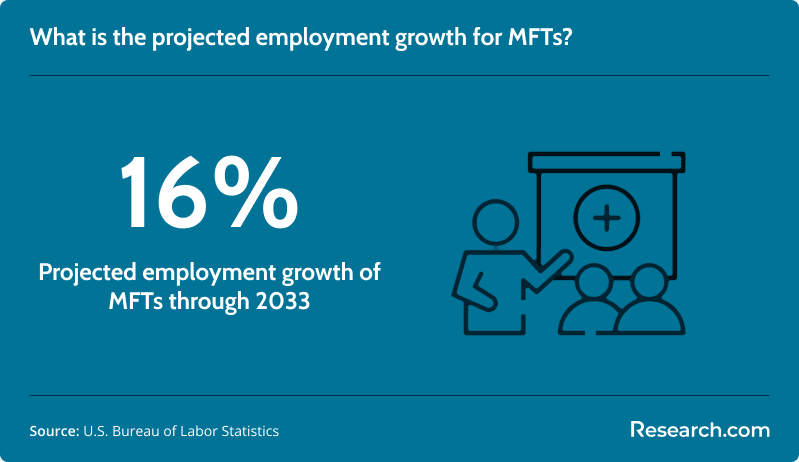
The job market for MFT graduates is supported by growing demand for mental health services and broader recognition of family and relationship-based treatment. One source notes strong growth projected for marriage and family therapists, and the Bureau of Labor Statistics projects 16% employment growth through 2033.
Job availability still varies by state, metro area, license level, and employer. Graduates who are not yet independently licensed may need to pursue associate-level roles under supervision before qualifying for private practice or higher-responsibility clinical positions.
Common Employers for MFT Graduates
- Private Practices: Many licensed MFTs provide therapy to individuals, couples, and families through solo or group practices.
- Community Mental Health Centers: These organizations often serve clients who face barriers to mental health care.
- Hospitals and Medical Centers: MFTs may work with patients and families managing illness, trauma, grief, or life transitions.
- Schools and Universities: Some MFTs provide counseling-related support, teach, or work in student services depending on role requirements.
- Employee Assistance Programs: EAP roles may involve short-term counseling, referrals, workplace stress support, and family-related concerns.
- Substance Abuse Treatment Centers: MFTs may support clients and families navigating addiction and recovery.
What Post-Graduation Support Do Online MFT Programs Offer?
Strong online MFT programs continue supporting students after coursework ends. Useful services may include career advising, clinical placement guidance, alumni mentoring, networking events, licensure workshops, exam preparation resources, and help understanding post-graduate supervision expectations.
Because MFT licensure can involve several stages, students should ask schools how they support graduates after degree completion. Programs that provide ongoing support may help graduates move more smoothly into counseling careers.
What Job Placement and Licensure Success Rates Should You Review?
Before enrolling, ask each online MFT program for outcome data. Important indicators include graduation rates, job placement rates, licensure exam pass rates, practicum placement completion rates, and how long graduates typically take to secure supervised post-graduate positions.
Not every program publishes the same metrics, so compare available data carefully and ask admissions advisors direct questions. You can also review Research.com’s broader resource on the online MFT program landscape for additional context.
Should You Pursue Complementary Graduate Programs to Enhance an Online MFT Career?
A second graduate program can make sense if it deepens your intended specialization, but it can also add cost and delay licensure progress. For example, an affordable master’s in child and adolescent psychology online may be relevant for therapists who want deeper preparation to serve younger clients and families.
Before pursuing another graduate credential, ask whether it improves your scope of practice, whether employers value it, and whether supervised clinical experience would be more useful than another degree.
Can Incorporating Forensic Psychology Enhance an Online MFT Career?
Forensic psychology knowledge can be valuable for MFTs who work near legal systems, custody disputes, domestic conflict, mandated treatment, or court-involved families. It can strengthen a therapist’s understanding of ethical documentation, legal boundaries, risk assessment, and family conflict in legally sensitive contexts.
Students interested in this niche can compare options such as a cost-conscious online forensic psychology master's. However, forensic psychology training does not automatically expand an MFT’s legal authority, so scope of practice and state regulations still matter.
How Can Combining an MFT Degree With a PsyD Dual Degree Benefit a Career?
Combining MFT training with doctoral-level psychology study may support advanced clinical knowledge, leadership, supervision, research, and academic goals. A PsyD pathway can provide deeper training in psychological assessment, diagnosis, intervention, and applied clinical practice.
This route is demanding and should be considered carefully because it may add substantial time and cost. Students exploring advanced pathways can compare PsyD dual degree programs to understand structure and career fit.
Common Mistakes to Avoid When Choosing an Online MFT Program
| Mistake | Why It Can Hurt You | Better Approach |
| Choosing a program before checking state licensure rules | You may graduate without meeting your state’s education requirements. | Contact your state board and ask the program for written licensure alignment details. |
| Looking only at tuition | Fees, residencies, books, supervision, and delayed graduation can change the real cost. | Compare total cost of attendance and likely clinical expenses. |
| Assuming online means fully remote | Most MFT programs still require in-person clinical hours. | Ask how practicum and internship placements work in your area. |
| Ignoring accreditation | Accreditation can affect financial aid, licensure, and employer confidence. | Verify institutional accreditation and relevant programmatic accreditation. |
| Relying only on rankings | A highly ranked program may not fit your state, budget, or schedule. | Use rankings as a starting point, not the final decision tool. |
| Assuming salary outcomes are guaranteed | Pay varies by location, license level, employer, and experience. | Research local job postings and supervised associate roles before enrolling. |
Here’s What Graduates Have to Say About Their Online MFT Programs
-
: "
My online MFT program made graduate school possible while I was managing work and family responsibilities. I could complete assignments around my schedule, but the clinical practicum still gave me real-world experience with clients. The format was flexible without removing the seriousness of the training. Miranda
"
-
: "
I needed to stay close to home, and online study let me pursue MFT training without moving. The virtual discussions were more engaging than I expected, and I appreciated being able to connect with classmates while keeping my family commitments in place. Keith
"
-
: "
Studying online helped me take ownership of my learning. I still had faculty support and peer interaction, but I could organize my week in a way that worked for me. The best part was applying concepts from class directly to clinical work during training. Donald
"
Key Insights
- An online MFT degree can prepare students for marriage and family therapy licensure, but only if the program meets the requirements of the student’s state licensing board.
- Most master’s-level MFT programs require around 60 credit hours and take two to three years full-time, while doctoral programs often take approximately four to five years.
- Online learning can reduce relocation barriers, but clinical practicum and internship requirements are usually completed in person at approved sites.
- Costs vary widely: online MFT programs may charge between $400 and $1,200 per credit hour, with total tuition commonly ranging from $24,000 to $72,000.
- Accreditation, clinical placement support, licensure alignment, and total cost are more important than convenience alone.
- Psychology is the most common undergraduate major among MFTs, with 8,232 degrees conferred in 2022.
- Offices of health practitioners are the largest employers of MFTs, employing 20,920 professionals in 2023.
- The Bureau of Labor Statistics reported a median annual wage of $67,230 for marriage and family therapists in May 2023.
- MFT employment is projected to grow by 16% through 2033, and a projected MFT shortage of 27,450 is expected by 2036.
- The strongest program choice is the one that fits your state, budget, learning style, clinical goals, and preferred client population.
References:
- Bureau of Labor Statistics (BLS). (2023). Marriage and family therapists, Occupational Outlook Handbook.
- Bureau of Labor Statistics (BLS). (2023). Marriage and family therapists.
- Council for Accreditation of Counseling and Related Educational Programs (CACREP). (n.d.). Marital, couple, and family counseling therapy.
- Data USA. (n.d.). Marriage and family therapists.
- Health Resources and Services Administration (HRSA). (2023). Projecting health workforce supply and demand.
Other Things You Should Know About the Best Online MFT Programs
Most online MFT programs in 2027 require the completion of around 60-66 credit hours. This typically includes core courses, electives, and supervised clinical training, necessary for licensure. Check specific program requirements as they can vary by institution.
No. Licensure rules are set by each state board, and an online MFT degree must meet that state’s education, practicum, and supervised clinical-hour requirements. Many states also require graduation from a COAMFTE-accredited or otherwise board-approved program.


