
2027 MFT vs. LMFT Degree Programs: Explaining The Difference

Co-Founder and Chief Data Scientist
Choosing between “MFT” and “LMFT” is often confusing because the terms are used inconsistently. In most cases, an MFT refers to a marriage and family therapy degree or pre-licensed professional pathway, while an LMFT is a licensed marriage and family therapist who has completed graduate education, supervised clinical experience, and state licensing requirements. That difference matters because it affects where you can work, whether you can practice independently, whether you can open a private practice, and how much responsibility you can legally take on with clients.
This guide explains the practical differences between an MFT education pathway and LMFT licensure. You will learn how coursework, clinical hours, exams, accreditation, state rules, online study, career options, private practice, and salary expectations compare. The goal is to help you choose a program that supports licensure, avoid costly mistakes, and understand what steps come after graduation.
Quick answer: MFT vs LMFT
An MFT is usually a graduate degree or training pathway in marriage and family therapy. An LMFT is a state-issued license that allows a qualified therapist to practice independently, subject to state law. A master’s degree in marriage and family therapy can prepare you for the LMFT pathway, but the degree alone does not usually make you independently licensed.
| Factor | MFT pathway | LMFT pathway |
| What it usually means | A marriage and family therapy degree or pre-licensed status | A licensed marriage and family therapist credential |
| Independent practice | Generally not allowed without supervision | Allowed when state licensure requirements are met |
| Typical education | Master’s degree in marriage and family therapy | Master’s degree plus post-graduate supervised experience and licensing exams |
| Clinical hours | Completed during practicum or internship in the degree program | Approximately 3,000 post-graduate supervised clinical hours, varying by state |
| Exam requirement | Usually no independent licensure exam at the degree stage | Commonly includes the AMFTRB National MFT Exam and, in some states, additional state exams |
| Best fit | Students preparing for supervised practice or licensure eligibility | Professionals seeking independent practice, private practice, or advanced clinical responsibility |
Key Things You Should Know About MFT vs LMFT
- An MFT program provides the academic foundation for marriage and family therapy, including systemic theory, assessment, counseling methods, ethics, and supervised practicum experience.
- LMFT is not simply a different degree title. It is a licensure status that typically requires a qualifying master’s degree, supervised post-graduate experience, and a licensing exam.
- Many candidates complete approximately 3,000 post-graduate supervised clinical hours before qualifying for LMFT licensure, although state rules vary.
- The AMFTRB National MFT Exam is a major licensing step in many jurisdictions. It covers six (6) content areas and has a total testing time of four (4) hours.
- Reported pay differs by role and licensure status. LMFTs have an estimated total salary of $111,174 annually, while MFTs average $85,006 per year.
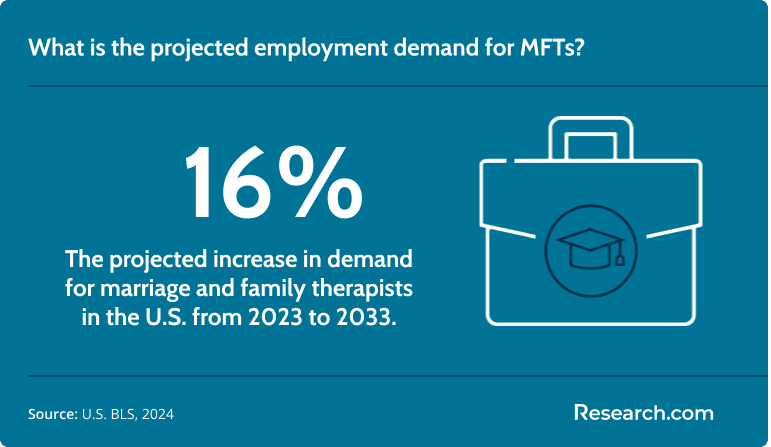
- Marriage and family therapy is projected to grow by 16% from 2023 to 2033, making licensure planning especially important for students entering the field.
- Are there fundamental differences in the coursework of an MFT degree vs. an LMFT degree?
- What are the differences in specialization options between MFT and LMFT programs?
- How does the practical training differ between MFT programs and the LMFT pathway?
- What are the licensing exam differences between MFT and LMFT pathways?
- How does the AMFTRB affect licensing differences between MFT and LMFT?
- What accreditation standards matter for MFT and LMFT preparation?
- What financial factors should you compare before choosing an MFT or LMFT pathway?
- What ethical and legal responsibilities apply to MFT and LMFT practice?
- Is a doctoral degree useful for advancing an MFT or LMFT career?
- Can online master degree programs in counseling support career advancement?
- How do state-specific licensing laws affect MFT and LMFT professionals?
- What continuing education and professional development requirements apply?
- What are the main career path differences for MFT graduates and LMFTs?
- Can additional certifications strengthen a therapy career?
- Are online psychology degrees accepted by employers?
- What are the benefits of an accelerated online psychology degree for therapy careers?
- Is MFT or LMFT better for private practice?
- How do salary expectations differ for MFTs and LMFTs?
- How is online therapy training different between MFT and LMFT pathways?
- What is the future career outlook for MFT and LMFT professionals?
Are there fundamental differences in the coursework of an MFT degree vs. an LMFT degree?
The coursework is usually not divided into two separate “MFT degree” and “LMFT degree” categories. The more accurate distinction is this: students complete an MFT or marriage and family therapy master’s program, then pursue LMFT licensure after graduation if they meet state requirements.
A qualifying MFT program generally covers systemic therapy, human development, family systems, couples counseling, assessment, diagnosis, ethics, research, and clinical practice. These courses prepare students to work with individuals, couples, and families through a relational lens rather than treating client concerns as isolated problems.
LMFT licensure adds requirements beyond the classroom. After earning the degree, candidates must complete supervised post-graduate clinical experience, document hours according to state rules, and pass required licensing exams. Those post-degree steps are what move a graduate from supervised practice toward independent clinical authority.
| Coursework area | Why it matters for MFT students | Why it matters for LMFT licensure |
| Systemic and relational theory | Builds the core framework for understanding couples and family systems | Supports clinical reasoning for independent practice |
| Assessment and diagnosis | Introduces clinical evaluation and treatment planning | Often becomes a major competency area for licensing exams and supervised practice |
| Ethics and law | Prepares students to handle confidentiality, consent, records, and professional boundaries | Becomes essential because licensed clinicians carry direct legal and ethical responsibility |
| Practicum or internship | Provides supervised client contact during the degree | Helps establish readiness for post-graduate supervised hours |
If you are comparing one year online masters programs, look closely at whether the program is designed for licensure preparation. Accelerated coursework may shorten the academic portion, but practicum placements, post-graduate supervised hours, and state licensing steps often take additional time.
What are the differences in specialization options between MFT and LMFT programs?
Specialization depends less on the letters “MFT” or “LMFT” and more on where you are in the training sequence. During an MFT master’s program, students usually receive broad preparation in relational therapy, couples work, family systems, child and adolescent development, ethics, and clinical methods. This broad base is important because early clinicians need general competence before narrowing their practice.
Specialized training often becomes more meaningful during practicum, internship, and post-graduate supervised experience. LMFT candidates may intentionally choose clinical placements focused on trauma, addiction, child therapy, couples counseling, grief, military families, or other populations. Once licensed, LMFTs may continue building a niche through continuing education, supervision, and additional credentials.
| Specialization area | When it may appear in training | Who should consider it |
| Couples therapy | Graduate coursework, practicum, post-graduate supervision | Students who want to focus on relational conflict, communication, intimacy, and divorce-related concerns |
| Child and adolescent therapy | Coursework plus youth-serving clinical placements | Students interested in schools, family agencies, pediatric settings, or child-focused clinics |
| Trauma-informed therapy | Advanced electives, supervised placements, continuing education | Clinicians working with abuse, violence, crisis, grief, or complex family stressors |
| Addiction and substance use | Specialized electives, clinical placement, related certification | Students who want to work in treatment centers, integrated care, or family recovery programs |
Students comparing a master of social work degree vs marriage and family therapy should also understand the practice orientation. MSW programs commonly emphasize social systems, advocacy, community resources, and case management, while MFT programs focus more directly on relational patterns, family systems, and therapeutic change within couples and families.
How does the practical training differ between MFT programs and the LMFT pathway?
Practical training is one of the biggest differences between earning an MFT degree and becoming an LMFT. The degree includes supervised clinical education, but licensure typically requires a much longer period of supervised post-graduate work after the degree is completed.
MFT programs: clinical training before graduation
- Practicum or internship: MFT programs include supervised clinical experience as part of the master’s curriculum. Students in accredited programs must complete at least 500 face-to-face client hours, with at least half involving couples or families.
- Close supervision: Students work under licensed professionals who review cases, monitor skill development, and help students connect theory with client work.
- Training focus: The goal is foundational competence. Students learn how to engage clients, apply systemic theory, document services, understand ethical obligations, and participate in treatment planning within the limits of trainee status.
LMFT pathway: supervised training after graduation
- Post-graduate clinical hours: After earning the MFT degree, candidates usually complete approximately 3,000 supervised clinical hours, although each state sets its own rules.
- Approved supervision: Supervision is typically provided by board-approved supervisors. Many states require at least four hours of supervision per month during this phase.
- Professional development: Post-graduate training allows candidates to deepen skills in specific settings, such as trauma treatment, child therapy, substance use treatment, or couples counseling.
If your goal is to become an addiction counselor, choose practicum and post-graduate placements that expose you to substance use assessment, treatment planning, relapse prevention, family recovery, and co-occurring mental health concerns.
| Training stage | Typical status | Main purpose | Decision point for students |
| Graduate practicum or internship | MFT student or trainee | Develop supervised foundational therapy skills | Ask whether the program helps students secure appropriate placements |
| Post-graduate supervised practice | Associate, intern, or pre-licensed clinician depending on state terminology | Accumulate required hours for LMFT eligibility | Confirm supervisor approval rules and hour categories in your state |
| Licensed independent practice | LMFT | Practice independently within state scope of practice | Plan for continuing education, specialization, insurance, and business requirements |
What are the licensing exam differences between MFT and LMFT pathways?
The main exam difference is that an MFT degree alone usually does not require an independent practice licensing exam, while LMFT licensure does. Exams are tied to legal authority to practice, not merely to completion of graduate coursework.
MFT pathway
- Exam status: Graduates with an MFT degree generally do not take a full independent licensure exam unless they are applying for licensure or a state-recognized associate credential.
- Professional title: “MFT” may refer to the field, degree, or pre-licensed role. Title rules vary by state, so graduates should not assume they can use any professional title without checking licensing board regulations.
- Practice limits: MFT graduates commonly work under supervision while completing the experience required for licensure.
LMFT pathway
1. Licensing exams:
- National MFT Exam: The AMFTRB administers the National MFT Exam, which is widely used as part of the LMFT licensure process.
- State-specific exams: Some jurisdictions add their own exams. California, for example, requires a Law and Ethics exam and a Clinical Examination for LMFT licensure.
2. Exam format and reporting:
- The National MFT Exam uses multiple-choice questions tied to major domains of marriage and family therapy practice. State-specific exams may test local law, ethics, documentation, reporting, and jurisdiction-specific practice rules.
- The California LMFT Clinical Exam includes 170 items, with some unscored, and provides immediate results. The National MFT Exam does not provide instant results and gives a performance breakdown after completion.
How does the AMFTRB affect licensing differences between MFT and LMFT?
The AMFTRB's role is central because it supports regulatory consistency for marriage and family therapy licensure across 52 jurisdictions. It does not turn an MFT degree into a license by itself. Instead, it helps state boards evaluate whether candidates meet the competency standards expected of licensed practitioners.
The Marital and Family Therapy National Examination, developed by the AMFTRB, is computer-based and includes 180 multiple-choice, objective questions. It covers six (6) content areas and allows a total testing time of four (4) hours.
- The Practice of Systematic Therapy: This area focuses on applying systemic theory, maintaining therapeutic relationships, and using a relational perspective in clinical work.
- Assessing, Hypothesizing, and Diagnosing: This area examines how therapists assess the client system, form and refine clinical hypotheses, and diagnose clients within a family and relational context.
- Designing and Conducting Treatment: This area addresses how therapists develop and carry out interventions with the client system.
- Evaluating Ongoing Process and Terminating Treatment: This area covers monitoring progress, using client feedback, modifying treatment, and planning appropriate termination.
- Managing Crisis Situations: This area focuses on identifying risk, responding to urgent clinical concerns, and protecting client welfare during crisis situations.
- Maintaining Ethical, Legal, and Professional Standards: This area covers legal compliance, ethical practice, professional competence, documentation, and treatment agreements.
The chart below shows the percentage of examinations in each domain.
What accreditation standards matter for MFT and LMFT preparation?
Accreditation matters because it can affect licensure eligibility, clinical placement quality, transferability, and employer confidence. The key point is that LMFT licensure does not usually come from a separate “LMFT degree accreditation.” Instead, students should choose an MFT or related graduate program that meets the educational standards required by the state where they plan to practice.
Accreditation for MFT programs
- Primary accrediting body: The Commission on Accreditation for Marriage and Family Therapy Education, or COAMFTE, accredits marriage and family therapy programs.
- Educational standards: COAMFTE standards address program mission, relational and systemic training, curriculum design, student learning outcomes, diversity and inclusion, clinical preparation, and competency assessment.
- Licensure relevance: Graduating from a COAMFTE-accredited program can make it easier to meet educational requirements in many states, although candidates still need to verify state-specific rules.
Accreditation and the LMFT pathway
- No separate LMFT program accreditor: LMFT is a license, not a standalone academic accreditation category. The relevant academic question is whether your graduate program satisfies your state board’s educational requirements.
- Post-degree requirements still apply: Even graduates of accredited programs must complete required supervised hours, exams, applications, fees, and continuing education as required by their licensing board.
- Portability concerns: If you may move states, ask how well the program’s curriculum aligns with licensure requirements in multiple jurisdictions.
If you are reviewing nationally accredited online colleges, confirm both institutional accreditation and program-level alignment with marriage and family therapy licensure requirements. Institutional accreditation alone does not guarantee that a program meets LMFT education rules.
| Accreditation question | Why it matters | What to ask before enrolling |
| Is the institution accredited? | Can affect financial aid eligibility, transfer credit, and employer recognition | Which recognized agency accredits the school? |
| Is the MFT program COAMFTE-accredited? | May support licensure preparation and portability | Does the program publish licensure alignment information by state? |
| Does the curriculum meet state requirements? | Licensure boards may require specific course areas | Has the program verified eligibility for the state where I plan to practice? |
| Are clinical placements available where I live? | Online students may still need local supervised sites | Who finds placements: the student, the school, or both? |
What financial factors should you compare before choosing an MFT or LMFT pathway?
The cost difference between MFT and LMFT preparation is not only tuition. Students should budget for application fees, textbooks, technology fees, practicum expenses, background checks, supervision-related costs, exam fees, licensing applications, professional liability insurance, and continuing education after licensure.
The degree is only the first major investment. Because LMFT licensure requires supervised post-graduate experience, candidates should also consider how much they may earn during the supervised phase, whether supervision is paid by an employer or paid out of pocket, and how long it may take to complete required hours in their state.
| Cost category | MFT degree stage | LMFT licensure stage |
| Tuition and fees | Primary cost during the master’s program | Usually already completed, unless additional coursework is required by the state |
| Clinical placement costs | May include travel, background checks, insurance, and site requirements | May continue during supervised employment or associate practice |
| Supervision | Typically built into practicum or internship | May be employer-provided or an additional out-of-pocket expense |
| Exams and licensing | Usually limited unless a state requires an associate-level process | Includes licensing exams, state applications, renewals, and related fees |
| Opportunity cost | Time spent in coursework and practicum | Time spent in supervised practice before independent licensure |
When comparing programs, focus on total cost to licensure rather than tuition alone. Affordable tuition is helpful, but a low-cost program that does not meet your state’s licensure rules can become more expensive if you must complete extra coursework later. For cost-focused options, review marriage and family therapy graduate programs online.
What ethical and legal responsibilities apply to MFT and LMFT practice?
Ethical and legal duties become more extensive as clinical independence increases. MFT students and graduates working under supervision must follow agency policies, supervisor direction, professional ethics, confidentiality rules, documentation standards, and mandated reporting laws. However, their work is usually overseen by a licensed professional.
LMFTs carry direct legal and professional responsibility for their clinical decisions. That includes informed consent, confidentiality, recordkeeping, risk assessment, duty-to-warn or protection obligations where applicable, boundaries, teletherapy compliance, and adherence to state practice acts. Licensed therapists must also maintain competence through continuing education and appropriate consultation.
| Responsibility | MFT student or pre-licensed clinician | LMFT |
| Confidentiality | Must follow laws, agency rules, and supervisor guidance | Directly accountable to clients, boards, and legal standards |
| Informed consent | Often uses agency or training-site procedures | Responsible for clear practice policies, fees, risks, benefits, and limits of confidentiality |
| Clinical documentation | Completed under site and supervisor review | Maintained independently according to legal, ethical, and payer requirements |
| Scope of practice | Limited by trainee or associate status | Defined by state license, competence, and professional standards |
If you are still comparing mental health careers, reviewing psychology career options can help you understand how therapy, counseling, psychology, and related roles differ in education, licensure, and scope of practice.
Is a doctoral degree useful for advancing an MFT or LMFT career?
A doctoral degree is not typically required to become an LMFT, but it can be valuable for certain career goals. It may make sense for professionals who want to teach at the college level, conduct research, move into senior clinical leadership, supervise advanced training, publish scholarship, or build expertise in a highly specialized area.
For clinicians focused primarily on direct practice, private practice, or agency work, LMFT licensure and strong supervised experience may be more immediately useful than a doctorate. The decision should depend on career goals, cost, time commitment, research interests, and whether doctoral training will produce a clear professional benefit.
| Goal | Is a doctorate likely to help? | Why |
| Independent clinical practice | Sometimes, but not usually required | LMFT licensure is the key requirement for independent practice |
| University teaching or research | Often helpful | Doctoral study can support academic, research, and faculty roles |
| Clinical leadership | Potentially helpful | Advanced credentials may support administrative or supervisory roles |
| Specialized scholarship | Helpful | Doctoral programs can deepen research and theoretical expertise |
Professionals interested in research-oriented or advanced academic pathways may want to compare PhD psychology online programs with marriage and family therapy doctoral options before committing to a long-term plan.
Can online master degree programs in counseling support career advancement?
Online master degree programs in counseling can support career growth when they are accredited, clinically rigorous, and aligned with the licensure requirements of the student’s intended state. They may be especially useful for working adults who need flexible scheduling while completing graduate coursework.
However, online format does not remove clinical requirements. Students still need supervised fieldwork, approved placements, and compliance with state licensing rules. Before enrolling, ask whether the program prepares students for counseling licensure, MFT licensure, or another credential. These pathways can overlap in some skills but often lead to different licenses and scopes of practice.
Students seeking cost-conscious counseling options can compare online master degree programs in counseling, but they should verify licensure alignment before making a decision.
How do state-specific licensing laws affect MFT and LMFT professionals?
State law can change almost every practical step in the MFT-to-LMFT pathway. Requirements may differ for acceptable degrees, required courses, supervised hour categories, supervisor qualifications, exam sequence, associate registration, teletherapy rules, continuing education, title usage, and license renewal.
This is why students should choose a program backward from the state where they want to practice. A program that works well for one state may require additional documentation or coursework in another. If you may relocate, ask the program how it supports graduates seeking licensure across state lines.
| State licensing issue | Why it matters | What to verify |
| Educational requirements | States may require specific courses or program types | Does the curriculum match your state board’s checklist? |
| Supervised hours | Hour totals and categories vary | Which hours count, and who can supervise them? |
| Exam requirements | Some states require national and state-specific exams | Which exams are required, and when can you take them? |
| Title rules | Using the wrong title can create legal issues | What title may you use before full licensure? |
| Teletherapy rules | Remote care may depend on client location and license jurisdiction | Can you serve clients across state lines? |
Students comparing broader counseling options may also review the cheapest online masters in mental health counseling, while remembering that mental health counseling and marriage and family therapy can lead to different licenses.
What continuing education and professional development requirements apply?
Continuing education becomes especially important after licensure. LMFTs usually must complete state-mandated continuing education to renew their licenses, and many states require specific training in ethics, law, supervision, cultural competence, telehealth, or other topics. Exact requirements vary by state.
MFT graduates who are not yet independently licensed may still complete professional development through employers, supervision plans, graduate programs, or professional associations. The difference is that licensed professionals generally have formal renewal obligations set by a licensing board.
- Check your renewal cycle: Know how often your state requires license renewal and documentation.
- Prioritize required topics: Ethics, law, mandated reporting, and risk management are common areas of emphasis.
- Use continuing education strategically: Choose training that supports your intended specialization, not just the fastest credits available.
- Track documentation: Keep certificates and course records in case of board audit.
Candidates comparing counseling credentials may also examine CACREP accredited programs, particularly if they are weighing counseling licensure against marriage and family therapy licensure.
What are the main career path differences for MFT graduates and LMFTs?
The biggest career difference is legal independence. MFT graduates are generally moving toward licensure and working under supervision. LMFTs have met state requirements for independent practice and can take on broader clinical, administrative, and private practice responsibilities.
Career paths for MFT graduates before licensure
- Supervised clinical roles: Graduates may work as interns, associates, trainees, or pre-licensed clinicians depending on state terminology.
- Agency-based employment: Common settings include community mental health centers, nonprofit organizations, family service agencies, school-linked services, and residential programs.
- Restricted autonomy: Pre-licensed professionals may provide therapy, but their work is supervised and limited by state law and employer policy.
- Licensure preparation: The main career goal during this stage is often to accumulate qualifying supervised hours and prepare for required exams.
Career paths for LMFTs after licensure
- Independent clinical practice: LMFTs may practice without ongoing clinical supervision, subject to state rules.
- Private practice: Licensed therapists may open practices, contract with payers, set clinical policies, and choose client populations.
- Specialized clinical work: LMFTs may focus on trauma, addiction, child and adolescent therapy, couples therapy, grief, or other niches.
- Leadership roles: Experienced LMFTs may become clinical supervisors, program managers, directors, consultants, or trainers.
- Academic and expert roles: Some LMFTs teach, conduct research, consult with organizations, or serve as expert witnesses.
If you are asking, “What do you need for a counseling degree?” remember that counseling, MFT, psychology, and social work credentials often have different degree names, supervised hour requirements, exams, and scopes of practice.
Students comparing therapeutic fields should also understand the difference between addiction counseling and psychology degree programs, since each prepares graduates for different client needs, settings, and licensing pathways.
Meanwhile, the chart below shows the largest employers of marriage and family therapists for 2023.
Can additional certifications strengthen a therapy career?
Additional certifications can be useful when they support a clear clinical goal. They should not be used as substitutes for licensure, but they can help a therapist build competence in a focused area, such as behavioral intervention, addiction treatment, trauma-informed care, play therapy, or family-based approaches.
The best certifications are those that match your client population, employer expectations, and long-term practice model. Before paying for a credential, ask whether it is recognized in your field, whether it requires supervised experience, and whether it improves your ability to serve clients ethically.
| Certification decision | Good reason to pursue it | Possible mistake to avoid |
| Behavior-focused credential | You work with behavioral challenges, developmental concerns, or interdisciplinary care teams | Assuming it replaces therapy licensure |
| Addiction-related credential | You plan to serve individuals and families affected by substance use | Choosing a credential without checking state addiction counseling rules |
| Trauma training | You frequently treat clients with trauma histories or crisis exposure | Taking brief courses without seeking supervision or consultation |
| Couples therapy training | You want a focused private practice niche | Marketing expertise before completing sufficient supervised practice |
For clinicians interested in behavior analysis, affordable BCBA online degree programs may be worth comparing, especially if behavioral assessment and intervention are relevant to your intended practice setting.
Are online psychology degrees accepted by employers?
Employers are more likely to respect online psychology and therapy-related degrees when the institution is properly accredited, the curriculum is rigorous, and the program includes appropriate clinical or applied training where required. The delivery format matters less than whether the degree meets professional, employer, and licensure expectations.
For therapy careers, the most important question is not simply whether the degree is online. It is whether the program qualifies you for the credential you need. A general online psychology degree may be useful for foundational knowledge or certain entry-level roles, but it may not meet requirements for therapy licensure unless it is specifically designed for that purpose.
- Verify accreditation: Confirm the school’s institutional accreditation and any program-level accreditation relevant to your goal.
- Check licensure alignment: Ask whether the program meets requirements in your state.
- Review outcomes: Look for information about graduate placement, exam preparation, and clinical training support.
- Understand degree limits: A psychology degree, counseling degree, and MFT degree may lead to different career options.
For a deeper discussion, review whether are online psychology degrees accepted by employers and how program quality affects employer perception.
What are the benefits of an accelerated online psychology degree for therapy careers?
An accelerated online psychology degree can help students complete academic requirements more quickly, but it should be evaluated carefully if the goal is therapy practice. Speed is useful only when the program also provides academic quality, advising, transfer support, and a realistic path into the next credential or graduate program.
For future MFT or LMFT professionals, an accelerated psychology degree may be most useful as an undergraduate foundation before applying to a master’s program in marriage and family therapy, counseling, psychology, or a related field. It is not usually the final step toward independent therapy practice.
When comparing an Accelerated psychology degree online, ask whether the program prepares you for graduate admission, whether courses transfer well, how intensive the schedule is, and whether the faster pace could affect grades or preparation.
Is MFT or LMFT better for private practice?
LMFT licensure is far more advantageous for private practice because independent clinical practice generally requires a license. An MFT degree can start the pathway, but the license is what usually allows therapists to operate independently, accept greater clinical responsibility, and build a private practice within state rules.
Why LMFT licensure matters for private practice
- Independent authority: LMFTs can provide therapy without ongoing supervision once fully licensed.
- Business ownership: Licensed therapists may open and manage a practice, subject to state law, business rules, and professional standards.
- Insurance participation: LMFTs may be able to contract with insurance providers, which can broaden access to clients.
- Specialized positioning: Licensed clinicians can build a practice around couples therapy, trauma, family conflict, parenting, addiction recovery, or other areas of competence.
- Client trust: Licensure signals that a therapist has met education, supervision, examination, and ethical requirements.
Why an MFT degree alone is limited for private practice
- Supervision requirements: Pre-licensed professionals generally cannot practice independently or operate as fully autonomous clinicians.
- Scope restrictions: State law may limit the services, titles, billing options, and practice structure available before licensure.
- Business constraints: Without licensure, it may be difficult or impossible to credential with insurers, advertise independent services, or assume sole responsibility for client care.
If private practice is your long-term goal, ask, “Which therapy specialization is right for me?” Your specialization should influence your practicum choices, supervision plan, continuing education, and eventual business model.
How do salary expectations differ for MFTs and LMFTs?
Salary expectations differ because licensure changes responsibility, autonomy, job eligibility, and practice setting. MFT graduates in supervised or entry-level roles often earn less than fully licensed professionals. The average annual pay for MFTs in the United States is $85,006 a year. The estimated total salary for an LMFT is $111,174, with an average salary of $99,615 per year.
These figures should be treated as estimates, not guarantees. Actual earnings depend on state, employer, years of experience, specialization, payer mix, caseload, private practice expenses, and whether the role is full-time, part-time, supervised, or independently licensed.
| Salary factor | How it affects MFT graduates | How it affects LMFTs |
| Licensure status | May limit job types and billing options | Expands eligibility for independent and higher-responsibility roles |
| Practice setting | Often agency-based or supervised | May include private practice, leadership, consulting, or specialized clinics |
| Specialization | Developing but usually still supervised | Can support niche services and advanced clinical roles |
| Experience | Early-career experience focused on hour accumulation | Can lead to supervision, management, or independent business opportunities |
Here are the top five best-paying related MFT and LMFT jobs in the U.S.
How is online therapy training different between MFT and LMFT pathways?
Online MFT training can deliver the academic portion of marriage and family therapy education, but it does not eliminate the need for supervised clinical experience. Students still need practicum or internship placements, faculty supervision, site supervision, and compliance with state requirements.
The LMFT pathway builds on online or campus-based graduate training through post-graduate supervised clinical hours and licensing exams. In other words, online coursework may help you complete the degree, but licensure depends on the full combination of education, clinical training, supervision, exams, and state board approval.
| Online training issue | What to check | Why it matters |
| Licensure disclosure | Whether the program states which states it prepares students for | Prevents enrolling in a program that does not meet your state’s requirements |
| Clinical placement support | Whether the school helps locate and approve sites | Field placement delays can slow graduation and licensure progress |
| Residency requirements | Whether any in-person intensives are required | Affects travel, cost, and scheduling |
| Supervision model | How faculty and site supervision are coordinated | Clinical training quality depends heavily on supervision |
Students exploring related clinical paths can compare the top online degree programs for addiction counseling, especially if they want training focused on substance use treatment and intervention skills.
If your priority is speed, the fastest online MFT program may be attractive, but you should still confirm accreditation, clinical placement support, and licensure alignment before enrolling.
What is the future career outlook for MFT and LMFT professionals?
The career outlook for marriage and family therapy is strong, with the field projected to grow by 16% from 2023 to 2033. Demand is supported by continued need for mental health services, relationship and family counseling, integrated behavioral health, and access to therapy through in-person, remote, and hybrid models.
LMFTs are likely to have broader opportunities than pre-licensed MFT graduates because licensure expands independence, billing options, private practice potential, and eligibility for specialized clinical roles. However, MFT graduates are still an important part of the workforce while they complete supervised experience.
Current trends affecting MFT and LMFT careers
- Teletherapy and hybrid care: Online service delivery has expanded access, but clinicians must follow state laws and licensing rules tied to client location.
- Greater emphasis on measurable outcomes: Employers and payers increasingly expect documentation, treatment planning, and evidence-informed care.
- Interdisciplinary care: Marriage and family therapists may work with physicians, social workers, school staff, addiction counselors, and case managers.
- Licensure portability concerns: Professionals who move states need to understand how supervision hours, exams, and education are evaluated across jurisdictions.
- Digital competence: Clinicians need comfort with secure platforms, telehealth ethics, client privacy, and technology-supported documentation.
Students comparing broader behavioral health education options may also review the cheapest online college for psychology, especially if they are still deciding between psychology, counseling, social work, and marriage and family therapy.
Common mistakes to avoid when choosing an MFT or LMFT pathway
| Mistake | Why it can hurt you | Better approach |
| Assuming MFT and LMFT are two equal degree types | You may misunderstand when you can practice independently | Treat MFT as the education pathway and LMFT as the license goal |
| Choosing a program based only on tuition | A cheaper program may not satisfy licensure requirements in your state | Compare total cost to licensure, including supervision and exams |
| Ignoring accreditation | Licensure eligibility and portability may be affected | Check institutional accreditation, program accreditation, and state board rules |
| Assuming online means easier | Clinical placements and licensure requirements still apply | Ask how online students complete practicum and supervision |
| Not planning for supervised hours | Post-graduate licensure can take longer than expected | Research hour categories, supervisor requirements, and associate registration early |
| Relying only on rankings | A highly ranked program may not be the right fit for your state, budget, or schedule | Use rankings as one input, then verify licensure alignment and clinical support |
Questions to ask before enrolling in an MFT program
- Does this program meet the educational requirements for LMFT licensure in the state where I plan to practice?
- Is the program COAMFTE-accredited, and if not, how does it document licensure alignment?
- How many face-to-face client hours are required before graduation?
- Who is responsible for finding practicum or internship placements?
- Can online students complete clinical requirements near where they live?
- What percentage of graduates pursue licensure, and what support does the program provide during that process?
- Does the curriculum include assessment, diagnosis, ethics, law, couples therapy, family systems, and treatment planning?
- What are the total costs beyond tuition, including fees, travel, supervision, exams, and licensing applications?
- If I move states, how portable is the degree likely to be?
- What types of supervised sites do students commonly use?
Here’s What Graduates Have to Say about MFT vs LMFT
I was able to continue working while moving toward LMFT licensure. Having access to lectures and course materials on my own schedule made it easier to organize my week and reduce stress. - Ian
My MFT program connected me with experienced faculty and a wide range of classmates. The online discussions were more engaging than I expected, and they helped me see family therapy from multiple perspectives. - Carlos
I was unsure about online learning at first, but the structure worked well for me while I pursued the LMFT pathway. The mix of independent assignments and interactive coursework helped me prepare for clinical work. - Aisha
References:
- AMFTRB. (2025). AMFTRB handbook for candidates. Retrieved from https://ptcny.com/pdf/AMFTRB2025.pdf
- Glassdoor. (2025). How much does a licensed marriage and family therapist (LMFT) make? Retrieved from https://www.glassdoor.com/Salaries/licensed-marriage-and-family-therapist-lmft-salary-SRCH_KO0,43.htm
- U.S. Bureau of Labor Statistics. (2024). Marriage and family therapists: Occupational outlook handbook. Retrieved from https://www.bls.gov/ooh/community-and-social-service/marriage-and-family-therapists.htm#tab-6
- ZipRecruiter. (2025). Entry-level marriage & family therapist salary. Retrieved from https://www.ziprecruiter.com/Salaries/Entry-Level-Marriage-Family-Therapist-Salary
Key Insights
- MFT usually refers to the degree or pre-licensed training pathway; LMFT refers to the state license that allows independent practice.
- A master’s degree in marriage and family therapy is only one part of the LMFT process. Candidates typically also need supervised post-graduate hours, exams, and state board approval.
- Licensure rules vary by state, so students should choose programs based on where they plan to practice, not just program name, cost, or speed.
- COAMFTE accreditation can support licensure preparation, but students should still confirm state-specific education and clinical requirements.
- Online MFT programs can be legitimate and useful, but they must provide clear clinical placement support and licensure alignment.
- LMFT licensure offers stronger private practice opportunities, broader autonomy, and typically higher salary potential than remaining in a pre-licensed MFT role.
- The smartest path is to plan backward from your desired license, state, specialization, and practice setting before choosing a program.
Other Things You Should Know About MFT vs LMFT
The MFT program focuses on educational coursework and supervised clinical training in 2027, preparing graduates for licensure as LMFTs. In contrast, the LMFT credential is the licensure status achieved post-degree, signifying that an individual has met all necessary requirements, including passing the licensing exam and completing required clinical hours.
An MFT degree focuses on academic coursework and training in marriage and family therapy. In contrast, an LMFT credential in 2027 signifies that a therapist has met clinical experience and licensing exam requirements to practice independently.
In 2027, the MFT (Master of Family Therapy) is an academic degree focusing on foundational therapy skills, while the LMFT (Licensed Marriage and Family Therapist) is a licensure obtained after completing supervised clinical hours and passing a state exam, granting the ability to practice independently.
In 2027, an MFT (Master of Family Therapy) degree is an educational qualification, while an LMFT (Licensed Marriage and Family Therapist) credential is a professional license. Earning an MFT is a step towards LMFT licensure, which requires additional clinical experience and passing a licensing exam.


