
2027 MSW vs. MFT Degree Programs: Explaining the Difference

Co-Founder and Chief Data Scientist
If you want a graduate degree that leads to counseling, therapy, or human services work, the choice between a Master of Social Work (MSW) and a marriage and family therapy (MFT) degree matters more than the course catalog may suggest. Both can lead to client-facing mental health careers, but they prepare you for different licenses, workplaces, responsibilities, and long-term career options.
An MSW is usually the stronger fit for students who want flexibility across therapy, case management, hospitals, government agencies, nonprofits, advocacy, and policy. An MFT degree is usually better for students who want to specialize in psychotherapy for couples, families, and relationship-based mental health concerns. This guide explains how the two paths compare in education, cost, licensure, salary, job outlook, and career mobility so you can choose the route that fits your goals instead of relying on program names alone.
Quick Answer: MSW vs. MFT Degree Programs
Choose an MSW if you want the broadest career range in social services, healthcare, public agencies, clinical social work, and policy. Choose an MFT degree if your main goal is to become a therapist focused on relationships, family systems, couples counseling, and private practice. Both fields have solid demand: social work jobs are projected to grow 7% from 2023 to 2033, while marriage and family therapist employment is projected to grow 16% over the same period.
| Decision Point | MSW Degree | MFT Degree |
| Best fit for | Students who want flexibility across clinical, community, healthcare, nonprofit, government, and policy roles | Students who want specialized therapy training for individuals, couples, and families |
| Typical full-time length | About two years | Usually two to three years, depending on state requirements |
| Common license path | Licensed clinical social worker, often called LCSW | Licensed marriage and family therapist, often called LMFT |
| Average salary cited | $50,102 | $57,856 |
| Projected employment growth | 7% from 2023 to 2033 | 16% from 2023 to 2033 |
| Annual openings cited | About 67,300 job openings per year | About 7,500 openings per year |
Key Things You Should Know About MSW vs. MFT Degree Programs
- An MSW commonly takes about two years of full-time study, while an MFT degree often takes two to three years because clinical training requirements vary by state.
- Median tuition is close in both fields: social work programs report $7,190 for in-state public tuition and $32,870 for out-of-state private tuition, while MFT programs report $7,038 for in-state public tuition and $33,550 for out-of-state private tuition.
- Salary data cited in this article shows social workers earning an average of $50,102 and marriage and family therapists earning $57,856 annually.
- Social work employment is projected to grow 7% from 2023 to 2033, with about 67,300 job openings per year.
- MFT employment is projected to grow 16% from 2023 to 2033, although the field is smaller, with about 7,500 openings per year.
- What are MSW and MFT degree programs?
- How long does it take to complete an MSW or MFT degree?
- Which degree usually costs less, MSW or MFT?
- What financial aid can MSW and MFT students use?
- How do MSW and MFT licensing requirements differ?
- Where do MSW and MFT graduates work?
- Which extra certifications can strengthen MSW or MFT career options?
- What is the quickest route to becoming a licensed counselor?
- How are current industry trends changing counseling careers?
- Can faith-based counseling credentials support career growth?
- Should you consider an accelerated online degree?
- Why does accreditation matter for online counseling and psychology programs?
- How can psychology credentials complement an MSW or MFT?
- What work can MSWs do that MFTs generally cannot?
- Do MSWs or MFTs earn more money for 2027?
- Which degree provides stronger long-term career security?
- Can MSWs and MFTs work on the same care teams?
What are MSW and MFT degree programs?
An MSW, or Master of Social Work, is a graduate degree that prepares students for social work practice across clinical and non-clinical settings. Depending on the program and state requirements, graduates may pursue roles in therapy, case management, child welfare, hospitals, schools, public agencies, community organizations, nonprofit leadership, advocacy, and social policy.
An MFT degree is a graduate program in marriage and family therapy. It prepares students to provide psychotherapy through a relational and family-systems lens. MFT students study how relationships, family structures, communication patterns, trauma, and behavioral health concerns affect individuals, couples, and families.
| Category | MSW | MFT |
| Primary focus | Social work practice, clinical care, advocacy, systems navigation, and community support | Psychotherapy for individuals, couples, and families, with emphasis on relationship systems |
| Typical clients | Individuals, families, children, older adults, crisis-affected clients, underserved communities, and people navigating social systems | Individuals, couples, and families dealing with relationship conflict, mental health concerns, parenting challenges, and family stress |
| Common career direction | Clinical social work, case management, healthcare social work, policy, child welfare, nonprofit services, and community programs | Marriage and family therapy, couples counseling, family counseling, behavioral health clinics, and private practice |
| Typical license goal | Licensed clinical social worker, or LCSW, for independent clinical practice | Licensed marriage and family therapist, or LMFT |
| Coursework emphasis | Human behavior, social policy, social justice, assessment, intervention, ethics, and field practice | Family systems, couples therapy, clinical assessment, psychotherapy models, ethics, and supervised counseling practice |
| Field training pattern | Often completed in social service agencies, hospitals, schools, community organizations, or clinical settings | Often completed in therapy clinics, counseling centers, behavioral health agencies, or supervised psychotherapy settings |
The simplest distinction is this: MSW training is broader, while MFT training is more specialized. If you want to work across both people and systems, the MSW may offer more room to pivot. If you are certain you want a therapy career centered on couples and family relationships, the MFT path may be more direct.
How long does it take to complete an MSW or MFT degree?
Both degrees require graduate-level coursework and supervised field experience, but the timeline is not identical. A full-time MSW typically takes about two years. An MFT degree often takes two to three years because programs may include more specialized clinical preparation and must align with state licensure requirements.
The degree itself is only one part of the timeline. Students also need to plan for post-degree supervision, licensing exams, state applications, and any required background checks or jurisprudence exams. These requirements can affect how quickly a graduate can practice independently.
| Timeline Factor | How It Affects MSW Students | How It Affects MFT Students |
| Full-time enrollment | Many students complete the program in about two years | Many students finish in two to three years |
| Part-time enrollment | Useful for working adults, but it extends the completion timeline | Also common for working adults, especially when clinical placements must fit work schedules |
| Field placement availability | Placements may be available across agencies, hospitals, schools, and community settings | Placements must usually support therapy-focused training and may be more specialized |
| Postgraduate supervision | Required for clinical licensure and varies by state | Required for independent practice and often closely tied to couples and family therapy experience |
| State licensing rules | Requirements differ by state and by social work license level | Requirements also vary by state and may affect approved coursework and supervised hours |
Before enrolling, ask each program how long students usually take to finish, how field placements are arranged, whether the curriculum meets your state’s licensing rules, and what graduates typically do while completing supervised hours.
Which degree usually costs less, MSW or MFT?
MSW and MFT tuition is similar enough that cost should not be judged by degree title alone. Residency status, public versus private tuition, online fees, transfer policies, field placement costs, and time to licensure can all change the real price of either option.
| Cost Category | MSW | MFT | What It Means for Students |
| Median in-state public tuition | $7,190 | $7,038 | The public in-state difference is small, so compare total program cost rather than tuition alone. |
| Median out-of-state private tuition | $32,870 | $33,550 | Private programs may cost substantially more, and the higher sticker price should be weighed against aid, completion time, and licensure fit. |
| Fieldwork expenses | Students may complete placements in social service settings, including unpaid internships | Students may face additional costs tied to clinical supervision before independent practice | Unpaid hours, transportation, background checks, and supervision fees can affect affordability. |
| Online savings | Online and hybrid formats may reduce relocation or commuting costs | Lower-cost online MFT options may help students compare tuition and flexibility | Online programs are not automatically cheaper, but they can reduce indirect expenses for some students. |
If your priority is minimizing debt, start with in-state public universities, employer tuition benefits, graduate assistantships, and online or hybrid programs that clearly meet licensure requirements. A program that is slightly cheaper upfront may cost more later if credits do not transfer, field placements are hard to secure, or the curriculum does not match the license you need.
What financial aid can MSW and MFT students use?
MSW and MFT students may use many of the same aid sources, including federal loans and institutional scholarships. The biggest difference is that MSW graduates often enter government and nonprofit roles, which can make some public service repayment options easier to use if all program rules are met. MFT graduates may also qualify for aid and repayment programs, but eligibility often depends on employer type and work setting.
| Aid Option | MSW Considerations | MFT Considerations |
| Federal student aid | MSW students can typically apply for federal loans, work-study, and available grant aid through the standard federal aid process | MFT students can also use federal aid when enrolled in eligible programs |
| Public Service Loan Forgiveness | The Public Service Loan Forgiveness program may be relevant because many MSW graduates work for government or nonprofit employers | MFT graduates may qualify if their employer and loan repayment situation meet PSLF rules |
| Scholarships | MSW students may find awards through professional groups and social work education organizations, including the National Association of Social Workers Foundation and the Council on Social Work Education | MFT students may find awards through mental health and therapy organizations, including the American Association for Marriage and Family Therapy Minority Fellowship and the CAMFT Educational Foundation Scholarship |
| Grants and fellowships | Some funding supports social workers who plan to serve underserved communities or shortage areas | MFT students may find fellowships through mental health organizations, though publicly funded options may be more limited |
| Loan repayment programs | MSW graduates may qualify for National Health Service Corps Loan Repayment when working in eligible mental health shortage areas | MFT graduates may also be eligible in some situations, but available qualifying positions may be fewer |
When comparing aid offers, look beyond the scholarship amount. Ask whether the award renews each year, whether it requires full-time enrollment, whether unpaid internship hours will reduce your ability to work, and whether your expected employer type could support loan forgiveness or repayment benefits.
The chart below shows the distribution of student loan forgiveness by eligibility type, based on 2024 reporting.
How do MSW and MFT licensing requirements differ?
Both MSW and MFT graduates must meet state licensing rules before practicing independently. The key difference is that social work licensing can lead to several kinds of roles, while MFT licensing is designed specifically for marriage and family therapy practice.
| Licensing Requirement | MSW Path | MFT Path |
| Common exam | MSW graduates pursuing licensure commonly take an Association of Social Work Boards exam, with content that may include ethics, policy, assessment, intervention, and practice standards | MFT graduates typically take the Marriage and Family Therapy National Exam, with emphasis on systemic therapy, clinical methods, ethics, and treatment planning |
| Supervised experience | Licensure may require 2,000 to 4,000 supervised hours, depending on state rules and license type | Candidates commonly need 3,000 to 4,000 supervised hours focused on marriage and family therapy practice |
| State variation | Rules vary significantly by state and by whether the graduate wants a clinical or non-clinical credential | Rules also vary by state, especially around approved coursework, supervision, and qualifying clinical experience |
| Online program risk | Students should confirm that online or hybrid MSW coursework and field placements meet the state licensing board’s standards | Students considering a marriage and family counseling degree online should verify state-specific LMFT eligibility before enrolling |
| Career flexibility during supervision | MSW graduates may be able to work in case management, community services, healthcare, or public agencies while completing clinical supervision | MFT graduates usually focus their supervised experience on therapy practice before independent licensure |
The practical takeaway is straightforward: check licensure before checking rankings. A respected program may still be the wrong choice if it does not meet your state’s coursework, fieldwork, or supervised-hour rules.
Where do MSW and MFT graduates work?
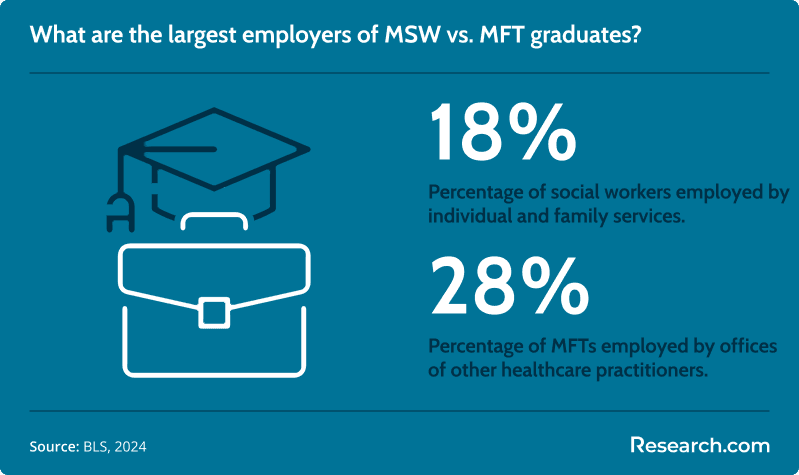
MSW and MFT graduates may both work in mental health, but their employment settings often differ. MSW graduates are more widely distributed across public service, healthcare, government, social services, and community programs. MFT graduates are more concentrated in therapy-focused environments, including private practice and family services.
| Work Setting | MSW Career Fit | MFT Career Fit |
| Government agencies | According to 2024 BLS data, 14% of social workers work in local government and 12% work in state government | Government roles exist but are less common for MFTs |
| Individual and family services | About 18% of MSWs work in individual and family services | About 27% of MFTs work in individual and family services |
| Private practice | LCSWs may enter private practice after meeting clinical licensure requirements | Private practice is a common goal, and 14% of MFTs are self-employed |
| Hospitals and healthcare systems | MSWs may handle discharge planning, care coordination, resource navigation, crisis intervention, and advocacy | MFTs may provide therapy services in healthcare or behavioral health settings |
| Community and nonprofit organizations | MSWs often support case management, program leadership, advocacy, and direct service delivery | MFTs may provide counseling services within community-based mental health programs |
Students who want structured employment, public-sector benefits, or broad social service roles may prefer the MSW. Students who want to build a therapy-centered practice and work primarily with relational concerns may prefer the MFT.
Which extra certifications can strengthen MSW or MFT career options?
Additional credentials can help MSW and MFT graduates deepen a specialty, but they should be chosen carefully. The right certification can support work with a specific client population, treatment model, or service setting. The wrong one can add cost without improving licensure eligibility or employment prospects.
For example, professionals who want applied behavior analysis skills may compare online BCBA coursework to see whether it aligns with their goals. This can be useful for work involving behavioral intervention, but students should review accreditation, faculty qualifications, supervision requirements, and whether the credential is recognized in the roles they want.
| Credential Choice | When It May Help | What to Check First |
| Behavior analysis coursework | Useful for professionals interested in behavioral intervention or related clinical support roles | Accreditation, supervised experience rules, and whether employers in your target setting value the credential |
| Trauma-focused training | Helpful for social workers and therapists serving clients with trauma histories | Whether the training is evidence-based and appropriate for your license scope |
| Substance use counseling preparation | Useful for graduates who want addiction-related counseling or case management roles | State credentialing rules and whether the program supports required practice hours |
| Clinical supervision training | Helpful later in a career for licensed professionals who want to supervise interns or associates | State board requirements for approved supervisors |
What is the quickest route to becoming a licensed counselor?
The fastest route is not always the shortest degree. It is the path that meets your state’s licensing requirements with the fewest delays. For MSW and MFT students, speed depends on choosing an approved program, completing field placements on time, passing the required exam, and arranging qualified supervision immediately after graduation.
Students who want a step-by-step overview of counseling licensure timelines can review Research.com’s guide to the fastest way to become a counselor. Use that type of resource as a planning tool, but verify every requirement with your state licensing board before committing to a program.
Practical ways to avoid licensing delays
- Confirm that the program’s curriculum is designed for the state where you plan to practice.
- Ask whether the school helps students secure approved field placements or expects students to find their own sites.
- Check whether online students receive the same placement support as campus students.
- Identify post-graduate supervisors before your final term if your state allows early planning.
- Keep detailed records of coursework, field hours, supervision hours, and evaluations.
How are current industry trends changing counseling careers?
Mental health careers are being shaped by telehealth, integrated care teams, technology-supported documentation, and growing demand for accessible services. These changes affect both MSW and MFT graduates, although not in identical ways. MSWs may see more opportunities in healthcare coordination, community mental health, public programs, and interdisciplinary service delivery. MFTs may see expanded opportunities in virtual therapy, couples counseling, family systems work, and private or group practice models.
Employer expectations are also shifting. Many organizations want professionals who can document care clearly, collaborate with other providers, understand ethical telehealth practices, and work with clients from diverse backgrounds. Some counseling professionals also compare adjacent credentials, such as LPC degrees, to understand how different licenses fit the broader mental health workforce.
| Trend | Impact on MSW Graduates | Impact on MFT Graduates |
| Telehealth | Can expand access for case management, therapy, and community-based services | Can support couples and family therapy delivery when allowed by state and employer policy |
| Integrated healthcare | Supports roles in hospitals, clinics, care coordination, and behavioral health teams | Creates opportunities for therapy services within healthcare and behavioral health programs |
| Data and documentation tools | Requires careful recordkeeping, compliance, and outcome tracking | Requires ethical documentation of treatment plans, progress notes, and clinical decisions |
| Greater focus on access and equity | Aligns strongly with social work’s emphasis on systems, advocacy, and underserved communities | Increases need for culturally responsive therapy with couples and families |
Can faith-based counseling credentials support career growth?
Faith-based counseling credentials can be useful when a professional wants to serve communities that value spiritual integration in counseling. They are not a substitute for state licensure, but they may complement an MSW, MFT, or counseling background in settings where religious values, pastoral support, and culturally aligned care are important.
Students interested in that niche can compare programs such as a Christian marriage counseling degree. Before enrolling, confirm whether the program is intended for ministry, counseling support, clinical licensure, or personal enrichment. Those categories are not interchangeable.
Should you consider an accelerated online degree?
Accelerated online programs can appeal to working adults who want a faster and more flexible route to graduate-level training. However, speed should not come at the expense of accreditation, licensure alignment, field placement quality, or faculty support. This is especially important in counseling and social work, where supervised practice and state board approval matter.
Students comparing fast online options, including the fastest online psychology degree, should ask whether the program is designed for the career outcome they actually want. A psychology degree, an MSW, an MFT degree, and a counseling degree can lead to different licenses and scopes of practice.
| Accelerated Online Program Question | Why It Matters |
| Does the program meet the licensure rules in my state? | A fast program is not useful if it does not qualify you for the license you need. |
| How are field placements arranged? | Clinical and social work programs require supervised experience, and placement delays can extend your timeline. |
| Is the workload realistic while working? | Accelerated courses can be demanding, especially during internship terms. |
| What student support is available online? | Advising, placement support, exam preparation, and faculty access can affect completion and licensure readiness. |
Why does accreditation matter for online counseling and psychology programs?
Accreditation is one of the most important factors in choosing an online mental health, counseling, psychology, social work, or therapy-related program. It signals that a school or program has been reviewed against quality standards, and it may affect credit transfer, financial aid eligibility, employer recognition, and licensure review.
Programmatic accreditation can be especially important when the degree leads to a regulated profession. For example, students comparing doctoral psychology options may review an online PsyD program APA accredited pathway to understand how accreditation connects to professional credibility. MSW and MFT students should apply the same principle: identify which accreditors and approvals matter for their specific license, state, and career goal.
How to verify accreditation before enrolling
- Check the school’s institutional accreditation through official accreditor or federal databases.
- Review whether the specific program has the professional accreditation or state approval needed for your field.
- Ask the program for written confirmation of which states its curriculum is designed to serve.
- Contact your state licensing board if you plan to use the degree for licensure.
- Do not rely only on marketing language such as “licensure-track” without checking the actual requirements.
How can psychology credentials complement an MSW or MFT?
Additional psychology coursework can strengthen a professional’s understanding of human development, assessment concepts, research methods, and behavioral science. For MSW and MFT graduates, this may support better clinical reasoning and collaboration with psychologists, psychiatrists, educators, and healthcare teams.
Options such as a one year masters in psychology may appeal to students who want concentrated psychology training. Still, students should be cautious: a psychology credential may enhance knowledge, but it does not automatically expand a licensed professional’s legal scope of practice. Always compare the credential with your intended role, state rules, and employer expectations.
What work can MSWs do that MFTs generally cannot?
MSW graduates can pursue several roles that are usually outside the MFT scope because social work training includes systems-level practice, resource coordination, advocacy, and public service functions. MFTs can be highly skilled therapists, but their training is not designed around broad social service authority or macro-level systems work.
| MSW Career Area | Why It Usually Fits MSWs More Than MFTs |
| Macro social work and policy advocacy | MSW programs prepare students to work on social policy, community programs, organizational leadership, and systems change. |
| Child welfare and protective services | Social workers may serve in child protective services, foster care, adoption services, and related casework roles that involve legal and agency responsibilities. |
| Hospital and medical social work | MSWs often help with discharge planning, insurance navigation, long-term care planning, crisis response, and patient advocacy. |
| Government and nonprofit program leadership | MSW training supports program administration, public service management, community initiatives, and social service delivery. |
| Case management and benefits navigation | Social workers frequently connect clients with housing, food assistance, healthcare, disability services, and other supports. |
An MSW is usually the better match if your goal is to change systems, lead social programs, work in public agencies, or combine counseling with advocacy and resource coordination. An MFT degree is usually better if you want your professional identity to center on psychotherapy and relational treatment.
If your interest is substance use treatment, you may also compare online addiction counseling degree options. Addiction counseling may overlap with both social work and therapy careers, but state credentialing rules can differ from MSW and MFT licensure.
Do MSWs or MFTs earn more money for 2027?
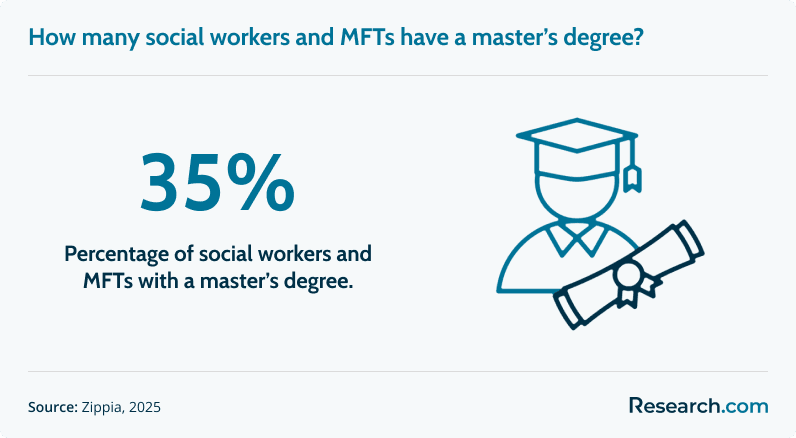
According to Zippia data published in 2025, marriage and family therapists earn an average of $57,856, while social workers earn an average of $50,102. That does not mean an MFT is always the better financial choice. Earnings vary by license level, state, employer, specialization, experience, and whether the professional works in private practice, healthcare, government, or nonprofit settings.
| Earnings Factor | MSW Considerations | MFT Considerations |
| Average salary cited | $50,102 | $57,856 |
| Starting role differences | Some MSW graduates begin in case management, nonprofit, or public service roles that may pay less | MFT graduates often focus on therapy roles, which may offer higher average pay |
| Private practice | LCSWs can move into private practice after meeting licensure and experience requirements | MFTs often view private practice as a central career path |
| Public sector employment | Government jobs may offer structured salaries, benefits, and stability | Government roles are less central to the MFT employment pattern |
| Long-term advancement | MSWs may move into healthcare, administration, policy, supervision, or program leadership | MFTs may increase earnings through specialization, private practice, supervision, or group practice ownership |
Students comparing mental health career routes may also look at how an addiction counseling degree vs psychology degree can lead to different roles and earning patterns. The most financially sound path is the one that matches your license goal, preferred work setting, and tolerance for business-building if you plan to enter private practice.
The chart below compares annual median salary figures for social workers, MFTs, and all other occupations, based on 2024 BLS reporting.
Which degree provides stronger long-term career security?
Both degrees can support stable careers, but they offer security in different ways. Social work has more annual openings and broader employment settings. Marriage and family therapy has a faster projected growth rate but a smaller number of annual openings.
| Career Security Factor | MSW | MFT |
| Projected growth | 7% from 2023 to 2033 | 16% from 2023 to 2033 |
| Annual openings | About 67,300 openings per year | About 7,500 openings per year |
| Industry range | Broad, including healthcare, social services, government, schools, nonprofits, and clinical practice | More specialized, with strong alignment to therapy, behavioral health, and family services |
| Public-sector stability | Often stronger because many social workers are employed in government and public service settings | Available in some settings, but less central than private practice and therapy clinics |
| Career adaptability | High, because MSWs can shift among clinical, administrative, policy, case management, and advocacy roles | Strong within therapy-focused work, especially for professionals committed to couples and family treatment |
The MSW may offer stronger adaptability because it can lead to more varied roles. The MFT may offer stronger specialization for students who want a focused psychotherapy career. If you are comparing degree and license terminology, Research.com’s explanation of MFT degree vs LMFT license can help clarify what you earn in school versus what you need for independent practice.
Can MSWs and MFTs work on the same care teams?
Yes. MSWs and MFTs often collaborate in hospitals, community mental health centers, family service agencies, schools, substance use programs, and private group practices. Their roles can complement each other because social workers often address resources, systems, advocacy, and care coordination, while MFTs often focus on relational therapy and family dynamics.
| Collaboration Scenario | MSW Contribution | MFT Contribution |
| Community mental health agency | Case management, resource coordination, crisis support, and service planning | Therapy for individuals, couples, and families |
| Hospital or healthcare program | Discharge planning, insurance navigation, family support, and patient advocacy | Behavioral health counseling and family-focused therapeutic support |
| Family services organization | Connection to public benefits, child welfare coordination, and community resources | Relationship counseling, parenting support, and family therapy |
| Private group practice | Clinical therapy, social work-informed care, and support for clients facing social stressors | Couples therapy, family therapy, and relational treatment planning |
For example, a graduate from one of the available online MSW programs may provide clinical social work and case coordination, while an MFT in the same practice provides couples or family therapy. Together, they can address both practical needs and relational mental health concerns.
If you are still deciding which client population or therapy focus fits you best, a therapy specialization guide can help you compare in-demand counseling directions before choosing a degree.
Common Mistakes When Choosing Between an MSW and an MFT
- Choosing only by salary averages: MFTs show a higher cited average salary, but MSWs may have broader advancement paths and more annual openings.
- Ignoring licensure rules: Online, out-of-state, and accelerated programs may not meet every state’s requirements. Always verify with the licensing board where you plan to practice.
- Assuming all therapy degrees lead to the same work: MSW, MFT, LPC, psychology, and addiction counseling pathways differ in scope, supervision, and career outcomes.
- Looking only at tuition: Field placement costs, supervision fees, commuting, unpaid hours, exam fees, and lost work time can change the real cost of a degree.
- Relying too heavily on rankings: Rankings may help with discovery, but licensure fit, accreditation, field placement support, and total cost are more important.
- Underestimating private practice realities: Private practice can offer flexibility, but it also requires client acquisition, billing, documentation, compliance, and business management.
Questions to Ask Before Enrolling
- Does this program meet the licensing requirements in the state where I plan to work?
- What license do most graduates pursue, and what percentage complete it?
- How are internships or clinical placements assigned?
- Can online students complete fieldwork in their local area?
- What is the total cost after tuition, fees, books, travel, supervision, and exam expenses?
- Are scholarships, assistantships, employer benefits, or loan repayment options available?
- What jobs do recent graduates actually get?
- Does the program prepare students for private practice, public service, healthcare, or policy roles?
- How much advising support is available for licensure planning?
- Will the degree still fit my goals if I later decide not to provide therapy full time?
Graduate Perspectives on MSW and MFT Choices
I wanted a helping profession, but I also needed a degree that would not lock me into one role. The MSW gave me room to begin in child welfare and later move into policy work, where I help shape programs that affect many more people. — Nathan
The MFT route taught me to think beyond individual symptoms and pay attention to relationships, communication, and family patterns. The training was demanding, but working with couples and families confirmed that this was the right path for me. — Jason
I was worried about debt, so I compared affordable online MFT programs before enrolling. The investment was still significant, but the degree helped me move toward private practice and a schedule that fits my life better. — Amara
References:
- Bureau of Labor Statistics (BLS). (2024a). Marriage and Family Therapists. Occupational Outlook Handbook. BLS.
- Bureau of Labor Statistics (BLS). (2024b). Social Workers. Occupational Outlook Handbook. BLS.
- Data USA. (2023a). Marriage & Family Therapy. Data USA.
- Data USA. (2023b). Social Work. Data USA.
- Hanson, M. (2024). Student Loan Forgiveness Statistics. Education Data Initiative.
- Zippia. (2025a). Marriage and Family Therapist Salary. Zippia.
- Zippia. (2025b). Social Worker Salary. Zippia.
Key Insights
- An MSW is the more flexible degree if you want options in therapy, healthcare, case management, government, nonprofits, advocacy, or policy.
- An MFT degree is the more focused choice if your primary goal is to provide psychotherapy for couples, families, and relationship-centered mental health concerns.
- MFTs show a higher cited average salary at $57,856 compared with $50,102 for social workers, but salary alone does not capture job variety, public-sector benefits, or advancement potential.
- Social work has slower projected growth at 7% from 2023 to 2033, but the field reports about 67,300 annual openings; MFT has faster projected growth at 16%, but about 7,500 annual openings.
- Licensure should drive your program choice. Before enrolling, confirm accreditation, state approval, field placement support, supervised-hour rules, and exam requirements.
- The better degree depends on your preferred work: choose MSW for broad systems-based impact and career adaptability; choose MFT for specialized clinical work with relationships and families.
Other Things You Should Know About MSW vs. MFT Degree Programs
MSW programs typically require a bachelor's degree in social work or related fields, while MFT programs often require a bachelor's in psychology or counseling. Additional prerequisites may include completion of specific courses and relevant work experience in mental health services.
An MSW commonly leads to the ASWB clinical exam for LCSW licensure, while an MFT degree usually leads to the AMFTRB Marriage and Family Therapy National Examination. State boards set the final licensing rules, including supervised postdegree hours before testing.


![2027 Best Advanced Standing Online MSW Programs [CSWE Accredited] thumbnail](https://research.com/resized/uploads/Online_Advanced_Standing_MSW_301dbd5368.jpg?format=thumbnail)


