
2027 Best Master’s in Christian Counseling Degree Programs

Co-Founder and Chief Data Scientist
Pursuing a career as a Christian counselor is rewarding but it can be challenging to find a Master’s in Christian Counseling Degree program that will prepare you for the demands of the role, both academically and spiritually. Drawing upon my 10+ years of experience as a seasoned career planning expert, I have undertaken comprehensive research to help you select the program that meets your goals. I also tackle concise points on possible roles, work environments, and salary potentials of Christian counselors.
In addition, I will enumerate the steps to becoming a Christian counselor. Whether you are just starting your educational journey or looking to enhance your qualifications, this guide serves as a valuable tool in your endeavors.
What are the benefits of getting a Master’s in Christian Counseling Degree?
- Most Christian counselors earn around $36,621 to $43,283 each year though similar types of counselors have the potential to earn more.
- Aside from working in religious institutions or affiliations, this degree enables you to be employed in schools, clinics, hospitals, rehabilitation centers, and mental health facilities.
- Licensed Christian counselors can expect a job outlook of 15% by 2032.
What can I expect from a Master’s in Christian Counseling?
In this program, you will dive into various counseling, spiritual, and theological topics. You can specialize in services specifically aimed at couples, families, or individuals and groups struggling with mental health issues.
As a Christian counselor, you provide emotional or mental health guidance while incorporating spiritual advice to help your clients grow their faith and have mental stability. Some of your daily tasks and responsibilities may include actively listening to your clients, showing them empathy, and conducting individual or group talk therapy sessions.
You also provide crisis interventions during times of emotional distress and set a good example by maintaining religious beliefs, practices, and scriptures. The degree also prepares you for roles as an addiction counselor, youth minister, or church counselor.
Where can I work with a Master’s in Christian Counseling?
A graduate with a Master’s in Christian Counseling Degree faces various opportunities in settings where individuals seek support:
- Firstly, you can work within your church, seminaries, and religious organizations, serving as a pastoral counselor or mentor.
- Hospitals and healthcare settings also present roles as chaplains, offering spiritual and emotional support to patients.
- Graduates can also thrive in educational institutions to assist students in navigating personal and academic difficulties.
- Christian counselors are also needed in addiction treatment centers, juvenile detention facilities, mental health clinics, or prisons.
- Beyond traditional roles, opportunities exist in community outreach programs, missionary works, and nonprofit projects.
- Alternatively, some pursue related studies, such as social work or teaching degrees, to take their skill sets to the next level or enter more complex roles.
How much I can make with a Master’s in Christian Counseling degree?
Students who wish to pursue master’s in pastoral counseling can expect to land an income between $36,621 to $43,283 (Salary.com, 2023). Furthermore, based on national benchmarks, I discovered that the 10% percentile of all other counselors earn $31,930 annually while the 90% percentile takes home $75,340 (U.S. Bureau of Labor Statistics, 2023a).
Income can also be affected by your specialization and location. For instance, marriage and family therapists who obtained a Christian counseling certification online or onsite may make as much as $63,300 per year. This job yields a yearly average salary of $88,980 in Utah, the highest among all the states (BLS, 2023b). Therefore, as you navigate your career path, you must consider these factors to enhance your earning potential.
- List of Master’s in Christian Counseling Programs for 2027 Program List
- How does program accreditation impact career prospects in Christian counseling? How does program accreditation impact career prospects in Christian counseling?
- How do programs differentiate in terms of specialized areas within Christian counseling? Specialized Areas
- How can you become a Christian counselor with a master’s degree? Becoming a Christian Counselor
- What key courses should students expect in a Master’s in Christian Counseling program? What key courses should students expect in a Master’s in Christian Counseling program?
- What opportunities exist for practical experiences and internships in Christian counseling? What opportunities exist for practical experiences and internships in Christian counseling?
- What is the job market for graduates with a Christian Counseling degree? Job Market
- What are the common admission requirements for Master’s in Christian Counseling programs? Admission Requirements
- What financial aid options are available for students pursuing a Master’s in Christian Counseling? Financial Aid
- What is the average cost of a Christian counseling program? Program Cost
- How can Christian counseling support addiction recovery? How can Christian counseling support addiction recovery?
- How do you meet licensure requirements in Christian counseling? How do you meet licensure requirements in Christian counseling?
- What does current research reveal about the effectiveness of Christian counseling? What does current research reveal about the effectiveness of Christian counseling?
- How do I choose the right Master’s in Christian Counseling program for my career goals? How do I choose the right Master’s in Christian Counseling program for my career goals?
- How do licensing options impact career growth in Christian Counseling? How do licensing options impact career growth in Christian Counseling?
- Can Christian Counseling Lead to Six-Figure Earnings? Can Christian Counseling Lead to Six-Figure Earnings?
Best Master’s in Christian Counseling Programs for 2027
Choosing a master’s in Christian counseling is not just a graduate school decision. It affects where you can work, whether you can pursue clinical licensure, how much supervised experience you will need, and whether your training prepares you for ministry-based care, professional counseling, chaplaincy, addiction support, marriage and family work, or private practice. The biggest mistake prospective students make is assuming every Christian counseling degree leads to the same career outcome. It does not.
This guide helps you compare Christian counseling master’s programs by accreditation, credit requirements, tuition structure, delivery format, licensure relevance, and practical training. It also explains how Christian counseling differs from secular counseling, what courses and internships usually involve, how licensing works, what careers graduates pursue, and how to evaluate whether a program fits your goals and budget.
Quick answer: What should you look for in a master’s in Christian counseling?
The best master’s in Christian counseling program for you depends on your intended role. If you want to become a licensed counselor, prioritize programs designed for clinical mental health counseling, marriage and family therapy, or another licensure-aligned pathway. If your goal is pastoral care, church-based counseling, chaplaincy, or ministry leadership, a non-licensure Christian counseling or pastoral counseling degree may be appropriate. Always verify institutional accreditation, programmatic accreditation when relevant, practicum requirements, supervised-hour expectations, state licensure rules, total cost, and whether online coursework meets requirements in the state where you plan to practice.
How Research.com evaluates Christian counseling programs
Christian counseling programs vary widely in purpose. Some are clinically focused and prepare students for state licensure, while others are designed for ministry, pastoral care, biblical counseling, or chaplaincy. To help readers compare options more clearly, Research.com applies a transparent ranking methodology that considers academic quality, institutional credibility, available program information, affordability signals, and the practical fit between a program’s curriculum and student career goals.
Our review process uses a data-informed approach and draws from institutional information, government datasets, academic sources, and recognized education databases. These include the IPEDS database, the Peterson’s database and its Distance Learning Licensed Data Set, the College Scorecard database, and the National Center for Education Statistics. Readers should still confirm details directly with each school because tuition, licensure alignment, course delivery, and field placement policies can change.
Program comparison at a glance
| School | Program focus | Credit hours | Estimated tuition | Accreditation listed |
| Garrett-Evangelical Theological Seminary | Pastoral care, counseling, chaplaincy, and spiritual care | 60 | $875/credit hour | Higher Learning Commission (HLC) |
| Fordham University | Mental health counseling with spiritual integration | 60 | $979/credit hour | Masters in Psychology and Counseling Accreditation Council (MPCAC) |
| Charlotte Christian College and Theological Seminary | Master of Divinity with pastoral counseling, chaplaincy, or pastoral studies | 96 | $1,437/course | Transnational Association of Christian Colleges and Schools (TRACS) Accreditation Commission |
| Oral Roberts University | Professional counseling, pastoral counseling, and divinity pathways | 6681 | $695/credit hour (onsite), $535/credit hour (online) | Commission on Accrediting of the Association of Theological Schools (ATS) |
| Calvary University | Biblical counseling and seminary-based counseling preparation | 60156 | $435$466/credit hour | HLC, Association for Biblical Higher Education Commission on Accreditation (ABHE) |
| Liberty University | Pastoral counseling, religion, divinity, and clinical mental health counseling options | 3675 | $410$545/credit hour | Commission on Accrediting of ATS, Council for Accreditation of Counseling and Related Educational Programs (CACREP) |
| Indiana Wesleyan University | Clinical addictions, clinical mental health, community care, marriage and family, and school counseling tracks | 3660 | $602$632/credit hour | CACREP, National Addiction Studies Accreditation Commission (NASAC) |
| Grace Theological Seminary | Master of Divinity in pastoral counseling | 75 | $466/credit hour | Commission on Accrediting of ATS, HLC |
| Houston Christian University | Christian counseling with psychology, ethics, multicultural counseling, and practicum work | 66 | $1,800/three-credit-hour course | Southern Association of Colleges and Schools Commission on Colleges (SACSCOC) |
| Dallas Baptist University | Non-licensure Christian counseling with onsite, online, and evening options | 36 | $1,271/credit hour | SACSCOC |
1. Garrett-Evangelical Theological Seminary
Garrett-Evangelical Theological Seminary offers a master’s pathway in Christian counseling through a residential clinical track and a hybrid chaplaincy and spiritual care track. The program is built for students who want training in pastoral care, counseling practice, and spiritual support in institutional or community settings. Coursework includes human relations skills, substance abuse and addiction, psychopathology, and ethical responsibilities. Students should confirm how the clinical track aligns with licensure requirements in the state where they plan to work. The program is generally completed in three years.
- Credit Hours: 60
- Estimated Tuition: $875/credit hour
- Accreditation: Higher Learning Commission (HLC)
2. Fordham University
Fordham University provides a graduate counseling program that combines mental health counseling preparation with spiritual integration. Students may study part time or full time and must complete at least 20 courses. The curriculum covers counseling skills, professional ethics, contemporary Christian faith, and assessment studies. The clinical placement component includes 600 total hours and weekly individual onsite supervision, giving students structured exposure to counseling practice.
- Credit Hours: 60
- Estimated Tuition: $979/credit hour
- Accreditation: Masters in Psychology and Counseling Accreditation Council (MPCAC)
3. Charlotte Christian College and Theological Seminary
Charlotte Christian College and Theological Seminary offers a Master of Divinity with concentration options in pastoral counseling, chaplaincy, and general pastoral studies. The program is a strong fit for students seeking ministry-centered preparation rather than a purely clinical counseling degree. Courses address biblical counseling, grief and loss, addictions, and sermon delivery. Students also complete an internship in a counseling setting. The degree can typically be completed in two to three years.
- Credit Hours: 96
- Estimated Tuition: $1,437/course
- Accreditation: Transnational Association of Christian Colleges and Schools (TRACS) Accreditation Commission
4. Oral Roberts University
Oral Roberts University offers multiple graduate routes for students interested in Christian counseling and ministry-related care. Options include a residential and hybrid MA in Professional Counseling, a hybrid Master of Divinity with related concentrations, and an online Master of Pastoral Counseling. Students may study counseling theories, group dynamics, counseling across the lifespan, Christian approaches to counseling, and spiritual issues in counseling. Field experiences are part of the training, and many students complete the degree in about three years.
- Credit Hours: 6681
- Estimated Tuition: $695/credit hour (onsite), $535/credit hour (online)
- Accreditation: Commission on Accrediting of the Association of Theological Schools (ATS)
5. Calvary University
Calvary University provides seminary-based counseling options for students interested in biblical counseling and faith-centered care. The residential master’s in Christian counseling is listed at 60 credit hours and includes biblical philosophy, systematic theology, family systems, and theological foundations. Students can also consider the five-year BS-to-MA in Biblical Counseling, which includes 99 undergraduate and 57 graduate hours. Coursework may include crisis counseling, theology, social psychology, individual appraisal, and vocational counseling.
- Credit Hours: 60156
- Estimated Tuition: $435$466/credit hour
- Accreditation: HLC, Association for Biblical Higher Education Commission on Accreditation (ABHE)
6. Liberty University
Liberty University offers several residential pastoral counseling-related degrees, including options under the MA in Pastoral Counseling, MA in Religion, and Master of Divinity. Students who want a licensure-oriented route should review the clinical mental health counseling program instead of assuming that all pastoral counseling degrees meet licensing standards. Coursework can include crisis intervention, gerontology, multicultural issues, marital counseling, and discipleship ministries. Depending on the program, students may complete a capstone project or clinical internship.
- Credit Hours: 3675
- Estimated Tuition: $410$545/credit hour
- Accreditation: Commission on Accrediting of ATS, Council for Accreditation of Counseling and Related Educational Programs (CACREP)
7. Indiana Wesleyan University
Indiana Wesleyan University offers counseling graduate tracks that may appeal to students who want Christian university training with specialization choices. Available areas include clinical addictions, clinical mental health, community care, marriage and family, and school counseling. Students study appraisal of individuals and families, career counseling, ecological counseling, and human sexuality and gender. Full-time students may finish in two to three years, while part-time students may take up to five years.
- Credit Hours: 3660
- Estimated Tuition: $602$632/credit hour
- Accreditation: CACREP, National Addiction Studies Accreditation Commission (NASAC)
8. Grace Theological Seminary
Grace Theological Seminary offers a Master of Divinity in Pastoral Counseling for students preparing for ministry leadership, pastoral care, and counseling-informed service. The curriculum includes biblical psychology, counseling theories, biblical languages, local church leadership, and spiritual formation. Because this is an M.Div. concentration, students should evaluate whether it supports their desired role in ministry, chaplaincy, or counseling-adjacent work. The program can be completed in three years.
- Credit Hours: 75
- Estimated Tuition: $466/credit hour
- Accreditation: Commission on Accrediting of ATS, HLC
9. Houston Christian University
Houston Christian University offers a Master’s in Christian Counseling Degree that includes Christian psychology and counseling, clinical psychopathology, multicultural counseling, ethics, and psychotherapy. In-person coursework is generally recommended, although online courses may be available for students needing more flexibility. Students complete two community practicum experiences and receive training in research design and program evaluation.
- Credit Hours: 66
- Estimated Tuition: $1,800/three-credit-hour course
- Accreditation: Southern Association of Colleges and Schools Commission on Colleges (SACSCOC)
10. Dallas Baptist University
Dallas Baptist University offers onsite and online master’s study in Christian counseling for students seeking a non-licensure route. The curriculum includes abnormal psychology, systematic theology, ministry research, faith formation across life stages, and conflict resolution. The program trains students to approach helping relationships through biblical perspectives while also engaging psychological and counseling concepts. Students may take courses onsite, remotely, or in the evening.
- Credit Hours: 36
- Estimated Tuition: $1,271/credit hour
- Accreditation: SACSCOC
Why accreditation matters for Christian counseling careers
Accreditation affects whether a degree is respected by employers, whether credits may transfer, whether students can access certain forms of financial aid, and whether the program can support licensure preparation. Institutional accreditation confirms that the school meets broad academic and operational standards. Programmatic accreditation, such as CACREP, MPCAC, ATS, NASAC, ABHE, or TRACS depending on the program type, can also signal that a specific curriculum meets standards within counseling, theological education, addiction studies, or biblical higher education.
If you are still asking, “What degree should I get?” accreditation should be one of your first filters. For clinical counseling goals, you need to confirm that the program meets your state board’s educational requirements. For pastoral care or ministry roles, accreditation still matters, but the relevant accreditor may differ from a clinical counseling accreditor.
| Accreditation question | Why it matters | What to verify |
| Is the institution accredited? | Institutional accreditation supports academic credibility and may affect transfer, aid, and employer recognition. | Check the school’s accreditor and current accreditation status. |
| Is the program licensure-aligned? | A Christian counseling degree may not automatically qualify graduates for LPC, LMHC, LMFT, or addiction counseling licensure. | Compare the curriculum against your state licensing board requirements. |
| Is there programmatic accreditation? | Some employers and licensing boards prefer or require graduates from certain accredited counseling programs. | Look for CACREP, MPCAC, ATS, NASAC, ABHE, TRACS, or other relevant recognition based on the program type. |
| Are practicum and internship hours included? | Supervised experience is often essential for clinical practice and professional readiness. | Ask how placements are arranged, who supervises them, and whether online students receive local placement support. |
How Christian counseling programs differ by specialization
Master’s programs in Christian counseling are not interchangeable. Some emphasize pastoral counseling and biblical care, while others prepare students for clinical mental health counseling, addiction counseling, school counseling, marriage and family work, trauma support, or chaplaincy. The right specialization depends on where you want to serve and whether you need a state license.
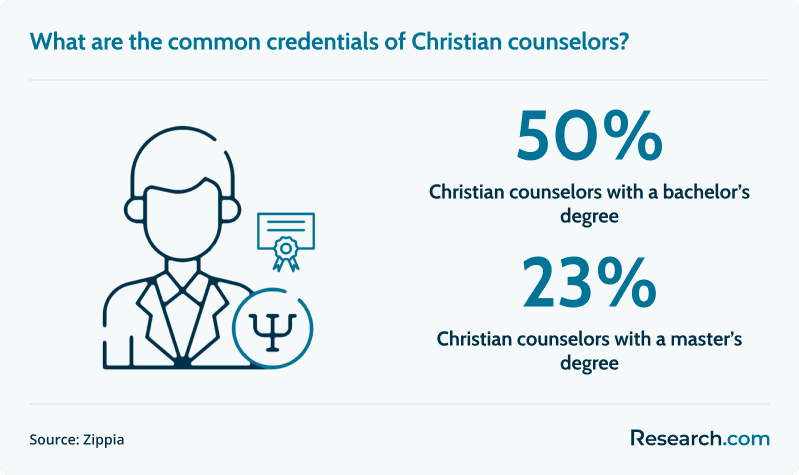
According to Zippia (n.d., retrieved December 19, 2023), 50% of Christian counselors hold a bachelor’s degree, 23% have a master’s degree, and only five percent have doctorates. Educational expectations vary by setting. Non-clinical pastoral or ministry counseling roles may not require the same credentials as licensed mental health practice, but many employers and states require or prefer clinical licensure for counseling services provided to the public. Arkansas, Kentucky, Maine, New Hampshire, North Carolina, and Tennessee are the only states that have licensure titles specifically for pastoral counselors (Jones, 2022).
| Pathway | Best for | Typical work settings | Licensure consideration |
| Licensure track | Students who want to become LPCs/LCPCs/LPCCs, LMHCs, LMFTs, or CACs | Clinics, private practice, hospitals, schools, agencies, outpatient centers | Requires state-specific coursework, supervised hours, exams, and post-degree requirements. |
| Non-licensure track | Students focused on church care, pastoral counseling, biblical counseling, or ministry leadership | Churches, ministries, nonprofits, faith-based organizations, chaplaincy-related settings | May not qualify graduates for independent clinical practice or insurance-reimbursed therapy. |
| Chaplaincy or spiritual care track | Students who want to support people in hospitals, correctional facilities, military settings, hospice, or community organizations | Healthcare, military, correctional, hospice, campus, and community settings | May require additional denominational endorsement or chaplaincy-specific credentials. |
| Addiction or substance abuse focus | Students interested in recovery support and counseling related to substance use | Outpatient programs, residential treatment centers, nonprofits, faith-based recovery ministries | Credentialing requirements vary by state and role. |
How to become a Christian counselor with a master’s degree
The route to Christian counseling depends on whether you are pursuing clinical practice, pastoral counseling, chaplaincy, or ministry-based support. A student who wants to provide therapy in private practice will follow a different path than someone who wants to counsel within a church or nonprofit ministry. For a broader counseling roadmap, see Research.com’s guide on how to become a counselor.
- Earn a bachelor’s degree. Common undergraduate fields include psychology, counseling, social work, theology, pastoral studies, biblical studies, or a related liberal arts major.
- Choose the right graduate program. Compare licensure-aligned counseling degrees, theological counseling degrees, and top online masters programs based on your career goal.
- Select a specialization if needed. Options may include clinical mental health counseling, marriage and family therapy, pastoral counseling, school counseling, addiction counseling, or chaplaincy.
- Complete practicum or internship requirements. Fieldwork may occur in churches, clinics, hospitals, nursing homes, mental health facilities, religious centers, correctional facilities, or community agencies.
- Apply for licensure if your role requires it. Clinical practice typically involves state-approved coursework, supervised post-graduate hours, examinations, background checks, and continuing education.
Religious counselors rank seventh among sources of mental or emotional support for U.S. college students, with four percent of students turning to them during difficult periods (Statista, 2023). While that share is modest, faith-based counselors can play an important role for students and community members who want support that recognizes spiritual beliefs alongside emotional concerns.
The chart below uses Statista data to show the share of U.S. college students who received counseling or emotional support from selected sources.
Courses students usually take in a Master’s in Christian Counseling program
A strong Christian counseling curriculum should develop counseling skills, ethical judgment, spiritual integration, cultural awareness, and field readiness. Students interested in addiction work may also want to review educational routes related to how to become a substance abuse counselor, since those roles often have their own state requirements.
| Course area | What students learn | Why it matters |
| Counseling theories | Major approaches to therapy, human behavior, and psychological distress, often interpreted alongside Christian perspectives. | Students need a practical framework for assessing client needs and choosing appropriate interventions. |
| Ethics in counseling | Confidentiality, informed consent, boundaries, mandated reporting, competence, and faith integration ethics. | Ethical practice is essential when counseling relationships overlap with churches, ministries, or close-knit faith communities. |
| Cross-cultural counseling ministry | How culture, race, ethnicity, family systems, immigration, disability, and belief systems shape counseling needs. | Christian counselors must avoid one-size-fits-all assumptions and provide respectful, culturally responsive support. |
| Theology | Biblical and theological foundations that may inform pastoral care, spiritual formation, and Christian counseling practice. | Students learn how faith commitments can be integrated responsibly rather than imposed on clients. |
| Crisis intervention | Short-term support strategies for grief, trauma, suicidal ideation, family crises, and acute distress. | Counselors and ministry leaders often encounter urgent needs that require clear protocols and referral judgment. |
| Ministry research | Research methods, program evaluation, and evidence-informed practice in ministry or counseling contexts. | Graduates need to evaluate whether counseling programs, interventions, and faith-based support models are effective. |
Practicum, internship, and field experience opportunities
Practical experience is one of the most important differences among Christian counseling programs. Some programs offer structured clinical placements, while others focus on ministry internships or supervised pastoral care. Students should ask who arranges placements, whether supervisors must be licensed, whether online students can complete hours locally, and whether hours count toward state licensure.
Field placements may occur in churches, counseling centers, faith-based nonprofits, hospitals, correctional facilities, recovery programs, schools, or community mental health organizations. This differs from many social work programs, including a fast track social work degree online, where placements often emphasize public agencies, hospitals, schools, and government-linked service systems.
The number of required hours depends on the degree type, specialization, and licensure goal. A non-licensure pastoral counseling internship may be supervised by a ministry mentor, while a clinical counseling internship usually requires supervision by an approved licensed professional. Before enrolling, ask the program to explain exactly how supervision works and whether your hours can be documented for future credentialing.
Job market for graduates with a Christian counseling degree
Graduates with Christian counseling training may work in faith-based and secular environments, but job options depend heavily on licensure status. A non-licensure degree may support pastoral care, ministry counseling, chaplaincy-related roles, nonprofit work, or community support positions. Licensure-aligned degrees can open broader opportunities in clinical mental health counseling, marriage and family therapy, addiction counseling, school counseling, and private practice.
- Graduates may work in individual and family services or offices of health practitioners, which account for 29% and 28% of marriage and family therapists’ employment respectively, based on the latest BLS data.
- Mental health and substance abuse counselors were most commonly employed in outpatient centers, at 18%.
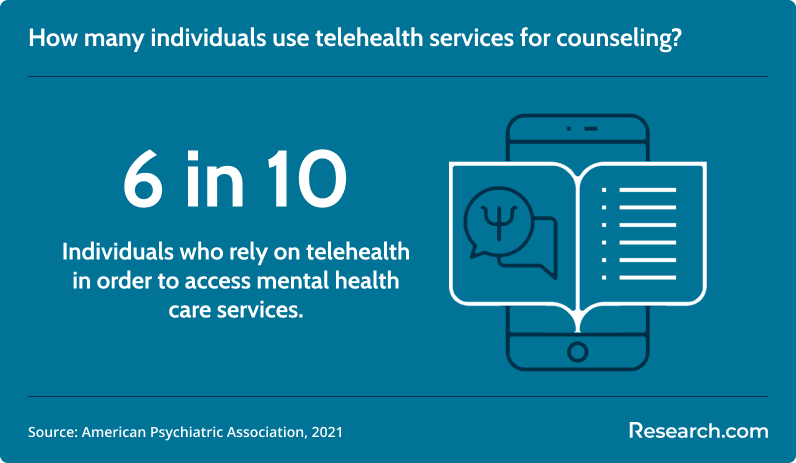
- Telehealth has become an important delivery model for mental health services. Based on American Psychiatric Association data from 2021, 6 in 10 individuals use telehealth services for mental health care.
Technology has also expanded how Christian counselors and spiritually integrated therapists can reach clients. However, telehealth does not remove licensing obligations. Counselors must follow state rules, privacy standards, supervision requirements, and professional ethics when providing online services.
Admissions requirements for Master’s in Christian Counseling programs
Admissions requirements vary by school, but most master’s programs ask applicants to demonstrate academic readiness, personal maturity, communication skills, and alignment with the program’s counseling or ministry mission. Students applying to clinical tracks should expect more scrutiny around readiness for supervised client-facing work.
- Official transcripts: Programs usually require transcripts showing completion of a bachelor’s degree and relevant coursework in areas such as biblical studies, counseling, psychology, theology, or liberal arts.
- GPA scores: Many schools look for a GPA of around 3.0 or higher, although policies differ by institution.
- Letters of recommendation: References may come from professors, supervisors, pastors, ministry leaders, employers, or other people who can speak to your academic ability, character, and service orientation.
- Resume or CV: Schools may ask for a record of education, employment, volunteer service, ministry involvement, counseling-related experience, or leadership roles.
- Personal statement: Applicants often write about career goals, faith background, service commitments, counseling interests, and reasons for choosing Christian counseling.
Financial aid options for Christian counseling graduate students
Graduate students in Christian counseling may use several funding sources, but aid availability depends on the school, accreditation status, enrollment level, and student eligibility.
- Students may qualify for university scholarships, federal loans, grants, or institutional aid. From the academic year 2022 to 2023, each full-time equivalent student in graduate school received an average of $28,300 in federal financial aid (Ma & Pender, 2023).
- Private loans from banks or credit unions may be available, but borrowers should compare interest rates, repayment terms, fees, and deferment options carefully.
- Some employers, churches, denominations, religious organizations, nonprofits, or foundations offer tuition assistance for students preparing for counseling, ministry, chaplaincy, or service roles.
Before borrowing, ask the financial aid office for the full cost of attendance, not just tuition. Also confirm whether scholarships continue after the first year, whether part-time students qualify, and whether unpaid practicum hours could affect your ability to work while enrolled.
Average cost of a Christian counseling master’s program
Top Master’s in Christian Counseling Degree programs often cost around $15,000 to $55,000 or more each year, although total cost depends on tuition, fees, credit load, residency requirements, delivery format, books, technology expenses, travel, and internship-related costs. Online programs may reduce commuting and relocation expenses, but they can still include technology fees, residency intensives, supervision costs, or local placement expenses.
To estimate real cost, use each school’s tuition calculator, review the published cost of attendance, and ask financial aid staff for a written breakdown. Do not compare programs by tuition alone. A lower-cost program may become more expensive if it requires travel, delays graduation, does not support placement, or fails to meet the licensure requirements you need.
| Cost factor | Why students overlook it | Question to ask |
| Program fees | Published tuition may exclude technology, student services, graduation, or clinical placement fees. | What fees are charged each term in addition to tuition? |
| Residency or intensive requirements | Hybrid and online programs may still require travel. | How many campus visits are required, and what are the estimated travel costs? |
| Internship costs | Fieldwork may reduce paid work hours or require background checks, insurance, or transportation. | Are there extra costs tied to practicum or internship placement? |
| Licensure preparation | Exams, applications, supervision, and continuing education may add costs after graduation. | What post-degree expenses should I expect for my target credential? |
How Christian counseling can support addiction recovery
Christian counseling may support addiction recovery by combining spiritual care, accountability, emotional support, and counseling-informed strategies. In faith-based recovery settings, counselors may help clients examine shame, grief, family conflict, relapse triggers, identity, forgiveness, and community support through a Christian framework. Programs that include substance abuse coursework can prepare students for roles in ministries, recovery nonprofits, outpatient settings, or addiction-focused services, though state credentialing rules still apply. Students interested in compensation patterns and recovery-related roles can review Research.com’s guide to careers in addiction recovery salary.
How to meet licensure requirements in Christian counseling
Licensure is state-specific and should be treated as a planning issue from the beginning of your program search. In many cases, a graduate must complete an approved master’s degree, supervised clinical hours, a state-recognized exam, background checks, ethics requirements, and continuing education. A degree labeled “Christian counseling” or “pastoral counseling” may not automatically qualify you for LPC, LMHC, LMFT, or addiction counseling licensure.
Before enrolling, review your state board’s requirements and ask the school to confirm, in writing if possible, whether the curriculum is designed to meet them. For a broader explanation of counselor and therapist credential steps, see this guide to licensed therapist requirements.
What current research suggests about Christian counseling effectiveness
Research on Christian counseling generally indicates that faith integration can be meaningful for clients who want their spiritual beliefs included in counseling. Outcomes depend on the counselor’s competence, the use of evidence-informed methods, the client’s goals, the quality of the therapeutic relationship, and whether spiritual interventions are client-led rather than imposed. Quantitative and qualitative work has explored resilience, mental well-being, coping, and identity, but effectiveness is not uniform across every population or program model.
Students comparing clinical training models may also want to examine marriage and family therapy pathways, including the best online MFT programs counseling, because these programs can show how relational, systemic, and clinical skills are taught in graduate counseling education.
How technology is changing Christian counseling practice
Telehealth, digital scheduling, online supervision, secure client portals, and virtual learning tools are now part of many counseling environments. Christian counseling programs increasingly need to prepare students for online confidentiality, informed consent, digital boundaries, crisis protocols, cybersecurity, and state-by-state practice limits. Remote delivery can improve access for clients in rural communities or for students in flexible programs, but it also raises ethical and legal questions.
Students who need flexible study options should compare online programs carefully. A low-cost online format may be appealing, but it must still provide appropriate supervision, placement support, and licensure alignment. To compare budget-conscious options, review affordable online master's in counseling programs.
Ethical issues in Christian counseling
Ethics are especially important in Christian counseling because counselors may be working at the intersection of mental health, spiritual care, ministry authority, and close community relationships. Ethical practice requires respect for client autonomy, accurate representation of credentials, confidentiality, appropriate boundaries, and responsible faith integration.
- Respect for client beliefs and autonomy: Christian counselors should never pressure clients to accept specific doctrines, spiritual practices, or interpretations. Faith-based interventions should match the client’s values and consent.
- Confidentiality and privacy: Counselors must protect client information except when disclosure is required by law or professional standards, such as risk of harm or mandated reporting situations.
- Professional boundaries: Dual relationships can be common in churches and faith communities. Counselors must manage overlapping roles carefully to avoid conflicts of interest or harm.
- Competent faith integration: Prayer, scripture, spiritual reflection, or pastoral guidance should be used thoughtfully and only when appropriate to the client’s goals and counseling context.
- Referral responsibility: Christian counselors should refer clients when needs fall outside their training, scope of practice, or legal authority.
Career paths after a Master’s in Christian Counseling
Career options depend on your degree type, licensure eligibility, experience, and setting. Some graduates become licensed professional counselors or therapists in Christian or secular environments after meeting state requirements. Others work as pastoral counselors, chaplains, ministry leaders, nonprofit program staff, teachers, or community support professionals.
- Graduates who pursue additional training in related fields may explore areas such as clinical psychology. Research.com’s guide to clinical psychology salary notes an annual income of $85,330.
- Social and community service managers earn $74,240, and school counselors make $60,140 (BLS, 2023c).
- Licensed marriage and family therapists and substance abuse, behavioral disorder, and mental health counselors are projected to increase by 15% and 18% respectively from 2022 to 2032 (BLS, 2023c; 2023d).
- Clinical and counseling psychologists are projected at an 11% employment increase (BLS, 2023e).
The chart below highlights U.S. Bureau of Labor Statistics job outlook data for counseling and related occupations.
Graduate programs that can complement Christian counseling
Some students strengthen their counseling preparation by adding training in a related discipline. For example, art therapy graduate programs may appeal to students who want to integrate creative expression into therapeutic or ministry-based support. Others may consider social work, marriage and family therapy, chaplaincy, addiction counseling, trauma studies, or psychology depending on their career goals. Before adding another credential, compare cost, licensure value, required supervision, and whether the additional degree expands your actual scope of practice.
Christian counseling vs. secular counseling
Christian counseling and secular counseling can both help clients address emotional distress, relationships, grief, trauma, addiction, anxiety, and life transitions. The difference is how spirituality is handled. Christian counseling intentionally integrates Christian beliefs when appropriate, while secular counseling generally uses psychological methods without a specific faith framework.
| Area | Christian counseling | Secular counseling |
| Core foundation | Integrates counseling principles with biblical, theological, or spiritual perspectives. | Uses psychological theories and evidence-based methods without a required religious framework. |
| Client goals | May include emotional healing, relational repair, spiritual growth, forgiveness, vocation, or faith alignment. | Typically focuses on symptom reduction, functioning, coping, insight, behavior change, and personal growth. |
| Methods | May include counseling techniques, prayer, scripture reflection, pastoral care, or faith community support when welcomed by the client. | May include CBT, psychodynamic therapy, family systems, humanistic therapy, trauma-informed care, and other clinical models. |
| Ethical emphasis | Must balance professional counseling ethics with responsible spiritual integration and client consent. | Follows professional ethics with attention to cultural humility, informed consent, neutrality, and client autonomy. |
| Best fit | Clients and students who want Christian beliefs meaningfully included in counseling or care. | Clients and students who prefer a nonreligious or religiously neutral counseling setting. |
Students who are still building an entry route into counseling can also compare lower-cost undergraduate pathways such as the cheapest bachelor's degree in substance abuse counseling online, especially if addiction support is part of their long-term plan.
Serving diverse populations in Christian counseling
Christian counseling must be culturally responsive to be ethical and effective. Clients bring different racial, ethnic, cultural, family, disability, socioeconomic, immigration, and religious backgrounds into counseling. Some may share the counselor’s Christian commitments; others may not. A well-prepared Christian counselor learns to listen before interpreting, to respect client autonomy, and to avoid using faith language in a way that dismisses trauma, discrimination, identity conflict, or systemic barriers.
Diverse clients may need support with interfaith family dynamics, migration stress, grief, disability-related isolation, racial trauma, sexuality and identity concerns, or conflict between cultural traditions and faith communities. Christian counseling programs should train students in multicultural competency, referral practices, crisis response, and inclusive communication.
Students who want to compare counseling roles across populations can start with Research.com’s overview of the different types of counselors. This can help clarify whether Christian counseling, clinical counseling, school counseling, addiction counseling, marriage and family therapy, or another specialization is the best fit.
How to choose the right Master’s in Christian Counseling program
A good program fit is not determined by reputation alone. You need alignment between your career goal, the program’s accreditation, the curriculum, supervised experience, cost, format, and licensing requirements. If you are considering addiction-focused counseling, budget comparisons such as the cheapest substance abuse counseling programs online can help you understand how specialized counseling programs differ in price and structure.
| Decision factor | Choose this if... | Be cautious if... |
| Licensure alignment | You want to practice as a therapist, LPC, LMHC, LMFT, or addiction counselor. | The program describes itself as Christian counseling but does not clearly meet your state board’s coursework requirements. |
| Pastoral or ministry focus | You want to serve in churches, ministries, chaplaincy, or biblical counseling settings. | You assume the degree will qualify you for clinical practice without verifying licensing rules. |
| Online format | You need flexibility and can complete fieldwork locally. | The school does not provide clear placement support or state authorization information. |
| Cost | The total cost fits your expected role, income, and borrowing limits. | You compare only per-credit tuition and ignore fees, travel, supervision, or delayed graduation. |
| Faculty and supervision | Faculty have counseling, ministry, research, or clinical experience connected to your goals. | Supervision expectations, credentials, or placement processes are unclear. |
Questions to ask before enrolling
- Does this program prepare students for licensure in my state?
- Is the degree clinical, pastoral, theological, biblical counseling-focused, or ministry-oriented?
- Who approves practicum and internship sites?
- Can online students complete supervised hours near home?
- What percentage of students complete the program, and how long do they usually take?
- What is the total cost of attendance, including fees, intensives, books, and placement expenses?
- Are graduates working in the roles I want?
- Will this degree support doctoral study, chaplaincy, or denominational endorsement if I need it later?
How licensing options affect Christian counseling career growth
Licensing expands the range of roles available to many counseling graduates, especially in clinical agencies, private practice, insurance-based therapy, hospitals, schools, and behavioral health organizations. However, not every counseling-related credential has the same scope of practice. For example, LPC, LMHC, LMFT, LCSW, and addiction counseling credentials differ in education, supervision, exams, legal authority, and typical work settings. Research.com’s guide to LCSW vs LPC can help students compare two common clinical pathways.
If you want long-term flexibility, choose a program that keeps clinical licensure options open. If your goal is specifically church-based counseling or pastoral care, a non-licensure path may be enough, but you should understand its limits before committing.
Can Christian counseling lead to six-figure earnings?
Some counseling professionals may eventually earn six-figure incomes, but it is not guaranteed by a Christian counseling degree alone. Earnings depend on licensure, specialization, location, employer type, caseload, years of experience, private practice structure, additional certifications, supervision credentials, and demand for specific services. Students aiming for higher earnings should plan strategically: pursue licensure when appropriate, build competence in high-need areas, understand business requirements if entering private practice, and avoid excessive debt relative to expected income.
For a broader discussion of income strategies in therapy careers, see Research.com’s guide on how to make $200k as a therapist.
Common mistakes to avoid when choosing a Christian counseling master’s program
- Assuming all Christian counseling degrees lead to licensure: Many pastoral, biblical, or ministry counseling degrees are not designed for state clinical licensure.
- Checking only tuition: Fees, residency travel, internship costs, books, supervision, and lost work hours can change the true price.
- Ignoring state rules: Licensure requirements differ by state, and online programs may not meet every state’s standards.
- Choosing by ranking alone: Rankings can be useful, but your decision should be based on program fit, accreditation, placements, cost, and career outcome.
- Overlooking supervision quality: Fieldwork is where students learn to apply theory ethically. Weak placement support can slow career progress.
- Confusing pastoral care with clinical therapy: Both can be valuable, but they involve different training, boundaries, legal responsibilities, and career paths.
- Assuming salary outcomes are guaranteed: Counseling income varies by credential, location, employer, specialization, and experience.
Here’s What Graduates Have to Say About Their Master’s Degrees in Christian Counseling
- Jacob: "Studying Christian counseling changed how I understood service, listening, and emotional care. The faculty and classmates created a strong support system, and the program helped me grow both professionally and personally."
- Ayisha: "The strongest part of my Christian counseling program was the community. Class discussions, supervised practice, and applied assignments helped me connect counseling theory with real human needs."
- David: "I chose graduate study in Christian counseling because I wanted a program that took faith and counseling skills seriously. Learning alongside committed faculty and peers gave me the confidence to serve with more wisdom and care."
References:
- American Psychiatric Association. (2021, May 26). New nationwide poll shows an increased popularity for telehealth services. https://www.psychiatry.org/news-room/news-releases/new-nationwide-poll-shows-an-increased-popularity
- Ma, J. & Pender, M. (2023). Trends in college pricing and student aid 2023. College Board. https://research.collegeboard.org/media/pdf/Trends%20Report%202023%20Updated.pdf
- Salary.com. (2023, November 27). Christian counselor salary. Retrieved December 19, 2023, from https://www.salary.com/research/salary/recruiting/christian-counselor-salary
- Statista. (2023). Percentage of U.S. college students who received counseling or support for their mental or emotional health from select sources in 2022-2023. https://www.statista.com/statistics/1126746/informal-help-seeking-mental-health-college-students-us
- U.S. Bureau of Labor Statistics. (2023a, April 25). Occupational employment and wages, May 2022 Counselors, all other. https://www.bls.gov/oes/current/oes211019.htm
- U.S. Bureau of Labor Statistics. (2023b, April 25). Occupational employment and wages, May 2022 Marriage and family therapists. https://www.bls.gov/oes/current/oes211013.htm
- U.S. Bureau of Labor Statistics. (2023c, September 6). Marriage and family therapists. Occupational Outlook Handbook. https://www.bls.gov/ooh/community-and-social-service/marriage-and-family-therapists.htm
- U.S. Bureau of Labor Statistics. (2023d, September 6). Substance abuse, behavioral disorder, and mental health counselors. Occupational Outlook Handbook. https://www.bls.gov/ooh/community-and-social-service/substance-abuse-behavioral-disorder-and-mental-health-counselors.htm
- U.S. Bureau of Labor Statistics. (2023e, September 6). Psychologists. Occupational Outlook Handbook. https://www.bls.gov/ooh/life-physical-and-social-science/psychologists.htm
Key Insights
- A master’s in Christian counseling can lead to different outcomes depending on whether the program is clinical, pastoral, theological, biblical counseling-focused, or chaplaincy-oriented.
- Students who want to become licensed counselors should verify state requirements before enrolling; a Christian counseling title alone does not guarantee licensure eligibility.
- Accreditation matters for credibility, aid, transfer, employer recognition, and licensure planning, but the relevant accreditor depends on the program’s purpose.
- Practicum and internship design should be a major decision factor, especially for online students who need local placement support.
- Total cost should include tuition, fees, travel, books, technology, fieldwork expenses, supervision, and potential post-degree licensure costs.
- Christian counseling is most appropriate for students who want to integrate faith responsibly with counseling or pastoral care, while secular counseling may be a better fit for those who prefer a religiously neutral framework.
- The safest next step is to identify your target role first, then choose a program that matches the credential, supervision, accreditation, and licensure pathway required for that role.
Other things you should know about Christian counseling degrees
Yes. Many 2027 Christian counseling master’s programs require a supervised practicum or internship, often totaling 100 to 600 clock hours. These placements usually must be completed in approved ministry, counseling, or clinical settings under a qualified supervisor before graduation.
The primary accrediting bodies for 2027 Master's in Christian Counseling programs are the Council for Accreditation of Counseling & Related Educational Programs (CACREP) and the Association of Theological Schools (ATS). Accreditation ensures the program meets high educational standards and is essential for licensure eligibility.


