
2027 How to Become a Radiology Technician in Colorado

Co-Founder and Chief Data Scientist
Becoming a radiology technician in Colorado does not require medical school, but it does require the right accredited training, certification, and state authorization to work with imaging equipment safely. For many students, career changers, and healthcare support workers, the main question is whether this path is realistic in terms of time, cost, licensing, and job opportunity.
The short answer: Colorado can be a practical state for entering radiologic technology if you choose an accredited program, complete supervised clinical training, pass the appropriate certification exam, and understand state requirements before enrolling. This guide explains the education path, skills, certification process, salary expectations, job outlook, program selection factors, financial aid options, and advancement routes so you can decide whether this career fits your goals.
Quick answer: How do you become a radiology technician in Colorado?
To become a radiology technician in Colorado, you generally complete an accredited radiologic technology program, gain clinical experience, pass the American Registry of Radiologic Technologists exam when required by your pathway, and meet Colorado’s state requirements for operating radiologic equipment. Many students pursue an associate degree, which can often be completed in about two years when attending full time.
Radiologic technologists in Colorado are reported to earn an average salary of $74,350 per year, while another cited estimate places the average annual salary at approximately $60,000. Because salary figures vary by source, employer, specialty, location, shift, and experience, applicants should compare current job postings and employer salary ranges before making financial assumptions.
Key Things to Know About Becoming a Radiology Technician in Colorado
- Colorado’s projected job growth rate for radiology technicians is 12% through 2030, which reflects continued demand for diagnostic imaging in healthcare settings.
- Salary estimates vary, but the average annual salary for radiology technicians in Colorado is cited at approximately $60,000, slightly above the national average.
- Programs at institutions such as the University of Colorado Denver and Colorado Mesa University are cited as accredited radiologic technology options with classroom instruction and clinical training.
- What education do you need to become a radiology technician in Colorado?
- Which skills matter most for radiology technicians in Colorado?
- What certification and licensing steps apply in Colorado?
- How much do radiology technicians make in Colorado?
- What is the employment outlook for radiology technicians in Colorado?
- Where do radiology technicians find the best job opportunities?
- What technology trends are changing radiology work?
- What challenges should future radiology technicians expect?
- What financial aid options can help pay for radiology technician training?
- How can radiology technicians move into ultrasound in Colorado?
- What legal and ethical responsibilities apply to radiology technicians?
- How can radiology technicians advance professionally in Colorado?
- How should you compare radiology technician programs in Colorado?
- Can radiology technician experience lead to advanced clinical roles?
- Can dual certification improve healthcare career options in Colorado?
What education do you need to become a radiology technician in Colorado?
Most aspiring radiology technicians in Colorado start by completing an accredited associate degree program in radiologic technology. These programs combine classroom coursework with supervised clinical practice, giving students the technical, safety, and patient care foundation needed for entry-level imaging roles.
Accredited programs are important because employers and certification bodies commonly look for formal training that meets recognized standards. Programs may be associated with organizations such as the American Registry of Radiologic Technologists and the Joint Review Committee on Education in Radiologic Technology. Before applying, students should confirm the program’s current accreditation status and whether it prepares graduates for certification and state requirements.
A typical two-year curriculum includes anatomy, physiology, radiographic positioning, radiation physics, image evaluation, medical terminology, patient care, and radiation protection. Clinical rotations are just as important as classroom learning because students must practice positioning patients, using imaging equipment, following safety procedures, and working with radiologists and other healthcare professionals.
After completing the education component, graduates usually move on to certification and state authorization steps. If you want a shorter route into healthcare imaging, compare realistic program timelines before enrolling. Research.com’s guide to what is the fastest way to become a radiology technician can help you understand which paths may reduce time without skipping required training.
| Education option | Best fit | Main advantage | What to verify before enrolling |
| Associate degree in radiologic technology | Students seeking the standard entry route into radiography | Combines academic coursework with clinical practice and can take as little as two years | Accreditation, clinical placement availability, certification preparation, and state eligibility |
| Hospital-based or technical school program | Students who want focused career training in a clinical environment | May offer strong hands-on exposure through healthcare facility partnerships | Whether credits transfer, whether the credential meets employer expectations, and whether graduates qualify for certification |
| Bachelor’s degree pathway | Students interested in leadership, education, management, or advanced imaging later | Can support long-term advancement beyond entry-level imaging roles | Total cost, transfer credit policies, clinical requirements, and career outcomes |
Which skills matter most for radiology technicians in Colorado?
Radiology technicians need more than the ability to operate imaging equipment. The role requires technical accuracy, patient communication, physical stamina, safety awareness, and the judgment to adapt procedures when patients have different mobility, pain, or medical needs.
On the technical side, students must learn how to use X-ray equipment and may later train in modalities such as CT, MRI, mammography, or other imaging areas. A strong understanding of anatomy, physiology, positioning, medical terminology, and image quality helps technologists produce diagnostic images that physicians can interpret effectively.
Patient-facing skills are equally important. Many patients arrive anxious, injured, uncomfortable, or unfamiliar with imaging procedures. Radiology technicians must explain what will happen, position patients respectfully, answer basic process questions within their scope, and maintain professionalism in fast-moving clinical settings.
Safety is a constant responsibility. Technologists must apply radiation protection principles, follow facility protocols, use shielding when appropriate, and keep exposure as low as reasonably achievable. Attention to detail matters because small errors in positioning, identification, or protocol can affect image quality and patient safety.
| Skill area | Why it matters | How to build it |
| Imaging equipment operation | Accurate images depend on correct technique, positioning, and machine use | Complete lab training, clinical rotations, and supervised practice |
| Anatomy and positioning | Technologists must capture the correct body area from the correct angle | Study anatomy consistently and practice positioning during clinicals |
| Patient communication | Clear explanations reduce anxiety and help patients cooperate safely | Practice simple, respectful explanations and ask clinical supervisors for feedback |
| Radiation safety | Technologists protect patients, coworkers, and themselves from unnecessary exposure | Learn ALARA principles, facility protocols, shielding practices, and documentation standards |
| Physical endurance | The job may involve standing for long periods and assisting patients with limited mobility | Develop safe body mechanics and learn patient transfer procedures |
| Critical thinking | Patient conditions, equipment limitations, and physician orders may require careful adjustments | Use clinical rotations to learn how experienced technologists solve problems |
What certification and licensing steps apply in Colorado?
Radiology technician certification requirements in Colorado begin with completing a qualifying radiologic technology education program. Many candidates graduate from a JRCERT-accredited program because that type of accreditation can support eligibility for recognized certification routes and reassure employers that the training met established standards.
After education, many graduates pursue certification through the American Registry of Radiologic Technologists. Passing the ARRT certification exam signals that a candidate has met professional standards in knowledge, ethics, and clinical competency. Employers often treat this credential as a key hiring requirement, especially for radiologic technologist positions in hospitals and outpatient imaging centers.
Colorado also has state-level oversight for workers who operate radiologic equipment. The Department of Regulatory Agencies is referenced as part of the state licensure process, and candidates should confirm current requirements directly with Colorado authorities before applying, paying fees, or accepting a position. Requirements can differ by role, equipment type, and facility policy.
Credential maintenance is not a one-time task. Radiology technicians should expect ongoing continuing education, ethical compliance, renewal deadlines, and employer-required competency checks. If you are comparing flexible training options, Research.com’s guide on how to become an Xray tech online can help you understand what can and cannot be completed remotely.
| Step | What you do | Why it matters |
| Choose an accredited program | Verify accreditation, curriculum, clinical sites, and graduate eligibility for certification | A weak program choice can delay certification, employment, or state authorization |
| Complete classroom and clinical training | Finish required courses and supervised imaging practice | Clinical competence is essential for safe patient care and exam readiness |
| Pass certification requirements | Meet ARRT or other applicable credentialing standards for your pathway | Certification strengthens employability and may be required by employers |
| Meet Colorado requirements | Submit required documentation, application materials, and fees when applicable | State authorization protects patients and confirms legal eligibility to perform covered duties |
| Maintain credentials | Complete continuing education and renew on schedule | Expired credentials can limit employment and advancement options |
How much do radiology technicians make in Colorado?
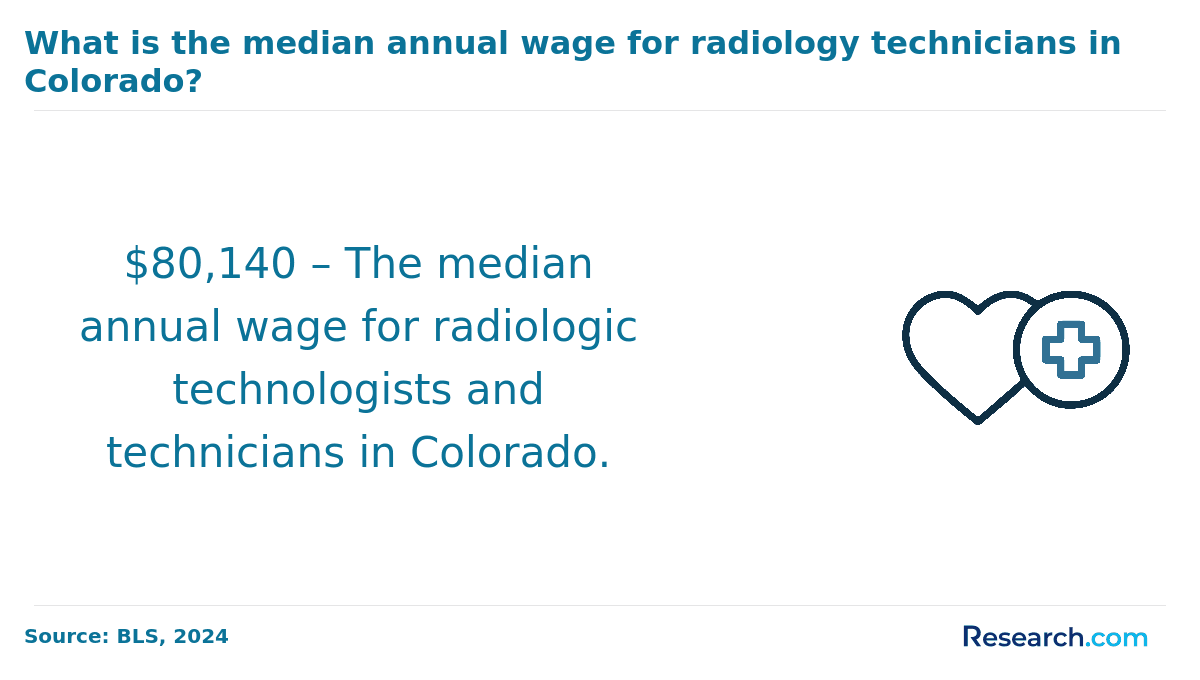
Radiology technician pay in Colorado depends on experience, employer type, location, shift, and specialty. The article’s cited salary figures include an average salary of $74,350 per year and another estimate of approximately $60,000 per year. These numbers should be treated as reference points rather than guaranteed outcomes.
Entry-level radiology technicians are described as typically earning between $45,000 and $55,000 annually. Early roles may be found in smaller hospitals, outpatient centers, nonprofit clinics, or facilities that need staff for general radiography. New graduates may also improve their prospects by being flexible with shifts, location, or facility type.
With experience and additional modality training, earnings may increase. Advanced radiology technicians in Colorado are cited as earning from $75,000 to over $90,000, especially in larger hospital systems or private organizations. Specialized work in CT or MRI may offer stronger pay potential, although requirements vary by employer.
Employer type also influences compensation:
- Public sector and government facilities: These jobs may offer stable pay and benefits, with cited salary ranges between $55,000 and $80,000 depending on experience.
- Private hospital networks and corporate imaging groups: Experienced technologists in urban markets such as Denver and Colorado Springs may see salaries exceeding $70,000.
- Nonprofit clinics and smaller practices: Pay may be lower, but some workers value flexible scheduling, community-focused work, or tuition support.
Location is also a major factor. Metropolitan areas may offer more openings and higher pay, but cost of living and competition can also be higher. If you are still comparing healthcare and skilled technical occupations, Research.com’s overview of all the trades can help you compare radiologic technology with other career-focused paths.
What is the employment outlook for radiology technicians in Colorado?
The job outlook for radiology technicians in Colorado is described as strong, with projected growth of 12% through 2030. Demand is supported by healthcare expansion, population needs, imaging use in diagnosis and treatment, and the continued importance of radiologic services in hospitals and outpatient care.
Urban areas such as Denver, Colorado Springs, and Boulder may provide a larger number of openings because they have more hospitals, specialty clinics, orthopedic practices, urgent care centers, and imaging facilities. Rural communities may have fewer openings, but some facilities may face hiring challenges and may value candidates willing to serve less densely populated areas.
Applicants can improve their competitiveness by graduating from an accredited program, preparing well for certification, completing strong clinical rotations, and building professional references. Specialized training in CT, MRI, mammography, or other modalities may also help experienced technologists move into higher-demand roles.
If your goal is to enter healthcare quickly, compare radiologic technology with other short healthcare programs. Research.com’s list of best rated healthcare degree programs you can earn in 2 years or less can help you evaluate time-to-workforce options across allied health fields.
Where do radiology technicians find the best job opportunities?
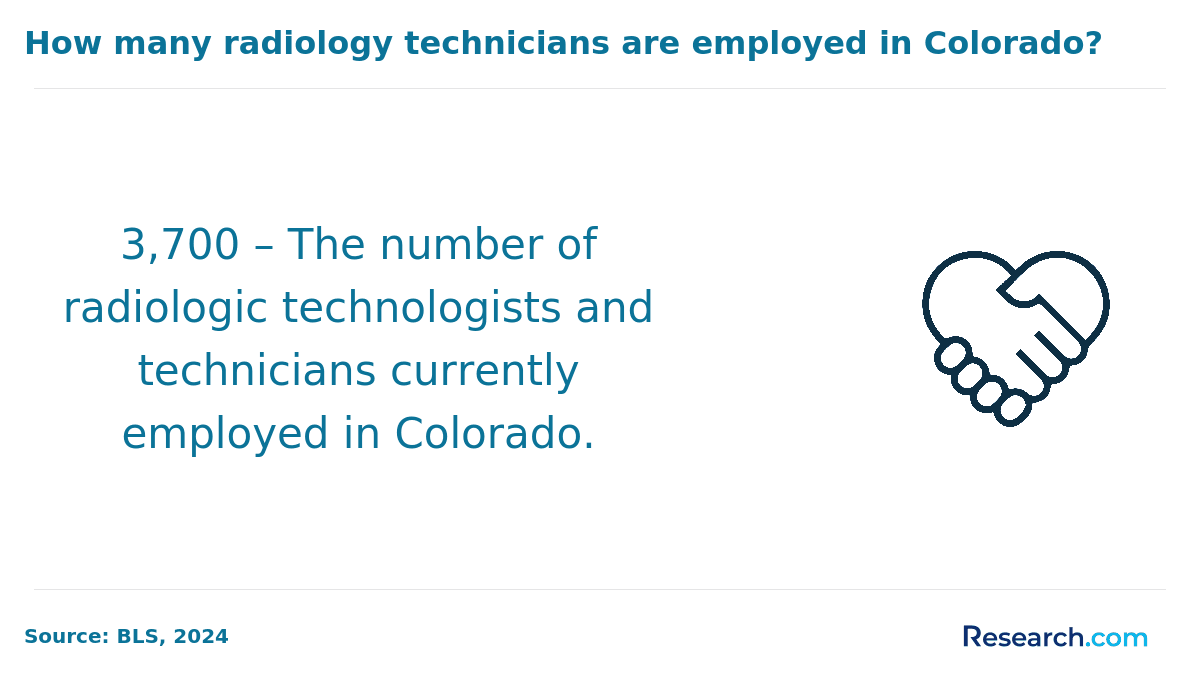
Radiology technicians in Colorado can work in several healthcare environments. The best setting depends on whether you value higher pay, schedule predictability, emergency-care experience, advancement options, or community-focused work.
| Work setting | Typical advantages | Possible trade-offs | Best for |
| Hospitals | Broad clinical exposure, advanced equipment, varied cases, and potential benefits | May require nights, weekends, holidays, or emergency coverage | Technologists who want fast-paced experience and growth opportunities |
| Outpatient imaging centers | More predictable scheduling and focused imaging workflows | May have narrower case variety than a hospital | Workers seeking routine hours and specialized imaging experience |
| Corporate imaging centers | Potentially competitive pay and clearer operational career ladders | Productivity expectations may be high | Technologists interested in efficiency, supervision, or management pathways |
| Government healthcare facilities | Stability, benefits, and public service mission | Hiring processes may be slower or more formal | Applicants who prioritize long-term security and structured benefits |
| Nonprofit and community clinics | Mission-driven work and service to underserved populations | Salary may be lower than in large systems | Technologists motivated by access, equity, and community health |
| Mobile imaging and rural services | Expands access to patients outside major metro areas | Travel, schedule variation, or independent work may be required | Flexible professionals comfortable with changing environments |
When comparing employers, look beyond the hourly wage. Ask about shift differentials, call requirements, modality training, tuition reimbursement, staffing ratios, patient volume, equipment quality, and promotion pathways.
What technology trends are changing radiology work?
Radiology is becoming more digital, more connected, and more data-driven. For Colorado radiology technicians, this means technical adaptability is increasingly important alongside patient care skills.
Digital radiography is now central to many imaging workflows. The original source material states that over 85% of Colorado’s imaging facilities use digital radiography systems. Technologists must be comfortable capturing images digitally, reviewing image quality, using picture archiving and communication systems, and following facility protocols for secure image storage and transmission.
Artificial intelligence is also affecting imaging workflows. AI tools may help flag potential abnormalities, support workflow prioritization, or assist radiologists in image review. These tools do not eliminate the need for skilled technologists. Instead, they increase the importance of image quality, correct positioning, patient identification, and understanding how technology fits into clinical decision-making.
Telemedicine and remote radiology support can improve access for rural communities. Technologists may need to transmit images securely, coordinate with off-site radiologists, and use communication tools that protect patient privacy. Workers who can combine hands-on imaging skill with digital workflow competence may be better positioned as facilities modernize.
What challenges should future radiology technicians expect?
Radiologic technology can be stable and meaningful work, but it is not an easy career by default. Students should understand the academic, clinical, physical, and emotional demands before committing time and money to a program.
First, the training is science-heavy. Anatomy, positioning, radiation physics, safety rules, and image evaluation require consistent study. Clinical rotations also require professionalism, punctuality, patient interaction, and the ability to accept feedback in real time.
Second, licensure and credential maintenance require organization. Candidates must complete the right education, pursue certification when applicable, and stay current with continuing education and renewal requirements. Missing a deadline or choosing a nonqualifying program can create avoidable career delays.
Third, the job can be physically demanding. Technologists may stand for long shifts, move equipment, assist patients with limited mobility, and work in urgent or high-pressure settings. Emotional resilience also matters because patients may be frightened, injured, seriously ill, or in pain.
Finally, job competition can vary by region. Denver and other urban markets may have many employers, but they may also attract many applicants. Rural areas may have fewer facilities, but some may offer incentives or stronger demand for qualified workers. Students comparing costs should also understand whether is associates degree in radiology online affordable and whether online coursework includes required in-person clinical training.
| Common mistake | Why it causes problems | Better approach |
| Choosing a program without checking accreditation | Graduates may face certification, licensure, or employer eligibility issues | Confirm accreditation and certification eligibility directly with the program and relevant agencies |
| Looking only at tuition | Fees, books, uniforms, commuting, background checks, and lost work hours can change total cost | Request a full cost estimate and compare financial aid, transfer credit, and clinical site distance |
| Assuming online means fully remote | Radiologic technology requires hands-on lab and clinical experience | Ask which courses are online and where clinical rotations are completed |
| Ignoring shift expectations | Hospitals may require evenings, weekends, holidays, or call coverage | Ask employers and clinical sites about typical schedules before choosing a setting |
| Expecting salary figures to be guaranteed | Pay varies by employer, specialty, geography, experience, and schedule | Review current job postings and ask programs for recent graduate employment information |
What financial aid options can help pay for radiology technician training?
Radiology technician students in Colorado should compare several funding sources before borrowing. Possible options include federal grants, state-specific scholarships, low-interest student loans, school-based aid, healthcare workforce scholarships, and assistance from professional organizations connected to radiologic technology.
Community colleges, technical schools, hospitals, and healthcare employers may also offer payment plans, tuition reimbursement, work-study opportunities, or support for employees moving into imaging roles. Students should ask each program whether clinical schedules make part-time work realistic, because unpaid clinical hours can affect income during training.
Before committing to a program, calculate the full cost of attendance rather than focusing only on tuition. Include fees, textbooks, uniforms, immunizations, background checks, drug screening, transportation to clinical sites, parking, exam fees, and lost work hours. Students interested in longer-term healthcare mobility may also compare radiology training with pathways such as how to get a nursing license in Colorado.
How can radiology technicians move into ultrasound in Colorado?
Radiology technicians who want to specialize beyond X-ray may consider diagnostic medical sonography. Their background in anatomy, patient positioning, imaging workflows, and patient care can be useful, but ultrasound is a distinct modality with its own physics, scanning techniques, protocols, and credentialing expectations.
A transition usually requires targeted sonography education through an accredited program or another employer-recognized training route. Students should confirm whether the program includes clinical scanning experience, prepares graduates for relevant credentials, and meets employer expectations in Colorado.
For a closer look at this specialty route, review Research.com’s guide on how to become an ultrasound technician in Colorado.
What legal and ethical responsibilities apply to radiology technicians?
Radiology technicians work with patients, medical images, and radiation-producing equipment, so legal and ethical standards are central to the job. Professional conduct protects patients, supports accurate diagnosis, and reduces risk for healthcare facilities.
- Maintain required credentials: Complete the appropriate education, certification, licensing, and continuing education steps for your role and equipment type.
- Protect patient privacy: Follow HIPAA requirements and facility policies when handling images, records, conversations, and electronic systems.
- Use informed communication: Explain procedures clearly within your scope, verify patient identity, and help patients understand what to expect.
- Apply radiation safety principles: Use the As Low As Reasonably Achievable principle, follow shielding and exposure protocols, and document according to facility standards.
- Work within scope: Do not interpret images, diagnose conditions, or provide medical advice reserved for radiologists or other licensed clinicians.
- Report concerns appropriately: Equipment problems, unsafe practices, patient identification errors, or ethical issues should be escalated through proper channels.
Professional organizations such as the Colorado Society of Radiologic Technologists can also help technologists stay informed about ethics, continuing education, and professional standards.
How can radiology technicians advance professionally in Colorado?
Radiology technicians can build long-term careers by adding specialized credentials, gaining experience in higher-acuity settings, moving into leadership, or pursuing additional healthcare education. Advancement usually requires a mix of technical skill, continuing education, strong clinical performance, and employer support.
Common specialty areas include computed tomography, magnetic resonance imaging, mammography, and nuclear medicine. Certifications from organizations such as the American Registry of Radiologic Technologists may strengthen a technologist’s qualifications and help employers verify competency in advanced modalities.
Continuing education is also essential. Colorado radiology technicians must complete continuing education credits every two years to maintain ARRT certification. This requirement helps professionals stay current with safety practices, technology changes, ethical standards, and clinical expectations.
Professional development options in Colorado may include:
- Advanced training and recertification courses through institutions such as the University of Colorado Anschutz Medical Campus
- Seminars, conferences, and networking opportunities offered through the Colorado Society of Radiologic Technologists
- Employer-based cross-training in CT, MRI, mammography, or leadership responsibilities
- Mentorship from senior technologists, radiology managers, or radiologists
The original source material cites employment growth of around 10% over the next decade in Colorado. For students and working technologists, the practical takeaway is simple: specialization and continuing education can make a meaningful difference in career flexibility.
How should you compare radiology technician programs in Colorado?
Program choice affects certification eligibility, clinical readiness, debt, employment options, and completion time. Do not choose based only on location or advertised tuition. Compare each program’s outcomes, clinical partnerships, and support systems before applying.
| Factor to evaluate | Questions to ask | Why it matters |
| Accreditation | Is the program currently accredited, and by which organization? | Accreditation can affect certification eligibility and employer confidence |
| Clinical placements | Where are clinical rotations held, and how far might students travel? | Clinical experience is required for skill development and may affect transportation costs |
| Certification preparation | Does the curriculum align with ARRT standards? | Graduates need strong preparation for certification and employment |
| Graduate outcomes | What are recent completion, exam pass, and job placement results? | Outcomes help you judge whether students are finishing and finding work |
| Total cost | What is the full cost after fees, books, supplies, exams, and transportation? | A lower tuition rate may not mean the lowest total cost |
| Schedule format | Are classes full time, part time, evening, hybrid, or in person? | Scheduling determines whether you can work while enrolled |
| Student support | Does the program provide tutoring, advising, career help, and clinical remediation? | Support services can affect persistence and job readiness |
If you are comparing allied health options more broadly, Research.com’s guide to the best medical assistant programs in Colorado can help you see how program structure, clinical preparation, and career outcomes differ across healthcare training paths.
Can radiology technician experience lead to advanced clinical roles?
Radiology technician training can create a foundation for broader healthcare roles because it develops patient care habits, anatomy knowledge, safety discipline, documentation skills, and comfort in clinical environments. Some technologists remain in imaging and specialize, while others use the experience as a stepping stone into nursing, healthcare administration, education, or other patient care professions.
Moving into an advanced clinical role usually requires additional education and a new credential or license. For example, nursing involves a different scope of practice, broader assessment responsibilities, and separate state requirements. If you are considering that direction, Research.com’s guide on how to become a nurse in Colorado explains the training and licensing pathway in more detail.
Can dual certification improve healthcare career options in Colorado?
Dual certification can make sense for radiology technicians who want more flexibility, stronger employability, or access to different patient care settings. For example, cross-training in another imaging modality or allied health discipline may help a worker qualify for more roles within a hospital, clinic, or outpatient center.
The value of dual certification depends on employer demand, training cost, time commitment, and whether the credential aligns with your long-term goal. It is usually more strategic to add a credential that complements your current role rather than collecting unrelated certifications. If you are exploring allied health expansion, Research.com’s guide on how to become a medical assistant in Colorado can help you compare a different patient care pathway.
What do radiology technicians say about their careers in Colorado?
-
: "
My radiology technician training at the University of Northern Colorado changed the way I saw healthcare. The clinical practice helped me adjust to the pace of a local hospital, and working with patients from many backgrounds has been one of the most meaningful parts of the job. Marge
"
-
: "
Colorado Mesa University’s radiology program gave me access to opportunities I had not considered before. Starting in a Colorado healthcare facility showed me how different rural and urban patient needs can be, and the career stability has made continuing education feel worthwhile. Andy
"
-
: "
Regis University helped me build a strong base in radiologic technology and encouraged me to keep learning. Once I began working in a Colorado hospital, I understood how valuable imaging professionals are for mountain communities and why specialization can keep this career interesting. Jess
"
Related Articles for Nearby States
- 2027 How to Become a Radiology Technician in Wyoming
- 2027 How to Become a Radiology Technician in Nebraska
- 2027 How to Become a Radiology Technician in Kansas
- 2027 How to Become a Radiology Technician in New Mexico
- 2027 How to Become a Radiology Technician in Utah
- 2027 How to Become a Radiology Technician in Oklahoma
- 2027 How to Become a Radiology Technician in Arizona
- 2027 How to Become a Radiology Technician in Texas
- 2027 How to Become a Radiology Technician in South Dakota
- 2027 How to Become a Radiology Technician in Nevada
Key Insights
- Becoming a radiology technician in Colorado usually requires an accredited radiologic technology education program, supervised clinical experience, certification preparation, and compliance with state requirements.
- An associate degree is a common entry route and can take as little as two years, but students should verify accreditation, clinical placement quality, and certification eligibility before enrolling.
- Salary expectations should be researched carefully. Cited Colorado figures include $74,350 per year, approximately $60,000 per year, entry-level earnings of $45,000 to $55,000, and advanced earnings from $75,000 to over $90,000.
- Colorado’s outlook is favorable, with a cited projected growth rate of 12% through 2030, but opportunity varies by location, employer type, specialty, and applicant credentials.
- The strongest candidates combine technical imaging skill with patient communication, radiation safety, attention to detail, and readiness for physically demanding clinical work.
- Program selection matters. Check accreditation, total cost, clinical sites, exam preparation, graduate outcomes, and schedule requirements before committing.
- Career growth often comes from specialization in areas such as CT, MRI, mammography, ultrasound, or nuclear medicine, as well as continuing education and professional networking.
- Do not assume online training is fully remote or that every program meets licensing and certification requirements. Radiologic technology requires hands-on clinical training.
References:
- All Allied Health Schools. (n.d.). What education do radiology technologists have? All Allied Health Schools.
- Colorado Department of Public Health and Environment. (n.d.). X-ray machine operators and technologists. Colorado Department of Public Health and Environment.
- Mayo Clinic College of Medicine and Science. (n.d.). Radiologic technologist - Explore healthcare careers. Mayo Clinic College of Medicine and Science.
- Medical Professionals. (2022). Ethical issues in radiology: A guide for rad techs. Medical Professionals.
- Niche. (2025). 2025 Best colleges with radiologic technician degrees. Niche.
Other Things You Should Know About Becoming a Radiology Technician in Colorado
The Colorado Department of Regulatory Agencies, through its Division of Professions and Occupations, oversees state registration for radiologic technologists. Applicants must also qualify through the American Registry of Radiologic Technologists, or ARRT, before they can work under Colorado’s registration rules.
To become a radiology technician in Colorado in 2027, you must complete an accredited radiologic technology program, typically an associate degree, which usually takes two years. Additionally, you need to pass the American Registry of Radiologic Technologists (ARRT) certification exam. Some clinical hours and hands-on training are also required.
To become a licensed radiology technician in Colorado in 2027, you need an associate degree in radiologic technology, pass the ARRT certification exam, and apply for state licensure. Continuing education is also required for license renewal every two years.


