2027 How to Become a Radiology Technician in California

Co-Founder and Chief Data Scientist
Becoming a radiology technician in California is a practical healthcare career path for people who want direct patient contact, hands-on technology, and a shorter training route than many clinical professions. The decision still requires careful planning: California has state licensing rules, most employers expect ARRT certification, and program choice can affect eligibility, cost, clinical placement, and how quickly you can start working.
This guide explains how to become a radiologic technologist in California, including education options, licensing steps, required skills, salary expectations, job outlook, industries hiring, specialization paths, and common mistakes to avoid. It is designed for prospective students, career changers, and allied health workers comparing radiology with nursing, ultrasound, medical assisting, or other healthcare roles.
Quick Answer: How do you become a radiology technician in California?
To become a radiology technician in California, you generally need to complete an approved radiologic technology program, gain supervised clinical experience, pass the American Registry of Radiologic Technologists (ARRT) exam or a state-approved equivalent, and apply for licensure through the California Department of Public Health’s Radiologic Health Branch. An associate degree is the common entry-level route, while a bachelor’s degree may help with leadership, education, or advanced imaging opportunities.
Key Things to Know About Becoming a Radiology Technician in California
- California’s radiology technician job market is projected to grow 13% through 2030, supported by healthcare expansion and increased imaging needs among an aging population.
- The average annual salary for radiology technicians in California is approximately $79,000, although pay varies by region, employer type, shift, experience, and specialization.
- Accredited programs at institutions such as California State University, Long Beach, and Loma Linda University can provide the classroom instruction and clinical practice needed for certification eligibility.
- ARRT certification is required along with completion of an accredited educational program and compliance with California’s state licensing standards.
- What education do you need to become a radiology technician in California?
- What skills do California radiology technicians need?
- What licensing and certification steps are required in California?
- How much do radiology technicians earn in California?
- What is the job outlook for radiology technicians in California?
- Where can radiology technicians find the best career opportunities?
- How can radiology technicians manage work-life balance in California?
- What financial aid and education support options are available?
- What trends and technologies are changing radiology?
- What challenges should future radiology technicians expect?
- What related allied health careers can radiology technicians consider?
- What legal and ethical rules should radiology technicians follow?
- How can radiology technicians advance their careers?
- How does radiology technology compare with nursing in California?
- How can radiology technicians move into ultrasound imaging?
What education do you need to become a radiology technician in California?
California radiology technician candidates must complete an approved postsecondary radiologic technology program. For most students, the standard entry route is an associate degree in radiologic technology from a program recognized by the Joint Review Committee on Education in Radiologic Technology (JRCERT) or another acceptable accrediting body. These programs combine classroom learning with supervised clinical training so students can learn anatomy, patient positioning, radiation physics, image production, equipment operation, and radiation protection.
Clinical training is not optional. Radiologic technology is a hands-on profession, and students must learn how to position patients, follow safety procedures, adjust imaging equipment, communicate during exams, and produce diagnostic-quality images under supervision. A strong program should provide enough clinical exposure to help students become comfortable in hospitals, outpatient centers, and other imaging settings.
After completing an approved program, candidates must pass the ARRT certification exam or a California-approved equivalent before applying for state licensure. This step confirms that the applicant meets core national and state expectations for safe imaging practice, patient care, and radiation safety.
Students looking for the fastest way to become a radiology tech should still prioritize accreditation and licensing eligibility over speed alone. A shorter program that does not qualify graduates for certification or California licensure can delay employment instead of accelerating it.
Bachelor’s degrees in radiologic sciences are also available. They are not always necessary for entry-level radiography positions, but they may be useful for students who want to move into advanced imaging, education, supervision, department leadership, or future graduate study.
| Education option | Best fit | Important considerations |
| Associate degree in radiologic technology | Students seeking the common entry-level route into radiography | Should include approved clinical training and meet California licensing expectations |
| Bachelor’s degree in radiologic sciences | Students interested in leadership, advanced study, teaching, or broader career mobility | Usually takes longer than an associate pathway and may cost more |
| Postsecondary certificate or diploma pathway | Students who already have relevant education or are entering a specific approved training route | Must be checked carefully for ARRT and California licensure eligibility |
| Online or hybrid coursework | Students who need flexibility for academic classes | Clinical training must still be completed in person at approved sites |
What skills do California radiology technicians need?
Radiology technicians need a blend of technical precision, patient care ability, and sound judgment. The job is not simply pressing buttons on imaging equipment. A technologist must prepare patients, follow physician orders, capture usable images, protect patients and staff from unnecessary radiation, and communicate clearly with radiologists and care teams.
- Imaging equipment competence: Radiologic technologists must know how to operate and adjust X-ray equipment and may later train on CT, MRI, or other imaging systems. Proper technique affects image quality and patient safety.
- Patient positioning: Accurate positioning is essential because poor positioning can produce unclear images, cause repeat exams, or expose patients to avoidable radiation.
- Radiation safety knowledge: Technologists must use shielding, exposure controls, monitoring practices, and safety protocols that align with California standards and workplace policies.
- Attention to detail: Small mistakes in technique, labeling, documentation, or patient verification can create serious clinical problems. Accuracy matters before, during, and after each exam.
- Communication: Patients may be anxious, injured, or unable to move easily. Clear instructions help them understand the exam and cooperate safely.
- Compassion and professionalism: Imaging often happens during stressful medical moments. A calm, respectful approach improves the patient experience and supports efficient care.
- Critical thinking: Technologists must adapt when patients have pain, mobility limits, trauma, or difficulty following instructions while still obtaining clinically useful images.
- Teamwork: Radiology technicians coordinate with radiologists, nurses, physicians, transport staff, and other healthcare professionals in fast-moving environments.
| Skill area | Why it matters in practice | How to build it |
| Technical imaging skills | Image quality affects diagnosis and treatment decisions | Choose a program with strong lab instruction and diverse clinical rotations |
| Radiation protection | Unsafe exposure can harm patients, staff, and the technologist | Master safety protocols and continue training after licensure |
| Patient communication | Patients need clear guidance, especially when they are in pain or worried | Practice explaining procedures in simple, calm language |
| Adaptability | Clinical situations are not always predictable | Seek feedback during clinical rotations and learn from complex cases |
What licensing and certification steps are required in California?
California radiology technicians must satisfy both professional certification expectations and state licensing rules. The main credentialing step is ARRT certification, which requires graduation from an approved radiologic technology program and successful completion of the ARRT certification exam. The exam covers patient care, radiographic procedures, radiation protection, image production, and equipment operation.
California also requires a state licensing process through the California Department of Public Health, Radiologic Health Branch. Applicants must submit documentation showing that they completed an approved program and passed the ARRT exam or another state-approved examination. They must also complete the state application process and pay required fees.
- Complete an approved radiologic technology education program.
- Finish the required clinical training attached to that program.
- Pass the ARRT certification exam or a California-approved equivalent.
- Submit the California license application to the Department of Public Health’s Radiologic Health Branch.
- Pay the applicable licensing fees.
- Meet renewal and continuing education requirements to keep the license active.
Because licensing rules determine whether you can legally practice, students should confirm eligibility before enrolling. If you are still comparing healthcare careers, a broader overview of radiology career requirements can help you understand how radiologic technology fits within the larger imaging field.
| Step | What to verify | Why it matters |
| Program selection | The school is accredited or otherwise approved for licensure eligibility | Graduating from the wrong program can block certification or licensing |
| Clinical placement | The program includes supervised hands-on training | Clinical experience is required for competency and job readiness |
| ARRT exam preparation | The curriculum aligns with exam content | Passing the exam is a key credentialing milestone |
| California application | Documentation, fees, and background requirements are complete | Incomplete applications can delay legal authorization to work |
| Continuing education | Renewal requirements are tracked on time | Licensure and certification must be maintained after employment begins |
How much do radiology technicians earn in California?
Radiology technician pay in California depends on experience, location, employer type, shift schedule, and whether the technologist has advanced imaging credentials. Entry-level radiology technicians typically earn between $55,000 and $70,000 annually. New graduates may begin in smaller clinics, public healthcare settings, nonprofit facilities, or entry-level hospital roles while building experience.
With experience and advanced certifications, earnings can rise. Experienced radiologic technologists in metropolitan areas such as Los Angeles, San Francisco, and San Diego can earn between $90,000 and $110,000 per year. Higher-paying positions are often found in large hospitals, specialized diagnostic imaging centers, government healthcare institutions, and competitive urban markets.
California wages can look attractive, but salary should be evaluated alongside cost of living, commuting time, benefits, schedule, and advancement potential. A position with a lower base salary but strong benefits, tuition support, pension options, or predictable hours may be a better long-term fit than a higher-paying role with heavy overtime or burnout risk.
| Career stage or setting | Salary information stated | Decision factor |
| Entry-level radiology technician | $55,000 to $70,000 annually | Good starting point, but compare training debt and local living costs |
| Average annual salary in California | Approximately $79,000 | Useful benchmark, not a guaranteed outcome |
| Experienced technologist in major metro areas | $90,000 to $110,000 per year | Often tied to experience, specialization, shift needs, and competitive markets |
| Mean annual salary in California as of May 2023 | Around $91,000 | Should be weighed against California’s high cost of living |
Employer type can also influence compensation and benefits:
- Public hospitals and government agencies may offer stable pay structures, benefits, and gradual increases based on tenure or performance.
- Private hospitals and specialized imaging centers may offer stronger base pay or bonuses in competitive markets.
- Nonprofit healthcare organizations may pay less in some cases but can provide benefits such as tuition reimbursement, mission-driven work, and flexible scheduling.
Students comparing healthcare training with other hands-on career paths can also review all the trades to understand how radiologic technology compares with skilled technical occupations outside traditional college pathways.
What is the job outlook for radiology technicians in California?
The employment outlook for radiology technicians in California is favorable, with projected growth of 13% through 2030. Demand is supported by the state’s aging population, the continuing need for diagnostic imaging, and the expansion of healthcare services across hospitals, clinics, outpatient imaging centers, and specialty practices.
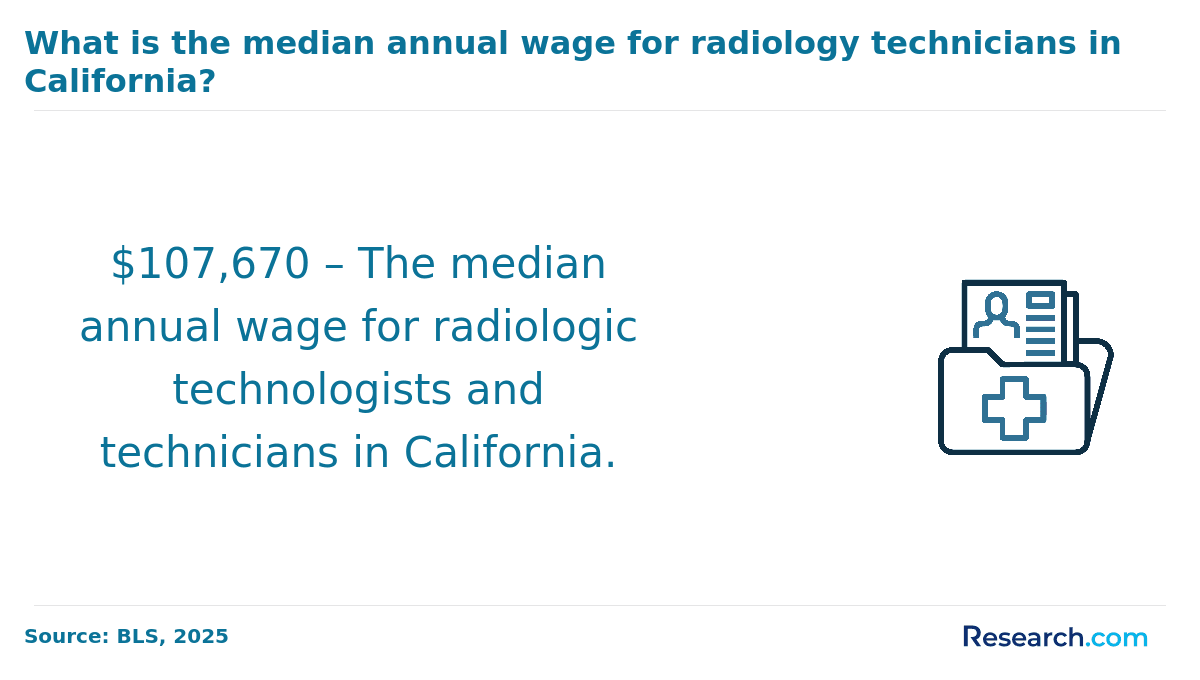
California also offers higher-than-average wages for radiologic technologists, with a mean annual salary of around $91,000 as of May 2023. However, pay should be interpreted carefully because housing, transportation, childcare, and other living costs can be high in major urban areas such as Los Angeles and San Francisco.
Job opportunities are not evenly distributed across the state. Urban areas may offer more openings and higher pay, but they can also have more competition and higher costs. Rural and underserved areas may provide different opportunities, including broader responsibilities, smaller teams, or stronger demand for flexible technologists.
Students who need flexible academic options can explore whether are there online radiology tech programs that combine online coursework with required in-person clinical training. Any online or hybrid program should be reviewed for accreditation, clinical placement support, and California licensing compatibility.
Important job outlook considerations include:
- Growth is projected at 13% through 2030, but local hiring conditions can differ by region.
- Higher California wages may be offset by high living expenses in major metro areas.
- Specialized imaging skills can improve competitiveness for advanced roles.
- Hospitals, outpatient centers, and government healthcare facilities may offer different schedules, benefits, and advancement paths.
Where can radiology technicians find the best career opportunities?
Radiology technicians can work in several healthcare environments, and each setting comes with different trade-offs. Some roles offer higher acuity and faster learning. Others provide predictable schedules, less emergency work, or better long-term stability. The best setting depends on whether you value variety, salary potential, schedule control, specialization, or benefits.
| Work setting | What the role is like | Best for |
| Hospitals | Fast-paced work with a wide range of exams, emergency cases, and interdisciplinary teamwork | Technologists who want broad experience and advancement opportunities |
| Outpatient imaging centers | Focused diagnostic imaging with more predictable patient flow and often more regular hours | Technologists who prefer routine scheduling and specialized imaging workflows |
| Physician offices and clinics | Smaller teams, routine exams, and more stable daily schedules | Technologists who want a lower-pressure environment |
| Mobile imaging services | Travel to nursing homes, correctional facilities, rural areas, or other off-site locations | Technologists who value independence and varied work locations |
| Specialty hospitals and trauma centers | Higher-acuity imaging in areas such as orthopedics, cardiology, or trauma care | Technologists seeking advanced clinical exposure |
| Federal and state agencies | Public-sector roles in settings such as military, VA, or public health facilities | Technologists seeking job stability and structured benefits |
| Education and research settings | Training, clinical instruction, or research support related to imaging | Experienced technologists interested in teaching or innovation |
Before accepting a position, ask about shift expectations, call requirements, patient volume, equipment age, cross-training opportunities, continuing education support, and how often technologists rotate through different imaging areas.
How can radiology technicians manage work-life balance in California?
Radiology work can be physically and emotionally demanding, especially in hospitals, trauma settings, and high-volume outpatient centers. California technologists may work nights, weekends, holidays, or rotating shifts depending on the employer. Work-life balance starts with choosing a setting and schedule that match your needs rather than assuming every radiology job looks the same.
Helpful strategies include setting clear boundaries around overtime, tracking fatigue, using paid leave when available, seeking mentorship, and choosing employers that offer realistic staffing levels and wellness support. Technologists should also communicate early with supervisors about workload concerns, ergonomic issues, or scheduling conflicts before stress becomes burnout.
Some healthcare workers also explore adjacent training to broaden their options. For example, reviewing the best medical assistant programs in California can help students compare patient-facing roles with different schedules, responsibilities, and training timelines.
What financial aid and education support options are available?
Radiologic technology programs can involve tuition, fees, books, uniforms, background checks, immunizations, transportation to clinical sites, exam fees, and licensing costs. Because the total cost is more than tuition alone, students should request a full cost breakdown before enrolling.
Financial support may come from federal aid, state grants, institutional scholarships, healthcare-related scholarships, employer tuition assistance, local healthcare organizations, or professional associations. Accredited programs typically have financial aid offices that can explain eligibility, deadlines, and documentation requirements. Students should begin this process early because some aid depends on program approval status, enrollment intensity, or application timing.
Career changers comparing radiology with other licensed healthcare fields may also find it useful to review how to become a nurse in California, especially if they want to compare training length, funding routes, clinical responsibilities, and long-term mobility.
| Cost or support factor | Questions to ask before enrolling |
| Accreditation and approval | Will this program qualify me for ARRT certification and California licensure? |
| Total program cost | What expenses are required beyond tuition? |
| Clinical placement | Does the school assign clinical sites, or must students find their own? |
| Financial aid | Which federal, state, institutional, or scholarship options are available? |
| Transfer credits | Will my prior coursework reduce cost or time to completion? |
| Exam and licensing fees | Are ARRT and California application costs included in the program estimate? |
What trends and technologies are changing radiology?
Radiology is becoming more digital, data-driven, and connected. California radiology technicians entering the field should expect to work with digital imaging systems, electronic health records, secure image-sharing platforms, and evolving clinical workflows that connect technologists, radiologists, physicians, and patients across multiple sites.
Digital imaging has replaced many older film-based processes, which means technologists must understand image acquisition, quality control, digital storage, and communication systems. Faster image availability can improve workflow, but it also increases expectations for accuracy, documentation, and secure handling of patient information.
Artificial intelligence is also affecting radiology workflows. AI tools may support image review, help flag possible abnormalities, prioritize cases, or reduce routine workflow burdens. These tools do not eliminate the need for skilled technologists. Instead, they increase the importance of proper image acquisition, protocol compliance, data quality, and human judgment.
Telemedicine and remote radiology are especially relevant in a geographically large and diverse state such as California. Technologists may need to capture and transmit high-quality images securely so radiologists can interpret studies from another location. This requires strong technical habits and strict attention to privacy and security procedures.
Technology-related competencies to build include:
- Digital radiography operation and image quality review
- Secure handling of imaging data and patient records
- Understanding how AI-assisted workflows support, but do not replace, clinical judgment
- Communication with remote radiologists and multidisciplinary care teams
- Continuing education in new protocols, equipment, and safety standards
What challenges should future radiology technicians expect?
The first challenge is getting into and completing an approved program. Many radiologic technology programs have limited seats, prerequisite courses, minimum GPA expectations, background requirements, and clinical availability limits. Students researching what is the most affordable associates degree in radiology online should be especially careful to confirm accreditation, clinical placement, and California licensing eligibility before choosing a low-cost option.
The second challenge is managing the credentialing process. Candidates must complete the required education, prepare for the ARRT exam or state-approved equivalent, gather documentation, submit a California license application, and meet ongoing renewal expectations. Missing paperwork or misunderstanding requirements can delay entry into the workforce.
The third challenge is the work itself. Radiology technicians may spend long hours standing, moving equipment, helping patients transfer safely, and working with people who are injured, frightened, or seriously ill. Hospital roles may include nights, weekends, holidays, and urgent cases. Outpatient roles may offer more predictable schedules but can still involve high patient volume.
Technology changes are another pressure point. Technologists must continue learning new equipment, imaging protocols, safety standards, and digital systems throughout their careers. The people who do best in this field are usually those who are comfortable being both technically precise and emotionally steady.
Common mistakes to avoid when becoming a radiology technician in California
| Mistake | Why it causes problems | Better approach |
| Choosing a program only because it is cheap or fast | It may not meet certification or California licensure requirements | Verify accreditation, approval status, clinical training, and exam eligibility first |
| Ignoring clinical placement details | Students may face travel burdens, schedule conflicts, or limited hands-on exposure | Ask where clinical sites are located and how placements are assigned |
| Assuming online coursework means fully online training | Radiologic technology requires in-person clinical practice | Confirm which parts are online and which must be completed onsite |
| Looking only at salary | High pay may come with high living costs, long commutes, nights, or overtime | Compare pay, benefits, schedule, location, and advancement opportunities together |
| Waiting until graduation to understand licensing | Application delays can postpone employment | Track ARRT and California requirements from the start of the program |
| Assuming salary outcomes are guaranteed | Actual pay varies by employer, city, specialization, experience, and shift | Use salary figures as benchmarks, not promises |
What related allied health careers can radiology technicians consider?
Radiology technicians who want a different work pace, more direct clinical care, or broader healthcare responsibilities may consider related allied health roles. Some paths build on imaging knowledge, while others shift toward patient intake, clinical assistance, administration, or specialized diagnostics.
Medical assisting is one option for people who want a shorter clinical support route with a mix of administrative and patient-care tasks. To compare that pathway with radiologic technology, see how to become a medical assistant in California.
| Career option | How it differs from radiology technology | Who may prefer it |
| Medical assistant | Broader front-office and clinical support duties rather than diagnostic imaging specialization | Students seeking patient interaction and administrative variety |
| Ultrasound technician | Uses non-ionizing sound-wave imaging and focuses heavily on sonographic anatomy and scanning technique | Radiology techs who want another imaging specialty |
| Nursing | Centers on ongoing patient care, assessment, medication support, and care coordination | Students who want broader clinical responsibility and bedside care |
| Advanced imaging technologist | Builds on radiography experience with CT, MRI, mammography, or nuclear medicine | Technologists who want to stay in imaging while increasing specialization |
What legal and ethical rules should radiology technicians follow?
Radiology technicians in California must practice within state licensing rules, employer policies, and professional ethics standards. Legal compliance starts with proper licensure through the California Department of Public Health and continued compliance with renewal and continuing education requirements. Practicing without proper authorization can lead to penalties, fines, or loss of the right to work in the field.
Ethical practice is just as important. Radiologic technologists work with patients who may be vulnerable, injured, anxious, or unable to advocate for themselves. The technologist’s responsibility is to protect the patient, obtain necessary information, maintain privacy, and use radiation only as appropriate for the ordered exam.
- Confirm patient identity and the ordered imaging procedure before beginning.
- Explain the procedure in clear language and answer appropriate patient questions.
- Use radiation protection practices, including shielding and exposure reduction methods.
- Follow the ALARA principle, meaning radiation exposure should be kept As Low As Reasonably Achievable.
- Maintain confidentiality under the Health Insurance Portability and Accountability Act (HIPAA).
- Document accurately and report imaging or safety concerns through proper channels.
- Communicate respectfully with California’s diverse patient population, including patients with language, cultural, mobility, or disability-related needs.
How can radiology technicians advance their careers?
Radiology technicians in California can advance by gaining experience, earning specialty credentials, pursuing additional education, or moving into leadership. Common imaging specialties include computed tomography (CT), magnetic resonance imaging (MRI), mammography, and nuclear medicine. These areas typically require additional training and successful completion of relevant examinations.
Continuing education is also part of long-term professional development. California licensed radiologic technologists must complete required continuing education units during each renewal cycle. This helps technologists stay current with equipment updates, radiation safety practices, clinical standards, and patient care expectations.
Professional organizations can support advancement through conferences, workshops, networking, and specialty education. The California Society of Radiologic Technologists (CSRT) offers state-focused professional resources, while national organizations such as ARRT support certification and continuing education recognition.
Experienced technologists may also move into lead technologist, clinical instructor, radiology supervisor, or department manager roles. Leadership positions may require additional management training, a bachelor’s degree, or experience coordinating staff, schedules, quality control, and compliance. Institutions such as the University of Southern California and various community colleges across California may offer relevant education or professional development options.
| Advancement path | What it may involve | Why it can help |
| CT, MRI, mammography, or nuclear medicine | Additional training and specialty examination | Can improve competitiveness for specialized imaging roles |
| Lead technologist | Clinical expertise plus workflow and team coordination | Provides a step toward supervision |
| Clinical instructor | Teaching students during lab or clinical training | Useful for technologists interested in education |
| Radiology manager | Leadership, staffing, compliance, budgeting, and quality improvement | Moves the career beyond direct imaging duties |
| Bachelor’s degree or further education | Broader coursework in imaging science, leadership, or healthcare administration | May support long-term mobility and non-entry-level roles |
How does radiology technology compare with nursing in California?
Radiology technology and nursing are both patient-centered healthcare careers, but they serve different functions. Radiology technicians specialize in diagnostic imaging. Nurses focus on ongoing patient assessment, care planning, medication-related support, treatment coordination, and bedside care. The better choice depends on whether you prefer imaging technology and procedure-based work or broader patient care and clinical management.
| Factor | Radiology technician | Nursing |
| Core focus | Producing diagnostic images safely and accurately | Providing ongoing patient care and clinical coordination |
| Patient interaction | Often procedure-based and shorter in duration | Often continuous across a shift or care episode |
| Technology use | Heavy use of imaging equipment and digital systems | Broad use of clinical tools, records, monitoring, and treatment systems |
| Best fit | Students who like anatomy, equipment, imaging, and precise procedures | Students who want broader responsibility for patient care |
Professionals considering a change from radiology into nursing, or comparing both before enrolling, can review how to get a nursing license in California to understand the licensing path and role expectations.
How can radiology technicians move into ultrasound imaging?
Radiology technicians who want to expand their imaging skills may consider ultrasound, also called diagnostic medical sonography. Ultrasound uses non-ionizing imaging technology, so the training emphasis differs from radiography. Sonography requires strong knowledge of soft-tissue anatomy, scanning technique, patient positioning, image optimization, and real-time interpretation support.
This transition can make sense for radiology technicians who enjoy imaging but want a specialty with different procedures and patient populations. Additional coursework, clinical training, and certification preparation are typically needed. For a focused breakdown of the pathway, review how to become an ultrasound technician in California.
What do radiology technicians say about their careers in California?
Marianne describes her radiology technician training at San Diego State University as a turning point that helped her build confidence in both patient care and imaging technique. After entering a California hospital role, she found that the range of patient cases strengthened her clinical judgment and made the work feel meaningful. - Marianne
Patricia credits California State University, Long Beach with preparing her for the pace of clinical imaging work. She notes that California’s diverse patient population has made communication, cultural awareness, and adaptability especially important in her day-to-day practice. - Patricia
Neil says his experience at the University of California, Riverside helped launch a career in a state where demand exists across both urban and rural healthcare settings. He values the continuous learning required in radiology and sees clear room for advancement as he gains experience. - Neil
Related Articles for Nearby States
- 2027 How to Become a Radiology Technician in Nevada
- 2027 How to Become a Radiology Technician in Oregon
- 2027 How to Become a Radiology Technician in Arizona
- 2027 How to Become a Radiology Technician in Idaho
- 2027 How to Become a Radiology Technician in Utah
- 2027 How to Become a Radiology Technician in Washington
- 2027 How to Become a Radiology Technician in New Mexico
- 2027 How to Become a Radiology Technician in Colorado
- 2027 How to Become a Radiology Technician in Montana
- 2027 How to Become a Radiology Technician in Wyoming
Key Insights
- The typical route to becoming a radiology technician in California is an approved radiologic technology program, supervised clinical training, ARRT certification or a state-approved equivalent, and state licensure through the California Department of Public Health.
- Do not choose a program based only on speed or tuition. Accreditation, clinical placement, certification eligibility, and California licensing compatibility matter more than a low advertised price.
- California offers strong earning potential, with an average annual salary of approximately $79,000 and a mean annual salary of around $91,000 as of May 2023, but cost of living and location can significantly affect real take-home value.
- The job market is projected to grow 13% through 2030, but opportunities vary by region, employer type, schedule, and specialization.
- Hospitals offer broad experience and fast-paced work, while outpatient centers, clinics, government facilities, mobile imaging, and education settings may provide different balances of pay, stability, and schedule control.
- Radiology technicians who want to advance should consider specialties such as CT, MRI, mammography, or nuclear medicine, as well as leadership, teaching, or management roles.
- AI, digital imaging, and tele-radiology are changing workflow expectations, but they increase rather than eliminate the need for technologists who can produce accurate images and protect patient safety.
- The best next step is to compare approved California programs, confirm licensing eligibility in writing, estimate total cost, and ask detailed questions about clinical placement, exam preparation, and graduate outcomes.
References:
- Best Trade Schools. (n.d.). How to Become an X-Ray Tech in California. Best Trade Schools
- Kaiser Permanente. (n.d.). Radiologic Technology. Kaiser Permanente
- Modern Technology School. (n.d.). How to Become a Radiology Technician in California. Modern Technology School
- Moorpark College. (n.d.). Radiologic Technology. Moorpark College
- Orange Coast College. (n.d.). Radiologic Technology. OCC
- Smith Chason College. (2024). A Step-By-Step Guide on How to Become a Radiologic Technologist. Smith Chason College
- U.S. Bureau of Labor Statistics. (2024). Occupational Employment and Wage Statistics. U.S. BLS
- Zippia. (2025). Radiologic Technician demographics and statistics in the US. Zippia
Other things you should know about becoming a radiology technician in California
The Joint Review Committee on Education in Radiologic Technology (JRCERT) and the California Department of Public Health's Radiologic Health Branch are the primary organizations that accredit radiologic technology programs in California in 2027. Accreditation ensures that programs meet high standards of education and training.
To enroll in a radiologic technology program in California in 2027, you need a high school diploma or equivalent, completion of prerequisite courses such as anatomy and physiology, and passing entrance exams. Checking specific school requirements is advisable as they may vary.
California requires a state certificate from the Department of Public Health’s Radiologic Health Branch, along with a current ARRT credential for most new technologists. To perform fluoroscopy, you also need a fluoroscopy permit issued by the same state agency.