
2027 Most Affordable Online Master’s in Communications

Co-Founder and Chief Data Scientist
Earning a master's in communication online can be a great way to advance your career while maintaining flexibility. This article tackles the challenge of finding affordable programs. It explores resources to help you identify reputable online communication programs that fit your budget. It emphasizes the value of online education in offering flexibility and accessibility to students, enabling them to continue working while furthering their education in communications.
What are the benefits of getting an online master’s degree in communications?
- An online master's degree in communications can lead to diverse career opportunities in digital media, public relations, marketing, and journalism.
- Professionals with a master's degree in communications can expect a competitive salary of $74,295.
- About 114,300 openings for media and communications are projected each year.
What can I expect from an online master’s degree in communications?
From an online master's degree in communications, you can expect to dive deep into the principles and practices of effective communication across various platforms. These programs typically focus on crafting messages, strategies, and campaigns that resonate with diverse audiences, while also honing technical skills like digital media production and data analysis. Online communications master's programs also offer concentrations in public relations, corporate writing, or strategic communications management, allowing you to tailor your studies to your specific interests and career goals.
Where can I work with an online master’s degree in communications?
With an online master's degree in communications, you can work in various organizations and industries that require effective communication skills. These include media companies, government agencies, colleges and universities, corporations, sports teams, and more. Graduates can pursue roles such as communication specialists, public relations managers, marketing directors, social media managers, and even teaching positions if they decide to share their knowledge with the next generation of communicators.
How much can I make with an online master’s degree in communications?
With an online master's degree in communications, professionals can earn an average annual salary of around $74,295. The exact salary can vary based on individual competencies, the specific career path chosen within the communications field, and the nature of the organizations where professionals work. Graduates with this advanced degree often pursue roles such as public relations managers and marketing directors which can offer higher earning potential than those with a bachelor's degree.
- List of the Most Affordable Online Master’s in Communications for 2027 List of Programs
- How long does it take to complete an online master’s degree in communications? How long does it take to complete an online master’s degree in communications?
- How does an online master’s degree in communications compare to an on-campus program? How does an online master’s degree in communications compare to an on-campus program?
- What is the average cost of an online master’s degree in communications? Program Cost
- What are the financial aid options for students enrolling in an online master’s degree in communications? What are the financial aid options for students enrolling in an online master’s degree in communications?
- What are the prerequisites for enrolling in an online master’s degree in communications? What are the prerequisites for enrolling in an online master’s degree in communications?
- What courses are typically in an online master’s degree in communications? What courses are typically in an online master’s degree in communications?
- What types of specializations are available in an online master’s degree in communications? What types of specializations are available in an online master’s degree in communications?
- How to Choose the Best Online Master’s Degree in Communications How to Choose the Best Online Master’s Degree in Communications
- What distinguishes high-quality online master’s in communications programs? What distinguishes high-quality online master’s in communications programs?
- What common challenges should I anticipate with an online master’s in communications? What common challenges should I anticipate with an online master’s in communications?
- What is the return on investment for an affordable online master's in communications? What is the return on investment for an affordable online master's in communications?
- How do career support services enhance graduate outcomes? How do career support services enhance graduate outcomes?
- Do employers value an online master's in communications as much as traditional degrees? Do employers value an online master's in communications as much as traditional degrees?
- How can an affordable online master's in communications lead to career advancement? How can an affordable online master's in communications lead to career advancement?
- What career paths are available for graduates of an online master’s degree in communications? Career Paths
- How can I leverage online resources to enhance my communication skills during the program? How can I leverage online resources to enhance my communication skills during the program?
- How are emerging digital trends influencing online communications curricula? How are emerging digital trends influencing online communications curricula?
- Is the Program Accredited and Recognized for Quality? Is the Program Accredited and Recognized for Quality?
- What are the benefits of completing an accelerated online master's degree in communications? What are the benefits of completing an accelerated online master's degree in communications?
- Can integrating game design principles enhance communications strategies? Can integrating game design principles enhance communications strategies?
Most Affordable Online Master’s in Communications Programs for 2027
An online master’s in communications can help working professionals move into strategic communication, public relations, corporate messaging, media, health communication, social media strategy, and leadership roles without leaving their jobs. The hard part is not finding a program; it is finding one that is affordable, accredited, flexible, and aligned with the kind of communication career you actually want.
This guide is for students comparing low-cost online graduate communication programs and trying to understand tuition, program length, admissions requirements, specializations, career outcomes, and return on investment. It explains what to look for, which cost factors matter beyond tuition, how online programs compare with campus-based options, and what questions to ask before applying.
Research.com reviewed affordability, accreditation, academic quality, program structure, and available communication-focused coursework using reputable education data sources and institutional information. Because tuition and fees can change, students should confirm current costs directly with each school before enrolling.
Quick Answer: What Is the Most Affordable Online Master’s in Communications?
The most affordable online master’s in communications is usually the accredited program with the lowest total cost after tuition, fees, transfer credit, employer assistance, scholarships, and time-to-completion are considered. Per-credit tuition is important, but it does not tell the full story. A 30-credit program at a slightly higher per-credit rate may cost less overall than a lower-priced 36-credit program.
Students should prioritize programs that match their career goals. For example, a public relations professional may need strategic communication or PR coursework, while a corporate employee may benefit more from organizational communication, leadership communication, or internal communication training.
How We Evaluated Affordable Online Master’s in Communications Programs
Finding a low-cost graduate communication program can be difficult because schools use different tuition models, course formats, fee structures, and completion timelines. To make the comparison more useful, Research.com considered affordability along with indicators of academic credibility and program fit.
Our evaluation used verified education and school data from the following sources:
- Integrated Postsecondary Education Data System, including the IPEDS database
- Peterson’s database, including its Distance Learning Licensed Data Set
- College Scorecard database
- National Center for Education Statistics
Students should use rankings as a starting point, not as the only decision tool. The best program for you depends on your budget, work schedule, preferred specialization, admissions profile, and career target.
Affordable Online Master’s in Communications Programs Compared
| Rank | School and Program | Program Length | Focus Area | Estimated Cost per Credit | Credits Required | Accreditation |
| 1 | Fitchburg State University, online MS in Communication | 6 months to 6 years | Social Media | $347 | 36 | New England Commission of Higher Education |
| 2 | Sam Houston State University, online Master of Arts in Communication Studies | 2 years | Communication Studies | $484 | 36 | Southern Association of Colleges and Schools Commission on Colleges |
| 3 | Missouri State University, online Master of Arts in Communication | 2 years | Communication | $279 | 33 | The Higher Learning Commission |
| 4 | Regent University, online Master of Arts in Communication | 2 years | Communication | $670 | 33 | Southern Association of Colleges and Schools Commission on Colleges |
| 5 | Arkansas State University, online Master of Arts in Communication Studies | 10 months to 2 years | Communication | $340 | 30 | The Higher Learning Commission |
| 6 | New Mexico State University, online Master of Arts in Communication Studies | 1.5 to 2 years | Organizational Leadership Communication or Organizational Analysis and Decision Making | $440 | 30 | The Higher Learning Commission |
| 7 | Columbus State University, online Master of Arts in Communication | 1 to 7 years | Communication | $301 | 30 | Southern Association of Colleges and Schools Commission on Colleges |
| 8 | Eastern Illinois University, online Master of Arts in Communication Studies | 1 to 2 years | Media and Critical Studies | $335 | 33 | The Higher Learning Commission |
| 9 | Purdue University, online Master of Science in Communication | 2 years | Public Relations | $520 | 30 | The Higher Learning Commission |
| 10 | University of Central Missouri, online Master of Arts in Communication | 2 years | Communication | $356 | 31 | The Higher Learning Commission |
Program Highlights: What Each Affordable Communications Master’s Offers
1. Fitchburg State University
Fitchburg State University’s online MS in Communication is built around social media as a professional communication tool. Students study social media theory, content planning, audience engagement, and campaign execution. The program can be a strong fit for students who want to work in digital communication, brand messaging, nonprofit outreach, government communication, health services communication, or business-focused social media strategy.
- Program Length: 6 months to 6 years
- Track or concentration: Social Media
- Estimated Cost per Credit: $347
- Required Credits to Graduate: 36
- Accreditation: New England Commission of Higher Education
2. Sam Houston State University
Sam Houston State University’s online Master of Arts in Communication Studies emphasizes interpersonal communication, intercultural communication, health communication, conflict, and human communication processes. The program may appeal to students interested in relationship-centered communication, organizational behavior, communication education, or roles requiring strong analytical and discussion-based skills.
- Program Length: 2 years
- Track or concentration: Communication Studies
- Estimated Cost per Credit: $484
- Required Credits to Graduate: 36
- Accreditation: Southern Association of Colleges and Schools Commission on Colleges
3. Missouri State University
Missouri State University offers an online Master of Arts in Communication that focuses on advanced communication theory and practice. Students can explore areas such as conflict, organizational communication, and communication and culture. The program’s graduate structure may be useful for students who want faculty interaction, research exposure, and a broad communication foundation.
- Program Length: 2 years
- Track or concentration: Communication
- Estimated Cost per Credit: $279
- Required Credits to Graduate: 33
- Accreditation: The Higher Learning Commission
4. Regent University
Regent University’s online Master of Arts in Communication is designed for students who want to strengthen their ability to connect with audiences, use research to understand media trends, apply social media and internet marketing concepts, and develop management-oriented communication skills. It may fit professionals seeking a broad communication degree with applied media and leadership components.
- Program Length: 2 years
- Track or concentration: Communication
- Estimated Cost per Credit: $670
- Required Credits to Graduate: 33
- Accreditation: Southern Association of Colleges and Schools Commission on Colleges
5. Arkansas State University
Arkansas State University’s online Master of Arts in Communication Studies develops message design, audience analysis, research, writing, nonverbal communication, and multicultural communication skills. Students preparing for roles such as Communications Manager or Program Manager may find the curriculum relevant because it connects theory with practical message strategy.
- Program Length: 10 months to 2 years
- Track or concentration: Communication
- Estimated Cost per Credit: $340
- Required Credits to Graduate: 30
- Accreditation: The Higher Learning Commission
6. New Mexico State University
New Mexico State University’s online Master of Arts in Communication Studies focuses on communication in organizations, leadership, strategy, and decision-making. Students can choose Organizational Leadership Communication or Organizational Analysis and Decision Making. The program may be especially useful for professionals who want to improve communication between employers and employees, organizations and members, or public institutions and their audiences.
- Program Length: 1.5 to 2 years
- Tracks or concentrations: Organizational Leadership Communication or Organizational Analysis and Decision Making
- Estimated Cost per Credit: $440
- Required Credits to Graduate: 30
- Accreditation: The Higher Learning Commission
7. Columbus State University
Columbus State University’s online Master of Arts in Communication combines theory, message strategy, creative content, campaign management, and applied communication practice. The program’s flexible completion window may work well for students who need to move slowly because of work, family, military service, or other obligations.
- Program Length: 1 to 7 years
- Track or concentration: Communication
- Estimated Cost per Credit: $301
- Required Credits to Graduate: 30
- Accreditation: Southern Association of Colleges and Schools Commission on Colleges
8. Eastern Illinois University
Eastern Illinois University’s online Master of Arts in Communication Studies includes a distinctive focus on communication pedagogy and teaching-oriented communication practice. It may be a good option for students interested in teaching communication, training, instructional communication, media analysis, or critical communication studies.
- Program Length: 1 to 2 years
- Track or concentration: Media and Critical Studies
- Estimated Cost per Credit: $335
- Required Credits to Graduate: 33
- Accreditation: The Higher Learning Commission
9. Purdue University
Purdue University’s online Master of Science in Communication allows students to customize their studies through concentrations such as Strategic Communication/Public Relations, Branding and Marketing Communication, Management Communication and Leadership, and Health Communication. The curriculum is aimed at students who want to build strategic plans, improve brand messaging, manage communication across platforms, and apply critical thinking to business communication challenges.
- Program Length: 2 years
- Track or concentration: Public Relations
- Estimated Cost per Credit: $520
- Required Credits to Graduate: 30
- Accreditation: The Higher Learning Commission
10. University of Central Missouri
The University of Central Missouri’s online Master of Arts in Communication covers social media analysis and promotion, group communication, leadership, conflict management, message design, persuasion, and verbal and nonverbal communication. Students looking for a broad graduate communication degree with workplace applications may find this structure practical.
- Program Length: 2 years
- Track or concentration: Communication
- Estimated Cost per Credit: $356
- Required Credits to Graduate: 31
- Accreditation: The Higher Learning Commission
What Graduates Say About Earning a Communications Master’s Online
- : "A campus program would not have worked with my full-time job and family schedule. The online format let me study when I had time, and evening webinars with communication professionals made the coursework feel directly connected to the field. — Shannah"
- : "The discussion boards were more valuable than I expected. My classmates worked in different industries and lived in different regions, so the conversations gave me perspectives I would not have gained in a local classroom. — Dennis"
- : "The courses were not just readings and papers. My instructors used multimedia assignments, interactive exercises, and applied projects that helped me feel connected to the program even though I was studying from home. — Lisa"
Key Findings
- Affordable online master’s in communications programs can range from accelerated formats to flexible multi-year plans, so students should compare both speed and workload.
- Credit requirements matter as much as per-credit tuition. Programs in this list require 30 to 36 credits, which affects total cost.
- Accreditation is essential. Every program listed identifies institutional accreditation from a recognized accreditor.
- Specialization fit is a major ROI factor. Strategic communication, public relations, health communication, organizational communication, and social media lead to different career paths.
- Online programs can be valuable for working adults, but they require strong time management, reliable technology, and proactive networking.
How Long Does an Online Master’s in Communications Take?
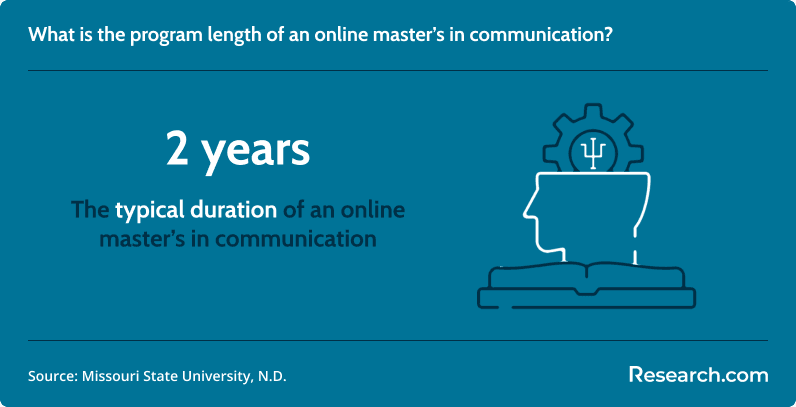
Most online master’s in communications programs take 18 months to two years for full-time students. Some accelerated programs move faster, while part-time students may need two or more years depending on course load, term structure, and personal schedule. Programs commonly require 30 to 48 credits, or about 10 to 16 courses, which directly affects completion time.
Before choosing the shortest program, ask whether the pace is realistic. Accelerated formats can be efficient, but they often require condensed assignments, frequent deadlines, and strong weekly availability.
| Enrollment Option | Typical Fit | Important Trade-Off |
| Accelerated online | Students who want to finish quickly and can handle a heavier pace | Less scheduling margin if work or family demands increase |
| Full-time online | Students who can take multiple courses while maintaining a predictable routine | Faster progress, but still requires consistent weekly study time |
| Part-time online | Working professionals, caregivers, and students balancing several obligations | More flexibility, but a longer time before graduation |
Online vs. On-Campus Master’s in Communications: Which Is Better?
An online master’s in communications is usually better for students who need flexibility, want to keep working, or live far from a campus. On-campus programs may be better for students who prefer in-person discussion, face-to-face faculty access, campus facilities, and a fixed weekly schedule.
Online communication programs often use asynchronous courses, recorded lectures, digital readings, virtual group projects, and online discussion boards. This format is similar in flexibility to affordable online public relations degree programs and other distance-learning options. Students comparing broader graduate options can also review affordable online masters programs across fields.
| Factor | Online Master’s in Communications | On-Campus Master’s in Communications |
| Schedule | Often designed for working adults with flexible access to materials | Usually follows scheduled class meetings |
| Networking | Requires intentional virtual networking, online events, and peer outreach | More informal networking through campus activities and in-person contact |
| Learning style | Works best for self-directed students who can manage deadlines independently | Works best for students who benefit from structured classroom routines |
| Costs | May reduce relocation, commuting, and campus-related expenses | May involve transportation, housing, or campus fees depending on location |
| Career impact | Can be respected when accredited and academically rigorous | May offer stronger local employer visibility in some markets |
What Is the Average Cost of an Online Master’s in Communications?
The cost of an online master’s in communications varies by institution, residency status, required credits, fees, and chosen concentration. Similar to the cost differences students see when comparing the cheapest masters in human resources, communication graduate tuition can look very different from one school to another.
For example, the average graduate tuition for in-state students is around $9,208 at the University of Southern California. Out-of-state tuition rates can range from $12,000 to over $23,000, and some programs advertise rates as low as $460 per credit hour. Cost differences may reflect residency rules, program reputation, technology fees, concentration requirements, and institutional pricing. Students comparing other professional graduate fields, such as the cheapest online master degree in healthcare administration, should use the same full-cost approach.
Financial Aid Options for Online Master’s in Communications Students
Graduate students often rely on several funding sources rather than one aid type. Federal aid at the graduate level is commonly loan-based, but students should also look for employer benefits, school-based awards, and professional scholarships.
- Federal Direct Unsubsidized Loans: These federal loans are available to graduate students and are not based on financial need. Interest accrues while the student is enrolled and during forbearance periods.
- Scholarships and Grants: Students should search university awards, alumni-funded scholarships, professional association funding, and communication-specific opportunities.
- Employer Tuition Assistance: Working professionals should ask HR whether communication, PR, marketing, leadership, or corporate training coursework qualifies for reimbursement.
- Work-Study Programs: Some schools offer work-study opportunities to graduate students, although availability may be more limited for online learners.
- University-Specific Aid: Many institutions maintain scholarships, tuition discounts, or grants for graduate and online students.
Admissions Requirements for an Online Master’s in Communications
Most online master’s in communications programs require a bachelor’s degree from an accredited institution. A communication major is often helpful but not always required. Students from business, journalism, marketing, English, education, public relations, media, psychology, and related backgrounds may also qualify, depending on the school. For a broader foundation, prospective students can review common communications degree requirements.
- Bachelor’s Degree: Applicants generally need an undergraduate degree from an accredited college or university.
- Minimum GPA: Many programs set a minimum GPA, often between 2.5 and 3.0, although stronger programs may admit students with higher academic profiles.
- Standardized Test Scores: Some programs require the GRE, while others make it optional or waive it for qualified applicants.
- Application Materials: Typical requirements include transcripts, a resume or CV, a statement of purpose, and letters of recommendation.
- English Proficiency: International applicants or non-native English speakers may need to submit TOEFL scores or similar evidence of English proficiency.
Common Courses in an Online Master’s in Communications
Coursework varies by program, but most graduate communication degrees combine theory, research, writing, strategy, and applied communication practice. Students should read course descriptions carefully to confirm whether a program is more academic, professional, media-focused, or leadership-oriented.
- Communication Theory: Students examine communication models, interpersonal interaction, persuasion, audience meaning-making, and the role of communication in society.
- Research Methods: This course teaches students how to design studies, gather information, analyze data, and apply ethical standards in communication research.
- Communication Technology: Students explore digital tools, social media, platform-based communication, and how technology changes audience behavior.
- Writing for Communication: Coursework may include press materials, executive messaging, campaign content, social media writing, reports, and audience-specific documents.
- Organizational Communication: Students study leadership messaging, employee communication, conflict, culture, engagement, and change communication inside organizations.
Specializations in Online Master’s in Communications Programs
Specializations help students connect graduate study to specific career goals. A master's degree in communications may offer formal concentrations, electives, certificates, or applied project options that let students build expertise in a defined area.
| Specialization | What Students Study | Best Fit For |
| Strategic Communication | Campaign planning, audience analysis, message strategy, and communication objectives | Students pursuing consulting, corporate communication, nonprofit outreach, or campaign roles |
| Organizational Communication | Internal communication, leadership, employee engagement, conflict, and workplace culture | Professionals seeking HR-adjacent, training, leadership, or internal communication roles |
| Public Relations and Marketing Communication | Brand reputation, media relations, marketing messages, and public-facing communication | Students interested in PR agencies, brand management, media outreach, and marketing teams |
| Health Communication | Patient education, public health campaigns, health information, and audience trust | Students targeting healthcare systems, public health organizations, advocacy groups, or health campaigns |
| Media and Mass Communication | Digital media, storytelling, content production, audience engagement, and media platforms | Students interested in journalism, digital content, social media, and multimedia communication |
Career options and salaries vary by specialization, experience, location, employer type, and portfolio quality. The Bureau of Labor Statistics data shown below summarizes median annual salary information for media and communication occupations.
How to Choose the Best Affordable Online Master’s in Communications
The right program is not simply the cheapest one. It is the program that gives you the strongest match between cost, quality, specialization, flexibility, and career support.
1. Start With Your Career Goal
Choose a program based on the job you want next, not only the degree title. If your target is public relations, look for media relations, crisis communication, campaign writing, and brand reputation coursework. If you want corporate leadership roles, prioritize organizational communication, leadership communication, change management, and internal messaging.
2. Verify Accreditation Before Comparing Price
Accreditation helps confirm that a school meets recognized academic standards. It can also affect employer recognition, transferability, and eligibility for certain financial aid programs. Do not enroll based only on a low sticker price.
3. Compare Curriculum, Not Just Tuition
Review required courses, electives, capstone options, faculty backgrounds, and whether the program includes projects that can become portfolio samples. Students considering long-term salary outcomes can also review broader college ROI discussions such as highest paying colleges, while remembering that individual outcomes are never guaranteed.
4. Look Closely at the Online Format
Ask whether courses are synchronous, asynchronous, or hybrid. Confirm how group projects work, whether lectures are recorded, how instructors provide feedback, and what technology platforms are required.
5. Prepare a Strong Application
Request transcripts early, choose recommenders who can speak to your writing and leadership potential, and write a focused statement of purpose. If standardized tests are required, plan preparation time before application deadlines.
6. Calculate the Real Cost
Include tuition, required credits, fees, books, software, travel for any residencies, graduation fees, and the cost of taking longer than planned. Then subtract confirmed scholarships, grants, employer reimbursement, and other aid.
Which Financial Aid Options Should Communications Master’s Students Consider?
Students financing an online master’s in communications should begin with the FAFSA, then compare institutional aid, employer tuition benefits, scholarships, and loan options. Schools with strong financial aid systems can lower out-of-pocket costs, so reviewing colleges with the best financial aid may help students identify institutions that support online learners.
Graduate assistantships may also be available at some universities, although online students should confirm whether remote assistantship roles exist. The most important step is to apply early. Aid deadlines may arrive before admission decisions, and late applicants may have fewer funding options.
What Distinguishes a High-Quality Online Master’s in Communications?
A strong online communications master’s program combines accreditation, rigorous coursework, experienced faculty, applied projects, responsive student support, and a curriculum that reflects current communication practice. Students should look for assignments that build usable skills: campaign plans, research reports, media strategies, stakeholder messaging, crisis communication materials, analytics summaries, and portfolio-ready writing samples.
Students comparing program quality across different communication-focused degrees can review additional options in online master’s in communication programs.
Common Challenges in an Online Master’s in Communications
Online graduate study is flexible, but it is not effortless. Students should expect deadlines, group work, independent reading, writing-heavy assignments, and technology-dependent learning. A student who waits passively for networking opportunities may miss one of the most valuable parts of graduate school.
| Common Challenge | Why It Matters | Better Approach |
| Underestimating weekly workload | Graduate communication courses often require extensive reading, writing, and discussion | Block study time before the term begins and review syllabi immediately |
| Relying only on discussion boards for networking | Online programs may not create informal relationships automatically | Attend virtual events, message classmates, and connect with alumni |
| Ignoring technology requirements | Weak internet access or unfamiliar software can disrupt assignments | Test platforms, update equipment, and identify IT support early |
| Choosing a mismatched specialization | A broad degree may not support a specific career pivot | Compare courses with job descriptions before applying |
| Assuming all communication degrees teach PR skills | Some programs are theory-heavy or research-oriented | If PR is the goal, compare coursework with a public relations degree pathway |
What Is the ROI of an Affordable Online Master’s in Communications?
The return on investment depends on total program cost, financial aid, time to completion, current experience, specialization, employer demand, and how effectively the student uses the degree. A lower-priced program may deliver strong value if it is accredited, career-aligned, and flexible enough to let the student keep working while studying.
To evaluate ROI, compare your current role with realistic next-step positions. Review job postings, required skills, salary ranges, portfolio expectations, and whether a master’s degree is preferred or required. Students aiming for digital media or platform-focused careers may also compare communication programs with social media degree programs.
How Career Support Services Improve Graduate Outcomes
Career support can help students turn graduate coursework into job opportunities. Valuable services include resume reviews, portfolio feedback, interview coaching, alumni networking, employer panels, internship guidance, and communication-specific job search support.
Students interested in corporate communication should look for programs that connect coursework with corporate communication careers, internal communication roles, crisis communication, executive messaging, and stakeholder engagement.
Do Employers Value Online Master’s in Communications Degrees?
Employers are more likely to respect an online master’s in communications when it comes from an accredited institution and shows evidence of rigorous coursework, strong writing, strategic thinking, research ability, and practical project experience. The delivery format matters less when the graduate can demonstrate relevant skills.
Students can strengthen employer confidence by building a portfolio that includes writing samples, campaign plans, analytics reports, presentations, media materials, and communication audits. Creative students who want to broaden their portfolio may also explore adjacent writing-focused options such as the cheapest online degree in creative writing, while keeping their primary career goal in mind.
How an Affordable Online Master’s in Communications Can Support Career Advancement
An affordable online master’s in communications can help professionals deepen their expertise without taking on unnecessary educational costs. It may support advancement by improving strategic thinking, writing, leadership communication, research interpretation, audience analysis, digital communication, and campaign planning skills.
- Potential for Higher-Level Roles: Graduate training can help prepare students for communication manager, PR director, corporate communication, and digital strategy positions, depending on experience.
- Leadership Preparation: Coursework in organizational communication and management communication can support team leadership, internal messaging, and change communication responsibilities.
- Career Transition: Professionals from journalism, marketing, education, business, nonprofit work, or HR may use the degree to move into communication-focused roles, including careers in public relations.
- Professional Network Access: Even affordable programs may provide alumni networks, faculty connections, peer collaboration, and virtual industry events.
- Ability to Keep Working: Online study can allow students to apply new concepts immediately in their current jobs while maintaining income.
Career Paths for Online Master’s in Communications Graduates
Graduates can pursue a range of careers depending on specialization, prior experience, industry knowledge, and portfolio strength. The degree can be especially useful for roles that require strategic message planning, audience research, writing, leadership communication, and digital content judgment.
| Career Area | Typical Responsibilities | Relevant Specialization |
| Strategic Communication | Plan campaigns, shape messaging, advise leaders, and align communication with organizational goals | Strategic Communication |
| Corporate Communication | Manage internal messaging, executive communication, employee updates, and stakeholder communication | Organizational Communication |
| Public Relations | Handle media outreach, reputation management, press materials, and public-facing campaigns | Public Relations and Marketing Communication |
| Marketing Communication | Create brand messaging, campaign content, customer communication, and cross-channel materials | Public Relations and Marketing Communication |
| Health Communication | Develop patient education, public health messaging, health campaigns, and audience-specific materials | Health Communication |
| Media and Digital Content | Produce content, manage platforms, write stories, analyze engagement, and reach target audiences | Media and Mass Communication |
Students interested in marketing roles should compare communication and marketing pathways carefully. A senior marketing major salary has an average salary of $104,308, but actual earnings depend on role, location, employer, experience, and performance.
Job Market for Online Master’s in Communications Graduates
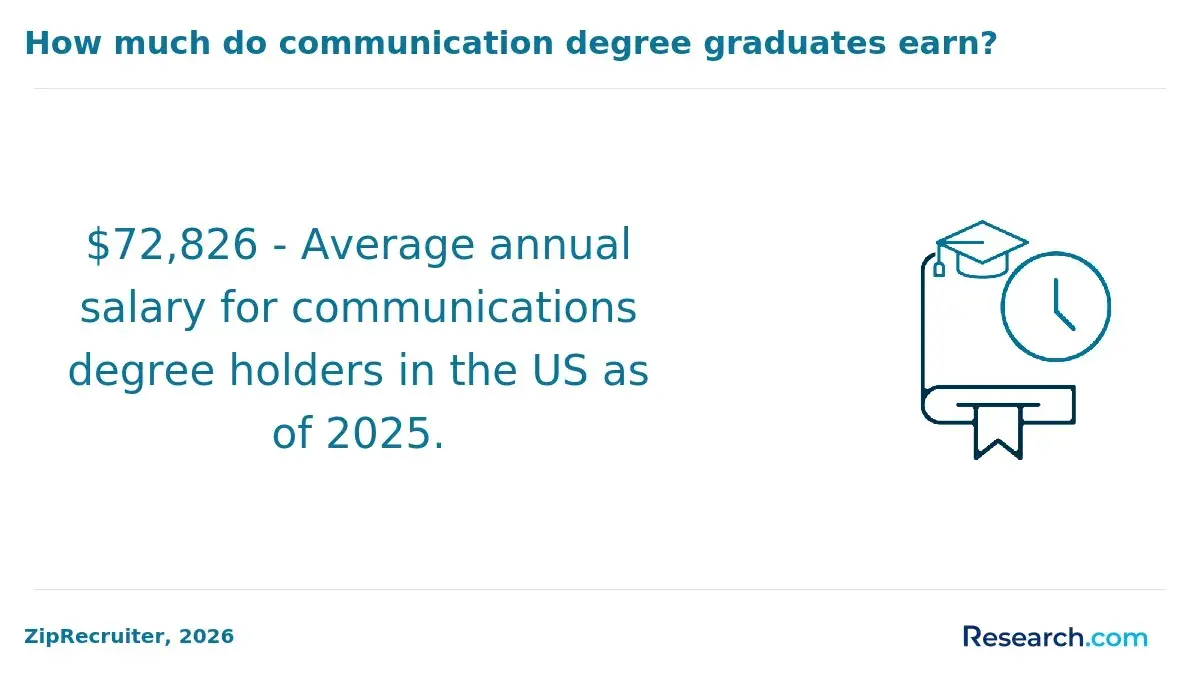
About 114,300 openings for media and communication jobs are projected each year. Graduates with an online master’s degree in communication can earn an average annual salary of around $74,295. These figures should be treated as broad labor-market indicators, not guarantees for any individual graduate.
The communications field spans media, business, healthcare, nonprofits, education, government, technology, and corporate services. Employers often look for candidates who can write clearly, understand audiences, manage digital platforms, interpret data, communicate during change, and protect brand reputation.
How to Build Communication Skills During an Online Program
Students should treat the online format as a professional development environment, not just a way to complete assignments. The strongest graduates leave with projects, tools, and relationships they can use in a job search.
- Attend online workshops: Look for webinars on public speaking, communication analytics, crisis messaging, social media strategy, writing, and digital marketing.
- Practice with content tools: Use platforms such as Canva, Hootsuite, or Adobe Creative Suite to create mock campaigns, presentations, reports, and social media materials.
- Build a professional network: Join LinkedIn groups, alumni communities, virtual conferences, and online communication associations.
- Create a portfolio: Save polished projects that show writing, strategy, research, campaign planning, and presentation skills.
- Apply coursework at work: If employed, look for opportunities to improve newsletters, reports, training materials, executive messages, or social media processes.
Digital Trends Shaping Online Communications Curricula
Online master’s programs in communications increasingly address digital analytics, social media strategy, content planning, multimedia communication, audience behavior, and platform-based messaging. Employers often expect communication professionals to understand both message quality and digital performance.
Students who want a faster route into social media-focused work may compare communications master’s programs with the fastest online social media marketing programs. The better choice depends on whether the student wants broad communication leadership training or a narrower digital marketing skill set.
Is the Program Accredited and Recognized for Quality?
Accreditation should be one of the first checks in any online graduate program search. It helps students identify schools that meet recognized standards for institutional quality. Accreditation may also affect financial aid eligibility and employer confidence.
Quality also depends on faculty expertise, course design, advising, career support, learning technology, and whether the curriculum reflects current communication practice. Students comparing communication with adjacent creative fields can review how accreditation and quality are discussed in areas such as online graphic design degree accredited programs.
Benefits and Trade-Offs of an Accelerated Online Master’s in Communications
An accelerated online master’s in communications can be valuable for students who want to finish quickly and can manage a demanding pace. It is not automatically the best choice for every learner.
| Potential Benefit | What It Means | What to Watch |
| Faster completion | Some students may finish sooner than in a traditional timeline | Condensed courses can leave little room for schedule disruptions |
| Career momentum | Students may qualify for advancement or a job search sooner | A degree alone does not guarantee promotion |
| Focused learning | Shorter terms can keep students moving continuously through the program | The pace may be stressful for students with unpredictable work hours |
| Possible cost control | Finishing sooner may reduce some term-based expenses | Always compare total tuition, fees, and required credits |
| Work-compatible format | Many accelerated online programs are designed for adults with jobs | Flexibility still requires disciplined weekly time management |
If you are comfortable with a faster workload and want to complete your degree sooner, an accelerated communications degree online may be worth considering. If your work schedule changes often, a standard or part-time format may be safer.
Can Game Design Principles Improve Communication Strategy?
Interactive storytelling, audience engagement, user experience, and immersive media can strengthen certain communication strategies, especially in digital marketing, advertising, public relations, training, and brand storytelling. Communications students do not need to become game designers, but understanding interactivity and audience motivation can be useful in modern content strategy.
Students considering a broader creative or interactive media path can explore whether is going to school for a game design degree worth it for their goals. For most communication careers, however, strong writing, research, audience analysis, and strategic messaging remain the foundation.
Common Mistakes to Avoid When Choosing an Online Communications Master’s
- Choosing only by tuition rate: Compare required credits, fees, aid, and time-to-completion before deciding.
- Ignoring accreditation: A low-cost program is risky if it lacks recognized accreditation.
- Assuming all programs teach the same skills: Some degrees focus on theory, others on public relations, media, health communication, or organizational leadership.
- Overlooking career support: Ask about alumni networks, portfolio help, employer events, and communication-specific advising.
- Underestimating online workload: Flexible does not mean easy. Graduate-level writing and research require consistent time.
- Failing to confirm current tuition: Published costs can change, and fees may not be obvious on the first program page.
- Relying only on rankings: Use rankings to build a shortlist, then evaluate fit, cost, format, curriculum, and outcomes.
Questions to Ask Before Applying
- Is the institution accredited by a recognized accreditor?
- How many credits are required to graduate?
- What is the current cost per credit, and what mandatory fees apply?
- Are online students eligible for scholarships, grants, assistantships, or tuition discounts?
- Is the program asynchronous, synchronous, or a mix of both?
- Does the curriculum match my career goal: PR, corporate communication, health communication, media, social media, or leadership?
- Will I complete a thesis, capstone, portfolio, comprehensive exam, or applied project?
- What career services are available to online graduate students?
- Can I speak with current students, alumni, or program advisors before applying?
- How long do students typically take to finish while working full time?
Key Insights
- The most affordable online master’s in communications is the program with the best total value, not just the lowest per-credit tuition.
- Program length matters. Options in this guide range from 6 months to 6 years, so students should match pace with their actual schedule.
- Specialization should drive your shortlist. Public relations, organizational communication, health communication, media, and social media careers require different coursework.
- Accreditation is non-negotiable. Verify institutional accreditation before comparing price, format, or convenience.
- Online degrees can be respected by employers when they are accredited, rigorous, and supported by strong work samples.
- ROI depends on more than salary. Consider aid, debt, current employment, career goals, portfolio development, and whether the program helps you move into a realistic next role.
- The best applicants ask detailed questions before enrolling, including total cost, course format, faculty access, career support, and graduate outcomes.
References:
- Indeed. (2025). What does a communications manager do? (Plus skills...). https://www.indeed.com/career-advice/finding-a-job/what-does-communication-manager-do
- National University. (N.D.). What Can I Do with a Strategic Communications Degree? Retrieved from: https://www.nu.edu/blog/what-can-i-do-with-a-strategic-communications-degree/
- Payscale. (2024). Master of Arts (MA), Communication Degree. Retrieved from: https://www.payscale.com/research/US/Degree=Master_of_Arts_(MA)%2C_Communication/Salary
- Purdue University Online. (N.D.). What Can I Do With a Master's in Communication? Retrieved from: https://online.purdue.edu/blog/communication/what-can-i-do-with-masters-communication
- U.S. Bureau of Labor Statistics. (2025). Writers and authors: Occupational outlook handbook. https://www.bls.gov/ooh/media-and-communication/writers-and-authors.htm
Other Things You Should Know About the Most Affordable Online Master's in Communications
Many programs accept up to 6 graduate transfer credits, but only from regionally accredited institutions with a minimum grade of B. Schools usually require approval before enrollment or during the first term, and they often cap transfer credits at one-half of the degree, such as 15 of 30 credits.
Prerequisites typically include a bachelor's degree in communications or a related field and a minimum GPA of 3.0. Some programs might require professional experience in communications. Check individual university requirements for specifics related to the 2027 academic year.


