
2027 What Does an Organizational Psychologist Do? Roles & Responsibilities

Co-Founder and Chief Data Scientist
Choosing a career in organizational psychology means deciding whether you want to use psychology to solve workplace problems at scale. Organizational psychologists—often called industrial-organizational or I/O psychologists—study how people behave at work, then use research, data, and practical interventions to improve hiring, leadership, motivation, performance, culture, and employee well-being.
This guide is for students considering psychology or business psychology, professionals thinking about a people analytics or organizational development career, and anyone comparing psychology career paths. You will learn what organizational psychologists do, what education and licensure may be required, where they work, how much they earn, what the job outlook looks like, and how to decide whether this path fits your goals.
Quick Answer: What does an organizational psychologist do?
An organizational psychologist applies psychological research to workplace issues. Their work may include improving hiring systems, measuring employee engagement, designing training programs, supporting organizational change, advising leaders, reducing workplace conflict, evaluating employee assessments, and studying how culture, structure, and management practices affect performance. Many roles are applied business roles, while others focus on research, teaching, consulting, or government work.
Key Things You Should Know About Organizational Psychologists
- Organizational psychologists connect evidence about human behavior with practical business decisions.
- Their work looks at both individuals and the larger workplace systems that shape behavior, performance, and culture.
- Strong roles in this field are usually data-heavy. Professionals often use surveys, interviews, experiments, statistical models, performance data, and program evaluations.
- The skill set is portable across industries because nearly every organization needs better hiring, leadership, engagement, and change management.
- Most organizational psychologists work closely with HR, executives, managers, legal teams, and employees to align people practices with organizational goals.
- What is an organizational psychologist?
- What are the specific roles and responsibilities of an organizational psychologist?
- What are the educational and certification requirements for becoming an organizational psychologist?
- What skills does an organizational psychologist need?
- Where can I work as an organizational psychologist?
- What are the career paths and advancement opportunities for organizational psychologists?
- How much do organizational psychologists make?
- What emerging trends are shaping the future of organizational psychology?
- Can integrating forensic psychology techniques advance organizational psychology practices?
- Is an accelerated bachelor's in psychology a strategic choice for aspiring organizational psychologists?
- What is the job outlook for organizational psychologists in the United States?
- What ethical guidelines govern the practice of organizational psychology?
- What alternative career options are available for organizational psychologists?
- What challenges do organizational psychologists commonly face?
- How can organizational psychologists quantify the effectiveness of their interventions?
What is an organizational psychologist?
An organizational psychologist is a psychology professional who studies behavior in work settings and applies that knowledge to organizational problems. The field is commonly called industrial-organizational psychology, or I/O psychology. “Industrial” traditionally refers to areas such as job analysis, hiring, selection, and performance measurement, while “organizational” refers to topics such as motivation, leadership, culture, employee engagement, teamwork, and change.
In practice, the work often blends both sides. An organizational psychologist might help a company redesign its promotion process, identify why turnover is rising, improve manager training, evaluate whether an employee assessment is fair, or measure whether a new leadership program actually changed behavior.
Employers hire organizational psychologists because people problems are also business problems. Low morale, poor communication, weak leadership, biased hiring practices, burnout, and failed change initiatives can affect productivity, retention, legal risk, and customer outcomes. Organizational psychologists bring a research-based approach to these issues instead of relying only on intuition or workplace trends.
| Common workplace problem | How an organizational psychologist may help |
| High employee turnover | Analyze exit data, engagement surveys, manager behavior, workload, compensation perceptions, and career development barriers. |
| Poor hiring outcomes | Conduct job analyses, validate selection tools, improve interview structure, and reduce bias in screening. |
| Leadership issues | Assess leadership competencies, design coaching or development programs, and measure manager effectiveness. |
| Low engagement | Identify motivation drivers, communication gaps, recognition issues, and team-level conditions affecting employee commitment. |
| Organizational change failure | Plan communication, assess readiness, manage resistance, and evaluate adoption of new systems or processes. |
What are the specific roles and responsibilities of an organizational psychologist?
Organizational psychologists do not all have the same job description. Some sit inside HR or people analytics teams, some consult for multiple clients, some conduct academic research, and others work in government, healthcare, or organizational development. Still, most roles involve diagnosing workplace problems, designing evidence-based solutions, and measuring whether those solutions work.
- Researching workplace behavior: They collect and interpret information from surveys, interviews, focus groups, assessments, performance records, and organizational data to understand what is happening inside a workplace.
- Improving recruitment and selection: They may build job analyses, structured interview guides, assessment tools, scoring rubrics, and selection systems that help employers choose candidates more fairly and effectively.
- Designing training and development: They create or evaluate programs for leadership, communication, technical skill development, onboarding, team performance, and career growth.
- Strengthening employee engagement: They study motivation, satisfaction, trust, workload, recognition, management quality, and career opportunities to recommend practical retention strategies.
- Supporting organizational change: During mergers, restructuring, technology rollouts, culture shifts, or process redesigns, they help leaders reduce resistance and improve adoption.
- Addressing conflict and team dysfunction: They assess team dynamics, communication problems, role ambiguity, and interpersonal friction, then recommend interventions such as facilitation, coaching, or workflow changes.
- Advancing diversity, equity, and inclusion: They examine policies, promotion practices, assessments, climate data, and bias risks to support fairer and more inclusive systems.
- Advising HR and executive leaders: Their findings often inform succession planning, workforce strategy, leadership development, employee experience, and organizational design.
If your interests lean toward management, strategy, and team leadership, Research.com also has a guide to organizational leadership careers.
| Responsibility area | Typical deliverables | Who uses the work? |
| Talent selection | Job analysis reports, interview guides, assessment validation studies | HR, recruiters, hiring managers, legal teams |
| Employee engagement | Survey design, dashboard reports, action-planning recommendations | Executives, managers, HR business partners |
| Training and development | Training needs analyses, curriculum plans, leadership programs, evaluation reports | Learning and development teams, managers, employees |
| Organizational change | Readiness assessments, communication plans, adoption metrics, resistance analyses | Senior leadership, change teams, project managers |
| Research and analytics | Statistical analyses, predictive models, research briefs, program evaluations | People analytics, executives, consultants, researchers |
What are the educational and certification requirements for becoming an organizational psychologist?
The most common route into organizational psychology starts with undergraduate study in psychology, business psychology, human resources, statistics, or a related social science field. A bachelor’s degree usually provides the foundation: human behavior, research methods, statistics, measurement, motivation, and organizational behavior.
Most professional organizational psychologist roles require graduate education. A master’s degree in industrial-organizational psychology can qualify graduates for many applied corporate, HR analytics, consulting, organizational development, or research-support roles. A doctoral degree, such as a PhD or Psy.D., is more common for advanced research positions, academic careers, high-level consulting, and roles requiring deeper expertise in psychological assessment or methodology. Students comparing flexible graduate options may want to review affordable online masters in industrial organizational psychology programs.
Practical experience matters. Internships, research assistantships, consulting projects, supervised fieldwork, and applied capstone projects help students demonstrate that they can translate theory into workplace results. Employers often look for evidence of survey design, data analysis, presentation skills, stakeholder management, and experience working with real organizational data.
If you are considering a clinical psychology route instead of an I/O psychology path, you can compare requirements in this guide to PsyD in Clinical Psychology requirements.
Education Pathway: Which Degree Level Makes Sense?
| Education level | Best fit | Common outcomes | Important consideration |
| Bachelor’s degree | Students building a foundation in psychology, business, HR, or research | HR assistant, recruiting coordinator, research assistant, training support roles | Usually not enough for roles formally titled organizational psychologist |
| Master’s degree | Students who want applied corporate, consulting, analytics, or organizational development roles | I/O consultant, people analyst, talent management specialist, training and development specialist | Often sufficient for many nonclinical business roles |
| Doctoral degree | Students aiming for advanced research, academic work, senior consulting, or specialized assessment roles | Professor, senior researcher, principal consultant, director-level specialist | Takes longer but may expand research and leadership opportunities |
Certification and Licensure
Licensure rules depend on the state, job title, and scope of work. In many corporate, consulting, HR, or research positions, organizational psychologists do not provide clinical services and may not need a psychology license. However, using the protected title “psychologist” can be regulated, and requirements vary by jurisdiction.
In the United States, licensure for psychologists commonly includes:
- Completing a doctoral program
- Finishing supervised professional experience, usually 1–2 years
- Passing the Examination for Professional Practice in Psychology (EPPP)
Because requirements vary, students should check the psychology licensing board in the state where they plan to work. This is especially important for anyone planning independent practice, assessment work, or services that may overlap with counseling, clinical, or protected psychological services.
Optional professional development can also help. The Society for Industrial and Organizational Psychology (SIOP) provides field-specific resources, conferences, publications, and professional guidance. Depending on a professional’s focus, credentials from psychometrics, HR, coaching, analytics, or leadership development organizations may also support credibility.
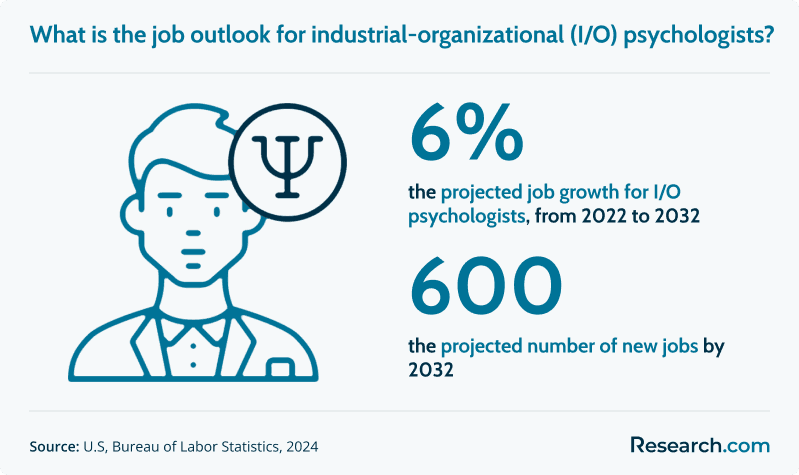
The field is projected to grow by 6%, but that does not mean every graduate will easily find a role titled organizational psychologist. The strongest candidates usually combine graduate training, applied experience, quantitative skills, and the ability to explain findings in business language.
What skills does an organizational psychologist need?
Organizational psychology sits at the intersection of behavioral science, statistics, communication, and business strategy. A strong candidate needs more than an interest in people. They must be able to gather evidence, interpret it carefully, influence stakeholders, and design interventions that work in real organizations.
- Research and analysis: Organizational psychologists need to design studies, evaluate evidence, analyze data, and explain what the results do and do not prove.
- Statistics and measurement: Many roles involve surveys, assessments, validation studies, workforce metrics, and program evaluation, so quantitative confidence is a major advantage.
- Communication: Findings must be translated into clear reports, presentations, training materials, executive recommendations, and employee-facing messages.
- Problem diagnosis: Effective practitioners separate symptoms from causes. For example, low engagement may reflect poor supervision, workload, unclear goals, limited advancement, or weak trust in leadership.
- Stakeholder management: They often work with employees, managers, executives, HR teams, legal departments, and consultants who may have different priorities.
- Ethical judgment: Work involving employee data, selection tools, performance information, and workplace investigations requires fairness, confidentiality, and transparency.
- Business understanding: Recommendations must fit the organization’s strategy, resources, legal context, and operational constraints.
- Adaptability: Remote work, AI tools, economic pressure, and changing employee expectations require continuous learning.
If you are comparing psychology specialties, Research.com also explains the forensic psychologist job description.
The chart below shows the most common majors taken by organizational psychologists when pursuing their bachelor's degree:
Where can I work as an organizational psychologist?
Organizational psychologists can work anywhere employee behavior, management systems, and workplace performance matter. Some roles are highly quantitative, some are consulting-focused, and others are embedded in HR, learning and development, leadership, or organizational change teams.
- Corporations: Large employers in technology, finance, retail, manufacturing, healthcare, and professional services may hire organizational psychologists to improve hiring, leadership, engagement, workforce planning, and culture.
- Consulting firms: Consultants may advise multiple clients on selection systems, leadership development, change management, assessments, employee surveys, and organizational design.
- Government agencies: Public organizations may use I/O expertise for workforce efficiency, employee testing, policy implementation, training, and employee engagement.
- Healthcare organizations: Hospitals and health systems may need help with burnout, teamwork, leadership, safety culture, communication, and staff retention.
- Colleges and research institutions: Doctoral-level professionals may teach, conduct research, publish, supervise students, or lead funded studies.
- Nonprofit organizations: Mission-driven organizations may use organizational psychologists to improve leadership, volunteer management, team effectiveness, culture, and change readiness.
- Human resources departments: Some I/O-trained professionals work in recruitment, employee relations, people analytics, talent management, learning and development, or organizational development.
Students deciding between clinical and research-oriented psychology paths may also want to compare a PhD vs PsyD in clinical psychology.
Deciding where to work as an organizational psychologist can be easier when you look at the salary levels of various industries. The chart below shows you the top-paying industries or sectors for organizational psychologists.
What are the career paths and advancement opportunities for organizational psychologists?
Career progression in organizational psychology often depends on graduate education, applied project experience, quantitative ability, consulting skill, and leadership exposure. Many people do not begin with the title “organizational psychologist.” They may first enter HR analytics, recruiting, training, research, or organizational development, then specialize over time.
| Career stage | Possible roles | How to move forward |
| Early career | HR analyst, research assistant, training coordinator, survey analyst, recruiting analyst | Build data skills, learn HR systems, assist with assessments, and complete applied projects. |
| Mid-career | I/O consultant, organizational development specialist, talent management specialist, learning and development manager, people analytics consultant | Lead projects, present to executives, manage stakeholders, and show measurable results. |
| Senior career | Director of Organizational Development, principal consultant, head of people analytics, talent strategy leader | Own strategy, supervise teams, influence enterprise-level decisions, and manage complex change. |
| Advanced academic or research path | Professor, senior researcher, author, doctoral supervisor, research director | Earn a doctorate, publish research, secure grants, teach, and contribute to the field’s evidence base. |
With an on-campus or online doctorate in psychology, professionals may qualify for advanced research, consulting, teaching, or leadership roles. However, a doctorate is not automatically necessary for every applied business role. For many students, the better question is whether the additional time and cost align with the specific positions they want.
How much do organizational psychologists make?
Organizational psychology can be a high-paying psychology career, but earnings vary by role, employer, degree level, geography, experience, and whether the work is corporate, consulting, academic, government, or nonprofit. Job title also matters: an I/O-trained professional working as a people analytics leader or executive consultant may be paid differently from someone in a university or public-sector role.
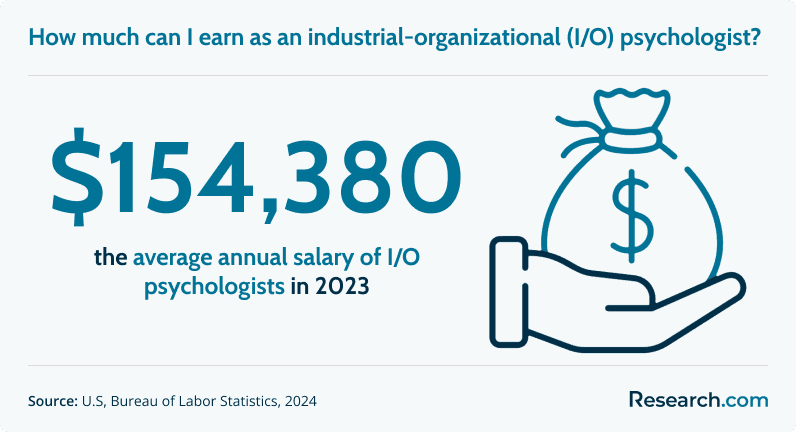
According to the United States Bureau of Labor Statistics (BLS), the annual mean wage for industrial-organizational psychologists is $154,380. The median annual wage for industrial-organizational psychologists was $147,420 in May 2023.
Other salary descriptions commonly place organizational psychologists in the United States between $70,000 and $125,000 per year, with entry-level positions for master’s-trained professionals sometimes starting around $60,000 to $75,000 annually. Professionals with a Ph.D. or Psy.D. and several years of experience can earn $100,000 or more, particularly in consulting, leadership, or specialized roles.
| Salary factor | Why it matters |
| Education level | Graduate degrees are common for I/O roles, and doctoral training may support advanced research, academic, or senior consulting work. |
| Industry | Consulting, large corporations, government, universities, and nonprofits can have very different pay structures. |
| Location | Pay often reflects local labor markets, employer concentration, and cost of living. |
| Experience | Senior consultants, directors, and leaders managing high-impact programs generally have higher earning potential. |
| Technical skills | Advanced statistics, assessment validation, people analytics, and data visualization can improve competitiveness. |
Organizational psychology is one of the highest paying psychologist paths, especially for professionals who combine psychology expertise with analytics, consulting, leadership, and business strategy.
What emerging trends are shaping the future of organizational psychology?
Several workplace shifts are changing what employers expect from organizational psychologists. The most competitive professionals are not only knowledgeable about motivation and assessment; they also understand technology, hybrid work, analytics, ethics, and employee experience.
- AI and people analytics: Employers are using AI-supported tools for recruiting, performance insights, workforce planning, and employee sentiment analysis. Organizational psychologists can help evaluate whether these tools are valid, fair, explainable, and useful.
- Hybrid and remote work: Distributed teams create new questions about trust, collaboration, performance management, communication norms, onboarding, and culture.
- Employee well-being and burnout: Organizations are paying closer attention to workload, psychological safety, mental health, manager behavior, and sustainable performance.
- DEI accountability: Organizations increasingly need evidence-based approaches to inclusion, fairness in selection, promotion equity, and bias reduction.
- Skills-based hiring: Employers are rethinking degree requirements, job descriptions, assessments, and internal mobility around measurable skills.
- Change fatigue: Digital transformation, restructuring, and economic uncertainty can exhaust employees, making change readiness and communication more important.
Students comparing graduate psychology options should look closely at curriculum, supervised experience, research expectations, and cost. For example, Research.com discusses program cost considerations in How much do PsyD programs cost?.
Can integrating forensic psychology techniques advance organizational psychology practices?
Forensic psychology and organizational psychology are separate fields, but some methods can overlap in useful ways. Organizational psychologists working on workplace investigations, misconduct risk, bias analysis, assessment integrity, or high-stakes decision-making may benefit from forensic-style rigor: careful documentation, structured interviews, evidence review, risk assessment, and attention to ethical boundaries.
This does not mean organizational psychologists should practice forensic psychology without proper training. Instead, it means that cross-disciplinary knowledge can strengthen investigative thinking and reduce unsupported conclusions. Professionals who want deeper exposure to investigative methods may compare masters in forensic psychology options, especially if their work involves compliance, workplace investigations, or behavioral risk assessment.
Is an accelerated bachelor's in psychology a strategic choice for aspiring organizational psychologists?
An accelerated bachelor's in psychology can make sense for students who want to complete undergraduate requirements faster and move into internships, work experience, or graduate study sooner. It may be especially useful for adult learners, career changers, or students who already have transferable credits.
The trade-off is pace. Accelerated programs can be demanding, and students planning for organizational psychology should not choose speed at the expense of research methods, statistics, writing, or internship opportunities. Before enrolling, ask whether the program includes quantitative coursework, faculty support, career services, transfer credit review, and preparation for graduate-level psychology study.
What is the job outlook for organizational psychologists in the United States?
The U.S. labor market for industrial-organizational psychologists is expected to grow, but it remains a relatively small occupation. According to the BLS, employment of industrial-organizational psychologists is projected to grow by 6% from 2023 to 2033, which is faster than average for all occupations.
In 2023, approximately 8,600 people were employed as industrial-organizational psychologists. The projection to 9,100 by 2033 represents a limited number of new positions, with about 500 new job openings annually when growth and replacement needs are considered. Another cited estimate describes 600 job openings each year over the decade, accounting for both new roles and replacement needs.
Opportunities are commonly found in management consulting, scientific research, government agencies, universities, and large organizations with mature HR, analytics, or organizational development functions. Candidates with advanced degrees, including traditional or online PhD industrial organizational psychology programs, and strong quantitative skills may be more competitive.
The practical takeaway: demand exists, but job seekers should be flexible with titles. Relevant roles may be listed as people analyst, talent management consultant, organizational development specialist, workforce researcher, employee experience strategist, leadership development consultant, or assessment specialist rather than “organizational psychologist.”
What ethical guidelines govern the practice of organizational psychology?
Organizational psychologists often work with sensitive employee data and high-impact decisions, so ethics are central to the role. Their recommendations may affect hiring, promotion, performance evaluation, workplace investigations, layoffs, leadership selection, and employee privacy.
- Confidentiality: Employee responses, assessment data, and interview findings should be handled carefully and shared only in appropriate forms.
- Informed consent: Participants should understand how their data will be used, especially in surveys, assessments, and research projects.
- Fair assessment: Selection tools, tests, and performance systems should be job-relevant, valid, and monitored for bias.
- Transparency: Leaders and employees should receive honest explanations of methods, limitations, and conclusions.
- Avoiding harm: Interventions should not sacrifice employee well-being for short-term metrics.
- Responsible data use: Analytics should avoid overclaiming, hidden surveillance, or unsupported predictions about individuals.
Continuing education helps practitioners stay current with changing ethical issues, especially around AI, employee monitoring, remote work, and assessment technology. Students comparing shorter graduate options may review 1 year masters programs psychology, while keeping in mind that program length should not replace careful evaluation of quality and fit.
What alternative career options are available for organizational psychologists?
Not every I/O-trained professional works under the title organizational psychologist. The degree can lead to several adjacent careers that use the same strengths: research, measurement, employee behavior, communication, and organizational systems thinking.
- Human resources: I/O training can support roles in HR management, employee relations, talent acquisition, retention strategy, performance management, and workforce planning.
- Learning and development: Professionals may design training, leadership programs, onboarding, coaching frameworks, or instructional materials.
- People analytics: Quantitative graduates may analyze engagement, turnover, performance, hiring, promotion, and workforce trends.
- Market research and consumer behavior: Survey design, behavioral research, and statistical analysis can transfer to customer insights and market research roles.
- Change management: Organizational psychologists can help companies manage restructuring, mergers, technology adoption, or culture transformation.
- Executive coaching: With appropriate training and experience, some professionals advise leaders on decision-making, communication, team management, and career growth.
- Employee experience and workplace wellness: Roles may focus on engagement, burnout prevention, culture, psychological safety, and work-life balance.
If you are exploring advanced education roles outside traditional psychology pathways, you can also read Research.com’s explanation of What is an EdS degree.
The chart below shows the industries that employ the most industrial-organizational psychologists.
What challenges do organizational psychologists commonly face?
The work can be influential, but it is not always straightforward. Organizational psychologists often operate in environments where data, politics, budgets, legal concerns, and leadership priorities intersect. Some of the challenges of working as a psychologist in this field include:
- Resistance to change: Employees and leaders may reject new systems, especially when changes affect power, workload, evaluation, or job security.
- Competing priorities: Business leaders may focus on speed, cost, or productivity, while psychologists must also consider fairness, well-being, and long-term sustainability.
- Limited data access: Poor HR systems, incomplete records, low survey participation, or privacy restrictions can make diagnosis difficult.
- Measuring impact: It can be hard to prove that a specific intervention caused changes in engagement, retention, productivity, or leadership behavior.
- Ethical pressure: Practitioners may be asked to justify decisions, assessments, or policies that create fairness or confidentiality concerns.
- Rapid workplace change: Remote work, digital tools, AI, shifting employee expectations, and economic uncertainty require constant adaptation.
Common Mistakes to Avoid When Pursuing This Career
| Mistake | Better approach |
| Assuming every psychology degree leads to I/O roles | Choose coursework in statistics, research methods, organizational behavior, HR, assessment, and analytics. |
| Ignoring accreditation and program quality | Verify institutional accreditation, faculty expertise, field experiences, and graduate outcomes before enrolling. |
| Focusing only on tuition | Compare total cost, financial aid, transfer credits, internship access, time to completion, and career services. |
| Overlooking quantitative skills | Build comfort with statistics, survey platforms, spreadsheets, data visualization, and basic analytics tools. |
| Expecting the title “organizational psychologist” immediately | Search related job titles such as people analyst, talent consultant, OD specialist, assessment analyst, or leadership development specialist. |
| Assuming licensure rules are the same everywhere | Check state requirements if you plan to use the psychologist title or provide services that may require licensure. |
How can organizational psychologists quantify the effectiveness of their interventions?
Measuring impact is one of the most important parts of organizational psychology. A good intervention should not stop at “employees liked it” or “leaders thought it went well.” It should be evaluated against clear goals, baseline data, and meaningful outcomes.
Common methods include pre- and post-intervention surveys, key performance indicators (KPIs), turnover analysis, engagement scores, productivity metrics, assessment validity studies, training transfer measures, focus groups, interviews, and ROI analyses. Strong evaluations combine quantitative data with qualitative feedback so the organization understands both what changed and why.
| Intervention | Possible success measures |
| Leadership training | Manager ratings, employee engagement, retention on managed teams, observed behavior change, promotion readiness |
| Hiring process redesign | Quality of hire, time to fill, adverse impact analysis, interview reliability, turnover among new hires |
| Engagement initiative | Survey scores, participation rates, absenteeism, retention, employee comments, manager action completion |
| Change management program | Adoption rates, training completion, productivity recovery, employee sentiment, resistance indicators |
| Well-being program | Utilization, burnout indicators, absenteeism, employee feedback, workload or scheduling changes |
Advanced research training can strengthen evaluation design, but students should match the degree to their career goals. For example, APA accredited PsyD online programs may be relevant for some psychology pathways, while I/O-focused graduate programs may be more directly aligned with organizational psychology roles.
Here’s What Organizational Psychologists Have to Say About Their Roles and Responsibilities
- Much of my work involves studying workplace culture and helping leaders turn employee feedback into concrete action. The most satisfying moments come when practical changes—clearer communication, better team alignment, or stronger manager habits—make the workplace healthier and more productive. Alicia
- I often move between training design, talent development, and evaluation. The role is rewarding because it combines data with human-centered problem solving, so the recommendations support both employee growth and organizational performance. Major
- My projects usually involve HR leaders and executives who want better hiring, stronger teams, and more inclusive systems. The work is challenging because every organization is different, but using psychology to create organization-wide improvement is what makes the field compelling. Jenna
Questions to Ask Before Choosing an Organizational Psychology Program
- Is the institution properly accredited?
- Does the curriculum include industrial-organizational psychology, statistics, research methods, psychometrics, organizational behavior, and applied consulting?
- Are there internships, practicums, capstones, consulting projects, or research assistantships?
- Do faculty members have I/O psychology, people analytics, organizational development, or assessment expertise?
- What job titles do graduates actually obtain?
- Does the program prepare students for corporate roles, doctoral study, consulting, or academic research?
- How much will the full program cost after fees, books, travel, and lost work time?
- Can you transfer credits or study part time while working?
- If you want to use the title psychologist, does the program support licensure requirements in your state?
References
- O*NET OnLine. (n.d). National Employment Trends: 19-3032.00 - Industrial-Organizational Psychologists. onetonline.org.
- O*NET OnLine. (n.d). National Wages: 19-3032.00 - Industrial-Organizational Psychologists. onetonline.org.
- Salary.com. (2025, May 1). Hourly Wage for Organizational Psychologists in the United States. salary.com.
- United States Bureau of Labor Statistics. (2024, April 3). Occupational Employment and Wages: 19-3032 Industrial-Organizational Psychologists. BLS.
- United States Bureau of Labor Statistics. (2025, April 18). Occupational Outlook Handbook: Psychologists. BLS.
- Zippia. (2025, January 8). Industrial/Organizational Psychologist Education Requirements. zippia.com.
Key Insights
- Organizational psychologists use research and data to improve hiring, leadership, engagement, culture, training, employee well-being, and organizational performance.
- A master’s degree can support many applied roles, while a doctoral degree is more useful for advanced research, academic careers, high-level consulting, and some licensed psychologist roles.
- Licensure is not required for every corporate or consulting I/O role, but state rules matter if you plan to use the title psychologist or provide regulated psychological services.
- The BLS reports an annual mean wage of $154,380 and a median annual wage of $147,420 in May 2023 for industrial-organizational psychologists.
- Employment is projected to grow by 6% from 2023 to 2033, but the occupation is small: about 8,600 workers were employed in 2023, with a projected increase to 9,100 by 2033.
- The strongest candidates usually combine psychology knowledge with statistics, assessment, communication, business understanding, and experience working with real workplace data.
- Students should evaluate programs by accreditation, curriculum, field experience, faculty expertise, total cost, transfer policies, and graduate outcomes—not by speed or tuition alone.
Other Things You Should Know About What an Organizational Psychologist Does
Organizational psychologists use surveys, structured interviews, field observations, and statistical analysis to study workplace behavior. They often compare employee data across teams, track outcomes such as turnover or engagement, and use validated instruments to measure job satisfaction, leadership, and performance.
In 2027, organizational psychologists emphasize mental health support, flexible work arrangements, and fostering a diverse and inclusive culture to improve employee well-being. They use data-driven assessments to tailor interventions and promote a balanced work-life environment, aiming to enhance overall job satisfaction.
In 2027, organizational psychologists must follow ethical guidelines set by the American Psychological Association, which include maintaining confidentiality, obtaining informed consent, and avoiding conflicts of interest, ensuring that all workplace interventions respect the rights and dignity of employees.


