2027 PhD vs PsyD in Clinical Psychology: Explaining the Difference

Co-Founder and Chief Data Scientist
Choosing between a PhD and a PsyD in Clinical Psychology is one of the most important decisions aspiring licensed psychologists make. Both doctorates can lead to clinical licensure, both require years of supervised training, and both can prepare graduates to diagnose and treat mental health conditions. The better choice depends on whether you want your career to center on research and teaching, direct patient care, leadership, specialty practice, or some combination of these paths.
This guide explains how PhD and PsyD programs differ in training model, admissions, coursework, clinical experience, dissertation or doctoral project expectations, cost, funding, licensure preparation, salary potential, and career outcomes. It is designed for students comparing doctoral programs for 2026 and beyond, especially those trying to decide which degree best fits their goals, finances, and preferred work setting. According to the U.S. Bureau of Labor Statistics, as of 2023, roughly 207,500 psychologists were practicing in the United States, including 76,800 clinical psychologists, the largest psychology specialty group.
Quick Answer: PhD vs PsyD in Clinical Psychology
A PhD in Clinical Psychology is usually the stronger fit if you want a career that includes research, university teaching, academic publishing, grant-funded work, or policy-related roles. A PsyD in Clinical Psychology is usually the better fit if your main goal is to provide therapy, assessment, and other direct clinical services. Both degrees can qualify graduates for psychologist licensure when the program meets state requirements, but the path, cost, training emphasis, and career flexibility can differ substantially.
| Factor | PhD in Clinical Psychology | PsyD in Clinical Psychology |
| Primary focus | Research plus clinical practice | Clinical practice and applied training |
| Training model | Scientist-practitioner model, also called the Boulder Model | Practitioner-scholar model, also called the Vail Model |
| Typical completion time | 5 to 7 years | 4 to 6 years |
| Research requirement | Original empirical dissertation | Applied doctoral project or clinically focused research project |
| Common career direction | Clinical practice, research, academia, hospitals, government, policy | Clinical practice, hospitals, mental health clinics, schools, private practice |
| Funding pattern | More likely to offer assistantships, stipends, and tuition support | Often offers less institutional funding, with more reliance on loans |
| Best for | Students who want strong research preparation and broad career flexibility | Students who want intensive clinical preparation for direct service roles |
Key Points About Choosing Between PhD and PsyD in Clinical Psychology
- Both degrees can lead to licensure, but only if the program and training sequence meet state requirements. Students should verify accreditation, internship outcomes, supervised hour requirements, and state licensing rules before enrolling.
- PhD programs usually offer deeper research training. They are often better aligned with academic, research, policy, and faculty careers, while still preparing students for clinical work.
- PsyD programs usually emphasize patient-facing practice. They are designed for students who want to spend most of their careers providing assessment, therapy, supervision, or clinical leadership.
- Salary depends more on role, location, licensure, setting, specialization, and experience than on degree title alone. PhD holders may earn more in research, academic, or leadership tracks, but PsyD graduates can earn comparable salaries in clinical settings.
- Cost and funding can change the decision. PhD programs are frequently more competitive but may offer stronger funding, while PsyD programs may be more accessible but can require greater borrowing.
- What is a PhD in Clinical Psychology?
- What is a PsyD in Clinical Psychology?
- How are PhD and PsyD programs different?
- What coursework and training should students expect?
- Do both degrees qualify graduates for psychologist licensure?
- How can PhD and PsyD students pay for doctoral study?
- Why does accreditation matter for Clinical Psychology doctoral programs?
- Could forensic psychology training strengthen a clinical psychology career?
- Can an accelerated psychology bachelor’s degree help future doctoral applicants?
- What licensure problems should PhD and PsyD graduates watch for?
- Can a 1 year online master’s in psychology shorten the path to doctoral study?
- What careers can PhD and PsyD graduates pursue?
- How much do licensed clinical psychologists earn?
- Are PhD and PsyD graduates in demand?
- How should you choose between a PhD and a PsyD?
What is a PhD in Clinical Psychology?
A Doctor of Philosophy in Clinical Psychology is a doctoral degree that trains students as both researchers and clinicians. Most PhD programs follow the scientist-practitioner model, which means students learn how to evaluate psychological evidence, conduct original research, and apply clinical methods in supervised practice settings.
Students in campus-based programs and online PhD programs in psychology typically study advanced psychological theory, statistics, research design, psychopathology, assessment, psychotherapy, ethics, and evidence-based intervention. The defining academic requirement is the dissertation: an original research project that requires students to design a study, analyze findings, and contribute to the field’s scientific knowledge.
Clinical training is still a major part of the PhD route. Students complete practicum placements and a full-year predoctoral internship before becoming eligible for licensure consideration. Graduates often work in universities, hospitals, academic medical centers, research organizations, government agencies, private practice, and healthcare systems. Admissions can be highly selective, and many programs use teaching assistantships, research assistantships, fellowships, or stipends to support doctoral students.
Applicants to a PhD in Clinical Psychology program commonly need:
- A bachelor’s degree in psychology or a closely related field, such as neuroscience, cognitive science, sociology, social work, or human development.
- Research experience, strong academic preparation, and recommendation letters that show readiness for doctoral-level scientific work.
- An on-campus or online master's in psychology degree is not always required, but it can improve an application when it includes graduate-level psychology coursework, a thesis, lab work, or relevant clinical exposure.
What is a PsyD in Clinical Psychology?
A Doctor of Psychology in Clinical Psychology is a professional doctorate built primarily around clinical practice. The PsyD developed in the early 1970s to prepare psychologists whose work would focus more on assessment, therapy, and patient care than on producing original research. Most PsyD programs use the practitioner-scholar model, which emphasizes the use of psychological science in real clinical settings.
PsyD students still study research, ethics, assessment, psychopathology, and psychological theory. However, the research requirement is usually more applied than a PhD dissertation. Instead of completing a large empirical research study, students may complete a doctoral project based on clinical practice, case analysis, program evaluation, literature review, or another practice-oriented topic.
Clinical training is the center of the PsyD experience. Students complete supervised practicum work, direct client contact, psychological assessment training, and a full-time year-long internship. Graduates commonly work in hospitals, community mental health centers, private practices, schools, rehabilitation programs, integrated healthcare settings, and other patient-facing environments.
PsyD programs often enroll larger cohorts than PhD programs. That can make them more accessible for students who are focused on clinical practice, but it may also mean less funding per student and greater reliance on loans.
Applicants to PsyD programs often have:
- A bachelor’s degree in psychology or a related field such as human services, social work, education, behavioral science, or nursing, especially when the applicant has completed core psychology prerequisites.
- A master’s degree is not always mandatory, but coursework or experience in clinical psychology, counseling psychology, school psychology, or mental health counseling may strengthen the application.
What are the main differences between a PhD vs a PsyD in Clinical Psychology?
The main distinction is purpose. A PhD prepares students to generate psychological knowledge and use that knowledge in clinical practice. A PsyD prepares students to apply psychological knowledge directly with clients, patients, families, and organizations. Both can be rigorous. The right choice depends on how much research you want in your training and future career.
| Decision Area | Choose a PhD if... | Choose a PsyD if... |
| Career goal | You want research, teaching, academic medicine, policy, or a blend of research and practice. | You want most of your professional time to involve therapy, assessment, supervision, or clinical leadership. |
| Research interest | You enjoy statistics, research design, lab work, publications, and long-term scholarly projects. | You want enough research literacy to use evidence-based care but do not want research to dominate your training. |
| Admissions strategy | You have strong research experience and are prepared for highly competitive admissions. | You have strong clinical motivation, interpersonal skills, and practice-oriented experience. |
| Program size | You prefer smaller cohorts and close research mentorship. | You are comfortable with larger cohorts and more practice-focused training environments. |
| Funding priorities | You want to pursue programs that may provide more assistantships, stipends, or tuition support. | You are prepared to compare tuition, loan needs, internship outcomes, and return on investment carefully. |
Training Model and Philosophy
PhD programs are usually grounded in the scientist-practitioner model. Students learn to ask research questions, test hypotheses, evaluate data, and translate evidence into clinical work. PsyD programs usually follow the practitioner-scholar model. Students learn to use research-informed methods in real-world assessment, diagnosis, and therapy.
Curriculum and Coursework
A PhD curriculum usually places greater weight on statistics, methodology, experimental design, research seminars, and dissertation development. PsyD coursework usually places greater weight on clinical assessment, therapy methods, supervision, multicultural practice, ethics, and applied intervention skills. Both degrees include clinical theory and professional standards, but the balance differs.
Research Expectations
PhD students complete an original empirical dissertation, often while working in faculty-led research groups. They may also present at conferences or publish scholarly work. PsyD students usually complete a doctoral project that connects research to practice, such as a clinically relevant review, case-based project, or intervention-focused analysis. PsyD students can participate in research, but it is typically not the central identity of the program.
Clinical Training
Both degrees require supervised clinical training and a year-long internship. PsyD programs generally place more emphasis on direct clinical experience across the curriculum, while PhD programs balance clinical work with research training. Students should compare practicum sites, internship match outcomes, assessment training, supervision quality, and specialty opportunities rather than assuming one degree automatically provides better clinical preparation.
Admissions and Competitiveness
Clinical Psychology PhD programs are often highly selective, commonly accepting only 3–10 students per year. Admissions committees typically look for strong grades, research experience, faculty fit, recommendation letters, and a clear statement of research interests. PsyD in clinical psychology admission requirements may be less research-focused, and many programs admit 20–50+ students annually. PsyD applicants are often evaluated for clinical maturity, service experience, communication skills, and alignment with the program’s practice mission.
Program Duration
A PhD in Clinical Psychology usually takes 5 to 7 years because students must complete extensive research training and a dissertation. A PsyD in Clinical Psychology usually takes 4 to 6 years, with more of the timeline devoted to clinical skill development and supervised practice.
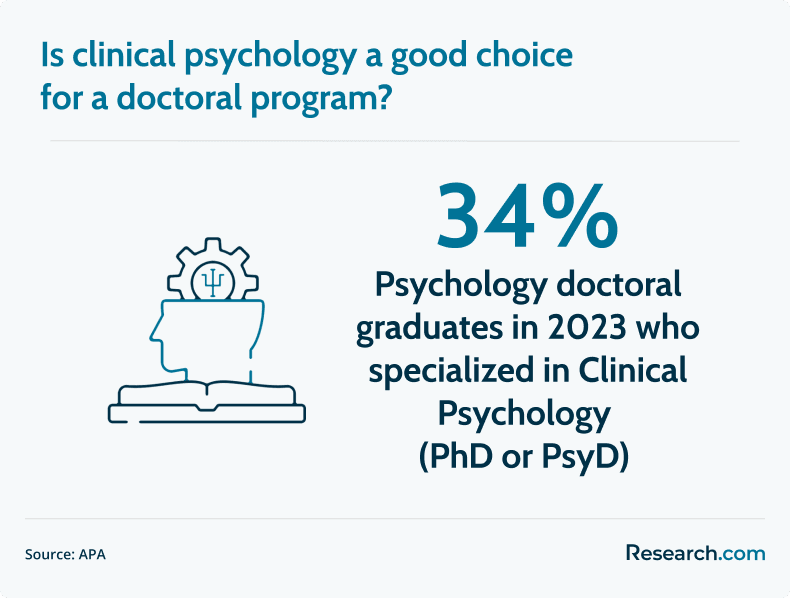
Clinical psychology remains a major doctoral specialty. In 2023, 34% of psychology doctoral graduates, or 2,465 individuals, completed degrees in clinical psychology, according to APA data. That continued concentration reflects strong student interest in clinical careers across both PsyD and PhD psychology programs.
What courses are included in PhD and PsyD in Clinical Psychology programs?
Doctoral curricula vary by institution, specialization, and accreditation standards, but most programs combine foundational psychology courses, supervised practice, ethics, assessment, and professional development. Students comparing programs should review not only course titles but also practicum structure, internship outcomes, faculty expertise, and whether the curriculum supports their state licensure plans. Foundational preparation may also build on earlier course requirements for psychology majors.
Common PhD in Clinical Psychology Courses and Requirements
- Psychological Research Methods. Students study research design, measurement, data collection, and methods for evaluating psychological evidence. This course supports dissertation development and prepares students to judge whether interventions are supported by evidence.
- Statistics in Psychology. This course covers advanced statistical tools used to analyze psychological data, test hypotheses, interpret findings, and evaluate research quality.
- Psychopathology. Students examine mental health disorders, diagnostic frameworks, symptoms, etiology, and evidence-based treatment considerations.
- Cognitive and Behavioral Assessment. This course teaches students to use psychological tests, interviews, and standardized measures to evaluate cognitive, emotional, behavioral, and personality functioning.
- Ethics and Professional Issues in Psychology. Students learn ethical standards, legal responsibilities, confidentiality rules, informed consent practices, and professional decision-making in both research and clinical settings.
- Research and Dissertation. The dissertation is the major scholarly project in a PhD program. Students develop an original research question, collect or analyze data, interpret findings, and defend their work.
- Internships and Practicums. PhD students complete supervised clinical placements and a year-long internship. These experiences help students apply assessment and intervention skills while continuing to build research expertise.
Common PsyD in Clinical Psychology Courses and Requirements
- Clinical Assessment. Students learn diagnostic interviewing, psychological testing, cognitive assessment, personality assessment, and report writing for clinical decision-making.
- Therapeutic Techniques and Interventions. This course introduces practical therapy approaches, including cognitive-behavioral therapy, psychodynamic therapy, humanistic approaches, and other evidence-informed methods.
- Multicultural Competence in Clinical Psychology. Students examine how culture, identity, ethnicity, social context, and lived experience affect assessment, diagnosis, treatment planning, and therapeutic relationships.
- Psychopathology. PsyD students study mental health disorders with an applied focus on recognizing symptoms, making diagnoses, and selecting appropriate interventions.
- Ethics and Professional Practice. This course prepares students to handle confidentiality, boundaries, documentation, mandated reporting, informed consent, and ethical dilemmas in clinical environments.
- Doctoral Project. PsyD students complete a practice-oriented project rather than a traditional PhD-style dissertation. The project may involve case analysis, program evaluation, literature synthesis, or another clinically relevant topic.
- Internships and Practicums. PsyD training includes substantial supervised clinical practice, direct client work, assessment experience, intervention training, and a full-year internship.
Do both degrees qualify you to become a licensed psychologist?
Yes. A PhD or PsyD in Clinical Psychology can qualify graduates to pursue licensure as psychologists, provided the program, supervised experience, internship, examination results, and state-specific requirements meet the rules of the licensing jurisdiction. The degree title alone is not enough. Students should confirm requirements with the licensing board in the state where they plan to practice.
| Licensure Step | What Students Should Confirm |
| Accredited doctoral program | Confirm that the doctoral program is accredited by the American Psychological Association or another accepted accrediting body for the state where you plan to seek licensure. |
| Supervised clinical training | Check practicum requirements, internship structure, supervisor qualifications, and documentation procedures. |
| Postdoctoral supervised experience | Many graduates must complete around 1,500 to 2,000 hours of supervised clinical experience after the doctorate, depending on state rules. |
| EPPP | All licensure candidates must pass the Examination for Professional Practice in Psychology, which covers broad areas such as assessment, ethics, intervention, and scientific foundations. |
| State-specific rules | Some states require jurisprudence exams, background checks, additional forms, continuing education, or specific supervised experience categories. |
Licensed psychologists may also pursue board certification through the American Board of Professional Psychology. Board certification is optional, but it can strengthen professional credibility, signal specialty competence, and support advancement in some clinical, hospital, academic, or leadership roles.
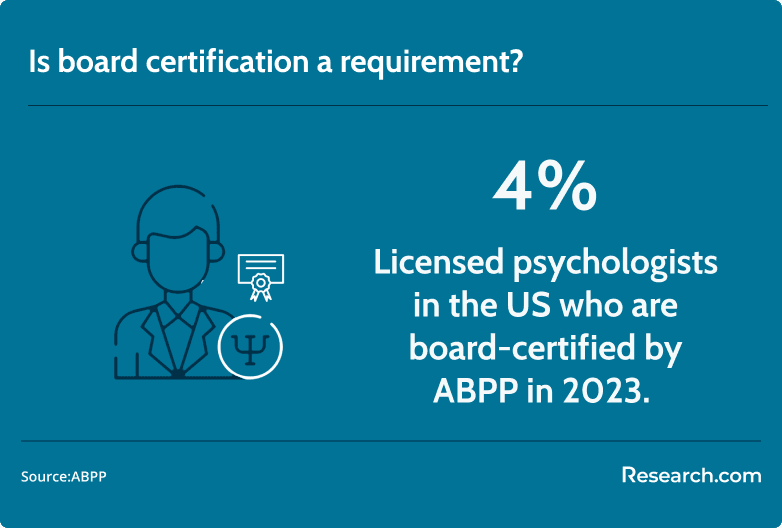
Board certification remains relatively uncommon. Only 4% of licensed psychologists in the United States, or 4,400 professionals, are board-certified. Based on the ABPP Directory, 30% of board-certified psychologists specialize in clinical psychology, while 7% focus on clinical child and adolescent psychology, making clinical psychology the most common specialization in 2023.
What are the financial aid programs for PhD and PsyD in Clinical Psychology students?
Doctoral psychology training can be expensive, and funding differs sharply by program. PhD students are often more likely to receive teaching or research support, while PsyD students may need to compare tuition, institutional scholarships, federal loans, and loan repayment options more carefully. Before enrolling, students should request a full cost estimate that includes tuition, fees, living expenses, internship-related relocation, insurance, books, assessment materials, and expected borrowing.
| Funding Option | How It Usually Works | Important Consideration |
| Teaching assistantships | Students support undergraduate instruction, grading, labs, or discussion sections in exchange for compensation that may include tuition support and a stipend. | More common in research universities and PhD programs. |
| Research assistantships | Students work on faculty research projects, often supported by grants. The University of North Carolina at Chapel Hill offers research assistantships for Clinical Psychology PhD students. | Best aligned with students who want research-intensive training. |
| Scholarships | Universities may offer merit-based or program-specific awards. William James College automatically considers applicants to its PsyD in Clinical Psychology program based on academic excellence and potential. | Scholarships may reduce cost but may not cover the full degree. |
| Fellowships | External fellowships such as the APA Minority Fellowship Program, NSF Graduate Research Fellowship, and Ford Foundation Fellowship may be available to doctoral students. | PhD applicants may be especially competitive when the fellowship emphasizes research. |
| Grants | Graduate students are generally not eligible for Pell Grants, but research-related grant support may be available through funded projects. | Availability depends on faculty funding, institution, and project fit. |
| Federal student loans | Direct Unsubsidized Loans and Grad PLUS Loans are commonly used by graduate students. | PsyD students may rely on loans more often when institutional funding is limited. |
| Federal Work-Study | Some institutions offer graduate work-study roles in psychology departments, student services, or related campus offices. | Availability varies by school and financial aid eligibility. |
| Employer tuition reimbursement | Students already working in mental health, social services, healthcare, or related fields may qualify for employer-sponsored education support. | Students should ask whether benefits apply to doctoral study and whether service commitments are required. |
| Service-based loan forgiveness and repayment | Public Service Loan Forgiveness may apply to qualifying nonprofit or government employment. The National Health Service Corps offers loan repayment options for licensed psychologists serving underserved areas. | Eligibility rules are specific, so students should document employment type, loan type, and payment history carefully. |
Cost Questions to Ask Before You Enroll
- What is the total expected cost through internship, not just first-year tuition?
- How many students receive funding, and how much of the degree does it usually cover?
- Are assistantships guaranteed, competitive, or renewed annually?
- What is the typical debt load for graduates?
- How many students match to internships on time?
- Does the program provide support for licensure paperwork, EPPP preparation, and postdoctoral placement?
What should I know about accreditation for Clinical Psychology doctoral programs?
Accreditation is one of the first things students should verify when comparing Clinical Psychology doctoral programs. An accredited program has been reviewed against recognized standards for curriculum, faculty qualifications, student support, supervised clinical training, and professional preparation. For students who want to become licensed psychologists, accreditation can affect internship eligibility, licensure approval, employer confidence, and future mobility between states.
Students should not choose a doctoral program based only on convenience, format, or tuition. They should review accreditation status, internship match data, graduation rates, licensure outcomes, faculty qualifications, practicum partnerships, and student support services. If affordability is a priority, comparing accredited options such as the cheapest PsyD programs can be useful, but low cost should never replace accreditation and licensure fit.
Common Mistakes When Comparing PhD and PsyD Programs
| Mistake | Why It Can Hurt You | Better Approach |
| Choosing a program before checking accreditation | Licensure, internship eligibility, and employer acceptance may be affected. | Verify accreditation directly and confirm state licensing board requirements. |
| Looking only at tuition | A lower sticker price may not reflect fees, living costs, travel, internship relocation, or lost income. | Compare total cost of attendance and expected debt at graduation. |
| Assuming all online or hybrid programs meet licensure rules | State boards may have specific rules for supervised training, residency, and internship. | Ask the program how it supports licensure in your intended state. |
| Ignoring internship match outcomes | Internship delays can extend the degree timeline and postpone licensure. | Review APPIC match information and ask about student support during the match process. |
| Choosing based only on degree title | A PhD is not automatically better than a PsyD, and a PsyD is not automatically easier. | Match the program’s training model to your career goals, finances, and preferred work setting. |
| Assuming salary outcomes are guaranteed | Earnings vary by location, setting, specialty, licensure, experience, and employment status. | Evaluate realistic career paths and compare program cost against likely roles. |
Could a Forensic Psychology Online Degree Enhance Your Clinical Psychology Career?
Forensic psychology training can be useful for clinicians who want to work where mental health and the legal system overlap. This may include competency evaluations, risk assessment, correctional settings, court-related consultation, trauma-informed work with justice-involved populations, or collaboration with attorneys and agencies. A forensic psychology online degree may help students build specialized knowledge before or after doctoral study, especially when they want to add legal and behavioral assessment skills to a clinical foundation.
Can an accelerated psychology bachelor's degree boost my clinical career prospects?
An accelerated bachelor’s degree in psychology can help motivated students complete foundational coursework sooner and move more quickly toward graduate preparation. It can also create earlier opportunities for research assistant roles, volunteer work, crisis line experience, community mental health exposure, or faculty mentorship. Students considering this route should make sure the curriculum includes core psychology, statistics, research methods, and writing-intensive work because doctoral admissions committees often look for evidence of academic readiness. Students comparing fast undergraduate options can review accelerated psychology bachelor's degree programs to understand available formats.
What are the common licensure challenges after earning a PhD or PsyD?
Licensure problems often arise when graduates discover too late that their program, supervised hours, internship, documentation, or state-specific requirements do not align with the jurisdiction where they plan to practice. Other delays can come from EPPP preparation, jurisprudence exams, background checks, postdoctoral supervision rules, or missing paperwork from practicum and internship sites. Students should contact state licensing boards early, keep detailed training records, and ask programs how they support graduates through the licensure process. Reviewing resources on APA accredited PsyD programs can also help students understand why accreditation and outcomes matter.
Can a 1 Year Online Masters in Psychology Accelerate Your Path to Clinical Practice?
A master’s degree can strengthen doctoral applications when it provides rigorous psychology coursework, research experience, clinical exposure, and strong faculty recommendations. A 1 year online masters in psychology option may help students build academic readiness before applying to PhD or PsyD programs, especially if their undergraduate record lacks psychology prerequisites or research preparation. However, students should confirm whether credits transfer, whether the degree supports doctoral admissions goals, and whether it includes the research or clinical experiences their target programs value.
What is the career path of PhD and PsyD in Clinical Psychology graduates?
Graduates of both degrees can build meaningful careers in mental health, healthcare, education, research, government, and private practice. The benefits of working as a psychologist include multiple practice settings and the ability to specialize over time. The degree you choose can influence your most likely path, but specialization, licensure, internship training, postdoctoral experience, and professional networks also matter.
| Career Role | Degree Fit | What the Role Involves |
| Clinical Psychologist | PhD or PsyD | Diagnoses mental health conditions, provides psychotherapy, conducts assessments, and develops treatment plans in hospitals, clinics, community agencies, or private practice. |
| Research Psychologist | PhD | Designs studies, analyzes psychological data, publishes findings, and works with universities, agencies, healthcare systems, or research organizations. |
| Professor of Psychology | PhD | Teaches college or university courses, mentors students, conducts research, writes grants, and contributes to academic program development. |
| Neuropsychologist | PhD or PsyD with specialization | Evaluates brain-behavior relationships, cognitive functioning, neurological conditions, brain injury, and rehabilitation needs. Students interested in this area can explore online PhD and PsyD programs in neuropsychology. |
| Health Psychologist | PhD or PsyD | Works on the psychological dimensions of illness, prevention, chronic disease, treatment adherence, pain, lifestyle change, and wellness programs. |
| School Psychologist | PhD or PsyD with appropriate credential | Supports student learning, behavioral health, assessment, counseling, and school-based intervention. This role differs from school counselor jobs, which may require only a master’s degree in school counseling. |
| Policy Analyst or Behavioral Science Advisor | PhD | Uses psychological research, data interpretation, and behavioral insights to inform public health, social services, government, or nonprofit initiatives. |
| Clinical Director or Program Administrator | PhD or PsyD | Supervises clinical teams, manages service delivery, develops protocols, monitors quality, and supports compliance in healthcare or community mental health settings. |
| Forensic Psychologist | PhD or PsyD with forensic training | Applies psychological expertise in legal contexts, including competency, risk, criminal behavior, court consultation, and expert testimony. Students can review forensic psychologist duties to understand the role more clearly. |
| Licensed Psychotherapist | PhD or PsyD | Provides individual, group, couples, or family therapy using evidence-based methods to address emotional, behavioral, and mental health concerns. |
| Consultant or Organizational Psychologist | PhD | Applies psychological principles to leadership, workplace behavior, organizational culture, team performance, and employee development. Students can compare organizational psychologist jobs to see whether this direction fits their interests. |
| Postdoctoral Fellow or Research Fellow | PhD | Builds specialized research, teaching, or clinical expertise after doctoral graduation before moving into a permanent role. |
| Department Chair | PhD | Leads an academic department, manages faculty, oversees budgets, supports curriculum, and guides teaching and research priorities. |
| Chief Psychologist | PhD or PsyD | Oversees psychological services, sets clinical standards, supervises staff, and supports training and quality improvement. |
| Executive Director of Mental Health Organizations | PhD or PsyD | Leads mental health organizations, manages strategy, builds partnerships, oversees operations, and advances service or advocacy goals. Additional training such as an MBA or MPH may be useful in some leadership roles. |
What is the average salary of a Licensed Clinical Psychologist?
According to ZipRecruiter (2025), licensed clinical psychologists in the United States earn an average salary of $131,590 per year. Most earn between $103,000 at the 25th percentile and $149,500 at the 75th percentile. These figures should be treated as broad salary benchmarks, not guarantees for a specific graduate or degree type.
Several factors can influence clinical psychologist pay:
- Experience level. New clinicians often earn less than psychologists with 10+ years of experience, advanced specialization, supervisory duties, or established practices.
- Location. Pay can be higher in metropolitan areas and high-cost states such as California, New York, or Massachusetts. Rural areas may pay less, although some roles may include loan repayment or recruitment incentives.
- Work setting. Private practice can offer higher income potential but also requires business expenses, marketing, billing, and administrative work. Hospitals and healthcare systems may provide steadier salaries and benefits. Academic and research roles may offer flexibility, prestige, grant opportunities, or consulting income but may have different base pay structures.
- Degree type. PhD graduates may have an earnings advantage in academic, research, policy, or leadership roles. PsyD graduates can earn similar incomes in therapy, assessment, private practice, and clinical administration roles.
- Specialization. Neuropsychology, forensic psychology, and health psychology may offer stronger compensation in some markets because they require advanced expertise.
- Licensure and certification. Full licensure is essential for independent practice. Board certification through the American Board of Professional Psychology or another specialty credential may improve credibility and advancement options.
- Employment status. Full-time roles generally provide steadier income. Part-time work may offer flexibility but can reduce annual earnings unless combined with private practice, consultation, or other professional activities.
Location can strongly affect salary. The chart below shows Washington as the highest-paying state for clinical psychologists, with an average salary of $124,465, followed closely by the District of Columbia and New York. Differences by state can reflect cost of living, healthcare funding, local demand for mental health services, and employer type.
Is there a demand for PhD and PsyD in Clinical Psychology graduates?
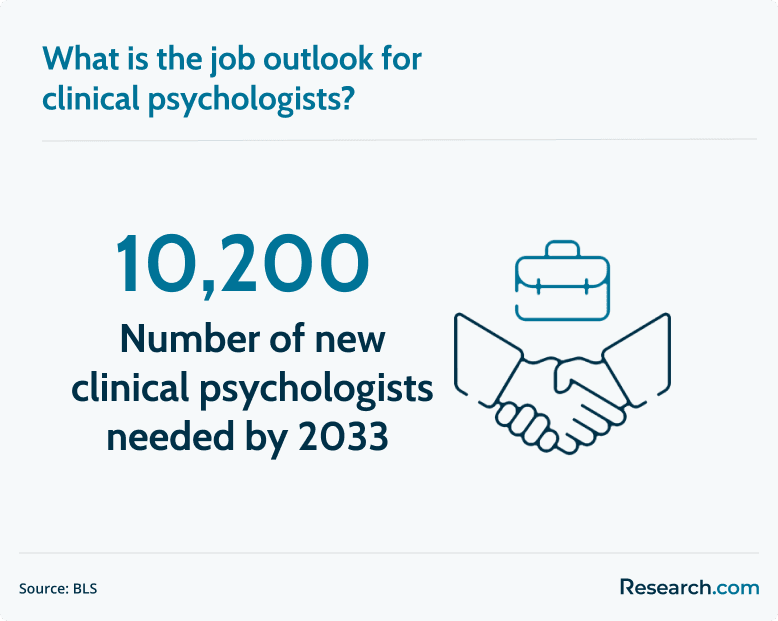
Demand for clinical psychologists is supported by rising mental health needs, expanded treatment access, telehealth use, and greater public willingness to seek care. The U.S. Bureau of Labor Statistics projects 13% growth for clinical psychologist jobs between 2023 and 2033, resulting in about 10,200 new roles. That rate is significantly faster than the average for other psychology occupations.
Consumer demand also remains visible. In 2024, a Statista survey found that 16% of U.S. adults were receiving therapy, an increase from the previous year. The broader mental health market was valued at $110 billion in 2024 and is projected by IMARC Group to reach $132 billion by 2033. Growth is linked to mental health awareness, reduced stigma, telehealth expansion, insurance coverage, and government support.
For students, the practical takeaway is this: demand exists, but employability still depends on licensure readiness, internship success, supervised experience, specialization, and willingness to work in settings with high need. A strong program should help students prepare for these requirements rather than simply promise broad career opportunity.
How to Choose Between PhD and PsyD?
The best degree is the one that fits your long-term work, learning style, financial situation, and tolerance for research. Both can lead to clinical practice, but they are not interchangeable experiences. Before applying, map your preferred career against the training model of each program.
| Ask Yourself | If Your Answer Is Yes | What It Suggests |
| Do I want to conduct original research or publish scholarly work? | You enjoy research questions, data, academic writing, and theory. | A PhD may be the better fit. |
| Do I want most of my career to involve direct therapy and assessment? | You are most motivated by patient care and applied practice. | A PsyD may be the better fit. |
| Do I want to teach at a university or compete for academic roles? | You see yourself mentoring students, writing grants, and conducting research. | A PhD usually offers stronger preparation. |
| Am I prepared for a highly competitive admissions process? | You have research experience, strong references, and a clear faculty fit. | Consider PhD programs, while also applying strategically. |
| Can I manage higher borrowing if funding is limited? | You understand the full cost and have a realistic repayment plan. | A PsyD may still be reasonable if outcomes and licensure support are strong. |
| Do I know the licensure rules in the state where I plan to practice? | You have verified accreditation, hours, exams, and documentation requirements. | You are better prepared to compare both degree options responsibly. |
APPIC data provides another useful comparison point. More students applied to PsyD programs, with 22,861 applicants, than to PhD programs, with 19,218 applicants. However, PhD students had a higher internship match rate, at 88% compared with 83% for PsyD students. Because internship placement is essential for licensure preparation, students should examine each program’s internship outcomes carefully.
A PhD may be the stronger choice if you want research depth, faculty mentorship, academic pathways, and potentially stronger internship placement odds. A PsyD may be the stronger choice if your priority is direct clinical work, practical training, and broader program availability. Either way, the strongest decision is based on verified program outcomes, accreditation, cost, training quality, and career alignment—not assumptions about prestige.
Practical Steps for Comparing Programs
- Identify the state where you most likely want to practice and review its psychologist licensure requirements.
- Confirm doctoral program accreditation and ask whether graduates qualify for licensure in your intended state.
- Compare internship match outcomes, practicum sites, postdoctoral placement support, and EPPP preparation.
- Review faculty expertise and make sure it matches your clinical or research interests.
- Calculate total program cost, including tuition, fees, living expenses, relocation, and expected debt.
- Ask current students and alumni about supervision quality, workload, faculty availability, and career support.
- Compare the program’s typical career outcomes with your own goals in practice, research, teaching, or leadership.
Match Rate for PhD and PsyD in Clinical Psychology in 2023

Key Insights
- A PhD and a PsyD can both lead to psychologist licensure, but the degree must align with accreditation, internship, supervised experience, examination, and state requirements. Always verify licensure fit before enrolling.
- A PhD is usually the better choice for students who want research, academia, policy, or a career that combines scholarship and clinical work. It typically takes 5 to 7 years and requires an original empirical dissertation.
- A PsyD is usually the better choice for students who want direct clinical practice as their primary professional identity. It typically takes 4 to 6 years and emphasizes assessment, therapy, practicum training, and applied clinical work.
- Funding can be a major difference. PhD programs are often more competitive but may provide stronger assistantship or stipend support, while PsyD students may need to rely more heavily on loans and should evaluate debt carefully.
- Internship outcomes matter. APPIC data showed 22,861 PsyD applicants and 19,218 PhD applicants, with PhD students recording an 88% match rate compared with 83% for PsyD students.
- Clinical psychology demand remains strong. The U.S. Bureau of Labor Statistics projects 13% growth for clinical psychologist jobs from 2023 to 2033, with about 10,200 new roles.
- Salary depends on more than degree title. ZipRecruiter reported an average licensed clinical psychologist salary of $131,590 per year, with most earning between $103,000 and $149,500, but location, specialization, setting, licensure, and experience strongly influence actual pay.
References:
- ABPP. (2023). ABPP Directory. Retrieved from https://abpp.org/directory/
- APPIC. (2023). APPIC match rates 2011–2023 by state. Retrieved from https://www.appic.org/Portals/0/downloads/APPIC_Match_Rates_2011-2023_by_State.pdf
- IMARC Group. (2025, March). U.S. mental health market size & growth forecast to 2033. Retrieved from https://www.imarcgroup.com/united-states-mental-health-market
- Page, C., Stamm, K., Assefa, M., & Khaddouma, A. (2024, March 1). The most and least common specialty areas for licensed psychologists. Monitor on Psychology, 55(2). Retrieved from https://www.apa.org/monitor/2024/03/top-psychology-specialties
- U.S. Bureau of Labor Statistics. (n.d.). Psychologists. Occupational Outlook Handbook. Retrieved from https://www.bls.gov/ooh/life-physical-and-social-science/psychologists.htm
- University of North Carolina at Chapel Hill. (n.d.). Psychology internship program. Retrieved from https://www.med.unc.edu/psych/education/psychology-internship/
- William James College. (n.d.). Paying for school. Retrieved from https://www.williamjames.edu/academics/clinical/psyd/paying-for-school.html
- ZipRecruiter. (n.d.). What is clinical psychologist salary by state? Retrieved from https://www.ziprecruiter.com/Salaries/What-Is-the-Average-Clinical-Psychologist-Salary-by-State
Other Things You Should Know About PhD and PsyD in Clinical Psychology Careers
Many programs have made the GRE optional or not required, but some still ask for scores. Applicants should check each program’s admissions page and confirm whether general GRE or GRE Psychology is accepted. The APA does not require the GRE for accreditation.
PhD candidates in Clinical Psychology are usually expected to conduct independent, original research leading to a dissertation. PsyD candidates focus less on research, often engaging in applied clinical projects instead. Both programs, however, may involve academic research, subject to program-specific requirements.