2027 Does a Psychology Degree Require Math? Courses Required for a Major

Co-Founder and Chief Data Scientist
Choosing psychology when math is not your strongest subject can feel risky, but the reality is more manageable than many students expect. Psychology is not built around calculus or advanced equations for most undergraduates. It does, however, require enough statistics and research methods to help students understand evidence, interpret assessment results, and make sound decisions about behavior, treatment, learning, and workplace performance.
This guide explains what math psychology majors usually take in 2027, which psychology tracks are more quantitative, which careers use data most often, and how students with math anxiety can prepare. You will also learn how software tools reduce the calculation burden, what admissions requirements to expect, which lower-math psychology-related careers exist, and how to choose a program without accidentally limiting your graduate school or career options.
Quick Answer: Is Psychology a Math-Heavy Major?
Psychology usually requires some math, but most programs focus on applied statistics rather than advanced mathematics. Students commonly take statistics and research methods because psychologists must know how to read studies, judge evidence, understand testing, and evaluate whether interventions are effective. A few programs may add algebra, quantitative reasoning, or advanced statistical coursework, especially for students interested in research, neuroscience, psychometrics, industrial-organizational psychology, or graduate study.
| Question | Short answer |
| Do most psychology majors take calculus? | Usually no. General undergraduate psychology programs rarely require calculus, though quantitative or research-intensive tracks may expect stronger math preparation. |
| Which math course is most common? | Statistics is the main quantitative course, usually supported by research methods. |
| Can I major in psychology if I am bad at math? | Yes. Many students who dislike math complete psychology degrees successfully by using tutoring, office hours, study groups, and statistics software practice. |
| What psychology fields require the most math? | Quantitative psychology, psychometrics, neuroscience, industrial-organizational psychology, mathematical psychology, and research roles tend to be the most data-heavy. |
| What psychology-related fields use less math? | Counseling, social work, human resources, substance abuse counseling, and many direct-service behavioral roles usually require less advanced quantitative work. |
What Students Should Understand Before Choosing Psychology
- Psychology is not completely math-free. Even counseling-focused students need enough research literacy to understand evidence, assessment results, and treatment outcomes.
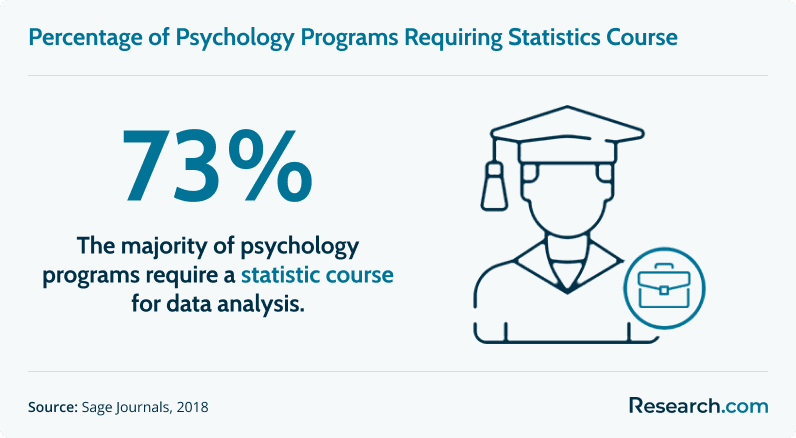
- Statistics is the main requirement. One study reported that 71% of psychology programs require an introductory statistics course.
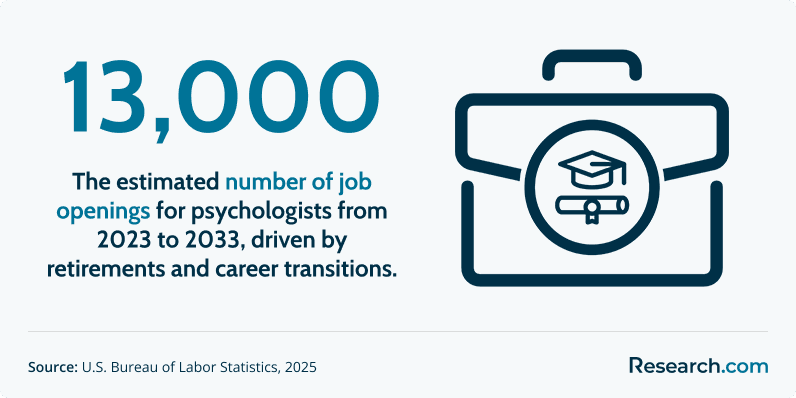
- Quantitative skills can improve career flexibility. The U.S. Bureau of Labor Statistics projects psychologist employment to grow 7% from 2023 to 2033, with approximately 13,000 job openings annually.
- Data-focused psychology careers can be financially strong. Roles involving statistical modeling, workforce analytics, assessment design, and research methods report median earnings from $67,697 to $122,928 per year, depending on specialization and experience.
- Lower-math options still exist. Counseling, human services, social work, and some human resources positions typically emphasize communication, ethics, intervention planning, and case management more than advanced analysis.
- Specialized quantitative abilities are valuable. Math-related psychology work may involve statistical methods (42.62%), employee selection, assessment design, and training program evaluation.
- Why does psychology use math?
- What math classes do psychology majors usually take in 2027?
- Which psychology specializations require more quantitative work?
- What data tools do psychology students use?
- Which high-paying psychology careers involve math?
- How can psychology students improve quantitative skills?
- Does math help counseling careers?
- Can certifications improve psychology career options?
- What are common psychology degree admission and academic requirements?
- How does math support marriage and family therapy?
- Why does field experience make statistics easier to understand?
- How is math useful in forensic psychology?
- What can students do about math anxiety?
- Where do psychology graduates with statistics skills work?
- Which psychology-related careers require the least math?
- What is the outlook for math-related psychology careers?
- How do advanced counseling programs use research and data?
Why does psychology use math?
Psychology uses math because the field studies behavior, thought, emotion, relationships, and development through evidence. Professionals may not perform complex calculations every day, but they often need to interpret patterns, compare scores, measure progress, and decide whether a finding is reliable enough to guide action.
In research, statistics helps psychologists test hypotheses, examine relationships between variables, and determine whether findings are meaningful or could have occurred by chance. In practice settings, data skills help with assessment interpretation, client progress monitoring, program evaluation, training outcomes, and evidence-based decision-making.
Some psychology areas are especially mathematical. Quantitative psychology develops statistical methods for psychological science. Psychometrics focuses on creating and validating tests for traits such as intelligence, personality, symptoms, and aptitude. Mathematical psychology uses formal models to explain cognitive processes such as memory, attention, learning, perception, and decision-making.
| Psychology activity | How math applies | Why students need it |
| Reading journal articles | Interpreting statistics, probability, samples, and research design | Helps students recognize strong evidence and question weak claims |
| Working with assessments | Understanding scores, norms, reliability, and validity | Supports ethical and accurate use of psychological tests |
| Monitoring therapy progress | Tracking client change and comparing outcomes over time | Helps professionals evaluate whether treatment is working |
| Analyzing workplace behavior | Reviewing employee surveys, performance data, selection results, and training outcomes | Improves hiring, leadership, productivity, and organizational decisions |
| Running experiments | Designing studies, comparing groups, and analyzing results | Allows psychologists to test ideas systematically rather than relying on opinion |
What math classes do psychology majors usually take in 2027?
Requirements differ by college, but most psychology students should expect statistics and research methods. Some degree plans also include college algebra, mathematical reasoning, or a general quantitative literacy course so students can read graphs, understand formulas, interpret datasets, and work with basic probability.
- Statistics. This is the most important math-related class for most psychology majors. Students usually study probability, correlation, regression, hypothesis testing, statistical significance, descriptive statistics, and interpretation of research findings. It also matters for students comparing the requirements to become an online therapist, since evidence-based therapy depends on reading research and understanding assessment data.
- Research Methods. This course explains how psychological studies are designed, conducted, evaluated, and reported. It often covers experimental design, surveys, ethics, sampling, variables, measurement, and how to interpret results.
- Algebra. Some schools require college algebra or a similar foundation course. Algebra helps students work with variables, equations, charts, formulas, percentages, and basic quantitative reasoning.
- Quantitative Psychology. This is usually an upper-level elective or advanced course for students interested in psychometrics, research, psychological measurement, data science, or graduate study. It may introduce more complex statistical techniques.
- Logic or Mathematical Reasoning. Some programs use these courses to build structured thinking, argument analysis, problem-solving, and analytical reasoning.
| Course | Typical difficulty | How to prepare |
| Statistics | Moderate for many students; difficult at first but closely tied to psychology examples | Practice explaining what results mean instead of focusing only on calculations |
| Research Methods | Moderate; requires careful reading and applied reasoning | Learn common study design terms and read sample psychology articles early |
| Algebra | Basic to moderate, depending on prior coursework | Review equations, fractions, percentages, graphs, and word problems |
| Quantitative Psychology | More advanced than standard undergraduate psychology courses | Build a strong statistics foundation and practice with data software |
| Logic or Quantitative Reasoning | Usually manageable with steady practice | Focus on patterns, argument structure, and step-by-step reasoning |
Which psychology specializations require more quantitative work?
The amount of math in psychology depends on the specialization. Students headed toward counseling or other direct-service roles may use basic data interpretation and outcome tracking, while students pursuing research, neuroscience, psychometrics, or industrial-organizational psychology should expect heavier statistics. The behavior analyst career path is another applied example because behavior analysts often collect data, monitor progress, and evaluate whether interventions are working.
- Research and Clinical Psychology. These areas rely on statistics to test theories, evaluate clinical studies, analyze experiments, and measure treatment outcomes.
- Quantitative and Mathematical Psychology. These tracks use statistical modeling, computation, formal theory, and mathematical frameworks to study behavior and cognition.
- Neuroscience and Biological Psychology. Researchers use statistics and modeling to analyze brain imaging, biological measures, neural activity, and cognitive performance.
- Educational and Cognitive Psychology. Specialists use data to evaluate learning, attention, memory, academic performance, and educational interventions.
- Psychometrics. This field depends on advanced statistics for test development and validation. Students may encounter reliability, validity, factor analysis, scaling, and item response theory.
- Industrial-Organizational Psychology. I-O psychologists analyze hiring systems, employee performance, engagement surveys, leadership programs, productivity, and organizational change efforts.
Industrial-organizational psychology shows how math can be practical rather than abstract. Professionals in this area use psychological theory, employee data, selection methods, training evaluation, and action planning to help organizations make better decisions about people.
| Specialization | Math intensity | Typical quantitative tasks |
| Counseling-focused psychology | Low to moderate | Reading research, interpreting assessments, and tracking outcomes |
| Clinical psychology | Moderate | Using tests, supporting diagnosis, and evaluating treatment results |
| Industrial-organizational psychology | Moderate to high | Analyzing workforce data, surveys, selection tools, and training outcomes |
| Neuropsychology | Moderate to high | Interpreting cognitive tests, brain-behavior patterns, and clinical assessment data |
| Psychometrics | High | Building tests, evaluating reliability and validity, and modeling measurement quality |
| Quantitative or mathematical psychology | Very high | Using advanced statistics, computational models, and research design |
What data tools do psychology students use?
Psychology students do not have to calculate everything manually. Many programs introduce software that helps students clean datasets, run statistical tests, build charts, and interpret output. Learning one tool well can make statistics less intimidating because students can focus on the meaning of results rather than the mechanics of every calculation.
- SPSS. SPSS is widely used in undergraduate and graduate psychology because it supports statistical analysis without requiring extensive programming experience. Students may use it for descriptive statistics, correlations, t-tests, ANOVAs, and regression. Familiarity with research tools such as SPSS can also help students evaluate EdS degree program requirements.
- MATLAB. MATLAB is common in cognitive psychology, neuroscience, and experimental research. It is useful for simulations, modeling, and analysis of large or complex datasets.
- Stata. Stata is used across the social sciences for statistical analysis, especially regression, large datasets, and panel data modeling.
- PsychoPy. PsychoPy is an open-source Python-based tool for designing and running psychology experiments. Researchers can create tasks through a graphical interface or use scripts for more control.
- PEBL. PEBL, or Psychology Experiment Building Language, is an open-source platform for building and administering psychological experiments. It includes more than 50 common tests, including the Iowa Gambling Task and the Wisconsin Card Sorting Test.
Which high-paying psychology careers involve math?
Psychology careers that use the most math often involve research, assessment, psychometrics, neuropsychological testing, legal evidence analysis, modeling, or workplace analytics. Many of these positions require graduate education, supervised experience, licensure, or specialized training depending on the role and state rules. They also appear among the highest paying psychology careers for professionals who can combine behavioral science with quantitative analysis.
| Career | How math is used | Median salary |
| Industrial-Organizational Psychologist | Evaluates selection systems, employee surveys, performance data, productivity, and organizational outcomes | $120,524 per year |
| Neuropsychologist | Interprets cognitive test results and brain-behavior data for diagnosis and treatment planning | $122,928 per year |
| Engineering Psychologist | Uses usability data, human factors research, behavioral findings, and modeling to improve products and systems | $92,813 per year |
| Mathematical Psychologist | Builds formal models of learning, behavior, cognition, perception, and decision-making | $67,697 per year |
| Forensic Psychologist | Applies assessment data, evidence review, and statistical reasoning in legal settings | $92,813 per year |
| Psychometrician | Develops and evaluates psychological, educational, clinical, and employment tests | $67,697 |
1. Industrial-Organizational Psychologist
Industrial-organizational psychologists use psychology to solve workplace problems. They may work on hiring, employee selection, leadership development, engagement surveys, performance measurement, training evaluation, and organizational change. Quantitative skills help them determine whether workplace practices are effective, valid, and fair.
Median salary: $120,524 per year.
2. Neuropsychologist
Neuropsychologists examine the connection between the brain and behavior, including memory, language, attention, emotion, and executive functioning. Their work often involves interpreting assessment batteries for people with brain injuries, strokes, neurological disorders, or cognitive changes.
Median salary: $122,928 per year.
3. Engineering Psychologist
Engineering psychologists study how people interact with technology, systems, products, and work environments. They may conduct usability testing, human factors research, error analysis, and design evaluation based on behavioral data.
Median salary: $92,813 per year.
4. Mathematical Psychologist
Mathematical psychologists use formal models to describe and predict behavior. Their research may focus on learning, reaction time, perception, memory, decision-making, and other cognitive processes.
Median salary: $67,697 per year.
5. Forensic Psychologist
A forensic psychologist applies psychological knowledge to courts, correctional systems, investigations, and other legal contexts. Quantitative reasoning can support risk assessment, competency evaluations, expert testimony, research interpretation, and evidence review.
Median salary: $92,813 per year.
6. Psychometrician
Psychometricians design, analyze, and refine tests that measure intelligence, achievement, personality, clinical symptoms, aptitude, and other psychological traits. Their work relies heavily on reliability, validity, scoring, scaling, and statistical interpretation.
Median salary: $67,697
How can psychology students improve quantitative skills?
The most effective way to get better at psychology-related math is to connect each number to a real behavioral question. Statistics becomes less abstract when it helps answer questions such as whether symptoms decreased after therapy, whether a training program improved retention, or whether an assessment measures what it claims to measure.
- Review the basics first. Before statistics, strengthen your understanding of percentages, averages, standard deviation, graphs, probability, and basic algebra.
- Get help early. Use tutoring centers, instructor office hours, peer tutors, or psychology department support before small misunderstandings become major grade problems.
- Use psychology-based examples. Practice with survey results, assessment scores, reaction-time data, treatment outcomes, or behavioral observations.
- Become comfortable with one software tool. SPSS, R, Python, Stata, MATLAB, PsychoPy, or PEBL can make data analysis more practical and less overwhelming.
- Study with other students. Teaching a concept to someone else quickly reveals whether you truly understand it.
- Connect math to your career goal. Students interested in behavior analysis may find that online BCBA certification programs reinforce the importance of measurement, progress tracking, and data-based intervention decisions.
Does math help counseling careers?
Counseling is usually not considered a math-intensive profession, but research literacy can make counselors more effective. Counselors who understand data are better prepared to evaluate client progress, select assessment tools carefully, interpret outcome research, and communicate evidence to supervisors, agencies, and other stakeholders.
Students planning to become counselors should not avoid statistics entirely. They do not need to become data scientists, but they should know how to read treatment research and judge whether an intervention has evidence behind it. If you want to enter the profession efficiently, compare education and licensure steps with a guide to the fastest way to become a counselor.
Can certifications improve psychology career options?
Certifications can help psychology graduates demonstrate focused skills beyond the degree, especially in behavior analysis, counseling specialties, assessment, evidence-based practice, and data-informed interventions. They do not replace required licensure, but they may strengthen professional credibility when they align with employer expectations.
Before choosing any credential, confirm whether employers in your target field recognize it, whether it requires supervised experience, whether it fits state rules, and whether it helps you qualify for the specific roles you want. Students considering counseling credentials can read What is LPC? to understand how licensure pathways differ from optional certificates.
What are common psychology degree admission and academic requirements?
Admission requirements vary by institution, degree level, program format, and selectivity. For bachelor’s programs, applicants are usually expected to show college readiness through prior coursework, transcripts, and sometimes standardized test scores, recommendations, or a personal statement.
- Minimum education level: High school diploma or GED.
- Minimum GPA: Typically between 2.5 and 3.0.
- Writing sample: Personal statement of intent.
- Transcripts: High school transcripts.
- Standardized tests: Some schools require SAT or ACT scores.
- Letters of recommendation: 2–5 letters for selective programs.
- Immunization records: Some schools may require proof of vaccinations.
A bachelor’s degree in psychology generally includes 120 credits and takes four years of full-time study. Part-time students may need longer, while transfer credits or accelerated formats can shorten the timeline. Students comparing flexible options may review accelerated online psychology degree programs, but they should make sure a faster schedule still allows enough time to master statistics, research methods, and graduate school prerequisites.
| Program factor | What to verify before enrolling |
| Accreditation | Make sure the institution is properly accredited and that the degree will be accepted by employers or graduate programs. |
| Math requirements | Check whether the curriculum requires statistics, algebra, research methods, quantitative reasoning, or advanced data courses. |
| Transfer credit | Ask how previous math, statistics, or general education coursework will apply to your degree plan. |
| Graduate school preparation | Look for research methods, statistics, lab experience, and opportunities beyond the minimum major requirements. |
| Licensure alignment | If you plan to become licensed later, confirm state-specific education, supervised experience, and exam requirements. |
| Online format | Confirm that online students receive tutoring, advising, faculty access, software support, and research preparation. |
How does math support marriage and family therapy?
Marriage and family therapists focus mainly on clinical relationships, communication patterns, assessment, ethical practice, and intervention planning. Still, quantitative literacy can strengthen practice by helping therapists interpret assessments, monitor treatment progress, evaluate outcomes, and understand research on family systems and therapy effectiveness.
Students interested in this pathway should look for programs that combine clinical training with research literacy and responsible assessment use. Reviewing the most affordable online marriage and family therapy programs can help identify accessible choices, but price should not be the only decision factor. Licensure alignment, supervised practice requirements, faculty expertise, and clinical placement support matter just as much.
Why does field experience make statistics easier to understand?
Statistics often makes more sense when students see how numbers connect to real clients, agencies, programs, and outcomes. Internships, practicums, supervised fieldwork, and research assistant roles help students apply classroom concepts to progress notes, assessment results, treatment planning, and program evaluation.
For example, a counseling student may track symptom changes over time, compare client outcomes before and after an intervention, or review agency reports on service effectiveness. Students who want to enter counseling quickly should still confirm the full degree, supervision, and licensure sequence described in What is the fastest way to become a counselor?.
How is math useful in forensic psychology?
Forensic psychology can involve high-stakes legal and clinical decisions, so careful reasoning is essential. Quantitative skills help professionals interpret tests, evaluate evidence quality, review research, assess risk, and communicate findings clearly in legal settings.
Students interested in forensic psychology should expect to build knowledge in assessment, ethics, research methods, and legal standards. An affordable online master's in forensic psychology may provide focused preparation, but students should verify whether the program supports their intended role, especially if licensure or doctoral-level practice is part of the plan.
What can students do about math anxiety?
Math anxiety is common among psychology students, especially those who chose the field because they wanted to study people rather than numbers. Avoiding math completely usually increases the problem. A better strategy is to break the work into smaller skills, practice consistently, and tie each concept to a psychology example.
- Identify the exact trigger. Determine whether the anxiety comes from formulas, timed tests, word problems, software, grades, or fear of embarrassment.
- Practice in short blocks. Several focused 20-minute sessions each week often work better than one long cram session.
- Ask for support early. Tutoring, office hours, peer groups, and online tutorials are most helpful before grades begin to fall.
- Put formulas into plain language. Explain what a result means in words before worrying about notation.
- Choose programs with strong support. Students comparing counseling degrees, including cheapest online LPC programs, should ask about tutoring, writing help, statistics support, and advising access.
Where do psychology graduates with statistics skills work?
Psychology graduates who understand statistics can work beyond traditional mental health roles. Their advantage is the ability to combine knowledge of human behavior with data about people, services, products, programs, and organizations.
- Healthcare. Graduates may analyze behavioral health programs, patient outcomes, clinical data, and service effectiveness.
- Education. Schools, colleges, and testing organizations use psychology-informed data skills to evaluate learning, assessments, student services, and interventions.
- Government. Agencies may need psychology graduates for public policy research, program evaluation, behavioral health initiatives, and workforce studies.
- Business and human resources. Employers use psychology and data to improve hiring, training, employee engagement, performance management, and workplace culture.
- Market research. Psychology graduates can study consumer behavior, survey responses, product preferences, and decision-making patterns.
- Technology. User experience, product design, behavioral research, and human factors roles often value professionals who can interpret user data.
Students choosing between client-facing and research-oriented paths should understand the difference between clinical psychology and counseling psychology degrees, because the choice can affect coursework, practicum expectations, research training, and long-term career options.
Which psychology-related careers require the least math?
Students who like psychology but want to avoid heavily quantitative work still have options. These careers usually focus on communication, support, intervention, advocacy, case planning, and applied understanding of human behavior. Even so, low-math roles may still involve basic documentation, assessment interpretation, and evidence-based practice.
| Career path | Math level | Primary focus |
| Mental Health Counselor | Low to moderate | Helping clients address emotional, behavioral, and psychological concerns |
| Substance Abuse Counselor | Low | Supporting people with addiction, recovery, relapse prevention, and treatment planning |
| Human Resources Specialist | Low to moderate | Employee relations, hiring, workplace policies, benefits, and conflict resolution |
| Social Worker | Low to moderate | Case management, advocacy, resource connection, and family or community support |
| Behavioral Therapist | Low to moderate | Using structured interventions to support behavior change |
- Mental Health Counselor. Mental health counselors use therapeutic approaches to help clients manage emotional and behavioral challenges. A master’s degree and licensure are typically required.
- Substance Abuse Counselor. A substance abuse counselor works with individuals facing addiction and recovery needs. The role emphasizes assessment, support, treatment planning, and relapse prevention rather than advanced data analysis.
- Human Resources Specialist. HR specialists apply psychology-related knowledge to hiring, employee relations, benefits, policies, and workplace communication. Some HR analytics roles use more data, but many generalist roles are less math-heavy.
- Social Worker. Social workers help individuals, families, and communities access resources and navigate difficult situations. Direct practice roles typically involve more casework than statistical analysis.
- Behavioral Therapist. Behavioral therapists use structured interventions to help clients change patterns related to anxiety, developmental needs, phobias, or behavior challenges. Data tracking may be required, but advanced modeling is usually not central to the job.
What is the outlook for math-related psychology careers?
The U.S. Bureau of Labor Statistics projects overall employment of psychologists to grow 7% from 2023 to 2033, which is faster than the average for all occupations. The same source reports about 13,000 job openings each year, largely due to workers changing occupations or leaving the labor force.
Psychology graduates with strong quantitative preparation may be more competitive for roles in research design, program evaluation, psychometrics, assessment interpretation, user research, and workforce analytics. The American Psychological Association has also emphasized the importance of psychologists with strong quantitative skills as research methods become more complex. Students who want additional training after earning a degree can compare accredited online certificate programs, but they should confirm employer recognition, accreditation, and whether the certificate supports their target role.
Current trends affecting psychology students concerned about math
- Evidence-based practice is a standard expectation. Counseling, clinical, school, and health-related settings increasingly expect professionals to connect interventions to research and outcomes.
- Assessment literacy is essential. Psychological, educational, and workplace assessments require responsible interpretation, not simple score reporting.
- Employers want data-informed judgment. Business, healthcare, technology, education, and government employers often value psychology graduates who can explain behavior using both theory and evidence.
- Software handles many calculations. SPSS, Stata, MATLAB, PsychoPy, and PEBL can run complex analyses, but students still need to understand what the output means.
- Graduate programs may expect deeper preparation. Students considering doctoral study, I-O psychology, psychometrics, neuroscience, or research careers should take undergraduate statistics and methods courses seriously.
How do advanced counseling programs use research and data?
Advanced counseling programs usually combine clinical skill-building with research methods, assessment, diagnosis, ethics, and outcome evaluation. The purpose is not to make counselors into mathematicians. It is to help them choose interventions responsibly, understand treatment evidence, and evaluate client progress.
Students seeking a faith-based pathway can compare Christian counseling degrees, but they should still ask how each program addresses research literacy, assessment, practicum preparation, and state licensure alignment.
Common mistakes psychology students make about math requirements
| Mistake | Why it creates problems | Smarter approach |
| Believing psychology has no math | Statistics, research methods, and assessment coursework can become an unpleasant surprise | Read the full degree plan before applying or enrolling |
| Choosing a program only because it appears easier | A weak research foundation can limit graduate school preparation and career flexibility | Look for strong support systems rather than trying to avoid all quantitative work |
| Overlooking accreditation and licensure alignment | Your degree or credits may not meet future graduate, employer, or state requirements | Confirm accreditation, state rules, and graduate admissions expectations in advance |
| Waiting too long to seek help in statistics | Early confusion can build quickly and affect later assignments | Use tutoring, office hours, and study groups during the first weeks of the course |
| Comparing programs only by tuition | A cheaper program may offer limited advising, placement help, tutoring, or research opportunities | Compare total value, including academic support and career preparation |
| Assuming online courses are easier | Online statistics still requires practice, discipline, software access, and instructor support | Ask about tutoring, faculty response times, software access, and course pacing |
| Treating salary figures as guarantees | Pay varies by degree level, location, licensure, experience, specialization, and employer | Use salary data as a planning reference, not a guaranteed outcome |
Questions to ask before choosing a psychology program
- Which statistics, math, and research methods courses are required for the major?
- Are statistics courses taught through psychology examples or as general math courses?
- What tutoring, software training, writing support, and faculty office hours are available?
- Will students use tools such as SPSS, Stata, MATLAB, PsychoPy, PEBL, R, or Python?
- Can transfer credits satisfy algebra, statistics, or general education math requirements?
- Does the curriculum support graduate study, licensure, research experience, or direct employment?
- Do online students receive the same advising, academic support, and research opportunities as campus students?
- Does the program fit your intended specialization, such as counseling, forensic psychology, I-O psychology, behavior analysis, or psychometrics?
Key Insights
- Most psychology majors need statistics, not advanced math. Statistics and research methods are the core quantitative requirements for many undergraduate students.
- Math matters because psychology is evidence-based. Students must be able to read studies, interpret assessments, and judge whether interventions produce meaningful results.
- The math level depends on the psychology path. Counseling-oriented roles use less advanced analysis, while psychometrics, quantitative psychology, neuroscience, I-O psychology, and research careers use more.
- Students with math anxiety can still succeed. Early tutoring, consistent practice, study groups, and software training can make statistics much more manageable.
- Quantitative skills can widen career options. They are valuable in healthcare, education, government, business, technology, market research, assessment, and program evaluation.
- Do not choose a psychology program just because it has fewer math requirements. Accreditation, licensure alignment, transfer policy, faculty support, research preparation, and career fit are more important long-term considerations.
References:
- American Psychological Association. (n.d.). Education and career guide: Quantitative psychology. APA.
- All Psychology Schools. (n.d.). Psychometrician career guide. All Psychology Schools.
- Bureau of Labor Statistics. (n.d.). Substance abuse, behavioral disorder, and mental health counselors. U.S. Bureau of Labor Statistics.
- ZipRecruiter. (n.d.). Engineering psychologist salary. ZipRecruiter.
- ZipRecruiter. (n.d.). Forensic psychologists salary. ZipRecruiter.
- ZipRecruiter. (n.d.). Industrial-Organizational psychologist salary. ZipRecruiter.
- ZipRecruiter. (n.d.). Mathematical psychology salary. ZipRecruiter.
- ZipRecruiter. (n.d.). Neuropsychologist salary. ZipRecruiter.
- Zippia. (n.d.). Psychologist job demographics. Zippia.
Other Things You Should Know About Psychology Degrees That Require Math
Yes. Most psychology majors must complete at least one statistics course, usually 3–4 credit hours, because research methods and data analysis are core requirements. Many programs also require quantitative reasoning or research design before upper-division psychology classes and the senior capstone.
In 2027, a psychology degree typically requires courses like statistics and research methods. These courses provide essential skills for analyzing data and understanding research findings, crucial for success in various psychological fields. Some programs may also require basic algebra, but the emphasis remains on statistics.