2027 How to Become a Court Clerk

Co-Founder and Chief Data Scientist
Becoming a court clerk is one of the most practical ways to enter the legal field without earning a law degree. Court clerks keep court records accurate, process filings, support judges and attorneys, communicate with the public, and help hearings move through the system on schedule. For people who want steady government work, legal exposure, and a clear path into court administration, this role can be a strong fit.
This guide explains what court clerks do, how to qualify for entry-level and advanced roles, which degrees and certifications may help, how much court clerks earn, and what to consider before choosing this career. It is written for students, career changers, legal support workers, and administrative professionals who want a realistic view of the job before applying.
Quick answer: How do you become a court clerk?
Most court clerk jobs require at least a high school diploma or GED, although some courts prefer applicants with an associate or bachelor’s degree in criminal justice, legal studies, public administration, business administration, or a related field. Candidates usually need strong clerical, communication, computer, and records-management skills. Depending on the court, applicants may also need to pass a background check, typing test, civil service exam, or jurisdiction-specific training.
Key things to know before pursuing this career
- A high school diploma is often the minimum requirement, but an associate’s or bachelor’s degree can improve competitiveness for state, federal, supervisory, or specialized court roles.
- Court clerks usually work in courthouses, court offices, or government legal departments at the municipal, state, or federal level.
- Typical duties include maintaining official records, entering case information, preparing dockets, handling filings, collecting fees, and supporting judges during court proceedings.
- Important skills include accuracy, organization, professional communication, customer service, confidentiality, legal terminology, and comfort with court technology.
- Some courts require civil service testing, background screening, keyboarding assessments, or formal training after hiring.
- The role can offer stable public-sector employment and a path into senior clerk, court administration, judicial assistant, paralegal, compliance, or broader legal support positions.
- What does a court clerk do?
- How to become a court clerk in 2026
- Best degree options for aspiring court clerks
- How to choose the right court clerk education program
- Court clerk certifications and professional credentials
- Skills court clerks need to succeed
- Where court clerks work
- How technology is changing court clerk work
- Court clerk salary and job outlook
- How court clerks can keep learning and grow professionally
- When forensic science knowledge may help a court clerk
- How forensic training can support evidence-related court work
- Can court clerk experience support a move into law enforcement?
- How legal training can strengthen court clerk skills
- Career advancement options for court clerks
- How court clerk skills apply to criminology careers
- Common challenges and mistakes to avoid
What does a court clerk do?
A court clerk is an administrative legal professional who helps keep court operations accurate, organized, and compliant with required procedures. The clerk’s work may not always be visible to the public, but it is central to how cases move through the judicial system.
Daily responsibilities commonly include receiving and filing court documents, updating case records, preparing calendars and dockets, recording minutes, issuing notices or subpoenas when authorized, processing court fees, and helping judges, attorneys, law enforcement officers, jurors, witnesses, and members of the public understand procedural requirements.
The exact job title and scope vary by jurisdiction. A municipal court clerk may spend much of the day processing traffic, ordinance, misdemeanor, or small claims matters. A state court clerk may work with civil, criminal, family, probate, or appellate cases. A federal court clerk may handle more complex filings and procedures tied to federal law, bankruptcy, immigration, or litigation involving the U.S. government.
Court clerks are not attorneys and generally do not provide legal advice. Their role is to manage official records and court processes fairly and accurately. If you are interested in other courtroom support careers, you may also want to compare this path with the steps to become a bailiff, another role that supports order and safety during court proceedings.
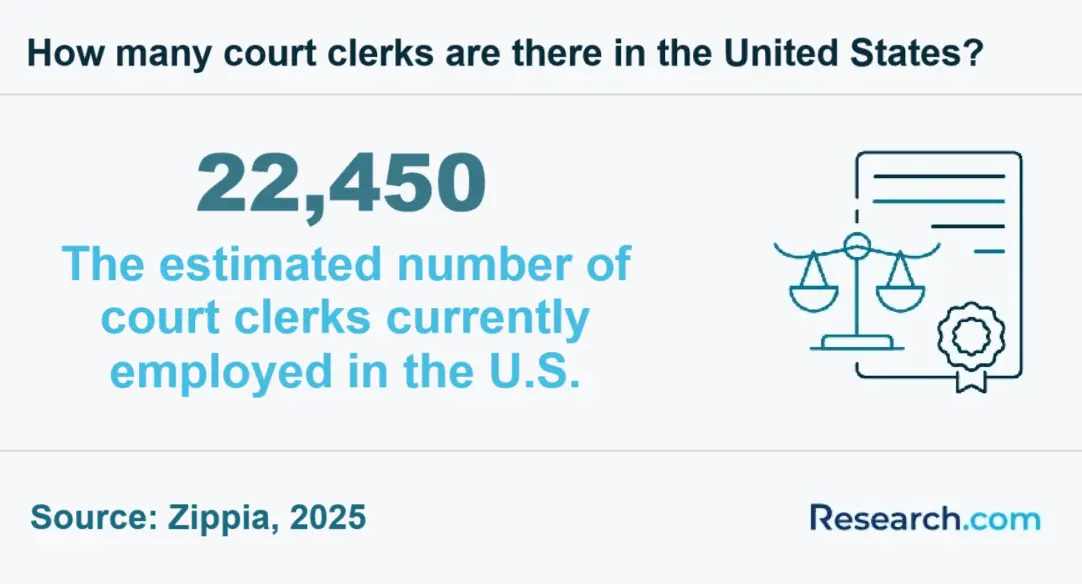
The image below shows the estimated number of court clerks currently employed in the United States.
How to become a court clerk in 2026
The path to becoming a court clerk is usually shorter than many legal careers, but it still requires preparation. Requirements differ by court system, so always read the job posting carefully and verify rules with the hiring court or local government agency.
1. Meet the minimum education requirement
Most entry-level court clerk positions require a high school diploma or GED. However, courts may prefer applicants who have completed college coursework or a degree in criminal justice, legal studies, public administration, business administration, political science, or a related area.
If your long-term goal is to work in a higher-level court or move into legal administration, a degree can help you build stronger knowledge of court procedures, legal terminology, government systems, records management, and professional communication. Students comparing legal and investigative paths may also explore what degree do you need to be a forensic expert, since forensic roles usually require more specialized science or criminal justice preparation.
2. Build practical administrative and legal skills
Before applying, focus on the skills courts use every day:
- Accurate data entry and document processing
- Professional phone, email, and in-person communication
- Familiarity with legal terminology and court forms
- Calendar management, scheduling, and deadline tracking
- Records organization and confidentiality practices
- Basic spreadsheet, word processing, and database skills
3. Gain experience in an office, legal, or government setting
You do not always need prior court experience, but related work can make your application stronger. Useful entry points include administrative assistant, records clerk, legal assistant, front-desk government employee, law office support staff, or courthouse intern. Experience handling confidential files, deadlines, public inquiries, or regulated records is especially relevant.
4. Apply to the right level of court
New applicants often begin with municipal, county, or local court positions because these offices may offer more entry-level openings. State and federal courts may require more experience, stronger typing or software skills, or additional education. Review each posting for required exams, residency rules, application deadlines, and supporting documents.
5. Prepare for testing, screening, and interviews
Some courts require candidates to complete a civil service exam, background check, typing test, written skills assessment, or interview panel. You may be asked how you handle angry members of the public, confidential information, simultaneous deadlines, or errors in official records. Prepare examples from school, work, internships, or volunteer experience.
6. Complete court-specific training after hiring
Most new court clerks learn local procedures on the job. Training may cover case management software, filing rules, fee processing, courtroom protocols, data security, public service standards, and the specific types of cases handled by that court.
7. Consider certifications once you have experience
Certification is not always required for an entry-level role, but it can support advancement. Professional development through the National Association for Court Management and state court clerk associations can help clerks keep up with changes in court administration.
The chart below shows the distribution of court clerks by highest educational attainment.
Best degree options for aspiring court clerks
You can become a court clerk without a four-year degree in many jurisdictions, but the right degree can make you more competitive and prepare you for advancement. Choose a program based on the court setting you want, the time you can commit, and whether you may later move into administration, paralegal work, compliance, criminal justice, or law school.
| Degree area | Best for | Why it helps court clerks |
| Criminal Justice | Students interested in criminal courts, law enforcement, corrections, or public safety | Covers courts, criminal procedure, ethics, and justice-system operations |
| Legal Studies or Paralegal Studies | Students who want strong legal document, research, and case-management skills | Builds familiarity with legal writing, court filings, civil procedure, and legal terminology |
| Public Administration | Students who want to move into court management or government administration | Emphasizes public agencies, policy, budgeting, ethics, and administrative systems |
| Business Administration | Students focused on office operations, supervision, records, and workflow management | Develops organizational, communication, accounting, and technology skills |
| Political Science | Students interested in government, law, policy, or future law school | Provides context on courts, constitutional systems, public policy, and legal institutions |
Criminal justice
A campus-based or online criminal justice degree can be useful if you want to work with criminal filings, law enforcement records, courtroom procedures, or public safety agencies. Coursework commonly introduces criminal law, court systems, ethics, and justice administration.
Legal studies or paralegal studies
Legal studies and paralegal programs are closely aligned with the document-heavy side of court clerk work. They often include legal research, legal writing, civil and criminal procedure, case preparation, and records management.
Public administration
A public administration degree online or on campus can be valuable for clerks who want to move into supervisory or court administrator roles. It can help you understand government operations, public finance, policy implementation, and ethical public service.
Business administration
Business administration can fit students who want a broad office-management foundation. Court clerks handle workflows, payments, schedules, records, customer service, and technology systems, all of which connect to business administration training.
Political science
A political science degree may be helpful if you want a deeper understanding of courts, constitutional law, government structures, and public policy. It can also support students who may later consider law school or policy-related roles.
How to choose the right court clerk education program
The best program is not automatically the most expensive or highest ranked. It is the one that matches the court clerk roles you want, fits your schedule and budget, and provides practical legal-administrative skills employers can recognize.
Questions to ask before enrolling
- What type of court work do I want? Municipal and county roles may require less formal education, while state, federal, supervisory, or specialized court positions may favor college coursework or a degree.
- Does the curriculum match court clerk duties? Look for courses in court procedures, legal terminology, records management, government administration, ethics, public service, and office technology.
- Is the school properly accredited? Accreditation matters because employers, transfer schools, and financial aid programs may not recognize coursework from unaccredited institutions.
- Can I complete the program while working? Online, evening, hybrid, and part-time formats can help working adults, but in-person programs may offer stronger local courthouse connections or internships.
- Does the program include an internship, practicum, or local legal network? Practical exposure can help you understand court workflow and build references.
- How much will the full program cost? Compare tuition, fees, books, technology costs, commuting, lost work time, and transfer-credit policies rather than tuition alone.
- Will the credits transfer if I continue later? If you start at a community college, confirm whether credits apply toward a bachelor’s degree.
- Does the program support related credentials? If you are also considering legal assistant work, review the requirements for paralegal certification before choosing courses.
Online vs. campus programs: which is better?
| Program format | When it makes sense | Trade-offs to consider |
| Online | You need flexibility because of work, family, location, or transportation limits | You may need to be more proactive about internships, networking, and hands-on experience |
| Campus-based | You want direct access to faculty, local legal employers, tutoring, or structured schedules | Commuting and fixed class times may make it harder to balance work or caregiving |
| Hybrid | You want flexibility but still value some in-person learning or local connections | Availability varies by school, and campus visits may still be required |
Court clerk certifications and professional credentials
Certifications can demonstrate specialized knowledge, but requirements are not uniform nationwide. Some credentials are state-specific, while others focus on court management or administrative technology. Before paying for a certification, verify whether it is recognized by the court systems where you want to work.
- Certified Court Clerk (CCC): Some states offer court clerk certification programs that teach local procedures, legal terminology, case processing, and court administration. These may be useful or required for advancement in certain municipal or state courts.
- Certified Municipal Court Clerk (CMCC): This credential may be relevant for clerks working in city or county courts that process traffic, ordinance, misdemeanor, and small claims matters.
- Certified Court Manager (CCM): The Institute for Court Management, part of the National Center for State Courts, offers training for experienced court professionals who want to move toward management.
- Certified Court Executive (CCE): This advanced path is generally aimed at professionals preparing for senior court leadership, including responsibilities tied to finance, operations, technology, and organizational strategy.
- Professional development through court associations: The National Association for Court Management offers resources and learning opportunities that can help clerks stay current even when a single national clerk certification is not required.
- Microsoft Office Specialist (MOS): While not a legal credential, MOS certification can verify skills in Word, Excel, and Outlook, which are commonly used in court offices.
If you are comparing shorter credentials across fields, broader online certificate programs may help you understand how certificate length, cost, and employer recognition differ.
Skills court clerks need to succeed
Court clerks need more than basic office ability. The work requires accuracy under pressure, professionalism with the public, discretion with confidential information, and the ability to follow procedures exactly.
| Skill | Why it matters in court clerk work |
| Attention to detail | Small filing, spelling, date, fee, or docketing errors can delay cases or create procedural problems. |
| Organization | Clerks manage multiple cases, deadlines, forms, schedules, and records at the same time. |
| Legal terminology | Understanding court language helps clerks process filings, communicate with attorneys, and follow procedures accurately. |
| Communication | Clerks explain procedural information, answer questions, coordinate with court staff, and assist the public without giving legal advice. |
| Technology skills | Courts increasingly rely on electronic filing, digital records, case management systems, spreadsheets, and secure databases. |
| Confidentiality | Clerks may handle sealed documents, personal information, juvenile records, victim information, or sensitive evidence records. |
| Time management | Deadlines, hearing schedules, filings, and court sessions require steady prioritization. |
| Conflict management | Members of the public may be confused, upset, or under stress when interacting with the court. |
The legal-document side of the role overlaps with some criminal law paralegal job requirements, especially accuracy, confidentiality, legal terminology, and the ability to work with structured case information. However, court clerks serve the court, while paralegals typically support attorneys.
You can build these skills through legal studies coursework, administrative work, courthouse internships, customer service roles, government office experience, and job-specific court training.
Where court clerks work
Court clerks work across multiple levels of the judicial system. The best setting depends on your experience, education, location, comfort with case types, and long-term goals.
- Municipal courts: These courts often handle traffic violations, misdemeanors, ordinance violations, and small claims. They can be a practical entry point for new clerks.
- State courts: State court clerks may work in trial, family, probate, criminal, civil, superior, district, circuit, or appellate courts. Duties can vary widely by division.
- Federal courts: Federal court positions may involve bankruptcy, immigration, constitutional, federal criminal, civil, or government-related cases. These roles may require more experience or education.
- Specialized courts: Clerks may work in juvenile, drug, bankruptcy, immigration, family, probate, or other specialized courts that require familiarity with specific procedures and sensitive populations.
- State and federal supreme courts: Clerks in high-level appellate environments help manage appeals, official records, filings, and schedules tied to significant legal matters.
- Government and administrative offices: Some court clerk skills transfer to county clerk offices, justice departments, regulatory agencies, legislative offices, and court administration departments.
- Remote or hybrid administrative roles: Some courts may allow remote or hybrid work for document processing, records review, scheduling, or digital filing tasks, although courtroom-facing work often remains on site.
How to decide which court setting fits you
Choose a municipal or county court if you want an accessible entry point and broad public interaction. Consider state courts if you want exposure to different case types and a larger court system. Federal courts may fit applicants with stronger credentials, experience, or long-term administrative goals. Specialized courts may be better if you are interested in family law, probate, juvenile justice, immigration, bankruptcy, or substance-use-related proceedings.
The salaries of court clerks vary depending on court level, role, experience, and location. The table below shows the top-paying states for court, municipal, and licensing clerks in the U.S.
| State | Annual Average Wage |
| Massachusetts | $63,820 |
| California | $62,000 |
| New York | $60,740 |
| Washington | $58,800 |
| Alaska | $58,630 |
How technology is changing court clerk work
Court clerk work is becoming more digital. Many courts now use electronic filing systems, digital case management platforms, online payment tools, remote hearing technology, and secure databases. This can reduce paper handling and speed up routine processes, but it also raises expectations for technical accuracy, cybersecurity awareness, and continuous training.
Technology does not remove the need for court clerks. Instead, it changes the nature of the job. Clerks must still review information, route documents correctly, protect confidential records, assist users who do not understand court systems, and help maintain procedural integrity. Workers who strengthen their legal, technology, and data-handling skills may also be better positioned to evaluate related paths, including some of the highest paying criminology jobs.
Court clerk salary and job outlook
Court clerk pay depends on location, court level, union or government pay structure, experience, education, certifications, and supervisory responsibility. Public-sector benefits, retirement plans, and job stability may also be important parts of total compensation, but they vary by employer.
Average salary
According to the U.S. Bureau of Labor Statistics, the annual average salary for court, municipal, and licensure clerks in the U.S. is $48,760, or $23.44 per hour.
Reported pay can vary by court type and seniority. A general breakdown includes:
- Municipal court clerks: Typically earn between $30,000 – $50,000 per year. These roles are often accessible to entry-level applicants and may not require a degree.
- State court clerks: Earn an average salary of $40,000 – $65,000, with higher pay possible in supervisory or specialized roles.
- Federal court clerks: Typically make $50,000 – $80,000, with senior-level clerks earning over $90,000. These positions often require more education or experience.
- Supreme court clerks: Can earn $100,000 or more, but these roles are highly selective and may require a law degree or substantial legal experience.
Job outlook
The U.S. Bureau of Labor Statistics projects employment for court, municipal, and license clerks to grow 4% from 2023 to 2033. That projection equals 6,300 openings for the job each year, on average, during that 10-year period.
Openings are expected to come from ongoing court operations, retirements, turnover, and the need for trained staff who can manage electronic records and filing processes. Automation may reduce some repetitive tasks, but courts still need people who understand procedures, maintain accurate records, and support judges and the public.
What affects earning potential?
- Education: Candidates with an associate or bachelor’s degree in criminal justice, public administration, or a legal studies degree online or on campus may qualify for more competitive roles.
- Experience: Clerks who understand court procedures, case management systems, and specialized case types may move into senior or supervisory positions.
- Location: Larger metropolitan areas and higher-level courts may offer higher wages, while smaller rural courts may pay less.
- Certification and training: Court-specific certification, management training, and technology skills can support advancement, though they do not guarantee a higher salary.
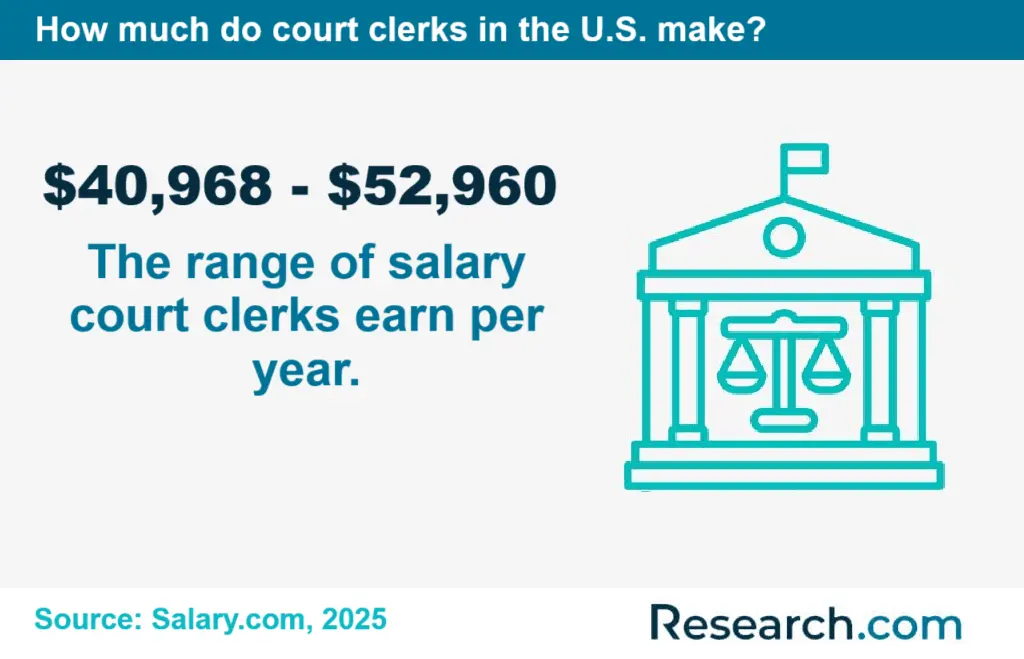
The image below shows how much court clerks earn per year, according to Salary.com.
How court clerks can keep learning and grow professionally
Continuous learning is important because court rules, filing systems, technology, privacy requirements, and administrative expectations change over time. Court clerks who keep learning are often better prepared for promotion, cross-training, and specialized assignments.
Useful options include state court training, local government workshops, legal administration conferences, software training, records-management courses, and professional association events. Clerks who want a broader justice-system foundation may also consider an online criminal justice degree, especially if they plan to pursue supervisory, compliance, or public safety-related roles later.
When forensic science knowledge may help a court clerk
Most court clerks do not need a forensic science degree. However, clerks who regularly work with criminal cases, evidence records, expert witness materials, or technical documentation may benefit from a basic understanding of forensic terminology and evidence-handling concepts.
This knowledge can make it easier to communicate with attorneys, law enforcement, forensic specialists, and court personnel when scientific evidence is part of a case file. If you want to add this background without changing fields entirely, comparing the cheapest online forensic science degree options may help you understand the cost and scope of available programs.
How forensic training can support evidence-related court work
Specialized forensic training may help court clerks who handle evidence-related filings, chain-of-custody documentation, expert reports, or complex criminal case records. The goal is not to turn clerks into forensic scientists, but to improve accuracy and communication when cases involve scientific or technical materials.
Clerks who want deeper academic preparation can review programs offered by the best colleges for forensic science in the US, but they should first confirm whether this training supports their specific court duties or career goals.
Can court clerk experience support a move into law enforcement?
Court clerk experience can be useful for some law enforcement-adjacent careers because clerks become familiar with legal procedures, official records, court orders, deadlines, and confidential information. Those skills may support future roles in investigations support, compliance, public safety administration, corrections administration, or government records work.
A move into sworn law enforcement or federal enforcement usually requires separate eligibility standards, physical requirements, background screening, and agency-specific training. If you are considering federal enforcement, review guidance such as how to apply for ICE agent to understand how different that path can be from court administration.
How legal training can strengthen court clerk skills
Supplemental legal training can help court clerks become more accurate and confident with legal documents, filing procedures, case terminology, and research tools. Short courses, workshops, paralegal classes, and court technology training can be especially useful for clerks who want to move into senior clerk, judicial assistant, paralegal, or court administration roles.
If you want targeted legal training without committing to law school, compare affordable ABA approved paralegal online programs and confirm whether the coursework supports your goals in court operations, legal support, or future paralegal work.
Career advancement options for court clerks
Court clerk experience can lead to several career paths inside and outside the courthouse. Advancement usually depends on years of experience, performance, education, certification, leadership ability, and knowledge of local court procedures.
| Advancement path | Typical next step | What may help |
| Senior court clerk | Supervise clerks, manage schedules, review filings, and support workflow quality | Experience, court-specific training, accuracy, and leadership skills |
| Court administrator | Oversee operations, budgets, staffing, technology, and court services | Public administration, management training, certifications, and supervisory experience |
| Judicial assistant | Support judges with calendars, case documents, correspondence, and legal materials | Legal research, writing, discretion, and strong courtroom knowledge |
| Paralegal or legal assistant | Support attorneys with document preparation, research, and case organization | Paralegal training, legal writing, and law office experience |
| Court reporter or transcriptionist | Create accurate records of court proceedings | Typing, listening, specialized transcription or stenography training |
| Law school or attorney track | Use court experience as exposure before pursuing a law degree | Bachelor’s degree, LSAT preparation if required, law school admission, and bar licensure |
| Compliance or government legal specialist | Work with regulations, records, procedures, or legal documentation in agencies or organizations | Regulatory knowledge, writing, analysis, and administrative experience |
Some reported salary ranges for advanced paths include senior court clerks at $50,000 – $75,000 per year, court administrators at $60,000 – $100,000 annually, paralegals at $50,000 – $80,000 per year, and many court reporters at $60,000 – $90,000. Becoming a lawyer may lead to salaries often exceeding $100,000 per year, but that route requires several years of law school and licensing.
If you are considering a legal support transition, it may help to understand what does a paralegal do. Paralegals generally assist lawyers with research, drafting, case organization, and client-related support, while court clerks work for the court and must remain neutral.
The chart below shows the job outlook or demand for court clerks compared with other types of clerks.
How court clerk skills apply to criminology careers
Court clerks develop transferable skills that can support broader criminology, justice administration, and public safety careers. These include records accuracy, procedural compliance, legal documentation, deadline management, confidentiality, and analytical thinking.
Possible adjacent roles may include investigative support, compliance assistant, public safety records specialist, victim services administration, corrections administration, or legal records analyst. If you are weighing a move beyond the courthouse, compare responsibilities and earning potential in broader criminology salary information before changing paths.
Common challenges and mistakes to avoid
Court clerk work can be stable and meaningful, but it is not stress-free. Applicants should understand the challenges before choosing this career.
Common challenges court clerks face
- High document volume: Courts process large numbers of filings, notices, orders, fees, and records, often under strict deadlines.
- Low tolerance for error: Incorrect dates, missing forms, wrong case numbers, or misfiled documents can create delays and extra work.
- Stressful public interactions: People who come to court may be anxious, angry, confused, or dealing with serious personal problems.
- Complex procedures: Filing rules, local court policies, privacy standards, and case processing requirements can change.
- Technology demands: Electronic filing systems, digital records, remote hearings, and cybersecurity expectations require ongoing learning.
- Confidentiality pressure: Clerks may handle sealed documents, juvenile information, victim details, criminal records, and sensitive evidence-related materials.
- Emotional strain: Some cases involve domestic violence, family conflict, criminal allegations, child welfare, or other difficult subject matter.
Common mistakes aspiring court clerks make
| Mistake | Better approach |
| Assuming every court clerk job has the same requirements | Check each posting for education, testing, background screening, residency, and experience rules. |
| Choosing a program without checking accreditation | Confirm that the school is accredited and that credits can transfer if you plan to continue your education. |
| Focusing only on tuition | Compare total cost, fees, books, technology, commuting, financial aid, and opportunity cost. |
| Ignoring typing, software, and records skills | Build practical office technology skills before applying, especially data entry and document management. |
| Confusing legal information with legal advice | Learn how to explain procedures neutrally without advising people what they should do legally. |
| Relying only on rankings or school reputation | Look for relevant coursework, internships, employer recognition, flexibility, and career services. |
| Assuming salary outcomes are guaranteed | Research local government pay scales, court level, benefits, and advancement policies in your area. |
How to prepare for the difficult parts of the job
- Practice organizing multiple deadlines and documents at once.
- Improve keyboarding, spreadsheet, word processing, and database skills.
- Learn basic legal terminology before applying.
- Develop calm customer service habits for tense interactions.
- Take confidentiality and ethics seriously from the start.
- Ask during interviews what training is provided for court software and local procedures.
If you are comparing court-based work with very different public-service careers, you may also be interested in how to become a forest ranger, which involves different requirements, work environments, and day-to-day challenges.
What court clerks often value about the career
- Direct exposure to the legal system: Court clerks see how cases move through the courts and learn procedures that many people outside the courthouse never encounter.
- Varied daily work: A clerk may update case records, assist during hearings, answer procedural questions, process filings, and coordinate schedules within the same week.
- Public-service impact: Accurate court administration helps judges, attorneys, litigants, and the public access records and move cases forward.
- Career mobility: Experience as a court clerk can support advancement into senior clerk, court administration, judicial assistant, paralegal, compliance, or other legal support roles.
Key Insights
- Court clerk is a practical legal career for people who want courthouse work without attending law school.
- A high school diploma may be enough for some entry-level roles, but an associate’s or bachelor’s degree can improve options in state, federal, supervisory, or specialized courts.
- The strongest degree choices are usually criminal justice, legal studies, paralegal studies, public administration, business administration, or political science.
- According to the U.S. Bureau of Labor Statistics, the annual average salary for court, municipal, and licensure clerks in the U.S. is $48,760, or $23.44 per hour.
- The U.S. Bureau of Labor Statistics projects 4% employment growth for court, municipal, and license clerks from 2023 to 2033, with 6,300 openings each year, on average, during that period.
- Technology is changing the work, but it is not eliminating the need for trained clerks who can manage records, support procedures, and protect confidential information.
- Before enrolling in a program, check accreditation, total cost, transfer policies, internship access, and whether the curriculum matches court clerk duties.
- The biggest risks are choosing education without a clear career goal, underestimating the stress of public-facing court work, and assuming all court systems have identical hiring requirements.
References:
- Salary.com. (2025, March 1). Court Clerk Salary in the United States. Salary.com.
- United States Bureau of Labor Statistics. (2024, April 3). Occupational Employment and Wage Statistics: 43-4031 Court, Municipal, and License Clerks. BLS.
- United States Bureau of Labor Statistics. (2024, August 29). Occupational Outlook Handbook. BLS.
- Zippia. (2025, January 8). Court Clerk Demographics and Statistics in the U.S. Zippia.
Other Things You Should Know About Becoming a Court Clerk
Court clerks are hired by state trial courts, appellate courts, federal courts, and local municipal or county courts. Applicants should target the clerk’s office, the state court system’s human resources portal, and federal vacancy notices on USAJOBS, where many clerk and courtroom support jobs are posted.
In 2026, aspiring court clerks typically need an associate or bachelor's degree in criminal justice, legal studies, or a related field. Some positions may require certifications. Online courses and specialized training programs can also provide relevant skills and enhance employability.