2027 Most Affordable Online Legal Studies Degree Programs

Co-Founder and Chief Data Scientist
An online legal studies degree is for students who want to work around the law without necessarily becoming attorneys. It can prepare you for roles in paralegal work, compliance, court administration, public policy, law enforcement support, contract management, and regulated industries such as healthcare, finance, real estate, and technology. The key decision is not simply whether to study legal studies online, but whether the degree level, accreditation, cost, specialization, and practical experience match the job you want.
This guide explains what online legal studies programs cover, how long they take, what they may cost, how financial aid works, which careers are realistic, and how to compare affordable programs. It also clarifies an important point: a legal studies degree is not the same as a law degree and does not, by itself, qualify you to practice law as an attorney.
Quick answer: What are the main benefits of an online legal studies degree?
- An online legal studies degree can support employment in law firms, corporate legal departments, compliance teams, courts, government agencies, nonprofits, and private-sector organizations.
- Online study may lower indirect expenses because students can often avoid campus housing, commuting, relocation, and some on-campus fees while continuing to work.
- Career outcomes vary by role, location, experience, and credentials, but legal-related positions cited in this guide range from a median annual salary of $60,970 for paralegals and legal assistants to more than $145,760 for higher-level legal occupations such as lawyers.
What can I expect from a legal studies degree?
A legal studies degree introduces students to the U.S. legal system, legal reasoning, research methods, writing for legal settings, ethics, civil and criminal procedure, contracts, constitutional principles, and regulatory frameworks. The goal is to help students understand how laws are created, interpreted, applied, and enforced across public and private institutions.
Most programs combine broad legal foundations with electives or concentrations. Students may study litigation, business law, criminal justice, public policy, health law, immigration, cybersecurity and privacy, or human rights. Strong programs also include applied work such as legal document drafting, case analysis, internships, simulations, or capstone projects.
Graduates commonly pursue support, administrative, analytical, compliance, and policy roles. Some use the degree as preparation for law school, but students planning to become lawyers should understand that they will generally need to complete a Juris Doctor program and meet state bar requirements after the bachelor’s degree.
Where can I work with an online legal studies degree?
Online legal studies graduates can work in several settings where legal knowledge is useful but attorney licensure is not always required. Law firms and corporate legal departments hire legal assistants, paralegals, legal operations staff, contract support professionals, and legal researchers. Government agencies may need staff who understand court processes, administrative rules, public records, enforcement procedures, or policy analysis.
Business environments also value legal studies training. Graduates may support compliance, risk management, human resources, procurement, real estate transactions, contract administration, and regulatory reporting. In advocacy and public policy, legal studies graduates may help research legislation, prepare reports, support lobbying efforts, or work with nonprofits focused on legal access, civil rights, public safety, or social services.
Actual job options depend on location, employer requirements, prior experience, internships, writing ability, technology skills, and whether the student adds credentials such as a paralegal certificate, compliance certification, or graduate degree.
How much can I make with an online legal studies degree?
Salary depends heavily on the job title, employer, geography, degree level, and experience. Salary.com reports that the average salary for individuals with a legal studies degree generally falls between $50,000 and $68,000, depending on the job and industry. Examples include:
- Paralegal: $56,444
- Legal Assistant: $52,000
- Police Officer: $59,632
- Real Estate Agent: $95,015, particularly for professionals who work with contract negotiations and property law
- Legislative Assistant: $49,521
- Lawyer: $126,900
Students should treat these figures as career-planning reference points, not guaranteed outcomes. A legal studies degree may support entry into legal-adjacent work, but becoming a lawyer requires additional legal education and licensure.
- 2027 affordable online legal studies degree programs
- How long does a legal studies degree take?
- Online vs. campus legal studies programs
- Average cost of a legal studies degree
- Financial aid for legal studies students
- How to find online schools that accept FAFSA
- Legal studies admission requirements
- Common legal studies courses
- Legal studies specializations
- How to choose a legal studies program
- Graduate education that can strengthen legal studies careers
- Certifications that can complement legal studies
- How to verify online program quality
- Supplementary credentials for career mobility
- Legal studies and criminology careers
- Legal studies degrees vs. law degrees
- Forensics and interdisciplinary legal careers
- Legal studies for forensic science careers
- Career paths for legal studies graduates
- How certifications can support advancement
- Job market for legal studies graduates
- Emerging trends in legal studies education
- Is an online legal studies degree worth it?
- Legal studies and federal law enforcement
- How to gain practical experience online
2027 List of Affordable Online Legal Studies Degree Programs
How do we rank schools?
A legal studies degree is a significant education investment, so affordability should be evaluated alongside accreditation, curriculum relevance, student support, transfer policies, and career preparation. A low tuition rate is useful only if the program is recognized, aligned with your goals, and realistic for your schedule.
The affordable legal studies program list below was prepared using data analysis from our team and the Research.com research methodology.
Sources used to create the ranking are the following:
- IPEDS database
- Peterson's database, including their Distance Learning Licensed Data Set
- The College Scorecard database
- The National Center for Education Statistics
Affordable online legal studies programs at a glance
| School | Program | Credits | Listed cost | Best fit |
| Bellevue University | Bachelor of Science in Legal Studies | 180 quarter credit hours (120 semester credits) | $371 per credit | Working adults seeking flexible online study |
| University of Maryland University College (UMUC/UMGC) | Bachelor of Science in Legal Studies | 120 credits | $499 per credit hour (in-state), $693 per credit hour (out-of-state) | Students wanting legal process, research, and support-role preparation |
| California University of Pennsylvania | Bachelor of Science in Criminal Justice | 120 credits | PA Resident (Full-time) $11,122; PA Resident (Part-time) $5,561; Non-PA Resident (Full-time) $15,744; Non-PA Resident (Part-time) $7,872 | Students interested in criminal justice, law enforcement, courts, or corrections |
| SUNY Canton | Bachelor of Science in Legal Studies | 121 credit hours | $7,070 per year (in-state), $16,980 per year (out-of-state) | Students seeking legal research, writing, and practical learning |
| University of Central Florida | Bachelor of Arts/Bachelor of Science in Legal Studies | 120 credit hours | $212 per credit (in-state); $748.89 per credit (out-of-state) | Students comparing in-state affordability with broad legal studies training |
| Dominican University | Bachelor of Professional Studies in Legal Studies | 120 credits | $35,410 per year | Students seeking legal studies with ethics, writing, and professional preparation |
| Liberty University | Bachelor of Science in Law and Policy | 120 credits | $390 per credit | Students interested in law, public policy, and Christian-centered instruction |
| Peirce College | Bachelor of Science in Paralegal Studies | 121 credits | $600 per credit | Students focused on paralegal preparation |
| Northeastern State University | Bachelor of Science in Legal Studies | 120 credits | $8,260 (9 months) | Students seeking legal studies for legal, business, government, or graduate pathways |
| Seton Hall University | Master of Legal Studies | 31 credits | $1,480 per credit | Non-lawyers seeking graduate-level legal and regulatory knowledge |
1. Bellevue University
Bellevue University offers a Bachelor of Science in Legal Studies that introduces students to the American legal system, legal research, legal writing, constitutional principles, professional responsibility, and ethics. The program is designed with online flexibility in mind, which can make it practical for adults balancing school with work or family obligations.
- Program Length: 4 years
- Tracks/concentrations: Game Development, Information Security and Assurance, IT Management, Network Administration, Software Development Using C#, among others
- Tuition cost: $371 per credit
- Required Credits to Graduate: 180 quarter credit hours (120 semester credits)
- Accreditation: Computing Accreditation Commission of ABET
2. University of Maryland University College (UMUC/UMGC)
The University of Maryland Global Campus offers an online Bachelor of Science in Legal Studies for students who want a structured understanding of legal procedures, legal reasoning, research, and writing. The curriculum includes areas such as contracts, criminal law, and legal ethics, supporting preparation for legal assistant, paralegal, and related legal support roles.
- Program Length: 4 years
- Tracks/concentrations: None specified
- Tuition cost: $499 per credit hour (in-state), $693 per credit hour (out-of-state)
- Required Credits to Graduate: 120 credits
- Accreditation: Middle States Commission on Higher Education
3. California University of Pennsylvania
California University of Pennsylvania offers a Bachelor of Science in Criminal Justice with several specialization options. The program emphasizes applied criminal justice concepts and can support students interested in law enforcement, courts, corrections, investigation, homeland security, or law and justice. Students should confirm the delivery format of any concentration before enrolling.
- Program Length: 4 years
- Tracks/concentrations: Criminology, Forensic Investigation and Cyber Forensics, Homeland and International Security California, Law and Justice (all in-person)
- Tuition and fees: PA Resident (Full-time) $11,122; PA Resident (Part-time) $5,561; Non-PA Resident (Full-time) $15,744; Non-PA Resident (Part-time) $7,872
- Required Credits to Graduate: 120 credits
- Accreditation: Computing Accreditation Commission of ABET
4. SUNY Canton (State University of New York Canton
SUNY Canton offers a Bachelor of Science in Legal Studies for students who want legal research, writing, analytical, and ethics training. The program is structured for students considering legal careers, paralegal work, or future law school study, and it includes practical learning opportunities such as internships.
- Program Length: 4 years
- Tracks/concentrations: None specified
- Tuition and fees: $7,070 per year (in-state), $16,980 per year (out-of-state)
- Required Credits to Graduate: 121 credit hours
- Accreditation: Middle States Commission on Higher Education
5. University of Central Florida (UCF)
The University of Central Florida offers Bachelor of Arts and Bachelor of Science pathways in Legal Studies. Students study core legal topics such as constitutional law, legal research, and civil litigation while also gaining exposure to applied legal experiences. The program may fit students interested in paralegal work, compliance, law enforcement, or graduate study.
- Program Length: 4 years
- Tracks/concentrations: None specified
- Tuition cost: $212 per credit (in-state); $748.89 per credit (out-of-state)
- Required Credits to Graduate: 120 credit hours
- Accreditation: Southern Association of Colleges and Schools Commission on Colleges
6. Dominican University
Dominican University offers a Bachelor of Professional Studies in Legal Studies that emphasizes legal reasoning, writing, research, ethics, and foundational legal knowledge. Coursework includes subjects such as constitutional law, criminal justice, and legal writing, making it relevant for students pursuing legal support roles or additional legal education.
- Program Length: 4 years
- Tracks/concentrations: None specified
- Tuition cost: $35,410 per year
- Required Credits to Graduate: 120 credits
- Accreditation: Higher Learning Commission
7. Liberty University
Liberty University offers a Bachelor of Science in Law and Policy with a Public Policy concentration. The program is delivered 100% online, uses 8-week courses, includes multiple start dates, and requires 120 credit hours. Students study legal research, legal writing, comparative legal systems, public policy analysis, and related topics within a Christian educational framework.
- Program Length: 4 years
- Tracks/concentrations: Pre-Law, Public Policy
- Tuition cost: $390 per credit
- Required Credits to Graduate: 120 credits
- Accreditation: Southern Association of Colleges and Schools Commission on Colleges
8. Peirce College
Peirce College offers a Bachelor of Science in Paralegal Studies for students targeting paralegal, legal assistant, or future legal education pathways. The curriculum covers legal research, legal writing, legal technology, ethics, criminal law, and civil litigation, with online flexibility designed for adult learners.
- Program Length: 4 years
- Tracks/concentrations: None specified
- Tuition cost: $600 per credit
- Required Credits to Graduate: 121 credits
- Accreditation: The American Bar Association (ABA); Middle States Commission on Higher Education
9. Northeastern State University
Northeastern State University offers a Bachelor of Science in Legal Studies that combines legal theory with practical application. The program is designed for students interested in legal, business, government, corporate, education, or graduate-study pathways, including those considering a Juris Doctorate or another advanced degree.
- Program Length: 4 years
- Tracks/concentrations: None specified
- Tuition cost: $8,260 (9 months)
- Required Credits to Graduate: 120 credits
- Accreditation: Higher Learning Commission
10. Seton Hall University
Seton Hall University offers an online Master of Legal Studies for non-lawyers who want graduate-level legal and regulatory knowledge. Students may pursue general legal studies or focus on areas such as healthcare, life sciences, or sports law. The program does not require the LSAT and is designed for practical use in regulated professional environments.
- Program Length: 4 years
- Tracks/concentrations: Various
- Tuition cost: $1,480 per credit
- Required Credits to Graduate: 31 credits
- Accreditation: Middle States Commission on Higher Education
What graduates say about online legal studies programs
The online format made it possible for me to keep working while completing my legal studies degree. The coursework strengthened my research, writing, and reasoning skills, and the faculty support helped me apply what I was learning to real workplace problems. Maria
I was unsure whether online learning would feel engaging, but the course platform, discussions, and assignments helped me stay connected. The program improved how I evaluate legal issues and organize evidence-based arguments. Ben
The degree gave me a clearer understanding of legal systems and legal documents. Affordability mattered to me, and the online structure helped me continue my education without stepping away from work. Alex
Key Findings
- Paralegals and legal assistants earned a median annual wage of $60,970 in 2023.
- The paralegal and legal assistant field typically requires an associate's degree and employed 354,300 individuals in 2022.
- Employment for paralegals and legal assistants is expected to grow 4% from 2022 to 2032, adding about 14,800 new jobs.
- Salary.com reports that the average salary for individuals with a legal studies degree generally falls between $50,000 and $68,000, depending on role and industry.
- Higher-level legal occupations cited in this guide include judges, mediators, and hearing officers at $132,950 and lawyers at $145,760.
How long does it take to complete a legal studies degree program?
The timeline for a legal studies degree online depends on degree level, transfer credits, term structure, and whether the student enrolls full time or part time.
| Degree level | Typical completion time | Who it may fit |
| Associate's Degree | About 2 years | Students seeking entry-level legal support training or a lower-cost path before a bachelor’s degree |
| Bachelor's Degree | Generally 4 years of full-time study | Students pursuing broader career options in legal support, compliance, policy, business, or law school preparation |
| Master's Degree | Online master of legal studies programs usually take 1 to 2 years after a bachelor’s degree | Working professionals who need legal and regulatory knowledge but do not plan to become attorneys |
| Part-Time Enrollment | A bachelor’s degree may take up to 6 years | Students balancing school with employment, caregiving, military service, or other responsibilities |
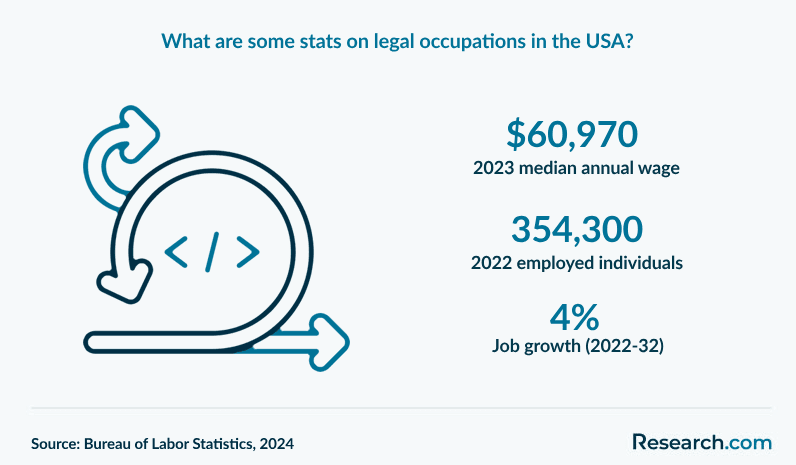
According to the Bureau of Labor Statistics, paralegals and legal assistants earned a median annual wage of $60,970 or $29.31 per hour in 2023. The occupation typically requires an associate's degree, employed 354,300 individuals in 2022, and is projected to grow 4% from 2022 to 2032, adding approximately 14,800 new jobs. These are shown in the graphic below.
How does an online legal studies degree compare to an on-campus program?
Online and campus-based legal studies programs can cover similar academic material, but they differ in scheduling, interaction, networking, and how students complete practical experiences. The better option depends on your work schedule, learning style, local opportunities, and need for flexibility.
| Factor | Online legal studies degree | On-campus legal studies degree |
| Schedule | Often better for working adults because coursework may be asynchronous or offered in flexible terms | Usually follows set class times and campus calendars |
| Cost considerations | May reduce commuting, housing, relocation, and some campus-based expenses | May involve more transportation, housing, and campus service costs |
| Interaction | Uses discussion boards, video meetings, email, virtual advising, and online collaboration tools | Provides face-to-face classes, campus events, and in-person faculty access |
| Practical experience | May include local internships, virtual simulations, remote projects, or externships arranged near the student | May offer easier access to campus-connected courts, clinics, internships, and local legal employers |
| Quality check | Accreditation and student support should be verified carefully | Accreditation, faculty experience, and career placement should still be reviewed |
What is the average cost of a legal studies degree program?
Legal studies degree costs vary by school type, degree level, residency status, transfer credits, online fees, books, and time to graduation. Students comparing programs should calculate total program cost, not just tuition per credit.
- Associate Degree: Ranges from $6,000 to $20,000 at community colleges or online institutions.
- Bachelor’s Degree: Typically costs between $20,000 and $60,000 at public institutions and can go up to $100,000 at private universities.
- Master’s Degree: Ranges from $30,000 to $70,000, depending on the university and program structure.
- Additional Costs: Textbooks, technology fees, legal research tools, exam proctoring, graduation fees, and other resources can add several thousand dollars to the total cost.
The College Board's 2023 Trends in College Pricing report shows that average published tuition and fees for full-time students increased in 2023-24. Public four-year in-state tuition rose by $270 to $11,260, while out-of-state tuition increased by $850 to $29,150. Public two-year in-district tuition rose by $100 to $3,990. Private nonprofit four-year tuition increased by $1,600 to $41,540. These represent increases of 2.5%, 3.0%, 2.6%, and 4.0% respectively, before adjusting for inflation. These are shown in the graph below.
What are the financial aid options for students enrolling in a legal studies degree program?
Financial aid can make a legal studies degree more manageable, but the best aid strategy is to prioritize grants, scholarships, employer support, and affordable accredited programs before borrowing more than necessary.
- Federal Aid: Students can complete the Free Application for Federal Student Aid (FAFSA) to be considered for Pell Grants, federal student loans, and work-study programs.
- Pell Grants: These need-based grants do not require repayment, while federal loans typically offer borrower protections and repayment options that private loans may not provide.
- Scholarships: Universities and private organizations may offer awards based on merit, financial need, background, academic interest, or field of study. Examples include the American Bar Association (ABA) Legal Opportunity Scholarship and American Association for Paralegal Education (AAPE) scholarships for paralegal studies students.
- State Aid: Some states fund grants or scholarships for residents attending eligible in-state institutions. Examples include California’s Cal Grant and New York’s Tuition Assistance Program (TAP).
- Military Aid: Veterans, active-duty military members, and eligible family members may qualify for GI Bill or Yellow Ribbon Program benefits.
- Employer Tuition Reimbursement: Law firms, corporations, government agencies, and compliance-heavy employers may help employees pay for job-related education.
- Private Loans: Private loans can fill funding gaps, but they often have higher interest rates and fewer repayment protections than federal loans. Compare carefully and exhaust federal options first.
Before enrolling, ask the school for a written estimate of tuition, fees, books, transfer credit impact, and expected aid. This makes it easier to compare real out-of-pocket cost across programs.
How to find online schools that accept FAFSA?
Using FAFSA can reduce the cost of an online legal studies degree, but only eligible accredited institutions can participate in federal student aid programs. Students can start by comparing online schools that accept FAFSA and then confirm details directly with each school.
How FAFSA works
- Eligibility: FAFSA is available to U.S. citizens and eligible non-citizens who meet federal student aid requirements.
- Types of aid: The FAFSA can help students qualify for grants, scholarships, federal work-study, and federal student loans.
- Application process: Students should gather tax records, bank information, and family financial details before completing the FAFSA online.
How to confirm that an online legal studies program accepts FAFSA
- Check accreditation: Confirm that the institution is accredited by a recognized accrediting body and participates in federal aid programs.
- Contact financial aid: Ask the school’s financial aid office whether the specific online legal studies program is eligible for federal aid.
- Verify before applying: Do not assume every online program at a school has the same aid eligibility, especially for certificates or non-degree credentials.
How to maximize financial aid
- Apply for grants and scholarships first: These can reduce the amount you need to borrow.
- Use work-study strategically: If available, work-study may provide income and relevant experience.
- Borrow conservatively: Federal student loans may be useful, but students should compare projected debt with realistic salary expectations.
FAFSA application tips
- Apply early: Submit the FAFSA as soon as possible after October 1st each year to improve access to available aid.
- Be accurate: Errors can delay your award package or require corrections.
- Follow up: After submission, monitor FAFSA status and respond quickly to school requests for additional documentation.
What are the prerequisites for enrolling in a legal studies degree program?
Admission requirements depend on degree level and school selectivity. Online programs may also ask for transcripts, placement information, personal statements, or proof of prior college credit.
- Associate's and Bachelor’s Degrees: Applicants typically need a high school diploma or equivalent. Some schools may prefer or require prior coursework in English, history, government, or social science.
- Master’s Degree: Applicants must hold a bachelor’s degree, sometimes in legal studies or a related field. Some programs may request relevant work experience or a minimum GPA.
- Additional Requirements: Programs may ask for letters of recommendation, a personal statement, standardized test scores such as SAT, ACT, or GRE, or an interview.
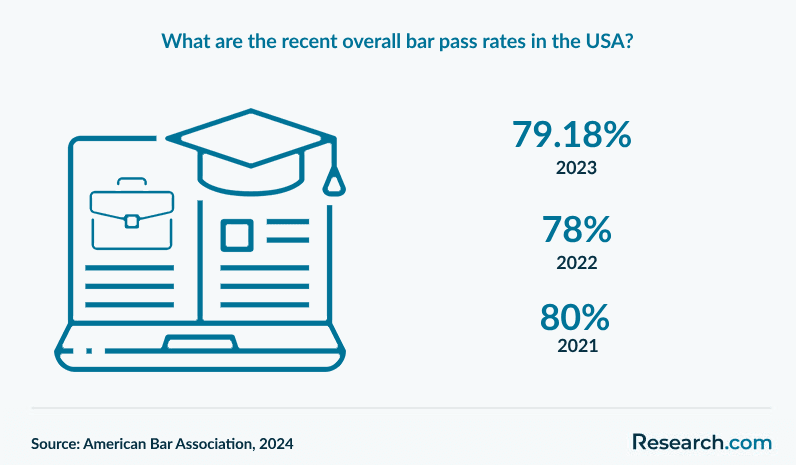
Students considering law school after legal studies should also pay attention to law school admission requirements and bar outcomes. According to the American Bar Association, the first-time bar exam pass rate for U.S. law school graduates was 79.18% in 2023, up slightly from 78% in 2022 but below the 80% rate in 2021 and the 84% rate in 2020. These are shown in the graphic below.
What courses are typically in a legal studies degree program?
Legal studies programs usually combine core legal foundations with electives that help students apply legal thinking to specific sectors. Course names vary by school, but the following subjects are common.
Core Courses
- Introduction to Law: Covers the structure of the legal system, legal institutions, sources of law, and legal reasoning.
- Constitutional Law: Examines the U.S. Constitution, major amendments, judicial review, and influential Supreme Court cases.
- Legal Research and Writing: Trains students to locate legal sources, analyze authority, draft legal documents, and communicate arguments clearly.
- Ethics in Law: Reviews professional conduct, confidentiality, conflicts of interest, attorney-client privilege, and ethical decision-making.
- Criminal Law: Introduces criminal liability, offenses, defenses, and criminal procedure concepts.
- Civil Litigation: Explains the lifecycle of civil cases, from pleadings and discovery to motions, trial, and appeal.
- Contracts: Studies contract formation, performance, breach, remedies, and interpretation.
- Torts: Covers civil wrongs such as negligence, intentional torts, liability, damages, and legal remedies.
Specialized Courses
- Family Law: Focuses on divorce, custody, adoption, marriage, support, and related domestic legal issues.
- Environmental Law: Examines environmental regulation, pollution control, conservation, land use, and agency enforcement.
- Intellectual Property Law: Covers patents, copyrights, trademarks, trade secrets, and ownership of creative or technical work.
- Corporate Law: Studies business entities, governance, mergers and acquisitions, securities regulation, and corporate compliance. Many online MBA programs also introduce related business-law concepts.
- Human Rights Law: Reviews domestic and international protections for civil rights, humanitarian concerns, discrimination, and individual freedoms.
- International Law: Explores treaties, international organizations, cross-border disputes, and legal relations among nations.
- Employment Law: Covers workplace discrimination, wage rules, labor relations, employee rights, and employer obligations.
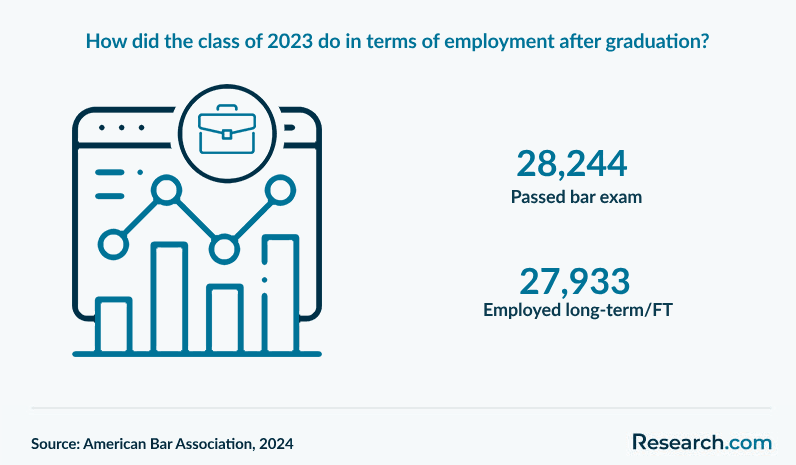
These courses can help students prepare for legal support, compliance, policy, or graduate study. They should not be confused with a full law school curriculum required for attorney licensure. Of 28,244 graduates who passed the bar exam in 2023, 27,933 are in long-term full-time positions. Smaller numbers are employed in long-term part-time (141), short-term full-time (127), and short-term part-time (43) roles. These are shown in the graphic below.
What types of specializations are available in legal studies degree programs?
Specializations help students connect legal knowledge to a specific career setting. The right concentration depends on whether you want to work in law firms, business, government, healthcare, technology, advocacy, or public safety.
- Criminal Justice: Focuses on the criminal justice system, criminal law, corrections, policing, investigations, and court processes.
- Paralegal Studies: Emphasizes legal research, drafting, document management, litigation support, case organization, and attorney support work.
- Business Law: Covers contracts, employment law, corporate governance, business entities, and compliance. Students comparing business-focused options may also review the cheapest business degree online programs.
- Environmental Law: Examines regulations related to pollution, land use, conservation, sustainability, and natural resources.
- Human Rights Law: Prepares students for work involving civil rights, advocacy, humanitarian concerns, NGOs, and international legal issues.
- Health Law: Covers healthcare compliance, patient rights, medical ethics, privacy, and healthcare policy. Students interested in healthcare leadership may also compare the cheapest online healthcare management degree programs.
- Immigration Law: Focuses on citizenship, visas, asylum, immigration proceedings, and advocacy.
- Cybersecurity and Privacy Law: Addresses data protection, digital privacy, cyber risk, compliance, and technology regulation. Students interested in this intersection may also explore the cheapest cyber security degree online programs.
How does one choose the best legal studies degree program?
The best legal studies program is the one that is accredited, affordable, aligned with your target role, and structured around your schedule. Avoid choosing only by tuition or ranking. Instead, evaluate outcomes and fit.
| Question to ask | Why it matters | What to look for |
| Is the institution accredited? | Accreditation affects credibility, financial aid, transfer credits, and graduate school options. | Recognized institutional accreditation and, when relevant, program-specific recognition. |
| Does the curriculum match my career goal? | A student aiming for compliance needs different electives than one targeting paralegal work or criminal justice. | Relevant courses, concentrations, and applied assignments. |
| Can I get practical experience? | Employers often value internships, writing samples, legal research ability, and technology skills. | Internships, simulations, externships, capstones, or local placement support. |
| What is the total cost? | Tuition per credit does not show the full price. | Fees, books, transfer credits, aid, time to completion, and graduation requirements. |
| What support is available online? | Online learners need accessible advising, tutoring, library access, and career services. | Virtual advising, legal research databases, writing support, and career coaching. |
| Can credits transfer? | Transfer policy can change cost and graduation timeline. | Written transfer evaluation before enrollment. |
- Accreditation: Verify recognized accreditation before enrolling. Students interested in related fields may also compare accredited criminal justice online degree options.
- Specializations: Choose a program with electives that support your intended career area.
- Faculty Expertise: Review whether instructors have legal, compliance, policy, government, or industry experience.
- Program Format: Decide whether asynchronous online courses, synchronous sessions, or campus-based classes best fit your life.
- Program Reputation: Look for employer connections, alumni outcomes, internship options, and graduate school placement information.
- Alumni Network and Career Services: Strong career support can help with internships, resumes, interviews, and job-search strategy.
Can complementary graduate education improve legal studies career trajectories?
Graduate education can help legal studies graduates move into management, compliance leadership, policy analysis, legal operations, or organizational administration. This can be especially useful for professionals who already work in law firms, corporations, courts, government agencies, healthcare organizations, or nonprofits and want to supervise teams or manage complex programs. Students interested in combining legal knowledge with leadership training can review online masters in organizational leadership options.
Should I pursue additional certifications to complement my legal studies degree?
Certifications can be valuable when they match a specific job target. A paralegal-focused student may benefit from an accelerated paralegal certificate, while a compliance-focused student may need credentials tied to regulation, privacy, healthcare, finance, or risk management. The strongest certifications are those recognized by employers in your target industry.
How can I verify the accreditation and quality of an online legal studies program?
Start with institutional accreditation, then evaluate program design, faculty qualifications, student support, internship options, technology access, and graduate outcomes. Ask whether credits transfer, whether the program qualifies for financial aid, and whether online students receive the same career services as campus students. Comparing related pathways, such as a paralegal studies online degree, can help you judge whether the curriculum is broad legal studies, paralegal preparation, or a hybrid of both.
How Can Supplementary Credentials Enhance My Career Prospects?
A supplementary credential can make your training more job-specific. For example, an associate degree in paralegal studies may strengthen practical skills in legal procedure, document preparation, research, and case organization. This can be useful for students whose legal studies program is broad but whose career goal is a hands-on legal support role.
Can a legal studies degree enhance criminology career opportunities?
Legal studies can complement criminology by adding knowledge of courts, constitutional protections, due process, evidence, criminal procedure, policy, and regulation. This combination can support roles in public safety, corrections, investigations, victim advocacy, compliance, or justice policy. Students comparing these overlapping fields can review criminology career pathways.
How do legal studies degrees differ from law degrees?
A legal studies degree teaches students about law, legal systems, legal documents, and legal analysis. A law degree is professional legal training that can lead to attorney licensure when paired with bar admission requirements. This distinction matters because legal studies graduates may work in law-related roles, but they generally cannot represent clients in court or practice law as attorneys without completing the required law degree and licensure process.
| Feature | Legal studies degree | Law degree |
| Main purpose | Broad understanding of legal systems for support, compliance, policy, business, or public-sector work | Professional preparation for legal practice |
| Common degree levels | Associate, bachelor’s, and master’s legal studies options | Juris Doctor and related law degrees |
| Attorney licensure | Does not by itself qualify a graduate to practice law | Can support bar eligibility when state requirements are met |
| Career examples | Paralegal, legal assistant, compliance analyst, policy assistant, court staff, contract administrator | Attorney, prosecutor, public defender, legal counsel, judge after required experience and selection |
Students interested in legal systems and criminal justice may also consider an online criminal justice degree if their goals are more closely tied to policing, corrections, courts, or public safety.
What role does interdisciplinary expertise, such as forensics, play in enriching a legal studies career?
Interdisciplinary skills can make legal studies graduates more useful in fields where law intersects with evidence, technology, regulation, and investigations. Forensic knowledge can help professionals understand evidentiary procedures, digital records, chain of custody, fraud analysis, and investigative reporting. Students interested in this overlap may compare an online forensics degree with legal studies options.
Can a legal studies degree complement a career in forensic science?
Yes. Legal studies can strengthen a forensic science career by improving understanding of courtroom procedures, evidence rules, legal documentation, testimony preparation, and regulatory compliance. Forensic professionals who understand both scientific analysis and legal context may be better prepared to support investigations and communicate findings. Students seeking specialized science-focused options can review the top ranked forensic science colleges.
What career paths are available for graduates of legal studies degree programs?
Legal studies graduates can pursue law-related careers in private firms, courts, corporations, government agencies, nonprofits, and regulated industries. Some roles may require additional certification, experience, background checks, licensure, or graduate education.
- Paralegal/Legal Assistant: Supports attorneys with research, document drafting, case management, discovery, trial preparation, and client file organization. Students focused on this path can compare the best paralegal certificate programs.
- Compliance Officer: Helps organizations follow laws, regulations, internal policies, and reporting requirements in industries such as finance, healthcare, manufacturing, technology, and government contracting.
- Legal Analyst: Reviews legal documents, regulations, case materials, and precedent to support attorneys, corporate teams, or agencies.
- Mediator: Helps parties resolve disputes outside court in settings such as family law, labor relations, community services, or business conflict resolution.
- Law Enforcement: Applies knowledge of criminal law, constitutional rights, and justice procedures in policing, investigations, or agency work. Students may also compare the best online criminal justice associates degree programs.
- Corporate Legal Consultant: Supports business decision-making around contracts, governance, transactions, compliance, and risk.
- Human Rights Advocate: Works with nonprofits, NGOs, government entities, or advocacy groups on civil rights, legal access, research, and public education.
- Court Administrator: Helps manage court operations, staffing, records, scheduling, budgets, and case flow. Court administrators support the functioning of the judiciary.
- Policy Analyst: Researches laws, regulations, and policy proposals for government agencies, think tanks, advocacy groups, or public-sector organizations.
- Law Librarian: Supports legal research and information management in law schools, courts, law firms, and government libraries.
According to the U.S. Bureau of Labor Statistics, in the United States, the median annual pay for several legal occupations in 2023 was as follows: arbitrators, mediators, and conciliators earned $71,540; court reporters earned $63,940; judges, mediators, and hearing officers earned $132,950; lawyers earned $145,760; and paralegals and legal assistants earned $60,970. These are shown in the graphic below.
How Can Additional Certifications Enhance Career Trajectories?
Certifications can help legal studies graduates show job-ready expertise in a focused area. Useful credentials may relate to paralegal work, compliance, privacy, cybersecurity, regulatory affairs, mediation, contracts, or healthcare administration. The right choice depends on the job postings you are targeting. To compare broader credential options, review What are the highest paying certificate programs?.
What is the job market for graduates with a legal studies degree?
The job market for legal studies graduates is broad but competitive. Employers often want candidates who can write clearly, research accurately, manage documents, understand procedure, use legal technology, and work with confidential information.
- Ongoing demand: Paralegals, legal assistants, and compliance staff remain useful because many employers need legal support and regulatory expertise.
- Regional variation: Larger metropolitan areas may offer more law firms, courts, corporate headquarters, agencies, and compliance departments.
- Advancement options: Graduates may add a certificate, pursue a master’s degree, enter law school, or specialize in compliance, privacy, contracts, or litigation support.
- Salary expectations: Pay varies by role, experience, and location. Paralegals may earn an average of $50,000 to $60,000 annually, while specialized roles can pay more. Students focused on paralegal credentials may compare ABA approved paralegal programs.
What are the emerging trends in legal studies degrees?
Legal studies education is changing as employers adopt technology, compliance obligations grow, and legal work becomes more interdisciplinary. Students should choose programs that teach both legal fundamentals and modern workplace tools.
- Legal technology and AI: Programs increasingly introduce e-discovery, legal research platforms, document automation, contract review tools, and AI-related ethical issues. Students should learn how to use technology while checking accuracy and confidentiality.
- Interdisciplinary legal training: Legal studies is increasingly paired with business, healthcare, cybersecurity, public administration, and criminal justice because legal risk appears across industries.
- Global and cross-border issues: International law, human rights, trade, immigration, and privacy regulation are more relevant for students aiming at multinational employers or advocacy organizations.
- Flexible online learning: Online programs now use virtual classrooms, asynchronous modules, simulations, remote collaboration, and local internship options to support working students.
- Cost-conscious credentialing: Students are paying closer attention to affordability, transfer credits, and career outcomes. Those considering graduate education can compare the cheapest master of legal studies online programs.
Is an online legal studies degree a worthwhile investment?
An online legal studies degree can be worth it if it is accredited, affordable, career-aligned, and paired with practical experience. It may be a strong fit for students who want law-related work without immediately committing to law school. It may be a poor fit for students who assume the degree automatically leads to attorney roles or guaranteed high salaries.
To evaluate return on investment, compare total cost, transfer credit policies, financial aid, time to completion, expected starting roles, internship access, and local job demand. If minimizing cost is the priority, students may also compare options such as the cheapest online college bachelor degree while making sure the program still supports their legal career goals.
Can a legal studies degree lead to a career in federal law enforcement?
A legal studies degree can support federal law enforcement preparation by building knowledge of criminal law, constitutional rights, administrative procedures, evidence concepts, and regulatory systems. However, federal law enforcement roles often have specific requirements related to citizenship, age, physical fitness, background checks, experience, training, and agency-specific qualifications. Students interested in immigration enforcement should review the requirements to become an ICE agent.
What are the best ways to gain practical experience with an online legal studies degree?
Experience is one of the most important ways to turn an online legal studies degree into job opportunities. Students should build evidence of research ability, writing skill, professionalism, confidentiality, and legal technology competence before graduation.
- Internships: Look for opportunities with law firms, courts, legal aid offices, compliance departments, government agencies, nonprofits, or corporate legal teams.
- Externships: Short-term supervised placements can help students understand how legal work is performed in real workplaces.
- Pro bono work: Volunteering with legal aid organizations or nonprofits can provide exposure to client services, legal access, advocacy, and community-based legal issues.
- Online simulations: Simulated cases, contract drafting, document review, negotiations, and legal writing projects can help online students develop applied skills.
- Freelance legal support work: Students with appropriate training may build experience through research, document preparation, or administrative support, while staying within rules on unauthorized practice of law.
Students aiming for paralegal work may strengthen their preparation with ABA-approved online paralegal certificate programs, especially if local employers prefer or require paralegal-specific training.
Common mistakes to avoid when choosing an online legal studies degree
| Mistake | Why it can hurt you | Better approach |
| Assuming legal studies is the same as law school | A legal studies degree does not by itself qualify you to practice law. | Use legal studies for law-related careers or as preparation before applying to law school. |
| Choosing only by tuition | The cheapest option may lack the specialization, support, or practical experience you need. | Compare total cost, accreditation, curriculum, career services, and outcomes. |
| Ignoring accreditation | Accreditation affects financial aid, credit transfer, employer recognition, and graduate school options. | Verify institutional accreditation before applying. |
| Not checking transfer credits | Poor transfer policies can increase both cost and time to graduation. | Request a written transfer evaluation before enrolling. |
| Waiting too long to gain experience | A degree alone may not be enough for competitive legal support roles. | Pursue internships, writing samples, simulations, and legal technology training early. |
| Assuming salary outcomes are guaranteed | Pay depends on employer, region, experience, credentials, and role. | Compare local job postings and salary data before borrowing. |
Key Insights
- An online legal studies degree is best for students who want legal knowledge for support, compliance, policy, business, government, or public-service roles—not for students expecting automatic attorney licensure.
- Program quality depends on accreditation, curriculum relevance, practical experience, faculty expertise, online support, and transfer credit policies.
- Costs vary widely, so students should compare total program cost, not just tuition per credit.
- Career outcomes improve when students pair the degree with internships, legal writing samples, research experience, legal technology skills, or targeted certifications.
- Paralegal, legal assistant, compliance, court administration, policy, law enforcement support, and contract-related roles are common paths, but salary and advancement depend on location, experience, and additional credentials.
- Before enrolling, confirm whether the program accepts FAFSA, whether credits transfer, whether the online format fits your schedule, and whether the degree directly supports your target job.
References:
- American Bar Association. (2024). Class of 2023 online table. American Bar Association.
- Bureau of Labor Statistics. (2023). Paralegals and legal assistants. Bureau of Labor Statistics.
- Bureau of Labor Statistics. (2023). Legal occupations. Bureau of Labor Statistics.
- College Board. (2023). Trends in college pricing: Highlights. College Board.
Other Things You Should Know About Online Legal Studies Degrees
When selecting an affordable online legal studies degree program, consider the program's accreditation, faculty expertise, curriculum relevance to your career goals, and flexibility. Also, evaluate tuition fees, financial aid options, and student reviews to ensure it fits your budget and educational needs.
Admission requirements typically include a high school diploma or equivalent, a minimum GPA of 2.5, and completion of an application form. Some programs might also require letters of recommendation or a personal statement to assess fit and readiness.
Yes, if the program is regionally accredited and the credits are accepted by the law school. Most U.S. law schools require a bachelor’s degree for admission, and the LSAT or GRE may also be required. An online legal studies major does not qualify a graduate to practice law.