
2027 Business Law Degree Courses & Concentrations

Co-Founder and Chief Data Scientist
Choosing the right degree can be overwhelming, especially with so many career paths and specializations in law and business. Many students struggle to determine which courses and concentrations will lead to strong job prospects and long-term growth.
With about 963,500 openings projected each year in business and financial occupations until 2033, understanding how a business law degree can align with this demand is essential. This guide breaks down core courses, top concentrations, and career outcomes to help you navigate your options and plan a successful future.
Key things you should know about business law degree courses and concentrations:
- Business law programs cover core areas such as contracts, corporate governance, compliance, and intellectual property, preparing students for diverse legal and business roles.
- Specializations can lead to high-paying careers, with corporate lawyers earning an average of $144,688 annually in the U.S.
- Flexible study formats, including online and accelerated options, make it easier for students to complete their degrees while balancing work or other commitments.
- What is a business law degree, and what does it cover? Degree Overview
- What courses are typically included in a business law degree? Typical Courses
- How long does it usually take to obtain a business law degree? Completion Time
- What skills do you gain from a business law degree? Core Skills
- What are the typical admission requirements for a business law degree? Admission Requirements
- What careers can you pursue with a business law degree? Career Paths
- What concentrations are available in business law programs? Concentrations
- What is the difference between an MBA in Business Law and a JD with a Business Law concentration? What is the difference between an MBA in Business Law and a JD with a Business Law concentration?
- Is business law a good major for future career growth? Job Outlook
- What additional licenses or certifications do business law graduates need to practice? Certifications
- What are some of the top-paying industries for lawyers in the U.S.? Top-Paying Industries
- What unconventional career paths can a business law degree unlock? What unconventional career paths can a business law degree unlock?
What is a business law degree, and what does it cover?
A business law degree is for students and working professionals who want to understand how law affects companies, contracts, transactions, employment decisions, taxes, compliance, risk, and corporate strategy. It can support several goals: preparing for law school or legal practice, moving into compliance or contract management, strengthening a business career, or building legal knowledge without necessarily becoming an attorney.
This guide explains what business law programs usually teach, how long different pathways take, what admissions committees may look for, which careers the degree can lead to, and how to decide whether an MBA, legal studies program, JD, or specialization is the right fit. It also highlights practical questions to ask before enrolling so you do not choose a program that fails to match your licensing, career, or return-on-investment goals.
Quick answer: Is a business law degree worth considering?
A business law degree can be useful if your career goals involve contracts, corporate governance, compliance, risk management, regulatory affairs, taxation, intellectual property, employment law, consulting, or legal practice. The best path depends on whether you want to practice law. If you want to become an attorney, you generally need a JD and bar admission. If you want legal knowledge for business, compliance, management, or consulting roles, an undergraduate business law major, legal studies master’s, MBA concentration, or certificate may be enough.
| Goal | Best-fit pathway | Important decision point |
| Practice as a lawyer | JD with business law coursework or concentration | Confirm bar eligibility in the state where you plan to practice. |
| Work in compliance, contracts, or risk | Bachelor’s, master’s in legal studies, MBA concentration, or certificate | Choose a program with practical coursework in regulations, contracts, audits, and policy writing. |
| Move into corporate leadership | MBA in Business Law or business-focused graduate program | Prioritize strategy, finance, governance, and compliance rather than litigation training. |
| Specialize in tax, IP, international business, or employment issues | JD concentration, LLM, graduate certificate, or focused electives | Check whether the specialization is recognized by employers in your target field. |
Students who want a shorter, non-JD route to legal knowledge may compare options such as the shortest online master's of legal studies programs, especially if they need flexibility while working.
What courses are typically included in a business law degree?
Business law programs combine legal reasoning with business decision-making. The exact curriculum depends on the degree level, but most programs teach students how to interpret legal rules, evaluate business risk, draft or review legal documents, and understand how regulations shape organizational choices.
Core legal courses
Foundational legal courses help students learn how laws are created, interpreted, challenged, and applied to business problems. Common subjects include:
- Contracts: Covers how agreements are formed, interpreted, performed, breached, and enforced.
- Torts: Introduces civil liability, negligence, damages, and risk exposure for individuals and organizations.
- Property Law: Explores ownership, leasing, land use, and real estate issues that often affect business transactions.
- Constitutional Law and Civil Procedure: Explains the structure of the legal system, court processes, jurisdiction, and procedural rules.
Business and management courses
Because business law sits between legal analysis and organizational decision-making, students often take courses that build financial and managerial literacy. These may include:
- Accounting and Finance: Helps students understand financial statements, investment decisions, valuation, and business performance.
- Economics: Connects legal and regulatory decisions to market behavior, competition, pricing, and incentives.
- Management and Organizational Behavior: Examines how companies operate, how leaders make decisions, and how workplace rules affect culture and performance.
This mix matters because many business law graduates are not only asked what the law says; they are asked how a legal issue affects revenue, operations, reputation, and long-term strategy.
Specialized business law courses
After completing introductory coursework, students may choose electives or concentrations tied to specific industries or legal functions. Typical options include:
- Corporate Law: Business formation, corporate governance, shareholder rights, mergers, acquisitions, and fiduciary duties.
- Employment and Labor Law: Workplace rules, employee rights, employer responsibilities, unions, discrimination, benefits, and dispute prevention.
- Intellectual Property Law: Copyrights, trademarks, patents, trade secrets, licensing, and infringement issues.
- International Business Transactions: Cross-border contracts, trade rules, import/export concerns, and legal issues affecting multinational companies.
- Tax Law: Business taxation, tax planning, audits, reporting obligations, and lawful strategies for managing tax exposure.
Practical skills training
Strong programs also teach applied skills. These courses are especially important because employers usually value graduates who can work with documents, deadlines, negotiations, and real business problems.
- Legal Research and Writing: Builds skill in finding legal authority, analyzing sources, and writing clearly for professional audiences.
- Negotiation and Mediation: Teaches students how to resolve disputes, structure agreements, and reduce the need for litigation.
- Trial Advocacy or Moot Court: Provides practice in oral argument, evidence analysis, and legal presentation, particularly in JD programs.
- Contract Drafting: Helps students understand clauses, risk allocation, remedies, and negotiation language.
- Compliance and Risk Management: Focuses on policies, audits, investigations, reporting systems, and regulatory obligations.
Business law is also a flexible area for students changing direction. Someone researching career alternatives for biology majors, for example, might later move toward regulatory compliance, life sciences contracting, intellectual property, or corporate policy work.
How long does it usually take to obtain a business law degree?
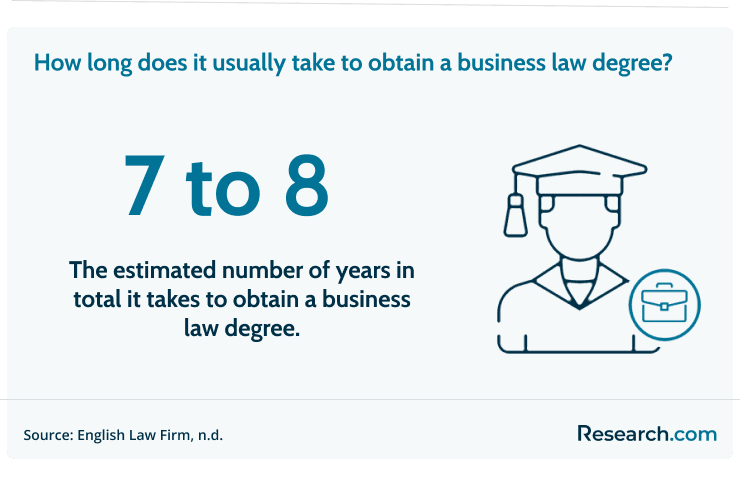
The timeline depends on the credential you choose. For students who want to become practicing lawyers, the traditional path often takes seven to eight years in total: four years for a bachelor’s degree followed by a three-year Juris Doctor program. Students who choose non-JD business law or legal studies programs may finish sooner, while part-time and online formats may extend the schedule.
| Pathway | Typical timeline stated for this pathway | Best for |
| Bachelor’s degree with business law coursework | Typically four years | Students preparing for business, compliance, paralegal, pre-law, or graduate study. |
| JD with business law concentration | Often part of the seven to eight years total when combined with undergraduate study | Students who want to become attorneys and pursue bar admission. |
| MBA in Business Law | Typically 1–2 years | Professionals seeking leadership, compliance, consulting, or management roles rather than legal licensure. |
| JD/MBA or combined program | May shorten the overall path compared with completing both degrees separately | Students aiming for senior corporate, legal, transactional, or executive roles. |
| Online or part-time program | May take longer but can offer more scheduling flexibility | Working adults balancing school with employment or family responsibilities. |
Several factors can change your actual completion time, including transfer credits, course load, whether the program runs year-round, internship or clinic requirements, and whether you study full time or part time. Some students first enter the legal field through support roles, such as those researching how to get into criminal law as a paralegal, before deciding whether to pursue a business law degree or JD.
What skills do you gain from a business law degree?
A business law degree develops more than legal vocabulary. It trains students to read complex rules, identify risk, communicate clearly, and make decisions where legal, financial, ethical, and operational priorities overlap.
| Skill | How it is used in business law work |
| Legal research and analysis | Interpreting statutes, cases, contracts, policies, and regulations to answer practical business questions. |
| Contract review and drafting | Spotting unclear terms, negotiating obligations, identifying risks, and protecting organizational interests. |
| Negotiation and dispute resolution | Helping parties reach agreements, settle conflicts, and avoid unnecessary litigation. |
| Critical thinking | Breaking down complex legal or regulatory problems and comparing possible solutions. |
| Business literacy | Understanding how legal choices affect operations, finance, reputation, growth, and governance. |
| Professional communication | Writing memos, policies, legal summaries, contract language, board materials, and client updates. |
| Ethical judgment | Recognizing when a decision may be technically legal but still risky, unfair, or harmful to stakeholders. |
| Time management | Handling deadlines, document review, negotiations, filings, meetings, and competing priorities. |
Business law also teaches students to respect professional boundaries. That idea appears across regulated fields. For example, healthcare professionals study the scope of practice for FNP to understand what they are legally allowed to do; business law students similarly learn when they can provide business guidance, when an attorney is required, and when a compliance issue needs escalation.
What are the typical admission requirements for a business law degree?
Admission requirements vary by degree level and institution. An undergraduate business law program is usually evaluated differently from a master’s program, MBA, JD, or certificate. Still, most schools look for evidence that applicants can handle reading-intensive coursework, analytical writing, and complex problem-solving.
- Educational background: Undergraduate applicants generally need a high school diploma or equivalent. Graduate, MBA, and JD applicants generally need a bachelor’s degree.
- Academic performance: Many competitive programs expect a GPA of 3.0 or higher, while highly selective law schools may expect stronger records.
- Standardized tests: Some programs may request LSAT or GMAT scores, especially for JD, MBA, or graduate-level admissions. Test-optional policies vary by institution.
- Letters of recommendation: Schools may ask for references from teachers, professors, supervisors, or employers who can discuss your academic readiness, work ethic, writing ability, or leadership potential.
- Personal statement or essay: Applicants often explain why they want to study business law, how the program supports their goals, and what experiences have prepared them for the field.
- Resume or professional experience: Graduate and MBA programs may value work in business, compliance, law, finance, human resources, government, consulting, or regulated industries.
Questions to ask admissions advisors before applying
- Does the program prepare students for legal practice, business roles, compliance work, or all three?
- If the program is online, does it have the same academic recognition as the campus version?
- Are internships, clinics, capstones, or employer projects available?
- What percentage of students are working professionals?
- Will transfer credits, prior graduate credits, or professional credentials reduce the time to completion?
- For JD programs, does the degree satisfy bar eligibility requirements in the state where you plan to practice?
What careers can you pursue with a business law degree?
Business law graduates can work in law firms, corporate legal departments, compliance teams, consulting firms, financial institutions, government agencies, nonprofits, startups, and regulated industries. The right role depends heavily on the credential earned. A JD and law license open attorney roles, while non-JD programs often support compliance, operations, contracts, policy, and risk management positions.
| Career path | Salary figure provided | What the role typically involves | Usually requires law license? |
| Corporate Lawyer | $144,688 | Advises businesses on transactions, governance, intellectual property, contracts, mergers, acquisitions, and compliance risks. | Yes |
| Compliance Officer | $98,949 | Creates policies, monitors regulatory requirements, conducts audits, trains employees, and helps prevent violations. | Usually no |
| Contract Manager | $106,387 | Drafts, reviews, tracks, and negotiates agreements while coordinating with legal, finance, procurement, and operations teams. | Usually no |
| Business Consultant | $116,358 | Helps organizations improve processes, manage risk, align operations with regulations, and solve business problems. | Usually no |
| In-House Counsel | $198,753 | Provides legal advice directly to a company on employment matters, contracts, governance, litigation, compliance, and strategy. | Yes |
Some business law careers benefit from complementary technical knowledge. For instance, professionals interested in corporate tax planning, financial compliance, or internal advisory work may compare business law training with an accelerated master's in taxation management online degree. Salary figures should be treated as reference points, not guaranteed outcomes; location, employer type, credentials, experience, and market conditions can all affect pay.
The chart below summarizes selected roles, salary figures, and responsibilities for business law-related careers.
What concentrations are available in business law programs?
Concentrations help students align business law training with a target industry, practice area, or professional function. Choosing a concentration is most useful when it matches the type of employer you want to work for and the problems you want to solve.
| Concentration | What it covers | Best fit for students interested in |
| Corporate Law | Business formation, mergers, acquisitions, governance, securities issues, fiduciary duties, and shareholder rights. | Corporate practice, in-house legal work, executive advisory roles, startups, and transaction-heavy environments. |
| Intellectual Property Law | Patents, trademarks, copyrights, trade secrets, licensing, infringement, and protection of intangible assets. | Technology, media, entertainment, life sciences, creative industries, and innovation-driven companies. |
| Tax Law | Federal, state, and international tax rules, planning, reporting, audits, and dispute resolution. | Corporate tax, accounting-adjacent roles, wealth planning, business structuring, and government tax work. |
| International Business Law | Trade rules, cross-border contracts, global compliance, import/export issues, and international dispute resolution. | Multinational companies, logistics, finance, trade compliance, and global consulting. |
| Employment and Labor Law | Workplace rights, employer obligations, labor relations, employment contracts, discrimination, benefits, and workplace disputes. | Human resources, employment law practice, compliance, workplace investigations, and employee relations. |
| Bankruptcy and Financial Restructuring Law | Insolvency, debt negotiation, creditor and debtor rights, restructuring plans, and bankruptcy proceedings. | Financial services, distressed companies, bankruptcy practice, turnaround consulting, and creditor representation. |
| Environmental and Sustainability Law | Environmental regulations, resource management, pollution control, corporate sustainability, and ESG compliance. | Energy, manufacturing, sustainability consulting, government agencies, and regulated industries. |
Students drawn to global markets sometimes compare international business law with quantitative business programs such as an accelerated online bachelor's degree in economics, because both can strengthen analysis of markets, policy, and regulation.
What is the difference between an MBA in Business Law and a JD with a Business Law concentration?
The main difference is licensure and depth of legal training. An MBA in Business Law is a business degree that adds legal knowledge for managers, consultants, executives, compliance professionals, and entrepreneurs. A JD with a Business Law concentration is a professional law degree designed for students who want rigorous legal training and, after meeting state requirements, the option to sit for the bar exam and practice law.
| Factor | MBA in Business Law | JD with Business Law concentration |
| Primary focus | Business strategy, leadership, finance, management, governance, and legal risk. | Legal doctrine, case analysis, legal writing, advocacy, professional responsibility, and business law practice. |
| Career direction | Management, consulting, compliance, operations, risk, entrepreneurship, or executive roles. | Attorney roles, corporate law practice, in-house counsel, litigation support, transactions, and legal advising. |
| Licensure outcome | Does not by itself qualify graduates to practice law. | Can lead to bar eligibility, subject to state rules and program approval. |
| Time to complete | Typically 1–2 years. | Usually requires three years of full-time study. |
| Best choice if you want to | Use legal knowledge to make better business decisions. | Represent clients, provide legal counsel, or work as a licensed attorney. |
An MBA route can make sense for professionals who want leadership mobility and legal fluency without becoming lawyers. For example, someone comparing RN MBA jobs may be more interested in management and compliance than litigation. A JD is the stronger choice for students who want the authority and responsibility that come with legal practice.
How to choose between the two
- Choose the MBA if you want to lead teams, manage risk, advise executives, or improve business decisions with legal awareness.
- Choose the JD if you want to practice law, represent clients, draft legal opinions, appear in court, or become in-house counsel.
- Consider a dual JD/MBA if your target roles require both advanced legal training and high-level business strategy.
- Do not assume an MBA concentration can substitute for a JD when a role requires a licensed attorney.
Is business law a good major for future career growth?
Business law can be a strong major or specialization for students who want adaptable skills in a regulated economy. Companies must manage contracts, employment rules, privacy obligations, tax issues, financial reporting, global transactions, intellectual property, and compliance programs. That creates ongoing demand for professionals who can connect legal risk with business decisions.
According to U.S. labor market projections, overall employment in business and financial occupations is expected to grow faster than the average for all occupations from 2023 to 2033. Approximately 963,500 openings are projected each year, on average. Those openings are not all business law jobs, but the projection shows that business and financial roles remain broad employment areas for legally informed professionals.
Current trends affecting business law careers
- AI and contract automation: Employers increasingly use legal technology for document review, contract management, e-discovery, and compliance monitoring. Graduates still need human judgment to interpret risk, negotiate terms, and handle exceptions.
- Data privacy and cybersecurity: Businesses face growing expectations around data handling, privacy policies, breach response, vendor risk, and cyber governance.
- Global regulatory complexity: Cross-border trade, supply chains, sanctions, and multinational operations require professionals who understand more than one legal and business environment.
- ESG and sustainability compliance: Companies are paying closer attention to environmental, social, and governance obligations, reporting, and reputational risk.
- Credential-based hiring: Employers may prefer candidates who combine a degree with targeted credentials in compliance, privacy, finance, mediation, or project management.
Students comparing business law with other legal or justice-related careers may also review criminal justice jobs salary information to understand how role type, credentials, and sector can influence earning potential.

What additional licenses or certifications do business law graduates need to practice?
The credentials you need depend on what you want to do. A business law degree alone does not automatically make someone a lawyer. Attorney roles generally require a JD, bar passage, and satisfaction of state character and fitness requirements. Non-attorney business law roles may not require licensure, but certifications can strengthen credibility in specialized fields.
| Credential | Who may need it | Why it matters |
| Bar Admission | Graduates who want to practice as attorneys. | Required to provide legal counsel, represent clients, and practice law under state rules. |
| Certified Compliance and Ethics Professional (CCEP) | Compliance, ethics, governance, and risk professionals. | Signals knowledge of compliance programs, ethics standards, and corporate risk controls. |
| Chartered Financial Analyst (CFA) | Professionals working with finance, securities, investment, or corporate transactions. | Demonstrates advanced financial analysis and ethical standards relevant to finance-heavy roles. |
| Certified Information Privacy Professional (CIPP) | Students targeting privacy, cybersecurity, data governance, or technology compliance. | Supports roles involving privacy laws, data protection, and risk mitigation. |
| Mediation or Arbitration Certification | Professionals interested in alternative dispute resolution. | Helps graduates facilitate settlements and structured dispute resolution outside court. |
Licensing rules matter because professional authority has limits. That issue is not unique to law. In healthcare, for example, professionals may ask can NP prescribe medication because legal authority depends on state rules and role scope. Business law students should use the same mindset: verify what a credential allows before relying on it for career planning.
What are some of the top-paying industries for lawyers in the U.S.?
Compensation for lawyers varies widely by practice area, employer, experience, geography, client base, and specialization. The roles below are examples of higher-paying or financially significant legal paths often connected to business law, intellectual property, tax, restructuring, or corporate advisory work.
| Legal role | Salary figure provided | Typical work |
| Patent Attorney | $247,842 | Helps clients secure patents, protect inventions, and manage technically complex intellectual property matters. |
| Corporate Attorney | $206,314 | Handles transactions, contracts, governance, mergers, acquisitions, and regulatory obligations for businesses. |
| Tax Attorney | $102,000 | Advises on federal, state, and international tax law, planning, compliance, audits, and disputes. |
| Family Lawyer | $110,033 | Works on divorce, custody, adoption, and family-related legal matters; this path is not business-law-specific but remains a common legal specialization. |
| Bankruptcy Lawyer | $102,333 | Guides individuals or businesses through restructuring, liquidation, creditor issues, and federal bankruptcy procedures. |
| Intellectual Property Attorney | $188,072 | Protects creative works, brands, inventions, trade secrets, licensing rights, and IP portfolios. |
Specialization can shape both earnings and career direction. The same is true outside law: choosing a focused credential such as an accelerated graduate certificate in supply chain and logistics management online can help professionals target a specific business function rather than pursuing a broad credential with no clear plan.
The chart below highlights selected high-paying legal fields and the different types of work they involve.
What unconventional career paths can a business law degree unlock?
A business law background can lead to roles outside traditional law firms. Graduates may work in regulatory investigations, procurement, privacy operations, ethics offices, startup advisory, nonprofit governance, government contracting, risk consulting, financial crime compliance, supply chain compliance, or public-private partnerships.
These paths are especially relevant for students who like legal analysis but do not necessarily want a courtroom-centered career. A candidate interested in enforcement, investigations, and regulated industries might also explore pathways such as how to become a DEA agent, where legal rules, documentation, compliance, and investigative judgment intersect.
Who should choose a business law degree?
A business law degree is most useful when you can connect it to a specific professional outcome. It is not the best choice simply because law “sounds versatile.” The value comes from matching the credential to your target role.
| Business law may be a good fit if you... | You may want another path if you... |
| Enjoy reading, writing, analysis, negotiation, and complex rules. | Dislike dense documents, detailed research, or policy-heavy work. |
| Want to work with contracts, compliance, governance, employment issues, tax, IP, or transactions. | Want a hands-on technical career with minimal legal or administrative responsibility. |
| Plan to become an attorney and are prepared for the JD and bar process. | Assume a non-JD business law degree will allow you to practice law. |
| Already work in business and want to move into risk, compliance, contracts, or leadership. | Need a short-term credential but have not identified a target job. |
| Want a career that blends legal knowledge with business strategy. | Prefer pure finance, marketing, data science, or operations without legal specialization. |
How to choose the right business law program
Before enrolling, compare programs based on outcomes, not only course titles. A strong program should fit your credential needs, schedule, budget, and target career.
- Start with your career goal. Decide whether you want to practice law, move into compliance, manage contracts, advise executives, specialize in tax or IP, or prepare for graduate study.
- Confirm licensure implications. If you want to become an attorney, verify JD accreditation and bar eligibility in your state before applying.
- Review the curriculum. Look for courses in contracts, corporations, compliance, legal writing, negotiation, employment law, tax, and any specialization you need.
- Check practical learning opportunities. Clinics, internships, externships, capstones, simulations, contract drafting labs, and employer projects can make the degree more useful.
- Evaluate faculty experience. Instructors with corporate, regulatory, litigation, compliance, or in-house experience can add practical context.
- Compare total cost, not just tuition. Include fees, books, technology, travel, lost work time, bar preparation, and credential costs.
- Ask about career support. Review employer connections, alumni outcomes, internship placement, resume support, and interview preparation.
- Consider flexibility carefully. Online or part-time formats can help working adults, but students should verify workload expectations and networking access.
Common mistakes to avoid
- Choosing a program without checking accreditation or bar eligibility. This is especially risky for students planning to practice law.
- Assuming every business law degree leads to attorney roles. A JD and law license are typically required for legal practice.
- Focusing only on tuition. A low-cost program may not be the best value if it lacks internships, employer connections, or relevant coursework.
- Ignoring transfer credit policies. Prior credits can affect completion time and cost, but policies differ by school.
- Relying only on rankings. A highly ranked program may still be a poor fit if it does not offer your desired concentration or schedule.
- Choosing a concentration too early without researching jobs. Specializations should match employer demand and your actual interests.
- Assuming salary figures are guaranteed. Pay depends on credentials, location, experience, employer type, practice area, and economic conditions.
- Overlooking technology skills. Contract platforms, compliance systems, legal research tools, and AI-assisted workflows are increasingly part of business law work.
Key Insights
- A business law degree teaches how legal rules affect companies, contracts, compliance, risk, governance, employment, taxes, intellectual property, and transactions.
- The right credential depends on whether you want to practice law. A JD with bar admission is the attorney pathway; an MBA, legal studies degree, certificate, or undergraduate major may be better for business, compliance, or contract roles.
- The traditional lawyer pathway often takes seven to eight years in total, while an MBA in Business Law typically takes 1–2 years and a JD usually requires three years of full-time study.
- Career options include Corporate Lawyer ($144,688), Compliance Officer ($98,949), Contract Manager ($106,387), Business Consultant ($116,358), and In-House Counsel ($198,753), but salaries are not guaranteed.
- Useful concentrations include corporate law, intellectual property, tax law, international business law, employment and labor law, bankruptcy and restructuring, and environmental and sustainability law.
- Business and financial occupations are projected to grow faster than average from 2023 to 2033, with approximately 963,500 openings projected each year, on average, but students should connect this broad outlook to specific roles and credentials.
- Before enrolling, verify accreditation, licensure outcomes, curriculum depth, practical training, total cost, career services, and whether the program fits your target job.
References:
- Birt, J. (2025). 11 of the Highest-Paying Lawyer Roles (With Salary Info). Indeed Career Guide
- English Law Firm. (n.d.). How Long to Become a Business Lawyer? ELF
- Glassdoor. (2025). Salary: Intellectual Property Lawyer in the United States 2025. Glassdoor
- U.S. Bureau of Labor Statistics. (2025). Occupational Outlook Handbook: Business and Financial Occupations. U.S. BLS
- Ziprecruiter. (2025). Salary: Corporate Lawyer, United States. Ziprecruiter corporate lawyer salary data
Other things you should know about business law degree courses and concentrations
In 2027, many business law degree programs offer hybrid models that incorporate online learning for flexibility. While core courses may be available online, institutions often require in-person participation for specialized courses and networking opportunities, ensuring students gain practical experience and personal interaction essential in the legal field.
While not always mandatory, internships are highly recommended as they provide real-world experience in legal and corporate environments. Many programs integrate internships, externships, or clinical opportunities as part of their curriculum to develop practical skills.
Students gain exposure to legal research, compliance processes, and client interaction under professional supervision. Completing an internship can significantly improve job prospects and help build a professional network.
Internships are crucial for business law degrees in 2027, though not always mandatory. They offer practical experience and networking opportunities, which enhance learning and career prospects. Many programs encourage internships to develop practical skills applicable to real-world legal and business environments.
Concentrations allow students to develop expertise in high-demand legal areas such as tax law, intellectual property, or international business law. Specializing can lead to higher salaries and positions in niche industries requiring advanced knowledge. Employers often seek candidates with targeted skills, making graduates with specialized training more competitive.
By selecting the right concentration, students can align their education with their long-term career goals and industry needs.


