
2027 Fastest Online Master's Programs in Business Law

Co-Founder and Chief Data Scientist
The modern business world is fast-paced and highly regulated. As such, a strong understanding of business law is very valuable. From navigating corporate contracts to ensuring compliance with global trade policies, legal expertise is essential for professionals in a wide range of industries.
Needless to say, earning a master’s degree in business law can open doors to advanced roles in legal consulting, compliance management, and corporate leadership. And thanks to online and accelerated options, you can now earn this career-boosting credential in less time and with greater flexibility.
In this article, we will guide you through the fastest online master’s programs in business law, helping you find a program that fits your goals, schedule, and budget. We will also answer some of the most common questions regarding this degree to help you make informed decisions.
What are the benefits of obtaining an online master's degree in business law?
- Career-Advancing Legal Expertise: A master’s in business law equips you with a deep understanding of legal principles in corporate settings, helping you qualify for roles in compliance, contract management, and executive leadership.
- Flexible Learning from Anywhere: Online programs allow you to study on your own schedule, making it easier to balance your education with work, family, or other responsibilities—no need to relocate or commute.
- Accelerated Path to Graduation: Many programs offer accelerated formats, allowing you to complete your degree in as little as 12–18 months, so you can apply your new skills—and earn a higher salary—sooner.
- Cost-Efficient and Career-Focused: Online degrees often come with lower tuition rates and fewer expenses, while still offering access to the same rigorous curriculum and professional networks as on-campus programs.
What can I expect from online master's programs in business law?
Online master’s programs in business law are designed to provide a comprehensive understanding of the legal frameworks that govern business operations—delivered in a format that fits your lifestyle. You can expect a curriculum that covers key areas such as corporate law, international business transactions, intellectual property, regulatory compliance, and contract negotiation. Most programs combine theory with real-world case studies to help you apply legal principles in practical business scenarios.
Coursework is typically delivered through a mix of video lectures, interactive modules, discussion boards, and written assignments. Many programs are asynchronous, meaning you can access materials and complete tasks on your own schedule, though some may include occasional live sessions or group projects.
You’ll also have access to digital libraries, academic advisors, and networking opportunities with peers and faculty—all online. Whether you’re looking to advance in your current career or pivot to a new role, these programs are structured to deliver high-impact knowledge without putting your life on hold.
Where can I work with an online master's degree in business law?
An online master’s degree in business law can open the door to a wide range of career opportunities across both legal and corporate sectors. This versatile credential is especially valuable in roles that require a solid understanding of legal principles without the need to become a licensed attorney. Graduates often find positions in areas such as:
- Corporate Compliance and Risk Management: Helping businesses stay in line with laws and regulations while minimizing legal and financial risks.
- Contract and Commercial Management: Drafting, reviewing, and negotiating contracts for companies, suppliers, and clients.
- Legal and Policy Advisory Roles: Offering strategic legal insight to executives, nonprofits, or government agencies on matters like intellectual property, labor laws, or international trade.
- Business Consulting and Leadership: Applying legal expertise in executive, managerial, or consulting roles where knowledge of legal frameworks enhances decision-making and corporate strategy.
Whether in private companies, global corporations, regulatory bodies, or NGOs, the knowledge gained from this degree helps you stand out in a competitive job market while offering flexibility to work across industries and borders.
How much can I make with an online master's degree in business law?
Salaries for professionals with an online master’s degree in business law can vary widely based on factors like job title, industry, location, and prior experience—but the degree often leads to well-paying roles. Graduates can expect to earn competitive salaries, especially in legal, compliance, and corporate leadership positions. Here’s a general idea of what you might earn:
- Compliance Managers: $90,000–$130,000 per year, with senior roles earning more depending on the organization and industry.
- Contract Managers: $80,000–$110,000 annually, particularly in sectors like tech, healthcare, or government.
- Legal Consultants and Policy Advisors: $75,000–$120,000 depending on experience and specialization.
- Corporate Executives with Legal Expertise: Over $150,000 annually, especially in finance, healthcare, and multinational firms.
Choosing an accelerated online program can help you reach these earning levels faster, giving you an early return on your educational investment while building long-term career growth.
- List of the Fastest Online Master’s Programs in Business Law for 2027 List of Programs
- What are the prerequisites for enrolling in an online master's program in business law? Requirements
- How long does it typically take to earn an online master's degree in business law? How long does it typically take to earn an online master's degree in business law?
- What is the average cost of an online master's programs in business law? Cost
- What are the financial aid options for students enrolling in online master's programs in business law? Financial Aid
- What courses are typically included in online master's programs in business law? Courses
- How do I choose the best among the fastest online master's programs in business law? How do I choose the best among the fastest online master's programs in business law?
- What are the differences between on-campus and online master's programs in business law? Online vs. On-Campus
- How do employers view online master's degrees in business law? How do employers view online master's degrees in business law?
- What career paths are available for graduates of online master’s programs in business law? What career paths are available for graduates of online master’s programs in business law?
- What is the job outlook for graduates of online master’s programs in business law? Job Outlook
- What are the potential challenges of pursuing an online master's in business law? What are the potential challenges of pursuing an online master's in business law?
- How Can Business Law Studies Complement Intelligence Disciplines? How Can Business Law Studies Complement Intelligence Disciplines?
Fastest Online Master’s Programs in Business Law for 2027
A fast online master’s in business law can help working professionals build legal fluency for contracts, compliance, governance, risk management, and corporate decision-making without enrolling in a JD program. The key decision is not simply which program is shortest. You also need to know whether the degree matches your career goal, whether the school is accredited, how much the credential will cost, and whether the curriculum fits the legal issues you handle at work.
This guide is for professionals comparing accelerated online business law master’s programs, including Master of Legal Studies and Master of Arts in Law options. You will learn which programs can be completed quickly, what admission requirements to expect, how online and campus formats differ, what courses are common, how employers may view the credential, and how to evaluate cost, career fit, and return on investment before applying.
Quick Answer: What Is the Fastest Online Master’s in Business Law?
The fastest online master’s programs in business law can typically be completed in 12 to 15 months by full-time students. Among the programs listed here, Pepperdine University and American University offer options that can be finished in as few as 12 months, while the University of Oklahoma offers an accelerated online Master of Legal Studies in International Business Law that can be completed in as little as 15 months.
Most business law master’s programs are designed for non-lawyers. They can strengthen careers in compliance, contracts, operations, risk, consulting, government affairs, and corporate leadership, but they generally do not qualify graduates to sit for the bar exam or practice law as attorneys.
How We Evaluated These Programs
Research.com rankings are built from institutional and program data reviewed by our research team. Key data sources include the Integrated Postsecondary Education Data System, Peterson’s data resources, the College Scorecard, and the National Center for Education Statistics.
Because a graduate degree in business law can represent a substantial financial and time commitment, our approach emphasizes transparency, completion options, cost information, accreditation, and program structure. For a fuller explanation of how Research.com evaluates schools and programs, review our ranking methodology.
Fastest Online Master’s in Business Law Programs Compared
| School | Program | Fastest Listed Completion Time | Credits | Cost or Tuition Information | Accreditation |
| University of Oklahoma | Master of Legal Studies, International Business Law track | 15 months | 32 | $20,000 | Higher Learning Commission |
| Arizona State University | Master of Legal Studies, emphasis on Business Law | 1 year full-time | 30 | $61,339 resident; $69,339 non-resident | Southern Association of Colleges and Schools Commission on Colleges |
| Regent University | Master of Arts in Law – Business Law | 1.5 years | 32 | $715 per credit hour | Southern Association of Colleges and Schools Commission on Colleges |
| Pepperdine University | Master of Legal Studies | 1 year | 26 | $2,680 per credit | Western Association of Schools and Colleges—Senior College and University Commission (WSCUC) |
| American University | Master of Legal Studies, Business concentration | 1 year | 30 | $2,386 per credit | Middle States Commission on Higher Education |
1. University of Oklahoma
The University of Oklahoma offers an online Master of Legal Studies through OU Law with a concentration in International Business Law. The program is built for professionals who want legal knowledge for global business, cross-border transactions, regulatory issues, and organizational decision-making rather than attorney licensure.
Students can complete the program in as little as 15 months while continuing to work full-time. OU Law offers two start dates per year, and online courses include faculty interaction through discussions, video calls, and applied learning activities.
- Program: Master of Legal Studies, International Business Law track
- Program length: 15 months
- Credits required: 32
- Cost: $20,000
- Accreditation: Higher Learning Commission
2. Arizona State University
Arizona State University, through the Sandra Day O’Connor College of Law, offers an online Master of Legal Studies with an emphasis on business law. The program uses a 30-credit curriculum made up of 10 asynchronous courses delivered in accelerated 8-week sessions.
The curriculum focuses on legal issues businesses face across formation, regulatory compliance, strategic planning, and transactions involving the purchase or sale of businesses. Students also study business environments connected to law firms, publicly traded companies, and federal and state regulatory agencies.
- Program: Master of Legal Studies, emphasis on Business Law
- Program length: 1 year full-time
- Credits required: 30
- Program cost: $61,339 resident; $69,339 non-resident
- Accreditation: Southern Association of Colleges and Schools Commission on Colleges
3. Regent University
Regent University offers a fully online Master of Arts in Law – Business Law program for students who want graduate-level legal training for organizational compliance, contracts, transactions, and negotiations. The program combines business management and contract law and is taught from a Christian perspective.
This degree can support advancement in nonprofit advocacy, corporate administration, compliance-oriented roles, and executive leadership. However, it is not a JD and does not make graduates eligible to sit for the bar exam in any state. The program is listed as Master of Arts in Law – Business Law, with a planned change to Master of Legal Studies in Spring 2026.
- Program: Master of Arts in Law – Business Law, to be changed to Master of Legal Studies in Spring 2026
- Program length: 1.5 years
- Credits required: 32
- Tuition per credit hour: $715
- Accreditation: Southern Association of Colleges and Schools Commission on Colleges
4. Pepperdine University
Pepperdine University offers an online Master of Legal Studies that helps students understand the U.S. legal system as it applies to contracts, compliance, negotiation, and business operations. The program may be a strong fit for entrepreneurs, nonprofit employees, managers, and corporate professionals who need to work with legal issues but do not plan to practice law.
Students can personalize the curriculum with electives such as business organizations and intellectual property. Full-time students who take 8 units per term can complete the program in as little as 12 months.
- Program: Master of Legal Studies
- Program length: 1 year
- Credits required: 26
- Tuition per credit: $2,680
- Accreditation: Western Association of Schools and Colleges—Senior College and University Commission (WSCUC)
5. American University
American University offers an online Master of Legal Studies with a Business specialization. Students who choose the Business concentration earn a certificate along with the MLS degree.
Courses in this concentration include Business Associations, Banking and Financial Services Compliance, Management of Organizations and Human Capital, and Business Law, Ethics, and Governance. Full-time students can complete the program in as few as 12 months.
- Program: Master of Legal Studies, Business concentration
- Program length: 1 year
- Credits required: 30
- Tuition per credit: $2,386
- Accreditation: Middle States Commission on Higher Education
What Are the Prerequisites for an Online Master’s Program in Business Law?
Most online master’s programs in business law are open to applicants from many academic and professional backgrounds. These degrees are commonly designed for business, compliance, operations, human resources, finance, nonprofit, public sector, and consulting professionals who need legal knowledge but are not pursuing attorney licensure.
- Bachelor’s degree: Applicants generally need a completed undergraduate degree from an accredited institution. A law or business major is not always required, although related preparation can be helpful.
- Minimum GPA: Many programs expect a minimum GPA, often around 2.5 to 3.0. Some schools may review lower GPAs through conditional admission or a holistic admissions process.
- Professional experience: Work experience in business, law, compliance, contracts, risk, finance, human resources, or public policy may strengthen an application, even when it is not mandatory.
- Application documents: Common requirements include official transcripts, a resume, a statement of purpose, and recommendation letters. GRE or LSAT scores are rarely required for these programs.
Before applying, confirm whether the program is meant for non-lawyers, whether it requires prior legal coursework, and whether it offers academic support for students without a law background.
The chart below shows that legal studies and business are among the most popular undergraduate majors for corporate lawyers.
How Long Does It Take to Earn an Online Master’s in Business Law?
Completion time depends on the number of required credits, term length, course load, and whether the program offers year-round enrollment. Many traditional online programs take 18 to 24 months for part-time students. Accelerated formats can shorten that timeline to 12 to 15 months for students who study full-time or take condensed terms.
Programs using 8-week courses, multiple start dates, or continuous enrollment may be easier to complete quickly. However, faster is not always better. A 12-month program can be demanding for students who work full-time, travel frequently, or have caregiving responsibilities.
| Study Pace | Typical Completion Pattern | Best For | Trade-Off |
| Full-time accelerated | Often 12 to 15 months | Students who can handle a heavy weekly workload | Less flexibility and more academic pressure |
| Part-time online | Often 18 to 24 months | Working professionals balancing school with job or family obligations | Longer time before graduation |
| Flexible pacing | Varies by school and course availability | Students whose workload changes by season | Requires careful planning to avoid delays |
If you are comparing accelerated degrees across fields, Research.com also covers options such as an accelerated online early childhood development degree and an accelerated business degree. The same planning principle applies: check credit load, transfer rules, course frequency, and whether the advertised completion time reflects a realistic schedule for working adults.
What Is the Average Cost of an Online Master’s Program in Business Law?
Online master’s programs in business law can vary widely in price. Based on the cost ranges provided for these programs, students may see total program costs from about $15,000 to $35,000 on average, while some private university options cost more depending on per-credit tuition and required credits.
Many schools charge tuition by credit hour. Programs commonly require 30 to 36 credits, and per-credit tuition may range from $500 to $1,200, though several programs listed in this guide publish higher per-credit rates. Cost also depends on fees, books, technology charges, residency requirements, and whether a public university charges different rates for resident and non-resident students.
| Cost Factor | Why It Matters | Question to Ask |
| Tuition model | Per-credit pricing can make shorter programs less expensive, but not always. | What is the total program cost, not just the per-credit rate? |
| Required credits | A 26-credit program and a 36-credit program can have very different total costs. | How many credits are required to graduate? |
| Fees | Online, technology, graduation, and student service fees can increase the bill. | Which fees are mandatory for online students? |
| Employer benefits | Tuition reimbursement can reduce out-of-pocket cost for working professionals. | Does my employer cover legal, compliance, or business graduate study? |
| Time to completion | Finishing sooner may reduce some costs, but only if the course load is manageable. | Can I realistically complete this program on the accelerated schedule? |
Students comparing tuition across online professional programs may also want to review Research.com guides on accelerated online STEM education programs and the cost of an online business degree to understand how program format, institution type, and credit requirements affect total price.
What Financial Aid Options Are Available?
Graduate students in accredited online business law programs may be able to use several types of financial aid. Eligibility depends on the school, the program, enrollment status, and the student’s financial profile.
- Federal financial aid: Students can complete the FAFSA to determine eligibility for federal loans and, in some cases, other aid. Confirm that the online program is eligible for federal aid before enrolling.
- Scholarships and grants: Universities, law schools, private foundations, and professional organizations may offer awards for graduate students in legal studies, business, compliance, public policy, or related fields.
- Employer tuition assistance: Companies may help pay for degrees that improve an employee’s ability to manage contracts, compliance, risk, governance, or business operations.
- Payment plans and institutional aid: Some schools allow students to spread tuition payments across a term or offer school-funded aid for online graduate learners.
Do not assume that a faster degree automatically produces a better financial return. Compare total cost, likely career use, employer support, and whether the degree is necessary for your target role. Students exploring cost-saving pathways in other fields can compare similar planning considerations in Research.com’s guide to an accelerated online degree in corrections.
The chart below uses chief compliance officer compensation as one example of how senior legal-risk and compliance roles may be compensated.
What Courses Are Included in an Online Master’s in Business Law?
An online master’s in business law, often structured as an MLS or legal studies degree, combines legal foundations with practical business applications. Students learn how laws affect contracts, organizations, employment decisions, regulatory obligations, intellectual property, and cross-border business activity.
For a broader look at legal studies options, Research.com also maintains a guide to affordable online master’s in legal studies programs.
| Course Area | What Students Learn | Career Relevance |
| Business organizations and corporate law | How corporations, partnerships, and LLCs are formed, governed, and regulated | Useful for managers, founders, consultants, and corporate operations staff |
| Contract law | Contract creation, interpretation, breach, enforcement, and remedies | Important for procurement, vendor management, sales operations, and contract administration |
| Regulatory compliance and risk management | How organizations identify legal obligations and reduce regulatory exposure | Core preparation for compliance, audit, governance, and risk roles |
| Intellectual property law | Business use of trademarks, copyrights, patents, trade secrets, and innovation protections | Relevant for technology, media, product, startup, and creative industries |
| International business law | Legal issues in global trade, international contracts, and multinational operations | Helpful for global business, supply chain, import/export, and multinational compliance |
| Employment and labor law | Legal issues involving hiring, workplace rights, labor relations, and employment policies | Useful for HR, operations, compliance, and management roles |
| Legal research and writing | How to read legal sources, analyze legal issues, and communicate legal conclusions clearly | Valuable for policy writing, contract review, compliance documentation, and executive briefings |
Some programs also allow electives in areas such as health law, cybersecurity law, real estate law, financial services compliance, or governance. Choose electives based on the industry where you plan to use the degree.
How Do You Choose the Best Fast Online Master’s in Business Law?
The best program is the one that matches your career objective, budget, schedule, and learning preferences. A program advertised as “fast” may not be the right choice if the curriculum does not cover your target field or if the workload is unrealistic alongside your job.
- Verify accreditation first: Choose a program from a regionally accredited institution. Accreditation affects financial aid eligibility, employer recognition, and transfer or further study options.
- Clarify the credential: Understand whether you are earning an MLS, MA in Law, or another legal studies credential. Ask whether the degree is intended for non-lawyers and confirm that it does not provide bar eligibility unless the school explicitly states otherwise.
- Compare total cost: Look beyond tuition per credit. Add required fees, textbooks, residency costs, and the financial impact of taking a heavier course load.
- Match courses to your career: Compliance professionals may need regulatory and risk courses. Contract managers should prioritize contract drafting, negotiation, and procurement-related coursework. Entrepreneurs may value business organizations and intellectual property.
- Study the online format: Asynchronous courses offer flexibility, while synchronous sessions may create more live interaction. Ask how often students meet with faculty, advisors, and classmates.
- Review student support: Strong online programs provide advising, library access, writing support, technology help, and career services designed for remote learners.
- Ask about completion reality: Request the average completion time for working students, not just the fastest possible timeline.
Research.com publishes guides across many accelerated pathways, including highly specific options such as accelerated dental assistant to dental hygienist online programs. Regardless of field, the same rule applies: do not choose a program solely because it is short. Confirm quality, fit, cost, and outcomes.
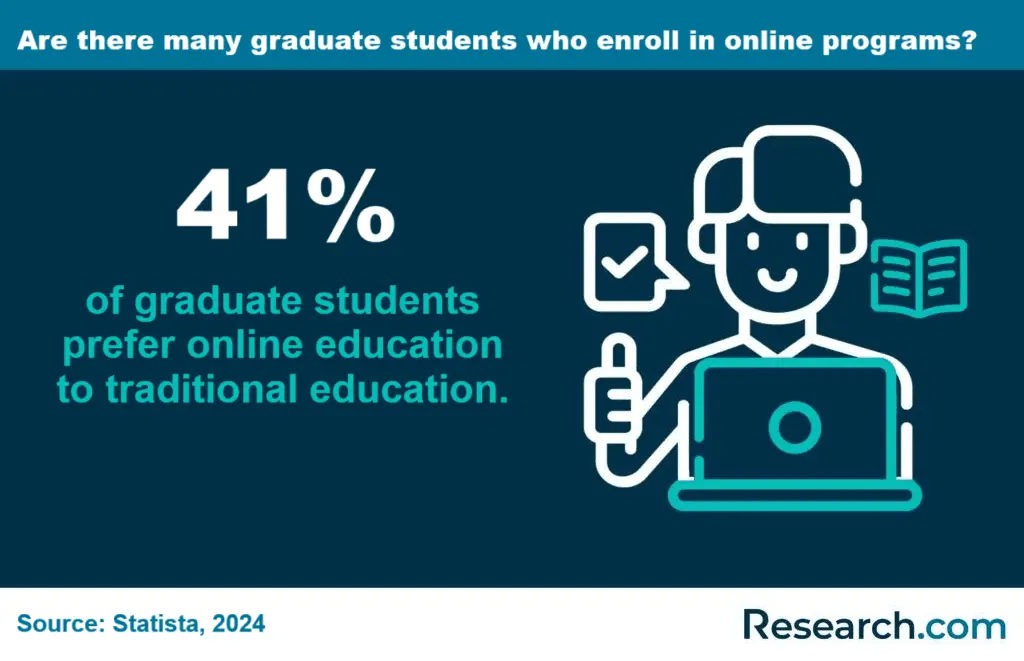
The image below shows that online programs continue to attract graduate students in the United States, including students who believe online education can provide a strong overall learning experience compared with traditional classroom-based study.
Questions to Ask Before You Apply
- Is the institution regionally accredited?
- Is the program designed for non-lawyers, attorneys, or both?
- Does the degree qualify graduates for attorney licensure? If not, is that acceptable for my career goal?
- What is the total cost of attendance, including fees?
- How many hours per week should I expect to spend on coursework in the accelerated format?
- Are courses asynchronous, synchronous, or a mix of both?
- Can I pause or slow down if my work schedule changes?
- Which electives support my target role in compliance, contracts, risk, HR, finance, or international business?
- Does the program provide career services for online students?
- What jobs have recent graduates pursued, and how does the school collect that information?
Online vs. On-Campus Master’s Programs in Business Law
Online and campus-based business law master’s programs can cover similar academic content, but the student experience is different. Your choice should depend on your schedule, need for structure, preferred learning environment, and networking goals.
| Factor | Online Program | On-Campus Program |
| Schedule flexibility | Often better for working professionals because coursework may be asynchronous or offered in shorter terms | Usually requires attendance at set times and locations |
| Completion speed | May offer accelerated formats, year-round courses, or multiple start dates | Often follows a traditional academic calendar |
| Networking | Built through virtual discussions, remote events, group projects, and online alumni communities | May offer more frequent in-person events and informal campus interaction |
| Cost | Can reduce commuting, relocation, and housing expenses, though tuition varies by school | May include additional campus-related expenses |
| Learning style | Best for self-directed students who can manage deadlines independently | Best for students who prefer in-person structure and immediate classroom interaction |
If cost is a major priority, compare tuition and fees carefully. You can also review Research.com’s guide to affordable online legal studies degree programs for additional context.
How Do Employers View Online Master’s Degrees in Business Law?
Employers are generally more likely to value an online master’s in business law when it comes from an accredited institution, has a practical curriculum, and clearly supports the candidate’s role. For jobs involving compliance, contracts, risk, procurement, human resources, finance, operations, or governance, the ability to understand legal issues and communicate with attorneys can be a meaningful advantage.
The credential is strongest when paired with relevant experience. For example, a compliance analyst who completes business law coursework may be better prepared for regulatory review, policy drafting, and internal investigations. A contract administrator may gain stronger negotiation and risk-assessment skills. A manager may become more effective at spotting issues that require legal counsel.
Some professionals also combine a business law master’s with targeted legal support credentials. If you are comparing shorter legal training options, see Research.com’s guide to the quickest online paralegal certification pathways.
What Careers Can You Pursue With an Online Master’s in Business Law?
A business law master’s can prepare graduates for roles where legal knowledge improves business decisions, but it is not a substitute for a JD when a job requires practicing law. The strongest career fit is usually in law-adjacent business functions: compliance, contracts, regulatory affairs, policy, risk, governance, and corporate operations.
If you are still deciding whether this credential is worthwhile, Research.com’s guide on whether a master’s in legal studies is worth it can help you compare career value, cost, and alternatives.
| Career Path | Typical Work | Why Business Law Helps |
| Compliance manager or officer | Develops policies and monitors whether organizational practices align with laws and regulations | Builds knowledge of regulatory obligations, risk controls, governance, and documentation |
| Contract manager or analyst | Reviews, drafts, tracks, and negotiates agreements with vendors, clients, and partners | Strengthens understanding of contract terms, breach, remedies, and negotiation issues |
| Corporate legal advisor in a non-JD role | Supports executives with legal issue spotting, risk review, and coordination with legal counsel | Improves ability to translate legal concepts into business decisions |
| Regulatory affairs specialist | Helps organizations comply with local, federal, or international requirements | Provides a framework for interpreting rules, managing submissions, and reducing exposure |
| Policy analyst or government affairs specialist | Studies laws, regulations, and public policy proposals for agencies, nonprofits, or companies | Develops legal research, analysis, and writing skills for policy-focused work |
The chart below shows average annual salaries for selected occupations that may align with a master’s degree in business law.
What Is the Job Outlook for Business Law Master’s Graduates?
The job outlook for business law master’s graduates depends on the role they pursue, their work experience, industry, location, and whether the position requires attorney licensure. The degree is most relevant to jobs where business decisions intersect with legal risk, regulation, contracts, and governance.
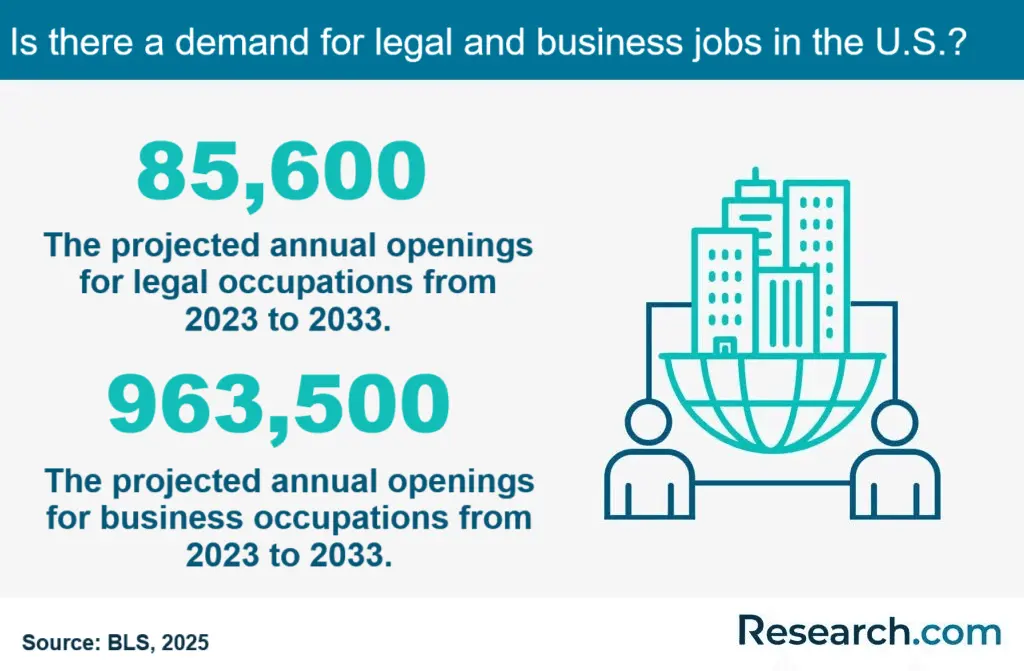
The U.S. Bureau of Labor Statistics business and financial occupations data projects faster-than-average growth for business and financial roles, with nearly 963,500 annual job openings and a median wage of about $80,920 as of May 2024. A business law master’s may be useful for roles within this broad category that involve compliance, risk, contracts, financial services regulation, auditing, or organizational governance.
Related legal occupations also remain relevant, though many attorney roles require a JD and bar admission. Existing projections cited for legal careers include:
- Lawyers are expected to see 5–8% growth through 2032, which could represent an estimated 30,000 jobs, with average salaries between $145,000 and $151,000.
- Paralegals and legal-support roles are projected for approximately 14% job growth through 2032.
Compliance is another important pathway. Existing data cited for compliance roles shows consistent 8% growth, an estimated 30,000 jobs, and strong compensation at senior levels. Chief compliance officer roles in public firms can reach up to $419,000, though compensation varies widely by employer, industry, company size, and leadership responsibility.
Students targeting senior corporate roles can also compare business law with other routes covered in Research.com’s guide to the highest-paying business jobs and careers.
Current Trends Affecting Business Law Graduates
- More legal risk in everyday business decisions: Companies increasingly need employees who can recognize contract, employment, privacy, compliance, and regulatory issues before they escalate.
- Growth of remote and online learning: Online graduate education has become a practical route for working professionals who cannot pause their careers for campus study.
- AI-assisted contract and compliance work: AI tools can support legal research, contract review, monitoring, and document workflows, but professionals still need judgment, policy knowledge, and escalation skills.
- Greater emphasis on cross-functional legal literacy: Employers often want business leaders who can collaborate effectively with legal counsel, risk teams, auditors, and regulators.
- Demand for specialized knowledge: Business law students may benefit from electives in cybersecurity, financial services, health law, international business, or intellectual property, depending on their industry.
What Are the Challenges of an Online Master’s in Business Law?
Online business law programs can be flexible, but they are not effortless. Accelerated formats require disciplined study habits, reliable technology, strong writing skills, and the ability to manage deadlines without frequent in-person reminders.
- Heavy workload: A 12-month or 15-month program may require substantial weekly reading, writing, and discussion participation.
- Limited in-person networking: Online students may need to be more intentional about attending virtual events, joining professional associations, and connecting with faculty.
- Less hands-on exposure unless you seek it out: Students should look for simulations, case studies, externships, capstones, or work-based projects.
- Technology dependence: Reliable internet, video conferencing tools, research databases, and learning management systems are essential.
- Credential confusion: Some applicants mistakenly assume an MLS or MA in Law leads to attorney licensure. In most cases, it does not.
Professionals in high-stakes remote or analytical fields often face similar discipline and information-management demands. For example, Research.com’s guide on how to become a CIA officer discusses career preparation in a field where judgment, analysis, and structured decision-making are also central.
How Can Business Law Study Support Intelligence, Security, and Risk Careers?
Business law can complement intelligence, security, cybersecurity, and risk-focused work because many of these roles involve regulation, data protection, contracting, investigations, compliance, and organizational decision-making. Legal training can help professionals understand how rules, evidence, documentation, and liability shape operational choices.
Students interested in security-focused graduate education may want to compare business law with specialized programs in intelligence analysis, cybersecurity policy, or national security. Research.com’s guide to online master’s degrees in intelligence can help you evaluate that alternative path.
Common Mistakes to Avoid
| Mistake | Why It Can Hurt You | Better Approach |
| Choosing only the fastest program | A short timeline does not guarantee the right curriculum, support, or career fit. | Compare speed with accreditation, course relevance, workload, and total cost. |
| Assuming the degree leads to becoming a lawyer | Most MLS and MA in Law programs do not provide bar eligibility. | Choose a JD if your goal is to practice law; choose business law if you need legal literacy for non-attorney work. |
| Looking only at tuition per credit | Fees and required credits can change the real cost. | Calculate total cost of attendance before applying. |
| Ignoring course format | Asynchronous and synchronous programs require different schedules and learning habits. | Ask how classes are delivered and how often live participation is required. |
| Skipping employer conversations | You may miss tuition assistance or choose a degree that does not align with promotion criteria. | Ask your manager or HR team whether the degree supports advancement or reimbursement eligibility. |
| Relying only on rankings | Rankings cannot account for every student’s career goal, schedule, and budget. | Use rankings as a starting point, then evaluate fit using program-specific questions. |
What Graduates Say About Online Business Law Study
- Dahlia: "Earning my business law degree online made it possible to keep my full-time compliance job while applying course concepts immediately at work. The flexible schedule mattered, but the practical legal training mattered even more. I finished a little after one year and moved into a higher role within six months."
- Cory: "I expected online courses to feel isolated, but the case discussions, legal scenarios, and faculty feedback kept me engaged. The program helped me shift from broad business consulting into work that involved legal and regulatory advising."
- Hazel: "The online format let me study contracts, intellectual property, and negotiation without putting my family or job on hold. I became more confident reviewing agreements and leading business discussions with legal implications."
References
- Devlin Peck. Online Learning Statistics: The Ultimate List in 2025. Devlin Peck.
- Lawmedia. Business Law Salary a Comprehensive Guide. Lawmedia.
- Pynar, G. Exploring Business Law Careers: Paths, Skills, and Future Opportunities. West Bright Law.
- Seattle University School of Law. Best Compliance Officer Jobs After Earning an MLS Degree. Seattle University School of Law.
- Smagalla, D. Chief Compliance Officer Pay Rises, but at a Slower Pace. The Wall Street Journal.
- United States Bureau of Labor Statistics. Occupational Outlook Handbook: Business and Financial Occupations. BLS business and financial occupations.
- United States Bureau of Labor Statistics. Occupational Outlook Handbook: Legal Occupations. BLS legal occupations.
Key Insights
- The fastest online master’s programs in business law can be completed in 12 to 15 months, but accelerated study requires a realistic plan for weekly coursework.
- Most business law master’s degrees are designed for non-lawyers and do not qualify graduates to sit for the bar exam.
- The strongest career fits are compliance, contracts, regulatory affairs, policy, risk management, governance, consulting, and corporate operations.
- Accreditation, total cost, curriculum relevance, online support, and employer recognition matter more than speed alone.
- Before enrolling, calculate the full cost of attendance, confirm financial aid eligibility, and ask whether the program’s electives match your target industry.
- A business law master’s can improve legal literacy and career mobility, but outcomes depend on your experience, role, industry, and how directly you apply the degree at work.
Other Things You Should Know About the Fastest Online Master's Programs in Business Law
To enroll in the fastest online master's programs in business law in 2027, candidates typically need a bachelor's degree in a related field and relevant professional experience. Some programs may require GMAT or LSAT scores and letters of recommendation.
Yes. Employers focus on regional accreditation, the school’s reputation, and whether the curriculum covers contracts, corporate law, compliance, and legal risk. A master’s in business law is not a qualifying law degree for bar admission, so it is valued for business, compliance, and management roles rather than attorney licensing.
Accelerated online master's programs in business law typically require around 30 to 36 credit hours for completion in 2027. This compact structure allows students to expedite their studies while covering essential curriculum and legal principles within a shorter timeframe.


