
2027 Most Affordable Online Health Information Management Degree Programs

Co-Founder and Chief Data Scientist
Choosing an online Health Information Management (HIM) degree is not just a question of finding the lowest tuition. The program you select can affect whether you qualify for key credentials, how quickly you graduate, how much support you receive online, and whether your coursework prepares you for healthcare data, coding, compliance, revenue cycle, and informatics roles. This guide is designed for students comparing affordable online HIM bachelor’s programs, working adults looking for a healthcare career path with remote-friendly skills, and current health information technicians considering advancement into management or analytics.
You will learn how online HIM degrees work, what they cost, how long they take, which programs are listed among the most affordable options for 2027, what accreditation means, what courses and specializations to expect, and how to evaluate career outcomes before enrolling.
Quick Answer: Is an Online Health Information Management Degree Worth Considering?
An online Health Information Management degree can be a practical choice if you want a healthcare career that combines patient data, technology, compliance, coding, analytics, and operations. The strongest programs are usually CAHIIM-accredited, include applied projects or a practicum, prepare students for HIM credentials such as RHIA when applicable, and provide clear information on tuition, transfer credits, student support, and graduate outcomes.
The degree is especially useful for students who want healthcare roles that do not require direct patient care every day. It may be less suitable if you want a clinical license, a bedside nursing role, or a program that guarantees a specific salary immediately after graduation.
What are the main benefits of earning a Health Information Management degree?
- Healthcare career options without a purely clinical focus: HIM graduates can work in hospitals, clinics, insurance organizations, government agencies, consulting firms, and healthcare technology companies.
- Flexible online study: Online HIM programs can help working adults continue earning income while completing coursework, and they may reduce commuting and campus-related expenses.
- Advancement potential: With experience, credentials, and specialized skills, HIM graduates may move into management, informatics, compliance, revenue cycle, analytics, or information governance roles.
What can I expect from a Health Information Management degree?
A Health Information Management degree teaches students how healthcare organizations collect, protect, code, analyze, and use patient information. The field sits at the intersection of healthcare, information technology, privacy law, reimbursement, and data quality. In practice, HIM professionals help make sure health records are accurate, secure, usable, and compliant with regulations.
| What you study | Why it matters in HIM work |
| Electronic health records, health information systems, ICD-10, CPT, and data standards | These tools support documentation, coding, reporting, billing, and clinical workflows. |
| Data analysis, healthcare statistics, and information governance | HIM professionals often review data quality, identify patterns, and support operational decisions. |
| Healthcare law, ethics, privacy, and HIPAA compliance | Patient information must be handled securely and in line with legal and organizational requirements. |
| Communication and management | HIM roles frequently involve working with clinicians, billing teams, administrators, auditors, and technology staff. |
| Informatics, analytics, compliance, or revenue cycle electives | Specialized coursework can help students prepare for more focused career paths after graduation. |
Students should expect a mix of technical, analytical, and administrative coursework. Many programs also include a capstone, internship, practicum, or applied project so students can connect classroom concepts to healthcare settings.
Where can I work with a Health Information Management degree?
HIM graduates are needed wherever healthcare data is created, stored, audited, billed, analyzed, or exchanged. The setting you choose can shape your daily responsibilities. A hospital HIM department, for example, may emphasize records management, coding, compliance, and clinical documentation, while a technology company may focus more on EHR implementation, data quality, workflow design, or informatics.
| Work setting | Common HIM responsibilities |
| Hospitals and health systems | Managing patient records, supporting documentation quality, overseeing coding workflows, and helping maintain regulatory compliance. |
| Clinics and physician practices | Handling records, coding, billing support, release of information, and practice-level data processes. |
| Government agencies | Analyzing health data, supporting public health reporting, and contributing to compliance or population health initiatives. |
| Health insurance companies | Reviewing claims, analyzing utilization patterns, supporting reimbursement operations, and managing healthcare cost data. |
| Consulting firms | Advising healthcare organizations on HIM operations, coding audits, EHR workflows, compliance, and data governance. |
| Healthcare technology companies | Supporting health information systems, product implementation, user training, analytics, and interoperability projects. |
How much can I make with a Health Information Management degree?
HIM salaries vary by role, location, employer, experience, credential, and whether the position focuses on records, coding, management, analytics, compliance, or information systems. The figures below reflect the salary data cited in the source article and should be used as comparison points rather than guaranteed outcomes.
| Source | Role or credential category | Reported salary |
| Payscale | Bachelor's Degree, Health Information Management | $65,000 |
| Payscale | Master of Science (MS), Health Informatics | $80,000 |
| Payscale | Health Information Manager | $70,000 |
| Indeed | Health Information Technician | $45,000 |
| Indeed | Medical Coder | $50,000 |
| Indeed | Clinical Data Analyst | $70,000 |
| Bureau of Labor Statistics (BLS) | Medical Records Specialists | $44,090 |
| Bureau of Labor Statistics (BLS) | Health Information Technicians | $46,660 |
| Salary.com | Health Information Management Manager | $107,717 |
| Salary.com | Health Information Management Specialist | $168,404 |
Before choosing a program based on income expectations, compare salary data for your state, target job title, and experience level. Entry-level coding or records roles generally differ from management, informatics, or analytics positions that may require more experience or additional credentials.
- Most affordable online health information management degree programs for 2027
- How long online HIM degrees usually take
- Online vs. on-campus HIM programs
- Average cost of a health information management degree
- Financial aid options for HIM students
- Common admission requirements and prerequisites
- Typical HIM courses
- HIM concentrations and specialization options
- How to choose the best HIM program for your goals
- Using business analytics to strengthen an HIM career
- How to verify online HIM program quality and accreditation
- Career paths for HIM graduates
- Job market outlook for HIM graduatesAdditional job-market factors
- How online HIM programs teach data privacy and HIPAA
- Whether to pursue certifications or graduate education after HIM
- How to evaluate HIM degree ROI
- How online HIM programs cover emerging technologies
- Career placement and networking in online HIM programs
- How accelerated allied health programs may complement HIM
- Online HIM programs with accelerated pathways
- How HIM programs may include analytics and bioinformaticsAccelerated HIM optionsAllied health options
- Questions to ask online HIM programs before applyingTechnology questionsROI questionsCredential questionsCareer-fit questions
What are the most affordable online health information management degree programs for 2027?
The most affordable online HIM program is not always the best fit for every student. A low per-credit rate can be valuable, but you should also check accreditation, transfer-credit rules, practicum requirements, eligibility for RHIA preparation when relevant, online student support, and total cost after fees. A completion program may be less expensive and faster for students who already have an associate degree, while first-time college students may need a full 120-credit bachelor’s pathway.
How do we rank schools?
Because tuition and program quality both matter, the ranking process uses public and education-sector data sources intended to help students compare programs with more transparency. Sources include:
- the IPEDS database
- Peterson's database, including the Distance Learning Licensed Data Set
- the College Scorecard database,
- the National Center for Education Statistics
Below are the online Health Information Management degree programs identified as affordable options for 2027.
1. Augusta University
Augusta University offers an online Bachelor of Science in Health Information Administration structured as a "2+2" pathway. Students complete the first two years of general education through an accredited institution, including Augusta if desired, and then apply to complete the final two years of upper-division HIM coursework online. The program is designed for students preparing for RHIA-oriented careers and includes emphasis areas such as informatics, data analytics, and information governance.
- Program Length: 2 years (completion program)
- Tracks/Concentrations: N/A
- Tuition Cost: $310 per credit hour (in-state); $882 per credit hour (out-of-state)
- Required Credits to Graduate: 60 (for the Augusta portion)
- Accreditation: Commission on Accreditation for Health Informatics and Information Management Education (CAHIIM)
2. East Carolina University
East Carolina University provides a fully online Bachelor of Science in Health Information Management. The program prepares students with the academic foundation needed to sit for the RHIA exam and combines liberal arts, general education, and professional healthcare coursework. Students study health data management, legal and ethical issues, health information systems, and other subjects tied to HIM practice.
- Program Length: 4 years
- Tracks/Concentrations: N/A
- Tuition Cost: $282 per credit hour (in-state); $954 per credit hour (out-of-state)
- Required Credits to Graduate: 120
- Accreditation: CAHIIM
3. Ferris State University
Ferris State University offers an online Bachelor of Science in Health Information Management for students who already hold an associate degree and RHIT certification. The curriculum builds on prior technical HIM preparation and is aimed at students seeking more advanced responsibilities. Online support and internship-based practical learning help students connect their existing experience with bachelor’s-level HIM expectations.
- Program Length: 2 years (completion program)
- Tracks/Concentrations: N/A
- Tuition Cost: $425 per credit hour (in-state); $675 per credit hour (out-of-state)
- Required Credits to Graduate: 63
- Accreditation: CAHIIM
4. Granite State College
Granite State College offers an online Bachelor of Science in Health Information Management intended for students who already have an Associate's Degree in Health Information. The program is built for transfer students and emphasizes flexibility, with most coursework delivered online. Students advance into upper-level topics such as healthcare policy, law, ethics, and management.
- Program Length: 2 years (completion program)
- Tracks/Concentrations: N/A
- Tuition Cost: $329 per credit hour (in-state); $329 per credit hour (out-of-state)
- Required Credits to Graduate: 120
- Accreditation: New England Commission of Higher Education (NECHE)
5. Indiana University-Bloomington
Indiana University-Bloomington offers an online Bachelor of Science in Health Information Management with coursework focused on current HIM practices and technology. The program includes a mentored practicum so students can apply HIM concepts in a real-world context, and career services are available to support the transition from degree completion to employment.
- Program Length: 4 years
- Tracks/Concentrations: N/A
- Tuition Cost: $287 per credit hour (in-state); $1,031 per credit hour (out-of-state)
- Required Credits to Graduate: 120
- Accreditation: CAHIIM
6. Louisiana Tech University
Louisiana Tech University offers an online Bachelor of Science in Health Informatics & Information Management. The program combines general education with professional coursework in health records, technology applications, coding, legal requirements, and management principles.
- Program Length: 4 years
- Tracks/Concentrations: N/A
- Tuition Cost: $345 per credit hour (in-state); $645 per credit hour (out-of-state)
- Required Credits to Graduate: 120
- Accreditation: CAHIIM
7. Rutgers University
Rutgers University provides an online Bachelor of Science in Health Information Management that covers core HIM principles, technology, data, and compliance. Students may have options to combine HIM study with other academic pathways, including a joint degree or a certificate in Health Information Management.
- Program Length: 4 years
- Tracks/Concentrations: May be combined with other majors for a dual degree
- Tuition Cost: $583 per credit hour (in-state); $1,043 per credit hour (out-of-state)
- Required Credits to Graduate: 120
- Accreditation: CAHIIM
8. University of Central Florida
The University of Central Florida offers an online Bachelor of Science in Health Informatics and Information Management. The program focuses on how technology is used to organize, manage, and analyze health information. It includes a community-based internship and prepares students for healthcare roles connected to data analysis, database administration, and IT coordination.
- Program Length: 2 years (with full-time enrollment)
- Tracks/Concentrations: N/A
- Tuition Cost: $212 per credit hour (in-state); $736 per credit hour (out-of-state)
- Required Credits to Graduate: 120
- Accreditation: CAHIIM
9. University of Wisconsin
The University of Wisconsin system offers an online Bachelor of Science in Health Information Management & Technology. Students can choose between Health Information Management and Health Information Technology concentrations. The program blends online coursework with applied learning and is structured for students preparing for leadership-oriented health information roles.
- Program Length: Depends on transfer credits; 61 credits within the program itself
- Tracks/Concentrations: Health Information Management; Health Information Technology
- Tuition Cost: Varies by campus (contact each campus for details)
- Required Credits to Graduate: 120
- Accreditation: CAHIIM
10. Western Kentucky University
Western Kentucky University offers an online Bachelor of Science in Health Information Management with coursework across medical terminology, anatomy and physiology, healthcare payment systems, ICD-10 coding, and related HIM functions. The program is designed to provide broad preparation for health information work in modern healthcare environments.
- Program Length: 4 years
- Tracks/Concentrations: N/A
- Tuition Cost: $440 per credit hour (in-state); $1,225 per credit hour (out-of-state)
- Required Credits to Graduate: 120
- Accreditation: CAHIIM
How long does it take to complete a health information management degree program?
Most HIM bachelor’s programs take two to four years, depending on whether you enter as a first-time student or transfer in with previous college credit. A traditional bachelor’s degree is commonly structured around four years of full-time study, while completion or bridge programs are often designed for students who already have an associate degree or related healthcare training.
| Student situation | Typical timeline | Best fit |
| First-time bachelor’s student | About 4 years | Students who need general education, prerequisites, and full HIM major coursework. |
| Associate degree holder | Often about 2 years in a completion program | Students with transferable credits who want to finish the upper-division HIM curriculum. |
| Working adult attending part time | Longer than full-time study | Students balancing employment, family responsibilities, or military service. |
| Student with many transfer credits | Potentially shorter | Students whose previous coursework is accepted toward general education or major requirements. |
Program requirements can also affect time to completion. Internships, practicums, capstones, course sequencing, and limited start dates may lengthen the timeline. Students comparing healthcare-focused graduate options, such as a masters in gerontology online, may find some overlap in healthcare administration, aging services, and patient data use, but HIM has a more direct focus on health records, coding, compliance, and information systems.
How does an online health information management degree compare to an on-campus program?
Online and on-campus HIM programs can lead to similar academic outcomes when the curriculum, accreditation, faculty support, and experiential learning are strong. The better choice depends on how you learn, whether you need schedule flexibility, and how much you value in-person interaction.
| Factor | Online HIM program | On-campus HIM program |
| Schedule flexibility | Often better for working adults and students with family obligations. | Usually follows set class times and campus schedules. |
| Location | Can be completed from anywhere with reliable internet, though practicums may have local requirements. | Requires regular access to campus facilities. |
| Cost considerations | May reduce commuting and relocation expenses, though fees still matter. | May include campus-related costs such as transportation, housing, or parking. |
| Networking | Networking may happen through discussion boards, virtual events, online advising, and remote internships. | Face-to-face interaction may make networking feel more immediate. |
| Hands-on learning | Can include virtual simulations, local practicums, and applied projects. | May offer easier access to campus labs, faculty offices, and nearby clinical partners. |
Students comparing healthcare and data-focused online programs may also review affordable online master’s bioinformatics options, especially if they are interested in a stronger data science or life sciences emphasis beyond HIM.
What is the average cost of a health information management degree program?
The cost of an HIM degree depends on tuition rate, residency status, number of transfer credits accepted, institutional fees, books, software, technology requirements, and whether the student studies online or on campus. Public universities often charge lower tuition to in-state students, while out-of-state rates can be substantially higher.
- Tuition: This is usually the largest published cost, but it is not always the full price of attendance.
- Fees: Online learning fees, technology fees, lab fees, student service fees, or graduation fees can change the final total.
- Books and supplies: HIM students may need textbooks, coding manuals, software access, or exam-preparation materials.
- Living and transportation costs: Online students may save on commuting or housing, while on-campus students should budget for daily expenses.
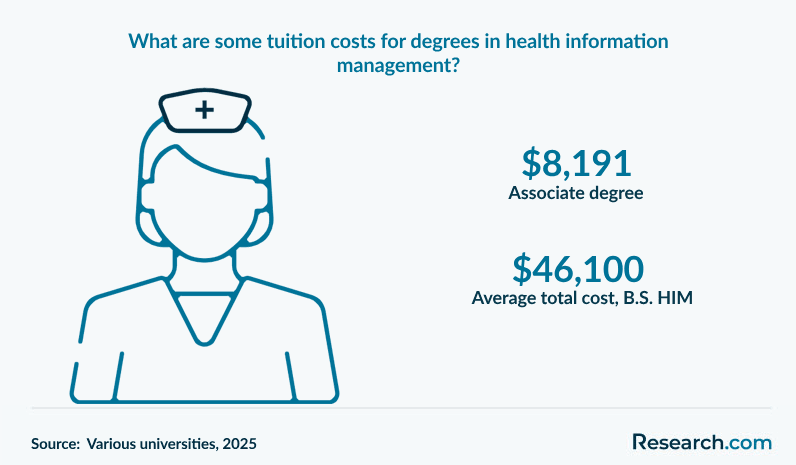
- Associate degree programs: Associate-level health information technology programs are generally less expensive. One example cited is a U.S. Career Institute program totaling around $8,191, including tuition and fees for four semesters.
- Bachelor's degree programs: The average total cost for a bachelor's degree in health information management is approximately $46,100. Students exploring other healthcare and behavioral health degrees may also compare affordability questions such as what is the most affordable online substance abuse counseling program, since total program cost can strongly affect ROI in patient-care and public-health-related fields.
Healthcare careers differ widely in educational cost and credential requirements. For example, students interested in hearing science may ask what do you need to be an audiologist? Audiology typically requires advanced doctoral-level education, while HIM prepares students for administrative, data, technology, compliance, and records-focused roles that support care delivery behind the scenes.
Among the more affordable examples cited, program costs include:
- University of Central Florida: $21,502.80 for in-state students.
- University of Cincinnati: Around $21,050
- Ferris State University: About $12,973.
At the higher end, some HIM programs can exceed $82,000, including options offered by Parker University.
Do not compare programs by sticker price alone. Use each school’s net price calculator, ask how many credits will transfer, confirm whether online students pay separate fees, and calculate the cost of taking prerequisite or repeated courses.
What are the financial aid options for students enrolling in a health information management degree program?
HIM students may be eligible for several forms of financial aid, depending on the institution, enrollment status, income, residency, academic record, and program level. Apply early, because some grants and scholarships have priority deadlines.
- Federal Student Aid: Submit the Free Application for Federal Student Aid (FAFSA) to determine eligibility for federal grants, loans, and work-study programs.2
- State aid: State grant and scholarship programs may be available to eligible residents.
- Institutional aid: Colleges may offer scholarships, grants, tuition discounts, or department-level awards for HIM or healthcare students.
- Private scholarships: Professional associations, community foundations, employers, and healthcare organizations may fund students based on merit, financial need, career goals, or field of study.
- Employer tuition assistance: Students already working in healthcare should ask whether their employer offers reimbursement for HIM-related coursework.
When comparing aid packages, separate free aid from loans that must be repaid. Also check whether scholarships renew automatically or require a minimum GPA, full-time enrollment, or continued major eligibility.
What are the prerequisites for enrolling in a health information management degree program?
Admission requirements vary by school and by whether the program is a full bachelor’s degree or a completion pathway. Always review the program’s official admissions page before applying.
- High school diploma or equivalent: First-time bachelor’s students typically need a high school diploma or GED.
- Minimum GPA: Many programs set a GPA requirement for admission to the university, the major, or the upper-division HIM sequence.
- Standardized tests: Some institutions may request SAT or ACT scores, although requirements vary.
- Prerequisite coursework: Programs may expect prior courses in biology, anatomy, medical terminology, or related foundational subjects.
- Healthcare background or associate degree: Completion and bridge programs may require previous healthcare coursework, an associate degree, RHIT preparation, or professional experience. Students considering advanced clinical pathways such as 1 year FNP programs should note that nursing licensure pathways and HIM pathways have different admissions and clinical requirements.
Digital health growth is one reason HIM skills are becoming more valuable. Globally, the digital health market is predicted to increase by 6.89% between 2025 and 2029, reaching an estimated value of $258.30 billion by 2029. In the United States, the digital health market is expected to grow by 6.71% during the same period, with projected market volume of roughly $70 billion by 2029. These projections point to continued demand for professionals who understand health data, privacy, informatics, and technology-enabled care.
The related market data is shown in the graphic below.
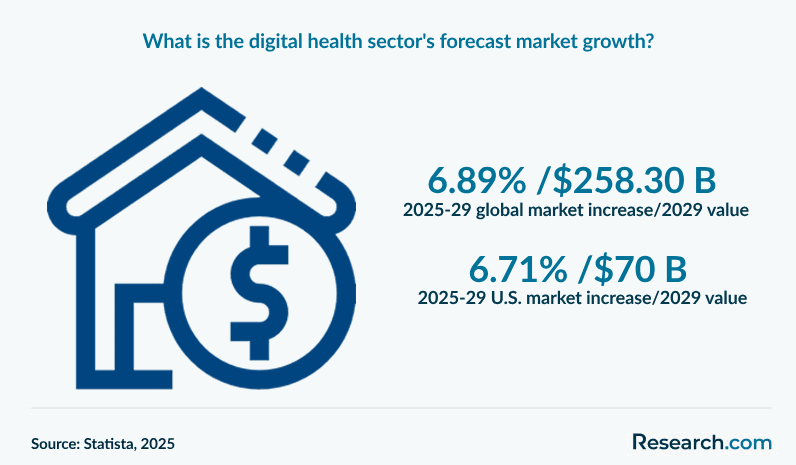
stats on digital health market
What courses are typically in a health information management degree program?
HIM coursework is designed to help students understand the healthcare system, medical language, health records, coding, reimbursement, information systems, privacy rules, quality improvement, and data use. A strong curriculum should balance technical skills with healthcare context and ethical decision-making.
Foundational Courses
Foundational courses help students understand the clinical and administrative language used throughout healthcare organizations.
- Anatomy and Physiology: Covers body systems and functions so students can better understand clinical documentation and terminology.
- Medical Terminology: Teaches prefixes, suffixes, roots, abbreviations, and anatomical terms used in health records.
- Pathophysiology: Examines disease processes and how illnesses affect the body.
- Pharmacology: Introduces drug classifications, actions, administration routes, and interactions.
- Healthcare Delivery Systems: Explores healthcare settings, payment structures, policy issues, and the organization of care.
Health Information Management Core Courses
Core HIM courses focus on the systems, rules, standards, and workflows that govern health information.
- Health Information Systems: Covers the design, implementation, use, and management of EHRs and related systems.
- Health Data Management: Focuses on collecting, storing, analyzing, governing, and improving the quality of health data.
- Coding and Classification Systems: Teaches ICD-10-CM and CPT coding for diagnoses, procedures, reporting, billing, and research.
- Healthcare Reimbursement: Explains billing, claims, payer models, reimbursement methodologies, and revenue processes.
- Healthcare Statistics: Builds quantitative reasoning skills for interpreting healthcare data and supporting quality initiatives.
- Legal and Ethical Issues in Healthcare: Examines privacy, confidentiality, release of information, consent, security, and ethical handling of patient data.
- Quality Improvement in Healthcare: Introduces tools and methods used to improve safety, reduce errors, and strengthen healthcare outcomes.
- Healthcare Management: Develops leadership, staffing, budgeting, policy, and operational skills for HIM departments and healthcare organizations.
Electives
Electives allow students to focus on career goals such as analytics, security, informatics, coding, compliance, or public health.
- Data Analytics: Covers data mining, visualization, predictive modeling, and interpretation.
- Health Informatics: Examines telehealth, mobile health, health IT, and artificial intelligence applications in healthcare.
- Health Information Security: Focuses on cybersecurity, risk management, breach prevention, and privacy protections.
- Revenue Cycle Management: Develops specialized knowledge in coding, billing, claims, and reimbursement.
- Clinical Documentation Improvement: Teaches methods for improving accuracy and completeness in clinical records.
- Long-Term Care: Addresses HIM requirements in nursing homes, assisted living, and related settings.
- Public Health Informatics: Applies informatics tools to public health reporting, surveillance, and prevention.
- Consumer Health Informatics: Studies technology that supports patient engagement and access to health information.
- Healthcare Law and Ethics: Provides deeper study of patient rights, malpractice, end-of-life care, and regulatory concerns.
- Project Management: Builds skills in planning, implementing, and monitoring healthcare technology or process-improvement projects.
- Research Methods: Teaches students how to evaluate evidence and conduct research in healthcare environments.
Students who want a stronger computing background may also compare HIM with a fast track computer science degree, especially if their long-term goal is health IT, software, analytics, or systems development rather than traditional HIM operations.
Digital health investment also shows why data and technology skills matter in HIM. In the first half of 2021, telemedicine was the top-funded digital health category worldwide, receiving $4.2 billion in investments. Wellness followed with $1.7 billion, mHealth apps received $1.6 billion, analytics companies received $1.5 billion, and clinical decision support received $1.1 billion. These categories show how healthcare delivery increasingly depends on data, platforms, and technology-supported decision-making.
What types of specializations are available in health information management degree programs?
A general HIM degree can qualify students for a range of entry-level and advancement-oriented roles, but a specialization can make the degree more targeted. Choose a concentration based on the work you want to do every day, not just the job title that sounds most impressive.
| Specialization | Focus | Potential roles |
| Health Informatics | Health IT systems, data use, workflow improvement, communication tools, and technology-supported care. | Health informatics specialist, clinical analyst, systems analyst, data analyst, project manager, healthcare IT consultant. |
| Data Analytics | Statistical methods, data mining, trend analysis, visualization, and healthcare performance insights. | Data analyst, healthcare data scientist, business intelligence analyst, quality improvement specialist. |
| Traditional Health Information Management | Records management, coding, release of information, data quality, privacy, and legal compliance. | Health information manager, medical records supervisor, coding specialist, compliance officer, privacy officer. |
| Revenue Cycle Management | Billing, coding, claims, reimbursement, healthcare finance, and revenue optimization. | Revenue cycle manager, billing specialist, coding specialist, claims analyst, healthcare financial analyst. |
| Health Information Security | HIPAA, cybersecurity, privacy, risk management, breach response, and information governance. | Health information security analyst, security officer, compliance officer, privacy officer, risk manager. |
| Clinical Documentation Improvement | Documentation accuracy, physician communication, coding guidelines, and quality reporting. | Clinical documentation improvement specialist (CDIS), coding specialist, health information manager. |
| Long-Term Care | RAI, MDS coding, quality measures, reimbursement, and compliance in long-term care settings. | Long-term care health information manager, MDS coordinator, quality assurance specialist. |
Some programs may also offer coursework in public health informatics or consumer health informatics. Public health informatics applies data and technology to surveillance, health promotion, and emergency preparedness. Consumer health informatics focuses on tools that help patients access, understand, and manage their own health information.
Students who want to combine HIM with broader clinical leadership may also review options such as the cheapest online nursing master's programs, although nursing and HIM have different admission, clinical, and licensure expectations.
Salary.com data as of January 1, 2025 shows notable earning potential in selected HIM roles. Health Information Management Managers earn an average of $107,717 per year, Health Care Information Management positions average $93,017 annually, and Health Information Management Specialists average $168,404 nationwide. In New York, Health Information Management Specialists average $196,696, while Directors of Health Information Management in New York average $200,513 per year. These figures show that advanced responsibility, specialization, location, and experience can substantially affect earning potential.
How does one choose the best health information management degree program?
The best HIM program is the one that fits your credential goals, schedule, budget, learning style, and career direction. Use the checklist below before submitting an application or deposit.
| Selection factor | What to verify | Why it matters |
| Accreditation | Confirm whether the program is accredited by CAHIIM when RHIA preparation is a goal. | Accreditation can affect credential eligibility, employer recognition, and program quality signals. |
| Total cost | Compare tuition, fees, books, software, transfer credits, and time to graduation. | The lowest tuition rate may not produce the lowest total cost. |
| Curriculum | Look for coding, EHRs, data management, privacy, reimbursement, analytics, and practical projects. | The curriculum should match the type of HIM role you want. |
| Faculty | Review faculty credentials, professional experience, and availability to online students. | Experienced faculty can connect coursework to real HIM practice. |
| Student support | Ask about advising, tutoring, technology help, writing support, and online orientation. | Support services can affect persistence and completion, especially for working adults. |
| Practicum or internship | Confirm placement expectations, local site requirements, and virtual alternatives if offered. | Applied experience can help students build confidence and employer-ready skills. |
| Career services | Ask about resume support, employer partnerships, job fairs, exam preparation, and outcome data. | Career support can make the transition from school to work more structured. |
Common mistakes to avoid when choosing an online HIM program
- Choosing only by tuition: A cheaper program may cost more if few credits transfer or required courses are offered infrequently.
- Ignoring accreditation: If you want RHIA-aligned preparation, verify CAHIIM status before enrolling.
- Assuming online means self-paced: Some online programs still require weekly deadlines, synchronous sessions, or fixed course sequences.
- Overlooking practicum requirements: Ask whether you must find your own site and whether your local area has placement options.
- Relying only on rankings: Rankings can narrow your list, but program fit, support, and credential alignment matter more.
- Assuming salary outcomes are guaranteed: Salaries depend on experience, location, role, credential, and employer demand.
How Can Complementary Business Analytics Enhance My HIM Career?
Business analytics can strengthen an HIM career by helping professionals move beyond recordkeeping and compliance into decision support, operational improvement, and healthcare strategy. HIM professionals with analytics training may be better prepared to interpret claims data, measure workflow performance, identify documentation gaps, support quality initiatives, or communicate data insights to administrators.
This combination is most useful for students interested in management, revenue cycle, health informatics, consulting, or business intelligence roles. Professionals who want a broader leadership and analytics foundation may compare HIM experience with programs discussed in affordable online MBA business analytics options.
How Can I Verify the Accreditation and Quality Standards of My Online HIM Program?
Start by confirming institutional accreditation and, when relevant, programmatic accreditation. For many HIM students, CAHIIM accreditation is especially important because it signals that the program meets recognized health informatics and information management education standards. Do not rely only on marketing language. Check the accreditor’s website, ask the program director, and request written confirmation of current status.
Quality also depends on curriculum currency, faculty expertise, practicum access, student support, technology platforms, and graduate outcomes. If you are comparing broader healthcare administration options or faster healthcare pathways, the guide to accelerated healthcare programs can provide useful context for evaluating format, speed, and fit.
What career paths are available for graduates of health information management degree programs?
HIM graduates can pursue roles across health records, coding, informatics, analytics, revenue cycle, compliance, privacy, information governance, and health IT. Entry-level roles may focus on records, coding, data quality, or billing support, while advanced roles often require experience, credentials, leadership ability, or specialized technical skills.
Traditional HIM Roles
- Health Information Manager/Director: Oversees patient information processes, legal and regulatory compliance, staff, policies, and health information system procedures.
- Medical Records Specialist/Technician: Maintains health records, processes information requests, and checks documentation for accuracy and completeness.
- Coding Specialist: Assigns diagnosis and procedure codes for billing, reporting, reimbursement, and statistical use, with possible specialization in inpatient, outpatient, or physician coding.
- Clinical Documentation Improvement Specialist (CDIS): Works with physicians and clinical staff to improve the quality, specificity, and completeness of documentation.
Health Informatics and Data Analytics
- Health Informatics Specialist/Analyst: Supports health information systems, analyzes data, and improves workflows that affect patient care and operations.
- Clinical Data Analyst: Reviews clinical data to identify trends, gaps, and improvement opportunities.
- Data Analyst: Collects and interprets healthcare data from EHRs, claims, surveys, and other sources.
- Health Data Scientist: Uses advanced statistical and machine learning methods to analyze large healthcare datasets and support predictive modeling.
Students who want deeper computing and analytics skills may also compare HIM with cheap Masters in Computer Science online programs, especially if they are targeting technical data, software, or health IT roles.
Revenue Cycle Management
- Revenue Cycle Manager: Oversees billing, coding, claims, reimbursement, and financial processes tied to patient care.
- Billing Specialist: Prepares and submits claims to insurers and government payers.
- Claims Analyst: Reviews healthcare claims, investigates denials, and resolves billing discrepancies.
- Healthcare Financial Analyst: Uses financial data to support budgeting, forecasting, and healthcare decision-making.
Compliance and Information Governance
- Compliance Officer: Helps healthcare organizations follow laws, regulations, and ethical standards related to privacy, data security, and billing.
- Privacy Officer: Develops and enforces policies that protect patient information and support HIPAA compliance.
- Information Governance Manager: Oversees organizational information assets, data quality, data governance, and security practices.
Other HIM-Related Careers
- Health Information Security Analyst: Protects patient data, implements security controls, and responds to data incidents.
- EHR Implementation Specialist: Helps healthcare organizations implement, configure, train users on, and optimize EHR systems.
- Health IT Consultant: Advises organizations on system selection, implementation, workflow design, and training.
- Educator: Teaches HIM topics in colleges, universities, or workforce training settings.
- Researcher: Studies health information practices, data quality, healthcare technology, or related topics.
- Entrepreneur: Builds an HIM consulting, coding, compliance, analytics, or health technology business.
Students comparing HIM with broader technology careers may also ask what can you do with a computer science degree? Computer science usually focuses more heavily on programming, systems, software, and technical development, while HIM focuses on healthcare data, records, compliance, coding, reimbursement, and informatics.
What is the job market for graduates with a health information management degree?
The labor market for HIM graduates is shaped by the growth of electronic health records, data-driven healthcare operations, privacy and compliance demands, reimbursement complexity, and the expansion of digital health tools. Demand can vary by region and role, but HIM skills remain relevant across many healthcare settings.
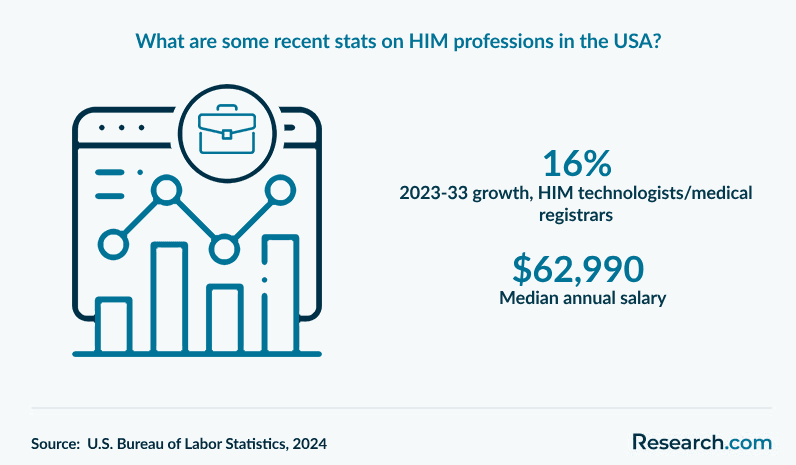
- Job growth: The U.S. Bureau of Labor Statistics projects 9% employment growth for medical records and health information specialists from 2021 to 2031, faster than the average for all occupations. Employment for health information technologists and medical registrars is expected to grow much faster than average, at 16% between 2023 and 2033.
- Salary: As of May 2023, the median yearly salary for these professionals was $62,990. Starting salaries can vary and may typically fall between $30,000 and $60,000 depending on experience, geography, employer, and role.
- In-demand skills: Employers often value data analytics, health informatics, coding, privacy, compliance, information security, and EHR experience. Students who already have a clinical background may compare HIM with options such as the shortest online MSN programs if they want to combine clinical leadership with health data expertise.
- Employment settings: HIM graduates can work in hospitals, clinics, physician practices, government agencies, insurance companies, consulting firms, and healthcare technology organizations.
The strongest job prospects often go to graduates who combine HIM coursework with practical experience, recognized credentials, strong communication skills, and familiarity with the systems employers already use.
What Questions Should I Ask Prospective Online HIM Programs?
Before applying, ask questions that force the school to explain outcomes, support, and credential alignment in specific terms. A good online HIM program should be able to answer clearly.
- Is the HIM program CAHIIM-accredited, and what credentials are graduates prepared to pursue?
- How many credits can I transfer, and will you provide a written transfer evaluation before enrollment?
- What is the total estimated cost, including tuition, fees, software, books, and exam-preparation materials?
- Are courses asynchronous, synchronous, or a mix of both?
- Does the program require a practicum, internship, capstone, or local site placement?
- What EHR, coding, analytics, or data tools will students use during the program?
- What student support services are available to online learners?
- What are the program’s graduation, retention, credential exam, and job placement outcomes?
- How often is the curriculum updated for HIPAA, coding systems, cybersecurity, interoperability, and digital health trends?
- Does the program connect students with employers, alumni, internships, or professional associations?
If you are considering coding-heavy HIM pathways, you may also compare related training through accredited medical billing and coding schools.
Here’s What Graduates Have to Say About Their Health Informatics Degrees
-
: "
Completing my HIM degree online made it possible to keep working full time while preparing for a more data-focused healthcare role. The workload was real, but faculty support and online peer connections helped me stay on track. I now work as a data analyst and use health information every day to support better patient care. Grace
"
-
: "
I had family responsibilities and did not think returning to school would be realistic. The online HIM format let me study around my schedule, and the assignments connected directly to the healthcare work I was already doing. Finishing with honors was a major milestone. Eleanor
"
-
: "
I was unsure about online learning at first, but interactive courses and a strong virtual community changed my mind. The program helped me understand new career possibilities, and I now work as a health informatics specialist. Skyler
"
How Do Online HIM Programs Address Data Privacy and HIPAA Compliance?
Online HIM programs typically address privacy and compliance through courses in healthcare law, data security, release of information, ethics, and information governance. Students learn how HIPAA affects patient information, how to identify privacy risks, and how healthcare organizations respond to data breaches or inappropriate access.
Strong programs do more than define HIPAA. They use case studies, policy analysis, simulated scenarios, and applied assignments so students can practice making decisions about confidentiality, consent, record access, and secure information exchange. Students interested in broader management training may also compare HIM coursework with health care management programs online.
Should I Pursue Additional Certifications or an Advanced Degree After My HIM Degree?
Additional credentials can be valuable, but they should match your career target. A new graduate seeking an entry-level records or coding role may need different preparation than an experienced HIM professional moving into compliance, informatics, revenue cycle leadership, or administration.
| Next step | When it makes sense |
| Professional certification | Useful when employers in your target role expect a recognized HIM, coding, privacy, security, or informatics credential. |
| Master’s degree | More relevant for leadership, administration, analytics, consulting, policy, or advanced informatics roles. |
| Short technical training | Helpful for building skills in analytics platforms, EHR systems, coding updates, cybersecurity, or data visualization. |
| Work experience first | Often the best option if you need to clarify your preferred HIM specialization before investing in more education. |
For students interested in healthcare administration leadership, options such as the cheapest online mha programs may be worth comparing after gaining HIM experience.
How Can I Evaluate the ROI of My HIM Degree?
To evaluate ROI, compare what you will spend with the realistic career outcomes the program can support. Include tuition, fees, books, technology, lost work time, commuting if any, and the number of credits you still need. Then compare those costs with job titles you are actually qualified to pursue after graduation, not only the highest-paying roles in the field.
- Calculate total program cost after transfer credits and financial aid.
- Identify three to five realistic target roles for your first job after graduation.
- Compare salary data by role, location, and experience level.
- Ask the program for graduate employment and credential exam outcomes.
- Estimate how long it may take to recover your out-of-pocket education cost.
- Consider long-term value, including advancement into management, analytics, compliance, or informatics.
Students weighing healthcare education costs across fields may also review comparisons such as online pharmacy school cost, while remembering that pharmacy and HIM lead to different credentials, job markets, and education requirements.
How Do Online HIM Programs Incorporate Emerging Technologies?
Modern online HIM programs increasingly include technology-focused coursework because healthcare organizations rely on EHR systems, analytics platforms, privacy controls, telemedicine tools, and interoperable data exchange. Students may work with simulated records, coding tools, database concepts, dashboards, and case studies involving artificial intelligence or cybersecurity.
The most useful programs teach technology in context. Students should learn not only what a tool does, but how it affects documentation quality, reimbursement, privacy, workflow, patient safety, and organizational decision-making. Students interested in health technology across pharmacy and medication systems may also compare related pathways such as online Pharm D programs USA.
How Do Online HIM Programs Support Career Placement and Networking Opportunities?
Career support matters more in an online program because students may not have daily campus contact with faculty, peers, and employers. Strong online HIM programs create structured opportunities to connect coursework with the job market.
- Virtual career advising and resume reviews
- Mock interviews and professional portfolio support
- Employer webinars, job fairs, or alumni panels
- Practicum or internship coordination
- Professional association guidance
- Credential exam preparation resources
- Faculty mentorship and online networking spaces
Students who want additional patient-facing experience before or during an HIM program may also explore online classes for medical assistant, although medical assistant training and HIM degree programs serve different career purposes.
Can Accelerated Allied Health Programs Complement My HIM Degree?
Accelerated allied health training can complement an HIM degree when it gives students practical exposure to clinical workflows, patient intake, documentation, billing, or front-office operations. This can be especially useful for students with no healthcare background who want to understand how patient information is created before it reaches the HIM department.
For example, medical assistant programs 6 weeks may provide practical healthcare context, but students should be careful not to confuse short-term allied health certificates with a bachelor’s-level HIM degree. The best choice depends on whether your goal is fast workforce entry, clinical support, health records, coding, informatics, or management.
Which Online HIM Programs Offer Accelerated Pathways?
Accelerated HIM pathways are typically most realistic for students who already have transfer credits, an associate degree, RHIT-related preparation, or prior healthcare coursework. These programs may use completion formats, prior learning assessment, compressed terms, or competency-based options to reduce time to graduation while still requiring students to meet academic and accreditation expectations.
Before choosing an accelerated option, confirm the weekly workload, course sequencing, practicum requirements, and whether acceleration affects financial aid eligibility. Students who want a focused comparison can review the quickest health information management program online.
Can Online HIM Programs Integrate Advanced Data Analytics and Bioinformatics into Their Curriculum?
Some online HIM programs include electives or projects in advanced analytics, machine learning concepts, big data interpretation, statistics, or informatics. This is most useful for students who want to move into health data analysis, clinical informatics, decision support, research operations, or healthcare technology roles.
Bioinformatics is more specialized and usually connects health data with biology, genomics, computational methods, and research. HIM students who want to move strongly in that direction may need additional graduate-level study, such as an online master's in bioinformatics, depending on their target role.
Key Insights
- Accreditation should be a first filter: If you want RHIA-oriented preparation, verify CAHIIM accreditation directly before enrolling.
- Affordable does not always mean low total cost: Transfer credits, fees, course sequencing, and residency tuition can change what you actually pay.
- Online HIM programs work best for organized students: Flexibility is valuable, but online programs still require deadlines, technology access, and steady weekly study time.
- Career paths are broader than medical records: HIM graduates may work in coding, compliance, revenue cycle, privacy, analytics, informatics, EHR implementation, and information governance.
- Data and technology skills are becoming more important: Digital health growth, EHR use, analytics, cybersecurity, and telehealth are changing what employers expect from HIM professionals.
- Salary outcomes vary widely: Reported salaries range by role, experience, location, and specialization; use local job postings and program outcomes to set realistic expectations.
- Ask programs for evidence: Before applying, request details on accreditation, practicum support, total cost, graduate outcomes, credential preparation, and online student services.
References:
- DataUSA.io. (2023). Health information management graduates in the United States. DataUSA.io.
- Salary.com. (2025). Director Health Information Management Salary in California. Salary.com.
- Salary.com. (2025). Health Care Information Management Salary. Salary.com.
- Salary.com. (2025). Health Information Management Specialist Salary. Salary.com.
- Salary.com. (2023). Health information manager salary. Salary.com.
- Salary.com. (2025). Health Information Management Manager Salary. Salary.com.
- Salary.com. (2025). Health Information Management (HIM) Analyst Salary in Los Angeles, CA. Salary.com.
- Salary.com. (2023). Registered health information administrator salary. Salary.com.
- Statista. (2024). Digital Health market volume in the United States from 2023 to 2029. Statista.
- Statista. (2021). Top funded digital health categories worldwide in the first half of 2021 (in billion U.S. dollars). Statista.
- U.S. Bureau of Labor Statistics. (2023). Computer and information systems managers. U.S. Bureau of Labor Statistics.
- U.S. Bureau of Labor Statistics. (2023). Medical and health services managers. U.S. Bureau of Labor Statistics.
- U.S. Bureau of Labor Statistics. (2023). Medical records and health information technicians. U.S. Bureau of Labor Statistics.
Other Things You Should Know About Health Information Management Degree Programs
Many affordable online health information management programs are CAHIIM-accredited, and that matters because CAHIIM is the main accrediting body for Health Information Management degrees in the United States. Graduates from CAHIIM-accredited bachelor’s programs are often eligible to sit for the RHIA exam through AHIMA.
In 2027, some universities offering affordable online health information management degree programs include Western Governors University, Southern New Hampshire University, and the University of Maryland Global Campus. Each institution offers competitive tuition rates and financial aid options for this in-demand field.


