2027 How To Become a Stenographer: Salary & Career Paths

Co-Founder and Chief Data Scientist
Becoming a stenographer is a decision to invest in a highly specialized language, technology, and accuracy skill. Stenographers capture speech in real time for courts, depositions, broadcasts, classrooms, public meetings, government sessions, and other situations where a reliable word-for-word record matters. In 2027, this career is being reshaped by court reporter shortages, expanded accessibility needs, remote proceedings, and the growing use of AI transcription tools.
This guide explains what stenographers do, how to train for the field, what certifications may be required, where jobs are found, what earnings can look like, and how to decide whether stenography is a practical career move for you. It is designed for students, career changers, legal support workers, transcription professionals, and anyone comparing stenography with court reporting, captioning, legal transcription, or related legal careers.
Quick Answer: How do you become a stenographer in 2027?
To become a stenographer, you typically need a high school diploma or equivalent, training in machine shorthand or court reporting, strong grammar and listening skills, and certification or state licensure when required. Many legal employers look for candidates who can pass an exam such as the Registered Professional Reporter (RPR) and produce real-time transcription at speeds up to 225 words per minute with strong accuracy.
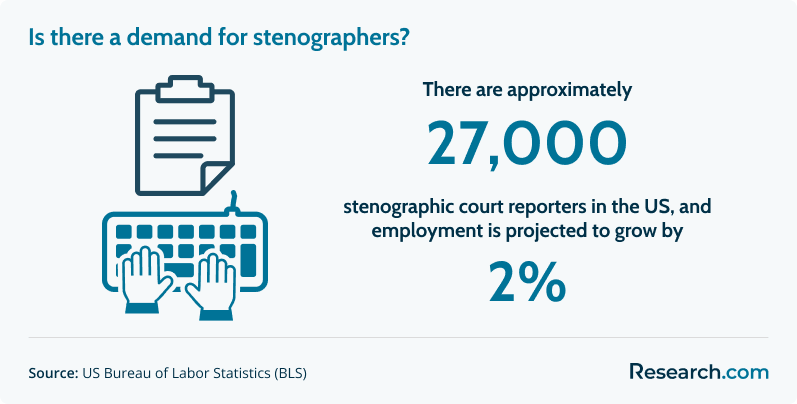
Stenography can lead to work in court reporting, depositions, legislative reporting, broadcast captioning, CART services, education accessibility, and specialized transcription. According to the National Court Reporters Association, the United States has approximately 27,000 active stenographic court reporters. The Bureau of Labor Statistics projects 2% employment growth for court reporters and captioners within a decade, with about 1,600 openings each year.
Key Things to Know About Becoming a Stenographer in 2027
- Employment projections are not identical across sources. Some estimates point to 5% growth within a decade, while the Bureau of Labor Statistics projects 2% growth for court reporters and captioners.
- Modern stenography is not limited to courtrooms. Stenographers also support live captioning, remote depositions, education access, corporate meetings, public agency proceedings, and media production.
- As of 2027, the average annual salary for a stenographer in the United States is approximately $44,635, but actual pay depends on location, credentialing, experience, specialization, and work setting.
- The number of stenographers in the United States has fallen by 21% over the past decade, yet shortages and accessibility requirements continue to create opportunities for trained professionals.
- What does a stenographer do?
- Are stenographers still in demand in 2027?
- What qualifications do you need to become a stenographer?
- What skills are essential for stenographers in 2027?
- How can legal education support a stenography career?
- How do stenographers get certified in the United States?
- What ethical and professional challenges should stenographers expect?
- Can advanced credentials expand stenography career options?
- How much do stenographers earn in 2027?
- Where do stenographers work?
- What career paths are available to stenographers?
- Can cross-disciplinary legal study improve stenography work?
- How will AI and automation affect stenography jobs?Key insights
What does a stenographer do?
A stenographer turns spoken words into written text while people are speaking. Rather than using a regular keyboard one letter at a time, stenographers use a stenotype machine that records sounds, syllables, phrases, and words through key combinations. This allows trained professionals to keep pace with rapid speech in real time.
In courts and legal proceedings, stenographers are often called court reporters. Their transcripts may become the official record for trials, hearings, depositions, sworn testimony, rulings, objections, and other legal events. Precision is essential because transcript errors can affect how testimony or legal statements are understood later.
Stenographers also work outside the legal system. They may caption live broadcasts, online conferences, university lectures, public meetings, workplace events, and accessibility services. Some roles require instant live output, while others focus on editing, formatting, and certifying transcripts after the event ends.
| Work activity | What it involves | Why it matters |
| Real-time transcription | Writing speech as it occurs with a stenotype machine and transcription software | Provides immediate text access and creates records for legal, educational, or public use |
| Transcript production | Editing, proofreading, formatting, and finalizing written records after proceedings | Makes the transcript clear, accurate, complete, and usable by courts, attorneys, or clients |
| Speaker tracking | Identifying who is speaking in hearings, meetings, depositions, or multi-person events | Reduces confusion and preserves context in official or live records |
| Confidential information handling | Protecting testimony, case materials, personal data, business information, and sealed records | Supports privacy, professional trust, and compliance with ethical standards |
| Captioning and communication access | Delivering real-time text for viewers, students, employees, or participants who need captions | Improves access and helps organizations meet accessibility responsibilities |
Are stenographers still in demand in 2027?
Yes. Stenographers are still needed, especially in settings where speed, certified accuracy, confidentiality, and human judgment are critical. The National Court Reporters Association reports approximately 27,000 active stenographic court reporters in the United States. The Bureau of Labor Statistics projects 2% employment growth for court reporters and captioners within a decade and about 1,600 openings each year.
Demand is shaped by retirements, staffing shortages in some court systems, accessibility laws, remote hearings, and the need for dependable transcripts when automated speech-to-text tools are not accurate or secure enough for high-stakes records.
Demand for live captioning and accessibility services
Stenography has expanded beyond courtrooms because many organizations need live text access. Schools, colleges, public agencies, employers, media outlets, and event organizers often use real-time captioning to support people who are deaf or hard of hearing. Laws such as the Americans with Disabilities Act have contributed to demand for accurate captions in classrooms, broadcasts, virtual meetings, public events, and workplace settings.
For instance, accredited non-profit universities may work with Communication Access Realtime Translation providers to support students during in-person lectures or online courses. CART work uses core stenography abilities: rapid machine shorthand, active listening, preparation for technical terminology, and real-time accuracy.
Remote and freelance opportunities
Remote depositions, virtual court events, livestreamed programs, online courses, and digital conferences have made location-flexible stenography more common. Some stenographers operate as freelancers or independent contractors for deposition agencies, captioning companies, CART providers, legal transcription services, and event platforms.
Flexibility can be valuable, but remote and freelance stenography also comes with responsibilities. Professionals need dependable equipment, secure internet, backup plans, private workspaces, deadline management, client communication skills, and strong data protection practices. Freelancers must also plan for taxes, unpaid administrative work, software subscriptions, professional insurance, and certification renewal costs.
If you are interested in legal proceedings, investigations, and evidence-based work, compare stenography with criminal justice and forensic science career paths before choosing a narrow legal support role.
| Demand driver | What it means for stenographers | Best-fit roles |
| Court reporter shortages | Trained reporters may find openings in courts, hearing rooms, and deposition services | Court reporter, deposition reporter |
| Accessibility requirements | Organizations need accurate live text for students, viewers, employees, and public participants | CART provider, education captioner, broadcast captioner |
| Remote proceedings | More legal, educational, and professional events can be covered from off-site locations | Freelance reporter, remote captioner, legal transcription specialist |
| AI adoption | Human verification remains important when records require accuracy, security, and chain of custody | Certified court reporter, realtime editor, transcript quality specialist |
What qualifications do you need to become a stenographer?
Most stenographers start with a high school diploma or equivalent, then complete focused training in court reporting, machine shorthand, grammar, legal terminology, transcript formatting, and real-time transcription software. Many programs take two to three years, but completion time depends on practice habits, speed-building progress, course load, transfer credits, and whether you study full time or part time.
Some students consider accelerated academic options such as a 6-month associate degree online. A shorter credential may help with general education or career exploration, but stenography is performance-based. Reaching professional stenotype speed usually requires sustained practice that cannot be replaced by a short academic timeline.
Depending on the employer, state, and role, common requirements may include:
- Completing a stenography, captioning, or court reporting training program.
- Passing a recognized certification exam, such as the Registered Professional Reporter exam from the National Court Reporters Association.
- Demonstrating real-time writing ability at 225 words per minute with strong accuracy.
- Meeting state licensure or state exam requirements where they apply.
- Using professional stenotype machines, computer-aided transcription software, and transcript production tools.
Typical path to becoming a stenographer
| Step | What to do | Decision point |
| 1. Test your career fit | Learn the differences among court reporting, CART, captioning, and transcription work | Decide whether you prefer legal proceedings, accessibility services, media captioning, or freelance work |
| 2. Select a training program | Compare online and campus-based stenography or court reporting programs | Review accreditation, state alignment, equipment costs, completion outcomes, and speed-building support |
| 3. Build machine shorthand speed | Practice stenotype writing consistently and progress through timed dictation levels | Confirm the program offers structured speed tests, feedback, and real-time practice |
| 4. Master transcript standards | Study punctuation, grammar, formatting, legal vocabulary, proofreading, and speaker identification | Choose practice material and electives that match your intended work setting |
| 5. Prepare for credentials | Use practice exams and verify state or employer certification expectations | Decide whether to pursue RPR, state licensure, NVRA credentials, or captioning-focused credentials |
| 6. Apply for work | Pursue roles in courts, depositions, captioning, CART services, transcription, or freelance reporting | Compare pay structure, benefits, remote rules, travel, transcript deadlines, workload, and growth options |
What are the essential skills needed to become a stenographer in 2027?
High-speed stenotype writing with accuracy
Stenographers must increase speed while keeping errors under control. Many court reporting and captioning roles expect at least 225 words per minute with 95–98% accuracy. Reaching that level usually takes months or years of regular drills, dictation practice, and feedback.
Confidence with equipment and transcription platforms
Professional stenographers use stenotype machines, computer-aided transcription systems, real-time output tools, CART platforms, and editing software. Technical reliability matters because equipment failure during a hearing, class, broadcast, or deposition can interrupt captions or compromise the record.
Focused listening in difficult environments
Proceedings and live events may include interruptions, overlapping voices, accents, emotional testimony, poor sound quality, specialized vocabulary, or rapid exchanges. Stenographers must follow context, identify speakers, and continue writing even when the situation is noisy or stressful.
Careful proofreading and detail control
Names, numbers, dates, legal citations, medical terms, financial details, and procedural language must be handled carefully. A small error can change the meaning of testimony or an official record, so strong proofreading habits are as important as typing speed.
Legal, medical, and technical vocabulary
Subject-matter knowledge improves both speed and accuracy. Legal terminology is essential for court and deposition work, while medical terminology can help in healthcare-related testimony or transcription. If healthcare documentation interests you, compare stenography with short medical certifications with strong healthcare career potential.
Legal procedure knowledge can also be useful in adjacent public safety and legal support careers. If you are exploring broader justice or security roles, compare this path with affordable online homeland security degree programs to understand how training requirements and outcomes differ.
| Skill | Why it matters | How to build it |
| Stenotype speed | Shows whether you can keep up with live speakers | Use daily drills, timed dictation, and structured speed-building courses |
| Accuracy | Protects the reliability of official transcripts and captions | Review transcripts, track errors, proofread carefully, and correct recurring mistakes |
| Listening stamina | Helps you sustain performance during long hearings, classes, or live events | Practice with difficult recordings, multi-speaker audio, and extended sessions |
| Software fluency | Improves real-time delivery, editing speed, and transcript production | Train directly with stenography, CAT, CART, and captioning tools |
| Professional ethics | Supports confidentiality, impartiality, and trust in sensitive settings | Study certification codes, court policies, client confidentiality rules, and data security practices |
How can complementary legal education enhance your stenography career?
Stenographers who understand legal procedure, case documents, litigation timelines, and courtroom terminology can often follow proceedings more easily. Extra legal education does not replace stenography training or certification, but it can strengthen your ability to understand context, communicate with attorneys and clerks, and manage legal transcript expectations.
If you want a more structured legal foundation, affordable online paralegal certificate programs may introduce legal research, civil procedure, legal writing, and case documentation. This option is most relevant for stenographers who plan to work with courts, law firms, deposition agencies, or litigation support teams.
How do you get certified as a stenographer in the US?
Certification gives employers, courts, agencies, and clients a way to assess a stenographer’s professional readiness. It can verify speed, accuracy, transcript preparation ability, and knowledge of ethics. Requirements vary by state, employer, and specialty, so check local rules before selecting a school or paying for an exam.
A common path is to complete a court reporting or stenography program, including programs available through nationally accredited online colleges and universities, then prepare for a national credential. Programs generally cover machine shorthand, real-time writing, grammar, legal and technical terminology, transcript production, and professional standards.
The Registered Professional Reporter credential from the National Court Reporters Association is one widely recognized option. To pass, candidates must achieve 95% accuracy or higher on each section.
The RPR skills exam includes three timed dictation sections:
- Literary dictation at 180 words per minute
- Jury charge at 200 words per minute
- Testimony or question-and-answer dictation at 225 words per minute
Certification and licensure questions to ask before choosing a program
- Does my state require court reporters to hold a license?
- Does this program prepare students for the RPR or another recognized credential?
- What share of students successfully reaches 225 words per minute?
- Does the curriculum include real-time writing, transcript formatting, and production?
- Are internships, court observations, mentorships, or practical placements available?
- What stenotype machine, software, subscriptions, and exam fees should I budget for?
- Will this credential support my intended path in court reporting, captioning, CART, or transcription?
What are the professional challenges and ethical considerations in stenography?
Stenography requires more than technical speed. Professionals must be neutral, accurate, discreet, and reliable. Court reporters and captioners may handle sealed records, sensitive testimony, medical details, private business information, employment matters, or personal data. Their conduct must protect the record and avoid any appearance of bias or improper influence.
The work can also be stressful. Stenographers may need to capture fast speech, overlapping dialogue, emotional testimony, technical language, objections, interruptions, and poor audio while maintaining composure. Transcript deadlines may be tight, especially for expedited legal records or live captioning assignments.
Ethical practice includes secure file storage, controlled access, careful corrections, transparent transcript procedures, and compliance with court or client rules. If you are interested in careers where confidentiality and precision are central, you may also review CIA officer requirements and career expectations to compare how other fields manage sensitive information.
| Common challenge | Risk | Better practice |
| Depending too much on software | Mistranslations or unreviewed errors may become part of the record | Keep machine shorthand skills sharp and review transcripts thoroughly |
| Taking assignments beyond your current ability | Accuracy can decline in technical, fast, or unfamiliar proceedings | Build vocabulary and practice with similar material before accepting complex work |
| Working with poor audio or an unreliable remote setup | Words may be missed, captions may lag, or records may become incomplete | Use quality microphones, tested platforms, backup internet, and clear audio protocols |
| Using weak confidentiality controls | Private information may be exposed, creating professional or legal consequences | Secure files, limit access, use approved systems, and follow court or client privacy rules |
| Overlooking state rules | You may be ineligible for certain court reporting positions | Verify licensure, certification, and exam requirements before applying |
Can advanced academic credentials broaden career opportunities for stenographers?
Most stenography jobs do not require a graduate degree. However, advanced study may help professionals who want to move into legal operations, compliance, intelligence, management, research, or documentation-heavy roles. The value depends on the target job. A graduate credential may be useful for leadership or analysis-focused work, but it may not improve ROI for someone focused only on freelance deposition reporting.
For stenographers interested in investigations, national security, analytical legal support, or complex information environments, a master's degree in intelligence may add research, analysis, and strategic decision-making skills. Before enrolling, compare cost, workload, employer expectations, and whether the degree clearly supports the role you want.
How much does a stenographer earn in 2027?
The average annual salary for a stenographer in the United States is $44,635. Earnings vary by experience, credential, work environment, state, freelance workload, and specialization. Entry-level stenographers may earn around $29,210, while experienced or highly specialized professionals in stronger markets can earn up to $64,712 annually. Many stenographers fall between $36,561 and $55,144 per year.
Geography can significantly affect pay. New York reports a median annual salary of $100,650 for court reporters and stenographers, which is more than double the national average. Utah reports the lowest median salary at $18,700 per year. These differences may reflect regional demand, court budgets, cost of living, workload, and the balance between public-sector and private-sector jobs.
| Salary figure | Amount | How to interpret it |
| Average annual stenographer salary in the United States | $44,635 | A broad benchmark that may not represent specialized court reporting, CART, or captioning roles |
| Entry-level salary estimate | $29,210 | More likely for new workers, limited-scope roles, or lower-demand markets |
| Common middle range | $36,561 to $55,144 | A typical range for many stenographers, depending on role, location, and experience |
| Higher-end salary estimate | $64,712 | More likely with certification, experience, specialization, or strong market demand |
| New York median annual salary | $100,650 | An example of a higher-paying state market |
| Utah median annual salary | $18,700 | An example of a lower-paying state market |
If you are comparing stenography with careers that use different compensation models, review mortgage broker salary and career path information to see how earnings can differ in commission-based or regulated fields outside legal services.
Where do stenographers typically work?
Stenographers work wherever spoken information must be captured accurately, quickly, or officially. Courts are still a major workplace, but opportunities also exist in law firms, deposition agencies, captioning companies, colleges, universities, media organizations, legislatures, public agencies, and corporate settings.
Some legal systems continue to face staffing pressure. California, for example, reported a shortage of up to 458 full-time court reporters in 2027. Outside the legal system, ADA compliance, online education, remote meetings, and live media accessibility also support demand. Pay varies by sector, however; the information sector provides the lowest pay, averaging $33,370 per year.
| Work setting | Typical duties | Best for |
| Courts | Record hearings, trials, testimony, rulings, objections, and official proceedings | Stenographers who want structured legal work and formal records |
| Deposition agencies | Capture sworn testimony outside the courtroom | Freelancers and legal reporters who are comfortable working with attorneys |
| Broadcast and media companies | Create real-time captions for live programming and streamed content | Fast writers who can manage pressure, changing topics, and live deadlines |
| Colleges and universities | Provide CART or captioning support for classes, lectures, and academic events | Professionals interested in accessibility and education environments |
| Government bodies | Record legislative sessions, committee hearings, public meetings, and official events | Stenographers who value public-sector work and procedural formality |
| Corporate and virtual events | Caption webinars, meetings, conferences, trainings, or internal proceedings | Remote-ready stenographers with strong technology and client service skills |
What are the different career paths for stenographers?
Stenography can support several career directions. Your best path depends on whether you prefer legal records, live captioning, government proceedings, education access, freelance flexibility, or specialized transcription. Certification requirements, state rules, vocabulary knowledge, and speed expectations will also shape your options.
Court reporter
Court reporters create official transcripts for hearings, trials, depositions, and other legal proceedings. They may work for local, state, or federal courts, or they may cover depositions through private agencies. Many employers prefer or require credentials such as the Registered Professional Reporter. If you are comparing credential options, review online certifications that may support career advancement. The median salary for court reporters is $63,560.
Broadcast captioner
Broadcast captioners produce real-time captions for live television, livestreams, emergency messages, sports, news, and other media. This role fits stenographers who can write quickly, shift topics without losing accuracy, and perform well under live production pressure. The average salary for broadcast captioners in the United States is $48,000.
Medical or legal transcriptionist
Some stenographers use their speed and terminology knowledge in specialized transcription. Compared with many traditional transcriptionists, stenographers may rely on shorthand and faster input methods. Medical records transcriptionists earn an average salary of $42,722, while legal transcription specialists make approximately $46,930.
Legislative stenographer
Legislative stenographers record debates, committee meetings, public sessions, and formal government proceedings. These roles require discretion, procedural awareness, and consistent accuracy. Legislative stenographers have an average salary of $74,453.
Realtime captioner in education
Education-focused realtime captioners provide live text access in classrooms, lecture halls, online courses, and academic events. Their work supports students who are deaf or hard of hearing and may be available through colleges, universities, or online universities with accredited programs. Real-time captioners typically earn around $131,001 a year.
| Career path | Reported pay figure | Best fit |
| Court reporter | $63,560 median salary | People who want legal proceedings, official records, and courtroom or deposition work |
| Broadcast captioner | $48,000 average salary | People who handle live media pressure and fast topic changes well |
| Medical records transcriptionist | $42,722 average salary | People interested in healthcare documentation and medical terminology |
| Legal transcription specialist | $46,930 approximate salary | People who want legal document work without necessarily working live in courtrooms |
| Legislative stenographer | $74,453 average salary | People interested in public records, government meetings, and formal proceedings |
| Realtime captioner in education | $131,001 typical annual pay | People focused on accessibility services in academic settings |
Can cross-disciplinary legal studies enhance your stenography career?
Legal studies can make stenography work easier when they help you understand procedure, evidence, terminology, and document standards. This is especially useful in court reporting, deposition reporting, and litigation support, where context can help you follow testimony and prepare cleaner transcripts.
Focused legal programs may be practical for working stenographers who want more legal knowledge without committing to a full degree. For example, accelerated online paralegal programs can introduce legal research, case preparation, civil procedure, and documentation concepts that complement stenography training.
What is the future of stenography jobs with AI and automation?
AI transcription is becoming more common in legal, business, media, and education environments. A 2025 report by the Secretariat and the Association of Certified E-Discovery Specialists found that 74% of legal professionals anticipate using AI-driven tools within the next 12 months. This will likely affect transcript workflows, discovery, captioning, document review, search, and quality control.
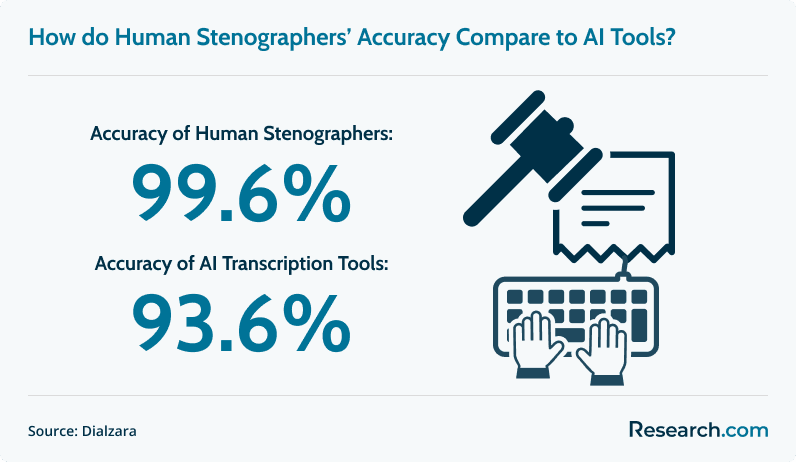
Even so, AI does not remove the need for skilled stenographers in settings that require certified accuracy, secure records, reliable speaker identification, and defensible chain of custody. Human transcriptionists have been reported to achieve approximately 99.6% accuracy, while AI transcription tools typically reach around 93.6% accuracy. That difference can matter greatly when proceedings include multiple speakers, accents, poor audio, legal objections, technical terms, or emotionally charged testimony.
The National Court Reporters Association has also warned about risks tied to AI-generated transcripts, including reliability, verifiable chain of custody, privacy, and security. For official records, human oversight remains important because courts, attorneys, agencies, and clients need confidence that transcripts are complete, accurate, and defensible.
How stenographers can stay competitive as AI improves
- Build real-time writing and editing skills that remain valuable in complex, high-stakes proceedings.
- Learn transcript technology while keeping human review and quality control central to your workflow.
- Develop specialized vocabulary in legal, medical, technical, government, or academic subjects.
- Maintain certifications and stay current on state rules for official reporting.
- Improve remote-work readiness, including audio setup, secure file transfer, platform troubleshooting, and backup systems.
- Target roles where confidentiality, certified records, and human verification are required.
If you want to understand how AI is also creating new types of work, compare stenography with emerging options such as AI trainer career paths.
Here’s What Stenographers Have to Say About Their Careers
-
: "
"My online stenography program was more organized than I expected. It started with the basics of machine shorthand, then moved into speed development, transcript formatting, and realistic dictation. By the time I began real-time court reporting, the pressure felt familiar because my training had already taught me to write at that pace." – Esther
"
-
: "
"I moved into stenography because I wanted a specific skill that could offer stronger long-term earning potential than my previous work. Online training let me practice around my schedule, and I eventually shifted into broadcast captioning. The job is intense, but the flexibility and pay made the change worth it for me." – Billie
"
-
: "
"Learning machine shorthand was difficult at first because I had to understand both the stenotype keyboard and software such as Case CATalyst. After about 18 months of steady practice, it started to click. Real-time writing is still demanding, but it is rewarding to know that people depend on the record I produce." – Vera
"
Common mistakes to avoid when becoming a stenographer
- Enrolling before checking state rules. Some states require court reporters to pass specific exams or hold a license before working in certain legal settings.
- Expecting a short program to guarantee job readiness. Stenography is a speed-based skill, and reaching 225 words per minute usually requires long-term practice.
- Comparing only tuition prices. Stenotype machines, software, subscriptions, exam fees, professional memberships, and transcript tools can raise the total cost.
- Ignoring accreditation and employer recognition. A cheaper program may not be a good value if it does not prepare you for accepted credentials or certification exams.
- Underestimating transcript editing. Fast writing is only part of the job; final records must be accurate, readable, and professionally formatted.
- Treating AI as a replacement for professional skill. AI can assist with workflows, but official records and high-stakes transcripts still require human review and judgment.
- Choosing a specialty without understanding the work environment. Court reporting, classroom CART, broadcast captioning, and freelance depositions involve different schedules, pressures, and client expectations.
How to decide if stenography is worth it for you
Stenography may be worth considering if you enjoy language, precision, legal or public proceedings, accessibility work, and technology-based skill development. It may be a poor fit if you dislike repetitive practice, intense listening, deadline pressure, confidentiality rules, or long periods of concentration.
| Choose stenography if... | Consider another path if... |
| You can commit to consistent speed-building practice | You want a credential that requires little hands-on skill development |
| You value accuracy, neutrality, confidentiality, and professional responsibility | You prefer low-pressure work with few urgent deadlines |
| You are interested in legal, government, media, education, or accessibility work | You do not want to learn specialized machines, software, or transcript tools |
| You want options in courts, freelance depositions, captioning, CART, or remote work | You need guaranteed earnings immediately after training |
| You are comfortable handling sensitive information ethically | You do not want work governed by confidentiality and recordkeeping expectations |
Key Insights
- Stenography remains relevant in 2027 because courts, schools, government agencies, media companies, and accessibility providers still need fast, accurate, human-verified records.
- The typical path includes a high school diploma or equivalent, specialized stenography or court reporting training, extensive speed practice, and certification or state licensure when required.
- Speed is a major barrier to entry. Many roles expect 225 words per minute with strong accuracy, and the RPR exam requires 95% accuracy or higher on every section.
- Income varies widely. The average annual stenographer salary is $44,635, but role, location, certification, experience, and specialization can significantly change earnings.
- AI will affect transcript workflows, but it does not remove the need for human stenographers in official proceedings, complex audio environments, confidential matters, and certified recordkeeping.
- The best training option is not automatically the shortest or cheapest. Compare accreditation, state licensing alignment, certification preparation, speed-building support, equipment costs, and graduate outcomes.
- Stenography is most worthwhile for people who are patient enough to build speed and who want a specialized career centered on accuracy, confidentiality, and real-time communication access.
References:
- Association of Certified E-Discovery Specialists. (2025, April 11). 2025 Legal AI report: Key insights from ACEDS + Secretariat. https://aceds.org/2025-legal-ai-report-key-insights-from-aceds-secretariat-aceds-blog/
- Bureau of Labor Statistics. (n.d.). Court reporters and simultaneous captioners. U.S. Department of Labor. Retrieved April 23, 2025, from https://www.bls.gov/ooh/legal/court-reporters.htm
- Dialzara. (2024, December 18). Speech-to-text accuracy vs. human transcription. https://dialzara.com/blog/speech-to-text-accuracy-vs-human-transcription/
- National Court Reporters Association. (n.d.-a). NCRA statistics. Retrieved April 23, 2025, from https://www.ncra.org/home/about-ncra/NCRA-Statistics
- National Court Reporters Association. (n.d.-b). NCRA statement: What to know before integrating AI. Retrieved April 23, 2025, from https://www.ncra.org/docs/default-source/uploadedfiles/pressrelease/press-releases/2024-press-releases/pr-_sept30_2024_ncra-statement_what-to-know-before-integrating-ai.pdf?sfvrsn=ae18473c_7
- National Court Reporters Association. (n.d.-c). Test center. Retrieved April 23, 2025, from https://www.ncra.org/certification/test-center
- NVRA. (n.d.). Certifications. National Verbatim Reporters Association. Retrieved April 23, 2025, from https://nvra.org/general/custom.asp?page=Certifications
- RL Resources. (2025, January 15). The future of stenography: Transforming the court reporting industry. https://rlresources.com/2025/01/15/the-future-of-stenography-transforming-the-court-reporting-industry/
- USA Wage. (n.d.). Court reporters' salary in the U.S. Retrieved April 23, 2025, from https://www.usawage.com/usa/court_reporters-salary.php
Other Things You Should Know About Becoming a Stenographer
To become a stenographer in 2027, candidates typically need a high school diploma, but further certification in court reporting or stenography is often required. Training programs and certifications focus on speed, accuracy, and familiarity with stenographic tools and may include completion of the Registered Professional Reporter (RPR) certification.
Court reporting and stenography employers usually require at least 225 words per minute on a stenography machine for official transcripts. Many certification exams, including NCRA’s Registered Professional Reporter test, use timed dictation at that speed, plus strong accuracy and punctuation skills.
In 2027, stenographers can advance to roles such as court reporting supervisor or freelance real-time captioner. With additional certification and experience, they can also transition into legal consultancy or transcription services management, enhancing both career growth and salary potential.