World Online Ranking of Best Environmental Scientists - 2026 Report

Co-Founder and Chief Data Scientist
On June 3, 2026, Research.com released the 5th edition of the annual ranking of the best environmental science scientists. Our latest publication is carefully designed to highlight the incredible achievements of top researchers who are working to protect our planet. By sharing this data, we hope to inspire breakthroughs and encourage global collaboration to solve climate issues.
This report serves as a vital resource for academic institutions, policymakers, and students looking for leading experts in the field. It provides a clear view of where the most important environmental research is taking place today. Connecting these bright minds with organizations worldwide helps speed up the development of sustainable practices.
For the 2026 edition, our research team thoroughly inspected over 9,000 profiles. The data was gathered from trusted sources, including OpenAlex, CrossRef, and other bibliometric databases. This careful review ensures that only the most dedicated and impactful scientists are recognized for their work.
To be included in the ranking, researchers must meet a strict minimum D-index requirement of 30. The final placement considers the scientist's D-index score, the proportion of their work that contributes to the field, and any notable awards they have received. This comprehensive report guarantees a highly accurate snapshot of the current academic landscape.
Latest studies in environmental science research
Recent scientific breakthroughs are finding exciting new ways to clean our water and power our future. For example, researchers recently invented a special solar-powered system that turns salty ocean water into fresh drinking water. Unlike older methods, this new tool leaves behind zero toxic waste and can even pull out valuable minerals at the same time.
Another major study revealed a much cleaner and faster way to extract lithium, which is a key ingredient needed for electric car batteries. Instead of using massive ponds that drain local water supplies over several years, scientists created a smart liquid that quickly separates the lithium from salty underground water. These amazing discoveries show how environmental science is actively creating smarter solutions for a sustainable world.
The key findings for the 5th edition of the best environmental science scientists ranking
- The United States is the leading country in environmental science, hosting 426 of the top-ranked scientists in this year's evaluation.
- China showed the most improvement year-over-year, moving up from 3rd place in the previous report to secure the 2nd place position with 106 leading scholars.
- The Chinese Academy of Sciences ranks as the top global institution, featuring 27 affiliated researchers in the top 1,000.
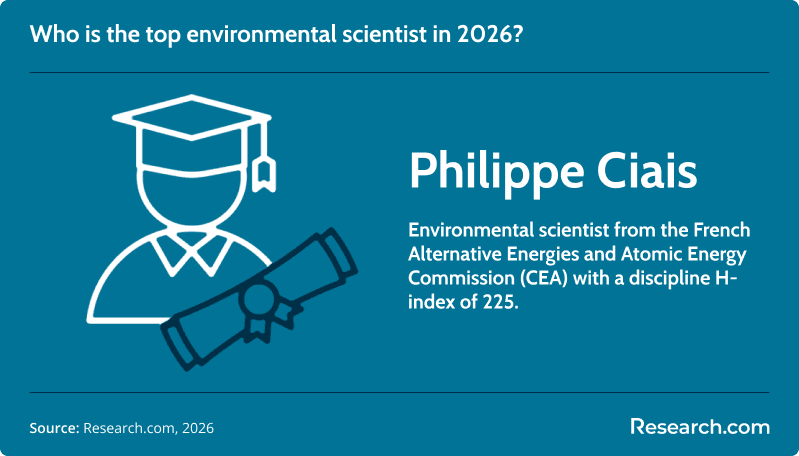
- P. Ciais from the French Alternative Energies and Atomic Energy Commission (CEA) in France holds the number one spot as the world's best active environmental science scientist.
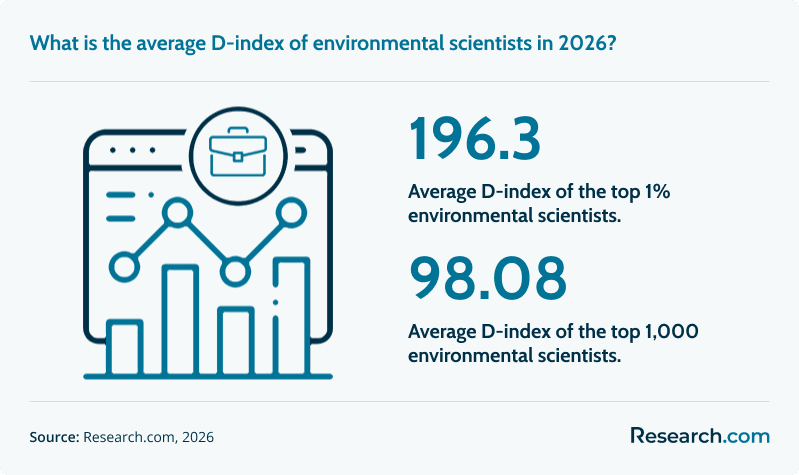
- The top 1% of researchers in this field boast an impressive average D-index of 196.3.
- Across the entire ranking of the top 1,000 scientists, the average D-index stands at a highly competitive 98.08.
The full ranking for the 2026 list of the best environmental scientists can be found here:
WORLD’S BEST ENVIRONMENTAL SCIENTISTS RANKING
Countries with the highest number of leading environmental science scientists
The United States maintains its dominant position, leading the evaluation with 426 scholars, a slight decrease from its top-ranked 449 scientists in the 2025 edition. China made a significant leap to claim the 2nd spot, featuring 106 leading researchers and moving up from 3rd place with 82 scholars in the preceding analysis. The United Kingdom experienced a minor drop to 3rd place, securing 81 top-ranked experts compared to its 2nd place standing with 84 scientists in the prior assessment.
Germany holds steady in 4th place with 65 scientists, demonstrating consistent growth from its 4th place ranking with 63 scholars recorded last year. Australia rounds out the top five, retaining its 5th place position with 46 affiliated researchers while improving upon the 43 individuals listed in the previous report.
Further down the leaderboard, Canada maintains a strong presence in 6th place with 33 scholars. France and Switzerland follow closely in 7th and 8th place with 31 and 30 scientists, respectively. The Netherlands and Spain complete the top 10, hosting 26 and 25 esteemed experts, marking minor shifts from their 9th and 10th positions in the 2025 dataset.
Please note that the country associated with a scientist is based on the affiliated research institution according to MAG, not on their actual nationality.
Institutions with the highest number of leading scientists
The Chinese Academy of Sciences solidifies its status as the world's premier institution for environmental research, holding onto 1st place with 27 scientists compared to the 23 scholars it hosted in the 2025 release. The National Center for Atmospheric Research reclaimed significant ground to secure 2nd place with 19 researchers, moving up from its 4th place finish with 17 scholars in the previous edition. The National Oceanic and Atmospheric Administration rounds out the top three with 18 affiliated experts, slipping down from 2nd place, where it previously featured the same number of scientists.
The Goddard Space Flight Center now holds 4th place with 16 prominent scholars, a slight decline from its 3rd place ranking and 17 scientists noted in the preceding evaluation. The University of Washington solidifies its position in the top five with 16 leading researchers, improving upon the 15 scholars it hosted while tying for 5th place in the prior assessment. These shifts illustrate a highly competitive landscape among global research centers striving to pioneer critical environmental studies.
Beyond the top five, Harvard University, ETH Zurich, and Tsinghua University share the 6th spot with 13 affiliated scientists each. The Massachusetts Institute of Technology (MIT) secures the 9th position with 11 leading researchers, transitioning from its 10th place standing in the previous analysis. Finally, the University of Colorado Boulder enters the ranking and anchors the top 10 with 10 prominent experts.
Advancing environmental science research through online universities
The rise of digital learning platforms is fundamentally changing how future experts study and contribute to the field. Online universities now offer specialized environmental science programs that allow students to balance demanding careers with rigorous academic research. This flexibility is crucial for training a diverse generation of scholars equipped to tackle complex global challenges like climate change and habitat conservation.
Beyond expanding access to education, these digital pathways demonstrate significant professional value in today's competitive job market. For instance, the 2024 Education Pays report from the Bureau of Labor Statistics underscores that individuals holding a master's degree earn notably higher median weekly wages and experience significantly lower unemployment rates than those with only a bachelor's degree. As online universities continue to refine their graduate programs, they play an increasingly critical role in advancing both individual careers and the broader scientific community.
H-index ranking—leaders, averages, and distribution
Representing Europe, P. Ciais from the French Alternative Energies and Atomic Energy Commission (CEA) in France holds the highest global rank at number 1 with a D-index of 225.
Following closely for North America is Joel Schwartz from Harvard University in the United States, who secures a global rank of 2 with a D-index of 221.
Standing at the forefront of Asian research is Yong Sik Ok from Korea University in South Korea, achieving a global rank of 8 with a D-index of 184.
For Oceania, the leading expert is Nanthi Bolan from the University of Western Australia, maintaining a global rank of 47 with a D-index of 140.
South America's top researcher is Paulo Artaxo from the Universidade de São Paulo in Brazil, ranking 59th globally with a D-index of 133.
Finally, representing Africa is Philip K. Thornton from Climate Change, Agriculture and Food Security in Kenya, who holds a global rank of 325 with a D-index of 102.
The top 1% of scientists feature an average D-index of 196.3, compared to the overall average of 98.08 for the entire ranking.
When it comes to publication volume, the leading 1% produce an average of 1,341.1 articles, while the broader top 1,000 average sits at 411.61.
In terms of citation impact, the top 1% command an impressive average of 157,405.9 citations, vastly outperforming the overall average of 42,671.4.
You can learn more about the methodology used to create this report here.
About Research.com
All research was coordinated by Imed Bouchrika, Ph.D., a computer scientist with a well-established record of collaboration on a number of international research projects with different partners from the academic community. His role was to make sure all data remained unbiased, accurate, and up-to-date.
Research.com is the number one research portal for science and educational rankings. Our mission is to make it easier for professors, research fellows, and students to progress with their research and find the top experts in a wide range of scientific disciplines. Research.com is also a leading educational platform that helps students find the best colleges, academic opportunities, and career paths.