2027 What Can You Do With a Master of Health Administration (MHA) Degree?

Co-Founder and Chief Data Scientist
Between 2024 and 2033, national health expenditures are expected to rise faster than the overall economy, with growth projected at 5.8% annually compared to 4.3% for the gross domestic product. This means healthcare spending will account for over 20% of the nation’s GDP by 2033. At the same time, fewer than half of Americans rate the quality of healthcare positively, and only a small fraction are satisfied with the current state of coverage.
These challenges highlight the need for skilled leaders who can manage resources, improve patient services, and strengthen organizational performance. A master’s-level health administration degree equips graduates with the expertise to address these issues by preparing them for diverse leadership and management roles across the healthcare system.
Key Things You Should Know About What You Can Do With an MHA
- A master’s-level health administration degree opens the door to leadership positions in hospitals, health systems, insurance providers, long-term care, and emerging areas like digital health.
- Graduates often earn competitive salaries, with many positions exceeding six figures depending on role, location, and experience.
- The U.S. Bureau of Labor Statistics (BLS) projects strong job growth for healthcare management roles, with employment expected to increase much faster than the average for all occupations through 2033.
- What jobs can you get with an MHA for 2027? Typical Jobs
- What is the average salary for MHA graduates? Salary
- How fast is demand growing for healthcare administrators? Job Growth
- What are the best MHA specializations for 2027? Specializations
- What skills do employers expect from health administration degree graduates? Key Skills
- How long does an MHA take to complete? How long does an MHA take to complete?
- What core courses are in an MHA curriculum? What core courses are in an MHA curriculum?
- How do you evaluate MHA program quality beyond rankings? How do you evaluate MHA program quality beyond rankings?
- How can interdisciplinary studies complement your MHA? How can interdisciplinary studies complement your MHA?
- How much does an MHA cost for 2027? Program Cost
- What additional certifications can elevate your MHA credentials? What additional certifications can elevate your MHA credentials?
- Is a health administration degree good for career changers coming from business, IT, or clinical roles? Is a health administration degree good for career changers coming from business, IT, or clinical roles?
What jobs can you get with an MHA for 2027?
A Master of Health Administration is designed for people who want to lead healthcare organizations, not provide direct patient care as their primary role. The degree prepares graduates to manage budgets, teams, compliance requirements, patient experience, quality improvement, operations, and strategy across hospitals, clinics, insurers, pharmaceutical companies, consulting firms, public health organizations, and other healthcare settings.
This guide is for prospective MHA students, working clinicians, business professionals, IT specialists, and healthcare employees who want to know whether the degree can lead to better leadership opportunities. You will learn which jobs are common for MHA graduates, how much healthcare administrators earn, how fast the field is growing, which specializations are most useful, what employers expect, and how to compare programs before enrolling.
Quick answer: What can you do with an MHA?
With an MHA, graduates can pursue management and leadership roles such as healthcare administrator, operations manager, clinical director, healthcare consultant, quality and safety manager, risk and compliance manager, finance manager, data analyst, clinical trials manager, biopharmaceutical manager, and healthcare executive. The best role depends on your previous experience, chosen specialization, location, and whether you want to work in direct healthcare operations, finance, consulting, compliance, analytics, or executive leadership.
Students who complete accredited online MHA programs may be able to keep working while preparing for advancement in hospitals, physician groups, long-term care organizations, insurance companies, pharmaceutical employers, and healthcare consulting firms.
| Career path | What the role focuses on | Best fit for students with strengths in |
| Biopharmaceutical Manager | Guiding product strategy, regulatory processes, partnerships, and operational planning in pharmaceutical or life sciences settings. | Regulation, project management, science-informed decision-making, and cross-functional leadership. |
| Clinical Director/Supervisor | Managing clinical departments, staff performance, patient service quality, safety standards, and day-to-day departmental goals. | Clinical experience, people management, patient care systems, and quality improvement. |
| Clinical Trials Manager | Coordinating research studies, timelines, ethics requirements, documentation, budgets, and regulatory expectations. | Research operations, compliance, communication, and detail-oriented project leadership. |
| Data Analyst | Using healthcare data to identify performance issues, improve outcomes, reduce waste, and support strategic decisions. | Analytics, health informatics, reporting tools, and evidence-based problem-solving. |
| Finance Manager | Overseeing budgets, reimbursement issues, revenue cycles, financial planning, and resource allocation. | Accounting, healthcare finance, forecasting, and financial strategy. |
| Healthcare Consultant | Advising healthcare organizations on operations, compliance, performance improvement, growth, and transformation projects. | Problem-solving, client communication, process improvement, and strategic analysis. |
| Healthcare Executive | Setting organizational direction, leading senior teams, managing major initiatives, and shaping culture across a health system or facility. | Executive communication, strategy, change management, and broad healthcare leadership experience. |
| Operations Manager | Improving daily workflows, staffing, service delivery, scheduling, patient throughput, and operational efficiency. | Systems thinking, logistics, team coordination, and performance management. |
| Quality and Safety Manager | Building programs that reduce preventable errors, track quality metrics, and strengthen patient safety practices. | Quality improvement, clinical standards, data review, and regulatory awareness. |
| Risk and Compliance Manager | Monitoring policies, privacy practices, legal exposure, documentation, audits, and healthcare regulations. | Compliance, ethics, documentation, HIPAA knowledge, and risk mitigation. |
What is the average salary for MHA graduates?
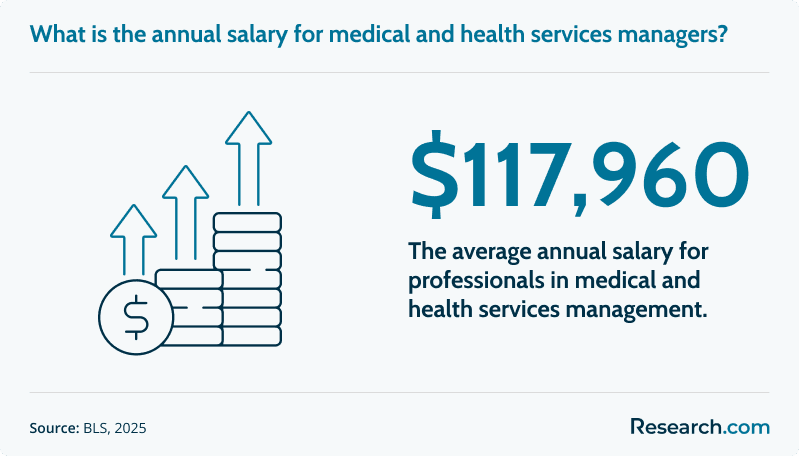
Salary is one of the main reasons students compare MHA programs carefully. According to BLS, medical and health services managers earned a median annual wage of about $117,960 in May 2024. That figure should be read as a broad labor-market benchmark, not a guaranteed salary for every graduate. Actual pay depends on role, experience, employer type, geographic market, and level of responsibility.
An MHA can improve access to leadership roles that often require graduate-level preparation or substantial management experience. Graduates who move into healthcare finance, operations, executive administration, compliance, consulting, or large-system management may have stronger earning potential than those in smaller organizations or early-career coordinator roles. If you are asking whether an MHA is worth it, salary should be evaluated alongside tuition, debt, work experience, job growth, and the type of role you realistically plan to pursue.
Students should also compare salaries by sector. Large hospitals, health systems, biopharmaceutical employers, consulting firms, and specialized finance or compliance departments may offer higher compensation than small practices, local clinics, or nonprofit community settings. However, smaller organizations may provide broader responsibilities earlier, which can help build leadership experience.
| Factor | How it can affect MHA salary |
| Employer size | Larger health systems often have more complex operations and more senior leadership layers, which can create higher-paying roles. |
| Industry sector | Hospitals, consulting, pharmaceuticals, insurance, and finance-related healthcare roles may differ significantly in pay structure. |
| Location | Metropolitan markets with major health systems may offer more leadership opportunities, though living costs may also be higher. |
| Prior experience | Clinicians, analysts, finance professionals, and managers may enter the MHA with transferable experience that supports faster advancement. |
| Specialization | Healthcare finance, compliance, informatics, operations, and quality improvement can lead to different salary paths. |
How fast is demand growing for healthcare administrators?
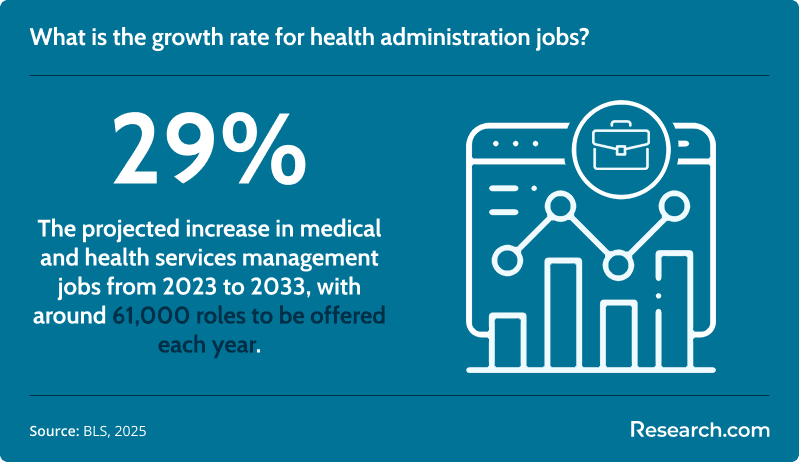
The labor-market outlook for healthcare administration is strong. BLS projects employment of medical and health services managers to grow by 29% between 2023 and 2033, a rate described as much faster than the average for most occupations. BLS also expects more than 61,000 openings for healthcare administrators each year on average, including both newly created positions and openings caused by workers leaving the field or retiring.
For students considering accelerated online MHA programs, this growth outlook is important because it suggests continued need for leaders who can manage increasingly complex healthcare environments. Faster programs may appeal to working professionals who already have relevant experience and want to move into management sooner, but the pace can be demanding.
Demand is tied to several pressures: an aging population, expanding healthcare delivery systems, technology-driven care models, rising attention to data, and complicated regulatory requirements. Healthcare employers need administrators who can coordinate people, budgets, compliance, quality, and technology without losing sight of patient outcomes.
CMS projections also show that national health expenditures are expected to remain a major part of the broader economy, which reinforces the need for skilled leaders who can manage resources responsibly. In practical terms, healthcare administration is not just about supervising offices; it is about helping organizations deliver care efficiently, safely, and sustainably.
What are the best MHA specializations for 2027?
The best MHA specialization is the one that matches your target role. A student who wants to manage hospital operations needs different preparation from someone aiming for healthcare analytics, compliance, finance, policy, or pharmaceutical leadership. Specializations can help you build a clearer professional identity and signal to employers that your training goes beyond general management.
Some students compare an MHA with business-focused alternatives, including the fastest online MBA in Healthcare Administration Programs. In general, an MHA is more healthcare-system focused, while an MBA in healthcare administration often emphasizes broader business frameworks applied to healthcare settings.
| MHA specialization | What you study | Career paths it may support |
| Healthcare Finance and Accounting | Budgeting, reimbursement, revenue cycle management, capital planning, and financial reporting. | Finance manager, revenue cycle leader, operations executive, healthcare financial analyst. |
| Health Informatics and Data Analytics | Electronic health records, performance dashboards, predictive modeling, data governance, and analytics-based decisions. | Data analyst, informatics manager, quality analytics leader, population health analyst. |
| Policy and Public Health Leadership | Health policy, public health systems, population-level planning, advocacy, and program implementation. | Policy advisor, public health administrator, nonprofit health leader, government program manager. |
| Quality Improvement and Patient Safety | Quality metrics, safety systems, preventable error reduction, process improvement, and performance monitoring. | Quality and safety manager, clinical operations leader, patient experience manager. |
| Risk Management and Compliance | Healthcare law, ethics, HIPAA, audits, internal controls, privacy, and organizational risk. | Compliance manager, risk manager, privacy officer, regulatory affairs leader. |
What skills do employers expect from health administration degree graduates?
Employers want MHA graduates who can connect healthcare knowledge with management execution. A strong candidate understands patients, finances, regulations, staff dynamics, quality goals, data, and operational constraints. Technical knowledge matters, but so do communication, judgment, and the ability to lead change without disrupting care.
According to Zippia, common healthcare administrator resume skills include patients (26.3%), patient care (8.5%), healthcare services (6.4%), home health (6.0%), mental health (5.7%), and HIPAA (3.3%). These resume patterns show that employers value administrators who understand both care delivery and the systems that support it.
Some MHA competencies overlap with executive business skills used in other leadership degrees. For example, strategic thinking, organizational management, and senior-level decision-making are also relevant to doctor of business administration jobs, although healthcare roles require sector-specific knowledge of compliance, reimbursement, patient safety, and care operations.
- Patient-centered leadership: Administrators must improve service quality, support safe care, and make decisions that consider patient experience, access, and outcomes.
- Healthcare operations knowledge: Employers look for candidates who can manage departments, coordinate services, improve workflows, and understand how care is delivered across settings.
- Behavioral health awareness: Mental health appears among common administrator resume skills, reflecting the need for leaders who can support integrated and responsive care models.
- Compliance and privacy literacy: HIPAA, infection control, documentation, and regulatory expectations are central to many administrative roles.
- Financial and analytical ability: MHA graduates should be able to read budgets, interpret performance data, assess costs, and make evidence-based recommendations.
- People management: Healthcare leaders supervise teams under pressure, resolve conflicts, communicate across disciplines, and support workforce stability.
Professionals comparing MHA and business-oriented programs may also review an accelerated MBA in Healthcare Management online to decide whether they want a healthcare-administration curriculum or a broader business curriculum with a healthcare focus.
How long does an MHA take to complete?
The length of an MHA program depends on enrollment status, course load, transfer policies, work schedule, and whether the school uses traditional semesters, shorter terms, or an accelerated format. Full-time students commonly finish in two years, while part-time students may need three to four years. Programs for working adults may include evening, weekend, online, or hybrid coursework.
Students who want the shortest route often compare fast-track online healthcare management master's programs. Some accelerated options can be completed in as little as 12 to 18 months, but they usually require more intensive scheduling and may be harder to balance with full-time employment or family responsibilities.
| Program format | Typical completion time stated | When it makes sense | Trade-off to consider |
| Full-time MHA | Two years | You can dedicate substantial time to graduate study and may want internships, fellowships, or campus-based networking. | Less flexibility if you need to work full time. |
| Part-time MHA | Three to four years | You want to keep working while spreading courses over a longer period. | Career benefits may take longer to materialize. |
| Accelerated MHA or healthcare management master’s | 12 to 18 months | You already have relevant experience and can handle an intensive academic pace. | Less room for schedule disruptions, internships, or slow-paced exploration. |
| Hybrid or online MHA | Varies by school | You need flexibility but still want structured faculty interaction and possible residencies or practicum experiences. | Some programs may require campus visits, synchronous sessions, or local fieldwork. |
What core courses are in an MHA curriculum?
An MHA curriculum usually combines healthcare-specific knowledge with leadership, finance, analytics, law, ethics, and operations coursework. The goal is to prepare students to manage healthcare organizations where clinical quality, financial sustainability, compliance, technology, and workforce needs intersect.
Many healthcare administrators enter the field from clinical backgrounds. Around 32% of professionals in the field majored in nursing before moving into administration. Others come from business, public health, health information management, finance, or healthcare administration programs.
Students with a health information background may also explore HIM degree jobs such as medical records manager, compliance officer, or health data analyst before applying to an MHA program. These roles can provide practical exposure to patient data, privacy requirements, coding systems, documentation, and operational reporting.
- Healthcare Finance: Introduces budgeting, reimbursement, financial statements, resource allocation, and revenue cycle issues.
- Health Policy and Law: Covers healthcare regulation, legal responsibilities, ethics, policy analysis, and compliance obligations.
- Healthcare Operations and Management: Focuses on staffing, service delivery, workflow design, leadership, strategy, and organizational performance.
- Data Analytics and Informatics: Teaches students how to interpret healthcare data, use information systems, and support decisions with evidence.
- Quality Improvement and Patient Safety: Examines methods for reducing errors, measuring outcomes, improving processes, and strengthening safety culture.
| Course area | Why it matters in the workplace |
| Finance | Healthcare leaders must understand budgets, reimbursement pressures, staffing costs, and financial trade-offs. |
| Policy and law | Administrators are responsible for operating within changing legal, privacy, and regulatory requirements. |
| Operations | Care delivery depends on efficient scheduling, staffing, communication, and process design. |
| Analytics | Employers increasingly expect leaders to use data when evaluating performance, quality, access, and cost. |
| Quality and safety | Improving outcomes and reducing preventable harm are central responsibilities for healthcare managers. |
How do you evaluate MHA program quality beyond rankings?
Rankings can help you discover programs, but they should not be the only reason you enroll. A strong MHA program should match your career goals, schedule, budget, learning style, and target healthcare sector. The most important question is not “Which program is ranked highest?” but “Which program is most likely to help me reach the role I want without creating unnecessary cost or risk?”
Accreditation should be one of your first checks. The Commission on Accreditation of Healthcare Management Education (CAHME) is a key accrediting organization for healthcare management education, and CAHME accreditation can signal that a program meets recognized industry standards.
| Quality factor | What to ask before enrolling | Why it matters |
| Accreditation | Is the program accredited by a recognized body such as CAHME? | Accreditation helps confirm that the curriculum, faculty, and outcomes meet external standards. |
| Career outcomes | Where do graduates work, and what roles do they obtain after graduation? | Employment outcomes show whether the program has a track record in your target field. |
| Faculty experience | Do instructors have healthcare leadership, policy, finance, analytics, or operations experience? | Practitioner-informed teaching can make coursework more relevant to real healthcare settings. |
| Experiential learning | Are internships, residencies, capstones, or consulting projects available? | Applied experience can help students build evidence of leadership ability. |
| Networking access | Does the school connect students with alumni, employers, fellowships, or healthcare partners? | Healthcare leadership hiring often depends on relationships as well as credentials. |
| Flexibility | Can you complete the program online, part time, full time, or through hybrid study? | The right format can prevent burnout and improve completion odds. |
| Total cost | What is the full cost after fees, books, travel, lost wages, and financial aid? | Tuition alone does not show the real price of a degree. |
Common mistakes when choosing an MHA program
| Mistake | Better approach |
| Choosing only by ranking | Compare accreditation, outcomes, cost, faculty, format, and employer connections. |
| Looking only at tuition | Estimate the full cost, including fees, technology, travel, residency requirements, books, and time away from work. |
| Assuming every online program fits your schedule | Check whether courses are asynchronous, synchronous, hybrid, or tied to required campus visits. |
| Ignoring career services | Ask about fellowships, internships, alumni networks, job placement support, and employer partnerships. |
| Picking a specialization too early | Review target job postings first, then choose electives that match the skills employers request. |
| Assuming the degree alone guarantees promotion | Build experience, measurable achievements, leadership examples, and a strong professional network while enrolled. |
How can interdisciplinary studies complement your MHA?
Interdisciplinary preparation can be useful when your target role sits between clinical science, operations, technology, and strategy. For example, exposure to scientific fields such as biochemistry may help future administrators understand clinical innovation, drug development, laboratory operations, and the scientific context behind healthcare decisions.
This does not mean every MHA student needs a science degree. It is most relevant for students interested in biopharmaceutical management, clinical research operations, academic medical centers, health technology, laboratory administration, or roles that require close collaboration with scientists and clinicians. Students who want to strengthen that background may compare affordable biochemistry degrees online as a separate or complementary academic option.
How much does an MHA cost for 2027?
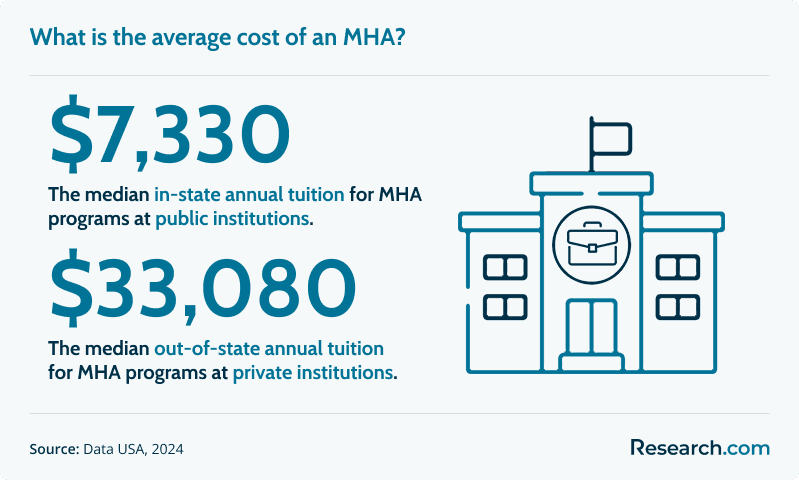
MHA costs vary widely by institution, residency status, delivery format, and program length. According to Data USA, median tuition rates for graduate programs show that public in-state tuition averages around $7,330 per year, while private out-of-state tuition averages about $33,080 annually. This difference makes cost comparison essential before applying.
Tuition is only one part of the total price. Students should also budget for books, software, technology fees, graduation fees, transportation, possible campus residencies, internship-related expenses, and any reduction in work hours. Employer tuition assistance, scholarships, grants, assistantships, and federal financial aid may reduce out-of-pocket costs.
For many students, an MHA follows a bachelor’s degree in a related area. Reviewing health science bachelor degree jobs can help you compare entry-level opportunities with the leadership roles that may become more accessible after graduate study.
The return on investment depends on your current salary, target role, debt level, program cost, and ability to move into management after graduation. A lower-cost accredited program may be a strong option for students who already have healthcare experience, while a higher-cost program may be easier to justify if it provides strong employer connections, fellowships, alumni access, or a clear route into competitive leadership roles.
How to estimate whether an MHA is financially reasonable
- Identify your target role: Do not evaluate the degree in the abstract. Choose specific jobs such as operations manager, compliance manager, finance manager, or clinical director.
- Compare job requirements: Look at current postings to see whether employers prefer or require an MHA, MBA, MPH, nursing leadership background, or specific certifications.
- Calculate total program cost: Include tuition, fees, books, residencies, travel, technology, and income changes.
- Review salary benchmarks carefully: Use the BLS median annual wage of about $117,960 for medical and health services managers as context, not as a guaranteed outcome.
- Ask about outcomes: Request employment data, fellowship placement information, alumni roles, and employer partnerships from each school.
- Consider opportunity cost: A part-time program may take longer, but it can allow you to keep earning while studying.
What additional certifications can elevate your MHA credentials?
Certifications can make an MHA more targeted when they fill a specific skill gap. They are most useful when tied to your intended role, such as healthcare finance, compliance, informatics, revenue cycle management, project management, quality improvement, or medical coding and billing operations.
For example, students interested in revenue cycle, documentation, reimbursement, and electronic records may benefit from practical exposure through accredited medical billing and coding schools online. This type of training can complement leadership coursework by helping future administrators understand the operational details behind claims, coding accuracy, and revenue management.
| Credential focus | When it can help | Possible MHA career connection |
| Revenue cycle or billing and coding | You want to work in finance, reimbursement, claims, or practice management. | Finance manager, revenue cycle leader, clinic administrator. |
| Compliance or privacy | You plan to manage HIPAA, audits, documentation, regulatory policies, or risk programs. | Risk and compliance manager, privacy officer, regulatory manager. |
| Health informatics or analytics | You want to use data, dashboards, EHR systems, and reporting tools to improve decisions. | Data analyst, informatics manager, quality analytics leader. |
| Quality improvement | You want to reduce errors, improve outcomes, and manage performance improvement initiatives. | Quality and safety manager, clinical operations leader. |
| Project management | You want to lead implementations, process redesigns, technology rollouts, or consulting projects. | Operations manager, consultant, transformation project lead. |
Is a health administration degree good for career changers coming from business, IT, or clinical roles?
An MHA can be a practical bridge into healthcare leadership for career changers, but the best path depends on what you already know. The degree is especially useful when it helps translate existing skills into a healthcare context.
Business and finance professionals may already understand budgeting, performance metrics, forecasting, staffing models, and strategy. An MHA can add healthcare-specific knowledge in reimbursement, compliance, operations, policy, and patient-centered systems.
IT professionals may find opportunities in healthcare analytics, informatics, privacy, cybersecurity, EHR optimization, and data governance. The growing importance of health informatics makes technical expertise increasingly valuable in administrative decision-making.
Clinicians such as nurses, therapists, and physicians may use an MHA to move from patient care into management. Their clinical background can provide credibility with care teams, while graduate coursework fills gaps in finance, policy, law, operations, and organizational leadership.
For nurses weighing advanced options, it may also be useful to compare what you can do with a dual MSN MBA degree. That route blends clinical leadership with business training and may be attractive for professionals targeting executive or entrepreneurial healthcare roles.
| Career changer background | Transferable strengths | MHA gaps to close | Possible roles after the transition |
| Business or finance | Budgeting, operations, strategy, performance management, financial analysis. | Healthcare law, reimbursement, clinical operations, patient safety, regulatory expectations. | Finance manager, operations manager, consultant, practice administrator. |
| IT or data | Systems thinking, analytics, cybersecurity, reporting, databases, process automation. | Healthcare workflows, HIPAA, clinical terminology, quality metrics, organizational leadership. | Health informatics manager, data analyst, compliance technology leader. |
| Clinical care | Patient care knowledge, clinical credibility, team-based communication, workflow awareness. | Finance, strategy, policy, executive communication, formal management methods. | Clinical director, quality manager, department supervisor, healthcare executive track. |
| Public health or nonprofit | Program planning, community health, grants, stakeholder engagement, population health. | Healthcare finance, operations, executive management, regulatory administration. | Public health administrator, policy leader, nonprofit health executive. |
Here’s what graduates say about earning an MHA
- : "Moving from clinical work into administration was harder than I expected, but my MHA helped me understand the finance, staffing, and operations decisions behind department leadership. As a Clinical Director, I now use those lessons to improve workflows and support safer, more consistent patient care. The degree did not replace experience, but it gave me a framework for leading with more confidence. — Angela"
- : "My background was in IT, so healthcare felt unfamiliar at first. The MHA helped me connect data, compliance, privacy, and organizational risk in a way that prepared me for work as a Risk and Compliance Manager. I now help protect patient information and support HIPAA-related processes across my organization. The transition made sense because the program helped me apply technical skills to healthcare problems. — Marcus"
- : "I chose an MHA because I wanted to move faster in hospital management. Within two years, I became an Operations Manager, but the biggest benefit was learning how to lead teams, evaluate processes, and communicate across departments. The residency and alumni network also helped me see career paths I had not considered before. Balancing school, work, and family was difficult, but the professional growth was worth it. — Priya"
Current trends shaping MHA careers
Healthcare administration is changing because healthcare organizations are being asked to do more with complex data, tighter resources, evolving regulations, and higher expectations for quality and access. MHA graduates who understand these trends can choose courses, internships, and certifications more strategically.
- Data-driven management is becoming standard: Administrators increasingly use dashboards, EHR data, financial reports, and quality metrics to guide decisions.
- Compliance remains a major leadership function: Privacy, documentation, reimbursement rules, audits, and risk management continue to shape administrative work.
- Quality and patient safety are central priorities: Leaders are expected to improve outcomes while managing cost, staffing, and operational pressure.
- Healthcare technology is expanding the administrator’s role: Informatics, telehealth operations, cybersecurity, and automation require leaders who can work across clinical, technical, and business teams.
- Career paths are becoming more interdisciplinary: Employers may value candidates who combine healthcare administration with finance, analytics, nursing, public health, IT, or scientific knowledge.
Practical steps before applying to an MHA program
- Define your target job first: Choose two or three roles you want after graduation, then work backward to identify the degree format, specialization, and experience you need.
- Check accreditation: Confirm whether the program has appropriate accreditation and whether CAHME accreditation matters for your goals.
- Compare total cost, not just tuition: Include fees, books, technology, travel, residency requirements, and lost income if you reduce work hours.
- Ask for graduate outcomes: Request information on employment rates, job titles, fellowships, internships, and alumni employers.
- Review faculty and employer connections: Look for instructors and partners with direct experience in healthcare leadership, operations, finance, compliance, analytics, or policy.
- Match electives to job postings: If employers in your target role ask for analytics, compliance, finance, or quality improvement, choose courses that build those skills.
- Plan how you will gain experience: Use internships, capstones, current workplace projects, volunteer leadership, or professional associations to build evidence of management ability.
- Be realistic about workload: Accelerated study can save time, but it may not be ideal if you have heavy work, caregiving, or travel obligations.
Key Insights
- An MHA is best suited for healthcare leadership roles: Common paths include operations, finance, compliance, consulting, quality improvement, analytics, clinical leadership, and executive administration.
- The labor market is favorable: BLS projects 29% employment growth for medical and health services managers between 2023 and 2033, with more than 61,000 openings expected each year on average.
- Salary potential is strong but not automatic: BLS reports a median annual wage of about $117,960 in May 2024 for medical and health services managers, but pay varies by sector, location, employer size, experience, and specialization.
- Specialization matters: Healthcare finance, informatics, quality improvement, risk management, compliance, and policy can lead to different career outcomes.
- Program quality should be judged beyond rankings: Accreditation, career outcomes, faculty experience, applied learning, employer networks, flexibility, and total cost are more useful decision factors.
- Career changers can use the MHA strategically: Business, IT, finance, public health, and clinical professionals can apply prior experience to healthcare administration if they intentionally fill sector-specific knowledge gaps.
- The best MHA choice is role-driven: Start with the job you want, then choose the program format, specialization, cost level, and experiential opportunities that support that goal.
References:
- BLS. (2025, August 28). Medical and health services managers. bls.gov.
- Brenan, M. (2024, December 6). View of U.S. Healthcare Quality Declines to 24-Year Low. Gallup.com. news.gallup.com.
- CMS. (2025). National Health Expenditure Projections 2024-2033. cms.gov.
- Data USA. (2024). Health Care Administration & Management. datausa.io.
- Zippia. (2025, January 8). Best Colleges and Degrees for Health Care Administrators. zippia.com.
Other Things You Should Know About What You Can Do With an MHA
To enroll in a Master of Health Administration program in 2027, applicants typically need a bachelor's degree, GRE or GMAT scores, a resume, and letters of recommendation. Some programs may require healthcare work experience or prerequisite coursework in fields like economics or management.
No, but CAHME accreditation is often preferred by employers because it signals a standardized curriculum and supervised practice. The Commission on Accreditation of Healthcare Management Education, or CAHME, accredits many U.S. MHA programs, and some employers screen candidates by accredited degree when hiring administrators.