
2027 MBA in Healthcare Salary

Co-Founder and Chief Data Scientist
An MBA in Healthcare Management is often considered by professionals who want to move from clinical, administrative, finance, operations, or consulting roles into higher-level healthcare leadership. The key question is not just whether the degree sounds valuable, but whether the salary upside, job opportunities, program cost, and career timeline make sense for your goals.
This guide explains what MBA in Healthcare Management graduates can realistically earn, which roles and industries tend to pay more, how experience and location affect compensation, and how this degree compares with alternatives such as the MHA. It also covers ROI, certifications, accreditation, online formats, networking, and technology trends so you can evaluate the degree as a career investment rather than a credential in isolation.
Quick Answer: What Salary Can You Expect With an MBA in Healthcare Management?
Professionals with an MBA in Healthcare Management commonly pursue roles such as medical and health services manager, hospital administrator, healthcare consultant, operations director, or executive leader. According to the Bureau of Labor Statistics, medical and health services managers earned a median annual wage of $117,960 as of May 2024. Earnings can be much higher in executive, pharmaceutical, biotech, consulting, and large health system roles, but salary depends heavily on experience, employer type, geography, and performance-based compensation.
What are the benefits of completing an MBA in healthcare management?
- A healthcare MBA can position graduates for management roles with a U.S. median salary near $117,960 per year.
- Medical and health services manager employment is projected to grow 29% between 2023 and 2033, which is much faster than the national average.
- Graduates may work across hospitals, biotech companies, insurers, consulting firms, health technology organizations, and digital health startups.
- Average U.S. salary for MBA in Healthcare Management graduates
- Highest-paying healthcare leadership jobs for MBA graduates
- How experience changes healthcare MBA salary potential
- How location affects MBA in Healthcare earnings
- MBA in Healthcare vs. MHA salary comparison
- Highest-paying industries and employer types
- Expected salary growth five and ten years after graduation
- What total compensation includes beyond base pay
- How to evaluate MBA in Healthcare Management ROI
- When an accelerated online healthcare administration degree may be worth it
- International salary comparisons for healthcare MBA graduates
- Certifications and skills that can increase earning potential
- Technology and labor market trends affecting future salaries
- How accreditation and program format affect career outcomes
- How networking and mentorship can influence advancement
What is the average salary for professionals with an MBA in Healthcare Management in the United States?
The most useful benchmark for MBA in Healthcare Management salary is the pay for medical and health services managers, because this category includes many hospital, clinic, health system, and healthcare operations leadership roles. The Bureau of Labor Statistics reports a median annual wage of about $117,960 as of May 2024.
Salary estimates vary by source because some include entry-level managers, smaller healthcare facilities, or professionals without graduate-level business training. For example, one salary analysis lists the overall average for health services managers at about $84,568 per year. That lower figure can still be useful as a reality check for early-career professionals or those working in smaller organizations.
For most MBA-trained professionals, the degree is not a guarantee of immediate executive pay. It is better viewed as a tool for moving into broader responsibility: budgeting, strategy, operations, analytics, people management, payer relationships, compliance, and growth planning. Those capabilities are what often lead to stronger career prospects after MBA in healthcare management.
| Salary reference point | Reported figure | How to interpret it |
| Medical and health services managers median wage | $117,960 | A strong national benchmark for many healthcare MBA career paths. |
| Health services manager average from one salary analysis | $84,568 | May better reflect a broader mix of experience levels and employer types. |
| Bachelor’s-level healthcare management average cited in the source article | ~$68K | Useful for comparing the potential graduate-degree premium, though outcomes vary. |
Which healthcare leadership roles offer the highest salaries to MBA graduates?
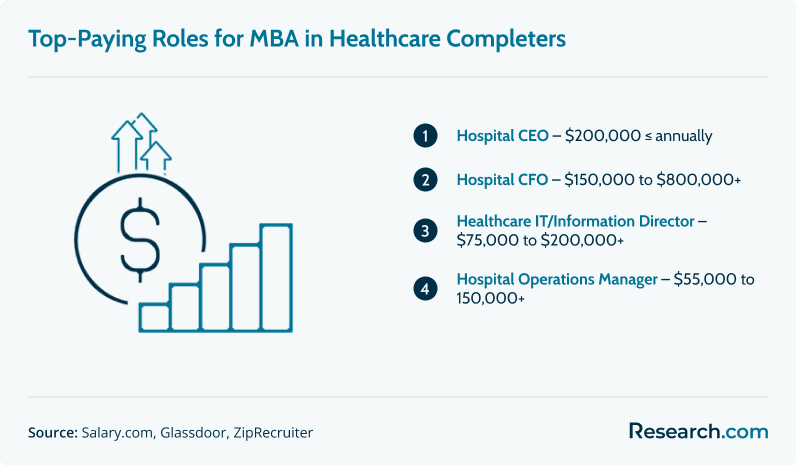
The highest salaries for healthcare MBA graduates are usually found in roles with enterprise-wide responsibility, financial accountability, regulatory exposure, and responsibility for large teams or facilities. The hospital Chief Executive Officer role sits at the top of the compensation ladder, with median salary estimates ranging from $250,000 to over a million dollars a year. These positions are among the most competitive outcomes for graduates of a healthcare business degree.
Other senior leadership roles can also be highly lucrative. Hospital Chief Financial Officers, for example, may earn between $150,000 and $800,000+. Outside the C-suite, leadership positions in healthcare technology, data, revenue cycle, operations, and information management can offer strong earnings, with Healthcare Information Managers and Technology Directors often falling in the $75,000–$200,000+ range.
The important distinction is scope. A manager responsible for one department will usually earn less than an executive responsible for a hospital, regional network, major product line, or multi-state operation. MBA coursework can help build the financial and strategic foundation for those roles, but advancement also requires experience, credibility, and measurable results.
| Role type | Typical salary range or benchmark stated | Best fit for |
| Hospital Chief Executive Officer | $250,000 to over a million dollars | Senior leaders with broad operational, financial, and governance experience. |
| Hospital Chief Financial Officer | $150,000 to $800,000+ | Professionals with finance, revenue cycle, accounting, and executive strategy expertise. |
| Healthcare Information Manager or Technology Director | $75,000–$200,000+ | Managers who combine healthcare operations knowledge with data, systems, or digital transformation skills. |
The visual below compares several of the top-paying healthcare leadership paths that MBA graduates may pursue after building substantial experience.
How does work experience influence MBA in healthcare salaries at the early, mid, and senior career stages?
Experience is one of the biggest salary multipliers for healthcare MBA graduates. Zippia reports an average salary of approximately $74,136 for someone with a master’s degree in healthcare management, compared with about $64,769 for someone with a bachelor’s degree. That difference is $9,367, or roughly a 14.5% increase associated with moving from bachelor’s-level to master’s-level preparation.
Early-career professionals may start closer to the lower end of the management pay range, especially if they are entering healthcare administration from a non-management role. The lowest 10% of health services managers earn around $69,000, which can resemble the pay level for newer managers or professionals in smaller settings.
At the mid-career stage, often after 5–10 years of relevant experience, many professionals move into director, practice manager, regional operations, revenue cycle, quality, or service-line leadership roles. At that point, compensation often approaches the national median of ~$118,000, depending on the market and employer.
At the senior level, pay can rise sharply. The top 10% of healthcare managers earn over $219,000 annually, which reflects the premium paid for leaders who manage larger budgets, complex organizations, high-risk operations, or executive-level strategy.
| Career stage | Common role examples | Salary pattern described in the source |
| Early career | Administrative manager, assistant manager, coordinator moving into management | May be closer to around $69,000 or the ~$80K starting range, depending on role and employer. |
| Mid-career | Department director, practice manager, operations manager | Often moves toward the national median of ~$118,000. |
| Senior career | Vice president, executive director, hospital administrator, C-suite leader | Can exceed $219,000 for top earners and may include larger bonuses. |
“After completing my MBA in Healthcare, I moved into an administrative manager role at about $75K. Five years later, I became a regional director and doubled my pay. The MBA helped me qualify for leadership opportunities, but the real acceleration came from combining the degree with operational experience.”
Whether you choose a traditional campus program or a healthcare MBA online, employers will still evaluate your track record. The chart below illustrates how education and work history can affect earning potential.
Does geographic location within the United States significantly affect MBA in Healthcare earnings?
Yes. Location can materially change MBA in Healthcare salary outcomes because healthcare labor markets differ by cost of living, hospital concentration, payer mix, competition for executives, and regional demand. Large metropolitan areas and high-cost states generally offer higher pay than rural markets or lower-cost regions.
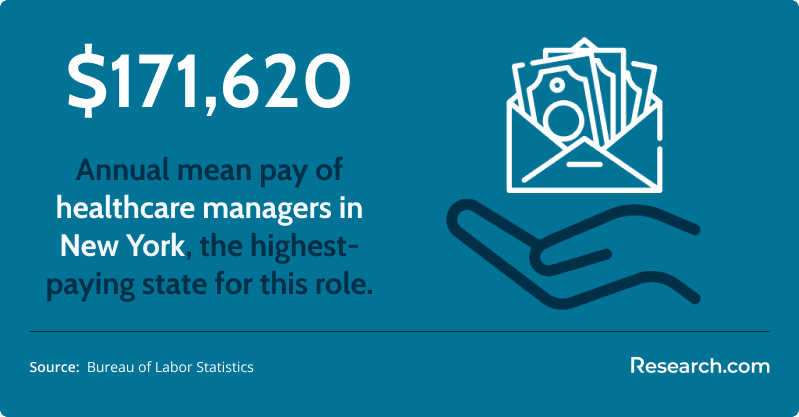
For example, New York health services managers earn about $171,620 on average. Other high-paying states include Massachusetts at $152K and California at $145K. By comparison, Arkansas reports average salaries around $94,840 for similar roles.
The difference can be substantial. A healthcare MBA professional in a major metro area may earn $50K+ more annually than someone in a smaller or lower-cost market. However, higher pay does not automatically mean higher purchasing power. Housing, taxes, commuting costs, and work intensity should be part of the comparison.
Even within a single state, salaries can vary widely. A medical MBA in Dalton, GA can earn upwards of $172K, which shows that local demand and employer mix can sometimes outweigh broad state averages.
| Location factor | How it affects salary | Decision point |
| High-cost coastal states | Often offer higher nominal pay. | Compare salary gains against housing and taxes. |
| Large metro healthcare hubs | More large hospitals, systems, consulting firms, insurers, and specialty employers. | Better fit for candidates seeking executive or corporate healthcare roles. |
| Rural or smaller markets | May pay less, but cost of living may also be lower. | Can offer faster responsibility growth if fewer candidates compete for leadership roles. |
The image below compares the top-paying states in the U.S. for healthcare managers.
How does an MBA in Healthcare salary compare with earnings for a Master of Health Administration (MHA) graduate?
An MBA in Healthcare Management and a Master of Health Administration can both lead to strong healthcare leadership careers, but they are designed for slightly different outcomes. The MHA is more specialized for healthcare administration, while the MBA usually provides broader training in finance, strategy, operations, markets, leadership, and business decision-making.
MHA graduates often move into hospital administration and health system management roles. Their earning potential is strong: the median salary for health administrators is about $110,680 per year. MBA graduates, however, may have more flexibility to pursue corporate healthcare, consulting, insurance, biotech, pharmaceutical, and finance-adjacent roles. A 2023 industry survey cited in the source article reports that MBAs working in healthcare average around $135,000 including bonuses.
General MBA graduates across all fields had an average starting pay of ~$129K in 2023. That does not mean every healthcare MBA graduate starts at that level, but it does show why some professionals choose the MBA when they want access to both healthcare and broader business leadership roles.
| Degree | Typical strength | Salary detail cited | Best for |
| MBA in Healthcare Management | Broad business leadership with healthcare specialization | Healthcare MBAs average around $135,000 including bonuses in the cited 2023 survey. | Professionals interested in hospitals, consulting, biotech, insurance, pharma, operations, or executive strategy. |
| Master of Health Administration | Focused healthcare administration preparation | Health administrators have a median salary around $110,680. | Professionals committed primarily to hospital, health system, or healthcare administration roles. |
If you are comparing leadership degrees more broadly, reviewing organizational leadership degree salary information can help you understand how healthcare management pay compares with other management-focused fields.
Which industries and employer types pay the most to MBA in Healthcare professionals?
Employer type can be just as important as job title. Healthcare MBA graduates often earn more in sectors with larger revenue streams, complex business models, product commercialization, advanced technology, or high-stakes regulatory and financial decisions.
Pharmaceutical manufacturing is one of the strongest examples. Medical and health services managers in that industry earn an average of about $225,700 per year, far above the approximately $139,500 reported for general hospitals. MedTech companies, health IT firms, health insurers, research and development organizations, specialty hospitals, and consulting firms can also pay premiums for MBA-trained professionals who understand both healthcare operations and business strategy.
Government agencies and large hospital systems still offer solid compensation, with medians around $130K in government and private hospitals. Smaller clinics, nursing facilities, and community health organizations may pay less, often under $100K median, but they can provide mission-driven work, broader responsibilities, or faster access to leadership opportunities.
| Employer type | Salary information stated | Why compensation may differ |
| Pharmaceutical manufacturing | About $225,700 average | High revenue, product strategy, regulation, commercialization, and global market complexity. |
| General hospitals | ~$139,500 | Large operations and budgets, but compensation varies by size, region, and ownership. |
| Government and private hospitals | Median around $130K | Stable leadership paths, but pay structures may be less flexible than corporate sectors. |
| Smaller clinics and nursing facilities | Often under $100K median | Smaller budgets and local market constraints. |
If you are still deciding between a healthcare-focused MBA and an administration-focused master’s, this guide on what is the difference between MHA and MBA can help clarify the trade-offs.
The chart below summarizes the top-paying industries for healthcare managers.
What is the salary growth trajectory five and ten years after completing an MBA in Healthcare?
Salary growth after a healthcare MBA is usually tied to how quickly a graduate moves from functional management into broader leadership. Many new graduates begin in mid-level roles, often around the ~$80K starting salary range, although pay varies by prior experience and employer.
Within five years, many professionals reach six-figure compensation if they have not already done so. Moves into department director, practice manager, operations leadership, or service-line management can push salary into the $100K–$130K range. Clinical practice managers average about $138K in the U.S., which gives one example of how specialized management roles can pay.
After ten years, healthcare MBA graduates may qualify for senior director, vice president, hospital administrator, or C-suite roles. Hospital administrators with a decade of experience can easily exceed $150K. Some experienced healthcare executives earn $300–$500K+ when bonuses and incentives are included, while experienced hospital CEOs can report total packages in the high six to low seven figures.
| Time after MBA | Likely career movement | Salary pattern described |
| At graduation or early after graduation | Mid-level management or transition into healthcare leadership | Often around the ~$80K starting salary range, depending on background. |
| Five years | Director, practice manager, senior operations manager, department leader | Often reaches $100K–$130K; clinical practice managers average about $138K. |
| Ten years | Senior leadership, hospital administrator, VP, or executive track | Can exceed $150K; some executives reach $300–$500K+ with incentives. |
“Five years after completing my healthcare MBA, I moved from a coordinator role into senior operations management. My salary rose by about 50%, but the bigger change was my responsibility level. I now manage budgets, teams, and process improvement work that I would not have handled before the degree.”
What does a complete compensation package for MBA in Healthcare professionals include?
Base salary is only one part of healthcare leadership compensation. A complete package may include performance bonuses, retirement contributions, health benefits, paid leave, professional development funding, leadership training, relocation support, tuition assistance, and—in some corporate or startup roles—stock options or equity.
For senior leaders, incentive pay can matter significantly. Bonuses may be tied to financial performance, patient access goals, quality metrics, cost reduction, expansion targets, or digital transformation milestones. In for-profit healthcare, biotech, health technology, and consulting environments, total compensation can diverge sharply from base salary.
Before accepting an offer, compare the full package rather than looking only at the headline salary. A lower base salary with strong retirement benefits, tuition reimbursement, or predictable bonuses may be more valuable than a slightly higher salary with limited benefits. Professionals at earlier stages who want a lower-cost entry route into healthcare may also compare options such as the cheapest medical assistant program online before committing to a graduate business degree.
| Compensation component | Why it matters |
| Base salary | The fixed annual pay used for budgeting and comparison across offers. |
| Bonus or incentive pay | Can reward performance, growth, quality, or operational results. |
| Retirement benefits | Can add long-term financial value beyond annual salary. |
| Professional development | May fund conferences, certifications, executive education, or leadership training. |
| Equity or stock options | More common in corporate, startup, biotech, or health technology settings. |
What is the potential return on investment (ROI) for an MBA in Healthcare Management?
ROI depends on the total cost of the degree, how much salary growth it helps unlock, and how quickly the graduate can move into higher-responsibility roles. A healthcare MBA can be worthwhile for professionals who already have relevant healthcare, business, finance, operations, clinical, or consulting experience and need the degree to compete for leadership positions.
To evaluate ROI, compare tuition, fees, books, travel, technology costs, lost income if you reduce work hours, interest on student loans, and the time required to finish. Then compare those costs with realistic salary scenarios, not just top executive earnings. The degree may pay off faster for someone who moves from a mid-level role into director-level compensation than for someone using it to make an early-career pivot with limited experience.
Some students may find a more specialized or lower-cost pathway more practical. For example, comparing the cheapest MHA programs online may make sense if your target role is traditional healthcare administration rather than broader business leadership.
| ROI question | Why it matters |
| Will the program help me qualify for roles I cannot access now? | The degree should solve a real career barrier, not just add another credential. |
| Can I keep working while enrolled? | Maintaining income can reduce opportunity cost. |
| Does the school have healthcare employer connections? | Career outcomes often depend on recruiting access, alumni networks, and local market relationships. |
| How much debt will I carry after graduation? | High debt can weaken ROI even when salary rises. |
| Are salary expectations based on my market and experience? | National averages may not match your city, employer type, or career stage. |
Is an Accelerated Online Healthcare Administration Degree Worth Considering?
An accelerated online healthcare administration degree can be useful for working professionals who need management training quickly and cannot pause their careers for a traditional full-time campus program. The main advantage is speed and flexibility: students may apply new skills at work while progressing through the curriculum.
However, accelerated programs are not automatically better. A shorter timeline can mean heavier weekly workloads, fewer breaks, and less time for internships, networking, or career exploration. The format works best for students who are organized, already familiar with healthcare settings, and clear about their career goals.
If speed is a priority, compare curriculum depth, accreditation, faculty experience, student support, employer reputation, and transfer credit policies. Reviewing options such as the fastest online healthcare administration degree can help you understand how accelerated formats differ.
| Accelerated format may fit if... | Consider another option if... |
| You have healthcare experience and want a faster management credential. | You need extensive career exploration or internship support. |
| You can manage a compressed academic schedule while working. | Your work or family schedule is unpredictable. |
| You already know your target role or employer type. | You are unsure whether you want healthcare administration, consulting, informatics, or finance. |
How do international salaries for MBA in Healthcare graduates compare to those in the United States?
Healthcare MBA salaries are generally higher in the United States than in many other countries. The difference reflects healthcare spending levels, employer budgets, market structure, private-sector compensation, and the scale of U.S. health systems.
In the United Kingdom, a healthcare manager earns around £45,000 per year, or approximately $56,000, on average. In Canada, experienced health administrators may top out near CAD 120,000, or around $88,000. In India, an entry-level MBA healthcare manager may earn ₹500,000–₹800,000 annually, which is about $6,000–$10,000.
Some international roles can still pay well, especially expatriate positions, global consulting roles, pharmaceutical leadership jobs, or healthcare strategy positions in markets such as the Middle East or Singapore. Still, U.S. salaries tend to be among the strongest for graduates of both campus and online healthcare management programs.
| Country or market | Salary figure stated | Interpretation |
| United States | Medical and health services managers median near $117,960 | One of the strongest markets for healthcare management compensation. |
| United Kingdom | Around £45,000, approximately $56,000 | Lower average salary than the U.S. benchmark. |
| Canada | Up to roughly CAD 120,000, around $88,000, for experienced professionals | Solid pay, but generally below comparable U.S. leadership compensation. |
| India | ₹500,000–₹800,000, about $6,000–$10,000, for entry-level MBA healthcare managers | Much lower nominal pay, reflecting different labor market and economic conditions. |
“After earning my online MBA in Healthcare and moving into the U.S. healthcare system, the salary difference was striking. In my home country, I expected to peak near $50K. In the U.S., my earning potential is much higher, and my international perspective helped me stand out.”
Which certifications or additional skills can boost earning potential for MBA in Healthcare holders?
Certifications can strengthen a healthcare MBA graduate’s profile when they demonstrate a specific capability employers need. They are especially useful in finance, quality, practice management, project leadership, process improvement, informatics, and healthcare technology.
Credentials such as the Certified Healthcare Financial Professional, Certified Professional in Healthcare Quality, and Certified Medical Practice Executive can help signal readiness for specialized leadership roles. Project management credentials may also be valuable because healthcare organizations frequently run complex initiatives involving compliance, technology, facilities, staffing, vendors, and patient experience.
Technical fluency is becoming increasingly important. Skills in healthcare data analytics, Electronic Health Record systems, Lean Six Sigma, process redesign, AI-enabled workflows, and decision support can help MBA graduates compete for roles that blend business leadership with digital transformation.
- Certified Healthcare Financial Professional (CHFP) – Supports healthcare finance, budgeting, reimbursement, and CFO-track preparation.
- Project Management Professional (PMP) – Demonstrates structured project leadership for large healthcare initiatives. Reviewing a project management specialist job description can help you see how these skills apply in practice.
- Certified Medical Practice Executive (CMPE) – Signals advanced expertise in physician practice and group practice management.
- Certified Professional in Healthcare Quality (CPHQ) – Validates quality improvement and performance management knowledge.
- Lean Six Sigma Green Belt or Black Belt – Shows process improvement ability, which is valuable in hospital operations and cost-reduction work.
Students comparing graduate-level preparation may also explore affordable online masters in healthcare administration options if cost is a major concern. The chart below highlights common skills found in healthcare manager resumes.
How are emerging trends shaping future salary prospects for healthcare MBA professionals?
Technology is changing what healthcare leaders are expected to manage. Telehealth, AI, predictive analytics, automation, cybersecurity, revenue cycle technology, patient access platforms, and digital operations are creating demand for leaders who can connect business strategy with clinical realities.
Telehealth expansion has created leadership roles such as Telehealth Program Manager and Virtual Care Director. A Telehealth Manager earns around $76,500 on average today, and these roles may become more strategic as virtual care becomes a standard part of healthcare delivery.
AI is also reshaping healthcare management. Organizations are using AI-driven scheduling, predictive analytics, automation, and decision support tools, which increases demand for managers who understand governance, workflow redesign, compliance, workforce impact, and measurable implementation outcomes. Employers are also competing for hard-to-fill talent: 69% of healthcare hiring managers say they are willing to raise starting salaries to recruit professionals on-site for hard-to-fill roles.
If your interests lean more toward data, systems, and informatics than general management, comparing master's degree in health informatics salary information may help you choose a better-fitting path.
The salary advantage will likely go to healthcare MBA professionals who can lead change rather than simply understand the technology. Employers need people who can evaluate vendors, manage implementation risk, train teams, protect data, improve workflows, and measure results. That is why the healthcare MBA salary outlook is strongest for graduates who combine leadership, analytics, finance, and healthcare operations expertise.
How Do Accreditation and Program Format Influence Career Advancement and Salary?
Accreditation, school reputation, employer relationships, and delivery format can all influence how employers view an MBA in Healthcare Management. Accreditation helps confirm that a program meets recognized academic and quality standards. For students, it can also matter for transfer credits, employer tuition reimbursement, financial aid eligibility, and graduate school recognition.
Program format matters for different reasons. Campus programs may offer in-person networking, local healthcare employer access, and structured recruiting. Online programs may be better for working professionals who need flexibility and want to apply coursework immediately in their current jobs. The stronger option is the one that fits your schedule, budget, learning style, and target career market.
Fast online pathways, including the fastest MBA in healthcare management online programs, may appeal to professionals who already have healthcare experience and want to move quickly. But speed should not outweigh accreditation, curriculum quality, faculty expertise, career support, and employer recognition.
| Factor to check | Why it affects career value |
| Accreditation | Supports program credibility and may affect aid, transfer, and employer reimbursement. |
| Healthcare-focused curriculum | Helps ensure the MBA covers healthcare finance, policy, operations, data, and compliance. |
| Career services | Can improve access to internships, alumni, employer contacts, and leadership openings. |
| Online vs. campus format | Determines flexibility, networking style, and how easily students can keep working. |
| Program pace | Accelerated options save time but may reduce flexibility and increase weekly workload. |
How Do Networking and Mentorship Opportunities Influence Career Advancement and Salary?
Networking and mentorship can influence salary because many healthcare leadership roles are filled through reputation, referrals, alumni connections, professional associations, and industry relationships. A strong MBA program should offer more than courses; it should help students build access to people who understand healthcare hiring and advancement.
Mentors can help students choose between hospital administration, consulting, payer strategy, biotech, digital health, operations, finance, or informatics. They can also help candidates prepare for leadership interviews, negotiate compensation, identify skill gaps, and avoid career moves that do not support long-term goals.
Networking quality varies widely by program. Before enrolling, ask whether students interact with healthcare executives, alumni, faculty with industry experience, employer partners, and professional associations. While programs in other MBA specializations, such as an online MBA in sports management, also emphasize relationship-building, healthcare students should look specifically for connections to hospitals, health systems, insurers, biotech firms, consulting groups, and health technology employers.
Common Mistakes to Avoid When Evaluating Healthcare MBA Salary Potential
- Assuming the MBA alone guarantees executive pay. Salary growth usually requires relevant experience, measurable results, leadership ability, and the right employer setting.
- Looking only at tuition. Include fees, interest, books, travel, lost income, and the time required to finish.
- Ignoring accreditation. A cheaper or faster program may be less valuable if employers do not recognize it or if it creates financial aid or transfer issues.
- Using national salary averages without checking your local market. New York, California, Massachusetts, Arkansas, and smaller local markets can produce very different outcomes.
- Choosing MBA vs. MHA without considering career direction. The MBA may fit broader business roles, while the MHA may fit traditional healthcare administration more directly.
- Overlooking total compensation. Bonuses, retirement benefits, professional development funds, and equity can materially change the value of an offer.
- Underestimating technology skills. Healthcare leaders increasingly need data, AI, analytics, EHR, and process improvement knowledge.
Questions to Ask Before Choosing an MBA in Healthcare Management Program
- Is the program properly accredited and recognized by healthcare employers?
- Does the curriculum include healthcare finance, operations, compliance, analytics, leadership, and strategy?
- Can I keep working while enrolled, and how will that affect ROI?
- What healthcare organizations recruit from or partner with the program?
- Does the program publish career outcomes or provide access to alumni in leadership roles?
- Will this degree help me reach my target role faster than an MHA, certificate, or specialized master’s?
- How much debt will I take on, and what salary increase would be needed to justify it?
- Does the program offer mentorship, internships, consulting projects, or executive networking?
Here's What Graduates Have to Say About Their MBA in Healthcare Management
- My MBA in Healthcare Management helped me move from clinical support into outpatient department leadership. I now manage a 40-person team and earn 60% more than I did before. Mariela
- The online format allowed me to continue working full-time. I earned a regional operations promotion before finishing the program. Rashid
- The coursework was immediately practical. Within a year of graduating, I redesigned a hospital process and received recognition for leadership. Lucienne
Key Insights
- Medical and health services managers, a common career category for healthcare MBA graduates, earn a U.S. median salary of about $117,960.
- The strongest salaries usually come from executive responsibility, high-revenue industries, large health systems, consulting, biotech, pharma, and technology-driven healthcare employers.
- Hospital CEO roles can pay at least $200k per year, with some compensation packages reaching far higher levels.
- MBA graduates may out-earn MHA graduates in some settings because the MBA can open doors to corporate healthcare, consulting, insurance, biotech, and finance-related roles.
- Industry choice matters: pharmaceutical company managers average more than $225K, compared with about $140K in general hospitals.
- Demand is strong, with healthcare management jobs projected to grow 29% from 2023 to 2033.
- Location can create large pay differences. New York averages about $172K, California is also a high-paying state, and Arkansas is closer to $95K.
- The best ROI comes when the program is accredited, affordable enough for your budget, connected to healthcare employers, and aligned with your target role.
- Technology skills in AI, analytics, telehealth, EHR systems, and process improvement can strengthen salary prospects for healthcare MBA professionals.
References
- Bureau of Labor Statistics. Medical and Health Services Managers, Occupational Outlook Handbook.
- Bureau of Labor Statistics. Occupational Employment and Wage Statistics. Medical and Health Services Managers, May 2022.
- CanadianSIM. Master’s in Health Administration in Canada.
- DY Patil Online. MBA Pharma Healthcare Management Salary.
- Talent.com UK. Salary data.
- University of Cincinnati. MHA vs. MBA: Which Path Is Best for You?
- Zippia. Health Services Manager Salary.
Other Things You Should Know About MBA in Healthcare Salary
Yes. Certifications such as Lean Six Sigma, CPA, or PMP can raise earning potential by signaling operational, financial, or project-management skill. Employers in hospitals, insurers, and consulting firms often pay more for candidates with an MBA plus a recognized credential, especially for management and analytics roles.
In 2027, salary outcomes for online and traditional on-campus MBA in Healthcare graduates are generally comparable, showing minimal difference as more employers value the skills and knowledge gained irrespective of the delivery mode.
In 2027, MBA in Healthcare graduates tend to earn the highest salaries in regions like California and New York, where the healthcare industry is robust. These areas typically offer salaries exceeding $125,000 annually due to high demand and cost of living.


