2027 Is a Master’s in Biotechnology Worth It?

Co-Founder and Chief Data Scientist
A master’s in biotechnology is a serious investment: tuition, time away from full-time work for some students, and a highly technical curriculum. The reason many students still consider it in 2027 is that biotechnology sits at the center of several fast-moving fields, including biopharmaceuticals, gene therapy, mRNA platforms, bioinformatics, precision medicine, agricultural technology, and environmental biotechnology. The U.S. biotechnology industry is valued at over $552.40 billion and is growing about 12.4% annually, which has increased interest in graduate-level biotech training.
This guide is for students with a science background, working laboratory professionals, career changers with relevant prerequisites, and bachelor’s degree holders deciding whether graduate school will improve their career options. You will learn what a biotechnology master’s covers, when it is worth the cost, which jobs it can lead to, what salaries may look like, how long programs take, what admissions committees expect, and how to compare schools without relying only on rankings.
Quick answer: Is a master’s in biotechnology worth it?
For many students, a master’s in biotechnology can be worth it if they want to move beyond entry-level lab work into research, biomanufacturing, regulatory affairs, product development, clinical research, or technical leadership. The degree is strongest for students who already have a foundation in biology, chemistry, biomedical engineering, or a related science and who want specialized training in areas such as molecular biology, bioinformatics, genetic engineering, bioprocessing, or biotech management.
It may be less worthwhile if you are unsure about working in science, need a licensed clinical healthcare career, or can reach your target role through employer training, a shorter certificate, or a more focused graduate program. The best decision depends on your career goal, program cost, location, internship access, and whether the curriculum matches the biotech sector you want to enter.
Best reasons to earn a master’s in biotechnology
- You want higher-responsibility scientific roles. Advanced degrees are often associated with management, research leadership, and specialized technical positions. Natural sciences managers, who often have graduate-level training, earn a median of ~$137,900.
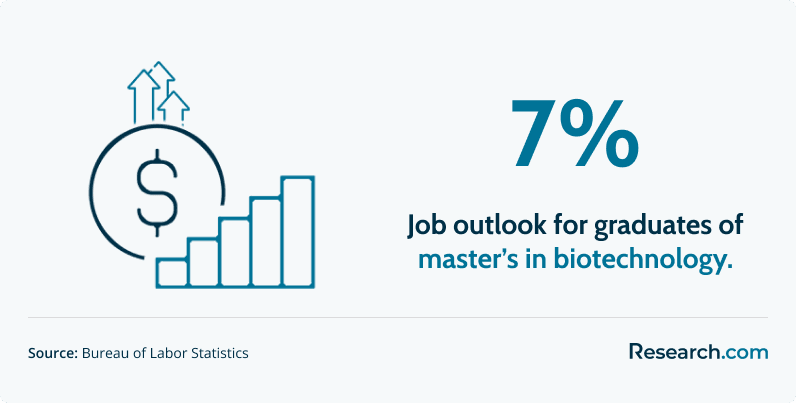
- You want to compete in a growing life sciences market. BLS data cited in this guide shows employment of biological scientists and technicians projected to grow 7% faster than average this decade.
- You need skills that are difficult to build through a bachelor’s alone. Graduate biotechnology programs commonly train students in areas such as gene editing, molecular diagnostics, bioinformatics, bioprocessing, regulatory affairs, and translational research.
- What does a master’s in biotechnology cover?
- Is a master’s in biotechnology worth it in 2027?
- What are the main advantages of a biotechnology master’s?
- What skills do biotechnology master’s students develop?
- How long does a master’s in biotechnology take?
- What jobs can you pursue with a master’s in biotechnology?
- How much can biotechnology graduates earn?
- Should you add data science skills to a biotechnology master’s?
- How can technology skills improve biotech career options?
- Can affordable bioinformatics courses improve biotechnology outcomes?
- How does biotechnology connect with environmental science?
- What are common admission requirements?
- Is a master’s in biotechnology better than a bachelor’s?
- Which schools offer strong biotechnology master’s programs?
What does a master’s in biotechnology cover?
A master’s in biotechnology is a graduate degree that applies biological science, laboratory methods, data analysis, and often business or regulatory knowledge to the development of products, therapies, diagnostics, processes, and technologies. Programs usually combine advanced science coursework with applied training for industries such as pharmaceuticals, healthcare, agriculture, food technology, environmental science, and biomanufacturing.
Common subjects include molecular biology, cell biology, genetic engineering, bioinformatics, bioprocessing, biostatistics, protein science, regulatory affairs, quality systems, and biotechnology commercialization. Some programs are research-heavy and prepare students for laboratory or doctoral pathways. Others are professional science master’s programs that emphasize industry projects, internships, regulatory knowledge, and business communication.
The master’s degree has become a major credential in this field. In 2022, U.S. schools awarded 4,245 biotech degrees, an increase of 8.5% from the previous year, and the master’s was the most common biotechnology degree earned. That does not mean every biotech worker needs a master’s, but it shows that graduate training is a common path for people who want more specialized or senior roles.
Biotechnology is broad, so it is important to distinguish it from related fields. Genetic counseling, for example, is a patient-facing specialty focused on helping individuals and families understand genetic risk. Students interested in that route should compare dedicated master’s programs in genetic counseling rather than assuming a general biotechnology degree will meet the same goal. Bioinformatics is another related but more computational field. It combines biology, computer science, and statistics; students drawn to data-heavy biology careers can review career paths for bioinformatics degree holders to see how those roles differ from wet-lab biotechnology jobs.
| Program focus | What you study | Best fit for |
| Research biotechnology | Molecular biology, cell systems, genetics, laboratory research, experimental design | Students aiming for R&D scientist, research associate, lab manager, or Ph.D. preparation |
| Biomanufacturing and bioprocessing | Scale-up, process development, GMP concepts, quality control, biologics production | Students interested in vaccines, biologics, cell therapy production, and manufacturing leadership |
| Bioinformatics and computational biotechnology | Genomics, programming, statistics, database tools, computational biology | Students who want to analyze biological data or work in precision medicine and genomics |
| Regulatory affairs and biotech management | FDA-related processes, quality systems, clinical trials, project management, commercialization | Students who want to move into compliance, product development, operations, or biotech business roles |
Is a master’s in biotechnology worth it in 2027?
A master’s in biotechnology is most likely to be worth it when the degree clearly connects to a specific career outcome. It can be a strong choice for students seeking advanced laboratory work, biopharmaceutical research, biomanufacturing, regulatory affairs, clinical research coordination, biotech product development, or a bridge into doctoral study. It is a weaker choice when a student is choosing it only because biotechnology sounds promising, without checking program costs, job requirements, internship access, or local hiring markets.
The labor market context is favorable. BLS reports about 148,400 job openings each year in life, physical, and social science occupations. The biotechnology R&D subsector reached record employment in 2024, and roles often aligned with graduate-level preparation continue to show demand. For example, biochemist jobs are projected to grow 9% from 2023–2033.
The financial case can also be strong, but it is not automatic. Medical scientists, a role often associated with graduate education, earn a median of about $100,890 per year. However, students should compare that potential against tuition, fees, living expenses, lost income if studying full time, relocation costs, and the opportunity cost of spending two years in school. A lower-cost public or online program with strong employer connections may produce a better return than a more expensive program that lacks internships or relevant specialization tracks.
In practical terms, the degree is worth considering if it helps you qualify for jobs that a bachelor’s degree will not realistically unlock. If your target employers regularly ask for a master’s degree, advanced wet-lab skills, bioinformatics training, regulatory knowledge, or project experience, graduate school may shorten the path to those roles. If your goal is entry-level lab work, a bachelor’s plus experience may be enough.
| Choose a biotechnology master’s if... | Consider another route if... |
| You want R&D, biomanufacturing, regulatory affairs, clinical research, or technical leadership roles. | You mainly want a licensed patient-care profession with separate licensure requirements. |
| Your bachelor’s degree gave you science fundamentals but not enough specialized biotech training. | You can get the role you want through employer training, a certificate, or direct work experience. |
| The program offers internships, capstones, industry projects, or faculty research aligned with your goals. | The curriculum is too general and does not match the biotech sector you want to enter. |
| You can manage the cost without taking on debt that is out of proportion to realistic salaries. | You have not compared tuition, fees, living costs, and likely entry-level compensation. |
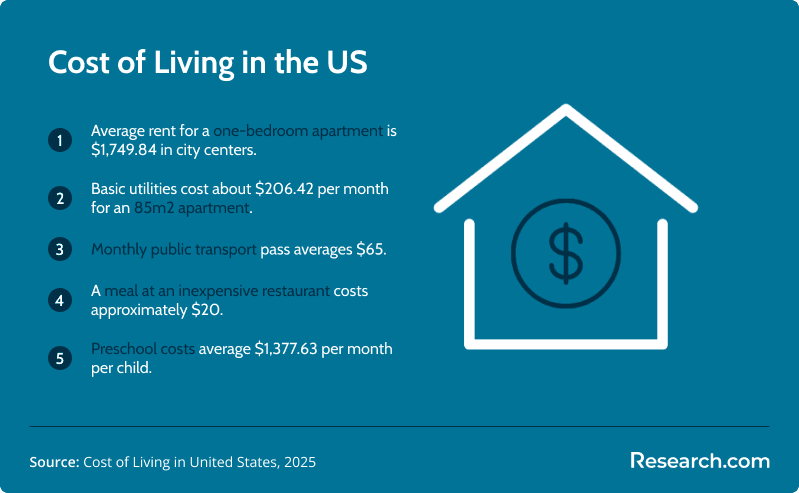
Cost of living also matters because many biotechnology jobs are concentrated in higher-cost regions. The image below presents the cost of living in the US as of current data.
What are the main advantages of a biotechnology master’s?
The value of a biotechnology master’s is not just the credential. The strongest programs help students build technical depth, professional credibility, research experience, and industry connections that are difficult to gain through undergraduate study alone.
- More advanced scientific expertise: Graduate coursework typically goes deeper into molecular systems, genetic engineering, biopharmaceutical development, bioinformatics, assay design, and applied research. This level of training can help you contribute to complex projects rather than only performing routine protocols.
- Better access to specialized and leadership-track roles: A bachelor’s degree may qualify you for lab technician, quality control, or research assistant roles. A master’s can make you more competitive for research associate, scientist, process development, regulatory, clinical research, and supervisory positions. Workers with a master’s earn about 20% more than those with just a bachelor’s on average, although individual outcomes depend on role, employer, region, and experience.
- Broader career options inside the life sciences industry: Biotechnology graduates can work in pharmaceutical companies, diagnostics, research institutions, agricultural biotechnology, environmental technology, clinical research organizations, and biomanufacturing. Students interested in the management side of healthcare and life sciences may also compare online healthcare management degree options if they want less laboratory work and more operations or administration.
- Stronger professional network: Faculty mentors, industry speakers, internships, alumni groups, and capstone sponsors can help students learn how biotech hiring works. For many students, these connections are as important as coursework because biotech jobs often require evidence of hands-on experience and credible references.
- A possible bridge to doctoral or professional study: Students considering a Ph.D., MD, or another advanced degree may use a biotechnology master’s to strengthen research skills, clarify a specialization, and improve academic credentials. This is especially useful for students who did not have extensive undergraduate research experience.
What skills do biotechnology master’s students develop?
A strong biotechnology master’s program should develop both technical and professional skills. Employers usually look for evidence that graduates can work safely in laboratory or production environments, interpret data, document work clearly, and contribute to regulated or interdisciplinary teams.
- Advanced laboratory methods: Students may build experience in cell culture, protein purification, gene cloning, assay development, CRISPR genome editing, PCR, and other molecular biology tools. Nearly 12% of biotech job postings list PCR experience as a required skill, making this a practical capability for many lab-based roles.
- Data analysis and bioinformatics: Biotechnology increasingly depends on large biological datasets. Many programs introduce R, Python, genomic analysis, statistical modeling, and computational biology tools. R programming appears on about 23.4% of biotechnology resumes, which reflects the growing importance of quantitative skills.
- Experimental design and troubleshooting: Graduate students learn to frame hypotheses, design experiments, evaluate controls, interpret unexpected results, and revise protocols. This is one of the main differences between performing assigned procedures and contributing to independent research.
- Regulatory, quality, and documentation practices: Biotechnology products often operate under strict quality and regulatory expectations. Students may learn about Good Manufacturing Practices, clinical trial documentation, FDA-related processes, validation, bioethics, and quality control systems.
- Scientific communication and project management: Graduates need to present findings, write technical reports, work across teams, and explain complex science to non-specialists. This is different from clinically focused programs such as online dental hygiene programs, where the curriculum centers more directly on patient care and clinical practice.
| Skill area | Why it matters | How to evaluate a program |
| Wet-lab techniques | Supports research, diagnostics, product development, and quality control roles. | Look for required labs, access to equipment, research rotations, and hands-on projects. |
| Bioinformatics | Helps graduates work with genomic, proteomic, and other high-volume biological data. | Check whether courses include R, Python, statistics, and biological databases. |
| Regulatory and quality systems | Important for biopharma, clinical trials, manufacturing, and product approval pathways. | Look for GMP, regulatory affairs, quality assurance, and clinical research coursework. |
| Business and communication | Useful for project management, product roles, consulting, and cross-functional teams. | Review capstones, internships, presentations, and industry-facing assignments. |
While the above are common industry expectations, the chart below presents skills that appear in biotech professionals' resumes.
How long does a master’s in biotechnology take?
Most full-time master’s in biotechnology programs take about two years. A common curriculum is ~30 to 36 credits, usually completed across four semesters. Some programs move faster; for example, American University’s program can be completed in 16 months of full-time study when students take summer courses. Part-time students, especially working professionals, may need 3 years or more depending on course availability and credit load.
Online and hybrid formats have made biotechnology graduate study more accessible, but students should still check whether laboratory requirements, internships, campus residencies, or research components require in-person attendance. The most affordable online biotechnology master’s programs usually take 2–3 years, which can be helpful for students balancing work and family responsibilities. As with other health and science fields, including online respiratory therapy programs, the real timeline depends on course sequencing, clinical or laboratory requirements, transfer policies, and whether the student enrolls full time or part time.
| Enrollment format | Typical timeline | Best for | Watch for |
| Full-time campus program | About two years | Students who can focus primarily on school and want lab access, research, and campus networking | Higher opportunity cost if you leave full-time work |
| Accelerated program | As short as 16 months in some formats | Students who can handle a heavier course load and want to reenter the workforce faster | Less scheduling flexibility and limited time for internships |
| Part-time program | 3 years or more | Working professionals who need to keep earning while studying | Longer time before career payoff |
| Online or hybrid program | Often 2–3 years | Students who need flexibility or do not live near a biotech campus | Lab access, internship placement, and employer recognition |
What jobs can you pursue with a master’s in biotechnology?
A master’s in biotechnology can support several career paths, but job titles vary widely by employer. Some graduates stay close to laboratory science, while others move into manufacturing, regulatory affairs, clinical research, technical sales, consulting, or product roles. If you are more interested in drug discovery and formulation specifically, you may also want to compare this path with guidance on how to become a pharmaceutical scientist.
- Research and development scientist: R&D roles involve designing and running experiments to support new therapies, diagnostics, agricultural products, biologics, or research platforms. The U.S. has about 8,900 new job openings each year for medical scientists, including biologists and chemists in biotech research.
- Bioprocess engineer or biomanufacturing specialist: These professionals help move biological processes from the lab to production. Work may involve vaccines, biologics, biofuels, cell therapies, or other products that require controlled scale-up and quality systems.
- Quality control or regulatory affairs manager: Biotechnology companies need professionals who understand scientific evidence, documentation, compliance, and product standards. These roles are essential for moving products from research into regulated markets.
- Clinical research coordinator or manager: Graduates interested in clinical translation may help manage trials for drugs, biologics, diagnostics, or devices. Biological technician roles, which support research and clinical laboratory work, are projected to grow 7% by 2033, and a master’s can help position graduates for supervisory responsibilities.
- Biotech business development, product, or consulting roles: Some graduates use scientific training in commercial positions, including technical product support, market analysis, sales engineering, investor research, or biotech consulting. These roles require the ability to explain science clearly to business stakeholders.
- Academic research associate or lab manager: A biotechnology master’s can also lead to staff scientist, research associate, or lab manager positions in university and hospital research settings. Some students later pursue a Ph.D. after gaining additional experience.
The biotechnology job market is broad. Employers may include pharmaceutical companies, biotech startups, universities, government laboratories, contract research organizations, clinical research organizations, agricultural technology firms, diagnostics companies, and environmental biotechnology groups. BLS reports nearly 35,700 jobs for biochemists/biophysicists in 2023, with continued growth expected.
| Career path | Typical work | Master’s advantage |
| R&D scientist | Design experiments, analyze findings, develop biological products or methods | Advanced lab training and research experience |
| Biomanufacturing specialist | Scale processes, monitor production, support quality and efficiency | Bioprocessing, GMP, and quality systems coursework |
| Regulatory affairs specialist | Prepare documentation, support submissions, interpret requirements | Scientific literacy plus regulatory training |
| Clinical research manager | Coordinate studies, manage trial documentation, communicate with teams | Research methods, communication, and project management |
| Biotech consultant or product specialist | Translate science for customers, investors, or internal business teams | Credibility in science and stronger communication skills |
The job outlook is very positive as the graphic below shows.
How much can biotechnology graduates earn?
Biotechnology salaries vary by title, region, employer type, experience, and whether the role is research, manufacturing, clinical, regulatory, or business-focused. Salaries may also differ between academia, government, startups, and established pharmaceutical companies. Biotechnology compensation can be higher than the broader health science career salary range, but no program can guarantee earnings.
- Entry-level roles: New master’s graduates may pursue research associate, lab technologist, quality control analyst, or related roles. Entry-level salaries may fall roughly between $50,000 and $70,000 per year, depending on location and employer. Biology bachelor’s graduates often start in the $40k’s.
- Mid-career roles: With 5-10 years of experience, many professionals move into higher-responsibility scientist, project, manufacturing, or quality roles. Biochemists and biophysicists have a median annual wage around $107,460 as of 2023. Biomedical engineers have median pay of about $106,950 as of May 2024.
- Advanced and leadership roles: Senior scientists, R&D managers, biotech program directors, and operations leaders can reach six-figure compensation. Data USA reports the average wage for professionals in the biotech field is $122,345. Medical and health services managers have a median around $110k, and some executive roles can exceed $150k on average.
Location is a major factor. Major biotechnology hubs such as Boston/Cambridge, the San Francisco Bay Area, and San Diego may offer higher pay, but they also tend to have higher living costs. The overall median wage for life, physical, and social science occupations was $78,980 in May 2024, which indicates that science occupations as a group can pay above the median for all occupations. A master’s may help graduates compete toward the higher end of the range, especially after they gain experience.
| Career stage | Example roles | Salary context from cited data |
| Early career | Research associate, lab technologist, quality control analyst | Roughly $50,000 to $70,000 per year for some entry-level roles |
| Mid-career | Scientist, project lead, bioprocess specialist, manufacturing supervisor | Biochemists and biophysicists: around $107,460 median annual wage as of 2023 |
| Technical or managerial leadership | Senior scientist, R&D manager, regulatory manager, program director | Average biotech field wage reported as $122,345; some leadership roles exceed $150k on average |
The table below gives you a quick view of the salaries.
Should you add data science skills to a biotechnology master’s?
Yes, data science can be a valuable complement if your career interests include genomics, precision medicine, computational biology, drug discovery, laboratory automation, or large-scale experimental data. Biotechnology now produces massive datasets, so professionals who can move between biology and analytics may be more competitive for interdisciplinary roles.
Students do not always need a second degree, but they should consider coursework in statistics, R, Python, machine learning fundamentals, database management, and bioinformatics. If you want a deeper analytics credential, compare affordable online master’s in data science programs with shorter certificates or electives inside your biotechnology program.
How can technology skills improve biotech career options?
Technology skills can help biotechnology professionals work more efficiently with automated instruments, digital lab notebooks, AI-supported analysis, data pipelines, and high-throughput experimental systems. These tools do not replace scientific judgment, but they can improve experimental planning, workflow tracking, and analysis of complex biological systems.
Students who want to move toward lab informatics, technical operations, automation, or cross-functional technology roles may benefit from formal IT training. For a broader technology pathway, compare fast online information technology degree programs with targeted certificates in laboratory informatics, cloud tools, or data management.
Can affordable bioinformatics courses improve biotechnology outcomes?
Affordable bioinformatics coursework can strengthen a biotechnology master’s if it fills a real skill gap. It is especially useful for students who want to work with genomic sequencing, personalized medicine, computational drug discovery, molecular diagnostics, or precision biotechnology. The key is to choose coursework that includes practical tools, biological datasets, and credible instruction rather than only high-level theory.
Before enrolling, check whether the course or program is accredited when relevant, whether credits can transfer, whether projects can be added to a portfolio, and whether the curriculum aligns with biotech employers. Cost-conscious students can compare the most affordable online master’s in bioinformatics programs as a possible add-on or alternative pathway.
How does biotechnology connect with environmental science?
Biotechnology can support sustainability through bioremediation, biofuels, waste treatment, sustainable agriculture, microbial systems, and biological approaches to environmental monitoring. Students interested in climate, conservation, soil health, water quality, or industrial sustainability may find environmental biotechnology a strong specialization.
This path is most useful when students combine laboratory knowledge with an understanding of ecosystems, earth systems, and environmental data. For example, genetic and microbial techniques can be paired with environmental assessments to improve waste treatment or resource management. Students who want more earth science context can explore online geology and geoscience degrees alongside biotechnology coursework.
Current trends affecting biotechnology master’s students
- AI and data-intensive biology: AI-supported modeling, automated analysis, and large biological datasets are increasing the value of computational skills. Students should not assume wet-lab skills alone will be enough for every career path.
- Growth in biologics and advanced therapies: mRNA vaccines, gene therapy, cell therapy, and biologics have increased demand for people who understand both biology and regulated production environments.
- Employer focus on applied experience: Internships, capstones, research projects, and industry collaborations can matter as much as the course list. Students should look for programs that produce evidence of job-ready skills.
- Flexible graduate formats: Online and hybrid options are more common, but biotechnology students must verify how programs handle laboratory training, internships, and hands-on work.
- Rising cost awareness: Students are paying closer attention to tuition, financial aid, employer reimbursement, relocation costs, and realistic salary outcomes before enrolling.
What are common admission requirements?
Admission requirements vary by university, but most biotechnology master’s programs look for evidence that applicants can succeed in advanced science coursework and laboratory or applied research settings.
- Bachelor’s degree: Applicants usually need a bachelor’s degree from an accredited institution. Common backgrounds include biology, chemistry, biochemistry, biomedical engineering, microbiology, or a related science. Students from adjacent health fields, such as those who completed a nutrition degree online, should check science prerequisites carefully.
- Prerequisite coursework: Programs may expect prior coursework in biology, molecular biology, genetics, chemistry, organic chemistry, calculus, statistics, or biochemistry. Some also expect laboratory experience.
- Minimum GPA: Many programs expect a minimum undergraduate GPA, often around 3.0 on a 4.0 scale. Strong performance in science and math courses can be especially important.
- GRE policy: The GRE has become optional or unnecessary at many programs by 2027. American University’s biotechnology master’s program, for example, does not require the GRE. Applicants should still verify each program’s current policy.
- Letters of recommendation: Most programs ask for 2-3 recommendations from faculty, research supervisors, or professional managers who can discuss your scientific ability and readiness for graduate study.
- Statement of purpose: A strong essay explains your biotechnology interests, relevant experience, career goal, and why the specific program is a good match.
- Resume or CV: Admissions committees review lab work, internships, research projects, publications, technical skills, professional experience, and evidence of commitment to the field.
- English proficiency: International applicants who studied in a non-English-speaking setting may need TOEFL or IELTS scores.
| Application component | What admissions teams look for | How to strengthen it |
| Transcript | Science readiness and ability to handle graduate coursework | Complete missing prerequisites before applying when possible |
| Research or lab experience | Evidence that you understand scientific work beyond the classroom | Highlight protocols, instruments, projects, and results |
| Statement of purpose | Clear fit between your goals and the program | Name specific tracks, faculty interests, or industry outcomes |
| Recommendations | Independent confirmation of your potential | Choose recommenders who can describe technical ability and reliability |
Competitive applicants usually show more than good grades. Research experience, a senior thesis, lab assistant work, biotech internships, quality control work, or professional science experience can make an application stronger. Programs want students who understand the field well enough to explain why they need graduate training.
Is a master’s in biotechnology better than a bachelor’s?
A master’s in biotechnology is not automatically better than a bachelor’s for every student. It is better when it helps you reach roles that require deeper technical training, stronger research experience, or graduate-level credibility. A bachelor’s may be enough for entry-level laboratory, technician, quality control, or sales support roles, especially if you gain strong experience after graduation.
Depth of training
A bachelor’s degree provides the scientific foundation: biology, chemistry, genetics, laboratory basics, and general scientific reasoning. A master’s adds specialization. Instead of only learning core concepts, students may complete advanced research, industry projects, bioinformatics work, regulatory training, or bioprocessing labs.
Career access
Many entry-level biotech jobs are open to bachelor’s graduates. However, a master’s can improve access to positions with more responsibility, especially in R&D, biomanufacturing, regulatory affairs, and technical project work. This is similar to other fields where graduate study expands options; for example, a master’s in child development can support more advanced education-related roles than a bachelor’s alone.
If you have a bachelor’s in biotechnology but want to teach science, compare certification and licensing steps in this guide on how to become a science teacher.
Salary potential
Graduate education can improve salary potential, but the early-career difference may be smaller than students expect. One analysis for research scientists showed master’s holders earning about $86,800 compared with $84,800 for bachelor’s holders. The larger advantage often appears later, when master’s graduates compete for senior scientist, project lead, regulatory, management, or specialized roles.
Further education
A master’s can strengthen preparation for a Ph.D., MD, or other advanced route by building research skills and improving academic credentials. However, a bachelor’s degree can also be sufficient for direct Ph.D. admission at some institutions. Students should compare whether a master’s is necessary for their long-term plan or whether direct doctoral admission is possible.
| Factor | Bachelor’s in biotechnology | Master’s in biotechnology |
| Typical role level | Entry-level lab, technician, assistant, or quality control roles | Advanced research, specialist, project, regulatory, or supervisory roles |
| Training depth | Broad science foundation | Specialized technical and applied training |
| Time investment | Undergraduate degree timeline | Usually about two additional years full time |
| Best fit | Students who want to enter the workforce quickly | Students targeting specialized or higher-responsibility biotech work |
Which schools offer strong biotechnology master’s programs?
There are many reputable biotechnology master’s programs in the United States, and the best choice depends on your goals. A student interested in biomanufacturing may need a different program from someone focused on genomics, regulatory affairs, environmental biotechnology, or biotech business development.
Research.com rankings use a distinct ranking methodology based on research and data analysis. Sources used for ranking work include:
Examples of well-known biotechnology-related graduate options include:
- Johns Hopkins University: Johns Hopkins offers an MS in Biotechnology with online and campus options. Students can explore concentrations such as biodefense and regulatory affairs, and the program benefits from the university’s research environment and proximity to major life science organizations.
- Northwestern University: Northwestern’s Master of Biotechnology Program blends science, engineering, and business. Its industry practica can be valuable for students who want applied experience and a path toward biotech management or product-focused work.
- University of Pennsylvania: UPenn’s biotechnology master’s allows students to shape the degree around areas such as molecular biology, biomedical technologies, and related interdisciplinary options. Its location in the Philadelphia pharmaceutical and biotech corridor can support networking.
- Harvard Extension School: Harvard offers a Master’s in Biotechnology: Life Sciences through its Extension School. The program is designed for working adults and includes online and on-campus coursework with attention to biotechnology science and management.
- University of California, Davis: UC Davis has biotechnology strengths connected to agriculture, environmental science, and biological research. Its California location may appeal to students interested in biotech ecosystems on the West Coast.
- Georgetown University: Georgetown’s Washington, D.C. location can be useful for students interested in biomedical science, internships, policy, regulatory affairs, and organizations such as the FDA or NIH.
Other notable options include:
- Boston University, particularly for students interested in biomedical science contexts;
- University of Maryland Global Campus, known for online biotech-related graduate study in areas such as bioinformatics and biotechnology management;
- Columbia University, where biotechnology study is connected to biological sciences;
- San Jose State University, which offers a Professional Science Master’s in Biotechnology;
- University of Wisconsin-Madison, which is noted for biotechnology and biomanufacturing-related training;
- North Carolina State, which offers a distinctive Master of Microbial Biotechnology.
How to choose the right biotechnology master’s program
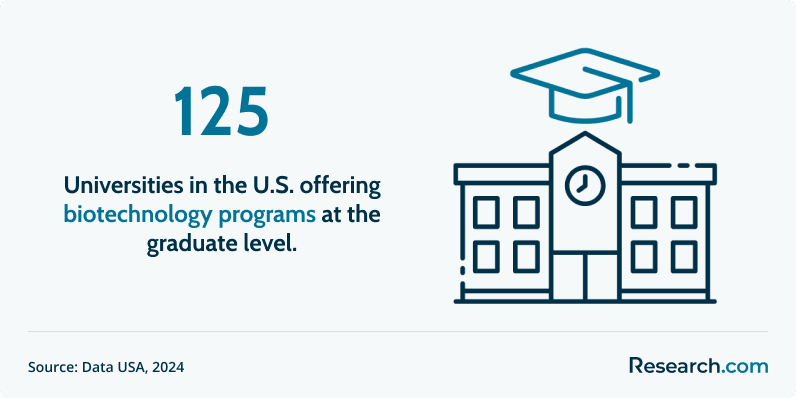
Do not choose a program only because the university name is familiar. Biotechnology is applied and highly specialized, so fit matters. There are at least 125 universities in the U.S. offering biotechnology programs at the graduate level, which gives students many options but also makes comparison important.
| Question to ask | Why it matters |
| Is the university properly accredited? | Accreditation affects financial aid, transferability, employer recognition, and academic legitimacy. |
| Does the curriculum match your target sector? | Biopharma, bioinformatics, environmental biotech, and regulatory affairs require different training. |
| Are internships, capstones, or industry projects built in? | Applied experience can improve employability and help you build a portfolio. |
| Who teaches the courses? | Faculty research areas and industry experience can shape your mentoring and networking opportunities. |
| What are the total costs? | Tuition alone does not show fees, living costs, commuting, lost income, or required materials. |
| Does the online format include meaningful hands-on training? | Online flexibility is valuable, but biotech students still need practical experience. |
| Where do graduates work? | Outcomes can reveal whether the program connects students to the jobs you actually want. |
Common mistakes to avoid
- Choosing without checking accreditation: Accreditation is essential for credibility, financial aid, and future academic options.
- Looking only at tuition: Compare total cost, including fees, books, housing, commuting, equipment, relocation, and lost income.
- Assuming every biotechnology program leads to the same jobs: A research-heavy program, a bioinformatics program, and a regulatory affairs program may lead to very different outcomes.
- Ignoring location and industry access: Biotech internships and jobs are often clustered in specific regions. Online students should ask how the program supports internship placement near them.
- Relying only on rankings: Rankings can help you start a search, but curriculum fit, faculty, specialization, cost, and outcomes matter more for your personal decision.
- Assuming salary outcomes are guaranteed: Salary depends on role, employer, region, experience, and performance. Use salary data as a planning tool, not a promise.
- Overlooking transfer and prerequisite policies: Missing prerequisites can delay admission or graduation, and not all credits transfer between schools.
Practical steps before applying
- Define your target role first. Decide whether you want R&D, biomanufacturing, bioinformatics, regulatory affairs, clinical research, environmental biotech, or biotech business.
- Collect job postings. Review 10 to 20 postings for your target roles and list the degrees, skills, software, laboratory techniques, and experience employers request.
- Match programs to those requirements. Choose programs that teach the specific methods and tools employers mention, not just broad biotechnology theory.
- Calculate total cost and likely timeline. Include tuition, fees, living expenses, transportation, technology, possible lost income, and whether you will study full time or part time.
- Ask about hands-on experience. Confirm whether the program includes internships, thesis research, capstones, labs, practicums, or employer-sponsored projects.
- Verify online limitations. If studying online, ask how labs are completed, whether campus visits are required, and how the school helps with local placements.
- Speak with current students or alumni. Ask what jobs graduates actually get, how responsive faculty are, and whether career services understand biotech hiring.
Graduate perspectives on a master’s in biotechnology
- After completing an M.S. in Biotechnology in 2024, I moved into an R&D scientist role at a biotech startup within three months. The graduate program gave me more than lab repetition; it taught me how to plan experiments, interpret complex data, and contribute to a cancer therapy project with more independence. Ginger
- I came from chemistry and completed the biotechnology master’s part time while working. The schedule was demanding, but the flexible format made it possible. The bioprocessing and quality regulation coursework helped me earn a promotion into a biologics manufacturing supervisor position. Luis
- The internship requirement was the most valuable part of my program. It helped me build industry contacts and led to my first biotech job. Two years later, I moved into project management, and the master’s degree continues to help because advanced credentials are important for promotion at my company. Ella
Key Insights
- A master’s in biotechnology is most valuable when it is tied to a clear career goal, such as R&D, biomanufacturing, regulatory affairs, bioinformatics, clinical research, or technical leadership.
- The labor market is favorable, with medical scientist roles projected to grow 11% from 2023 to 2033 and about 148,400 annual openings across life, physical, and social science occupations.
- Salary potential can be strong, but outcomes vary. Entry-level biotechnology-related roles may start around $50,000–$70,000, while the average wage in the biotech field is reported at about $122,345.
- Most programs take about two years full time and require around 30-36 credits. Accelerated, online, hybrid, and part-time options can change the timeline.
- The best programs provide more than coursework. Look for hands-on labs, internships, capstones, faculty expertise, industry partnerships, and training in high-demand tools such as PCR, R programming, and bioinformatics.
- A master’s is not always necessary for entry-level biotech work. It becomes more compelling when your target role requires graduate-level technical depth, research independence, or leadership preparation.
- Program fit matters more than brand name alone. Compare accreditation, curriculum, total cost, location, graduate outcomes, and how well the program matches the biotechnology sector you want to enter.
References:
- Advanced Academic Programs – Johns Hopkins University. MS in Biotechnology.
- American University. Biotechnology (MS) Program Overview.
- Coursera. Research Scientist Salary: Outlook and Trends.
- Data USA. Biotechnology (CIP 26.1201) Profile.
- EducationData.org. Average Cost of College in America.
- EducationData.org. Private vs. Public College Tuition.
- Genetic Engineering & Biotechnology News. Top 10 Life Sciences Jobs Through 2033.
- Grand View Research. U.S. Biotechnology Market Size, Share & Trends Report.
- Numbeo. Cost of Living in United States.
- Sacred Heart University. Uncovering the True ROI of a Graduate Degree.
- U.S. Bureau of Labor Statistics. Biological Technicians, Occupational Outlook Handbook.
- U.S. Bureau of Labor Statistics. Biomedical Engineers, Occupational Outlook Handbook.
- U.S. Bureau of Labor Statistics. Employment Projections: Life, Physical, and Social Science Occupations.
- Zippia. Biotechnologist Jobs, Salaries & Career Outlook.
Other Things You Should Know About Master’s in Biotechnology
Many biotechnology master’s programs do not require the GRE in 2027, and those that do usually list it as optional or review it holistically. Check each university’s graduate admissions page, because requirements can change by department, and some programs instead ask for prerequisite coursework in biology, chemistry, or statistics.
Admission requirements typically include a bachelor's degree in biology or a related field, a minimum GPA of 3.0, GRE scores, and letters of recommendation. Some programs might also require relevant work experience or specific coursework completion prior to application.