2027 Best Careers to Pursue With a Health Informatics Master’s Degree

Co-Founder and Chief Data Scientist
Choosing a master’s degree in health informatics is not just a school-selection problem. It is a career decision that affects the roles you can pursue, the technical skills you will build, the healthcare settings you can work in, and the return you can reasonably expect from graduate study. The field sits at the intersection of healthcare, data, information systems, compliance, and patient safety, which means the best program for one student may be a poor fit for another.
This guide is designed for working healthcare professionals, IT specialists moving into healthcare, recent graduates considering graduate school, nurses exploring informatics roles, and professionals comparing online, accelerated, and campus-based options. It explains what a health informatics master’s degree can lead to, which specializations matter, what skills employers look for, how to compare programs, and how to avoid costly mistakes before enrolling.
Quick answer: What can you do with a health informatics master’s degree?
A master’s degree in health informatics can prepare graduates for data, technology, operations, compliance, and leadership roles across hospitals, clinics, public health agencies, insurers, healthcare technology companies, and consulting firms. Common job titles include health informatics analyst, clinical informatics specialist, healthcare data analyst, health information manager, health IT project manager, informatics nurse specialist, health informatics consultant, and, with substantial experience or clinical credentials, chief medical information officer.
- A master’s degree in health informatics can support career movement into hospitals, clinics, insurance organizations, public health agencies, and health technology companies.
- Common career options include health informatics specialist, clinical data analyst, health information manager, healthcare data analyst, and chief information officer roles.
- Programs typically build skills in data analysis, electronic health record management, healthcare IT implementation, interoperability, privacy, and systems integration.
- The demand for health informatics professionals is projected to grow significantly, with an estimated 50,000 new jobs expected annually through 2030 as healthcare organizations increasingly rely on technology to improve patient care and operational efficiency.
- What are the best careers to pursue with a health informatics master’s degree for 2027?
- What are the different specializations within health informatics?
- What certifications are beneficial for a health informatics career?
- How is the job market for health informatics professionals?
- What technical skills are essential for health informatics professionals?
- What are the key analytical skills needed in health informatics?
- What are the typical career paths for health informatics professionals?
- What is the role of health informatics in patient safety and quality of care?
- What is the impact of health IT policy and regulations on health informatics professionals?
- What criteria should I use when evaluating a health informatics master’s program?
- Is a one-year master’s program a worthy investment in health informatics?
- What are the predicted future trends in health informatics?
- What is the role of public health perspectives in health informatics education?
- How do health informatics programs bridge academic theory and clinical practice?
- What supplementary accelerated training options can complement a health informatics master’s degree?
- What role do experiential learning opportunities and industry partnerships play in health informatics education?
- What are the key differences between online and on-campus health informatics master’s programs?
- What are the advanced degree options after a health informatics master’s program?
- What is the return on investment for a health informatics master’s degree?
- What are the available financial support options for health informatics master’s programs?
- What are the unique advantages of an accelerated health information management program?
What are the best careers to pursue with a health informatics master’s degree for 2027?
The best career path depends on your background. Clinicians often move into clinical informatics, nursing informatics, or CMIO-related pathways. IT professionals may be better positioned for EHR implementation, health IT project management, cybersecurity, or systems integration. Students with strong quantitative skills may prefer analytics, data science, quality improvement, or population health roles.
| Career option | Best fit for | Typical focus |
| Health Informatics Analyst | Students who enjoy data, operations, and process improvement | Analyzes patient, clinical, and administrative data to identify trends, improve workflows, and support better decision-making. |
| Clinical Informatics Specialist | Clinicians, healthcare staff, or IT professionals who understand clinical workflows | Improves EHR use, supports clinical teams, and helps align technology with patient care. |
| Health IT Project Manager | Professionals with organizational, technical, and communication strengths | Leads health technology implementation, manages timelines and budgets, and supports adoption across departments. Students with technology backgrounds may also compare this path with the best online information technology degree programs. |
| Health Data Scientist | Students with strong statistics, programming, and machine learning interests | Uses modeling, visualization, and advanced analytics to extract insights from complex healthcare datasets. |
| Informatics Nurse Specialist | Registered nurses who want to combine clinical expertise with healthcare technology | Improves nursing workflows, EHR use, telehealth adoption, documentation, and patient engagement. |
| Chief Medical Information Officer | Physicians with informatics expertise and leadership experience | Guides health IT strategy and ensures technology supports clinical goals and patient safety. |
| Health Informatics Consultant | Professionals who like project-based work and advising organizations | Helps healthcare organizations implement systems, manage data, improve workflows, and meet compliance goals. |
| Health Informatics Educator | Experienced professionals interested in teaching and training | Teaches informatics principles in academic, clinical, or professional training settings. |
| Healthcare Data Analyst | Students interested in dashboards, quality metrics, cost analysis, and reporting | Works with healthcare datasets to support quality improvement, cost control, and management decisions. |
| EHR Implementation Specialist | Professionals who enjoy training, troubleshooting, and workflow design | Supports electronic health record rollouts, user training, system configuration, and post-launch support. |
| AI Specialist in Healthcare | Technically advanced students interested in machine learning and clinical applications | Develops, implements, or evaluates AI-supported tools for image analysis, diagnosis support, drug discovery, and related healthcare uses. |
Students interested in organization-wide healthcare leadership may also compare health informatics programs with the best one-year online MPH degree programs, especially if their long-term goal involves public health administration, population health, or policy.
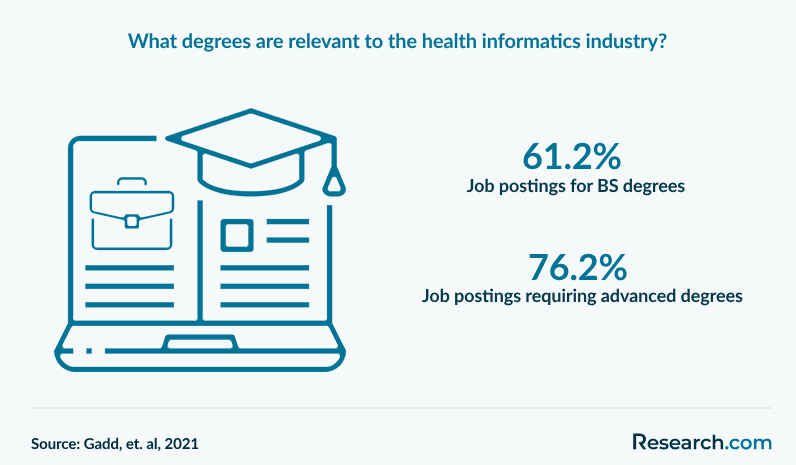
Graduate education is increasingly relevant in this field. A study found that 61.2% of job postings require a bachelor's degree, while approximately 76.2% of job postings seek candidates with advanced degrees, particularly those with specialized training in health informatics. This does not mean every informatics job requires a master’s degree, but it does show why graduate-level preparation can matter for competitive, specialized, or leadership-focused roles.
What are the different specializations within health informatics?
Health informatics is not a single-track field. A program may emphasize data analytics, clinical systems, public health, information management, cybersecurity, nursing informatics, or biomedical data. Before choosing a school, identify the specialization that matches your target job.
| Specialization | What it emphasizes | When it makes sense |
| Data Analytics | Statistical analysis, data mining, predictive modeling, dashboards, and data visualization | Choose this if you want analyst, data scientist, quality improvement, or population health analytics roles. |
| Health IT | EHR systems, telehealth platforms, health information exchange, security, and technology management | Choose this if you want to work in systems implementation, IT management, interoperability, or health technology operations. |
| Clinical Informatics | Clinical workflow design, decision support, patient safety, EHR optimization, and evidence-based care | Choose this if you have clinical experience or want to work closely with providers and care teams. |
| Public Health Informatics | Population health data, outbreak tracking, surveillance systems, policy evaluation, and community health interventions | Choose this if you want to work in government, public health agencies, nonprofits, or population health programs. |
| Bioinformatics | Genomics, proteomics, computational biology, and biomedical research data | Choose this if you are interested in personalized medicine, drug discovery, or research-intensive roles. |
| Nursing Informatics | Nursing workflows, clinical documentation, technology adoption, and patient care improvement | Choose this if you are a nurse seeking a bridge between bedside care, technology, and leadership. Some nurses also compare this direction with 1 year FNP programs when deciding between informatics and advanced practice. |
| Pharmacy Informatics | Medication management systems, drug interaction tools, dispensing workflows, and pharmacy operations | Choose this if your interests combine medication safety, pharmacy systems, and clinical decision support. |
| Consumer Health Informatics | Patient portals, telehealth, patient education tools, and self-management technologies | Choose this if you want to improve patient engagement, digital access, and patient-facing health tools. |
Students interested in the broader relationship between health, populations, and the environment may also review the requirements to be an environmental scientist, but health informatics is generally the stronger fit for those who want a data-and-healthcare technology career.
What certifications are beneficial for a health informatics career?
Certifications are not a substitute for a strong graduate program, relevant experience, or technical skill. However, they can help validate knowledge, especially for professionals changing fields or targeting specialized roles. The best certification depends on whether you are focused on health information management, health IT, or early-career informatics work.
| Certification | Issuing organization | Best for |
| Registered Health Information Administrator | AHIMA | Professionals focused on health information management, records, compliance, and data governance. |
| Certified Professional in Healthcare Information and Management Systems | Healthcare Information and Management Systems Society, Inc. (HIMSS) | Health IT professionals with experience in healthcare systems, technology management, and informatics leadership. |
| Certified Associate in Healthcare Information and Management Systems | HIMSS | Early-career professionals or career changers who want a recognized starting credential in healthcare information systems. |
If your background does not include computing, programming, databases, or systems work, you may need more than a certification. A technical bridge option such as a fast track computer science degree can help some students build the computing foundation needed for data-heavy informatics roles.
How is the job market for health informatics professionals?
The health informatics job market is supported by several long-running forces: electronic health record adoption, expanding healthcare datasets, telehealth, analytics-driven care management, cybersecurity concerns, and pressure to improve quality while controlling costs. According to Burning Glass Technologies, there were over 1.3 million job postings related to health informatics in 2023.
Job outlook and employment forecasts
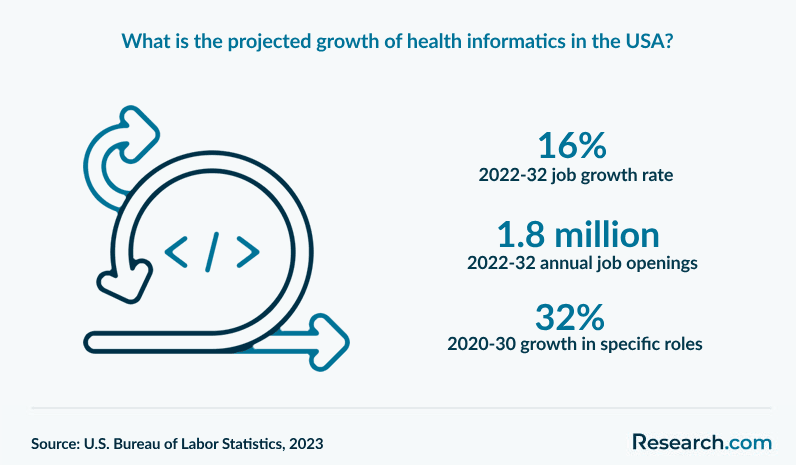
The field is commonly discussed alongside related healthcare technology and information management occupations. The Bureau of Labor Statistics projects a 16% growth in healthcare informatics jobs from 2022 to 2032, much faster than the average for all occupations. The healthcare sector is also expected to see approximately 1.8 million job openings annually from 2022 to 2032.
- Growth rate: BLS projects 16% growth in healthcare informatics jobs from 2022 to 2032.
- Job openings: Healthcare is expected to generate approximately 1.8 million job openings annually from 2022 to 2032.
- High-demand roles: Clinical informatics specialist, health informatics consultant, informatics nurse, and health IT leadership roles remain important in organizations that depend on reliable digital systems.
- Related management demand: The need for medical and health services managers, who often use health informatics expertise, is projected to grow by 32% from 2020 to 2030.
These figures are useful, but they should not be read as guaranteed outcomes for every graduate. Hiring depends on your experience, technical portfolio, location, employer type, and the relevance of your program’s curriculum.
Where health informatics professionals work
Health informatics graduates can work in clinical, administrative, research, public health, payer, and technology settings. The strongest applicants usually understand both the language of healthcare and the realities of data systems.
- Hospitals and health systems
- Physician practices and specialty clinics
- Public health agencies
- Insurance companies and payer organizations
- Healthcare technology vendors
- Consulting firms
- Academic medical centers and research organizations
Salaries
Salary outcomes vary widely by role, employer, region, experience, technical skill, and leadership responsibility. The median salary for healthcare informatics specialists was approximately $102,240 in 2022. Reported role-specific figures include $83,000 for Clinical Analyst, $104,000 for Health Information Manager, $89,311 for Clinical Data Systems Specialist, $127,950 for Health Informatics Consultant, and $300,000 to $349,000 per year for top earners in Chief Medical Information Officer roles.
- Median salary: Approximately $102,240 for healthcare informatics specialists in 2022.
- Clinical Analyst: $83,000.
- Health Information Manager: $104,000.
- Clinical Data Systems Specialist: $89,311.
- Health Informatics Consultant: $127,950.
- Chief Medical Information Officer: $300,000 to $349,000 per year for top earners.
- Salary trend: Some reports indicate that salaries have increased by over 24% since 2021, with a median salary now around $107,400.
For clinicians considering parallel graduate pathways, comparing informatics with the cheapest online nursing master's programs may help clarify whether the better return comes from technical specialization, nursing leadership, or advanced clinical practice.
What technical skills are essential for health informatics professionals?
Health informatics professionals do not all need to be software engineers, but they do need enough technical fluency to work with data, systems, vendors, clinicians, and compliance teams. The more technical the role, the more important programming, databases, statistics, and cloud systems become.
- Data analysis: Ability to collect, clean, organize, and interpret clinical, administrative, and operational data.
- Programming: Working knowledge of Python, R, or SQL for data manipulation, analysis, reporting, and automation.
- Database management: Understanding of relational databases, SQL, NoSQL concepts, querying, and data storage structures.
- Electronic health record systems: Familiarity with platforms such as Epic, Cerner, or Allscripts, including workflows, documentation, reporting, and implementation issues.
- Health information exchange: Knowledge of interoperability, secure data sharing, standards, and cross-organization information flow.
- Data visualization: Ability to communicate findings using dashboards, charts, and tools such as Tableau or Power BI.
- Information security and cybersecurity: Understanding of patient data protection, HIPAA requirements, privacy safeguards, and risk management.
- Cloud computing: Familiarity with cloud-based storage, analytics, and application environments used in healthcare.
- Networking and system administration: Basic understanding of systems infrastructure, access, troubleshooting, and technical operations.
Students who are deciding between informatics and broader computing careers can compare these skills with the career options described in what can you do with a computer science degree.
What are the key analytical skills needed in health informatics?
Technical tools matter, but analysis is what turns raw health data into practical decisions. Strong health informatics professionals can evaluate data quality, interpret patterns in context, and explain what the findings mean for patient care, operations, compliance, or cost.
- Data analysis: Cleaning, structuring, and examining health data to identify actionable patterns.
- Critical thinking: Evaluating evidence, recognizing bias, and understanding limitations in datasets and reports.
- Problem-solving: Diagnosing issues in workflows, data quality, technology adoption, or system integration.
- Data visualization: Presenting findings clearly to clinicians, executives, IT teams, and nontechnical stakeholders.
- Data interpretation: Connecting numbers to healthcare operations, patient outcomes, staffing issues, and policy requirements.
- Statistical analysis: Applying statistical methods to identify relationships, evaluate interventions, and test assumptions.
- Data mining: Exploring large datasets to uncover patterns that may not be visible in routine reports.
- Predictive modeling: Using historical data to estimate future outcomes and support proactive planning.
What are the typical career paths for health informatics professionals?
Career progression in health informatics usually depends on three things: domain knowledge, technical depth, and leadership ability. Entry-level candidates often begin in analyst, implementation, or support roles. Mid-career professionals may manage projects, lead analytics initiatives, or supervise informatics teams. Senior professionals often move into director-level, CIO, CMIO, or consulting leadership roles.
| Career stage | Common roles | How to move up |
| Entry-level | Health Informatics Analyst, Clinical Informatics Specialist, Health IT Consultant, EHR Implementation Specialist | Build EHR experience, learn SQL or analytics tools, document project outcomes, and understand clinical workflows. |
| Mid-career | Informatics Manager, Project Manager, Data Scientist, Clinical Systems Lead | Develop project management, stakeholder communication, advanced analytics, privacy, and system implementation experience. |
| Senior-level | Chief Medical Information Officer, Director of Informatics, Chief Information Officer | Lead cross-functional initiatives, manage budgets, align technology with strategy, and demonstrate measurable improvements in quality or operations. |
Nurses deciding between informatics leadership and advanced nursing practice can also compare health informatics programs with the shortest online MSN programs.
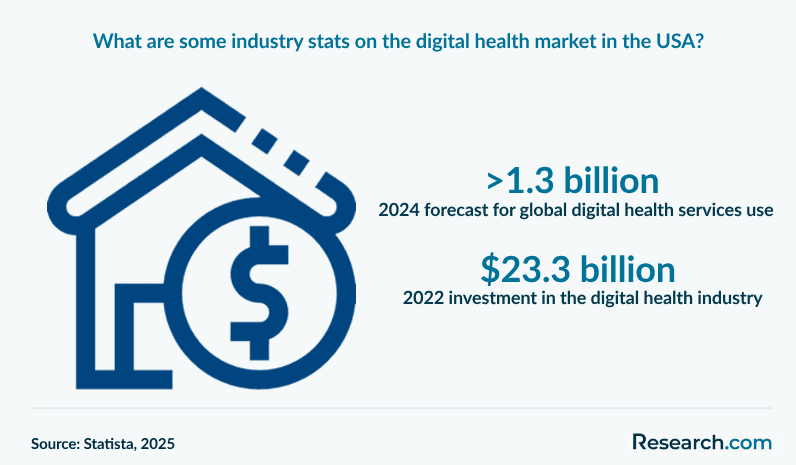
The digital health market is expanding quickly. By 2024, it is estimated that more than 1.3 billion people worldwide will be using digital health services, including telehealth platforms and wearable technology. Investment in the digital health sector reached approximately $23.3 billion in 2022. These trends help explain why employers value professionals who can manage healthcare data, evaluate digital tools, and support technology-enabled care.
What is the role of health informatics in patient safety and quality of care?
Health informatics is not only about technology. Its strongest value is in improving how care is delivered, documented, monitored, and evaluated. A poorly designed system can frustrate clinicians and create safety risks. A well-designed informatics strategy can reduce errors, improve coordination, and make quality problems visible sooner.
- Reducing medical errors: EHR alerts, medication checks, clinical decision support, and standardized documentation can help reduce preventable mistakes when designed and implemented carefully.
- Improving care coordination: Shared records, interoperability, and care management tools can help providers see relevant patient information across settings.
- Monitoring outcomes: Analytics can reveal trends in readmissions, adverse events, wait times, treatment patterns, and quality measures.
- Supporting patient engagement: Patient portals, telehealth platforms, and remote monitoring tools can help patients participate more actively in their care.
Health informatics also affects adjacent administrative functions. For example, better documentation and cleaner data can support billing, coding, and compliance workflows. Students exploring this operational side can read about the pros and cons of medical billing and coding.
What is the impact of health IT policy and regulations on health informatics professionals?
Regulation shapes nearly every informatics role because healthcare data is sensitive, highly regulated, and often shared across many systems and organizations. Professionals in this field must understand privacy, security, interoperability, documentation, and governance requirements.
- HIPAA compliance: Protecting patient health information is a core responsibility in data access, reporting, exchange, and system design.
- Meaningful Use: Health informatics professionals may support the effective adoption and use of electronic health records to improve care quality.
- Interoperability: Systems must increasingly exchange information securely and reliably across providers, payers, and platforms.
- Data governance: Organizations need clear rules for data ownership, access, quality, retention, use, and protection.
Healthcare systems also face broader structural pressures. A 2024 global survey reported that access to treatments and long waiting times (46%), insufficient healthcare staffing (45%), and the cost of accessing treatment (32%) were major concerns. Other reported challenges included the impact of an aging population (23%) and bureaucratic hurdles (22%). Health informatics cannot solve these issues alone, but it can help organizations measure problems, allocate resources, and evaluate interventions.
Students interested in aging-related care, workforce needs, and healthcare services for older adults may also compare this field with gerontology; reviewing gerontologist salary information can help clarify how the two career directions differ.
What criteria should I use when evaluating a health informatics master’s program?
A strong health informatics master’s program should match your career goal, not just sound impressive on a brochure. Start with accreditation and curriculum, then examine hands-on learning, faculty expertise, employer connections, and transparent graduate outcomes.
| Evaluation factor | What to look for | Why it matters |
| Accreditation and institutional quality | Confirm the university is properly accredited and that the program is housed in a credible school or department. | Accreditation affects credibility, transferability, financial aid access, and employer trust. |
| Curriculum fit | Look for courses in analytics, EHRs, interoperability, health data standards, privacy, project management, and healthcare operations. | The curriculum should prepare you for your target role, not only provide broad healthcare technology exposure. |
| Technical depth | Check whether the program teaches SQL, statistics, visualization, programming, database concepts, or applied analytics. | Data-heavy roles require demonstrable technical ability. |
| Clinical and operational relevance | Look for case studies, healthcare workflow analysis, EHR projects, quality improvement work, and applied health data assignments. | Employers value graduates who understand real healthcare environments. |
| Experiential learning | Ask about practicums, capstones, internships, employer projects, simulation labs, and research opportunities. | Hands-on evidence can strengthen your resume and interview performance. |
| Career support | Review advising, job placement support, alumni access, portfolio development, and employer partnerships. | Career services can be especially important for career changers. |
| Format and pace | Compare online, hybrid, campus, part-time, and accelerated formats. | The best format is the one you can complete while meeting work, family, and learning needs. |
| Total cost | Review tuition, fees, technology costs, travel, books, lost income, and time to completion. | Sticker tuition alone does not show the true cost of a degree. |
If your long-term goal is broader healthcare administration rather than data and systems work, compare informatics programs with accelerated MHA programs online before committing.
Is a one-year master’s program a worthy investment in health informatics?
A one-year health informatics master’s program can be worthwhile for students who already have relevant experience, can handle an intensive course load, and want to reduce time away from career advancement. It may be less suitable for students who need foundational coursework in healthcare, statistics, programming, databases, or clinical workflows.
- Choose a one-year format if: you have a strong academic foundation, can study intensively, and want a faster credential for advancement or a targeted career pivot.
- Be cautious if: you are new to both healthcare and technology, need internships, or require more time to build a portfolio.
- Compare carefully: an accelerated schedule should not eliminate essential applied experience, analytics training, or career support.
Students comparing compressed graduate pathways can review 1 year master's programs online to understand how accelerated formats differ across disciplines.
What are the predicted future trends in health informatics?
Health informatics is being shaped by the increasing complexity of healthcare data, the continued use of digital health tools, and growing expectations for secure, interoperable, and evidence-based systems. The strongest professionals will be those who can evaluate technology critically rather than simply adopt every new tool.
- Artificial intelligence and machine learning: AI and machine learning are being applied to diagnosis support, treatment planning, image analysis, personalized medicine, and drug discovery. Informatics professionals may help evaluate, implement, monitor, and govern these tools.
- Big data analytics: Larger health datasets create opportunities for population health management, outbreak identification, quality improvement, and predictive planning.
- Telehealth and remote patient monitoring: As virtual care and remote monitoring expand, organizations need professionals who can integrate these tools into clinical workflows and data systems.
- Precision medicine: Integrating genetic, clinical, and operational data requires informatics expertise in data management, interpretation, and privacy.
- Internet of Medical Things: Connected devices and sensors generate health data that must be secured, interpreted, and integrated with other systems.
- Blockchain technology: Blockchain may be explored for health data security, privacy, exchange, and patient identity management.
- Virtual and augmented reality: VR and AR may support training, patient education, and selected treatment contexts.
- Ethical and social implications: Privacy, fairness, bias, accountability, and transparency are increasingly important as healthcare uses more advanced data tools.
What is the role of public health perspectives in health informatics education?
Public health perspectives help informatics students think beyond individual patient encounters. They introduce population-level questions: Which groups are underserved? Which communities face delayed treatment? Which interventions improve outcomes? Which data gaps hide inequities?
A program that integrates public health with informatics may be especially useful for students interested in disease surveillance, community health analytics, health policy, emergency response, resource allocation, or population health management. If you are weighing public health against informatics, consider whether is a public health degree worth it for your goals.
How do health informatics programs bridge academic theory and clinical practice?
The best programs do not stop at concepts. They ask students to solve realistic healthcare problems involving messy data, complex workflows, competing stakeholders, privacy constraints, and patient safety concerns. Useful learning experiences may include simulations, case studies, capstone projects, clinical partnerships, EHR exercises, and analytics projects using healthcare-style datasets.
Students who have little direct clinical exposure may benefit from supplemental healthcare training or experience. For example, reviewing medical assistant programs can help some career changers understand front-office and clinical workflow basics, although a medical assistant program is not equivalent to a graduate informatics degree.
How should you interpret graduate testimonials and outcome claims?
Graduate stories can be encouraging, but they should not be the main reason you choose a program. Testimonials often highlight successful outcomes without showing the full range of student experiences. Treat them as context, then verify the numbers that matter.
- Ask the school for employment outcomes by role, not only general placement claims.
- Find out how many graduates enter informatics-specific jobs rather than unrelated healthcare roles.
- Review whether outcomes differ for career changers, clinicians, and students with prior IT experience.
- Look for capstone examples, employer partners, and alumni job titles that match your target path.
What supplementary accelerated training options can complement a health informatics master’s degree?
Short-term training can be useful when it fills a specific gap. It should not distract from the core competencies employers expect in health informatics: data literacy, healthcare systems knowledge, privacy, interoperability, analytics, and workflow improvement.
- Technical bootcamps or courses: Useful for SQL, Python, R, Tableau, Power BI, cloud tools, or cybersecurity basics.
- Healthcare workflow training: Helpful for students coming from IT or analytics who have limited exposure to clinical settings.
- Certification preparation: Useful when aligned with health information management or health IT roles.
- Clinical support exposure: A 6 week medical assistant program may help some students understand patient-facing workflows, but it should be viewed as supplemental context, not a replacement for informatics training.
What role do experiential learning opportunities and industry partnerships play in enhancing health informatics education?
Experiential learning is especially valuable in health informatics because the field requires applied judgment. Students need to understand not only what a system can do, but how real clinicians, patients, administrators, and IT teams use it under pressure.
- Internships and practicums: Help students gain workplace experience and understand healthcare operations.
- Capstone projects: Let students demonstrate practical skills through analytics, implementation, quality improvement, or workflow projects.
- Industry partnerships: May provide access to current tools, employer feedback, guest speakers, and applied project ideas.
- Collaborative research: Can be useful for students interested in doctoral study, academic roles, or data-intensive healthcare innovation.
Students interested in pharmacy-related informatics or medication systems may also explore advanced healthcare education options such as online pharmacy school.
What are the key differences between online and on-campus health informatics master’s programs?
Online and on-campus health informatics programs can both be rigorous. The better choice depends on your schedule, learning style, access to local healthcare employers, and need for in-person networking.
| Format | Advantages | Potential drawbacks | Best for |
| Online | Flexible scheduling, access from any location, often easier for working professionals, may include virtual labs and remote collaboration tools. | Requires strong self-discipline; networking and hands-on experiences may require extra effort. | Working professionals, career changers with job constraints, and students who do not live near a suitable campus. |
| On-campus | Direct access to faculty, campus resources, research centers, peers, and local employer relationships. | Less flexible; commuting, relocation, or schedule conflicts may increase total cost. | Students who want in-person networking, structured routines, and direct access to campus-based projects. |
| Hybrid | Combines online flexibility with periodic in-person learning, labs, or networking. | May still require travel or scheduled campus attendance. | Students who want flexibility but also value face-to-face engagement. |
If your interests lean toward genomics, biomedical research, and computational biology, compare health informatics programs with the best online masters in bioinformatics.
What are the advanced degree options after a health informatics master’s program?
After earning a health informatics master’s degree, some professionals continue into doctoral or specialized clinical pathways. This is most useful for students who want research roles, academic positions, senior strategy work, or deep expertise in a clinical-technical niche.
- Doctorate in health informatics: Suitable for advanced research, academic roles, innovation leadership, and complex data systems work.
- Doctorate in public health or public health-related fields: Useful for population health, policy, surveillance, and public-sector leadership.
- Clinical doctoral pathways: Appropriate for professionals who want to combine informatics with pharmacy, nursing, medicine, or another clinical field.
- Pharmacy-focused pathways: Students interested in medication systems and pharmacy informatics may compare options such as online pharmacy school.
What is the return on investment for a health informatics master’s degree?
The ROI of a health informatics master’s degree depends on your starting point and target role. A nurse moving into informatics leadership, an analyst gaining healthcare specialization, or an IT professional entering a health system may see different returns. Do not evaluate ROI using salary alone; consider total cost, time, opportunity cost, experience gained, and whether the curriculum maps to job postings you actually want.
| ROI factor | What to examine |
| Total program cost | Tuition, fees, technology costs, books, travel, and any income reduction while enrolled. |
| Program length | Whether a full-time, part-time, or accelerated format helps you reach your goal faster without sacrificing preparation. |
| Career alignment | Whether the program’s courses and projects match roles such as analyst, clinical informatics specialist, project manager, or health IT leader. |
| Graduate outcomes | Employment rates, job titles, employer types, salary reporting, and alumni career progression. |
| Career services | Resume support, employer connections, interview preparation, portfolio guidance, and internship access. |
| Existing experience | Students with healthcare or IT experience may be able to convert the degree into advancement more directly than students changing both fields at once. |
If you are comparing shorter, lower-cost healthcare technology credentials, review options such as the best accredited medical billing and coding schools online, but remember that billing and coding is a different career path from graduate-level health informatics.
What are the available financial support options for health informatics master’s programs?
Graduate school can be expensive, so compare funding options before enrolling. Do not assume the lowest tuition is automatically the best value, and do not assume financial aid will cover all costs. Ask each program for a clear cost breakdown and funding options in writing.
- Merit-based scholarships: Awards based on academic, professional, or leadership qualifications.
- Need-based grants: Funding tied to financial need and institutional policies.
- Federal aid: Graduate students may have access to federal aid options depending on eligibility and program status.
- Employer tuition reimbursement: Healthcare systems, insurers, and technology employers may help pay for job-related graduate education.
- Teaching or research assistantships: Some programs offer paid or tuition-reducing assistant roles.
- Payment plans and loans: These may spread costs over time, but students should review repayment obligations carefully.
Students who want a related but potentially different undergraduate or management-focused route can compare options such as a health information management degree online.
What are the unique advantages of an accelerated health information management program?
An accelerated health information management program may be useful for students who want a faster route into records management, compliance, coding oversight, data governance, or administrative health information roles. It is not identical to a health informatics master’s degree, which typically places more emphasis on analytics, systems, interoperability, and healthcare technology strategy.
- Faster completion: Accelerated formats can reduce time to credential completion.
- Focused curriculum: Programs may emphasize job-specific competencies in health information management.
- Career relevance: Students can build skills related to documentation, compliance, health data quality, and administrative systems.
- Alternative pathway: Students not ready for a master’s degree may use this route to enter or advance in healthcare information roles.
For students specifically seeking a rapid route in this area, review the accelerated health information management program online.
Common mistakes to avoid when choosing a health informatics master’s program
| Mistake | Why it can hurt you | Better approach |
| Choosing a program without checking accreditation | Accreditation can affect credibility, financial aid, and employer acceptance. | Verify institutional accreditation and ask how the program is reviewed for quality. |
| Focusing only on tuition | A low tuition program may lack career support, applied projects, or technical depth. | Compare total cost, outcomes, curriculum, and experiential learning. |
| Assuming all online programs offer the same experience | Some online programs are highly interactive; others may provide limited support. | Ask about faculty access, group projects, virtual labs, practicum options, and advising. |
| Ignoring technical requirements | Analytics and data roles may require SQL, statistics, visualization, or programming skills. | Match courses to job postings for your target roles. |
| Relying only on rankings | A highly ranked program may not fit your schedule, budget, or career goal. | Use rankings as one input, then verify curriculum, cost, format, and outcomes. |
| Assuming salary outcomes are guaranteed | Salary depends on experience, location, employer, and role. | Review realistic outcomes for graduates with backgrounds similar to yours. |
| Skipping hands-on experience | Employers often want evidence that you can apply informatics skills in real settings. | Prioritize capstones, practicums, internships, employer projects, or portfolio-building assignments. |
Questions to ask before enrolling
- Is the university accredited, and how is the health informatics program evaluated?
- Which career paths is the curriculum designed to support?
- Does the program teach SQL, statistics, programming, data visualization, EHR systems, privacy, and interoperability?
- Are there practicums, internships, capstones, simulations, or employer-sponsored projects?
- What job titles do recent graduates hold?
- Does the school report employment outcomes by role and student background?
- How often is the curriculum updated to reflect health IT, AI, analytics, and regulatory changes?
- What support is available for career changers without healthcare or IT experience?
- What is the full cost of attendance, including fees and technology requirements?
- Can employer tuition reimbursement, scholarships, assistantships, or federal aid reduce the net cost?
Key Insights
- Health informatics is a career bridge: It connects healthcare, data, technology, compliance, and quality improvement, making it valuable for clinicians, IT professionals, analysts, and healthcare administrators.
- Role fit matters more than the degree title: A student targeting data science needs a different curriculum than a nurse pursuing informatics leadership or an IT professional moving into EHR implementation.
- The job market is supported by strong demand signals: Burning Glass Technologies reported over 1.3 million job postings related to health informatics in 2023, and BLS projects 16% growth in healthcare informatics jobs from 2022 to 2032, with approximately 1.8 million healthcare job openings annually from 2022 to 2032.
- Advanced education can strengthen competitiveness: A study found that 61.2% of health informatics job postings require a bachelor's degree, while approximately 76.2% seek candidates with advanced degrees.
- Salary potential varies widely: The median salary for healthcare informatics specialists was approximately $102,240 in 2022, while reported role-specific figures range from $83,000 for Clinical Analyst to $300,000 to $349,000 per year for top-earning Chief Medical Information Officers.
- Program evaluation should be practical: Check accreditation, curriculum, technical depth, experiential learning, career outcomes, format, and total cost before applying.
- Do not choose based on speed alone: One-year and accelerated programs can be valuable, but only if they preserve essential technical training, applied learning, and career support.
- AI and digital health are changing employer expectations: Professionals who understand data governance, privacy, interoperability, analytics, and ethical technology use will be better positioned than those who only know individual software tools.
References:
- Adelphi University. (2024). MS in Healthcare Informatics - Online Programs. Adelphi University.
- Data USA. (2022). Indiana University-Bloomington. Data USA.
- Gadd, C. S., et. al. (2021). Education, experience, skills, and knowledge required for health informatics jobs in the United States: An empirical analysis of job postings. Journal of Biomedical Informatics, 118, Article 103810.
- Interview Query. (2024). Master's in Health Informatics Salary (Updated in 2024). Interview Query.
- Kent State University. (n.d.). Health Informatics Career Outlook. Kent State University.
- Logan University. (2023). A career in health informatics combines data and healthcare. Logan University.
- Northern Kentucky University. (2024). Jobs I Can Get With a Health Informatics Master's Degree. Northern Kentucky University.
- Purdue Global. (2022). Health Informatics Industry Trends and Career Outlook. Purdue Global.
- Sacred Heart University. (n.d.). Consider Pursuing a MS in Healthcare Informatics. Sacred Heart University.
- Salary.com. (2025). Clinical informatics manager salary in the United States. Salary.com.
- Salary.com. (2025). Director of health informatics salary. Salary.com.
- Statista. (2024). Clinical IT executive titles in health organizations in the US. Statista.
- Statista. (2024). Leading problems in healthcare systems worldwide 2024. Statista.
- Statista. (2025). Digital health. Statista.
- University of Washington. (n.d.). Career Outlook - clinical-informatics. University of Washington.
- U.S. Bureau of Labor Statistics. (2023). Health information technologists and medical registrars. U.S. Bureau of Labor Statistics.
Other Things You Should Know About Health Informatics Master’s Degrees
The Certified Professional in Health Informatics, or CPHIMS, is the main credential for management-track roles and requires an active U.S. or Canadian health-related license or a bachelor’s degree plus at least three years of information and management experience. Some employers also value RHIA or RHIT certification.
In 2027, individuals with a Health Informatics Master’s degree can expect high demand in roles such as Clinical Informatics Specialist, Health Informatics Consultant, and Data Analyst. These positions are driven by the ongoing integration of technology in healthcare and the need for experts in health data management and analysis.