2027 Best Non-Clinical Healthcare Jobs & Careers You Should Consider

Co-Founder and Chief Data Scientist
You do not have to provide direct patient care to build a meaningful career in healthcare. Many healthcare systems rely on professionals who manage records, protect data, coordinate programs, process insurance claims, hire staff, analyze trends, improve compliance, and keep organizations running.
This guide is for students, career changers, and healthcare workers who want the stability and purpose of the healthcare field without becoming a nurse, physician, therapist, or other clinical provider. You will learn which non-clinical healthcare jobs are worth considering in 2026, what education or certifications they usually require, how long it can take to qualify, which roles may pay more, and how to choose a path that fits your strengths.
The timing matters. Healthcare employment is projected to generate nearly 2 million openings per year between 2023 and 2033, including openings from growth and worker replacement. A meaningful portion of that demand supports non-clinical work: administration, health information, cybersecurity, compliance, billing, analytics, education, and operations.
Quick Answer: What are the best non-clinical healthcare jobs?
The best non-clinical healthcare jobs are roles that support healthcare delivery without requiring hands-on patient treatment. Strong options include medical and health services manager, health information technician, medical billing and coding specialist, healthcare compliance officer, clinical data analyst, information security analyst, healthcare HR manager, health educator, healthcare marketing specialist, and nurse paralegal.
Some jobs can be entered with a certificate in as little as six months, while management, analytics, compliance, and informatics roles often require an associate or bachelor’s degree plus experience. The right choice depends on whether you prefer administration, technology, data, law, public health, or business operations.
Key Things You Should Know About Non-Clinical Healthcare Jobs and Careers
- Some entry-level non-clinical healthcare jobs can be reached in as little as six months, especially in billing, coding, medical office support, and records-related work.
- Degrees in healthcare administration, health information management, public health, business, or health IT prepare students for many non-patient-facing healthcare roles.
- Credentials such as Certified Professional Coder (CPC), Certified Billing and Coding Specialist (CBCS), Registered Health Information Technician (RHIT), and training from paralegal certification programs can help candidates compete for specialized roles.
- Best non-clinical healthcare jobs for 2026
- Skills employers expect in non-clinical healthcare careers
- Best degrees for non-clinical healthcare work
- Certifications that can strengthen your application
- How long it takes to qualify
- Highest-paying non-clinical healthcare careers
- How pay can vary by location
- Career progression and advancement options
- How online education can support career growth
- Challenges to consider before choosing this field
- How mentorship and networking can help
- Trends shaping non-clinical healthcare careers
- Current demand for non-clinical healthcare jobs
- Fast-growing non-clinical healthcare roles
- Moving from a non-clinical role into clinical work
- Key insights
What are the best non-clinical healthcare jobs and careers for 2026?
The best non-clinical healthcare careers in 2026 are concentrated in administration, health data, cybersecurity, compliance, public health, legal support, and business operations. These jobs help healthcare organizations function safely and efficiently, even though they do not usually involve diagnosing, treating, or physically caring for patients.
| Career | What you do | Good fit if you like | Common entry path |
| Medical and Health Services Manager | Oversee departments, clinics, budgets, staff, scheduling, policies, and daily operations. | Leadership, planning, healthcare business operations, and problem-solving. | Bachelor’s degree plus healthcare experience; some start in office or coordinator roles. |
| Medical Records and Health Information Technician | Organize patient records, maintain health data, support coding accuracy, and protect confidential information. | Detail-oriented work, records systems, privacy rules, and structured tasks. | Certificate or associate degree in health information or a related field. |
| Health Educator or Community Health Worker | Teach communities about prevention, wellness, access to services, and public health programs. | Outreach, education, social impact, and community-based work. | Certificate, associate degree, or bachelor’s degree depending on the employer. |
| Information Security Analyst | Protect healthcare systems and patient data from cyber threats, breaches, and unauthorized access. | Technology, cybersecurity, risk management, and systems protection. | IT experience, cybersecurity training, and a related degree or certification. Learn more about how to become an information security manager. |
| Clinical Data Analyst | Use reports, dashboards, and datasets to help hospitals improve quality, efficiency, and outcomes. | Spreadsheets, databases, analytics, reporting, and evidence-based decisions. | Degree or coursework in health informatics, data analytics, statistics, or health information. |
| Human Resources Manager | Recruit healthcare staff, manage benefits, support employee relations, and help organizations retain workers. | People operations, hiring, conflict resolution, and workforce planning. | Business, HR, or healthcare administration background. Review HR officer salary information to compare related roles. |
| Healthcare Marketing Specialist | Promote services, manage campaigns, support patient communications, and build community awareness. | Writing, branding, digital marketing, healthcare communications, and outreach. | Marketing, communications, public relations, or healthcare business degree. |
| Nurse Paralegal | Review medical records, assist with healthcare-related legal cases, and support attorneys in medical claims. | Law, healthcare documentation, research, and case analysis. | Nursing or medical background plus legal training; some pursue paralegal education. |
| Medical Billing and Coding Specialist | Convert healthcare services into standardized codes for billing, reimbursement, and insurance claims. | Accuracy, rules, insurance processes, and working independently with records. | Certificate or training program plus a credential such as CPC or CBCS. Compare the difference between CBCS and CPC certification. |
| Healthcare Compliance Officer | Help organizations follow healthcare laws, privacy rules, billing standards, and internal policies. | Regulations, audits, ethics, risk reduction, and policy review. | Healthcare administration, health information, legal studies, or compliance experience. |
These roles differ widely. Some are administrative and people-focused; others are technical, analytical, or legal. In 2024, 24% of healthcare support jobs required previous work experience, and over 85% included on-the-job training. That matters for new graduates because many employers expect candidates to keep learning after hiring rather than arrive fully trained.
The chart below shows the salary distribution of healthcare support workers, based on BLS data published in 2025.
What skills do you need for non-clinical healthcare careers?
Non-clinical healthcare workers need a mix of administrative judgment, technical comfort, communication ability, and discipline with confidential information. The exact skill set depends on the job, but most employers look for candidates who can work accurately in a regulated, fast-changing environment.
| Skill | Why it matters in healthcare | Roles where it is especially useful |
| Clear communication | Non-clinical staff often translate complex policies, billing questions, data findings, or program updates for coworkers, patients, vendors, or leadership. | Health educator, HR manager, care coordinator, administrator, marketing specialist. |
| Organization | Healthcare work involves deadlines, documentation, compliance requirements, schedules, and sensitive records. Small mistakes can cause delays or billing problems. | Medical records technician, billing specialist, compliance officer, office manager. |
| Adaptability | Healthcare rules, software, workflows, and payer requirements change often. BLS data shows 61% of healthcare support jobs require adaptability. | Nearly all non-clinical healthcare roles, especially operations and health IT. |
| Teamwork | Even without treating patients, you may coordinate with clinicians, administrators, finance teams, IT staff, insurers, and community partners. | Healthcare administrator, HR professional, project manager, community health worker. |
| Data and technology skills | Electronic health records, reporting tools, spreadsheets, databases, and scheduling systems are now central to healthcare operations. | Clinical data analyst, informatics specialist, health information technician, cybersecurity analyst. Students interested in data-heavy roles may compare the top database management degree programs. |
| Problem-solving | Billing denials, staffing gaps, missing information, compliance risks, and reporting errors require calm analysis and practical solutions. | Billing and coding specialist, health services manager, compliance officer, HR manager. |
Soft skills vs. technical skills: which matters more?
Both matter, but the balance changes by role. A billing and coding specialist needs strong accuracy, coding knowledge, and insurance literacy. A community health worker needs trust-building and cultural awareness. A health informatics specialist needs stronger data and systems skills. Before choosing training, read actual job postings in your target area and list the software, credentials, and experience employers mention repeatedly.
What’s the best degree for a non-clinical healthcare career?
The best degree depends on the type of non-clinical work you want. Healthcare administration is a strong fit for management and operations. Health information management works well for records, coding, privacy, and compliance. Public health fits outreach, prevention, and community programs. Business programs with healthcare coursework can support HR, finance, project management, and marketing roles.
| Degree area | Best for | Possible job outcomes | Who should consider it |
| Healthcare Administration | Operations, leadership, staffing, budgets, and facility management. | Medical office manager, department coordinator, health services administrator. | Students who want to lead teams or improve how clinics and healthcare organizations operate. Review the steps for how to become a health administrator. |
| Health Information Management | Medical records, coding systems, privacy, electronic health data, and compliance. | Health information technician, coding specialist, records supervisor, compliance assistant. | Detail-oriented students who prefer structured work with data, documentation, and rules. |
| Public Health | Community health, prevention, health education, program planning, and population-level outcomes. | Health educator, community health worker, public health program assistant, outreach coordinator. | Students who want to improve health across communities rather than work inside one clinic. Explore related public health careers. |
| Business Administration with a healthcare focus | HR, finance, marketing, project management, and healthcare business strategy. | HR specialist, marketing coordinator, operations assistant, healthcare project coordinator. | Students who want flexible business skills that transfer across healthcare employers. |
| Informatics or Health IT | Healthcare data systems, analytics, electronic records, reporting, and technology implementation. | Health informatics specialist, clinical data analyst, EHR analyst, health IT coordinator. | Students who enjoy technology and want to work at the intersection of healthcare and data. |
Some students begin with an associate degree to enter the workforce sooner. NCES data shows that 18% of all associate degrees were awarded in health-related programs, while 13% of bachelor’s degrees were also in health-related fields. A bachelor’s degree can open more doors in management, analytics, and leadership, but a shorter credential may be more practical if your first goal is to start working quickly.
Who should avoid a non-clinical healthcare degree?
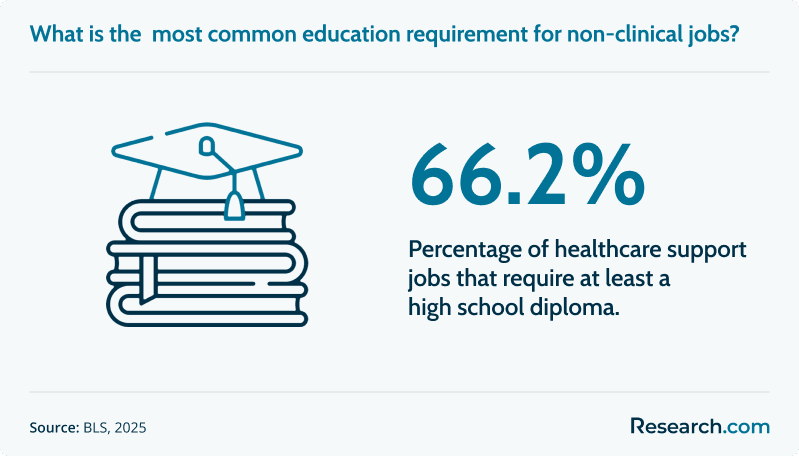
A non-clinical healthcare degree may not be the best fit if your primary goal is to provide direct patient care, perform procedures, diagnose conditions, prescribe treatments, or qualify for a licensed clinical role. In that case, compare nursing, allied health, therapy, radiology, laboratory, or pre-professional programs that meet clinical licensure requirements.
What certifications are best for non-clinical healthcare careers?
Certifications are most useful when they match a specific job function. They can help entry-level candidates prove job-ready skills, and they can help experienced workers move into coding, records, management, education, legal support, or compliance-related work.
| Certification | What it signals | Best for |
| Certified Professional Coder (CPC) | Knowledge of medical coding for diagnoses, procedures, and insurance claims. | Medical coding, billing support, revenue cycle roles, and claims review. |
| Certified Billing and Coding Specialist (CBCS) | Ability to handle billing procedures, insurance information, coding basics, and patient data securely. | Entry-level billing and coding roles, medical office billing, and insurance processing. |
| Registered Health Information Technician (RHIT) | Readiness to manage health information, electronic records, data quality, and privacy-related responsibilities. | Health information technician jobs, hospital records departments, and EHR-focused work. |
| Certified Medical Manager (CMM) | Administrative leadership ability for medical practices and healthcare office operations. | Practice management, clinic administration, and office leadership roles. |
| Certified Health Education Specialist (CHES) | Preparation to design, deliver, and evaluate health education programs. | Health education, community outreach, wellness programming, and public health roles. |
| Paralegal Certification | Legal research, case support, documentation, and legal procedure knowledge that can be applied to healthcare-related cases. | Healthcare compliance, medical-legal support, nurse paralegal work, and patient rights roles. |
Do not choose a certification only because it is popular. First, search job postings for your target role and location. If employers consistently ask for CPC, CBCS, RHIT, or another credential, prioritize that one. If the postings emphasize degree level and experience instead, a certificate may be helpful but not enough by itself.
How long does it take to get qualified for a non-clinical job?
You can qualify for some non-clinical healthcare jobs in as little as six months, but the realistic timeline depends on the role, credential, employer requirements, and your previous work experience.
| Training path | Typical length | Roles it can support | Best choice when |
| Certificate program | 6 months to 1 year | Medical billing specialist, coding assistant, health unit clerk, medical office support. | You want the fastest path into healthcare and are comfortable starting in an entry-level role. |
| Associate degree | 2 years | Health information technician, administrative coordinator, medical office technology roles, some public health support jobs. | You want a stronger foundation than a short certificate and may later transfer into a bachelor’s program. |
| Bachelor’s degree | 4 years | Healthcare administration, informatics, analytics, HR, compliance, public health, and management-track roles. | You want more long-term mobility and are aiming for leadership, data, or specialized administrative roles. |
Associate degree programs may also prepare students for exams such as the RHIT or CBCS, depending on the curriculum and eligibility rules. Always confirm exam requirements directly with the credentialing body before enrolling.
The chart below shows how healthcare support workers are distributed by specific vocational preparation level, based on BLS data reported in 2025.
What are the highest-paying non-clinical healthcare careers?
The highest-paying non-clinical healthcare careers usually require more responsibility, specialized technical ability, leadership experience, or advanced knowledge of healthcare operations. The salary ranges below come from the original career estimates provided and should be treated as general guidance, not guaranteed earnings.
| Career | Estimated salary range | How people often enter the path |
| Medical and Health Services Manager | $110,000–$135,000 | Start in medical office administration, department coordination, or operations support, then move into supervisory and management roles. |
| Information Security Analyst in Healthcare | $100,000–$125,000 | Begin in IT support, systems administration, or junior cybersecurity roles before specializing in healthcare data protection. |
| Health Informatics Specialist | $85,000–$115,000 | Build experience in medical records, data entry, EHR support, reporting, or health information management. |
| Human Resources Manager in Healthcare | $90,000–$120,000 | Enter as an HR assistant, recruiter, coordinator, or generalist, then advance into healthcare workforce leadership. |
| Care Case Manager, non-clinical path | $70,000–$90,000 | Start as a community health worker, patient advocate, program assistant, or benefits navigator. Review careers in care case management if coordination work interests you. |
| Health Policy Analyst | $75,000–$95,000 | Begin through public health internships, research assistant roles, nonprofit program work, or government health policy support. |
How to evaluate salary claims
When comparing salaries, look beyond the job title. Pay can change based on employer type, city, years of experience, credentials, degree level, and whether the role is entry-level or managerial. A “healthcare analyst” at a small nonprofit may not pay the same as an informatics role at a large hospital system or insurance company.
How do non-clinical salaries compare by location?
Location can have a major effect on pay, but a higher salary does not always mean a better financial outcome. States and cities with large hospital networks, higher living costs, and stricter regulatory environments may pay more for roles such as medical and health services manager or health information technician. California, New York, and Massachusetts are examples where wages are often higher for some healthcare roles.
Lower-cost areas such as Texas, Florida, or parts of the Midwest may post lower salaries, but housing, transportation, taxes, and daily expenses can make the take-home value more favorable. A $55,000 salary in Ohio may support a stronger lifestyle than a $70,000 salary in San Francisco after rent and commuting costs are considered.
Rural health systems also need non-clinical staff to support operations, documentation, billing, care coordination, and workforce retention. Initial salaries may be more modest, but some regions may offer lower competition, faster advancement, or incentives such as loan repayment help.
How to compare pay by location
- Check salary ranges from job postings in the city or region where you plan to work.
- Compare those salaries with rent, transportation, insurance, taxes, and childcare costs if relevant.
- Look for employer benefits, tuition assistance, remote-work policies, and promotion pathways.
- Use government wage data and healthcare workforce sources to validate what employers are advertising.
- Do not relocate for salary alone unless the cost-of-living math still works after expenses.
What are the career progression and growth opportunities in non-clinical healthcare positions?
Many non-clinical healthcare careers have a clear advancement pattern: start in support work, build technical or operational expertise, earn a relevant credential, then move into coordination, supervision, analytics, compliance, or management. The path is often gradual, but it can be reliable for workers who document results and keep learning.
| Starting role | Next step | Longer-term advancement |
| Medical office assistant | Office coordinator or practice supervisor | Clinic manager or health services manager |
| Medical records clerk | Health information technician | Health information manager, compliance analyst, or informatics specialist |
| Billing assistant | Certified coder or revenue cycle specialist | Billing manager, coding auditor, or compliance officer |
| Community health worker | Program coordinator or care coordination specialist | Public health manager, care case manager, or health equity coordinator |
| IT support technician | Healthcare systems analyst or security analyst | Information security manager or health IT leader |
Some employers support advancement through tuition reimbursement, internal training, and leadership development. A credential from a certified medical assistant program may also help some workers understand clinical workflows, although students should confirm whether that type of program aligns with their non-clinical goals before enrolling.
How Can Advanced Online Education Enhance Your Non-Clinical Healthcare Career?
Online education can help working adults move from task-based roles into higher-responsibility positions without leaving the workforce. Programs in healthcare administration, health informatics, public health, business analytics, cybersecurity, or compliance can strengthen leadership, data interpretation, project management, and healthcare systems knowledge.
Online study is most valuable when it directly supports a career target. For example, an aspiring healthcare administrator may benefit from an accelerated administration pathway, while a data-focused worker may need database, analytics, or informatics coursework. Programs such as the fastest PharmD online programs are more clinically specialized, so students considering them should be clear about whether they want clinical knowledge, administrative application, or a future licensed healthcare path.
Questions to ask before choosing an online program
- Is the institution properly accredited?
- Does the curriculum match the job titles I want?
- Will credits transfer if I later pursue another degree?
- Does the program prepare students for any required certification exam?
- Are internships, projects, or employer partnerships available?
- What student support is available for working adults?
- What is the total cost, including fees, books, exam costs, and technology requirements?
What challenges should you consider in non-clinical healthcare jobs?
Non-clinical healthcare can be stable and rewarding, but it is not automatically easy. Many roles require accuracy under pressure, constant documentation, privacy awareness, and the ability to keep up with changing systems and regulations.
| Challenge | Why it matters | How to reduce the risk |
| Fast technology changes | Healthcare systems continue to adopt new software, digital records, AI-supported tools, and reporting platforms. | Build spreadsheet, database, EHR, cybersecurity, and analytics skills early. |
| Regulatory pressure | Privacy, billing, compliance, and documentation rules affect many non-clinical jobs. | Choose programs that include healthcare law, HIPAA-related training, compliance, and ethics. |
| Competition for higher-level roles | Leadership, analytics, and compliance jobs may require experience beyond a degree. | Gain internships, volunteer experience, projects, certifications, and measurable workplace achievements. |
| Entry-level pay variation | Short certificate paths can lead to work quickly, but starting pay may vary widely by employer and region. | Compare local job postings before enrolling and consider whether the role has a promotion path. |
| Credential confusion | Not every certificate is equally valued by employers. | Match credentials to real job postings and consider affordable options such as cheap online medical billing and coding courses only after checking employer expectations. |
How Can Mentorship and Networking Accelerate Your Career Growth?
Mentorship can help you understand which jobs are realistic, which credentials matter, and how hiring works inside healthcare organizations. Networking is especially helpful in non-clinical healthcare because job titles vary across hospitals, insurers, nonprofits, technology vendors, and government agencies.
Good networking does not require aggressive self-promotion. Start by asking informed questions. Talk with alumni, instructors, supervisors, professional association members, and people working in roles you want. Ask what they do each day, what software they use, what they wish they had learned earlier, and which credentials employers respect.
Education can also expand your network. For example, students in an online bachelor's in kinesiology may connect with health, wellness, rehabilitation, and performance-related professionals, although they should compare that path carefully with administration, public health, or informatics programs if their goal is strictly non-clinical healthcare work.
What Emerging Trends Are Shaping Non-Clinical Healthcare Careers?
Several healthcare trends are changing non-clinical work. Digital records, telehealth operations, AI-supported analytics, cybersecurity threats, value-based care, and health equity initiatives are increasing the need for workers who understand both healthcare and systems thinking.
- AI and analytics: Healthcare organizations are using more data tools to identify risk, improve workflows, support documentation, and monitor outcomes. Workers who can interpret data responsibly will have an advantage.
- Cybersecurity and privacy: Digital health records and connected systems create greater need for professionals who can protect patient information.
- Telehealth operations: Virtual care requires scheduling systems, compliance workflows, billing processes, user support, and quality monitoring.
- Health equity programs: Hospitals, public agencies, and nonprofits are paying more attention to gaps in access, outcomes, and community trust.
- Credential-based hiring: For technical roles such as coding, health information, and cybersecurity, employers may look for job-specific credentials in addition to degrees.
Students who want leadership roles may compare options such as a healthcare administration degree online, especially if they need flexible study while working.
Are non-clinical healthcare jobs in high demand right now?
Yes. Non-clinical healthcare roles are in demand because healthcare organizations need people to manage growth, technology, data, staffing, compliance, insurance processes, and patient access. The demand is not limited to hospitals; it also appears in insurance companies, public health agencies, rehabilitation organizations, nonprofits, health technology companies, and government programs.
Recent reports point to continued activity in this area. In the first quarter of 2025, over 1,000 non-clinical positions were posted for rehabilitation professionals, including care coordination and client interaction roles. Healthcare also added 51,000 new jobs in April 2025, showing continued hiring strength across the broader sector.
Still, demand varies by job title. Entry-level administrative roles may have more applicants, while specialized roles in health informatics, cybersecurity, coding, compliance, and analytics may require more targeted training.
What non-clinical healthcare jobs are growing the fastest?
Some of the fastest-growing non-clinical healthcare roles are connected to technology, documentation quality, preventive care, compliance, and digital health. These jobs reflect how healthcare is becoming more data-driven, regulated, and focused on coordinated care.
- Clinical documentation specialist: Reviews health records for accuracy, completeness, coding support, and reimbursement documentation. AI-assisted records and insurance review activity are increasing the importance of this role.
- Population health analyst: Uses public health and healthcare data to identify trends, track risks, and support prevention-focused programs.
- Health equity coordinator: Works with hospitals, public agencies, and community organizations to address gaps in access and outcomes.
- Healthcare compliance officer: Helps organizations follow federal and state rules, privacy standards, billing requirements, and internal policies.
- Digital health project manager: Coordinates telehealth tools, apps, remote monitoring projects, and digital workflow changes in healthcare settings.
The chart below lists the highest-paying states for healthcare support workers, based on BLS data reported in 2024.
Can you transition from a non-clinical role to a clinical career?
Yes. A non-clinical healthcare job can be a practical starting point for someone who later decides to become a nurse, radiologic technologist, therapist, laboratory professional, or another clinical provider. However, non-clinical experience does not replace clinical education, supervised training, or licensure requirements.
Starting in medical records, billing, administration, insurance support, or care coordination can help you understand healthcare terminology, workflows, documentation, privacy rules, and communication expectations. That knowledge can make the transition to clinical training smoother.
For example, a medical coder who later pursues nursing will already understand documentation standards, insurance language, and patient record systems. They would still need to complete an approved nursing program and meet licensure requirements. Students interested in high-acuity care should review the qualifications for critical care nurses, which include advanced clinical preparation, acute care experience, and certification.
Some healthcare employers offer tuition assistance or internal mobility programs. If you think you may eventually move into clinical work, ask employers whether they support degree completion, prerequisites, flexible scheduling, or clinical program partnerships.
Common Mistakes to Avoid When Choosing a Non-Clinical Healthcare Path
- Choosing a program before choosing a role: Start with target job titles, then work backward to the education and credentials employers request.
- Ignoring accreditation: Accreditation can affect transfer credits, employer recognition, financial aid eligibility, and exam eligibility.
- Assuming all certificates lead to jobs: Some certificates are useful; others may not match employer requirements in your area.
- Looking only at tuition: Include books, exam fees, software, technology costs, commuting, lost work hours, and retake fees.
- Relying only on national salary ranges: Local wages, cost of living, employer type, and experience level can change the financial picture.
- Overlooking entry-level experience: Internships, administrative jobs, volunteer work, and project experience can matter as much as coursework for first jobs.
- Assuming online programs meet every requirement: Always verify certification, licensure, internship, transfer, and employer-recognition requirements before enrolling.
Here’s What Graduates Have to Say About Their Non-Clinical Healthcare Careers
I work as a data coordinator for a hospital group, so I am not in scrubs and I am not responding to emergencies. My reports still help clinicians make better decisions, and that makes the work feel meaningful. – Aileen
I used to wonder whether a healthcare job without direct patient care would feel important. Now I manage outreach programs that improve access for real families, and I can see the impact without going to medical school. – Sara
I moved into healthcare human resources after retail. The work is steadier, the benefits are better, and I finally feel like my job connects to something bigger. – Gregor
Key Insights
- Non-clinical healthcare careers let you work in healthcare without providing direct patient treatment.
- Strong 2026 options include healthcare administration, medical billing and coding, health information, compliance, health informatics, cybersecurity, HR, public health, and healthcare marketing.
- Over 1.9 million healthcare job openings are expected annually through 2033, and many roles supporting the system are non-clinical.
- Some roles can be entered in as little as 6 months, but management, analytics, informatics, and compliance careers often require more education and experience.
- 85.6% of healthcare support workers receive on-the-job training, while 24% need prior experience, so entry-level candidates should look for employers that train and promote internally.
- Adaptability matters: 61% of employers in healthcare support roles value workers who can adjust to changing tasks, tools, and regulations.
- Health-related fields account for 18% of all associate degrees and 13% of bachelor’s degrees, showing how common healthcare-focused education has become.
- The best path is not always the longest or most expensive one. Choose based on job postings, accreditation, certification requirements, cost, transfer options, and realistic local salary data.
References:
- Blasi, W. (2025). Why there are so few ‘safe’ jobs right now. Help My Career. MarketWatch.
- Bureau of Labor Statistics (BLS). (2024). 31-0000 Healthcare Support Occupations (Major Group). Occupational Employment and Wage Statistics. BLS.
- Bureau of Labor Statistics (BLS). (2025a). Healthcare Occupations. Occupational Outlook Handbook. BLS.
- Bureau of Labor Statistics (BLS). (2025b). Healthcare support occupations. BLS.
- Bureau of Labor Statistics (BLS). (2025c). Occupational Employment and Wage Statistics. Occupational Employment and Wage Statistics Query System. BLS.
- The Non-Clinical PT. (2025). The Non-Clinical Job Market & Career Insights Report – Q1 2025. Career Paths. The Non-Clinical PT.
Other Things You Should Know About Non-Clinical Healthcare Jobs
Healthcare management, medical writing, and health informatics often require a bachelor's degree in 2027. A degree can be in related fields like healthcare administration, communications, or computer science, depending on the role. This educational background enhances job prospects and potential earnings.
Relevant certifications include Certified Medical Administrative Assistant (CMAA), Certified Health Data Analyst (CHDA), Project Management Professional (PMP), and Certified Professional in Healthcare Quality (CPHQ). Many employers also value HIPAA training and Epic or Cerner software credentials for roles in scheduling, billing, quality, and patient access.